Sydney Airport Car Park: Motion-Sensing LED Lighting Upgrade Project
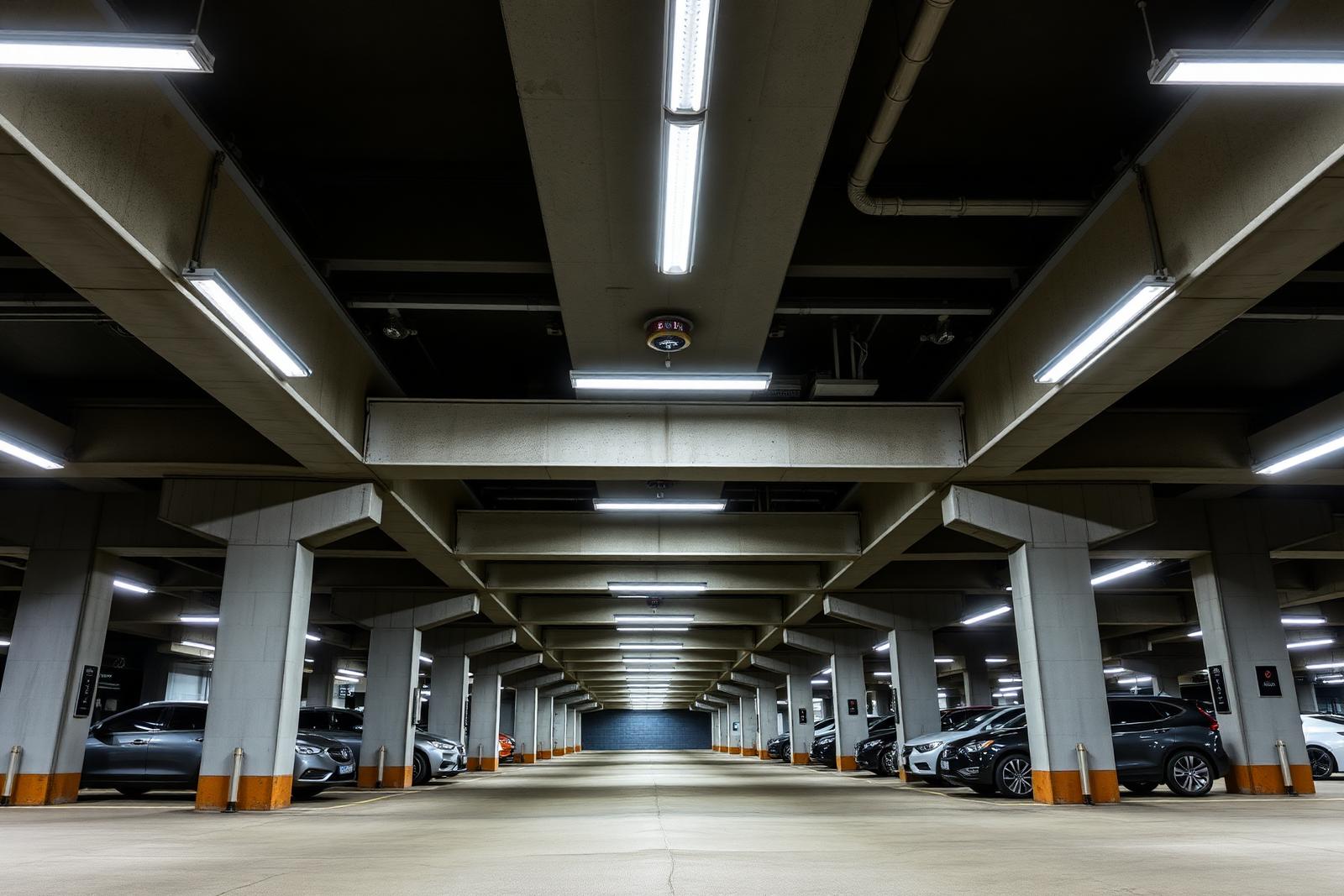
Introduction — the on-site problem
At XHLWX (led-project-light.com), a Custom Indoor LED Lighting Manufacturer based in China, we specialize in delivering high-performance, tailored lighting systems for large-scale infrastructure projects worldwide. The management of Sydney Airport's (SYD) P1 multi-storey car park approached us with a significant challenge: their existing lighting, comprised of thousands of outdated T8 fluorescent tubes, was operating 24/7. This resulted in exorbitant energy expenditure, frequent maintenance cycles involving costly lamp and ballast replacements, and inconsistent light levels that compromised both user safety and the effectiveness of CCTV security systems. The facility, which serves one of the world's busiest airports, required a solution that would not only slash operating costs but also dramatically improve visibility, safety, and the overall user experience for millions of travelers annually, all while minimizing disruption to its round-the-clock operations.
What "custom" meant on this project — capability matrix
For the Sydney Airport P1 project, "custom" meant engineering a luminaire from the ground up to meet the unique environmental and operational demands of a high-traffic car park. We developed the XHL-CTL7 series, a robust linear trunking system with integrated controls. The specifications were rigorously defined to balance performance, longevity, and compliance with Australian standards (AS/NZS 1158.3.1).
| Parameter | Specification | Standard | Notes |
|---|---|---|---|
| Luminous Efficacy | >150 lm/W | Project Requirement | Essential for maximizing energy savings and achieving a rapid ROI. |
| Optics & Glare | 4000K CCT, CRI >85, UGR<19 | AS/NZS 1158.3.1 | Asymmetrical wide-beam optic designed to illuminate drive lanes and parking bays uniformly, while a prismatic diffuser minimizes glare for drivers. |
| Control System | DALI-2 Digital Addressable | IEC 62386 | Each fitting incorporates a Tridonic DALI-2 driver and an integrated high-frequency microwave motion sensor for granular control. |
| Housing & Ingress | Anodized 6063 Aluminum, PC cover | IP65, IK08 | Sealed against dust, water jets, and vehicle exhaust fumes. Impact resistance ensures durability against accidental knocks. |
| Chipset & Driver | Samsung LM281B+ LEDs, Tridonic ADVANCED Driver | L80B10 > 70,000 hrs | Top-tier components selected for high efficiency, color stability, and exceptional operational lifetime, minimizing maintenance needs. |
| Dimensions | Custom lengths: 1475mm, 1775mm | Project Requirement | Manufactured in specific lengths to perfectly align with existing mounting points and structural beams, simplifying installation. |
| Certification | CE, RoHS, RCM | Global & AUS Standards | Fully compliant with European and Australian electromagnetic compatibility and safety standards. |
Engineering solutions
The project's success hinged on solving three core challenges: rampant energy waste, suboptimal safety conditions, and the logistical difficulty of upgrading a 24/7 facility.
How did we reduce energy consumption by over 80%?
The primary driver of savings was the implementation of an intelligent, demand-based lighting system. We moved away from the previous 'always-on' model by embedding a high-frequency microwave motion sensor and DALI-2 driver into every single XHL-CTL7 luminaire. These sensors were programmed with a custom logic: in standby mode, light levels are dimmed to a 'base' level of 15% (approx. 20 lux), ensuring a baseline of safety and visibility. Upon detection of a vehicle or pedestrian, the luminaires in the immediate zone, as well as adjacent zones, instantly ramp up to 100% output (approx. 100 lux). After a 90-second hold time with no new motion, they gracefully dim back to standby. This dynamic response ensures that light is only delivered where and when it's needed, cutting fixture 'on-time' at full power by an estimated 85% and leading to a total system energy reduction of over 80% compared to the previous fluorescent setup.
What was the strategy for ensuring driver safety and eliminating glare?
Safety in a car park is a function of visibility. We addressed this through advanced optical engineering. Firstly, we achieved a high uniformity ratio (Umin/Uavg) of 0.4 across all drive lanes, exceeding the requirements of AS/NZS 1158. By eliminating dark spots and shadows, we significantly enhanced the clarity of the airport's CCTV footage, acting as a powerful security deterrent. Secondly, we tackled the critical issue of driver glare. A car park is a low-ceiling environment where exposed light sources can be blinding. Our solution utilized a specially designed prismatic polycarbonate diffuser that directs light downwards and outwards in a wide, asymmetric pattern while shielding the LED source from the driver's direct line of sight. This resulted in a measured Unified Glare Rating (UGR) of less than 19, a level considered excellent for task-oriented environments and exceptionally comfortable for a driving context, preventing momentary vision impairment for navigating drivers.
How were installation time and maintenance costs minimized for a 24/7 facility?
With the car park operating continuously, a swift and non-disruptive installation was paramount. Our solution was a modular trunking rail system. The base rails were installed first, and the luminaires were then simply 'clicked' into place with a tool-free mechanism. The fixtures were pre-wired with male/female connectors, enabling a plug-and-play electrical connection that reduced on-site labor time by an estimated 40% per fixture compared to traditional hard-wiring. For maintenance, the value proposition is even stronger. The system's L80B10 lifetime of over 70,000 hours, combined with the Tridonic driver's low failure rate, translates to a theoretical maintenance-free period of over 15 years in this motion-sensing application. This virtually eliminates the recurrent costs and logistical headaches of replacing lamps and ballasts, a major operational burden of the old system.
Project results — measured
The post-installation audit confirmed a transformative improvement in both performance and efficiency. The new system delivered on every key metric promised during the planning phase.
- Energy Savings: Total energy consumption was reduced by 82%, from an annual 1,850,000 kWh to just 333,000 kWh.
- Illuminance Levels: Average illuminance on the driving surface increased from a variable 30-50 lux to a consistent 75 lux in standby and 100+ lux in active zones, exceeding Australian safety standards.
- Light Quality: The CCT was standardized at a neutral 4000K with a CRI of 85, dramatically improving visual acuity and the color accuracy of security camera footage.
- Glare Reduction: The measured UGR was consistently below 19, a significant improvement from the previous setup which was often measured above 25.
- Financials: Based on energy and maintenance savings, the project achieved a full return on investment (ROI) in just 18 months.
Photometric files & compliance (IES / LDT / DIALux / CE / RoHS)
Transparency and verifiable performance are cornerstones of our process. For the Sydney Airport P1 project, we provided a complete package of documentation to support our proposal and guarantee the final results. Full IES and LDT photometric files were supplied for each custom variant of the XHL-CTL7 luminaire. Before a single fixture was manufactured, our lighting design team submitted a comprehensive DIALux Evo simulation of the entire multi-storey car park. This virtual model allowed the client and their consulting engineers to review the predicted lux levels, uniformity, and glare ratings in every area, ensuring the proposed solution met all aspects of the AS/NZS 1158.3.1 standard. All components and finished luminaires are fully certified for CE, RoHS, and Australian RCM, and our manufacturing facility operates under strict ISO9001:2015 quality management protocols.
Frequently Asked Questions
Q: Were you able to manufacture the fixtures in custom lengths to fit the building's structure?
A: Yes, a key part of this custom project was manufacturing the linear fixtures to specific lengths of 1475mm and 1775mm. Our agile production line can accommodate custom lengths with a precision of +/- 2mm, which was critical for aligning with existing mounting points and minimizing installation labor.
Q: What is the effective detection range of the integrated motion sensors?
A: We used a high-frequency 5.8 GHz microwave sensor specifically chosen for its performance in car park environments. It provides a reliable detection diameter of up to 12 meters when installed at the typical 3-meter mounting height. This wide coverage reduces the total number of sensors required and ensures seamless activation as vehicles move through the space.
Q: How was emergency lighting integrated into the system?
A: Compliance with emergency lighting standards was non-negotiable. Approximately 15% of the supplied luminaires were manufactured as emergency variants. These units seamlessly integrate a self-testing, 3-hour battery backup pack and indicator LED within the standard housing, ensuring a uniform aesthetic while providing code-compliant egress lighting during a power failure.
Q: What was the delivered color temperature (CCT) and why was it chosen?
A: We delivered a consistent 4000K CCT with a high Color Rendering Index (CRI) of 85. This neutral white light was specified by the client's security consultants as it provides excellent visual clarity for drivers and pedestrians. More importantly, it significantly enhances the performance and color accuracy of modern HD CCTV cameras, making it easier to identify details.
Request a custom quote
At XHLWX (led-project-light.com), a Custom Indoor LED Lighting Manufacturer based in China, we transform complex lighting challenges into efficient, reliable, and intelligent solutions. Our success at the Sydney Airport P1 car park demonstrates our capability to handle large-scale, mission-critical infrastructure projects requiring deep customization. If you have a project with unique requirements for efficiency, control, and performance, contact our engineering team today to discuss a bespoke lighting system designed and manufactured for you.