Riyadh's King Fahd Road: A 12km Smart LED Street Lighting Upgrade
Project Background and Challenges
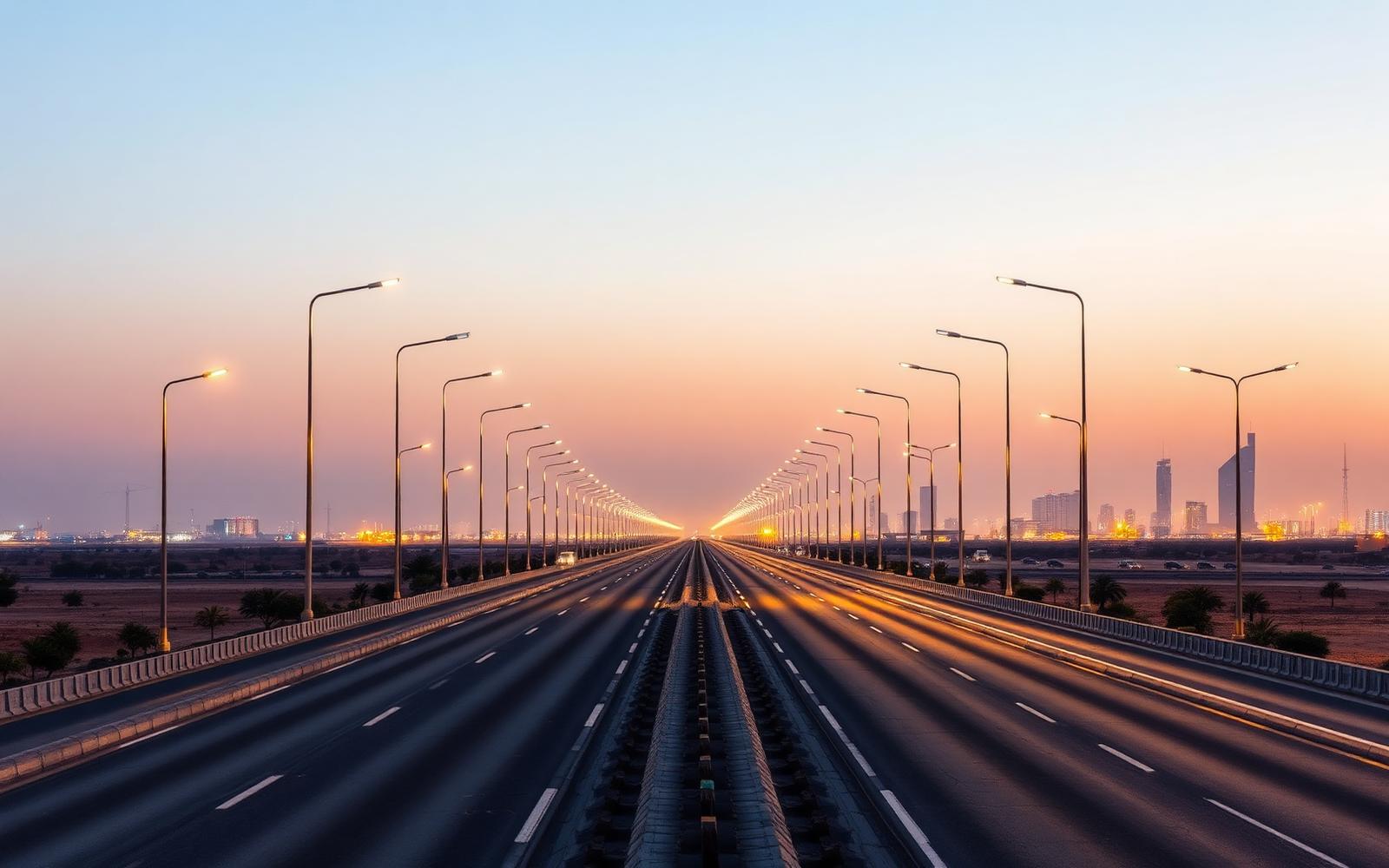
King Fahd Road is more than just a thoroughfare; it is a vital economic and social artery running through the heart of Riyadh, Saudi Arabia. As a critical component of the city's infrastructure, its performance directly impacts public safety, economic activity, and the overall quality of life for millions of residents and commuters. In line with the ambitious goals of Saudi Vision 2030, the Riyadh Municipality initiated a landmark project to modernize the entire 12-kilometer stretch of this iconic road, with a primary focus on its aging and inefficient lighting system.
The existing infrastructure relied on traditional High-Pressure Sodium (HPS) lamps, which presented a multitude of challenges for a forward-thinking metropolis:
- Excessive Energy Consumption: The legacy HPS fixtures, many rated at 400W or higher, were consuming vast amounts of electricity. In a region aiming for sustainability and resource optimization, this level of energy expenditure was no longer tenable.
- Poor Light Quality and Safety Concerns: HPS lamps produce a monochromatic orange-yellow light with a very low Color Rendering Index (CRI). This poor color rendering distorts the perception of the environment, making it difficult for drivers to distinguish between objects, road markings, and potential hazards, thereby compromising nighttime safety.
- High Maintenance Overheads: With a relatively short lifespan and high failure rate, the HPS lamps required frequent and costly maintenance. Replacing lamps on a busy highway necessitated disruptive lane closures, involving significant logistical costs and risks to maintenance crews.
- Lack of Control and Intelligence: The old system operated on a simple on/off schedule, running at 100% power throughout the night regardless of traffic density. This lack of dynamic control meant significant energy was wasted during low-traffic periods in the early morning hours.
- Environmental Constraints: The system needed to perform reliably in Riyadh's harsh climate, characterized by extreme summer temperatures often exceeding 45°C (113°F), high humidity, and frequent dust and sandstorms that can degrade luminaire performance and aesthetics.
The Riyadh Municipality sought a world-class partner to deliver not just a replacement but a complete transformation—a solution that would establish King Fahd Road as a benchmark for smart urban infrastructure. XHLWX Lighting was selected for our proven expertise in large-scale smart lighting projects and our portfolio of luminaires engineered for extreme environments.
The XHLWX Smart Lighting Solution
Our approach was holistic, beginning with a comprehensive lighting design study that modeled the entire 12km corridor. This included main carriageways, complex multi-level interchanges, and adjacent service roads. The design objective was to surpass the requirements of the ME3a lighting class as defined by CIE 115 and local SASO 2902 standards, ensuring exceptional visibility and safety for all road users.
The cornerstone of the project is our XHLWX Arid-Star Pro Gen3 series street light. This luminaire was specifically engineered to meet and exceed the project's stringent requirements:
- Tailored Wattage and Optics: We deployed a mix of 120W, 150W, and 200W Arid-Star Pro luminaires to replace the incumbent 250W and 400W HPS fixtures. Each luminaire was fitted with precision-engineered optics (Type II and Type III distributions) to create a highly uniform light pattern across the wide lanes of King Fahd Road, eliminating the dark spots and glare associated with the old system.
- Robust and Durable Construction: Recognizing the climatic challenges, the Arid-Star Pro features a die-cast aluminum housing (ADC12) with a corrosion-resistant powder coating. It is certified with an IP66 rating for total protection against dust and water ingress and an IK09 rating for high impact resistance, ensuring long-term durability.
- Advanced Thermal Management: A passive cooling system with vertically oriented fins maximizes heat dissipation, allowing the luminaire to operate reliably at high ambient temperatures without performance degradation, crucial for the long Saudi summers.
The result is a seamlessly integrated lighting system that transforms the nocturnal environment of King Fahd Road into a safer, more visually comfortable, and aesthetically pleasing urban space.
Technical Highlights
This project showcases three core pillars of modern lighting technology where XHLWX excels:
1. High Efficacy and Radical Energy Savings
The primary driver for the project was to achieve significant energy reduction. By transitioning from HPS to our cutting-edge LED technology, the project realized immediate and substantial gains. The Arid-Star Pro Gen3 boasts a system efficacy of over 160 lumens per watt, more than double that of the old HPS lamps. This leap in efficiency, combined with the lower wattage of the LED fixtures, resulted in a baseline energy saving of over 60% even before implementing smart controls. When the dynamic dimming schedules are factored in, the total energy reduction climbs to an astonishing 67%, translating into millions of Saudi Riyals in annual savings and a massive reduction in the city's carbon footprint.
2. Advanced DALI-Casambi Wireless Control
To elevate the project from a simple LED retrofit to a truly smart corridor, we implemented a sophisticated hybrid control system. Each Arid-Star Pro luminaire is equipped with a DALI-2 driver, providing granular digital control and diagnostic feedback for every single light point. For network communication, we integrated a Casambi wireless node into each pole.
This DALI-Casambi architecture offers the best of both worlds:
- Wireless Flexibility: The Casambi Bluetooth Mesh network eliminated the need for expensive and disruptive trenching to lay new control cables. The luminaires form a self-healing, self-organizing mesh network, ensuring robust and reliable communication across the entire 12km length.
- Digital Precision: DALI allows for precise dimming commands and gathers critical operational data from each luminaire, including power consumption, operating hours, and fault status.
This data is fed into a cloud-based Central Management System (CMS) accessible to the Riyadh Municipality's operations team. The CMS provides a map-based dashboard for real-time monitoring, enables the creation of sophisticated dimming schedules (e.g., 100% power during evening peak hours, dimming to 70% after midnight, and further to 50% in the early morning), and generates automated fault reports. This proactive approach transforms maintenance from a reactive, costly exercise to a planned, efficient operation.
3. Superior Glare Control and Visual Comfort
Driver safety was paramount. A key deficiency of many powerful LED street lights is disabling glare, which can be a significant hazard. Our optical design team focused heavily on visual comfort. The Arid-Star Pro's prismatic lenses are designed to precisely control light distribution, directing it only where needed—on the road and pavements. This achieved a Threshold Increment (TI) value well below the 15% maximum stipulated by standards, ensuring drivers are not dazzled. Furthermore, with an Upward Light Output Ratio (ULOR) of 0%, the new system directs no light into the night sky, drastically reducing light pollution and contributing to Riyadh's dark-sky initiatives.
Installation and Commissioning Process
Executing a project of this scale on one of the busiest roads in the Middle East required meticulous planning and execution. The installation was carried out in phases over several months, with work restricted to late-night hours (1 AM to 5 AM) to minimize traffic disruption.
Our on-site technical support team worked closely with the local contractor, ensuring adherence to the lighting design plan and providing real-time problem-solving. The 'plug-and-play' nature of the luminaires and the wireless control system greatly expedited the physical installation process.
The commissioning phase highlighted the power of the Casambi system. Using a simple smartphone app, technicians could group luminaires into zones, assign them to the network, and test functionality on-site. The fine-tuning of dimming schedules and alarm thresholds was then completed remotely via the central management platform. A comprehensive training program was delivered to the municipality's maintenance and operations staff, empowering them to take full ownership of their new smart lighting infrastructure.
Measured Results and Project Impact
The successful completion of the King Fahd Road project has delivered tangible, measurable improvements:
- Lighting Performance: Post-installation photometric audits confirmed the achievement of all design targets. The road surface now features an average illuminance of 30 lux with an overall uniformity (Uo) of over 0.5, creating a bright, evenly-lit environment that greatly enhances driver confidence and safety.
- Energy Savings: Real-world data from the CMS confirmed an average energy reduction of 67% compared to the old system. This represents a significant operational cost saving for the city and a major contribution to its sustainability goals.
- Color Quality: The switch to 3000K CCT LED lighting provides a warm, natural white light with a CRI of >70, rendering colors accurately and improving the overall aesthetic of the urban landscape.
- Operational Efficiency: The automated fault reporting system has led to an estimated 90% reduction in ad-hoc maintenance call-outs. Maintenance is now planned and proactive, saving time, money, and reducing risk to workers.
As a representative from the Riyadh Municipality stated, "The King Fahd Road smart lighting project by XHLWX is a flagship achievement. It has not only made our most important road safer and more efficient but has also provided us with a future-proof digital platform that can be expanded upon for years to come."
FAQ
Q1: Why was a DALI-Casambi hybrid system chosen over other smart control protocols?
The DALI-Casambi architecture was selected for its unique combination of reliability and flexibility, making it ideal for a large-scale retrofit project like this. DALI (Digital Addressable Lighting Interface) is a robust, standardized protocol for wired control within the luminaire, providing precise dimming and detailed diagnostic feedback. Casambi (Bluetooth Low Energy Mesh) provides the wireless communication backbone between luminaires and the gateway, eliminating the need to install costly and disruptive control wiring along the 12km road. This hybrid approach delivers the granular control of a wired system with the installation ease and self-healing resilience of a wireless mesh network.
Q2: How do the Arid-Star Pro luminaires handle the extreme heat and dust of Riyadh?
The Arid-Star Pro Gen3 was engineered from the ground up for harsh desert climates. Its thermal management system uses a die-cast aluminum body with an array of vertical fins that create a chimney effect, promoting natural convection to dissipate heat effectively, ensuring the LED chips and driver operate well within their temperature limits even during peak summer heat. The luminaire is sealed to an IP66 rating, meaning it is completely impervious to dust and high-pressure water jets, preventing internal contamination from sandstorms. The exterior is finished with an advanced TGIC polyester powder coating, which resists corrosion and UV degradation, maintaining its performance and appearance for years.
Q3: What are the long-term benefits for Riyadh beyond the immediate energy savings?
While the 67% energy savings are a major benefit, the long-term value is even more significant. This project establishes a digital infrastructure canopy over a key city asset. The enhanced safety from better lighting reduces accidents and improves public security. The drastic cut in maintenance costs frees up municipal budgets for other public services. The system is future-proof; the smart nodes can potentially host other sensors for traffic monitoring, environmental sensing, or public Wi-Fi. Ultimately, the project enhances Riyadh's image as a leading global smart city, attracting investment and improving the quality of life for its citizens.