
How Does Alabaster Thickness Affect Hotel Wall Light Transmission?
Quick answer
Specify alabaster hotel sconces with practical guidance on stone thickness, translucency, sourcing, LED selection, sampling and compliance.
Introduction
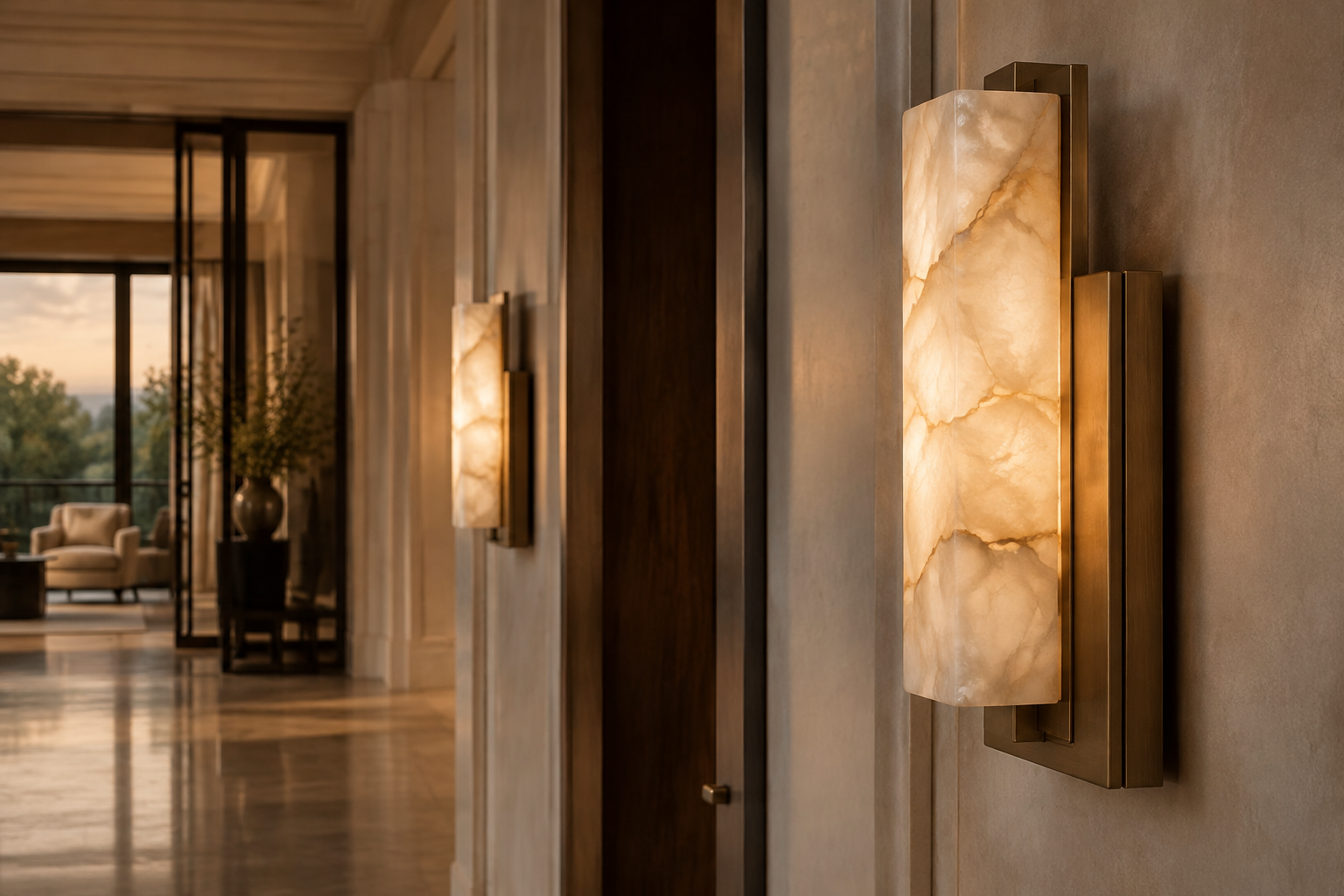
At XHLWX (led-project-light.com), a Custom Indoor LED Lighting Manufacturer based in China, ... thicker alabaster generally transmits less light, but mineral variation prevents thickness alone from predicting brightness. For hotel sconces, compare 8 mm and 12 mm panels as design targets, using the same LED module, cavity and dimming level before approving production.
Thickness changes the path light travels through the stone. However, veins, inclusions, colour, surface finish and mineral composition also influence transmission and diffusion.
A thinner, heavily veined piece may appear darker than a thicker, clearer piece. Therefore, a thickness dimension is not a reliable substitute for an illuminated material sample.
For hotel owners, interior designers and FF&E buyers, the procurement question is: which stone, thickness and optical assembly reproduce the approved appearance consistently? This article addresses custom alabaster hotel sconces for corridors, guestrooms and interior lounge areas across EU, US, Middle Eastern and Southeast Asian projects.
Design Criteria and Standards
Specify alabaster thickness together with illuminated appearance, mechanical support and LED geometry, rather than treating thickness as an independent brightness control.
First establish the material identity. Commercial “alabaster” can describe gypsum alabaster or calcite-based stone; engineered imitations also enter decorative-lighting supply chains.
These materials should not be accepted as interchangeable. Require the supplier to identify the material, disclose treatments and document the source as specifically as available records support.
The following values are recommended specifications or design targets, not measured XHLWX product results or universal requirements. Final requirements depend on the selected luminaire and destination market.
| Parameter | Spec | Standard | Notes |
|---|---|---|---|
| Stone thickness | Design target: compare 8 mm and 12 mm samples | Project material approval | Confirm strength, edge geometry and illuminated appearance before fixing production thickness |
| CCT and colour rendering | Recommended specification: 2700–3000 K; CRI Ra ≥90 | IES measurement guidance; WELL v2 where applicable | Evaluate colour through the stone, not just the bare LED module |
| Glare and distribution | Design target: UGR ≤19 only where the room brief requires it; broad diffuse output | EN 12464-1 where applicable | UGR depends on installation; stone sconces may need luminance review rather than a narrow beam specification |
| Control interface | Recommended specification: select DALI-2, Casambi, KNX integration or 0-10V to match the project | IEC 62386 for applicable DALI equipment; interface documentation | Confirm driver compatibility, gateways and minimum stable dimming |
| Housing, material and IP | Recommended specification: supported stone on aluminium or steel; IP20 for suitable dry interiors | EN 60598; IEC 60529 | Bathroom or damp-area requirements need a location-specific assessment |
| LED and driver brands | Recommended specification: assess Osram, Bridgelux or Samsung LEDs with Tridonic or Mean Well drivers | Model-specific component documentation | Brand names do not establish suitability or finished-luminaire approval |
| Market compliance | Recommended specification: establish applicable CE, RoHS and US UL requirements before purchase | EN 60598; relevant EU legislation; UL 1598 where applicable | SAA is relevant only if separately required; ISO 9001 concerns management systems, not luminaire safety |
EN 12464-1 addresses indoor workplace lighting; it does not prescribe an alabaster panel thickness. Apply it to relevant hotel work areas and tasks without assuming every decorative sconce must independently satisfy a room-level criterion. WELL v2 can inform a project’s lighting strategy, but neither a warm CCT nor a stone diffuser establishes WELL compliance.
Customisation Options and Materials
The most dependable customisation strategy approves a stone range and optical assembly together, rather than selecting an attractive unlit slab alone.
Use the comparison below to choose what to sample. All thickness figures are design targets, and the verdicts describe selection priorities rather than guaranteed performance.
| Construction option | Likely optical behaviour | Sourcing or fabrication consideration | Verdict |
|---|---|---|---|
| Solid alabaster, 8 mm design target | Potentially higher transmission within a comparable stone batch | Handling strength and edge support require review | Sample when a brighter decorative glow is important |
| Solid alabaster, 12 mm design target | Potentially lower transmission and stronger visual depth | Additional weight affects brackets and wall fixings | Sample when visual substance is the priority |
| Solid alabaster, 16 mm design target | May need greater cavity output to achieve the desired appearance | More material does not guarantee fewer defects | Use only after optical and thermal validation |
| Thinner stone with a separate diffuser | Can reduce visible LED images | Adds interfaces, cleaning considerations and possible light loss | Useful when uniformity outweighs maximum transmission |
| Engineered alabaster-look material | Potentially more repeatable appearance, depending on formulation | Must be disclosed and separately assessed | Consider only when genuine natural stone is not required |
How Should Alabaster Thickness Be Selected for a Softly Glowing Hotel Corridor Sconce?
Select thickness through matched illuminated samples because the installed appearance depends on stone, LED spacing and cavity reflectance together.
Keep LED type, operating current, module position, internal finish and dimming setting unchanged during comparison. View the samples beside the proposed wall finish and from normal corridor approach angles. Inspect bright spots, dark veins, edge glow and reflected images on adjacent polished surfaces.
A design target of 30–50 mm between the LED plane and the stone can be an initial mock-up variable, not a guaranteed mixing distance. Shallow fittings may need a different module arrangement or an intermediate diffuser. Do not compensate automatically for darker stone by increasing electrical power.
Which Sourcing Documents Help Buyers Control Alabaster Translucency and Natural Variation?
A traceable material description and an approved illuminated range are more useful than a promise that every natural stone piece will match exactly.
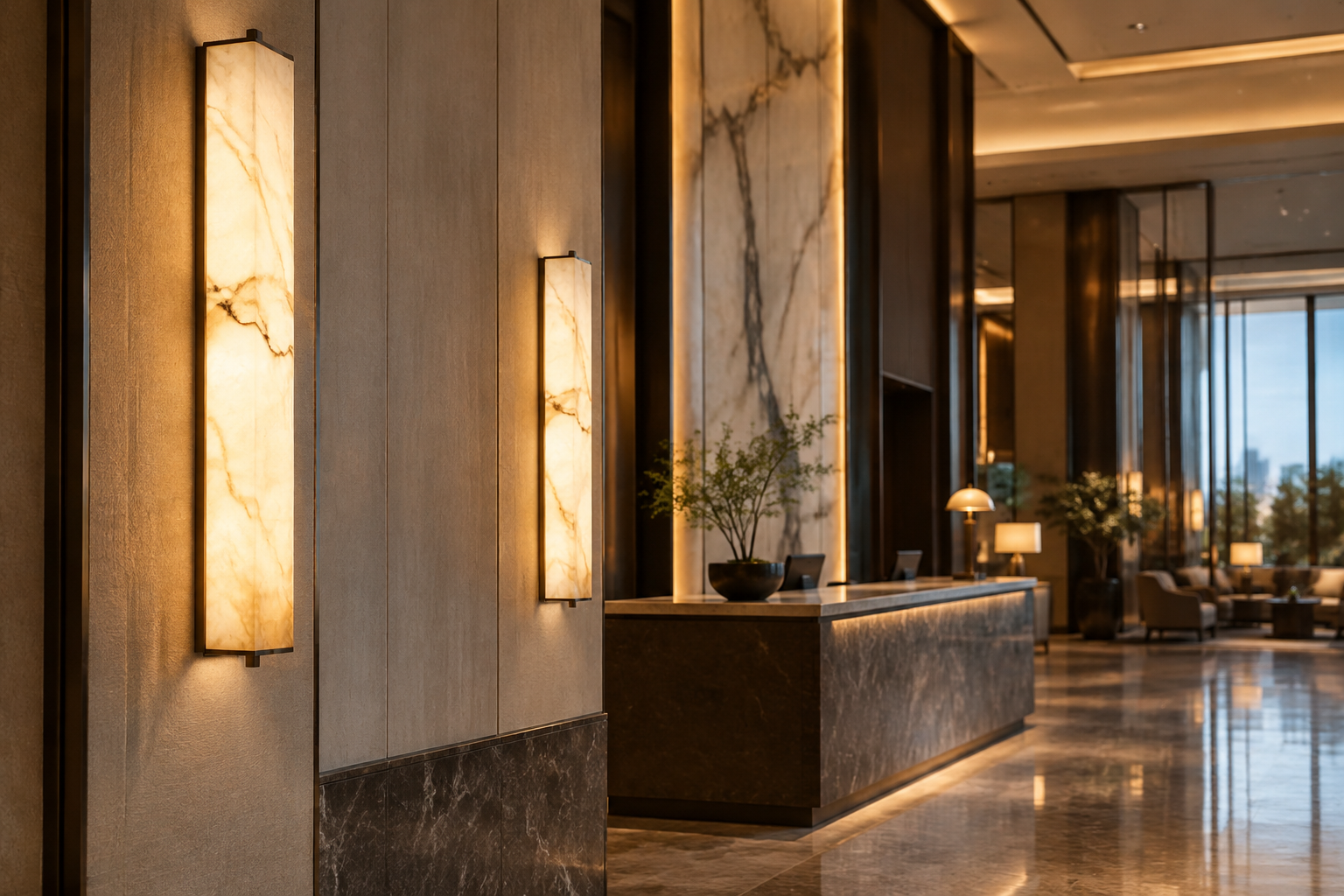
Request the material name, available quarry or distributor traceability, batch identification, finish description and disclosure of fillers, coatings or sealers. Specify whether repairs are acceptable and require representative samples showing both ordinary and visually extreme material.
For paired guestroom sconces, ask the fabricator to propose adjacent-cut or visually selected pairs without guaranteeing identical veining. For long corridors, agree on a sorting approach that avoids abrupt appearance changes. Retain physical boundary samples showing the lightest, darkest and most strongly veined acceptable appearances; photographs alone are insufficient.
Which Metalwork and Mounting Details Protect Alabaster During Hotel Use?
Supported edges, restrained clamping pressure and serviceable metalwork reduce damage risk more effectively than simply increasing stone thickness.
Gypsum alabaster is comparatively soft and vulnerable to moisture and unsuitable cleaning chemicals. Specify a cleaning method validated on the actual stone and finish. Avoid unsupported projections and arrangements where housekeeping equipment can strike exposed corners.
Provide a load-bearing metal chassis, appropriate isolating pads and fixings suitable for the actual wall substrate. Review stone retention, access to electrical parts and replacement procedures together. Any adhesive, backing film or sealer must be assessed for heat exposure, ageing and possible changes to illuminated colour.
 How Does Alabaster Thickness Affect Hotel Wall Light Transmission?: Which sourcing documents help buyers control alabaster translucency and natural variation?
Controls and Commissioning
Approve the driver and control interface with the actual stone assembly because low-level dimming can reveal unevenness hidden at full output.
DALI-2 is suitable where the project requires compatible addressable control. Casambi may suit wireless scene control when the selected components and site conditions support it.
KNX normally requires a compatible interface or gateway arrangement. For 0-10V, verify the dimming curve, switching method and low-end behaviour rather than assuming interchangeable performance.
A recommended commissioning specification is to inspect scenes at 100%, 50% and 10% commanded output. These commands do not imply matching percentages of perceived brightness.
Check flicker, abrupt transitions, audible noise and differences between adjacent sconces. If deeper dimming is required, make the lowest stable operating level an explicit acceptance condition.
Coordinate the decorative sconces with the wider room lighting. Stone wall lights should not be assumed to provide task, accessible-route or emergency-lighting performance without separate design verification.
Sampling, MOQ, Lead Time and Quality Control
Approve a representative first article before fixing production appearance, and obtain MOQ and lead time against the final material and construction requirements.
A recommended procurement sequence uses 3 approval stages: material-range review, working first article and pre-production confirmation. This is a recommended workflow, not an advertised factory commitment. Confirm the chosen thickness tolerance, illuminated appearance range, metal finish, mounting detail and control behaviour at the appropriate stage.
MOQ depends on stone availability, cutting yield, custom metalwork, finish batches and driver purchasing conditions. Lead time depends on approved drawings, sample revisions, material availability, testing and packaging. Request separate dates for sampling, approval, production readiness and dispatch rather than relying on a single headline duration.
Incoming inspection should check dimensions, cracks, repairs and material consistency against retained samples. Assembly inspection should address stone support, wiring protection, earthing where applicable and service access.
Final checks should include illumination, dimming and the electrical safety tests required by the approved construction and applicable standard. Agree on protective packaging and replacement-stone traceability before shipment.
Photometric Files & Compliance
Use finished-luminaire photometry and market-specific documentation because bare-LED data cannot establish the performance or compliance of an alabaster sconce.
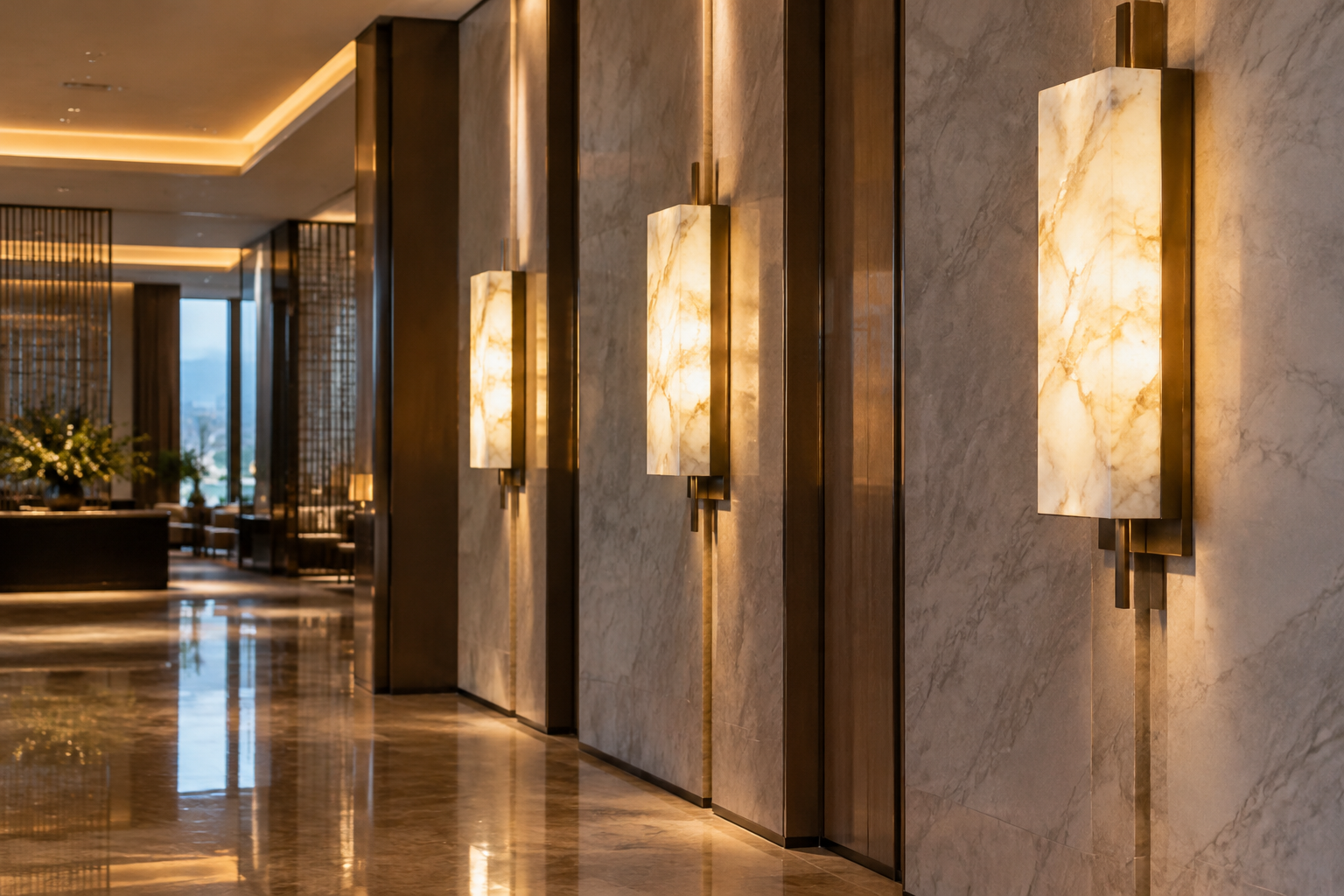
Request IES and LDT photometric files for the approved optical construction and import them into DIALux for room-level assessment. A file measured using a different stone thickness or diffuser is not automatically representative. Record the tested stone description, thickness, LED configuration, driver setting and thermal operating condition with the photometric report.
Distinguish material transmission from luminaire efficiency. A laboratory transmission measurement needs a defined spectrum and collection geometry; a simple lux-meter comparison is only a controlled comparative check.
Scattering stone can redirect light outside a detector’s acceptance angle. Likewise, finished-luminaire output includes losses in the cavity, diffuser and other components, not just the stone.
For EU supply, determine applicable legislation, technical documentation and declaration requirements, including RoHS where applicable. Assess luminaire safety against the relevant EN 60598 requirements. CE marking is not the same as independent product certification.
For US procurement, confirm the required listing route with the project team and authority having jurisdiction. UL certification, when specified, must cover the relevant finished configuration.
Middle Eastern and Southeast Asian markets require country-specific review of electrical supply, conformity routes and documentation. Never infer finished-product approval from a driver certificate or an ISO 9001 certificate.
 How Does Alabaster Thickness Affect Hotel Wall Light Transmission?: Photometric files & compliance
Frequently Asked Questions
The following answers summarise purchasing decisions that should be confirmed through representative samples and project-specific documentation.
Q: What Alabaster Thickness Should We Specify for Hotel Wall Lights?
Start with matched samples rather than a universal thickness rule. Comparing 8 mm and 12 mm is a design target for initial evaluation, not a structural prescription. Keep the LED module and cavity unchanged, then assess brightness, veining, edge durability and weight. Approve the production dimension only after reviewing the complete supported assembly.
Q: Can We Specify a Guaranteed Light-transmission Percentage for Alabaster?
A transmission percentage is meaningful only when the material and measurement method are defined. As a recommended specification, compare at least 2 representative stone samples under the same source and collection geometry. Define whether acceptance concerns material transmission, visible uniformity or finished-luminaire output. Do not turn an informal lux comparison into a certified optical property.
Q: How Can Buyers Reduce Colour Differences Between Adjacent Alabaster Sconces?
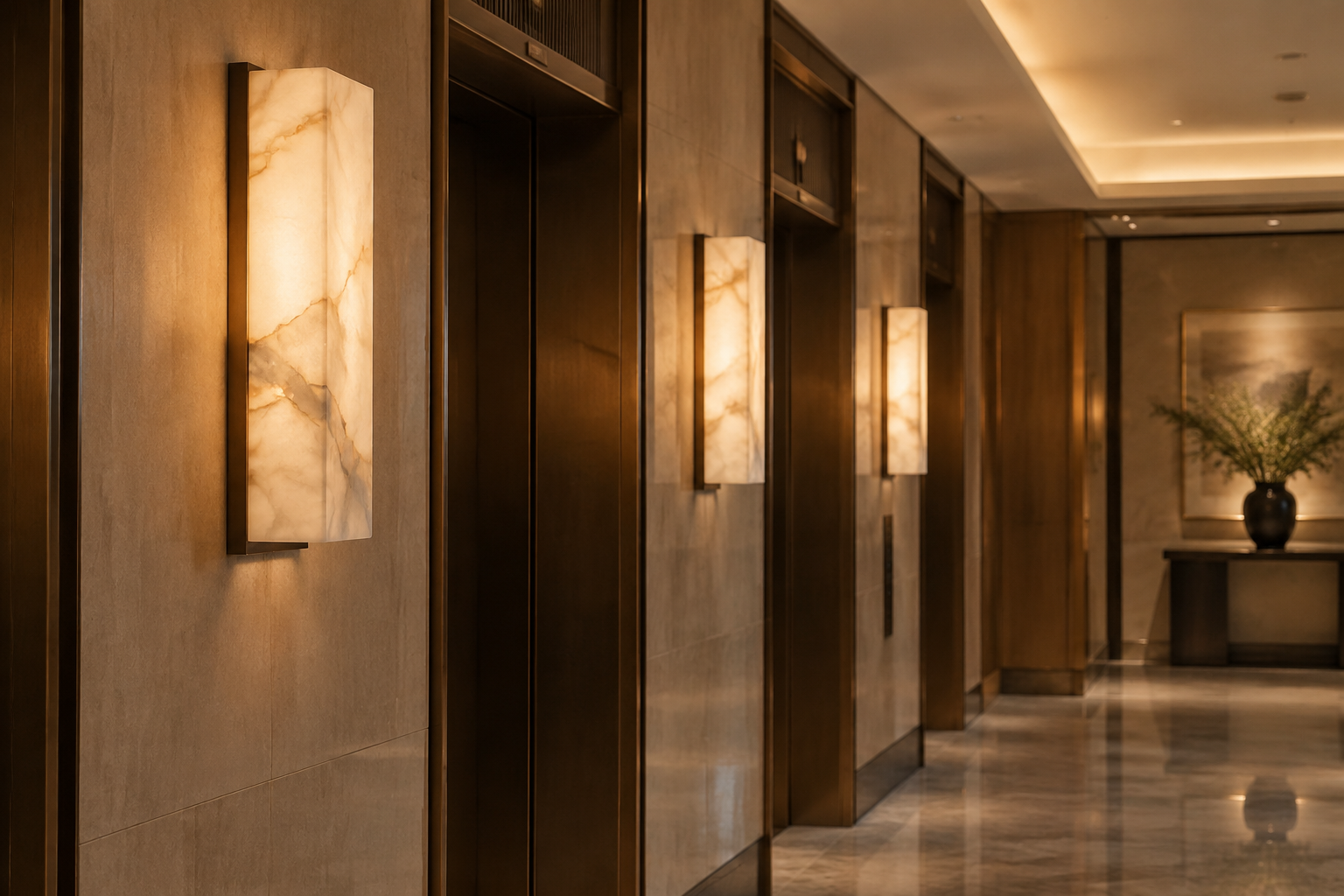
Control both stone selection and the LED system. A recommended specification is to approve 3 illuminated boundary samples representing light, dark and strongly veined acceptable material. Use a consistent LED specification, disclose treatments and agree on pairing or corridor sorting. Natural stone will still vary, so define an acceptable visual range rather than promising identical panels.
Q: Can Custom Alabaster Sconces Use DALI-2 or Wireless Dimming?
Yes, provided the selected driver, control equipment and luminaire construction are compatible. A recommended commissioning specification is to review 100%, 50% and 10% commanded output with the actual alabaster installed. Check stable dimming, visible unevenness and noise. Confirm DALI-2 device credentials where relevant, or validate the proposed Casambi arrangement and any KNX integration separately.
Sources and Technical References
Consult current official publications and model-specific records; these references support specification decisions but do not certify any product described here.
- EN 12464-1 — Light and lighting — Lighting of work places — Part 1: Indoor work places. Obtain the applicable edition through a national standards body such as BSI.
- EN 60598 — Luminaires. Select the applicable general and particular requirements through the relevant standards body; related IEC publications are available from the IEC Webstore.
- IES technical publications. Consult the Illuminating Engineering Society for applicable photometric measurement and reporting guidance.
- WELL v2, Light concept. Review project requirements through the International WELL Building Institute.
- DALI-2 certification and device records. Check the DALI Alliance for relevant products and interface information.
- CE marking and RoHS. Review official European Commission guidance alongside the applicable legislation.
 How Does Alabaster Thickness Affect Hotel Wall Light Transmission?: Q: How can buyers reduce colour differences between adjacent alabaster sconces?
Request a Custom Quote
A useful custom quote request defines the stone appearance, optical assembly, control interface and destination-market documentation before price comparison.
Send dimensioned drawings, quantities, installation locations, wall construction, reference finishes, desired illuminated appearance, control requirements and destination country. Include sample expectations, paired-stone preferences, required photometric deliverables and the approval programme. Ask the quotation to identify assumptions, exclusions and the proposed evidence for material and electrical acceptance.
At XHLWX (led-project-light.com), a Custom Indoor LED Lighting Manufacturer based in China, ... your custom alabaster wall-light brief should connect sourcing, thickness, light transmission and serviceability in a single approval package. Request a proposal based on representative illuminated samples, documented component selections and clearly defined production acceptance criteria.
Need a tailored lighting plan for your project?
Our senior lighting designers reply within 48 hours with a free design proposal & quotation.