
How Can Hotel Restaurant Pendants Deliver 150–300 Lux?
Quick answer
Specify custom hotel restaurant pendants for a 150–300 lux table design target, with warm ambience, suitable optics, controls and verified compliance.
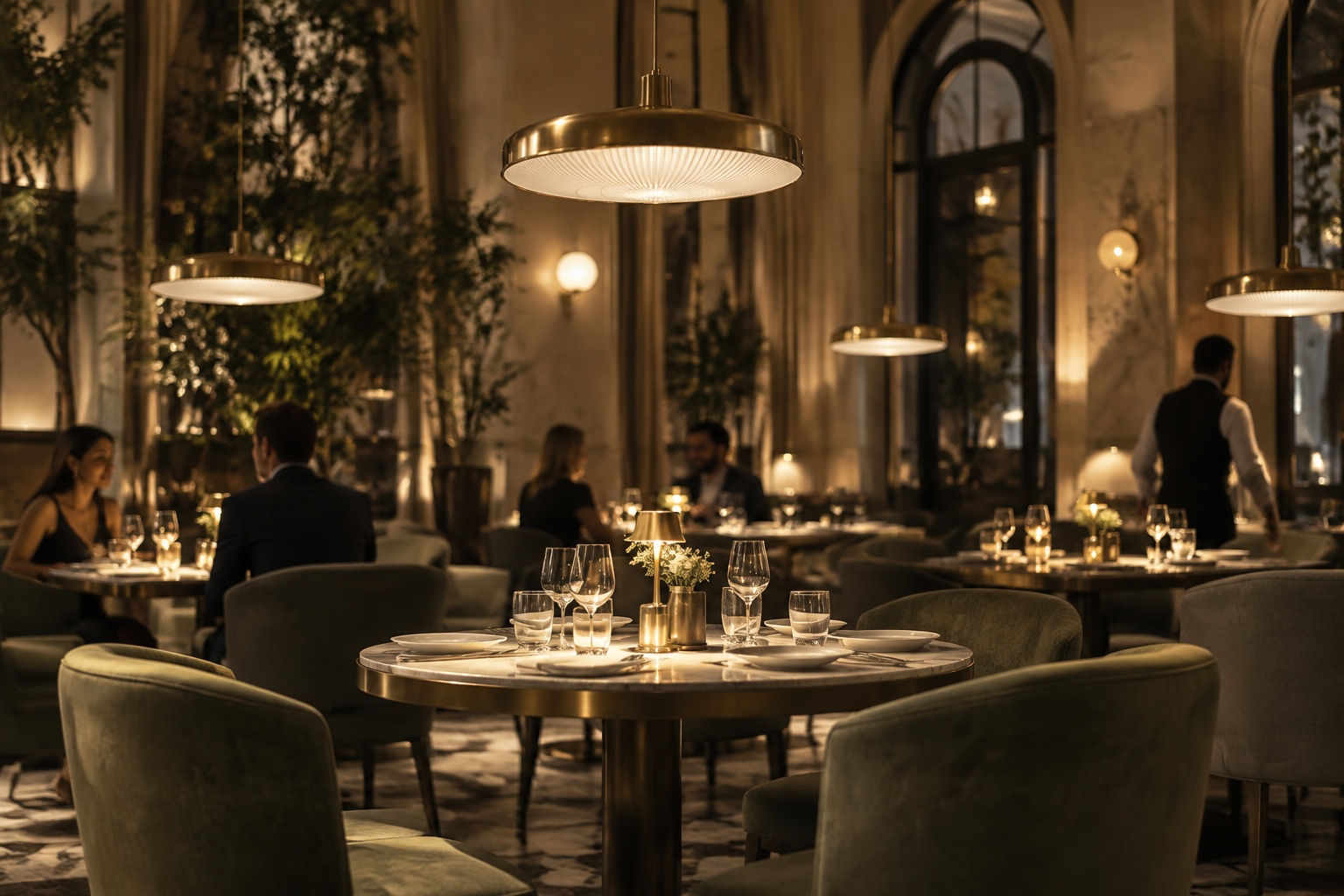
Introduction: Custom Pendants for Hotel Restaurant Tables
At XHLWX (led-project-light.com), a Custom Indoor LED Lighting Manufacturer based in China, ... recommend a 150–300 lux design target for hotel restaurant tables. Achieve it with shielded, dimmable pendants, warm-white LEDs and verified table-plane photometry, while softer surrounding light preserves ambience and visible contrast.
The design target concerns illuminance on occupied dining surfaces, not a universal requirement for every restaurant or operating scene. Breakfast, informal dining and evening service may need different settings. Hotel owners should agree the operating brief with the lighting designer before decorative shapes, quantities or wattages become fixed.
A pendant should therefore be specified as both an interior feature and an optical system. Its shade, diffuser, suspension height and driver influence whether guests see attractive food, readable menus and comfortable faces—or bright sources reflected in polished tables.
For EU, US, Middle East and Southeast Asia procurement, a common visual design can require different electrical assemblies and approval documentation. Treat destination requirements as an input to engineering, rather than a final shipping check.
Design Criteria and Standards: Targeting 150–300 Lux on Restaurant Tables
Specify table illuminance, visual comfort and colour quality together; wattage alone cannot establish restaurant lighting performance.
Use 150–300 lux as the design target for the agreed active dining scene, measured horizontally at the actual tabletop elevation. State whether acceptance concerns average illuminance, minimum readings or both. A table average can conceal a bright centre and dim perimeter, so define the measurement grid before approving a sample.
Assess staff working areas separately. EN 12464-1 addresses lighting of indoor workplaces; the applicable activity and national adoption matter.
Do not describe the dining target as automatic compliance with every workplace requirement. IES guidance provides complementary application and measurement context.
”
The numerical performance entries below are recommended specifications for design development, not verified product capabilities. Standards and certification names identify assessment routes, not approvals already held.
| Parameter | Spec | Standard | Notes |
|---|---|---|---|
| Table illuminance | 150–300 lux design target in the agreed dining scene | EN 12464-1; applicable IES guidance | Assess actual tabletop height and pendant spacing |
| CCT | 2700–3000 K recommended specification | Project colour-quality schedule | Compare finishes, food and faces under a physical sample |
| Colour rendering | CRI Ra ≥90; R9 ≥50 recommended specification | CIE colour-rendering methodology; project brief | Request source data; CRI alone does not describe every colour appearance |
| UGR and glare | Installation-specific assessment; shield direct source views | EN 12464-1 | UGR is not an unconditional property of an isolated pendant |
| Beam distribution | 24–60° recommended starting specification | IES photometric data; project calculation method | Select from table size, mounting distance and verified distribution |
| Control | DALI-2, Casambi, KNX integration or 0–10 V, as selected | Applicable protocol documentation | Confirm driver, interface, gateway and low-end compatibility |
| Housing/material/IP | Aluminium, steel or brass; IP20 recommended specification for suitable dry interiors | EN 60598; IEC 60529 | Cleaning exposure may require a different protection specification |
| LED and driver | Candidate Osram, Bridgelux or Samsung LEDs; Tridonic or Mean Well driver | Selected component datasheets | Brand availability and exact model suitability require confirmation |
| Market compliance | Applicable CE/RoHS documentation; UL route where required; SAA evidence where specified | Destination legislation and applicable product standards | These routes are not interchangeable or blanket approvals |
| Manufacturing quality | Request current ISO9001 documentation if required by procurement | ISO9001 | A quality-management certificate does not certify luminaire safety |
Avoid a blanket “UGR compliant” statement without the room model and viewing assumptions. For decorative pendants, seated sightlines and reflected source images deserve particular attention.
Customisation Options and Materials: Matching Pendant Form to Restaurant Use
Choose the optical construction before finalising decorative materials, because shade geometry determines usable light and source visibility.
A custom pendant can combine a downward task component with a softly luminous body. These functions should be evaluated separately: a glowing shade can appear bright while delivering insufficient illumination to the dining surface.
| Construction | Table-light behaviour | Procurement or maintenance issue | Verdict |
|---|---|---|---|
| Opaque metal shade with recessed optic | Directs more light toward the table | Check source cut-off and internal finish | Strong candidate for controlled table illumination |
| Opal glass pendant | Spreads light and creates a luminous focal point | Check luminance, weight and glass replacement | Good for softness; verify table illuminance separately |
| Fabric shade with internal diffuser | Provides a softer decorative presence | Confirm cleanability and heat compatibility | Suitable where housekeeping accepts the material |
| Perforated metal shade | Combines downward output with decorative light patterns | Review bright apertures from seated positions | Use when patterns support the interior rather than distract |
| Custom linear pendant | Can distribute light along communal tables | Coordinate suspension, rigidity and service access | Useful for long tables when photometry confirms coverage |
How Should Pendant Size and Suspension Follow the Table Layout?
Pendant dimensions should follow table geometry, guest sightlines and optical distribution rather than a fixed decorative ratio.
For early coordination, a bottom-of-pendant clearance of 650–850 mm above the tabletop is a recommended design target, not a universal mounting rule. Adjust it after checking seated views, staff movement and the luminous opening. Large shades may obstruct conversation even when their light distribution is acceptable.
Round tables may suit a central pendant; long banquettes may need repeated units or a linear assembly. Model the actual furniture plan, including table moves anticipated during hotel operations.
Which Finishes and Materials Suit Hotel Restaurant Housekeeping?
Specify finishes against the hotel's cleaning method and replacement strategy, not appearance alone.
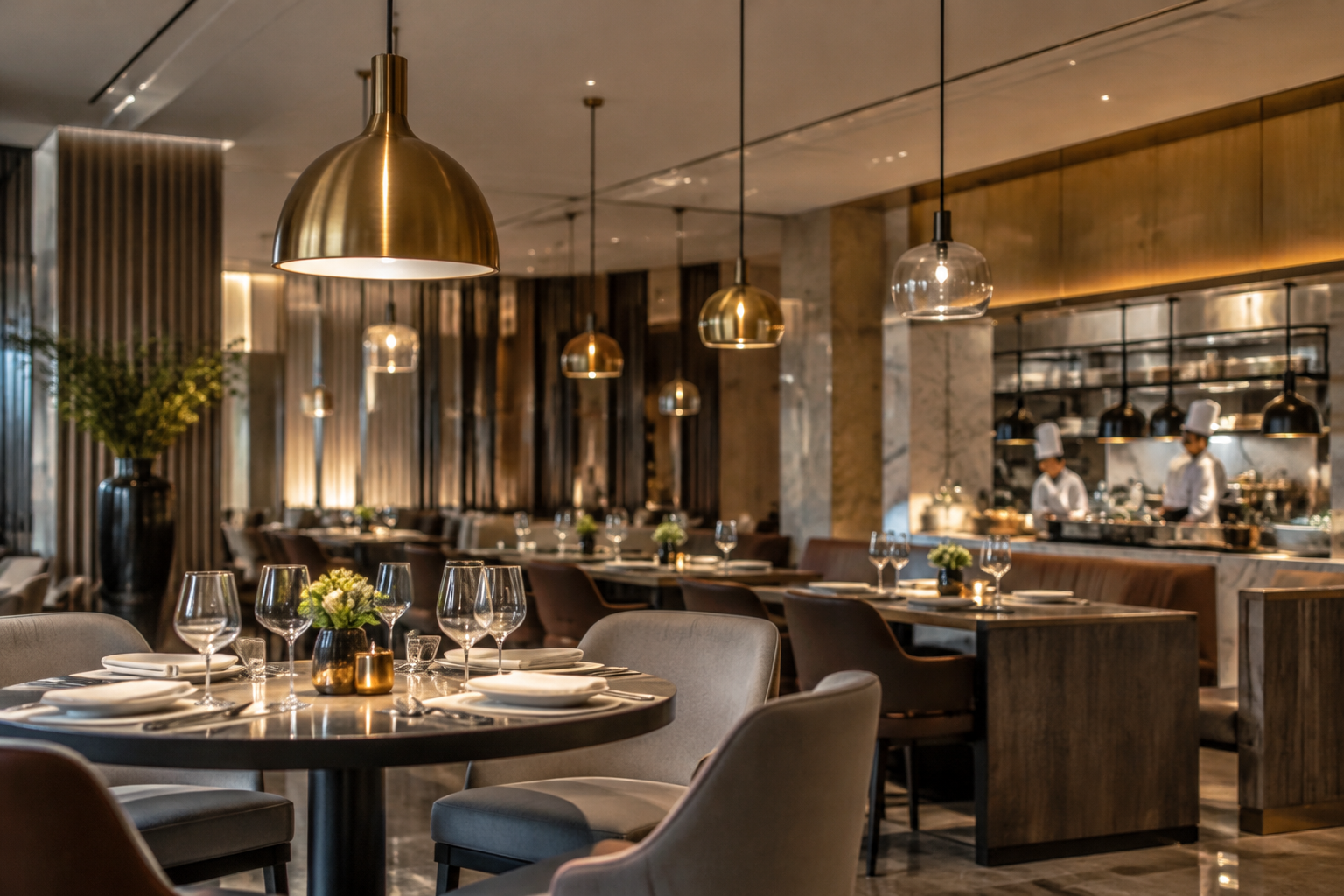
Powder-coated aluminium can provide a comparatively lightweight housing; brass offers a different visual character and may require agreed lacquer protection. Glass needs secure retention and a replacement plan. Fabric should be reviewed for staining, dust and compatibility with nearby food-service activity.
Approve physical finish samples under the intended lighting. Record texture, sheen, colour reference and permissible variation, especially where adjacent pendants must appear consistent.
Can Decorative Glass Deliver Comfortable Light Without Visible Hotspots?
Decorative glass needs an internal optical strategy to control hotspots and preserve useful downward light.
Opal density, source setback and diffuser geometry influence both comfort and output. A denser diffuser may hide the LED more effectively while reducing transmitted light. Clear or tinted glass can expose bright components and create reflections in glassware.
Review a powered sample from seated and standing positions. Require any material or diffuser change after approval to trigger an optical review, because decorative substitutions can alter the calculation assumptions.
 How Can Hotel Restaurant Pendants Deliver 150–300 Lux?: Which finishes and materials suit hotel restaurant housekeeping?
Controls and Commissioning: Breakfast, Dining and Evening Scenes
Select controls around hotel operating scenes and verify the complete driver-to-control combination before ordering production quantities.
DALI-2 supports addressable control when compatible devices are selected and commissioned. Casambi can suit wireless scene control where network planning, accessibility and the hotel's IT policy permit it.
KNX integration commonly requires an appropriate lighting interface or gateway. A 0–10 V solution needs explicit agreement on dimming behaviour, wiring and switching at minimum output.
These names do not guarantee identical performance. Confirm the selected driver model, load, control interface, fade behaviour and recovery after power interruption. Assess flicker and temporal light artefacts using declared data and appropriate testing; a smooth visual demonstration alone is insufficient.
A recommended commissioning schedule should include:
- An active dining scene checked against the 150–300 lux design target.
- An evening scene agreed through a hospitality mock-up, without assuming the same illuminance target must always apply.
- A housekeeping scene supporting inspection and cleaning.
- A defined power-restoration state and staff-accessible override.
Measure each scene with furniture and finishes installed. Record control levels, readings and measurement conditions. Do not equate a dimmer percentage directly with lux: driver response and contributions from other indoor lighting affect the result.
Sampling, MOQ, Lead Time and Quality Control: Approving Bespoke Restaurant Pendants
Approve a representative powered sample before fixing production release, because drawings cannot demonstrate glare, finish appearance or dimming quality.
The sample should represent the intended optical assembly, LED, driver, diffuser, finish and suspension system. If it is a visual prototype rather than a production-equivalent electrical sample, identify that limitation explicitly. Keep an approved reference and a documented component schedule.
MOQ and lead time cannot be responsibly fixed without a reviewed specification. Custom tooling, glass manufacture, finish processes, testing scope and component availability all influence the commercial offer.
Request separate milestones for drawings, sample approval, production, inspection and dispatch. Do not confuse factory dispatch with arrival at the hotel.
The quality-control plan should cover:
- Dimensions, finish consistency and suspension hardware.
- Glass or diffuser retention and accessible service points.
- Applicable electrical safety checks for the selected construction class.
- Functional operation, dimming and identification labels.
- Packaging appropriate to fragile parts and destination handling.
Ask the supplier to define inspection coverage, acceptance criteria and corrective action. Sampling plans should be agreed rather than implied. Substituting an LED or driver requires technical review because it can affect output, colour, thermal behaviour, control compatibility and compliance documentation.
Photometric Files & Compliance: Verifying Restaurant Pendant Performance
Use configuration-matched photometry and destination-specific compliance evidence before accepting a bespoke pendant for procurement.
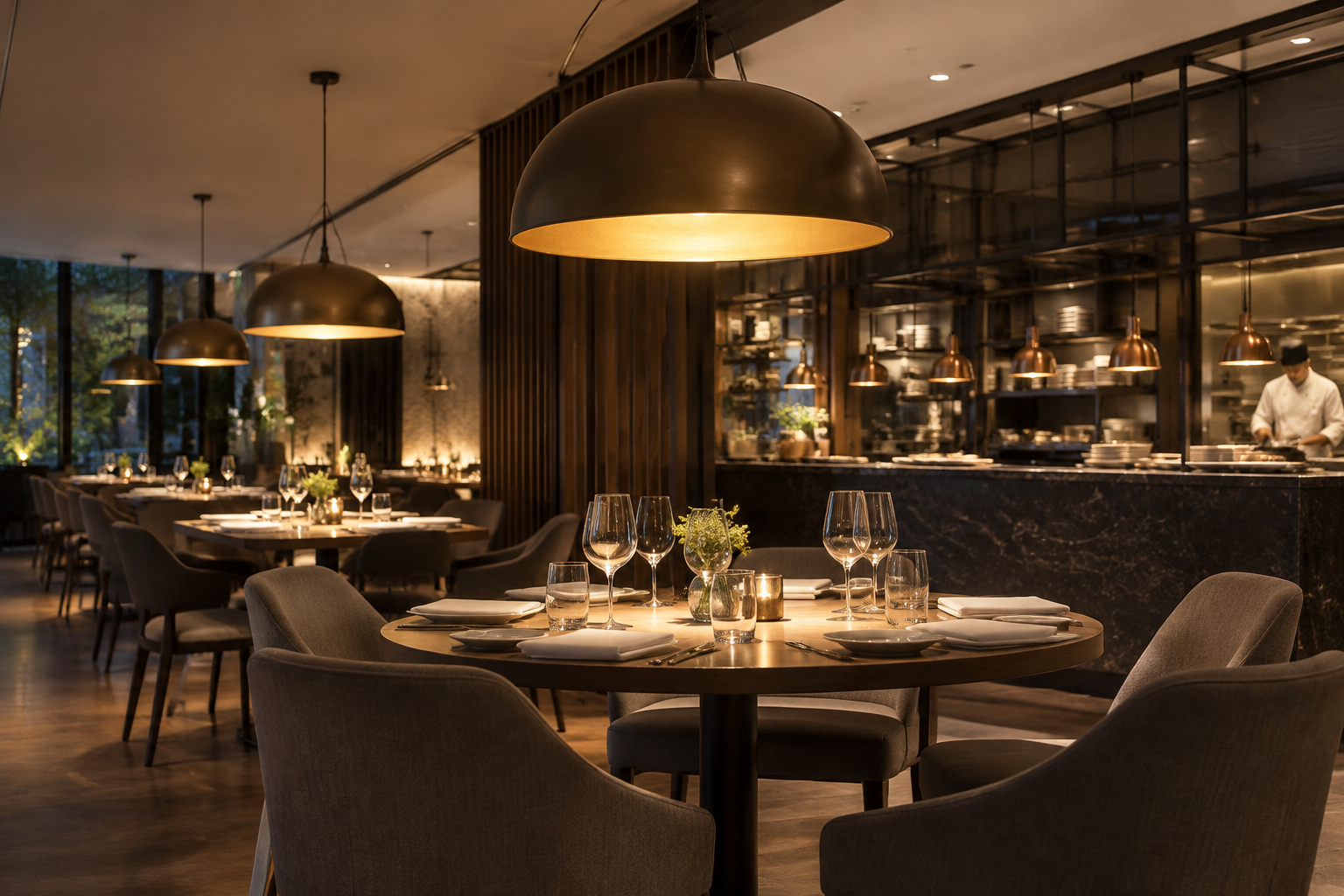
Request IES and LDT photometric files for the proposed optical configuration, together with the associated test report and operating conditions. The file should correspond to the LED package, optics, diffuser and output under consideration. A file from a visually similar pendant is not automatically representative.
Import the files into DIALux using the actual room dimensions, reflectances, furniture positions and mounting heights. Document maintenance assumptions and contributions from other interior luminaires. Review table calculations alongside rendered views, while recognising that a rendering is not proof of visual comfort.
For electrical safety, identify the applicable EN 60598 requirements and relevant luminaire part for the EU specification. CE marking is not a universal third-party certificate; verify the applicable legislation, declaration and supporting documentation. RoHS concerns restricted substances and does not establish photometric performance.
For US procurement, confirm the required listing route with the project authority and verify coverage of the supplied assembly. Middle East and Southeast Asia requirements vary by country and project.
SAA documentation is not a universal substitute for local acceptance. Component approvals alone do not establish complete-luminaire compliance.
 How Can Hotel Restaurant Pendants Deliver 150–300 Lux?: Photometric files & compliance: verifying restaurant pendant performance
Frequently Asked Questions
Q: Is 150–300 Lux Mandatory for Every Hotel Restaurant Table?
No; 150–300 lux is a design target here, not a universal statutory requirement. The appropriate level depends on service style, guest needs and the agreed scene. Evaluate staff tasks separately against applicable workplace requirements. Define the tabletop measurement plane and acceptance criteria so the lighting designer, owner and supplier assess the same conditions.
Q: Can a Single Decorative Pendant Achieve the Table Illuminance Target?
A single pendant may work, but only configuration-specific photometry can support that decision. The 150–300 lux design target depends on table dimensions, mounting distance, beam distribution and other indoor lighting. Large shades do not necessarily produce useful downward output. Calculate the proposed arrangement and confirm it with a representative powered sample before production approval.
Q: Should Hotel Restaurant Pendants Use DALI-2 or Casambi?
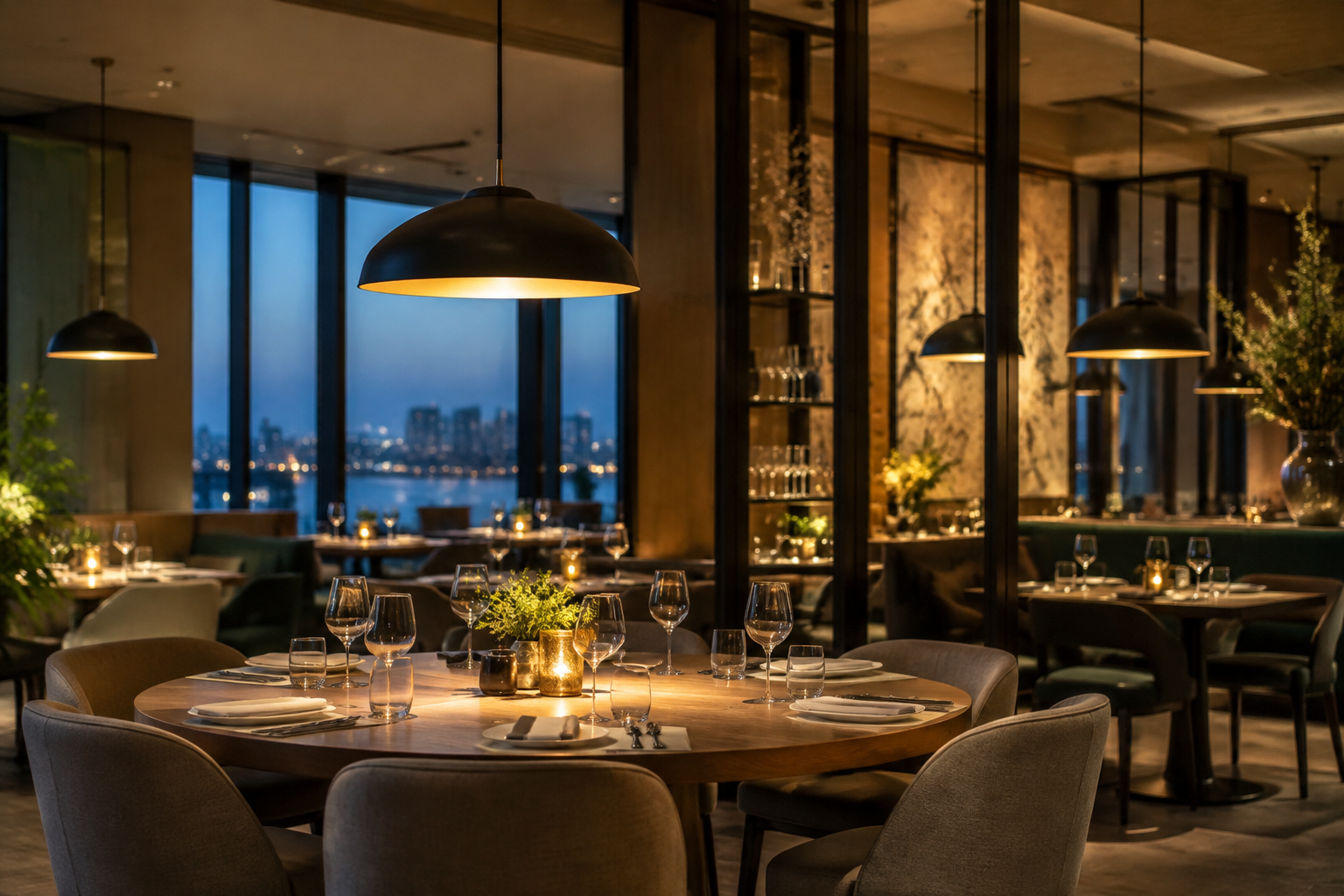
Choose the control system according to the hotel's infrastructure, operating policy and commissioning resources. DALI-2 is an option for addressable wired lighting; Casambi is an option for wireless scene control. Neither choice guarantees a particular minimum output. Request compatibility evidence and test the selected driver, scene recall and power-restoration behaviour using the intended pendant configuration.
Q: What Information Is Needed for a Bespoke Pendant Quotation?
Provide the restaurant plan, table schedule, ceiling details, design references, quantities and installation country. Include the 150–300 lux design target where applicable, preferred control system, finish references and required delivery milestones. Identify whether photometric testing, project calculations and third-party compliance work belong in the supplier's scope, because these requirements influence cost and programme.
Sources and Technical References: Checking Standards and Approval Routes
Use official standards and scheme resources to confirm current editions, scope and destination applicability.
- EN 12464-1 — Light and lighting — Lighting of work places — Part 1: Indoor work places: consult national standards bodies through CEN-CENELEC.
- EN 60598 — Luminaires: obtain the applicable general and particular requirements through the relevant national standards catalogue.
- IES — Illuminating Engineering Society: review applicable lighting guidance and photometric resources at ies.org.
- WELL v2 — WELL Building Standard: check project-specific lighting features through the International WELL Building Institute.
- DALI-2: check certification scope and product records through the DALI Alliance.
These references support specification decisions; they do not verify any particular XHLWX product or project.
 How Can Hotel Restaurant Pendants Deliver 150–300 Lux?: Q: Should hotel restaurant pendants use DALI-2 or Casambi?
Request a Custom Quote: Define the Restaurant Pendant Package
A useful custom quote starts with the dining layout, optical objective, destination requirements and approval responsibilities.
Send the reflected ceiling plan, furniture layout, pendant references, finish schedule, control brief and required documentation. Ask the quotation to distinguish luminaire supply from calculations, samples, testing, installation and commissioning. Require written confirmation of MOQ, programme and proposed component models after engineering review.
At XHLWX (led-project-light.com), a Custom Indoor LED Lighting Manufacturer based in China, ... start with a configuration-specific brief for hotel restaurant pendants. Include the 150–300 lux design target, intended scenes and destination market so optical, decorative and compliance requirements can be evaluated together before procurement.
Need a tailored lighting plan for your project?
Our senior lighting designers reply within 48 hours with a free design proposal & quotation.