
How Should Custom Hotel Table Lamps and Power Bases Be Specified?
Quick answer
Specify bespoke guestroom table lamps with durable materials, accessible switches and compliant power bases for EU, US, Middle East and Southeast Asian hotels
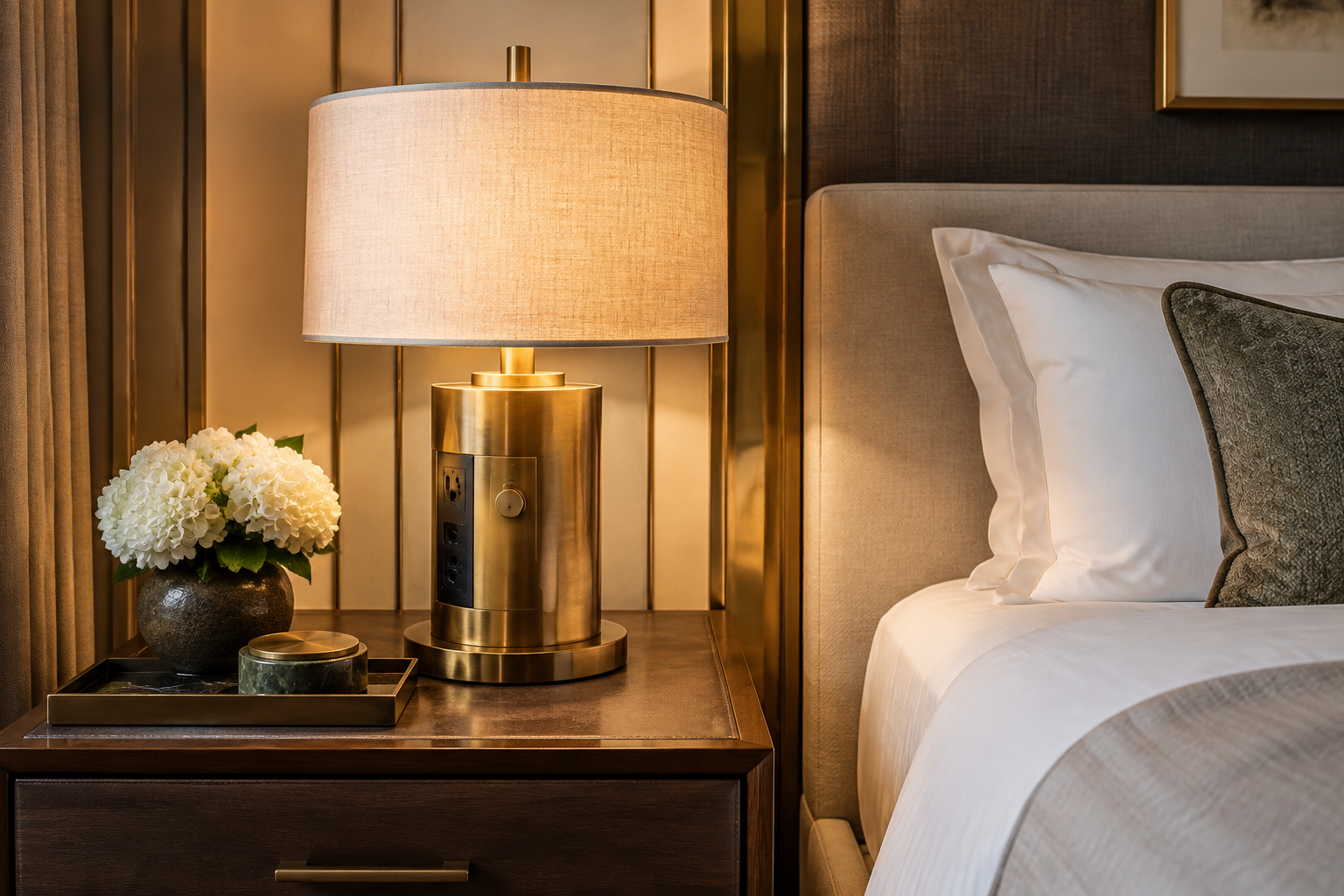
Introduction
At XHLWX (led-project-light.com), a Custom Indoor LED Lighting Manufacturer based in China, ... custom hotel table lamps should combine serviceable materials, reachable switches and market-specific power bases. A recommended specification is 2700–3000 K lighting with CRI ≥90, plus separately accessible light controls and outlets positioned clear of bedding and drink spills.
A guestroom table lamp is both a lighting instrument and a frequently handled electrical accessory. Its shade determines reading comfort; its base must resist everyday knocks; and its switches should be understandable without instructions. Adding mains outlets or USB charging changes the design from a decorative object into a coordinated electrical assembly.
For hotel owners, designers and FF&E buyers, the useful specification therefore connects appearance, usability, maintenance and destination-market requirements. Approve these together, rather than choosing a silhouette first and attempting to fit sockets into the remaining space.
Design Criteria and Standards
A bespoke guestroom lamp needs a coordinated specification covering light quality, electrical architecture, accessible operation and replaceable components.
The values below are recommended specifications or design targets, not claims about tested XHLWX products. Final selections depend on the room layout, operating brief and conformity assessment.
| Parameter | Spec | Standard | Notes |
|---|---|---|---|
| CCT and colour quality | Recommended specification: 2700–3000 K; CRI ≥90 | IES measurement guidance; WELL v2 where applicable | Evaluate shade-induced colour shifts with the complete lamp |
| Glare and beam | Design target: UGR ≤19 where relevant to a separately assessed desk task; recommended specification: shielded diffuse distribution or 30–60° reading optic | EN 12464-1 where applicable; IES photometric reporting | UGR depends on the room and viewing geometry; it is not an isolated table-lamp guarantee |
| Light output | Recommended specification: dimmable output selected through room simulation and mock-up | IES; project lighting brief | Avoid specifying wattage as a substitute for useful illumination |
| Control | Recommended specification: local tactile control; DALI-2, Casambi, KNX gateway or 0-10V only when required | DALI Alliance requirements; applicable KNX specifications | Confirm driver compatibility, dimming behaviour and guestroom control logic |
| Housing, materials and IP | Recommended specification: metal structural base, replaceable shade and IP20 for dry guestrooms | EN 60598 series; applicable IP classification requirements | IP20 is not spill protection; assess power-base openings separately |
| LED and driver brands | Recommended specification: evaluate Osram, Bridgelux or Samsung LEDs; Tridonic or Mean Well drivers | Component datasheets and applicable safety requirements | Availability, dimensions, thermal limits and dimming determine selection |
| Certification and compliance evidence | Require destination-specific CE/RoHS documentation, applicable UL listing, SAA evidence where relevant, and ISO9001 evidence if contractually requested | Applicable EU legislation; UL 153 where applicable; relevant national requirements | CE, RoHS, UL, SAA and ISO9001 are not interchangeable approvals |
| Integrated power base | Recommended specification: destination-specific socket and replaceable USB-C charging module | Applicable socket, charger and finished-assembly requirements | Confirm earthing, insulation, thermal behaviour and total rated load |
EN 12464-1 addresses indoor workplaces; it should not be presented as a universal bedside-lighting requirement. Use it where the project’s task and space classification justify its application. WELL v2 is a building-level framework, not a table-lamp safety certificate.
Customisation Options and Materials
The best material combination balances visual intent with stability, cleaning resistance, electrical isolation and practical component replacement.
Assess samples using the actual housekeeping products and handling conditions specified by the operator. A finish name alone does not define coating durability, repairability or colour consistency.
| Material or assembly | Practical advantage | Main limitation | Verdict |
|---|---|---|---|
| Coated steel base | Weight, stiffness and adaptable fabrication | Scratches can expose the substrate | Strong default for value-conscious bespoke programmes |
| Aluminium housing with ballast | Flexible machining and integrated heat paths | Requires deliberate stability design | Good for compact bases with replaceable modules |
| Brass or plated metal | Premium visual language and tactile detail | Fingerprints, coating wear and finish variation | Suitable when finish samples and cleaning rules are approved |
| Stone sleeve over metal chassis | Substantial appearance and useful mass | Brittleness, natural variation and heavier handling | Use as a decorative component, not an assumed electrical enclosure |
| Fabric shade on replaceable frame | Soft guestroom ambience and easy style changes | Dust retention and material-dependent light transmission | Prefer removable shades with validated thermal clearance |
How Should Materials Support a Base Containing Outlets?
A power base should use an engineered internal enclosure rather than rely on decorative materials for electrical protection.
Stone, timber and ceramic can form the visible shell, but socket mounting, cable retention and protective measures need their own design. Provide service access without exposing guests to live components, and protect cable routes from sharp edges and moving parts.
For metal assemblies, determine the appropriate protection class and earthing arrangement with the electrical designer and test laboratory. An earthed outlet introduces requirements that cannot be resolved by describing the lamp itself as double-insulated. Specify replacement access for charging modules without requiring destruction of the decorative base.
Where Should the Switch Sit for Comfortable Bedside Use?
The primary light switch should be reachable from the normal resting position without moving the lamp or reaching behind the shade.
A tactile switch on the front or accessible side of the base usually communicates its purpose better than a concealed cord switch. The correct position depends on mattress height, bedside furniture, lamp setback and whether the guest approaches from the left or right.
Use a full-size room mock-up to assess reach, hand clearance and visibility. Separate the lighting control from charging connections so guests do not unplug devices while searching for the switch. If touch control is proposed, test operation with dry hands, cleaning residues and the intended finish; keep its interaction simple and predictable.
Which Socket and USB Arrangement Works Across Hotel Markets?
Market-specific power modules are preferable to assuming a universal socket can satisfy every destination’s electrical requirements.
EU, US, Middle East and Southeast Asian hotels require country-level decisions, not merely regional labels. Confirm supply characteristics, accepted socket format, plug, cord, protective arrangements and required approval route before approving base tooling. Do not assume acceptance in one country establishes acceptance elsewhere.
For USB-C, a recommended specification is 30–65 W USB Power Delivery when the brief includes higher-power devices. State whether that output is available per port or shared, and document simultaneous-use limits. Position openings to reduce foreseeable liquid exposure; a side-facing arrangement still requires appropriate safety assessment and does not establish spill resistance.
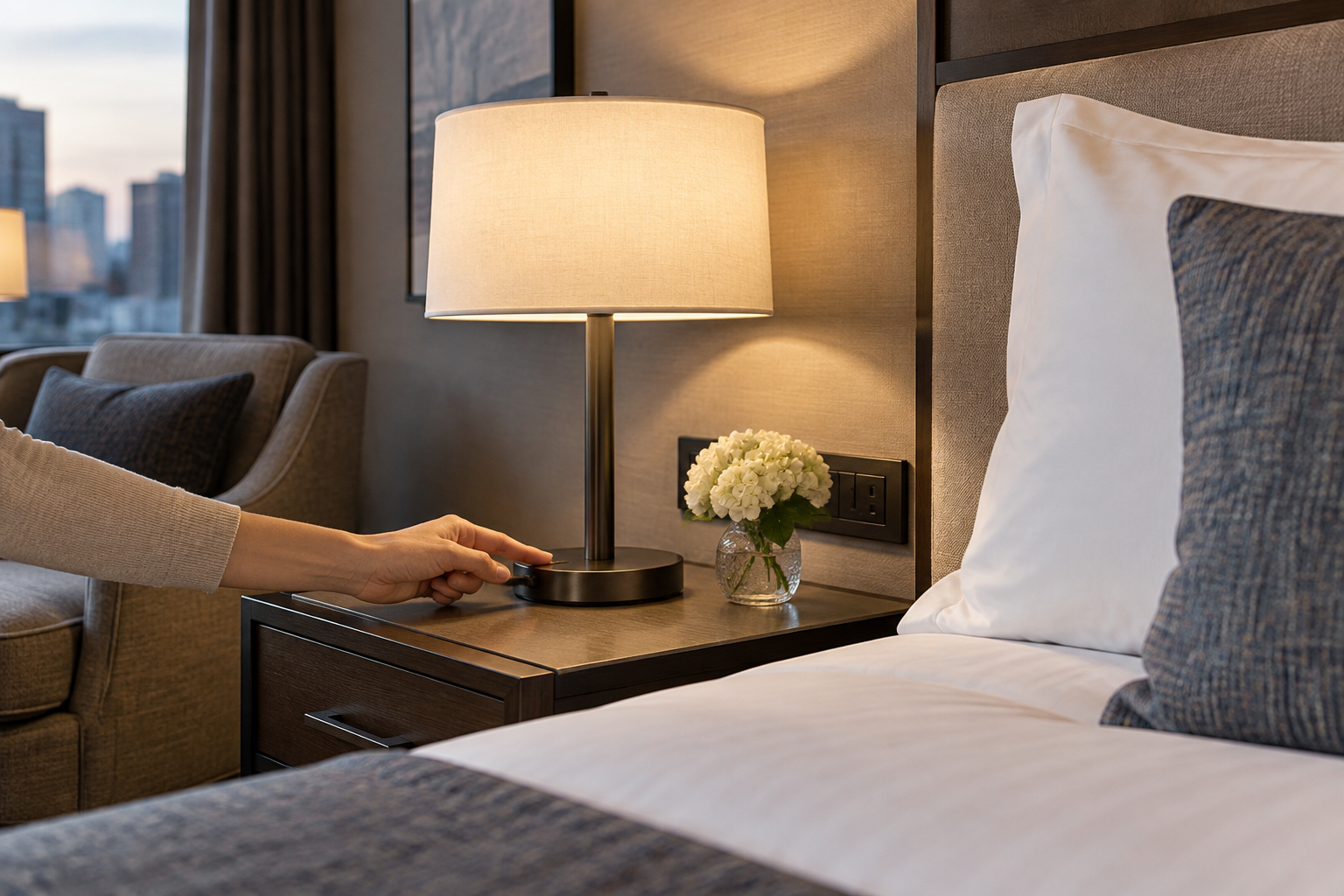 How Should Custom Hotel Table Lamps and Power Bases Be Specified?: Where should the switch sit for comfortable bedside use?
Controls and Commissioning
Local switching should remain intuitive even when the table lamp participates in a wider guestroom control system.
Choose the control architecture before finalising the driver and base dimensions. DALI-2 can support addressed control through compatible equipment, while Casambi provides a wireless option subject to system design.
KNX commonly requires a suitable interface or gateway. A 0-10V arrangement needs compatible control wiring and verified off-state behaviour.
Not every control belongs in every lamp. For a straightforward guestroom, a local switch and compatible dimmable source may be the more maintainable solution. Where networked controls are required, define responsibility for addressing, software configuration, gateway integration and future replacement.
Keep charging availability separate from lighting behaviour where the operator requires it. A guest switching off the shade light should not unexpectedly interrupt phone charging. Coordinate this with master-switch, occupancy and housekeeping modes rather than bypassing the room’s electrical strategy.
Commission the complete sequence: local on/off, dimming, minimum stable level, power restoration, master-off response and charger operation under simultaneous load. Record whether the lamp recalls its previous brightness or starts at a predetermined level. Both can work; ambiguity creates guest complaints and maintenance confusion.
Sampling, MOQ, Lead Time and Quality Control
Sampling and procurement commitments should follow the electrical configuration, approved finish and destination-market compliance plan.
Request separate confirmation of minimum order quantity, sample charges, tooling, testing scope and production lead time. No fixed MOQ or delivery period should be assumed for a bespoke power-base lamp. Existing components may simplify procurement, while new castings, unusual finishes or a different socket arrangement can introduce additional dependencies.
A useful approval sequence includes a finish sample, appearance prototype, functional engineering sample and signed production reference. Make clear which sample demonstrates aesthetics and which represents the intended electrical construction. An attractive mock-up is not evidence of compliance.
The quality-control plan should address:
- Base stability, shade alignment and switch accessibility on the specified furniture.
- Finish consistency against an agreed physical reference and defined tolerances.
- Socket retention, cord anchorage, cable routing and service-panel security.
- Electrical safety checks appropriate to the construction and applicable requirements.
- Thermal evaluation with the intended light source and charging load.
- Packaging protection, identification labels and spare-module traceability.
Agree the inspection method and acceptance criteria before production. Replacement drivers, shades and charging modules should be identified by controlled part references, not only by photographs or supplier descriptions.
Photometric Files & Compliance
Photometry should represent the approved lamp configuration, while compliance evidence should identify the actual electrical assembly being supplied.
Request IES and LDT photometric files for the relevant source, optic and shade combination. Use DIALux to assess the lamp alongside the room’s other lighting, realistic furniture positions and surface reflectances. A bare-module file cannot reliably describe a shaded table lamp whose fabric or lining changes the distribution.
Where project-specific photometry is unavailable during concept design, label substitute data as provisional. Validate the resulting assumptions through an appropriate sample and, where required, laboratory measurement. Do not publish calculated illumination as a measured installation result.
EN 60598 is a luminaire safety standards series; the applicable general and particular requirements depend on the product. Integrated outlets and charging electronics may introduce additional requirements beyond the luminaire assessment. For the US, discuss UL 153 and any relevant power-assembly requirements with the laboratory rather than assuming component recognition covers the finished lamp.
For EU supply, establish applicable CE legislation, supporting technical documentation and RoHS evidence. Elsewhere, confirm national acceptance and import requirements.
SAA documentation is relevant only where the procurement route or destination calls for it. ISO9001 concerns quality management and does not establish product electrical safety.
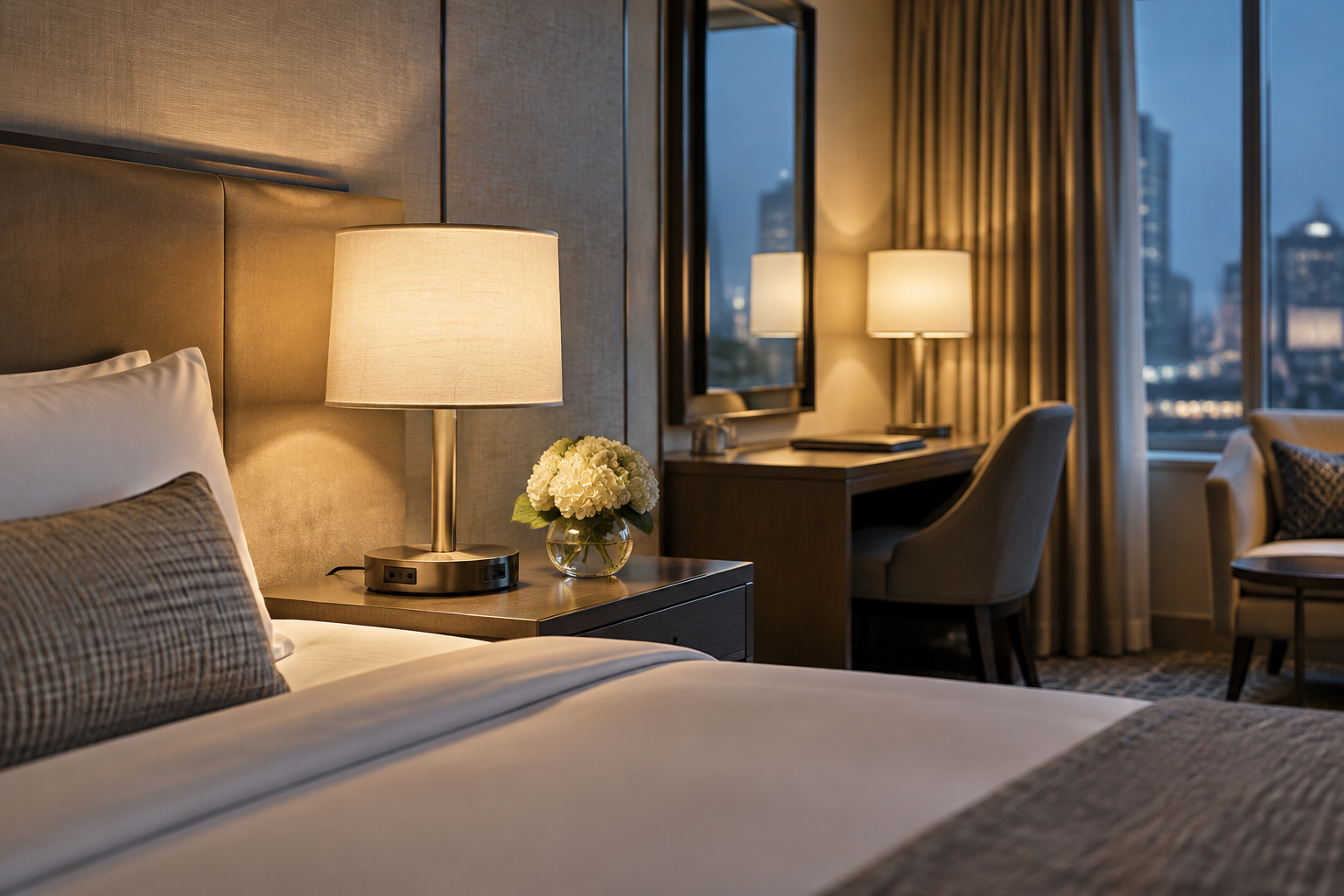 How Should Custom Hotel Table Lamps and Power Bases Be Specified?: Photometric files & compliance
Frequently Asked Questions
Q: What Colour Temperature Should a Custom Hotel Table Lamp Use?
Warm-white light is a practical starting point for a guestroom table lamp. A recommended specification is 2700–3000 K with CRI ≥90, subject to the interior palette and intended tasks. Review the complete lamp because shade fabric and lining can alter perceived colour. Coordinate bedside lighting with adjacent reading and ambient lighting rather than selecting each independently.
Q: Should Power Outlets Remain Active When the Lamp Is Switched Off?
Charging should remain available when the light is off if that matches the hotel’s operating brief. A recommended specification is 2 independently defined functions: lighting control and charging supply. Coordinate both with the room’s master-switch strategy and applicable electrical requirements. Confirm the behaviour during commissioning so guests do not discover that a light switch interrupts overnight charging.
Q: Can One Power-base Design Serve Every International Hotel Market?
A shared decorative housing may be feasible, but the electrical configuration needs country-specific validation. A recommended specification is 1 approved electrical variant per destination configuration, with controlled socket, cord, charger and label references. EU, US, Middle East and Southeast Asian requirements are not uniform. Confirm laboratory scope and local acceptance before treating an existing variant as suitable elsewhere.
Q: What Should Buyers Approve Before Releasing a Bespoke Lamp Order?
Buyers should approve appearance, operation, electrical construction and documentation before releasing production. A recommended specification is 1 signed reference sample for each approved configuration, supported by finish references, component details and inspection criteria. Confirm switch reach, charging behaviour and replacement access in the room mock-up. Agree MOQ, lead time and compliance responsibilities separately rather than inferring them from the sample.
Sources and Technical References
Authoritative standards bodies and scheme owners should guide the compliance brief, with applicable editions confirmed by the project team and laboratory.
- CEN-CENELEC: European standards framework and national-member routes for EN 12464-1 and the EN 60598 series.
- Illuminating Engineering Society — IES: lighting measurement guidance, technical publications and photometric data practices.
- International WELL Building Institute — WELL v2: building-level light features and project assessment requirements.
- DALI Alliance: DALI-2 certification information and searchable certified-product resources.
- UL Solutions: lighting safety evaluation resources and applicable product certification pathways.
- European Commission — CE marking: manufacturer responsibilities and the distinction between CE marking and voluntary certification.
These references support specification decisions; they do not demonstrate certification of any particular proposed lamp.
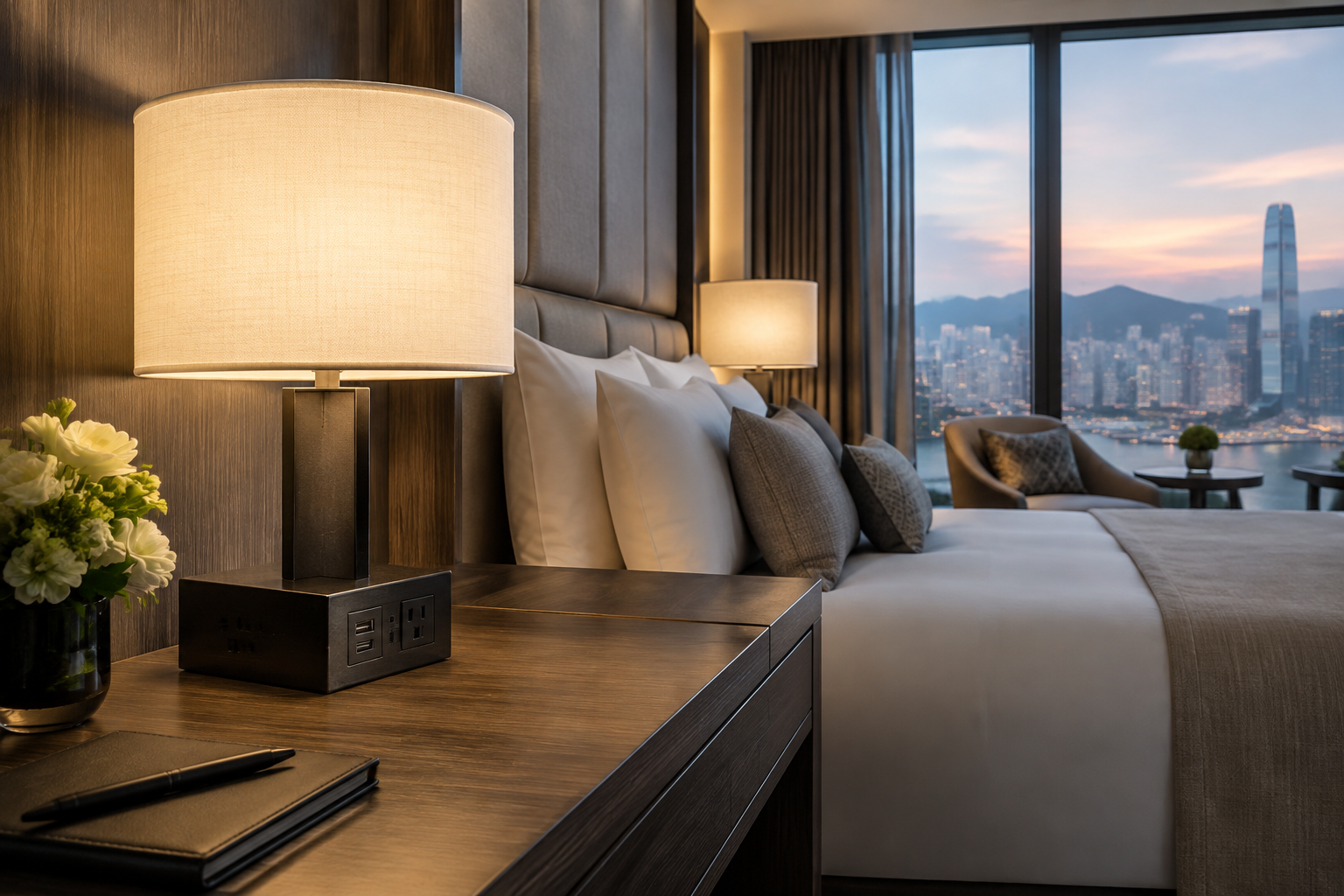 How Should Custom Hotel Table Lamps and Power Bases Be Specified?: Q: Can one power-base design serve every international hotel market?
Request a Custom Quote
A useful quotation brief combines the lamp design with its destination, operating sequence and required verification documents.
Provide drawings or reference images, furniture dimensions, quantities by destination, finish samples, shade material, socket requirements and the charging brief. Include the desired controls, replacement strategy, compliance route, packaging expectations and delivery milestones. Request written confirmation of exclusions, testing responsibilities and any components still awaiting approval.
At XHLWX (led-project-light.com), a Custom Indoor LED Lighting Manufacturer based in China, ... a custom hotel table-lamp enquiry should begin with these project-specific inputs. Request a coordinated proposal for materials, switch position, power-base configuration, sampling and documentation, with performance targets clearly distinguished from verified product evidence.
Need a tailored lighting plan for your project?
Our senior lighting designers reply within 48 hours with a free design proposal & quotation.