
How Should Hotel Lobby Bars Use 1800–2200K Warm Dimming?
Quick answer
Specify hotel lobby bar warm dimming with practical guidance on ambience, glare, controls, custom finishes, photometry and international compliance.
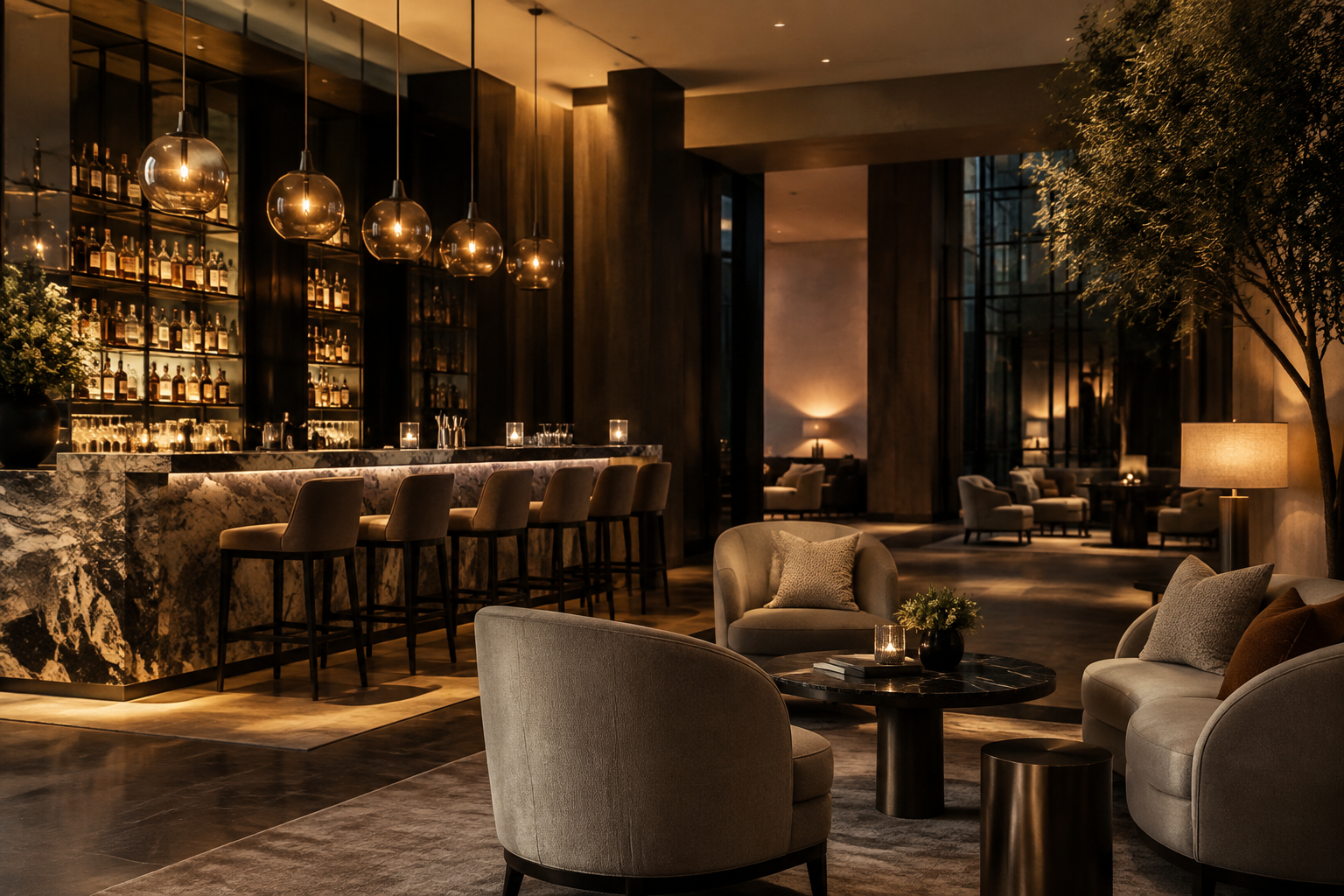
Introduction: Hotel Lobby Bar Mood Lighting After Dark
At XHLWX (led-project-light.com), a Custom Indoor LED Lighting Manufacturer based in China, ... we recommend 1800–2200K warm dimming for lobby bar ambience. Use 2200K at higher output and 1800K at lower output as design targets, with separate task lighting and a recommended specification of CRI ≥90.
The objective is an intimate room that still works as a hospitality workplace. Guests should recognise faces, read menus and move comfortably between the reception area, lounge seating and bar. Bartenders need clear visibility for preparation, cleaning and payment tasks without flooding the lounge with operational light.
Warm dimming changes colour temperature as output decreases. It differs from dimming a fixed-colour LED, which becomes darker without intentionally becoming warmer.
For this application, the specified endpoints describe an evening mood layer, not the entire hotel's lighting palette. Decorative pendants, shaded table lamps and concealed joinery lighting can provide that layer while independently controlled task luminaires support service.
Design Criteria and Standards for 1800–2200K Lobby Bar Lighting
A successful lobby bar specification separates atmospheric lighting from task visibility, glare control and applicable safety requirements.
Treat the numerical performance values below as recommended specifications or design targets, not verified XHLWX product results. Confirm feasibility against the selected LED engine, driver, optical assembly and project mock-up.
| Parameter | Spec | Standard | Notes |
|---|---|---|---|
| CCT and warm-dim curve | Design target: 2200K at the upper evening setting, approaching 1800K at the lowest usable setting | IES measurement guidance; project acceptance criteria | Request the colour-versus-output curve, not just endpoint labels. |
| Colour rendering | Recommended specification: CRI Ra ≥90 and R9 ≥50 throughout the operating range | IES measurement guidance | Check skin tones, timber, upholstery and red finishes in a sample. |
| Glare and beam | Design targets: UGR ≤19 where a suitable calculation applies; 24–36° task beams or broad diffuse decorative output | EN 12464-1 | UGR depends on the installation; it is not a universal standalone pendant rating. |
| Controls | Project-selected DALI-2, Casambi, KNX interface or 0-10V | DALI Alliance certification records where applicable | Confirm whether colour follows a built-in curve or requires separate channel control. |
| Housing and protection | Recommended specification: aluminium heat sink, serviceable steel or brass body; IP20 for suitable dry locations | EN 60598; IEC 60529 | Assess cleaning exposure and spill risk before selecting protection near the bar. |
| LED and driver | Candidate brands: Bridgelux or Samsung LEDs; Tridonic or Mean Well drivers | Component documentation and final assembly assessment | Names are procurement options, not claims about installed components or compatibility. |
| Market documentation | Applicable CE/RoHS documentation; UL listing where specified; SAA only where relevant; ISO9001 evidence if requested | Applicable legislation, product standards and quality-system requirements | These are different conformity mechanisms; none is claimed here for an unsupplied product. |
As initial design targets, consider 50–100 lx on seating-area tables and 200–300 lx on designated bar-service work surfaces. These are preliminary project values, not universal statutory minima. Detailed preparation, cash handling or cleaning may require higher levels under the applicable task criteria.
EN 12464-1 addresses indoor workplace lighting; identify the actual task before adopting its criteria. WELL v2 can inform visual comfort and light-quality decisions, but amber evening lighting alone does not establish WELL compliance or a circadian benefit.
Customisation Options and Materials for Hotel Lobby Bar Luminaires
Custom luminaires should conceal bright sources, complement the interior palette and remain accessible for maintenance.
A decorative body is only part of the specification. Shade transmission, diffuser thickness, internal reflections and heat dissipation can change the result. Approve the illuminated assembly rather than relying on an unlit finish sample.
| Approach | Mood-lighting advantage | Main limitation | Verdict |
|---|---|---|---|
| Fixed warm-white LED with dimming | Simple colour behaviour and straightforward scene setting | Does not intentionally become warmer as output falls | Choose when stable colour matters more than a candlelike transition. |
| Integrated warm-dim LED engine | Links lower output with warmer appearance | Curve and minimum output depend on the engine-driver combination | Strong default for coordinated evening ambience. |
| Independently controlled colour channels | Allows project-specific colour and output scenes | Requires compatible drivers, programming and channel calibration | Choose when different operating periods need independent colour control. |
| Replaceable warm-dim lamps in custom shades | Supports lamp replacement and decorative flexibility | Lamp variability, physical fit and dimmer compatibility need checking | Suitable only after testing the complete lamp-and-shade assembly. |
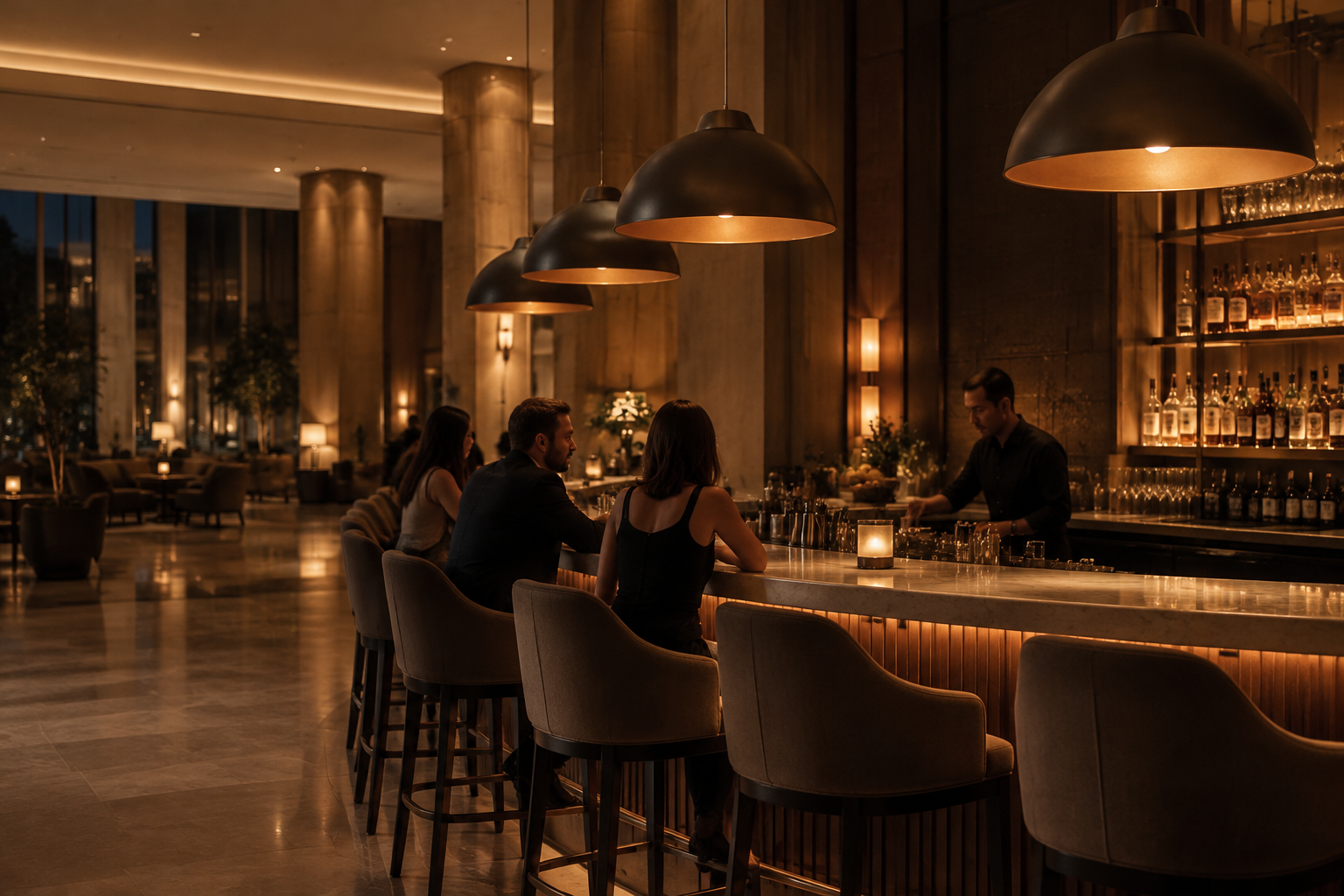
How Should Pendant Shades Limit Glare Over Lobby Bar Seating?
Pendant shades should hide the LED from normal seated viewpoints while illuminating the intended surface.
Review sightlines from lounge chairs, bar stools and the circulation route. A deep shade, recessed diffuser or internal baffle can help, but each changes distribution.
Polished metal may create secondary reflections; translucent stone can reveal hotspots. Set pendant height through a full-scale mock-up rather than appearance alone, and check reflections in glossy tables and nearby interior glazing.
Which Finishes Work Best with Very Warm Lobby Bar Lighting?
Finish selection should follow an illuminated material review because very warm light can alter perceived colour and contrast.
Brushed brass, bronze, timber and textured fabrics are useful candidates, not guaranteed matches. Compare actual approved samples under the proposed warm-dim endpoints and the service scene.
Review fingerprints, cleaning chemicals, coating consistency and repairability. Specify the finish process and reference sample instead of relying only on broad descriptions such as antique brass.
Can Bespoke Table Lamps and Joinery Lighting Share the Same Warm-dim Scene?
Different luminaire types can share a scene only when their colour transitions and dimming behaviour are coordinated.
A table lamp may look brighter than a concealed strip at the same control command. Match visible results, not percentages alone.
Specify compatible colour curves, diffusion and low-end behaviour across the family. Keep LED modules and drivers replaceable where practicable, with access that does not require dismantling upholstered furniture or damaging finished joinery.
 How Should Hotel Lobby Bars Use 1800–2200K Warm Dimming?: How should pendant shades limit glare over lobby bar seating?
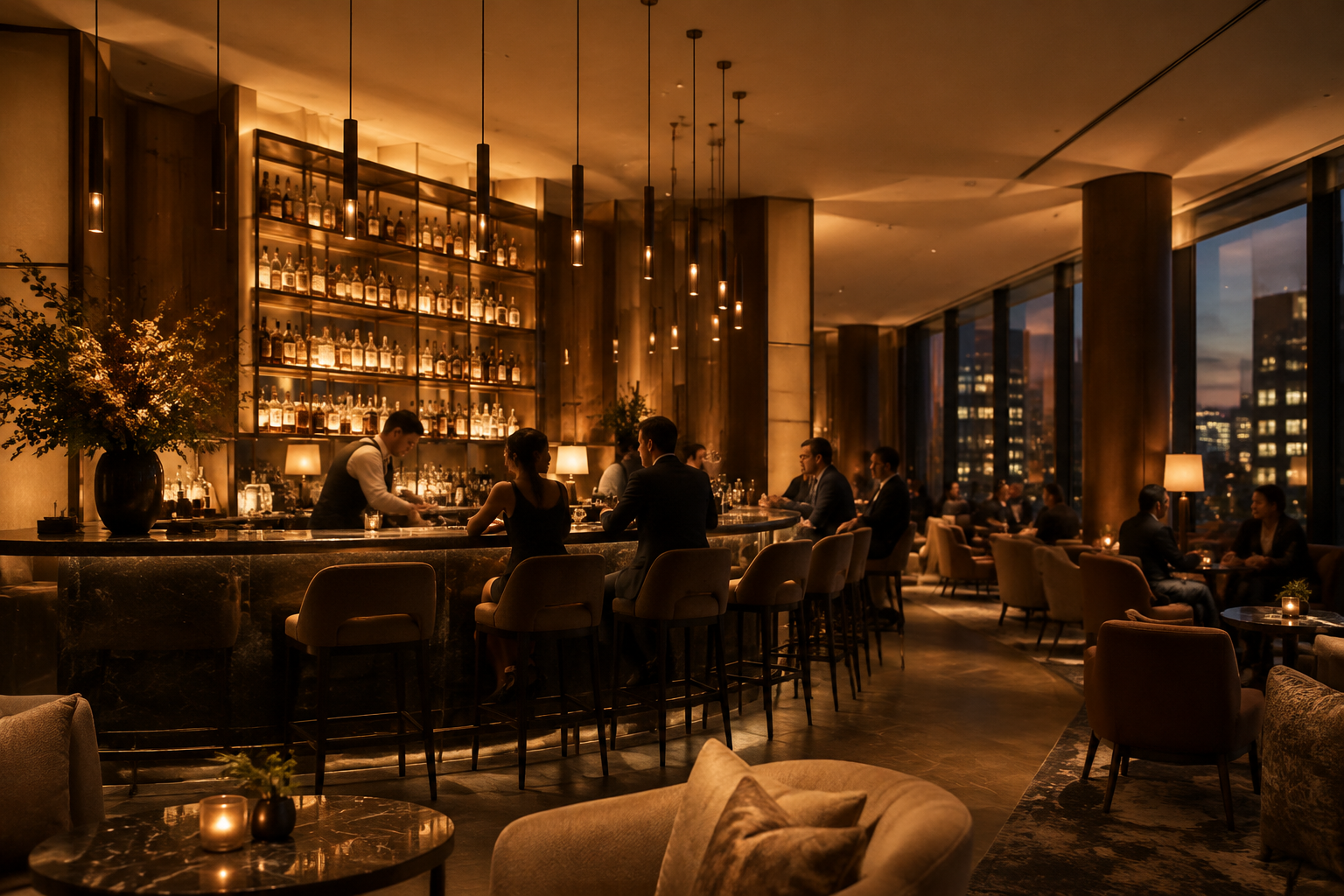
Controls and Commissioning for Hotel Lobby Bar Evening Scenes
Choose the control architecture around the required colour behaviour, operating routines and building integration.
DALI-2 is useful for addressable control, but the label alone does not guarantee warm dimming. A compatible driver may implement a built-in curve, while independently adjustable colour channels require suitable colour-control support. Confirm the exact device functions, controller capability and commissioning scope.
Casambi can suit wireless zoning where the selected driver and module support the intended channel behaviour. Review radio performance, applicable local approvals and staff access.
KNX integration normally needs compatible actuators or gateways; test scene recall across the complete chain. With 0-10V, confirm low-end response, wiring practice and whether separate switching is needed for off.
Recommended commissioning scenes include:
- Arrival: welcoming faces and legible menus without flattening the lounge atmosphere.
- Evening: warm ambient layers, balanced table lighting and discreet service illumination.
- Late service: the warmest approved appearance while preserving circulation and transaction visibility.
- Cleaning: independently raised task and general lighting for inspection.
A recommended low-end acceptance target is stable operation at 1% light output, but approve a higher floor if necessary to avoid flicker or dropout. Control percentage is not automatically equal to measured light output.
Check cold starts, slow fades, power recovery, camera banding and manual override. Keep emergency lighting independent of mood scenes as required by local rules.
Sampling, MOQ, Lead Time and Quality Control for Bespoke Lobby Bar Lighting
Approve the optical sample and control behaviour before releasing bespoke luminaires for production.
Begin with a design package covering drawings, dimensions, finishes, mounting details, service access and the electrical concept. Then review an illuminated sample using the intended LED engine, driver, shade and control interface. A substitute driver can invalidate an otherwise convincing dimming demonstration.
MOQ, sample charges and lead time require a project-specific quotation. They depend on tooling, custom glass or metalwork, finish processes, component availability, required testing and order quantity. Ask for separate milestones for drawing approval, sample approval, material procurement, assembly, inspection and shipment rather than accepting an unexplained delivery promise.
The quality plan should identify approved component references, traceability requirements, finish inspection criteria, applicable electrical tests and functional dimming checks. Require reapproval for substitutions that could change safety, output or colour. Agree spare drivers, LED modules and diffusers before ordering, and confirm who holds the replacement bill of materials after handover.
 How Should Hotel Lobby Bars Use 1800–2200K Warm Dimming?: Controls and commissioning for hotel lobby bar evening scenes
Photometric Files & Compliance for International Lobby Bar Procurement
Photometric modelling and compliance review should use the final proposed luminaire configuration, not a visually similar catalogue product.
Request IES and LDT photometric files for the relevant optics and diffusers, then model the interior in DIALux. Include realistic surface reflectances, furniture positions and maintenance assumptions. Photometry from the upper-output setting does not establish low-end colour quality; request supporting dimming and colour data for the approved operating range.
For EU projects, assess applicable legislation, the EU Declaration of Conformity, CE marking and RoHS documentation. Use the applicable EN 60598 requirements for luminaire safety; CE is not itself a third-party product certificate.
For US procurement, establish the required listing route and acceptance criteria with the authority having jurisdiction and project team. A listed driver does not make the complete custom luminaire listed. UL 1598 or UL 153 may be relevant depending on the product type.
Middle Eastern and Southeast Asian requirements vary by country. Confirm local registration, import and electrical requirements early. SAA documentation is not a blanket approval for these regions, and ISO9001 concerns quality management rather than luminaire safety certification.
 How Should Hotel Lobby Bars Use 1800–2200K Warm Dimming?: Frequently Asked Questions
Frequently Asked Questions
These answers address common specification decisions for warm-dim hotel lobby bars.
Q: Is 1800K Too Warm for an Entire Hotel Lobby Bar?
Very warm light is best treated as an atmospheric layer rather than the sole source for every activity. Use 1800K as a design target for the lowest evening mood setting, then maintain separately controlled illumination for menus, payments and service. Review faces, finishes and circulation in a mock-up before deciding how much of the room should share that appearance.
Q: Does Every DALI-2 Driver Support Warm Dimming?
DALI-2 does not automatically establish a driver's colour-control behaviour. Confirm whether the proposed assembly uses an internal warm-dim curve or independently controlled colour channels. For a recommended specification of 1800–2200K, request the actual curve, minimum stable output and controller compatibility. Check the relevant certification record and test the complete luminaire, driver and control combination before approval.
Q: What Colour Rendering Should a Lobby Bar Warm-dim Luminaire Provide?
Colour rendering should be assessed across the approved dimming range, not only at maximum output. A recommended specification is CRI Ra ≥90 with R9 ≥50, subject to component feasibility and sample approval. Ask for supporting data at representative settings and review skin tones, food, fabrics and timber. A high headline CRI does not guarantee acceptable appearance in the finished room.
Q: What Should Buyers Request Before Ordering Custom Warm-dim Luminaires?
Buyers should request a coordinated technical package covering appearance, performance, controls and market compliance. Include drawings, finish samples, component references, photometry and an illuminated mock-up using the proposed driver. State 1800–2200K as the design target rather than assuming every warm-dim product provides that range. Confirm quoted MOQ, approval milestones, spare parts and evidence for any claimed certification before purchase.
Sources and Technical References for Lobby Bar Lighting Specifications
Use current official publications and project-specific regulatory advice to validate requirements before procurement.
- CEN/CENELEC: Standards catalogue for EN 12464-1, indoor workplace lighting, and applicable EN 60598 luminaire safety publications.
- IEC: Official Webstore for luminaire safety, IP classification and controlgear standards referenced by national adoptions.
- IES: Illuminating Engineering Society for lighting guidance and measurement references, including ANSI/IES LM-79 for optical and electrical measurements.
- DALI Alliance: Official technical resources for DALI-2 functions and certification verification.
- International WELL Building Institute: WELL v2 Light for the applicable lighting features and assessment framework.
- European Commission: CE marking guidance and RoHS guidance for distinct conformity obligations.
- UL Solutions: Lighting testing and certification for product-specific assessment routes.
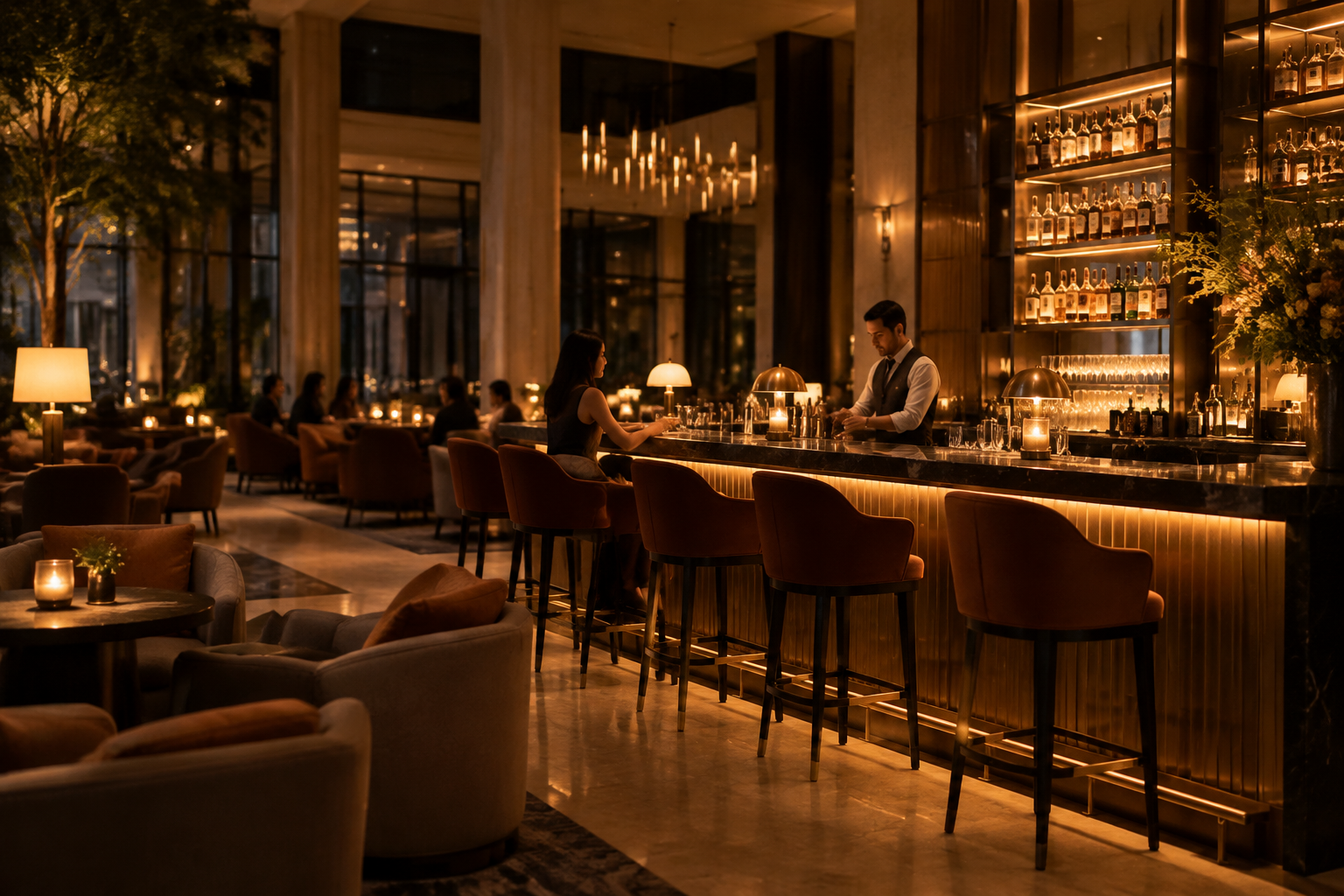 How Should Hotel Lobby Bars Use 1800–2200K Warm Dimming?: Q: What colour rendering should a lobby bar warm-dim luminaire provide?
Request a Custom Quote for Your Hotel Lobby Bar
A useful quotation starts with the lighting intent, interior details and destination-market requirements.
Send the lobby bar plan, reflected ceiling plan, seating layout, luminaire references, quantities, finish samples and preferred control system. Identify operational scenes, service tasks, mounting constraints and required compliance evidence. Request separate pricing for samples, tooling, production, testing and spare components where applicable.
At XHLWX (led-project-light.com), a Custom Indoor LED Lighting Manufacturer based in China, ... we recommend defining the complete warm-dim assembly before procurement. Request a project-specific proposal around the 1800–2200K design target, with component selection, sample acceptance and documentation requirements agreed before production.
Need a tailored lighting plan for your project?
Our senior lighting designers reply within 48 hours with a free design proposal & quotation.