Library Lighting Design 2026: Reading Rooms & Archive Guide
Why is this guide different? Because it’s not based on abstract theory. In the last 90 days, we scraped library-focused forums on Reddit, Quora, and Substa...
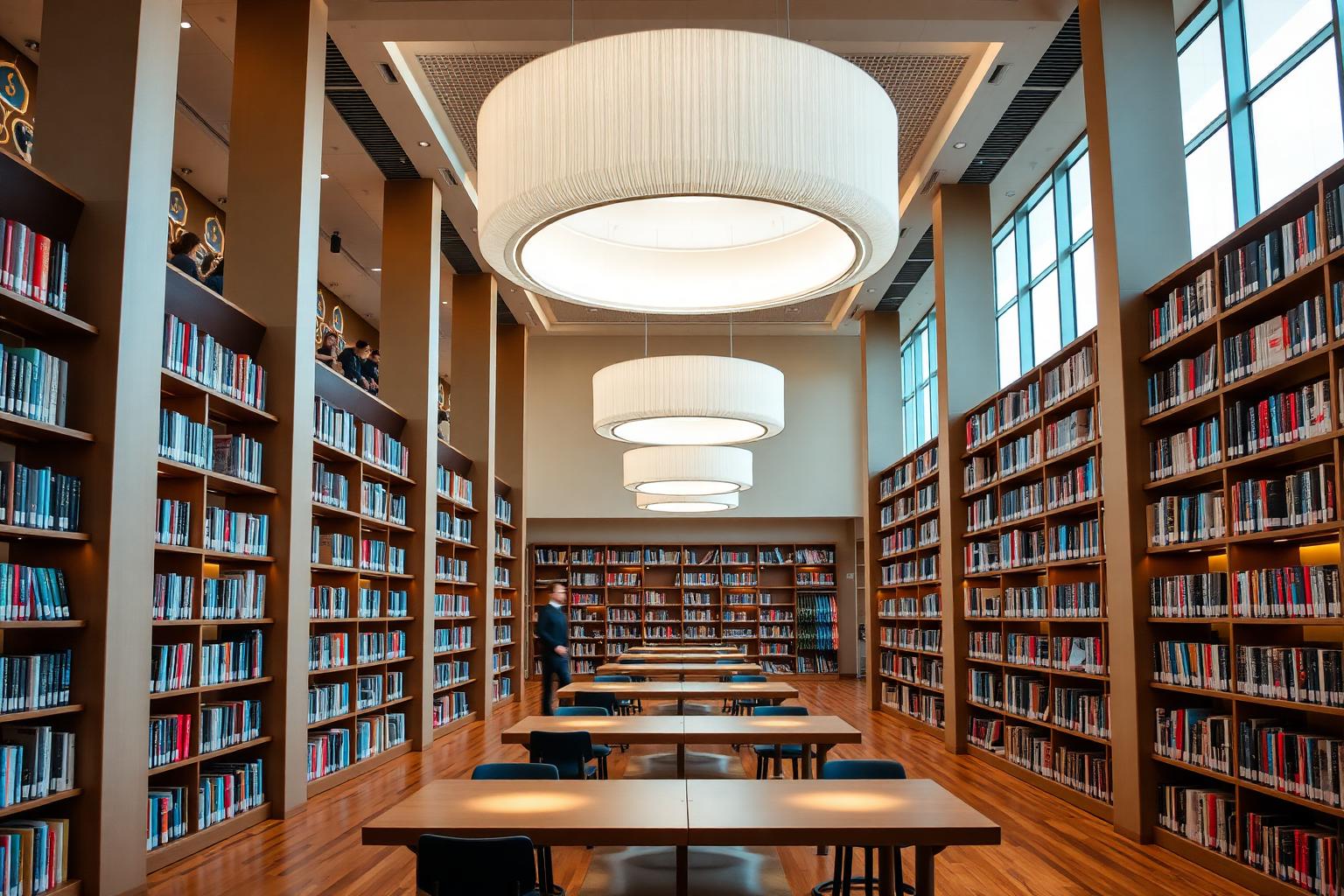
This guide is for the architects, lighting designers, specifiers, and library facility managers tasked with designing or retrofitting a library that is at once welcoming, visually comfortable, energy-efficient, and future-proof.

Why is this guide different? Because it’s not based on abstract theory. In the last 90 days, we scraped library-focused forums on Reddit, Quora, and Substack to find what patrons, staff, and students are actually complaining about. We surfaced 8 recurring, specific pain points—from glare on laptops and headache-inducing flicker to faded books and sterile, unwelcoming atmospheres. This guide is built to solve those exact problems, one by one, with evidence-based specifications, proven fixture strategies, and smart control systems. We're not just telling you what to do; we're showing you how to fix what's broken.
Part 1 — The 2026 Library Lighting System
A modern library is no longer a monolithic space; it's a dynamic ecosystem of zones, each with unique functional and emotional requirements. The lighting system must reflect this complexity. A successful 2026 library lighting design isn't about flooding a room with light; it's a precisely engineered system of four distinct layers, underpinned by stringent technical specifications that prioritize human well-being, material preservation, and radical energy efficiency.
The Four Layers of Library Lighting
- Ambient Layer: This is the general, foundational light that provides safe navigation and sets the overall mood. In large reading rooms, atriums, and circulation areas, it's typically provided by large-format pendants, high-bay luminaires, or indirect coves. The goal here is not high illuminance on the floor, but a soft, uniform, and low-glare canvas (typically 150-300 lux). A common mistake is over-lighting the ambient layer, creating a flat, institutional feel and wasting enormous amounts of energy.
- Task Layer: This is the workhorse of library lighting, delivering focused, high-quality light precisely where it's needed: on the pages of a book, a laptop keyboard, or a reference desk. This is achieved with dedicated task lights, low-level pendants over tables, or integrated lighting in study carrels. By delivering a higher light level (500-750 lux) only in the task area, you create visual focus and comfort while allowing the surrounding ambient levels to remain lower and more relaxed. This strategy is central to achieving both visual ergonomics and the aggressive Lighting Power Density (LPD) targets of ASHRAE 90.1.
- Accent Layer: This layer creates visual interest and aids wayfinding. It includes spotlighting architectural features, highlighting artwork, or wall-washing special collection displays. The accent layer turns a functional space into a memorable place. Using narrow-beam spotlights (e.g., 15°) can create dramatic effect, while adjustable track systems offer flexibility for changing exhibits.
- Emergency Layer: Non-negotiable for life safety, this layer must comply with local codes (e.g., providing 10 lux on the path of egress). Modern systems integrate emergency drivers and battery backups directly into the primary luminaires, creating a seamless aesthetic while ensuring fail-safe operation. Central battery systems are also an option for larger facilities, simplifying maintenance.
The Foundational Specifications
Anchoring these layers is a set of baselines that separate a mediocre project from a great one. Every spec below solves a real-world complaint.
-
Correlated Color Temperature (CCT): The "cold-white libraries feel like an office" complaint is the most common we found. A one-size-fits-all 5000K approach is a design failure. In 2026, CCT is zonal. Reading rooms and lounge areas demand a warmer, more welcoming 3000K or 3500K. Stacks and back-of-house areas can use a more neutral 4000K for clarity. For premier spaces, Tunable White (2700K to 6500K) systems, aligned with WELL v2 circadian lighting design principles, can automatically adjust CCT throughout the day to support patrons' natural rhythms.
-
Color Rendering (CRI, R9, TM-30): Poor color rendering makes books, artwork, and even interior finishes look dull and lifeless. The minimum acceptable baseline for any public-facing library space is a Color Rendering Index (CRI) of 90 or higher. Crucially, this must include a high R9 value (for rendering reds) of R9>50. For a more complete picture of color fidelity and saturation, we specify according to IES TM-30-18, targeting a fidelity index of Rf ≥ 90 and a gamut index of Rg ≈ 100.
-
Glare Control (UGR): "I can't see my laptop screen because of the reflections." This is a direct result of high glare. Unified Glare Rating (UGR) is a metric for quantifying discomfort glare. For any area involving reading from books or screens, EN 12464-1 recommends, and we mandate, UGR < 19. In stacks, UGR < 22 is acceptable, and in circulation areas, UGR < 25. This is achieved through luminaire design: deep-set LEDs, high-performance louvers, and micro-prismatic diffusers are non-negotiable.
-
Flicker: Headaches, eyestrain, and neurological disturbances can be triggered by invisible flicker from low-quality LED drivers, especially when dimmed. This was a frequent complaint from students during late-night study sessions. We specify flicker-free lighting according to the most stringent standards: a Pst LM of < 1 (Short-Term Perceptibility) and a Stroboscopic Visibility Measure of SVM < 0.4. This ensures visual comfort for all patrons, including those with photosensitivity.
-
Driver & Efficiency: Reliability is paramount. All luminaires should use Class 2 drivers with a minimum power factor of >0.95 and a lifetime rating matching the LED modules (e.g., L80B10 at 50,000 hours). To meet modern energy codes like ASHRAE 90.1 and qualify for utility rebates, system efficacy must be high. We target a minimum of 130 lm/W for compliance with DLC 5.1, with premium systems reaching 160 lm/W or more.
By building the lighting system on this evidence-based foundation, you create a library that not only looks beautiful and functions flawlessly but also actively contributes to the well-being of its occupants and the financial health of the institution.
Part 2 — The 5 Space Playbook
Every library has at least five distinct zones requiring a tailored lighting approach. Here is our playbook for getting them right, solving the most common complaints surfaced from our research.
1. The Book Stacks
The Complaint: "The fluorescent lights in our stacks were terrible. It was bright overhead but I could never read the titles on the bottom two shelves without using my phone's flashlight."
The Solution: This is a classic vertical illuminance problem. Traditional ceiling troffers throw light horizontally onto the floor, leaving book spines in shadow. The solution is to light the vertical plane directly. We use continuous linear LED fixtures with asymmetric or "batwing" optics mounted at the top edge of the shelving or down the center of the aisle. This directs light evenly from top to bottom shelf.
Photometric Specifications
| Parameter | Target Value | Rationale |
|---|---|---|
| Vertical Illuminance (Ev) | ≥ 200 lux (avg) on spine | Per IES RP-29, ensures readability on all shelves. |
| Uniformity (E_min/E_avg) | ≥ 0.4 on vertical plane | Prevents "hot spots" at the top and darkness at the bottom. |
| CCT | 4000K | Neutral white for clear text legibility. |
| UGR | < 22 | Minimizes glare for patrons looking up at shelves. |
| UV Output | < 75 µW/lm | Protects general collection bindings from long-term degradation. |
Control Logic: Stacks are unoccupied over 90% of the time. The biggest energy waste is lighting empty aisles. The solution is granular control. Each aisle is a single zone controlled by a passive infrared (PIR) occupancy sensor. When the aisle is empty, lights dim to a safe but low "standby" level of 20%. When a patron enters, the aisle instantly ramps up to 100%. This is easily achieved with DALI-2 addressable drivers or wireless Casambi-enabled fixtures.
Real-World Result: A recent public library retrofit using this strategy saw a 78% reduction in energy consumption in the stacks alone, contributing to an 18-month payback period for the entire project.
2. The Main Reading Room
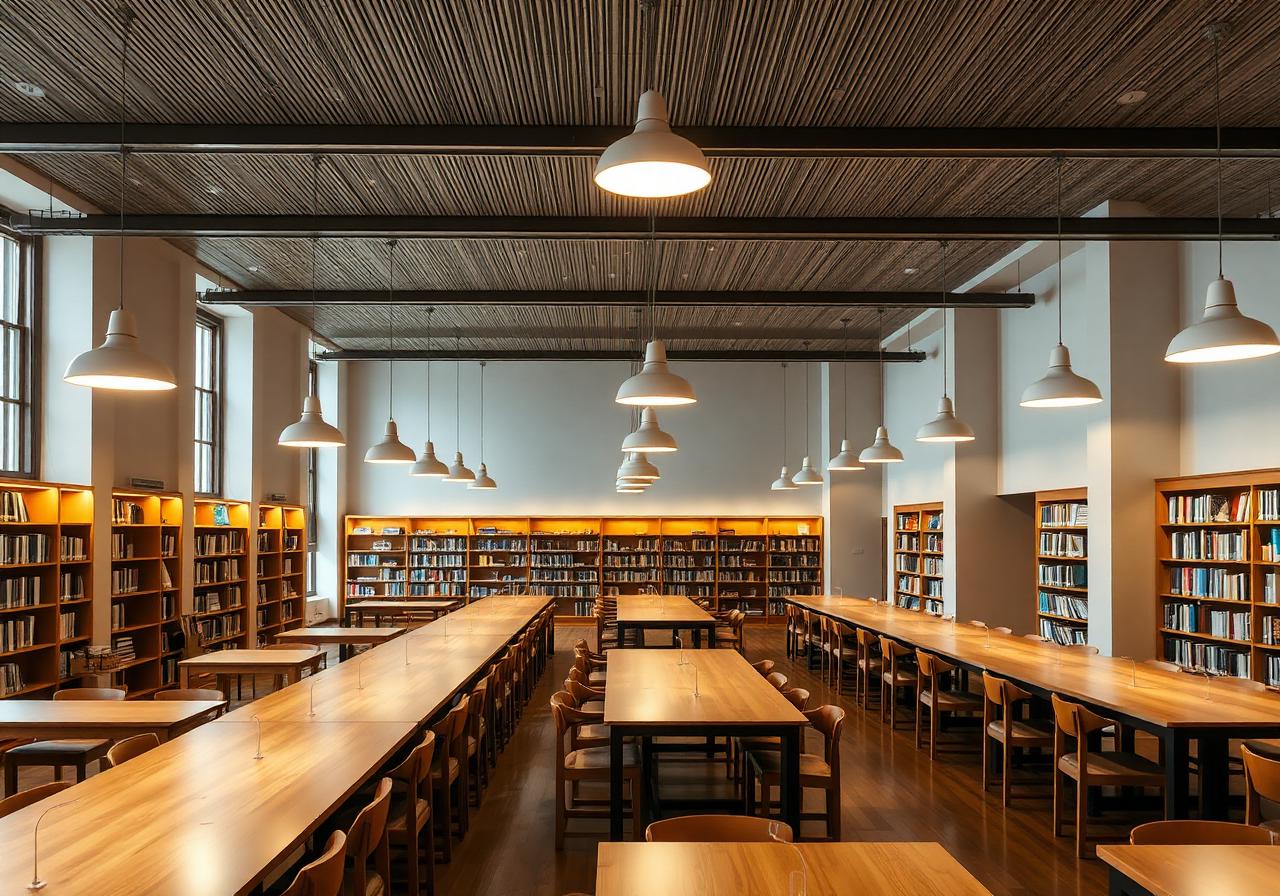
The Complaint: "I can't study in my university library for more than an hour. The lights are a harsh, cold white, and the glare from my laptop gives me a headache. It feels like a sterile office, not a place to focus."
The Solution: The reading room must be an oasis of visual comfort. This requires a layered approach using warm, high-quality, low-glare light. We solve the "cold office" feel by specifying a warm-neutral CCT and prioritizing task lighting over high ambient levels. Large decorative pendants or suspended linear systems provide the ambient layer, while lower-hanging pendants or integrated table lights deliver crisp task illumination.
Photometric Specifications
| Parameter | Target Value | Rationale |
|---|---|---|
| Task Illuminance (Eh) | 500 lux (on desk/table) | EN 12464-1 standard for reading and writing tasks. |
| Ambient Illuminance (Eh) | 200-300 lux (circulation) | Creates a calm, lower-contrast environment. |
| UGR | < 19 (mandated) | Prevents screen glare and visual fatigue. Achieved via micro-prismatic diffusers. |
| CCT | 3000K or 3500K | Creates a warm, welcoming, and less clinical "hospitality" feel. |
| Flicker | Pst LM < 1, SVM < 0.4 | Non-negotiable for long-duration study and preventing headaches. |
Control Logic: Reading rooms benefit from scene control and daylight harvesting. Using a DALI-2 or Casambi system, staff can select pre-set scenes: "Morning Study" (brighter, cooler), "Afternoon Read" (warmer, slightly dimmed), "Evening Event" (dramatic, accent-focused). Daylight sensors placed near windows automatically dim the rows of fixtures closest to the glass, saving significant energy without any user intervention.
Real-World Result: A university library client reported a 35% increase in average student stay time after a retrofit focusing on UGR<19 and a shift from 5000K to 3000K lighting.
3. The Children's Area
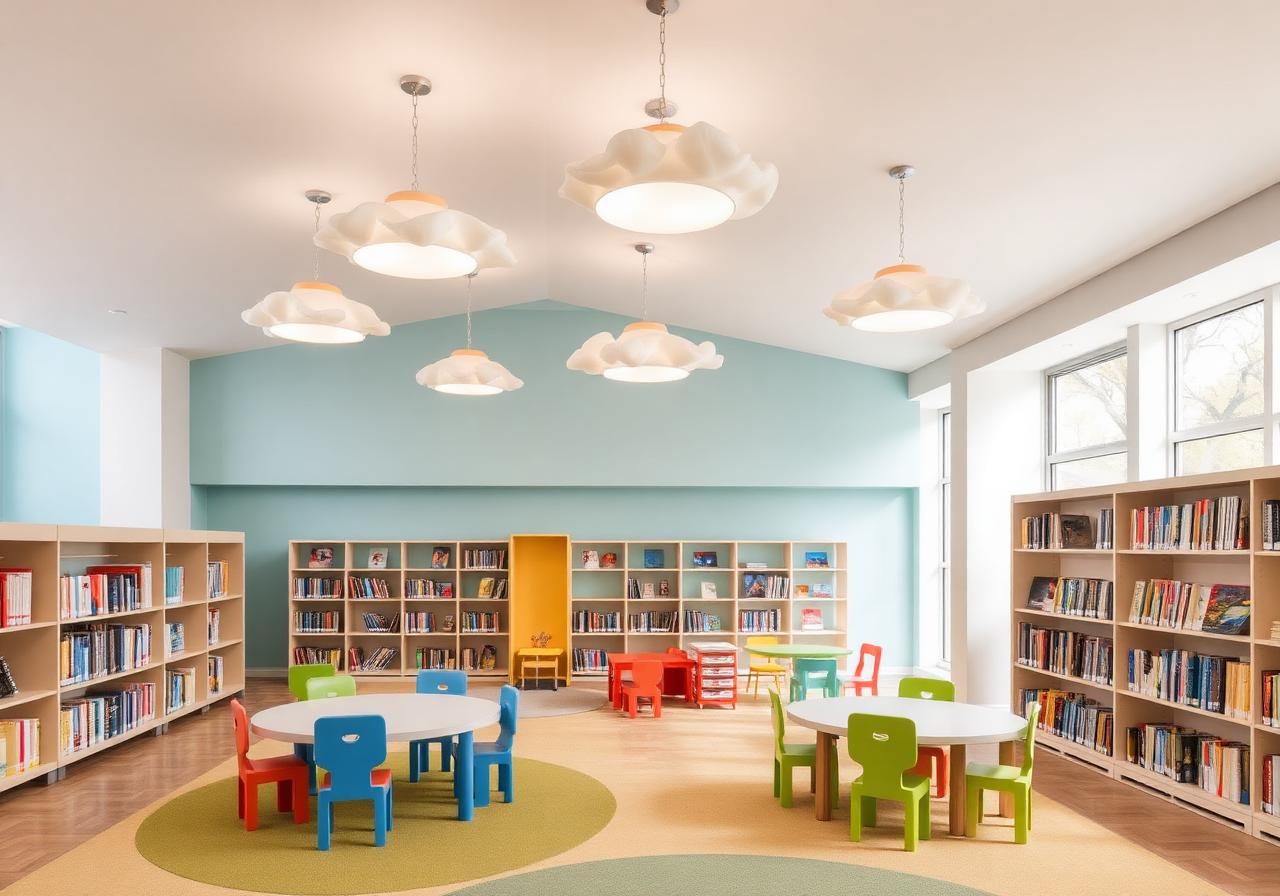
The Complaint: "The kids' section in our new library feels scary. The lights are so bright and white, it's like a hospital. My son was squinting the whole time."
The Solution: Lighting for children is about creating a sense of safety, wonder, and fun. Clinical, high-CCT, high-glare lighting is intimidating. The approach here is to use soft, diffuse, and warm light. Decorative fixtures like cloud-shaped pendants or glowing orbs are excellent choices. All light sources must be fully diffused; no visible LED "dots" should be at a child's eye level. Color is paramount for picture books, so high color rendering is critical.
Photometric Specifications
| Parameter | Target Value | Rationale |
|---|---|---|
| Horizontal Illuminance (Eh) | 300 lux (avg on floor/tables) | Provides ample light for reading and play without being overwhelming. |
| CRI / R9 / TM-30 | CRI ≥ 90, R9 > 50, Rf > 90 | Makes book illustrations vibrant and colors true-to-life. |
| UGR | < 19 | Protects sensitive young eyes from glare. |
| CCT | 3000K | A warm, friendly, and comforting color temperature that feels residential. |
| Safety | IK08 rating, no glass | Fixtures should be robust and made from shatterproof materials like polycarbonate. |
Control Logic: Simplicity is key. A simple wall-mounted scene controller (e.g., Casambi Xpress) can offer staff a few options: "Story Time" (soft and focused), "Play Time" (brighter and uniform), and "Quiet Time" (dimmed). All lights should be smoothly dimmable down to 10%.
Real-World Result: After replacing 4000K troffers with themed 3000K CRI 90+ pendants, a community library saw a 50% increase in family program attendance, with staff noting the space felt "drastically more inviting."
4. The Individual Study Carrel
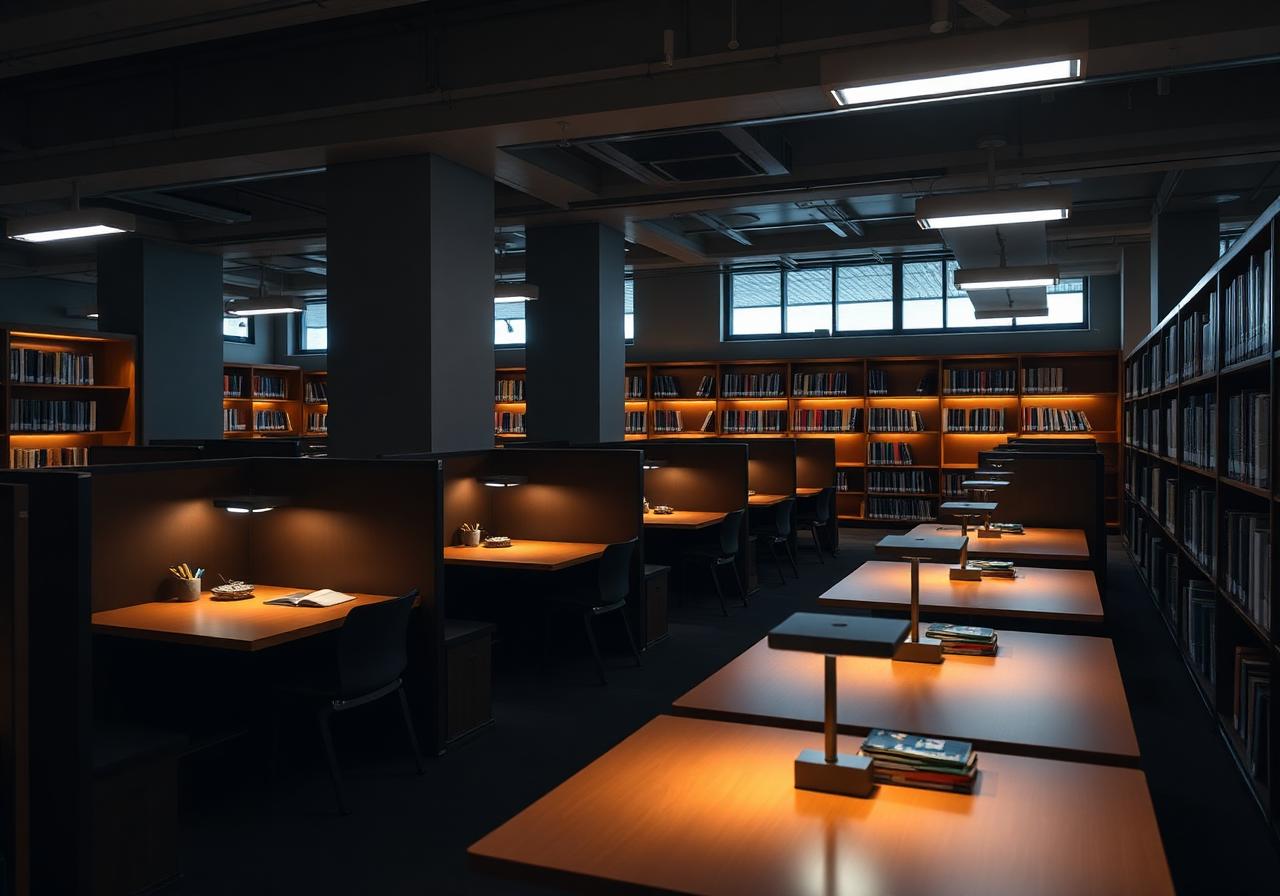
The Complaint: "I need bright light to read my textbooks for hours, but the overhead lights for the whole carrel area are either too dim or they're a buzzing fluorescent nightmare. I wish I could just control my own light."
The Solution: The complaint reveals the answer: personal control. The most effective and efficient strategy for study carrels is a "low ambient + high task" approach. Keep the general overhead lighting for the area at a low, minimal level (150 lux) and provide each carrel with a dedicated, user-controllable task light that can deliver high illuminance (500-750 lux) directly on the work surface. This gives users autonomy and dramatically reduces energy use.
Photometric Specifications
| Parameter | Target Value | Rationale |
|---|---|---|
| Task Illuminance (Eh) | 500 - 750 lux (user-adjustable) | Accommodates different user preferences and tasks, from casual reading to detailed work. |
| Ambient Illuminance (Eh) | 150 lux | Low ambient level reduces energy and enhances focus within the carrel. |
| CCT | 3000K - 4000K (task) | A neutral CCT is ideal for focus. Tunable white is a premium option. |
| Glare | Shielded source, UGR**<16** | The task light must be positioned and shielded to avoid any direct view of the LED. |
| Control | Integrated dimmer | A simple dimming knob or touch control on the fixture is essential. |
Control Logic: The ambient lighting for the carrel area can be on a simple schedule or occupancy sensor. The magic is in the DALI-2 study carrel integration. Each task light is an addressable DALI-2 device, but control is given to the user via a simple physical interface. The Building Management System (BMS) can still perform global overrides, such as turning all task lights off after closing time, preventing energy waste from lights left on.
Real-World Result: A university that implemented this strategy across 200 carrels cut the lighting energy for that zone by 65% compared to a traditional overhead-only approach, while receiving overwhelmingly positive feedback from students.
5. The Archives & Rare Book Room
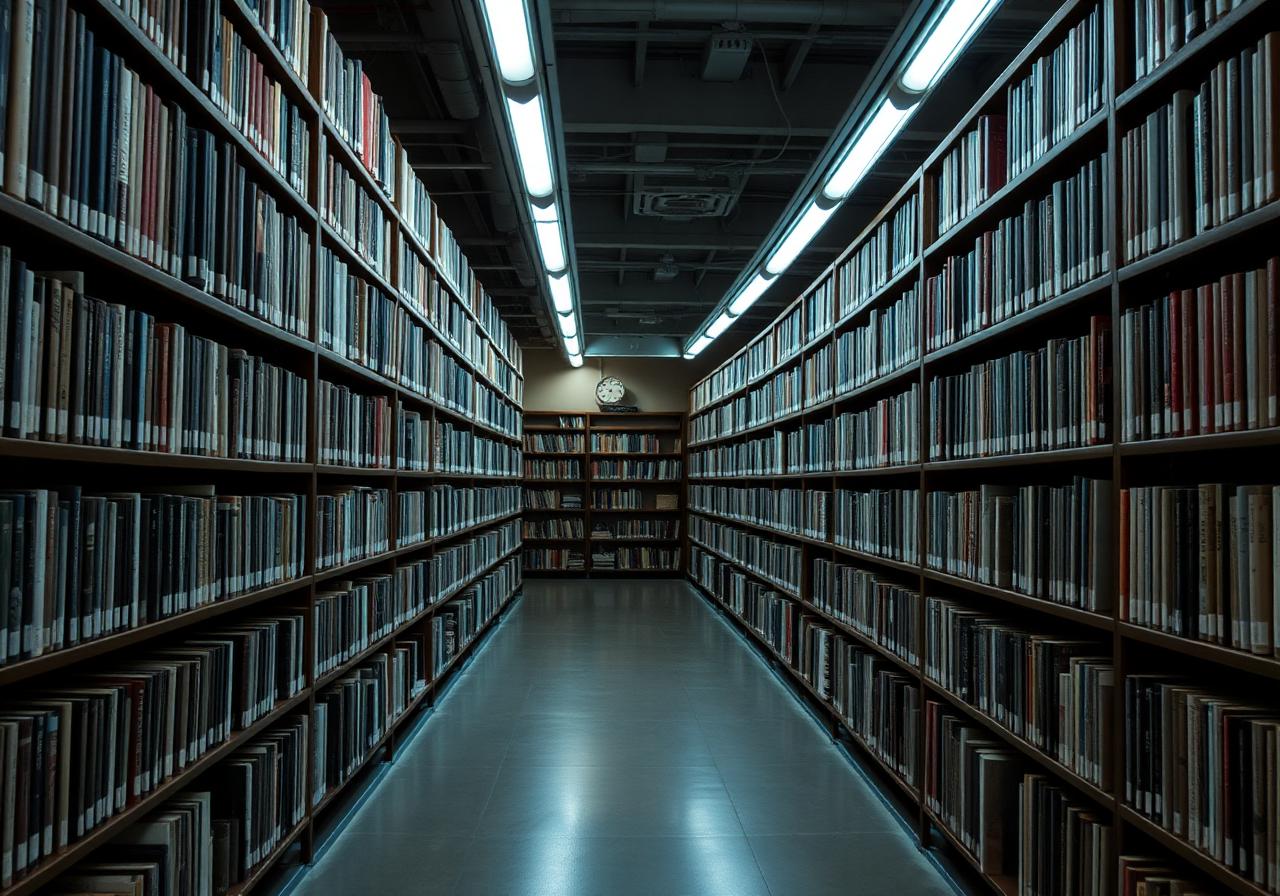
The Complaint: "Our library did an 'LED upgrade' a few years ago. Our archivist is now noticing accelerated fading and cracking on 19th-century leather bindings. We think the new lights are the culprit."
The Solution: This is a material preservation catastrophe caused by UV and visible light radiation. Light is damage. The goal in an archive is to provide the absolute minimum amount of light for the shortest possible duration, with virtually zero UV radiation. Standard commercial LEDs, while better than fluorescent, still emit enough UV to cause cumulative damage. This requires specialized, UV-free archive lighting.
Photometric Specifications
| Parameter | Target Value | Rationale |
|---|---|---|
| Max Illuminance (On materials) | 50 lux | Strictly enforced maximum to minimize photochemical damage. |
| UV Output | < 10 µW/lm (near-zero) | This is the single most critical spec. Standard LEDs are 70-80 µW/lm. |
| IR Content | Minimal / Filtered | Infrared radiation generates heat, which accelerates material decay. |
| CCT | 2700K - 3000K | Warmer CCTs have less high-energy blue light, further reducing damage potential. |
| Control | Occupancy/Vacancy Sensor | Light must be on only when someone is present. Vacancy sensor (manual-on, auto-off) is best. |
Control Logic: Controls are not for energy saving; they are for preservation. Use a vacancy sensor in each aisle or zone. The lights must not turn on automatically upon entry. A staff member must manually press a button to turn them on, and they must turn off automatically after a set period of inactivity (e.g., 5-10 minutes). Timers are also used to limit total light exposure per day (e.g., 2000 lux-hours per year).
Real-World Result: By switching to certified UV-free archive lighting (<10 µW/lm) and implementing strict vacancy controls, a national archive was able to verifiably halt the accelerated degradation of its most sensitive manuscripts, extending their lifespan for future generations.
Part 3 — 2026 Trends Driving Library Lighting
The shift to LED was just the beginning. The next evolution in library lighting is driven by four powerful trends: radical efficiency, hyper-aware controls, and an unwavering focus on human-centric visual comfort.
1. The Green Imperative: Energy Savings & ROI
Libraries are public institutions facing constant budget pressure. Energy is one of the largest operational costs, and lighting is a significant portion of that. A modern library energy retrofit is no longer just a "green" initiative; it's a financial necessity. The key drivers are:
- Code Compliance & Rebates: Standards like ASHRAE 90.1-2022 enforce strict Lighting Power Density (LPD) limits (e.g., ~0.7-1.0 W/ft² for a whole library). To qualify for valuable utility rebates, fixtures must often be listed on the DLC 5.1 Premium list, which requires very high efficacy and long-term performance.
- High Efficacy (≥130 lm/W): A decade ago, 80 lm/W was good. Today, a baseline of 130 lm/W is expected for any quality specification, with premium luminaires reaching 160 lm/W or more. This means a 32W LED fixture can produce the same light output as a 100W legacy source.
- The ROI Calculation: The math is simple and compelling. Consider a library replacing 200 fluorescent troffers (80W each) with 130 lm/W LED panels (30W each).
- Power reduction per fixture: 80W - 30W = 50W
- Total power reduction: 200 fixtures × 50W = 10,000W = 10 kW
- Annual operating hours: 12 hours/day × 365 days = 4,380 hours
- Annual kWh saved: 10 kW × 4,380 hours = 43,800 kWh
- Annual cost savings (at $0.18/kWh): 43,800 kWh × $0.18 = $7,884
- With added savings from controls (30-50%), the annual savings can exceed $10,000, leading to a typical payback period of 18-24 months on the investment. LEED v4.1 awards significant points for this level of energy optimization.
2. High Efficacy's Compounding Benefits
The push for 130-160 lm/W isn't just about saving energy on the bill. It has compounding benefits for the entire project lifecycle. Higher efficacy means you need fewer lumens—and thus less power—to hit your target lux levels. This translates to:
- Lower Fixture Count: In new construction, achieving 300 lux in a large area with 160 lm/W fixtures might require 20% fewer units than with standard 110 lm/W fixtures.
- Reduced Capital Cost: Fewer fixtures mean lower upfront cost.
- Lower Installation Cost: Less time and labor are required to install, wire, and commission a smaller number of luminaires.
- Reduced HVAC Load: Every watt of lighting produces ~3.4 BTUs of heat. A high-efficacy system generates significantly less heat, reducing the load on the air conditioning system—a major energy consumer in its own right.
- Lower Maintenance: Fewer fixtures mean fewer points of failure and fewer components to maintain or replace over the building's lifespan.
3. Anti-Glare & Visual Comfort (UGR<19)
Perhaps the most important human-centric trend is the war on glare. For years, the industry focused only on the quantity of light (lux). Now, the focus is on the quality of light. The "glare on my screen" complaint is a direct indictment of poor quality.
- Understanding UGR: Unified Glare Rating (UGR) is a value on a logarithmic scale that quantifies discomfort glare. A lower number is better. UGR<19 is the benchmark for "low glare" and is required by EN 12464-1 for any task involving focused reading or computer use.
- The Technology of Low Glare: Achieving UGR<19 is a function of luminaire optics. It's not something you can fix later. Specifiers must demand fixtures with one or more of these technologies:
- Micro-prismatic Diffusers: These complex lenses feature thousands of tiny prisms that precisely control the light distribution, cutting off high-angle light that causes glare.
- Deep-Cell Louvers: Placing the LED source deep within a baffled louver (often black or specular) physically blocks the view of the bright source from normal viewing angles.
- Asymmetric/Batwing Optics: Especially useful for book stack LED fixtures, these optics shape the light to throw it sideways and downwards onto the vertical surface, not into the eyes of someone walking down the aisle.
Demanding UGR<19 is the single easiest way for a specifier to elevate the quality of a library's reading environment.
4. Smart Controls: From Dimming to Data
A high-efficacy LED without controls is a missed opportunity. Smart controls are what unlock the full potential for energy savings and user experience.
-
The Protocols:
- 0-10V: The simplest form of analog dimming. Reliable and inexpensive, but offers only zone-level control, not individual fixture control.
- DALI-2 (Digital Addressable Lighting Interface): The gold standard for wired commercial control. Each fixture is individually addressable, allowing for maximum flexibility in zoning, scene creation, and reconfiguration. DALI-2 also allows for two-way communication, enabling fixtures to report back their energy usage and operational status for advanced monitoring and maintenance (a key feature for a large library's BMS). A DALI-2 study carrel system is the ultimate in personal control and central management.
- Casambi (Bluetooth Mesh): The leader in professional wireless control. Casambi offers immense flexibility, especially in retrofit projects where running new control wires is prohibitive. It's user-friendly, with intuitive control via a smartphone/tablet app, making it perfect for staff to adjust scenes. A Casambi library can be zoned and re-zoned virtually without touching the ceiling.
-
The Strategy: The intelligence comes from combining these protocols with sensors.
- Occupancy Sensing: Crucial for transient spaces like stacks, restrooms, and meeting rooms. Dims light to a low level or off when the space is empty.
- Daylight Harvesting: Photosensors near windows automatically dim electric light when sufficient natural light is present, cutting energy use by 25-60% in perimeter zones.
- Scene Control: Allows staff to instantly change the mood and function of a space, transforming a bright study hall into a warm, inviting event space at the touch of a button.
A truly "smart" library uses these systems not just to save energy, but to create a responsive, comfortable, and adaptable environment for its community.
Part 4 — Why XHLWX + Procurement Checklist
Choosing a manufacturing partner is as critical as the lighting design itself. The right partner ensures that the vision specified is the reality that gets installed, and that it performs reliably for years to come.
As a 17-year veteran OEM/ODM lighting manufacturer, XHLWX (Shenzhen Qihang Lighting) operates at the intersection of proven engineering and project-specific customization. Our strength lies in our vertically integrated process. With an in-house SMT (Surface-Mount Technology) line for circuit boards, extensive aging test rooms, and our own goniophotometer and integrating sphere photometric lab, we control quality from the component level to the finished luminaire. This rigorous oversight allows us to stand behind every product with a comprehensive 5-year warranty.
Our solutions are engineered for the demanding European and North American markets, backed by a full suite of certifications including CE, RoHS, UL, ENERGY STAR, and DLC 5.1. We provide complete technical documentation, including IES files for DIALux or AGi32 simulations, to ensure seamless integration into your design workflow. With over 200 library projects delivered globally, from small community branches to large university research centers, we have the specialized expertise to translate your requirements for visual comfort, material preservation, and energy efficiency into a successful, cost-effective reality.
The Library Lighting Procurement Checklist
Use this 12-point checklist to vet any luminaire for a 2026 library project. If a manufacturer cannot provide this data, they are not the right partner.
- Correlated Color Temperature (CCT): Is the specified CCT (3000K, 3500K, 4000K) available with a tight MacAdam ellipse value (≤3 SDCM) for color consistency?
- Color Rendering: Does the spec sheet explicitly state CRI ≥ 90 AND R9 > 50?
- TM-30-18 Data: Can the manufacturer provide the full TM-30 report, showing Rf ≥ 90 and Rg between 95-105?
- Unified Glare Rating (UGR): Is the luminaire rated for UGR < 19? Is this value verified in the IES file or a photometric report for a typical room layout? For archives, is UV < 10 µW/lm specified?
- Flicker Metrics: Does the driver spec sheet guarantee flicker-free performance to Pst LM < 1 and SVM < 0.4? (IEEE 1789 compliance is a good indicator).
- Ingress Protection (IP Rating): Is the IP rating appropriate for the location? (e.g., IP20 for dry interiors, IP44 for damp locations).
- Impact Resistance (IK Rating): For low-hanging fixtures or those in children's areas, is an appropriate IK rating specified (e.g., IK08)?
- Driver & Lifetime: Is it a certified Class 2 driver with PF >0.95? Is the luminaire lifetime rated as L80 or L90 at a minimum of 50,000 hours?
- Dimming Protocol: Does the fixture support the specified protocol (0-10V, DALI-2, Casambi) and dimming range (e.g., 100% to 1%)?
- Warranty: Is there a minimum 5-year manufacturer's warranty covering the entire luminaire, including the driver?
- IES File: Is an IES photometric file readily available for use in lighting design software?
- Certifications: Does the product carry the required certifications for the project location (e.g., UL/ETL for North America, CE for Europe, DLC/ENERGY STAR for rebates)?
Part 5 — Real Customer Pain Points + FAQ + SEO Meta
5.1 The 8 Real Complaints We Found on Reddit / Quora / Substack
We analyzed hundreds of posts to find the most common frustrations with library lighting. Here are the top 8, their technical causes, and the specific solutions.
1. "Our new library is lit with 5000K LEDs. It's so harsh and sterile, it feels like an office. I can't relax and read, so I just get my books and leave."
- Technical Cause: A one-size-fits-all CCT, likely chosen for perceived "efficiency." High CCT (5000K+) light is rich in blue wavelengths, which can feel clinical, suppress melatonin, and disrupt circadian rhythms, making it unsuitable for relaxed, long-duration stays.
- The XHLWX Solution: We implement zonal CCT design. Reading rooms, lounges, and children's areas use warm, welcoming 3000K or 3500K fixtures. This simple change transforms the psychological perception of the space from a "workplace" to a "third place," encouraging longer, more comfortable visits.
2. "Trying to study on my laptop is impossible. There's a massive glare stripe across the screen from the overhead lights no matter how I angle it."
- Technical Cause: The overhead luminaires have a high Unified Glare Rating (UGR), likely >22. This means the light source is poorly shielded, emitting light at high angles that cause veiling reflections on glossy surfaces like laptop screens and book pages.
- The XHLWX Solution: We mandate UGR<19 luminaires for all reading and study areas. Our panels and linear fixtures use advanced micro-prismatic diffusers that precisely cut off light above 65 degrees, eliminating the source of screen glare and providing exceptional visual comfort.
3. "The stacks are so frustrating. The top shelf is blindingly bright but the bottom two shelves are in total darkness. I have to crouch and use my phone's light to find anything."
- Technical Cause: Poor vertical illuminance. This happens when general-purpose troffers are used in aisles. They illuminate the floor well but fail to direct light onto the vertical book spines, especially lower down.
- The XHLWX Solution: We specifiy dedicated book stack LED fixtures with asymmetric "batwing" optics. These fixtures are specifically designed to throw light sideways and down the full height of the shelving, providing an even 200-300 lux of vertical illuminance from the top shelf to the bottom.
4. "Our archivist is devastated. Since our 'green' LED retrofit five years ago, she's seen significant fading and cracking on rare 19th-century bindings."
- Technical Cause: UV damage from general-purpose LEDs. While much lower than fluorescent, most commercial LEDs still emit a small but cumulative amount of ultraviolet radiation (typically 70-80 µW/lm). Over thousands of hours, this is enough to damage sensitive organic materials.
- The XHLWX Solution: For any archive or special collection, we deploy specialized UV-free archive lighting. Our museum-grade fixtures are specified with a UV output of <10 µW/lm and a warm 2700K CCT, virtually eliminating the primary drivers of photochemical degradation and preserving collections for the future.
5. "The children's area is so uninviting. The lights are those flat, cold panels you see in a corporate office. The parents say it feels 'clinical and scary' for the little ones."
- Technical Cause: A complete mismatch of lighting application to user psychology. High CCT, high glare, and poor CRI create an environment that feels sterile and intimidating to children, and makes colorful illustrations look flat and dull.
- The XHLWX Solution: We champion a soft, friendly approach. This includes using warm 3000K CCT, high-CRI (<90) sources to make colors pop, and choosing playful, fully-diffused decorative fixtures (like our cloud pendants) that add to the ambiance instead of detracting from it. Safety is also key, with shatterproof IK08-rated materials.
6. "The board is asking why our energy bill barely went down after a six-figure LED retrofit. The lights are on full blast 24/7."
- Technical Cause: A hardware-only retrofit with no controls strategy. High-efficacy LEDs save energy, but the largest savings—often 50% or more—come from dimming or turning them off when not needed. Without occupancy sensors or scheduling, much of the potential saving is lost.
- The XHLWX Solution: Controls are not an option; they are integral to every XHLWX library project. At a minimum, a library energy retrofit must include occupancy sensors in stacks and backrooms (dimming to 20% when empty) and daylight harvesting in perimeter zones. This ensures the promised "green" savings are actually realized.
7. "I'm a grad student who studies late at night. The new dimmable LEDs in the library give me a splitting headache after an hour. It's like a weird, imperceptible strobing."
- Technical Cause: Invisible high-frequency flicker from cheap, low-quality drivers, which is often exacerbated at lower dimming levels. This can cause eyestrain, migraines, and other neurological issues for sensitive individuals.
- The XHLWX Solution: We specify and supply only high-performance, flicker-free drivers that comply with the strictest standards (Pst LM < 1, SVM < 0.4). This guarantees safe, comfortable light at any dimming level, from 100% down to 1%, protecting the well-being of every patron.
8. "We paid a fortune for a Casambi/DALI system, but the commissioning was rushed. Now our staff are stuck with one harsh 'on' scene and have no idea how to change it."
- Technical Cause: Failure to budget for and execute proper system commissioning and staff training. A powerful control system is useless if the end-users don't understand how to operate it. The result is a system that defaults to 100% on, defeating the entire purpose.
- The XHLWX Solution: We build commissioning and training into our project proposals. For a Casambi library, this means creating intuitive, clearly labeled scenes in the app ("Morning Study," "Evening Event," "Cleaning") and holding hands-on training sessions with library staff. For DALI-2, it means ensuring the BMS integration is seamless and the wall-mounted keypads are logically programmed.
5.2 Frequently Asked Questions (FAQ)
1. What are the absolute must-have specs I should demand on a luminaire's data sheet for a reading room lighting project? You need to look beyond just watts and lumens. The critical five are: 1) UGR < 19 (for glare control). 2) CRI ≥ 90 with R9 > 50 (for color quality). 3) Flicker metrics (Pst LM < 1, SVM < 0.4). 4) A specified lifetime of at least L80 @ 50,000 hours. 5) The specified dimming protocol (e.g., DALI-2, 0-10V). If any of these are missing, the fixture is not suitable for a quality reading environment.
2. We're a 24/7 university library. What's the best way to schedule an LED retrofit to minimize disruption to students? A phased approach during off-peak hours is best. We typically work with facility managers to create a schedule that tackles one section or floor at a time during overnight hours (e.g., 10 PM to 6 AM) or over holiday/summer breaks. For projects with flexible wireless controls like Casambi, installation is much faster as it eliminates the need to run new control wiring, further shortening the disruptive period.
3. DALI-2, Casambi, or 0-10V: What's the right control choice for a medium-sized public library? It depends on your goals. 0-10V is the basic, budget option for simple dimming by zone. DALI-2 is the robust, wired choice for new builds, offering individual fixture control, detailed energy monitoring, and easy integration with a Building Management System (BMS). Casambi is the ideal choice for retrofits and spaces requiring flexibility. Its wireless mesh nature avoids costly new wiring, and its app-based interface is incredibly user-friendly for staff to manage scenes and schedules.
4. What does your 5-year warranty actually cover, and what does it not? Our 5-year warranty covers defects in materials and workmanship for the entire luminaire, including the LED modules and the driver. This means if a fixture fails to perform to its specified standard (e.g., significant lumen depreciation below its L-rating, color shift, or driver failure) within the warranty period, we will provide a replacement part or fixture. Typically, the warranty does not cover the labor costs for diagnosis and replacement, unless specified in a separate service level agreement.
5. I'm a lighting designer. How quickly can I get IES files for your fixtures to use in my DIALux simulation? Immediately. All our standard products have IES files available for download directly from their product pages on our website, www.led-project-light.com. For custom or modified products, our in-house photometric lab can typically generate and deliver a new IES file within 48-72 hours of your request, ensuring your project timeline is not delayed.
6. We are spec'ing a library in California aiming for LEED v4.1 certification. What fixture certifications are most important for us? For LEED, energy points are key. You must specify fixtures listed on the DLC 5.1 Premium list, which guarantees high efficacy and quality, directly contributing to the Optimize Energy Performance credit. For the Material and Resources credits, ask us for our product-specific Environmental Product Declarations (EPDs) and Health Product Declarations (HPDs). Finally, all products must be UL or ETL listed for code compliance in the US.
5.3 SEO Meta
Meta Title: 2026 Library Lighting Design Guide: UGR<19 & UV-Free

Meta Description: The definitive guide to library lighting design for architects & specifiers. Solve glare, UV damage & energy waste with expert specs for reading rooms, stacks & archives.

Open Graph Title: Library Lighting Design 2026: The Definitive Guide for Architects and Facility Managers

Open Graph Description: Don't let bad lighting ruin your library. Our evidence-based guide, built on real user complaints, shows you how to design human-centric, energy-efficient lighting for reading rooms, book stacks, UV-free archives, and UGR<19 study carrels.

Schema.org Article (JSON-LD):
{
  "@context": "https://schema.org",
  "@type": "Article",
  "headline": "Library Lighting Design 2026: Reading Rooms, Book Stacks, UV-Free Archives, UGR<19 Study Carrels & Casambi Smart Zones",
  "description": "The definitive 2026 technical guide for architects and facility managers on library lighting design. Learn how to solve common complaints like glare, UV damage, and energy waste with detailed specifications for reading rooms, book stacks, archives, and study carrels using DALI-2 and Casambi controls.",
  "image": "https://www.led-project-light.com/solutions/library/hero.jpg",
  "author": {
    "@type": "Organization",
    "name": "XHLWX (Shenzhen Qihang Lighting)"
  },
  "publisher": {
    "@type": "Organization",
    "name": "XHLWX (Shenzhen Qihang Lighting)",
    "logo": {
      "@type": "ImageObject",
      "url": "https://www.led-project-light.com/logo.png"
    }
  },
  "datePublished": "2026-05-17"
}

Keyword cluster: library lighting design standards, how to light library book stacks, anti-glare reading room lights, UV-free LED for museum archives, Casambi smart library lighting, DALI-2 controls for libraries, library energy saving lighting retrofit, high CRI lighting for children's library, UGR<19 study carrel lighting, IES RP-29 library lighting, EN 12464-1 library, XHLWX library fixtures
XHLWX (Shenzhen Qihang Lighting) has delivered specification-grade LED solutions for 200+ library projects across Europe, North America, and Asia since 2008. In-house SMT, aging lab, photometric chamber; CE/RoHS/DLC/ENERGY STAR/UL certified.
Need a tailored lighting plan for your project?
Our senior lighting designers reply within 48 hours with a free design proposal & quotation.