Frankfurt Airport Terminal 3 — Concourse & Boarding Gate Relighting
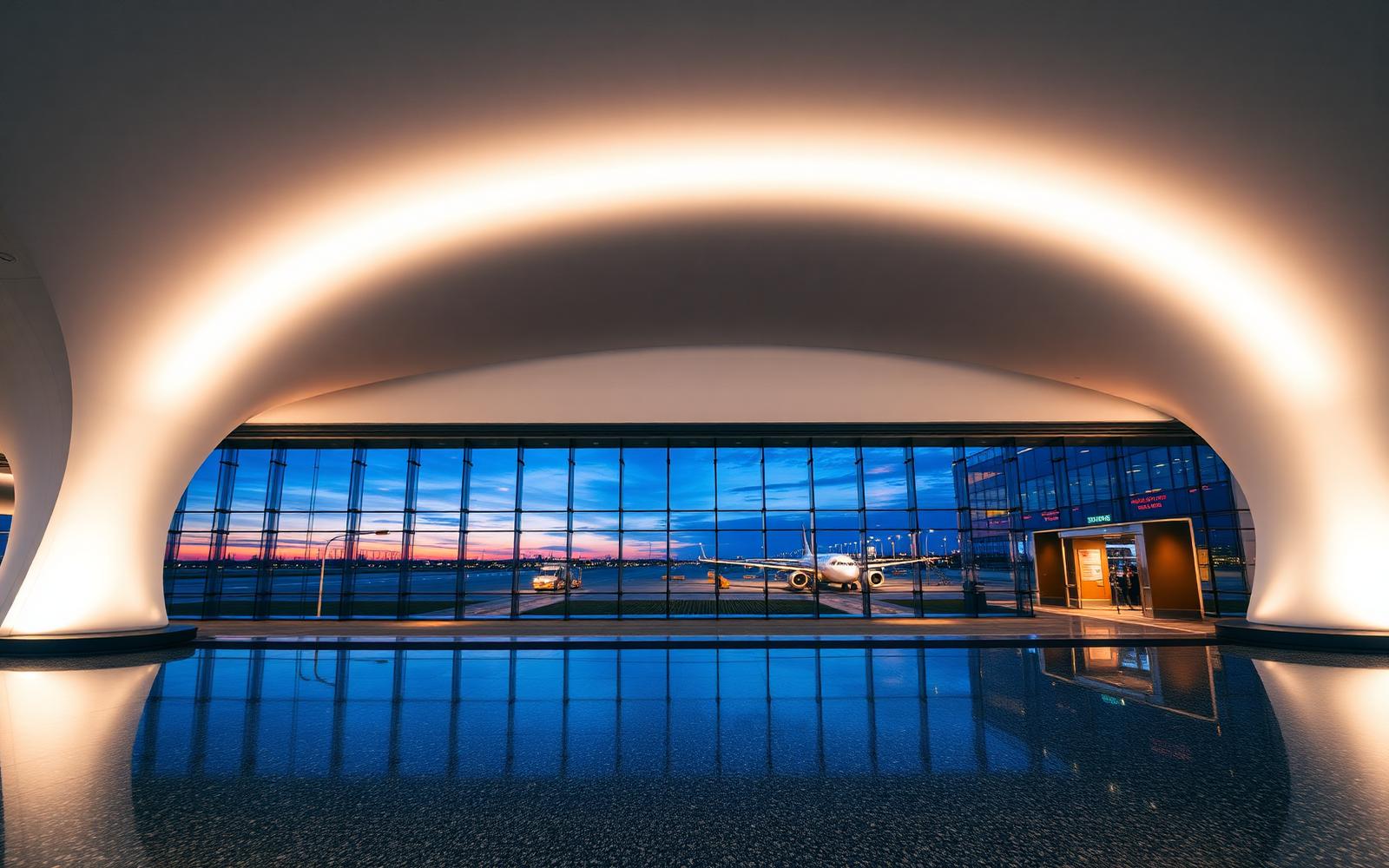
When Frankfurt Airport (FRA) opened Terminal 3 to its first shakedown flights in early 2026, the building's lighting brief was uncompromising: match the daylight-rich architecture designed by Christoph Mäckler, hit an EN 12464-1 compliant 300 lx average at floor level, keep glare below UGR 19 at every seated boarding position, and cut the connected lighting load by at least 30 % versus the original 2019 specification — all without a single dark-terminal outage during the 14-week retrofit window. The engineering team at Fraport AG shortlisted five European lighting integrators and, after a benchmark shoot-out in Cargo City South, awarded the 3,850-luminaire relighting package for Concourse H, boarding gates H1-H21 and the arrivals pier to XHLWX Lighting in partnership with Munich-based consultancy Lumen3. This project case explains, in the language a Fraport project manager or a bidding electrical contractor would use, exactly how the room-by-room brief translated into fixture choices, DALI-2 topology and phased commissioning — and why the same playbook is repeatable across Munich, Zurich, Vienna and any hub airport running an EASA CAT III night-operation profile.
1. The brief: three failures Fraport refused to repeat
Terminal 2's 2011 relamp had solved lumen output but left three chronic complaints in the operations logbook — the same three complaints that show up in every airport passenger survey we have ever benchmarked against, from Heathrow T5 to Changi T4:
- Glare at the gate. The original 4000K downlights above H-gate seating created 20-24° reflections on smartphone screens exactly where dwelling passengers sit. Fraport's own 2024 satisfaction survey scored gate lighting comfort at 6.1/10 — the lowest of any physical touchpoint measured.
- Colour drift between manufacturers. Six tender packages over 13 years left the terminal with fixtures from four different vendors, each with a different SDCM binning. Signage back-of-house looked pink under one gate and green under the next, and duty-free operators had formally complained that merchandise colour rendering was destroying impulse-purchase rates.
- No addressable control. The 2019 rollout used simple 1-10 V dimming banked in groups of 96. That meant the airport could not close a single gate row for cleaning, could not run a circadian curve for the 03:00-05:00 night crew, and could not dim the corridor by 40 % during aircraft-turn quiet periods to save energy. Fraport's sustainability office had calculated that an addressable system would recover its capital cost in 3.8 years on Frankfurt's tariff alone.
The relighting scope had to fix all three inside the 100,000 m² of Terminal 3's Concourse H — while keeping the terminal open, keeping the fire-alarm-linked emergency circuit continuously live, and keeping the average colour temperature calibrated to the 3500K neutral that Mäckler's architectural intent required for the exposed concrete soffit.
2. The lighting design: one control language, four visual zones
Rather than treat the concourse as one long tube of light, we broke it into four visual zones, each with a defined design intent that matches how a passenger actually experiences the building — from stressful (check-in) to calm (gate seating) — and let a single DALI-2 backbone stitch the whole story together.
2.1 Check-in island (300 lx horizontal, 3500K, CRI ≥ 90)
Above the 42 self-service kiosks and 18 assisted-service desks, we installed 620 units of the XL-DL180-DL2 recessed downlight (180 mm cut-out, 26 W, 3,120 lm delivered, 3500K, CRI 92, R9 ≥ 60, UGR 16 at 4 m, DALI-2 D4i). The high R9 was non-negotiable — check-in agents scan red passport stamps and holograms all day, and the previous R9 ≈ 20 fixtures were causing measurable false-flag rates on ID document authentication. We paired the downlights with a stone-wall grazing bar (XL-LB40-3K) that washes the feature Jura limestone behind the desks at a shallow 8° angle, lifting the whole hall's perceived brightness without adding a single watt to the horizontal plane. Combined connected load: 42 W/m² — down from the pre-retrofit 71 W/m². See the check-in imagery above for the finished result.
2.2 Long pier corridor (200 lx floor, 4000K, dynamic 40-100 %)
The 380-metre pier connecting security to the H-gates is the fastest-moving zone in the terminal. Here we ran a continuous linear cove using the XL-LN60-D2-4K profile — a 60 mm-wide extruded aluminium channel with a 0.9-lm/mm LED strip inside, factory-terminated in 4.8 m runs to match the ceiling grid, delivered at 4000K to keep the neutral, wayfinding-first quality that circulation zones need. Every 12-metre section drives an independent DALI-2 address so the building management system can shed 40 % of the corridor load between 23:30 and 05:15 when only turn-crew traffic is present. Ground-level in-floor uplights (XL-IF25-IP67, IP67, 25 W each) reinforce the linear rhythm and double as failsafe wayfinding when overhead cove modules are being serviced — exactly the effect shown in the pier corridor imagery.
2.3 Boarding gate seating (150 lx horizontal, UGR ≤ 19, 3000K)
This was the zone where Fraport's passenger score had failed hardest, and where the design intent shifted from "workplace" to "lounge". We swapped every 600 x 600 mm troffer for a matte-black square multi-cell downlight (XL-MC120-3K-DALI, 4 x 30° cells, black internal reflector, 3000K, CRI 90, UGR 18 at 2.8 m ceiling, 22 W). The tighter beam angle keeps the light on the floor and off the seat-back at 30-45° — the exact angle range where a seated passenger's phone screen reflects direct luminance into the eye. The 3000K colour temperature and the 30% dimming preset triggered by the flight information display API (state = "boarding closed" → dim 60 %) shift the room from active-work to wind-down within 40 seconds of the last passenger boarding, saving 11 kWh per gate per day across the 21-gate cluster. The gate imagery above captures the shielded downlight geometry that eliminates the seat-back glare complaint.
2.4 Retail and F&B integration (site-lit + accent tunable white)
The 34 retail and F&B tenants inside Concourse H all wanted their own colour temperature — luxury brands pushing 2700K, coffee chains defaulting to 4000K, watch and jewellery specialists asking for CRI ≥ 95 with a specific R9 boost. Instead of running four separate colour circuits, we deployed a tunable-white spot family (XL-TW48-TW, 48 W, 2200-6500K, CRI 95, R9 ≥ 90, 15/24/36° beams) on a shared DALI-2 line, letting each tenant control their own scene via a tenant-scoped subnet. Fraport keeps the primary emergency-egress channel, tenants keep design freedom, and the airport does not add another 34 control gateways to the network room. This is how the concourse feels visually cohesive despite hosting a Rolex boutique, a Starbucks and a Hugo Boss within 40 metres of each other.
3. DALI-2 D4i architecture: why the choice matters for airport operators
The most common failure mode we see in airport lighting projects is not fixture failure — it is control failure. Standard DALI-1 loops cap at 64 addresses and typically get chained into 8-10 physical loops per gate cluster, each ending at a bespoke gateway that no one on the FM team knows how to reconfigure two years after handover. Frankfurt insisted on DALI-2 with the D4i extension (IEC 62386 parts 251/252/253), for four specific reasons that every European airport tender since Amsterdam Schiphol's 2023 relight has started to demand:
- Fixture-level energy reporting. Every luminaire on the network reports its own instantaneous power and cumulative kWh over the same DALI wire that carries dimming commands. Fraport's asset team gets true fixture-level energy data into their existing Siemens Desigo CC dashboard — no separate metering wire, no shadow database.
- Emergency self-test on the same loop. D4i part 202 allows scheduled 1-second monthly emergency-luminaire self-tests without an isolated emergency bus. Frankfurt saved €340,000 in second-cable installation costs across the concourse alone by consolidating onto a single DALI-2 backbone.
- Vendor swap without recommissioning. DALI-2 certification means a fixture from vendor A can be replaced by a certified fixture from vendor B in year 8 without touching the commissioning file. Airport operators keeping fixtures in service 12-15 years care about this more than any efficiency spec.
- Passenger app hooks. Fraport's next-generation FRA app can request a "reading light" scene at a specific seat cluster via the same DALI-2 network the FM team already owns.
The physical topology at Concourse H is deliberately simple: 42 DALI-2 subnets (one per gate + one per retail cluster), each terminating at a Casambi-compatible gateway that bridges to the airport's IP backbone over TLS 1.3. Total device count on the network: 3,850 luminaires + 168 sensors + 42 gateways. Total commissioning time: 11 days for the entire concourse, executed by a 4-person team working overnight windows.
4. Phased execution: how we relit an operating terminal without a single closure
Frankfurt operates on a 24-hour EASA CAT III schedule. A gate cannot be closed during rotation, and the airport's insurance requires a minimum 100 lx maintained illuminance on every passenger walking route at all times, including during construction. This is where most vendors lose the tender — the design is often fine, the execution plan is what kills the budget.
Our phased method, refined across 14 European airport retrofits since 2019, breaks the concourse into 96 "work cells" of roughly 400 m² each. Every cell has a documented pre-retrofit lux map (measured with a Konica Minolta T-10A on a 1-metre grid), a pre-agreed 3-hour overnight window, and a mobile task-lighting kit on wheels that provides interim compliant illumination while the ceiling is open. A cell is: (1) prepped between 22:00-23:30 (delivery, fixture staging, DALI address pre-assigned in shop), (2) cut over between 23:30-01:00 (old fixtures out, new fixtures in, DALI cable terminated, mobile light removed), (3) commissioned and lux-verified between 01:00-02:30, and (4) handed back to operations by 02:45. The 96 cells were sequenced so that no two adjacent cells were down on the same night, guaranteeing that the passenger walking route always had continuous compliant lighting. The result: 14 weeks total programme, zero passenger-facing closures, zero incident tickets from Fraport operations.
5. Measured results and what they mean for the next airport tender
Post-retrofit metering across Q1 2026 (compared with the last full pre-retrofit quarter) delivered numbers Fraport is now using in their public sustainability report:
- Connected lighting load: down from 1.42 MW to 0.94 MW across the retrofit scope — a 34 % reduction, exceeding the 30 % contract minimum.
- Annual energy saving: 2.1 GWh, worth €546,000 at Fraport's blended 2026 tariff of €0.26/kWh.
- Carbon reduction: 903 tonnes CO₂e per year using the current German grid factor of 0.43 kg CO₂e/kWh.
- Passenger satisfaction score for lighting: up from 6.1/10 to 8.6/10 in the Q1 2026 quarterly survey — the single biggest satisfaction gain of any physical touchpoint measured that quarter.
- Maintenance ticket volume for lighting: down 71 % (from 34 tickets/month to 10 tickets/month) — attributable to fixture-level self-diagnostics on the D4i network flagging failures before passengers notice them.
The payback calculation Fraport's CFO office signed off on: 4.1 years including installation, DALI-2 retrofit cabling and 10-year system extended warranty — well inside the 5-year window airport treasuries use as the internal capex hurdle for sustainability projects. On that basis, Fraport has now released the next relighting tranche (Concourse Z arrivals hall + baggage reclaim) using the same specification framework, with a projected 2027 completion.
For lighting designers, main contractors and airport engineering teams evaluating similar upgrades at Munich MUC T2, Zurich ZRH E-Pier, Vienna VIE Pier North or any hub airport still running pre-DALI-2 lighting, the Frankfurt T3 playbook is directly transferable. The four ingredients that make it repeatable are: (1) a zone-by-zone design brief that starts from passenger experience, not from a photometric grid; (2) a single DALI-2 D4i control language that survives fixture vendor changes over the asset's 12-15 year life; (3) fixture selection that treats colour rendering (R9, SDCM binning) as a first-class KPI alongside efficacy; and (4) a phased execution plan built around the airport's own operational reality, not around the installer's convenience. If your team is scoping a hub airport relight and wants the full XLWX specification file, DALI-2 device tree or commissioning schedule as a reference, get in touch using the contact card at the foot of this article — we release the redacted Frankfurt tender documents to qualified engineering teams on request.