
How Should Hotels Specify Headboard-Integrated Wall Lights?
Quick answer
Specify custom headboard sconces with coordinated joinery, shielded reading optics, accessible drivers and market-specific compliance documentation.
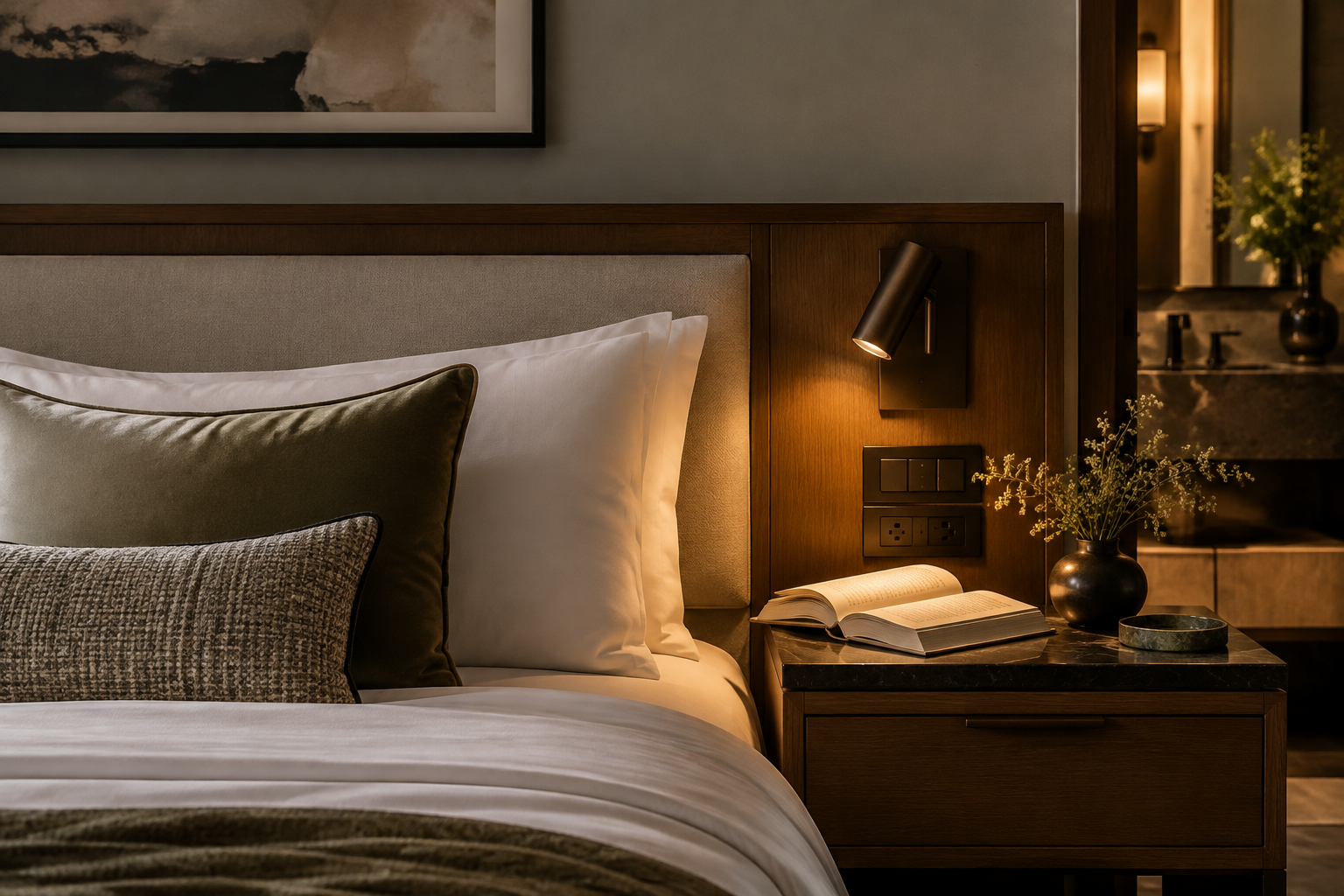
Introduction
specify headboard-integrated sconces as coordinated lighting-and-joinery assemblies. Use 2700–3000 K and CRI ≥90 as recommended specifications, with accessible drivers, shielded reading optics and coordinated mounting details. Verify compliance and photometry for each destination before procurement.
A headboard-integrated wall light is a luminaire recessed into, attached through or supported by hotel headboard joinery. Unlike a conventional wall-mounted sconce, its installation depends on the furniture build-up: upholstery, backing boards, decorative panels, structural supports and concealed cable routes.
The procurement unit is therefore not just a decorative fitting. It is the luminaire, its fixing interface, electrical connection, driver location, controls and maintenance route.
Owners, interior designers and FF&E buyers should agree these interfaces before releasing joinery drawings. Otherwise, an approved appearance can conceal an inaccessible driver, insufficient fixing depth or a reading beam aimed away from the guest’s book.
Design Criteria and Standards
Headboard lighting should provide comfortable reading, intuitive operation and safe integration without requiring major joinery removal for routine maintenance.
Start with the mattress position, pillow stack, seated eye position and bedside furniture. Coordinate these references with the complete bed assembly rather than a floor dimension alone. Mattress changes and thick upholstery can shift the relationship between the guest and the light.
The following values are recommended specifications, not verified product performance. Confirm the final schedule through a sample, photometric assessment and the applicable compliance process.
| Parameter | Spec | Standard | Notes |
|---|---|---|---|
| CCT and colour rendering | Recommended specification: 2700–3000 K; CRI ≥90 | IES guidance; WELL v2 where relevant to the project | Approve skin tones, bedding and timber under the actual light source |
| Glare and beam | Recommended specification: shielded 20–40° reading optic; assess glare from both pillows | EN 12464-1 where the assessed task is within scope; IES guidance | UGR is an installation assessment, not a universal product rating; no bedroom-wide UGR limit is assumed |
| Reading-plane illumination | Design target: 300 lx on the agreed reading plane, adjustable downward | IES guidance; project lighting brief | Validate the target against guest comfort, beam position and spill onto the adjacent pillow |
| Control interface | DALI-2, Casambi, KNX integration or 0–10 V, selected by room architecture | IEC 62386 for DALI; relevant interface documentation | KNX may require a gateway; specify the actual driver and control pathway |
| Housing, materials and IP | Recommended specification: metal optical housing and IP20 for dry guestroom locations | EN 60598; IEC 60529 | Confirm mounting-surface suitability, ambient conditions and thermal clearance |
| LED and driver selection | Request named options such as Bridgelux LEDs with Tridonic or Mean Well drivers | Component datasheets; applicable luminaire assessment | Brand names are sourcing options, not confirmed supplied components or assembly approvals |
| Certification and documentation | Require market review of CE/RoHS, UL and SAA requirements; request ISO9001 evidence if claimed | Applicable EU legislation; relevant UL standards; Australian requirements if specified; ISO 9001 | These are different conformity frameworks; none is claimed here as an existing product approval |
EN 12464-1 addresses indoor workplaces; it should not be presented as a blanket requirement for every private guestroom task. Use its applicable principles carefully, alongside the owner’s brief and relevant IES recommendations. WELL v2 can inform a project seeking that framework, but selecting a particular CCT does not establish WELL compliance.
Customisation Options and Materials
Choose the construction around the guest’s reading position, the headboard substrate and the maintenance strategy before selecting decorative finishes.
The comparison below describes design trade-offs rather than measured performance. A room can combine a decorative ambient sconce with a separately controlled reading optic when their functions remain clear.
| Headboard-integrated option | Main advantage | Integration constraint | Verdict |
|---|---|---|---|
| Recessed adjustable reading light | Precise aiming with a restrained appearance | Requires recess depth, thermal space and an accessible connection | Best when joinery depth and aiming geometry are confirmed |
| Surface-mounted sconce through headboard | Flexible decorative form and straightforward front access | Needs reinforced backing and coordinated cable exit | Best for statement designs with serviceable mounting plates |
| Upholstery-integrated reading module | Compact appearance within a padded headboard | Fabric compression and trim tolerances require close coordination | Best only after a representative upholstered mock-up |
| Combined ambient-and-reading assembly | Consolidates bedside functions | Requires separate optical and control decisions | Best when guests can identify each function immediately |
| Recessed diffuse bedside module | Soft local illumination with minimal projection | May lack useful reading direction without another optic | Best as supplementary ambient light, not an assumed reading substitute |
How Should Sconces Mount Through Upholstered Hotel Headboards?
Upholstered headboards need a rigid fixing interface that prevents fabric compression from loosening the luminaire or obstructing its trim.
Provide a structural backing plate or engineered support behind the upholstery. Define the finished fabric plane, recess opening and trim overlap in the same drawing. Do not assume foam or decorative fabric can carry the fitting’s load.
Keep cut edges protected and prevent cable abrasion against mounting hardware. Assess upholstery proximity during thermal review; fabric must not cover ventilation or interfere with the manufacturer’s mounting conditions. Confirm that the fitting can be removed without tearing fabric or releasing concealed staples.
Which Materials Suit Timber, Veneer and Metal Hotel Headboards?
Material selection should balance visual consistency, thermal behaviour, cleaning resistance and compatibility with the supporting joinery.
Aluminium can suit compact optical housings, while steel can provide rigid mounting brackets. Brass or decorative metal sleeves may support the interior concept, but the finish description must identify whether the effect is solid material, plating, paint or another treatment.
Coordinate timber and veneer cut-outs with their supplier’s movement allowances. Approve finish samples beside the actual veneer, upholstery and bedding. Cleaning compatibility should be checked using the hotel’s intended products; a visually acceptable sample does not establish chemical resistance.
Where Should a Headboard Reading Light Sit Relative to the Pillow?
Set the light position from a full-scale bedside mock-up rather than copying a universal mounting height.
Evaluate a seated guest, a reclining guest and the neighbouring sleeper. Check whether an adjustable arm can illuminate the reading plane without exposing a bright source to either pillow. Confirm that the fitting does not conflict with cushions, head movement or bedside objects.
Record the approved position against the finished mattress and headboard geometry. If room types use different beds, repeat the coordination rather than assuming the same drilling template remains suitable.
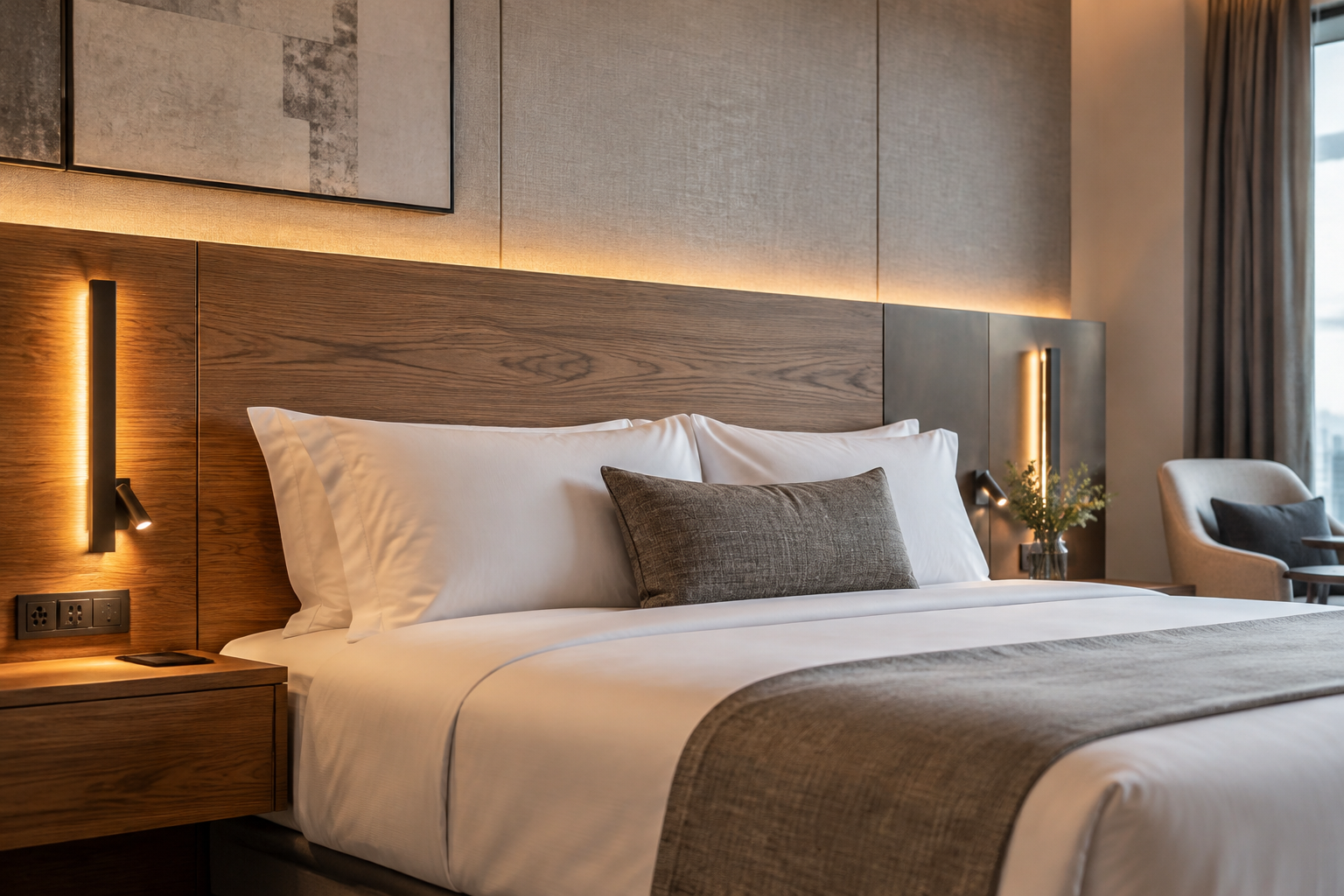 How Should Hotels Specify Headboard-Integrated Wall Lights?: Which materials suit timber, veneer and metal hotel headboards?
Controls and Commissioning
The control system should let guests find, switch and dim each bedside function without understanding the hotel’s automation architecture.
Define the sequence before choosing electronics: local switching, reading-light dimming, master-off behaviour, room-entry scenes and restoration after a power interruption. Decide whether reading lights remain independently available when decorative room lighting is off.
DALI-2 provides an interoperable framework when compatible certified devices are selected, but commissioning and system configuration still matter. Casambi is an ecosystem rather than a generic dimming input; verify the selected module, network design and operation without guest phones.
KNX integration may use dedicated actuators or a gateway to the lighting interface. With 0–10 V, confirm whether a separate switching function is needed for a reliable off state.
Test the complete combination of driver, light engine, control device and firmware. Check low-end behaviour, visible flicker, audible noise and consistency between bedside fittings. Do not substitute a driver after approval without reviewing dimming, thermal behaviour and compliance implications.
Commissioning records should identify the installed configuration and approved scenes. Keep access to drivers and control modules practical for hotel engineering staff, with circuits safely isolatable under local electrical rules.
Sampling, MOQ, Lead Time and Quality Control
Sampling should resolve optical, mechanical and electrical interfaces before the hotel commits to production quantities.
A recommended sampling plan uses 2 stages: an engineering sample for integration checks and a finish-approved reference sample for production acceptance. Combine these only when the project team accepts the remaining risk.
The engineering sample should use representative joinery, upholstery, controls and supply conditions. Check fixing strength, rotation limits, touch-accessible surfaces, cable protection and removal access. The reference sample should record the accepted finish, optical appearance, components, labels and packaging arrangement.
MOQ and lead time are quotation-specific. They depend on tooling, finish batches, component availability, document preparation and the number of room variants. Distinguish sample development, approval, production and transport in the programme; do not treat the factory dispatch date as arrival at the hotel.
Quality-control documentation should connect each production variant to its approved drawings and bill of materials. Specify relevant electrical safety checks, functional tests, finish inspection and traceability.
Agree inspection sampling and acceptance criteria contractually rather than assuming an unspecified factory default. Keep replacement drivers and light engines identifiable for future servicing.
Photometric Files & Compliance
Photometry and safety documentation must represent the selected luminaire configuration, not merely a similar housing or an approved component.
Request IES and LDT photometric files for the proposed light engine, optic and output. Import them into DIALux where appropriate to assess distribution and reading-plane illumination.
Model the bed and headboard geometry realistically, then confirm close-range glare and guest comfort using the physical sample. A calculation cannot fully reproduce a guest’s moving eye position.
For EU procurement, review applicable CE obligations, the EU Declaration of Conformity, RoHS documentation and relevant safety and EMC evidence. Cite EN 60598 with the applicable part and edition identified by the responsible assessor. CE marking is not a universal third-party certification.
For US projects, confirm the required listing route with the authority having jurisdiction and project electrical team. Middle East and Southeast Asia requirements vary by country, importer and installation conditions; identify these before freezing the design.
SAA evidence is relevant only where that Australian certification route is required or contractually requested. ISO 9001 concerns quality management, not the electrical safety approval of an individual sconce.
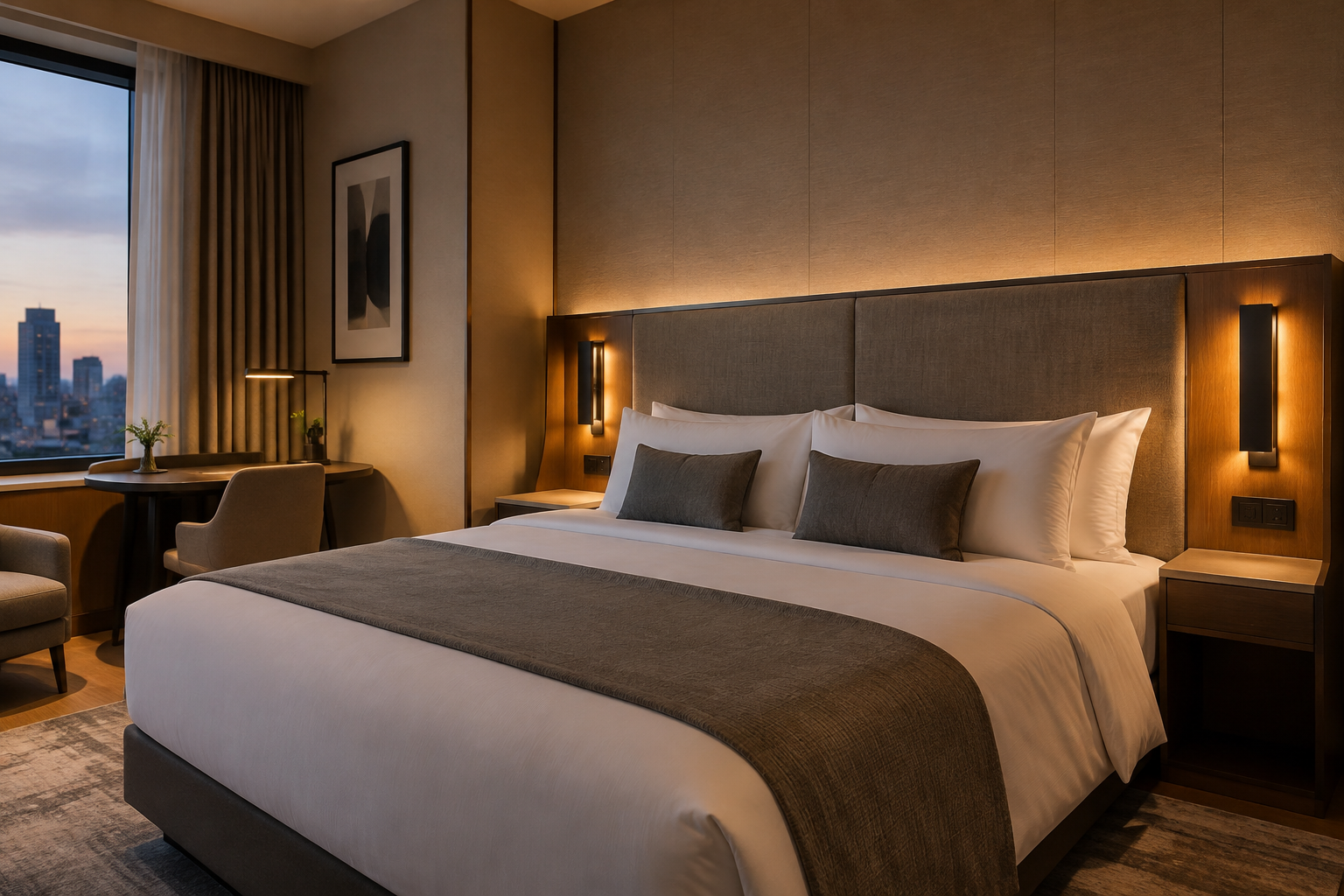 How Should Hotels Specify Headboard-Integrated Wall Lights?: Photometric files & compliance
Frequently Asked Questions
Q: Can a Headboard-integrated Sconce Provide Both Reading and Ambient Light?
A combined fitting can serve both functions when its optical channels and controls are designed separately. A recommended specification is 2 independently controlled channels: a shielded reading beam and a diffuse ambient source. Confirm that ambient brightness does not compromise sleep comfort and that the reading beam reaches the agreed task plane without excessive spill onto the adjacent pillow.
Q: What Colour Temperature Should Hotel Headboard Reading Lights Use?
Warm-white light is a practical starting point, but the final choice should be approved with the room finishes. A recommended specification is 2700–3000 K with CRI ≥90. Compare samples beside bedding, timber and upholstery, and check their appearance against other room luminaires. These values are procurement recommendations, not proof of sleep benefits or compliance with a wellness framework.
Q: Can the LED Driver Be Concealed Inside the Hotel Headboard?
A driver can be concealed if its mounting conditions, thermal environment and service access are suitable. A recommended design target is 1 clearly documented service route that avoids dismantling the upholstered headboard. Check the driver manufacturer’s requirements, isolate mains safely and protect wiring. A remote driver location may be preferable when the joinery cavity is shallow or crowded.
Q: Which Documents Should Buyers Request Before Approving Production?
Buyers should request coordinated drawings, an approved component schedule, photometric data and destination-specific conformity evidence. A recommended specification is 1 controlled approval package per distinct electrical and optical configuration, with finish variants identified. Include control compatibility, installation instructions and maintenance access details. Confirm that reports and declarations cover the supplied assembly rather than only its LED module or driver.
Sources and Technical References
Use primary standards and programme documentation to verify scope, terminology and current requirements before signing the procurement specification.
- CEN-CENELEC: European standards information for EN 12464-1 and EN 60598; obtain the applicable editions through an authorised standards body.
- IEC: IEC Webstore for IEC 60598, IEC 60529 and IEC 62386 publications; check regional adoption separately.
- IES: Illuminating Engineering Society for lighting guidance and photometric terminology.
- IWBI: WELL v2 for the current Light concept and applicable verification requirements.
- DALI Alliance: DALI technical information for certification scope and product verification.
- European Commission: CE marking guidance for manufacturer responsibilities and applicable conformity procedures.
These references support specification decisions; they do not certify a proposed custom luminaire or replace project-specific assessment.
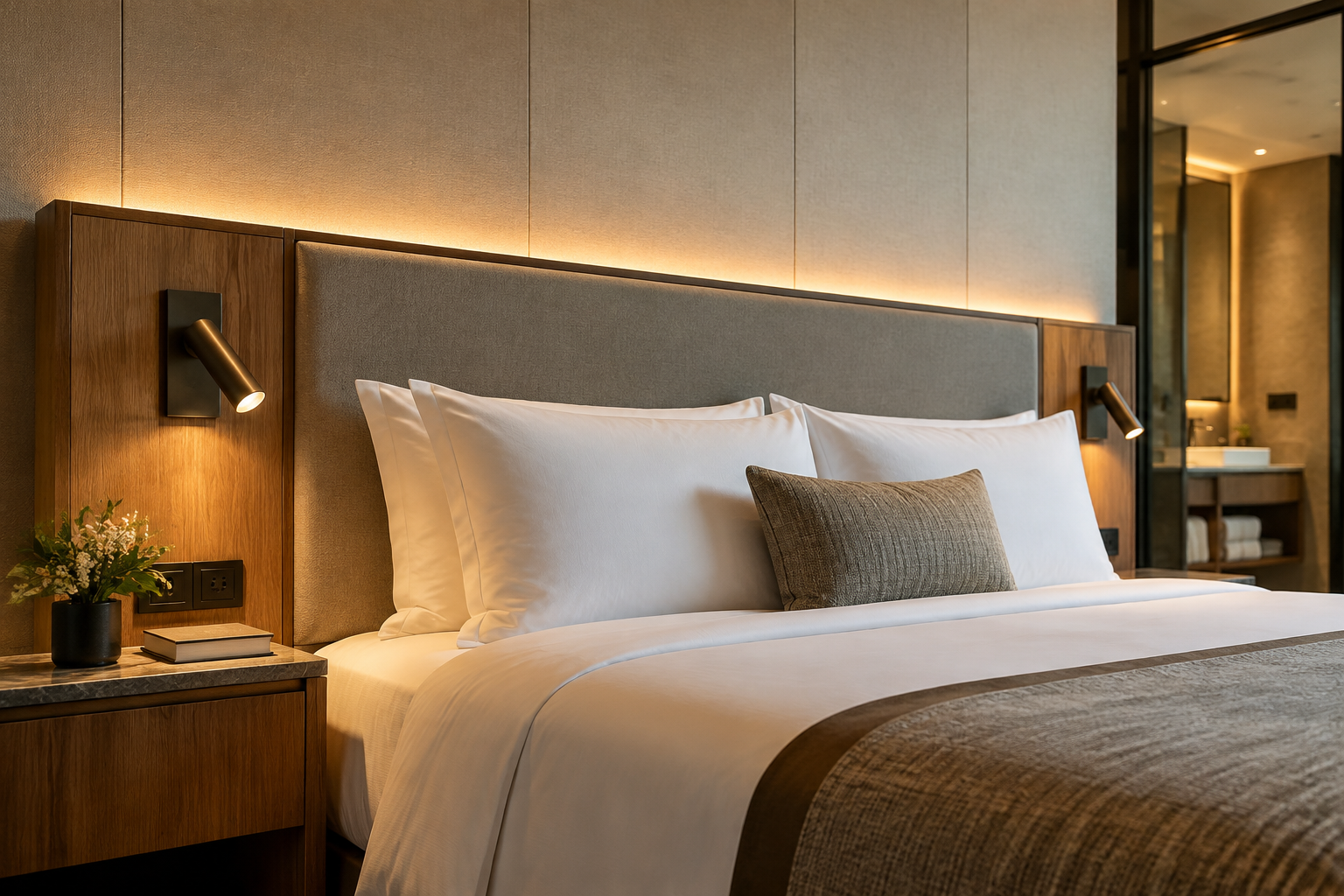 How Should Hotels Specify Headboard-Integrated Wall Lights?: Q: Can the LED driver be concealed inside the hotel headboard?
Request a Custom Quote
A useful quotation starts with the headboard interface, required lighting function and destination-market documentation rather than a reference image alone.
Send headboard elevations and sections, mattress references, substrate details, finish samples, room quantities and variant schedules. Include the required control architecture, supply characteristics, preferred driver location, maintenance route and requested delivery programme. Identify who supplies the mounting reinforcement, cables, connectors and final installation labour so the joinery and lighting packages do not leave an interface unassigned.
At XHLWX (led-project-light.com), a Custom Indoor LED Lighting Manufacturer based in China, ... start the quotation discussion with coordinated headboard drawings and destination requirements. Request proposed component options, a sampling plan, photometric deliverables and a clearly bounded compliance scope before approving production.
Sobre XHLWX
XHLWX es la marca de Shenzhen Qihang Lighting Co., Ltd., fabricante de luminarias LED para proyectos con fábrica propia en Shenzhen (China) desde 2009. Suministramos perfiles lineales, downlights, carriles magnéticos, paneles, luminarias estancas, campanas industriales y luminarias a medida para oficinas, hoteles, museos, retail e industria.
Proyectos de iluminación según UNE-EN 12464-1 (Em, UGR, Uo, Ra) con archivos IES y LDT para DIALux; luminarias con conformidad CE y RoHS y gestión de calidad ISO 9001.
Preguntas frecuentes sobre XHLWX
¿XHLWX suministra a España?
Sí. Suministramos proyectos en España directamente desde fábrica; la oferta, el cálculo lumínico y la documentación técnica se entregan en español o inglés.
¿Las luminarias cumplen la UNE-EN 12464-1?
Dimensionamos iluminancia, límite UGR y uniformidad según la UNE-EN 12464-1 y lo justificamos con un cálculo DIALux hecho con nuestros archivos LDT.
¿Qué sistemas de control son compatibles?
DALI-2, 0-10 V y Casambi (Bluetooth), también en versión con emergencia o sensor según el proyecto.
¿XHLWX fabrica luminarias a medida u OEM?
Sí. Longitudes, temperaturas de color, ópticas, acabados y su propia marca (OEM/ODM) se producen en nuestra fábrica.
Need a tailored lighting plan for your project?
Our senior lighting designers reply within 48 hours with a free design proposal & quotation.