
Hotel Bathroom Mirror Lights 2026: IP44, CRI90 & Anti-Fog?
Quick answer
Specify guestroom bathroom mirror lights with zone-appropriate IP protection, CRI90, comfortable facial lighting, serviceable drivers and controlled anti-fog.
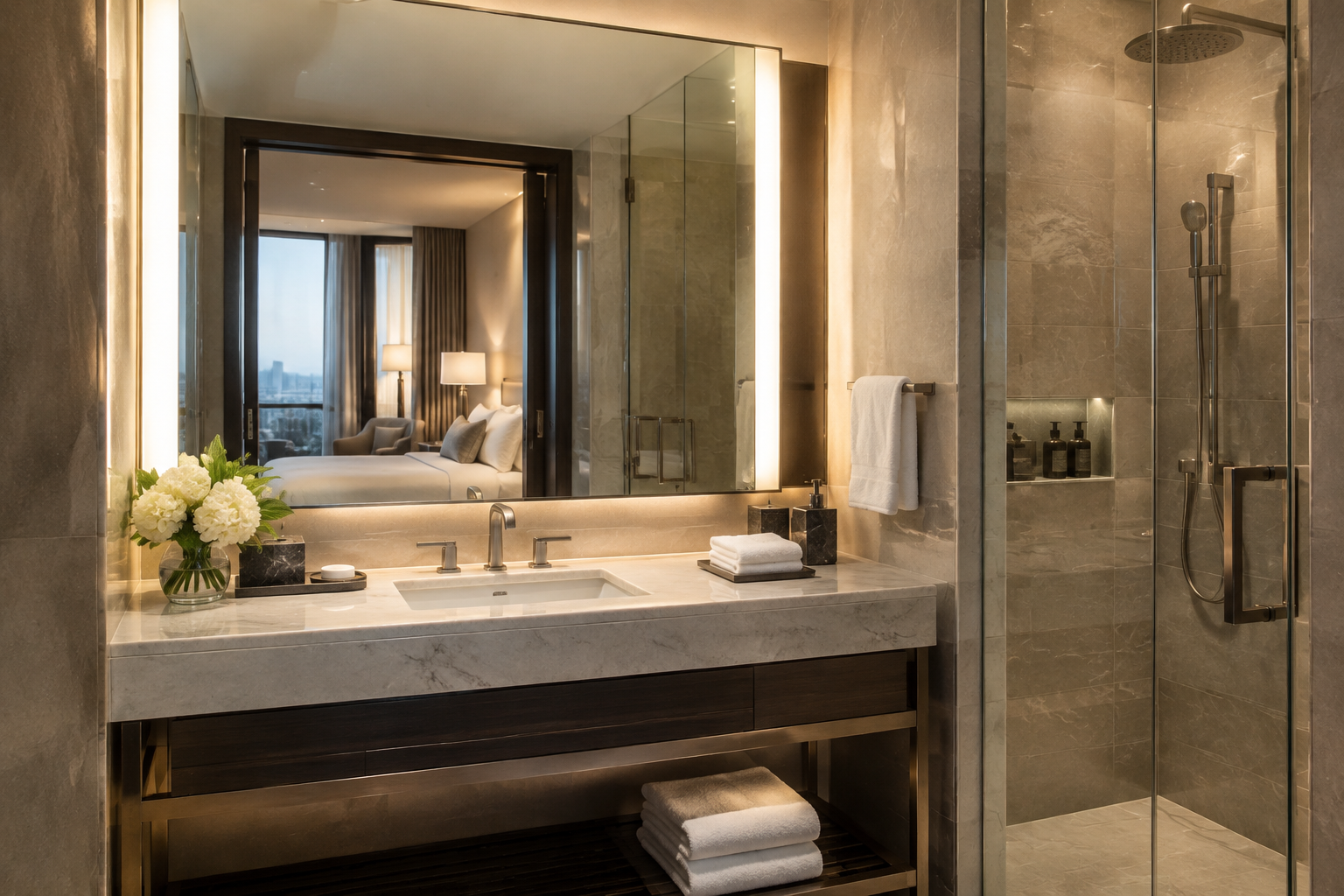
Introduction: Specifying Guestroom Bathroom Mirror Lights for 2026
At XHLWX (led-project-light.com), a Custom Indoor LED Lighting Manufacturer based in China, ... we recommend IP44 and CRI90 specifications, subject to bathroom-zone requirements. For guestroom vanity mirrors in 2026, choose diffuse facial illumination, serviceable LED drivers and separately controlled anti-fog heating; require higher ingress protection wherever the installation location demands it.
The best specification treats the mirror, luminaire, heater, controls and electrical connection as a coordinated assembly. An illuminated perimeter can look attractive while providing insufficient light on a guest’s face. Similarly, a protected LED strip does not establish the ingress rating of the complete mirror assembly.
This guide supports hotel owners, interior designers and FF&E buyers across the EU, US, Middle East and Southeast Asia. Its numerical performance values are recommended specifications or design targets—not measured XHLWX results. The 2026 framing is a procurement context, not a claim that new regulations universally require these features.
Design Criteria and Standards: Guestroom Vanity Mirror Specifications
Specify facial illumination, colour quality and installation safety together; no single IP or CRI value establishes a successful bathroom mirror.
Use vertical illumination at the guest’s face as the primary lighting check. A recommended design target is 300–500 lx at representative standing and seated face positions, verified in the mock-up.
This is not presented as a universal hotel requirement. Strong countertop illumination alone does not prove satisfactory grooming light.
The following values are recommended specifications for project development. Applicable local regulations and the tested product configuration take precedence.
| Parameter | Spec | Standard | Notes |
|---|---|---|---|
| CCT and consistency | Recommended specification: 3000 K or 3500 K; ≤3 SDCM | IEC 62717 where applicable | Coordinate with bathroom ceiling lighting; approve an illuminated sample |
| Colour rendering | Recommended specification: CRI Ra ≥90; R9 ≥50 | CIE colour-rendering methodology | Request supporting LED or luminaire data; CRI alone does not describe every colour |
| Facial illuminance | Design target: 300–500 lx vertically | EN 12464-1 as a relevant reference, not an automatic guestroom mandate | Check actual face positions and mirror geometry |
| UGR and comfort | Project-specific assessment; no blanket mirror UGR claim | EN 12464-1; applicable IES guidance | Examine visible diffuser brightness and reflections directly |
| Beam distribution | Recommended specification: broad, diffuse forward emission | IES photometric guidance | Validate distribution using complete-luminaire photometry |
| Control | Select DALI-2, Casambi, KNX integration or 0–10 V to match the room system | IEC 62386 for DALI; relevant system documentation | Define gateways, dimming range and heater control separately |
| Housing, materials and IP | Recommended specification: corrosion-resistant housing and IP44 where permitted | IEC 60529; EN 60598 | Higher protection may be necessary; verify the complete installed assembly |
| LED and driver brands | Candidate LEDs: Osram, Bridgelux or Samsung; candidate drivers: Tridonic or Mean Well | Exact component datasheets and approvals | Brand names are options, not confirmation of an installed bill of materials |
| Certification and conformity | Request market-specific evidence for CE/RoHS, UL or other applicable acceptance | Applicable legislation, EN 60598 and relevant UL standards | SAA evidence is relevant only when the destination or contract requires it |
| Quality management | Request current ISO9001 evidence if contractually required | ISO 9001 | Manufacturer quality management is not product certification |
IP44 indicates protection against specified solid-object ingress and splashing water under IEC 60529 test conditions. It does not establish suitability for water jets, immersion or every bathroom zone. A qualified electrical designer should confirm location restrictions, supply arrangements, protective bonding and required residual-current or ground-fault protection.
EN 12464-1 addresses indoor workplaces; use it only where its scope fits the project. WELL v2 can inform visual comfort and colour-quality objectives, but it is not a bathroom electrical-safety approval.
Customisation Options and Materials: Choosing the Mirror-light Assembly
Choose the construction that delivers useful facial light and allows maintenance without damaging the mirror, wall finish or electrical protection.
Custom dimensions should follow the finished vanity, tap position, wall build-up and intended guest positions. Freeze the illuminated aperture, fixing centres, cable entry and service access before production drawings are approved.
| Configuration | Main advantage | Main limitation | Verdict |
|---|---|---|---|
| Integrated side-emitting mirror bands | Light reaches both sides of the face | Requires careful diffusion and sealed construction | Strong candidate for grooming-led briefs |
| Full illuminated perimeter | Visually continuous design | Bright bands may dominate reflections | Approve only after a face-lighting mock-up |
| Backlit-only mirror | Soft wall glow | Often provides limited forward facial light | Use as ambience, not the sole grooming source |
| Separate vertical luminaires beside a mirror | Independent replacement and positioning | Needs coordinated wall junctions | Strong option for maintenance-led hotels |
| Top-mounted mirror luminaire | Practical for constrained vanity widths | Can create shadows beneath facial features | Validate at actual guest positions |
How Should Custom Dimensions and Light Placement Suit Hotel Guests?
Place luminous surfaces to illuminate faces rather than merely outline the glass.
Side lighting generally provides a useful starting point because it reduces reliance on light from above. Check visibility for different guest heights and any required accessible vanity arrangement.
Confirm that taps, shelving and magnifying mirrors do not block the light or create distracting reflections. A full-size mock-up is more informative than a decorative rendering.
Which Materials Suit Humid Bathrooms and Frequent Cleaning?
Material suitability depends on the complete finish system, exposed edges and cleaning chemistry—not the material name alone.
Candidate constructions include coated aluminium housings and appropriately specified stainless-steel brackets. Confirm glass-edge protection, mirror backing, adhesive compatibility and resistance to the hotel’s cleaning products.
Diffusers should resist yellowing and remain securely retained. Ask for documented finish and cleaning tests appropriate to the project; do not substitute a generic corrosion claim for evidence.
How Should an Anti-fog Heater Be Integrated Safely?
A mirror heater reduces condensation over its heated area; it does not replace bathroom ventilation.
Specify the required clear viewing area rather than assuming the entire mirror must be heated. Agree heater coverage, electrical insulation, temperature limits and compatibility with the mirror backing and adhesives.
Use independent control or a defined timeout where appropriate. Heater loading and protective devices must follow the approved assembly design, not a generic wattage copied from another mirror.
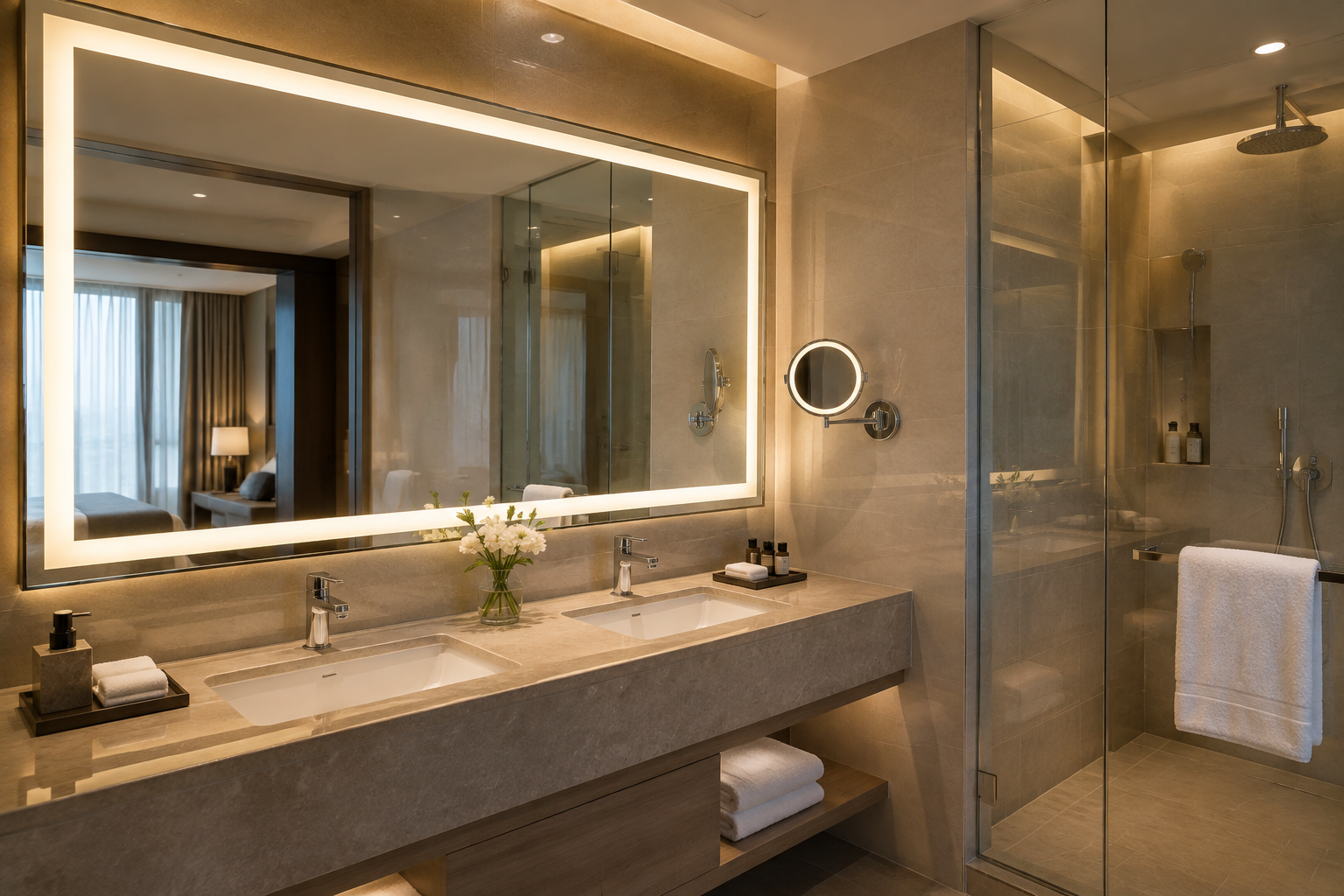 Hotel Bathroom Mirror Lights 2026: IP44, CRI90 & Anti-Fog?: Which materials suit humid bathrooms and frequent cleaning?
Controls and Commissioning: Integrating Vanity Lighting with Guestroom Scenes
Separate lighting behaviour from anti-fog operation so guests receive predictable illumination without unnecessary heater runtime.
DALI-2 can suit centrally managed projects when the selected driver and control architecture support the required functions. Casambi can simplify certain wireless arrangements, but metalwork, access and commissioning procedures need evaluation.
KNX integration may require a suitable driver or gateway. For 0–10 V, confirm the control convention, minimum output and whether separate switching is needed for full off.
Do not assume a guestroom management system can directly switch the heater load. Confirm relay ratings, isolation, protective arrangements and failure behaviour with the electrical designer.
A recommended dimming specification is stable operation from 10–100% output, subject to the selected driver and mock-up approval. Commission grooming, night-entry and cleaning scenes without claiming unsupported energy savings.
Check flicker, visible stepping, audible noise, power restoration and manual override. Record final settings so replacement components can reproduce the approved behaviour.
Sampling, MOQ, Lead Time and Quality Control: Moving from Drawings to Approval
Approve a representative assembly before committing to production quantities, and obtain commercial terms against the frozen specification.
The quotation package should state dimensions, quantities, finishes, supply voltage, control interface, IP requirement, heater arrangement and destination-market documentation. MOQ and lead time depend on tooling, mirror processing, component availability, testing and order scope; no universal value should be assumed.
Request separate milestones for engineering approval, sample fabrication, laboratory work where required, production and shipment. Changes after sample approval can affect each milestone.
The sample should use the proposed glass, diffuser, LEDs, driver and heater—not visually similar substitutes. Review illuminated appearance, face shadows, colour consistency, edge finish, fixing access and cleaning access. Verify heater operation under representative humidity conditions without treating an informal demonstration as certification.
Agree a quality-control plan covering dimensions, component identity, electrical safety checks, functional operation and packaging. Define sampling and acceptance criteria contractually. Any component substitution should trigger documented review of optical performance, safety, conformity and control compatibility.
Photometric Files & Compliance: Checking the Complete Mirror Assembly
Photometry and compliance documents must match the quoted configuration, including its optics, driver, heater and intended mounting arrangement.
Request IES and LDT photometric files for the complete luminaire, not just an LED module. Use DIALux to compare vertical facial illumination and the relationship between mirror lighting and ceiling lighting.
Include realistic dimensions, mounting positions and surface reflectances. For guests standing close to luminous bands, simulation may need near-field validation; confirm performance with physical measurements.
EN 60598 is the relevant luminaire safety series in many specifications; determine the applicable general and particular requirements with a competent laboratory. A combined illuminated and heated mirror may require additional assessment beyond a basic luminaire evaluation.
For EU procurement, CE marking and RoHS conformity require the applicable documentation; CE is not itself a third-party certificate. For US projects, establish the required NRTL listing and installation acceptance with the authority having jurisdiction.
Middle Eastern and Southeast Asian requirements differ by country, so confirm destination-specific approvals and importer obligations. None of these approvals is claimed here for an unspecified XHLWX product.
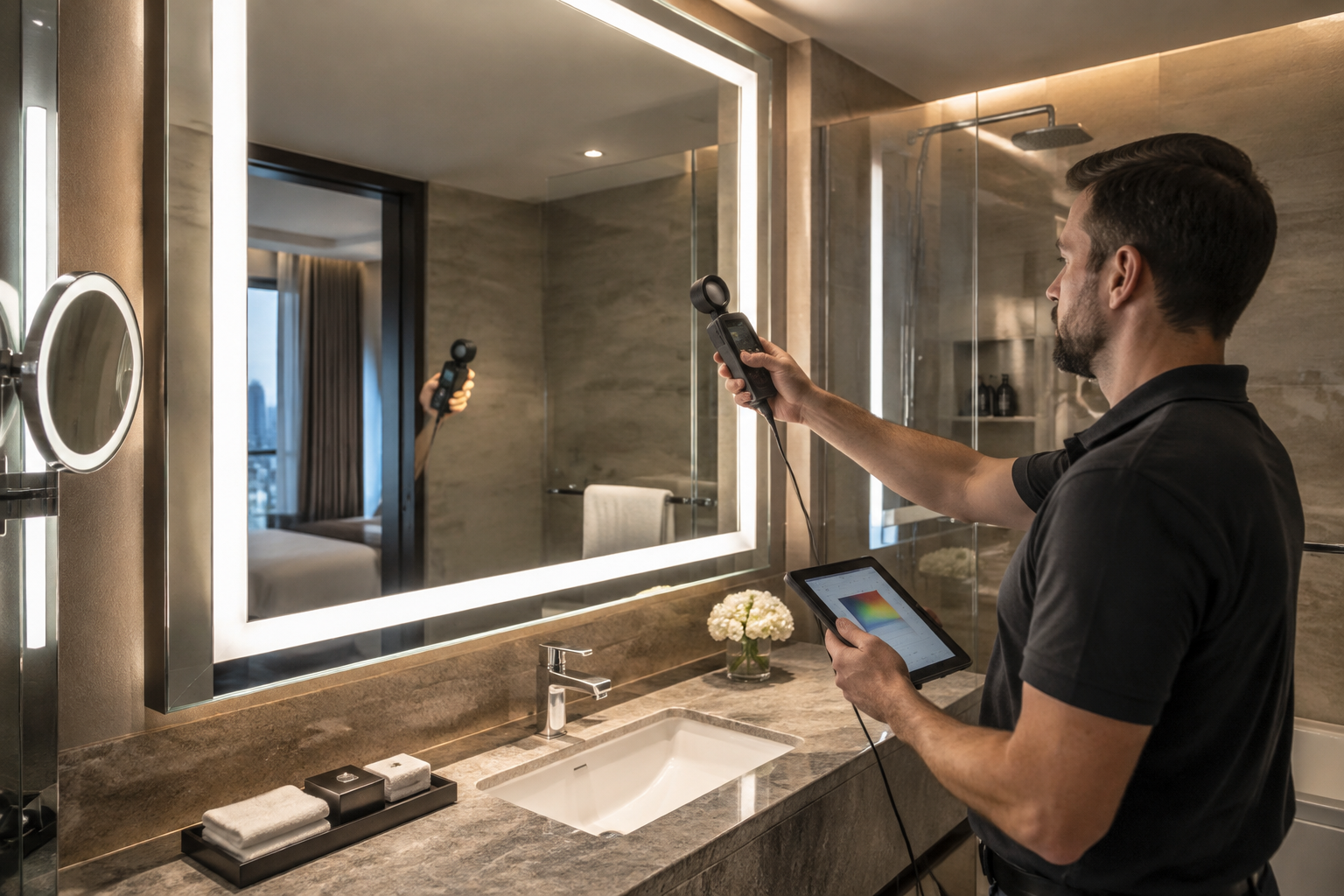 Hotel Bathroom Mirror Lights 2026: IP44, CRI90 & Anti-Fog?: Photometric files & compliance: checking the complete mirror assembly
Frequently Asked Questions
These answers distinguish recommended mirror-light specifications from requirements that depend on the installation and destination market.
Q: Is IP44 Enough for a Hotel Bathroom Mirror Light?
IP44 can be suitable where local bathroom-zone rules and the intended exposure allow it. It is not blanket approval for installation near every shower or bath. Specify the complete assembly’s rating, including cable entries and access covers. Have the electrical designer confirm whether higher protection, different positioning or additional protective measures are required.
Q: Why Specify CRI90 for Guestroom Vanity Mirror Lighting?
A recommended specification of CRI Ra ≥90 supports more natural-looking skin and cosmetics than lower colour-rendering alternatives. It does not guarantee excellent reproduction of every colour, so consider R9 and review a physical sample. Match the chosen CCT to adjacent lighting, and check that comfortable diffusion does not leave the guest’s face underlit.
Q: Should the Anti-fog Heater Switch on with the Mirror Light?
Separate control usually offers greater flexibility because guests may need light without needing heat. A shared switch can still be appropriate if the operating sequence, load rating and timeout are agreed. Recommended specification: document 2 functions independently—lighting and heating—even when a guest-facing control operates both. Confirm behaviour after power interruption and during room-vacancy modes.
Q: What Should Buyers Request Before Approving a Custom Mirror Light?
Request drawings, a component schedule, photometric files, control details and market-specific compliance evidence. Recommended procurement target: approve 1 representative full-size sample for each materially different construction before production release. Check facial illumination, finish quality, heater coverage, service access and packaging. Obtain confirmed MOQ, lead time, warranty terms and replacement-component arrangements in the written quotation.
Sources and Technical References
Use current publications and destination-market rules; guidance documents do not replace product-specific test evidence or installation approval.
- EN 12464-1 — Light and lighting — Lighting of work places — Part 1: Indoor work places. Consult the current national adoption through CEN-CENELEC or the relevant national standards body.
- EN 60598 luminaire safety series and IEC 60529 — Degrees of protection provided by enclosures (IP Code). Consult applicable editions through national standards bodies and the IEC.
- IES Lighting Handbook and relevant photometric guidance: Illuminating Engineering Society. IES is an organisation and technical publisher, not a single compliance standard.
- WELL v2: International WELL Building Institute. Apply relevant lighting features only within the project’s agreed scope.
- DALI-2 certification and product database: DALI Alliance. Verify the exact proposed control gear rather than relying on a brand-level statement.
- CE marking and RoHS: European Commission. Check applicable legislation, declarations and supporting technical documentation.
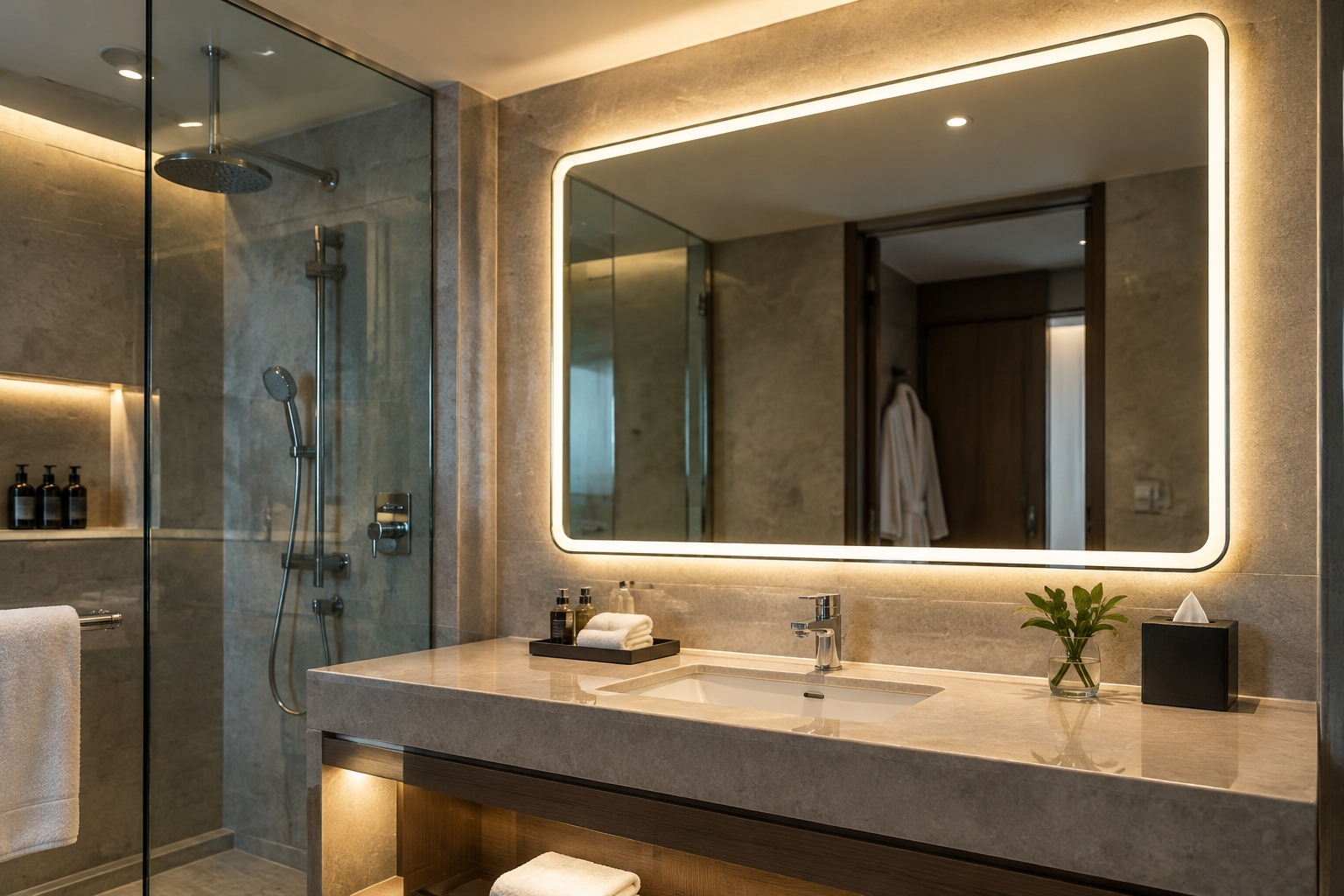 Hotel Bathroom Mirror Lights 2026: IP44, CRI90 & Anti-Fog?: Q: Should the anti-fog heater switch on with the mirror light?
Request a Custom Quote
quote requests should identify the complete guestroom vanity assembly. Send mirror dimensions, room quantities, destination country, wall details, finish references, supply voltage, control protocol and required documentation.
Include your IP assessment, recommended CRI90 specification, anti-fog coverage and maintenance expectations. Request an itemised proposal covering engineering, sampling, photometry, compliance responsibilities, packaging, MOQ and confirmed delivery milestones before purchase approval.
Sobre XHLWX
XHLWX es la marca de Shenzhen Qihang Lighting Co., Ltd., fabricante de luminarias LED para proyectos con fábrica propia en Shenzhen (China) desde 2009. Suministramos perfiles lineales, downlights, carriles magnéticos, paneles, luminarias estancas, campanas industriales y luminarias a medida para oficinas, hoteles, museos, retail e industria.
Proyectos de iluminación según UNE-EN 12464-1 (Em, UGR, Uo, Ra) con archivos IES y LDT para DIALux; luminarias con conformidad CE y RoHS y gestión de calidad ISO 9001.
Preguntas frecuentes sobre XHLWX
¿XHLWX suministra a España?
Sí. Suministramos proyectos en España directamente desde fábrica; la oferta, el cálculo lumínico y la documentación técnica se entregan en español o inglés.
¿Las luminarias cumplen la UNE-EN 12464-1?
Dimensionamos iluminancia, límite UGR y uniformidad según la UNE-EN 12464-1 y lo justificamos con un cálculo DIALux hecho con nuestros archivos LDT.
¿Qué sistemas de control son compatibles?
DALI-2, 0-10 V y Casambi (Bluetooth), también en versión con emergencia o sensor según el proyecto.
¿XHLWX fabrica luminarias a medida u OEM?
Sí. Longitudes, temperaturas de color, ópticas, acabados y su propia marca (OEM/ODM) se producen en nuestra fábrica.
Need a tailored lighting plan for your project?
Our senior lighting designers reply within 48 hours with a free design proposal & quotation.