
How Should Hotel Night Lights Deliver 0.5–5 Lux Paths?
Quick answer
Specify hotel under-bed sensor lighting with 0.5–5 lux design targets, concealed sources, reliable controls and practical testing for guestroom night paths.
Introduction
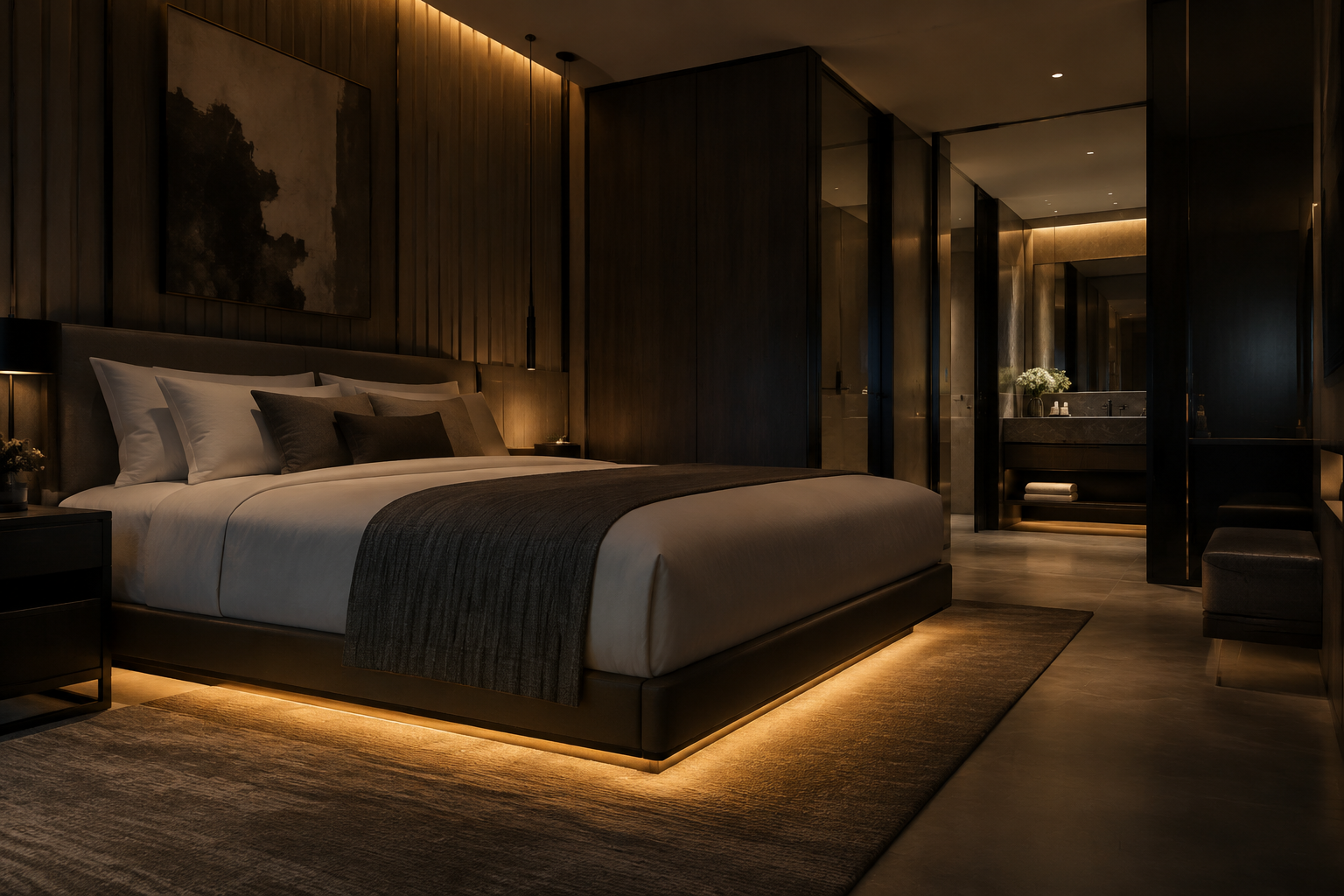
At XHLWX (led-project-light.com), a Custom Indoor LED Lighting Manufacturer based in China, ... we recommend concealed, sensor-triggered hotel night lights with a 0.5–5 lux floor-level design target. Illuminate the route from bed to bathroom, shield LEDs from reclining guests, and commission detection and dimming in a furnished guestroom rather than selecting fixtures by wattage alone.
This range is a project design target, not a universal hotel lighting requirement or an emergency-lighting standard. The right setting depends on flooring, furniture shadows, guest needs and applicable regulations. Night pathway lighting should reveal where to place a foot without activating general room lighting or unnecessarily disturbing another occupant.
For hotel owners, designers and FF&E buyers across the EU, US, Middle East and Southeast Asia, the essential purchase is a coordinated system: luminaire, driver, sensor, mounting detail and control sequence. This article explains how to specify that system without confusing product claims with verified performance.
Design Criteria and Standards
A useful specification defines floor illumination, source concealment and control behaviour before choosing LED power or strip length.
Set the horizontal measurement plane at the finished floor along the intended walking route. Record where readings are taken: beside each bed exit, around furniture corners, across the bathroom threshold and at any change in level.5–5 lux with other guestroom lights off and representative curtains closed.
Do not treat the upper value as an average that permits dark gaps. Agree acceptable minimum and maximum readings at identified checkpoints. A dark carpet may look less legible than pale stone at the same illuminance; visually inspect both the route and its boundaries.
EN 12464-1 addresses indoor workplace lighting; it does not establish this proposed guestroom night-path range. Review applicable requirements for staff activities and other relevant spaces separately. WELL v2 can inform broader light-management decisions, but a warm night light alone does not demonstrate WELL compliance or a health outcome.
The table below contains recommended specifications and verification references, not declarations about an existing product.
| Parameter | Spec | Standard | Notes |
|---|---|---|---|
| Floor illuminance | Design target: 0.5–5 lux along the agreed route | Project criteria; applicable local requirements | Measure in the furnished room; not an emergency-lighting criterion |
| CCT and colour rendering | Recommended specification: 1800–2400 K; CRI Ra ≥80 | Project colour specification; WELL v2 context | Approve physical samples; CCT alone does not describe spectral effects |
| UGR and visual comfort | Recommended specification: no direct LED view from agreed bed positions | EN 12464-1, where applicable | UGR is not a standalone guarantee for concealed near-floor lighting |
| Beam distribution | Recommended specification: shielded asymmetric spread toward the route | IES and LDT photometric data | Select beam distribution through modelling and mock-up review, not a universal angle |
| Controls | Recommended specification: DALI-2, Casambi, KNX integration or 0–10V as scheduled | Relevant protocol documentation; DALI Alliance records where applicable | Define gateway, sensor, driver and low-end compatibility |
| Housing, material and IP | Recommended specification: aluminium profile; IP20 in dry protected locations | EN 60598; IEC 60529 | Reassess ingress protection for cleaning exposure and bathroom locations |
| LED and driver brands | Recommended candidates: Osram, Bridgelux or Samsung LEDs; Tridonic or Mean Well drivers | Exact component datasheets | Brand selection does not establish complete-luminaire compliance |
| Certification and documentation | Specify applicable CE/RoHS evidence, UL listing or SAA certification; verify any ISO9001 claim separately | Destination rules; applicable EN 60598 requirements | These are not interchangeable; ISO9001 concerns quality management |
Older guests or people with reduced vision may need more light than the proposed night setting. Provide an accessible manual route to brighter illumination rather than making the low-level sensor circuit the only option.
Customisation Options and Materials
Choose the mounting position that keeps the route visible after furniture, bedding and cleaning access are considered.
Under-bed lighting is not automatically the best answer. A recessed plinth can hide the source effectively, but deep bed frames, bed skirts or stored luggage can block the output. A low-level wall luminaire may provide a more dependable route where furniture changes between room categories.
| Approach | Main advantage | Main constraint | Verdict |
|---|---|---|---|
| Recessed under-bed linear light | Conceals the source within the furniture silhouette | Bedding and plinth geometry can obstruct light | Preferred when the bed detail is fixed and sampled |
| Low-level wall night light | Less dependent on bed construction | Requires coordinated wall openings and shielding | Preferred for a predictable bed-to-bathroom route |
| Bedside cabinet underside light | Integrates with joinery and local wiring | May leave a shadow beyond the cabinet | Suitable as part of a checked route, not by assumption |
| Bathroom vanity underside light | Helps identify the destination | Does not necessarily illuminate the approach | Useful supplementary lighting |
| Exposed adhesive LED strip | Simple initial installation | Visible dots, cleaning damage and difficult replacement | Avoid as the finished guest-facing solution |
How Should Under-bed Lights Fit Different Hotel Bed Bases?
Custom profiles should follow the approved bed geometry while remaining removable for maintenance.
Request coordinated furniture drawings showing recesses, support legs, cable exits and mattress overhang. For twin layouts, check each bedside exit independently. A shared sensor or centrally mounted strip may miss a guest leaving from the outer edge.
Use mechanically retained profiles where cleaning or movement could loosen adhesive. Agree connectors and cable slack with the furniture supplier, and keep electrical components clear of moving storage mechanisms. Repeat the review when the bed supplier or upholstery detail changes.
Which Materials Suit Cleaning and Guestroom Maintenance?
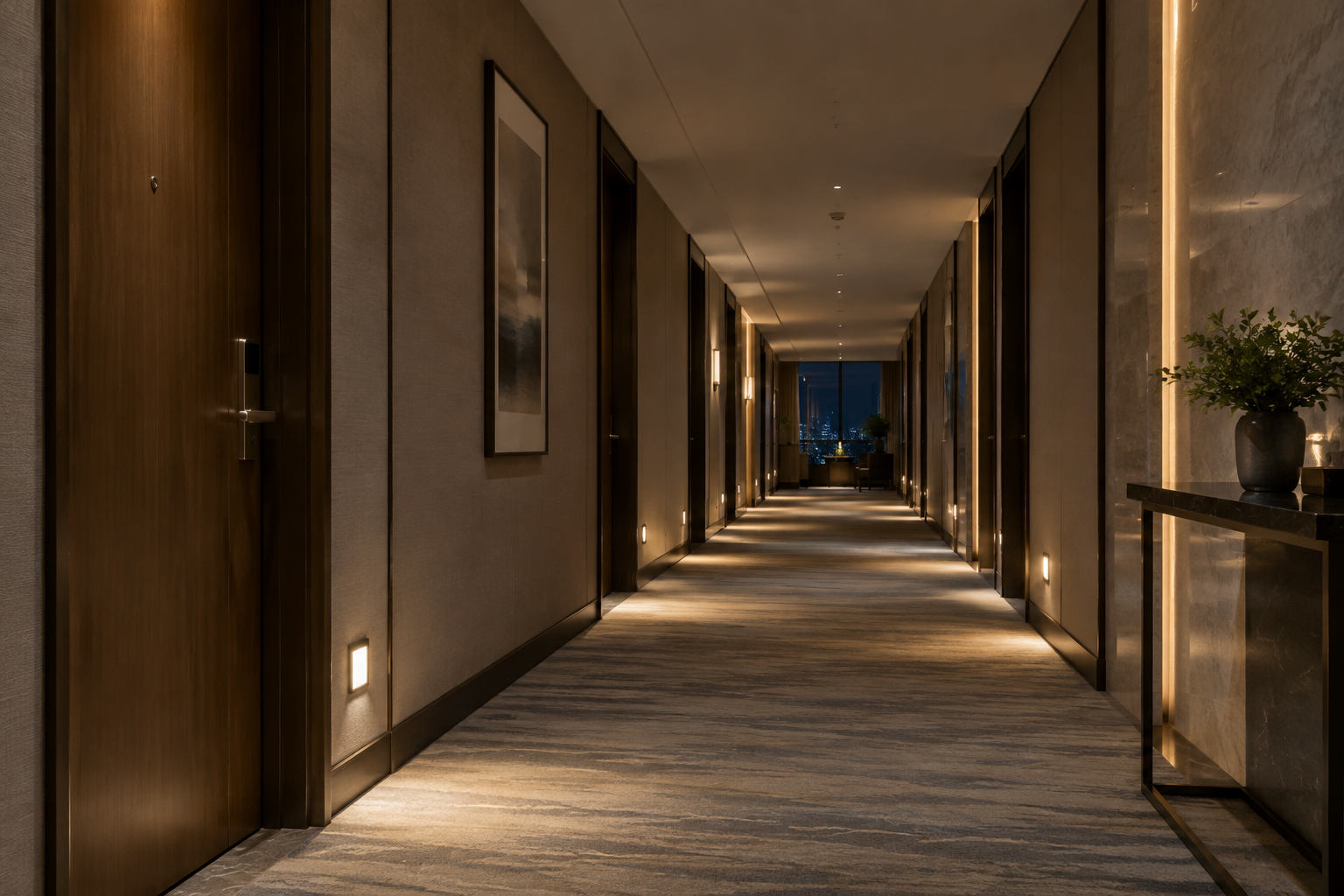
Aluminium profiles with replaceable diffusers provide a practical starting point for serviceable indoor night lighting.
Specify finish samples, diffuser retention and cleaning compatibility. An anodised or powder-coated finish should be approved against the actual housekeeping products; neither description proves chemical resistance. Polycarbonate and PMMA diffusers have different properties, so select against impact, appearance and documented cleaning needs.
Ingress protection belongs to the complete assembly, including connections and end caps. A dry under-bed position and a bathroom-adjacent installation may need different solutions under the destination rules.
How Can Designers Prevent Visible Dots and Unwanted Spill?
Source setback, shielding and diffuser design should prevent direct LED views without creating gaps in the walking route.
Review the luminaire from lying, seated and standing positions. Glossy tile or polished furniture can reflect a hidden source into the guest’s eyes. Test bedding hanging over the edge and luggage placed nearby.
Higher LED density or stronger diffusion may improve appearance, but neither replaces a geometry check. Approve the illuminated effect with final materials before freezing the profile dimensions.
 How Should Hotel Night Lights Deliver 0.5–5 Lux Paths?: Which materials suit cleaning and guestroom maintenance?
Controls and Commissioning
Reliable night lighting requires a defined sequence for activation, retriggering, manual override and power recovery.
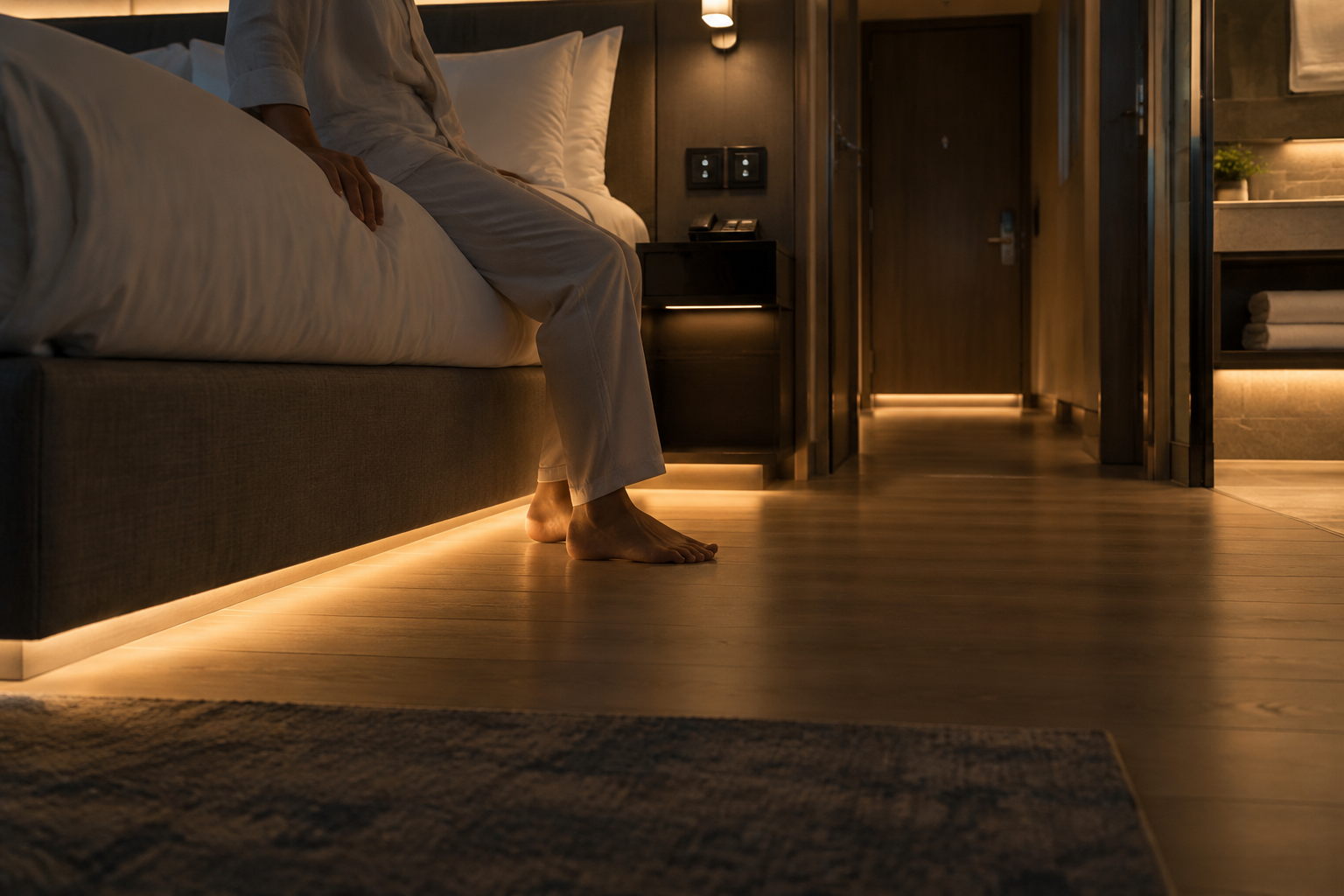
Specify a recommended operating sequence in which leaving the bed activates the relevant path without switching on ceiling lights. Consider an ambient-light condition or night scene so housekeeping movement does not cause unnecessary activation in daylight.
For the mock-up, recommended starting settings are a 30–90 second hold time and a 1–3 second fade-down, subject to guest-safety review. These are commissioning targets, not guaranteed product capabilities. Illumination must become useful promptly when a guest places a foot on the floor; do not introduce a decorative delay.
PIR sensors require suitable sightlines and thermal contrast. Microwave sensors can detect beyond the intended zone, depending on construction and sensitivity. Neither technology should be selected without checking unwanted activation from bed movement, adjacent circulation and bathroom activity.
DALI-2 supports interoperable control functions when the selected devices and application are compatible. Casambi needs a verified local operating strategy and handover arrangements.
KNX commonly coordinates room-level logic through suitable interfaces. With 0–10V, confirm the actual minimum output and whether a separate switching function is needed for darkness.
Test low-end dimming for flicker, abrupt steps, residual glow and audible noise. An oversized driver may behave poorly at the tiny load needed for a night path. Agree how the system behaves after a power interruption and ensure guests retain an understandable manual override.
Sampling, MOQ, Lead Time and Quality Control
A furnished-room mock-up should approve the lighting effect and operating sequence before bulk production begins.
Provide the manufacturer with bed and joinery drawings, floor finishes, electrical supply information, room-control details and destination documentation requirements. Request a complete sample assembly rather than a loose LED strip: include the profile, diffuser, driver, sensor and intended wiring arrangement.
MOQ and lead time require a project-specific quotation. Custom extrusion, finish matching, tooling, component availability and compliance evaluation can change both. Ask the quotation to distinguish engineering review, sample manufacture, approval, production and shipping; do not treat an unapproved estimate as a delivery commitment.
Use a signed approval sample and controlled bill of materials. The inspection plan should identify dimensional checks, finish assessment, wiring inspection, functional sensor tests and electrical safety testing appropriate to the product. Define sampling levels and acceptance criteria contractually rather than implying that unspecified testing covers every unit.
Keep drivers, connectors and sensor settings accessible for maintenance. Request replacement-part references and written approval before component substitutions, because a different driver can change dimming behaviour even when nominal wattage remains unchanged.
Photometric Files & Compliance
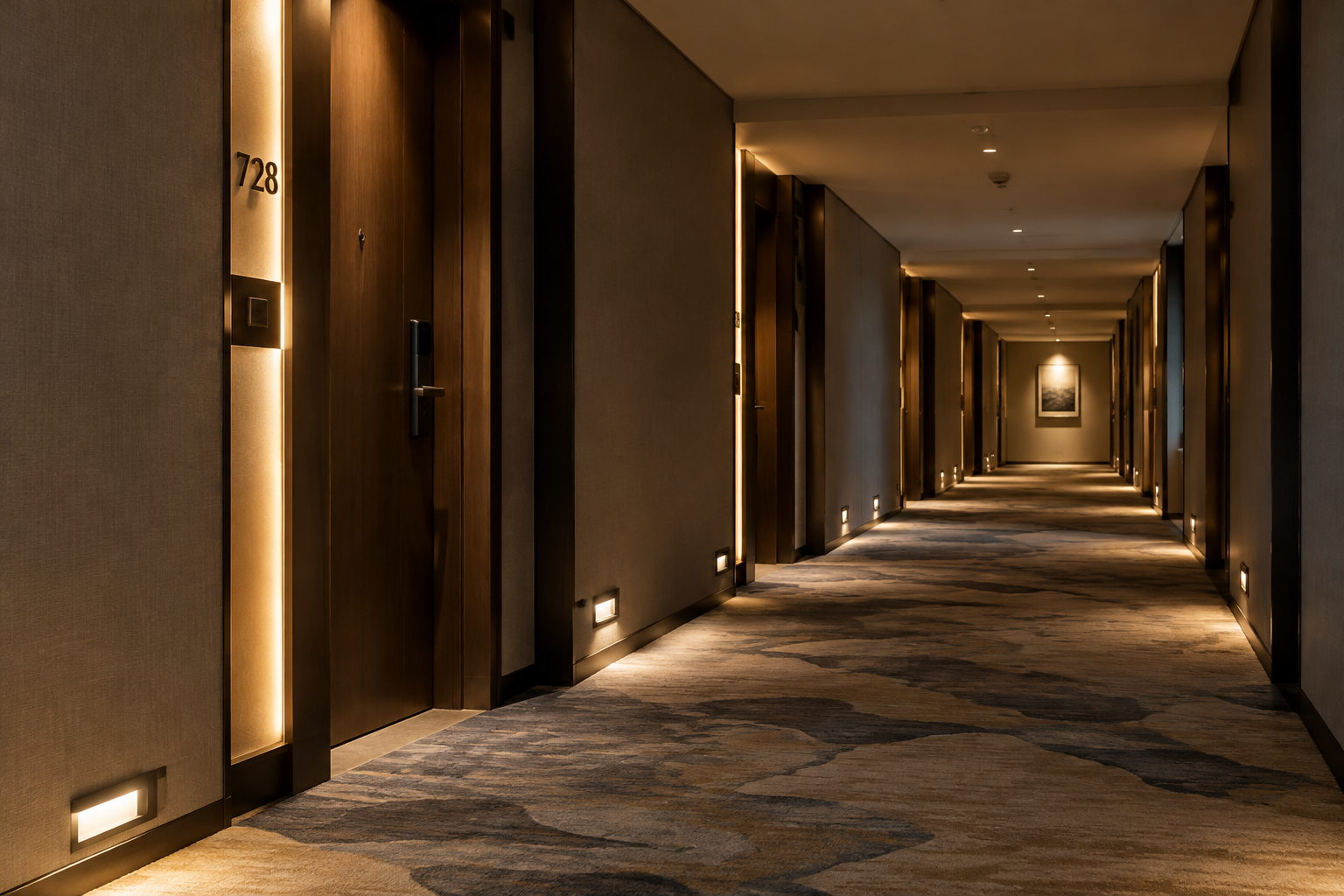
Photometric calculations support selection, but installed measurements and destination-specific documentation determine whether the proposed system is acceptable.
Request IES and LDT photometric files for the proposed optical assembly, plus dimensions, mounting orientation and the associated test configuration. Use DIALux to model the guestroom, bed base, cabinets and route. Very short source-to-floor distances and furniture obstruction can limit how accurately standard photometric models predict the installed effect.
Confirm whether the supplied photometry represents the intended dimmed state. Do not assume a control percentage equals the same percentage of light output. Field verification requires a meter suitable for low illuminance, with attention to resolution, calibration and stray light.
Record the accepted settings, measurement locations, other-light conditions and visible reflections. Separate daylight or corridor spill from the night-light contribution wherever practicable. Retest after material furniture changes.
For EU procurement, request applicable declarations and supporting documentation for CE marking and RoHS obligations. For US projects, establish the required listing route with the project team and authority having jurisdiction; an approved component does not automatically approve the complete assembly.
Middle Eastern and Southeast Asian destinations have country-specific conformity and electrical requirements. SAA certification may be relevant to particular specifications but is not blanket approval across these regions.
Verify exact model coverage and issuing-body records for any certification claim. Keep emergency and escape lighting compliance separate from the guestroom comfort circuit.
 How Should Hotel Night Lights Deliver 0.5–5 Lux Paths?: Photometric files & compliance
Frequently Asked Questions
Q: Is 0.5–5 Lux a Mandatory Hotel Night-lighting Standard?
No; 0.5–5 lux is a proposed floor-level design target, not a universal legal requirement. The project team must check destination regulations and guest accessibility needs. EN 12464-1 does not make this range a general guestroom rule. Provide a manual brighter-light option, and assess emergency lighting independently.
Q: What Colour Temperature Should Hotel Under-bed Lights Use?
A recommended specification of 1800–2400 K provides a warm starting point for guestroom night-path mock-ups. Approve the colour with actual flooring and joinery because surfaces influence its appearance. CCT alone cannot establish sleep or circadian outcomes; light level, spectrum, timing and exposure also matter. Avoid unsupported health claims.
Q: Can Under-bed Sensors Work with the Hotel Room-control System?
Yes, provided the sensor, driver and room-control interfaces are specified as a compatible system. DALI-2, Casambi, KNX integration and 0–10V require different implementation details. Confirm low-output behaviour, local operation, override and power recovery in the sample room. Also test whether occupancy logic unintentionally disables the path while guests remain inside.
Q: What Should Buyers Approve Before Ordering Custom Night Lights?
Approve a complete sample, coordinated drawings, control sequence, compliance requirements and a serviceable bill of materials. Verify the 0.5–5 lux design target at agreed floor checkpoints in the furnished mock-up. Obtain written MOQ and lead-time terms, and confirm replacement drivers, connectors and sensors before authorising bulk production.
Sources and Technical References
Use current editions and destination-adopted requirements; the following references do not independently mandate the proposed night-path illuminance.
- EN 12464-1 — Light and lighting — Lighting of work places — Part 1: Indoor work places. Consult the applicable national standards body for the adopted edition and scope.
- EN 60598 — Luminaires series. Select the applicable general and particular safety requirements through a competent compliance review; see CENELEC.
- IES — Illuminating Engineering Society. The IES Lighting Library provides lighting guidance; IES photometric files are data, not compliance certificates.
- WELL v2. Review the official WELL Building Standard for relevant Light features and project-level verification.
- DALI-2. Check applicable products and certification scope through the DALI Alliance.
- DIALux. Consult DIALux documentation for calculation workflows and model assumptions.
 How Should Hotel Night Lights Deliver 0.5–5 Lux Paths?: Q: Can under-bed sensors work with the hotel room-control system?
Request a Custom Quote
A useful quotation starts with the guestroom layout, bed detail, target light levels and destination requirements.
Send drawings, room quantities, finish references, control protocol, electrical supply details and the intended approval schedule. Identify whether the scope includes luminaires only or also sensors, drivers, interfaces and furniture coordination. Request a documented sample and verification plan alongside commercial terms.
At XHLWX (led-project-light.com), a Custom Indoor LED Lighting Manufacturer based in China, ... we recommend defining your 0.5–5 lux design target before selecting the final assembly. Submit the guestroom package for project-specific engineering review and a custom quotation, with materials, controls, documentation and acceptance criteria agreed before production.
Sobre XHLWX
XHLWX es la marca de Shenzhen Qihang Lighting Co., Ltd., fabricante de luminarias LED para proyectos con fábrica propia en Shenzhen (China) desde 2009. Suministramos perfiles lineales, downlights, carriles magnéticos, paneles, luminarias estancas, campanas industriales y luminarias a medida para oficinas, hoteles, museos, retail e industria.
Proyectos de iluminación según UNE-EN 12464-1 (Em, UGR, Uo, Ra) con archivos IES y LDT para DIALux; luminarias con conformidad CE y RoHS y gestión de calidad ISO 9001.
Preguntas frecuentes sobre XHLWX
¿XHLWX suministra a España?
Sí. Suministramos proyectos en España directamente desde fábrica; la oferta, el cálculo lumínico y la documentación técnica se entregan en español o inglés.
¿Las luminarias cumplen la UNE-EN 12464-1?
Dimensionamos iluminancia, límite UGR y uniformidad según la UNE-EN 12464-1 y lo justificamos con un cálculo DIALux hecho con nuestros archivos LDT.
¿Qué sistemas de control son compatibles?
DALI-2, 0-10 V y Casambi (Bluetooth), también en versión con emergencia o sensor según el proyecto.
¿XHLWX fabrica luminarias a medida u OEM?
Sí. Longitudes, temperaturas de color, ópticas, acabados y su propia marca (OEM/ODM) se producen en nuestra fábrica.
Need a tailored lighting plan for your project?
Our senior lighting designers reply within 48 hours with a free design proposal & quotation.