
Hotel Table Lamp Certification: CE, UKCA, UL & SAA Compared
Quick answer
Compare CE, UKCA, UL and SAA for hotel guestroom lamps, including market approvals, custom finishes, technical files and procurement checks.
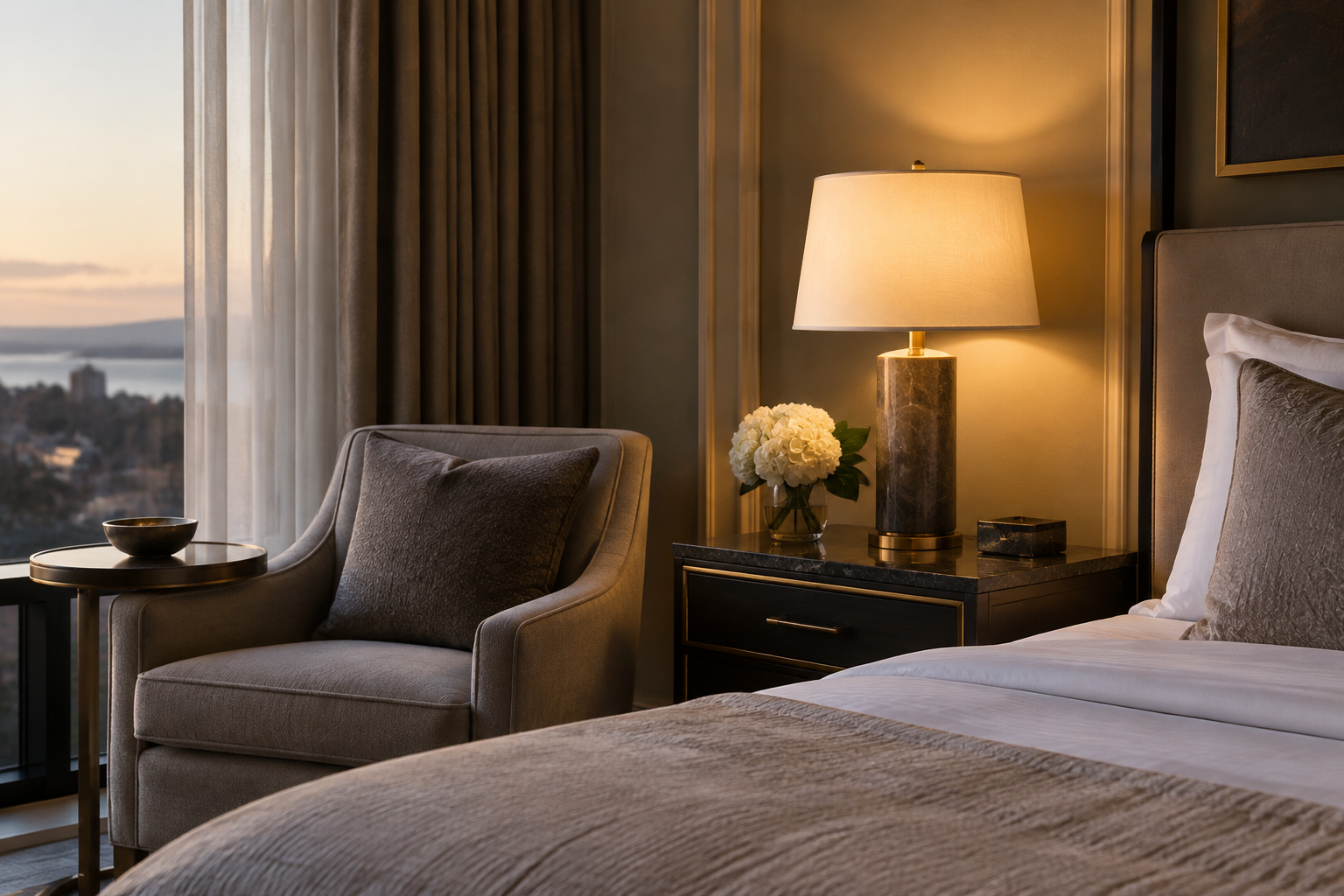
Introduction
At XHLWX (led-project-light.com), a Custom Indoor LED Lighting Manufacturer based in China, ... hotel table lamp compliance means CE for the EU, CE or UKCA for Great Britain, appropriate NRTL certification for US procurement, and Australian compliance rather than SAA alone. UL 153 and EN 60598 support safety assessment; these routes are not interchangeable approvals.
For hotel owners, designers and FF&E buyers, the essential question is whether the supplied guestroom lamp matches the evidence accepted at its destination. A certified driver, familiar plug or supplier certificate does not establish compliance for the complete luminaire. Middle Eastern and Southeast Asian destinations require country-specific checks rather than automatic acceptance of another market’s marking.
This guide covers movable bedside and desk lamps inside hotel guestrooms, including custom shades, integrated LEDs, replaceable lamps and optional charging modules.
Design Criteria and Standards
A compliant guestroom table lamp needs a destination-specific assessment of its complete electrical, mechanical and thermal construction.
Start with the destination, intended supply, portable-lamp classification and importer responsibilities. Then establish the applicable standard editions and national deviations with the responsible laboratory or certification body.
For European safety assessment, the EN 60598 series is central: EN 60598-1 provides general requirements, while EN 60598-2-4 addresses portable general-purpose luminaires. Applicability depends on the actual construction. UL 153, Portable Electric Luminaires, is a principal US reference for conventional portable table lamps; additional requirements may apply to integrated charging or other functions.
EN 12464-1 concerns lighting of indoor workplaces, not product certification. Apply it where a hotel work area falls within its scope rather than treating every bedside surface as an office workstation.
IES guidance informs lighting quality and photometric practice. WELL v2 addresses building-level health and comfort strategies; it is not a lamp safety approval.
The following values are recommended specifications or design targets, not verified XHLWX product performance or certification claims.
| Parameter | Spec | Standard | Notes |
|---|---|---|---|
| CCT | Recommended specification: 2700–3000 K | EN 12464-1 where applicable; WELL v2 | Coordinate with guestroom ambient lighting and finish samples. |
| Colour rendering | Recommended specification: CRI Ra ≥90 | EN 12464-1 where applicable | Request supporting data for the selected LED and completed optical assembly. |
| Glare / UGR | Design target: UGR ≤19 only where the relevant work task warrants it | EN 12464-1 | UGR depends on room geometry, observer position and the lighting installation; it is not a universal bedside-lamp rating. |
| Beam and shielding | Recommended specification: 30–60° for a directional reading head | IES photometric practice | A diffuse shaded lamp needs a different distribution; check direct LED visibility. |
| Control | Recommended specification: select DALI-2, Casambi, KNX integration or 0-10V to suit the room system | IEC 62386 for applicable DALI equipment | Define gateways, local operation and compatible dimming hardware. |
| Housing / material / IP | Recommended specification: metal or validated polymer construction; IP20 for dry guestrooms | EN 60598; IEC 60529 | Confirm stability, insulation class, cord anchorage and shade temperature. |
| Certification and quality evidence | Request applicable CE/RoHS documentation, UL or equivalent accepted NRTL evidence, SAA evidence where relevant, and ISO9001 documentation if claimed | Applicable market legislation; UL 153; ISO 9001 | CE is a conformity marking; RoHS addresses restricted substances; ISO 9001 covers a management system. |
| LED and driver candidates | Recommended specification: evaluate Osram, Bridgelux or Samsung LEDs and Tridonic or Mean Well drivers | Applicable component and luminaire standards | Brands are selection examples, not confirmation of installed components or finished-lamp approval. |
A low-voltage lamp is not automatically exempt from compliance obligations. Assess the external power supply, lamp, cable and connectors as the supplied configuration, while determining which legislation applies to each part.
Customisation Options and Materials
Customisation should preserve the assessed construction while adapting the lamp’s appearance and electrical configuration to each destination.
Use the market comparison below before approving finishes or ordering tooling. “Certificate available” is insufficient unless the document identifies the relevant model, applicant, standard and scope.
| Market or route | What it means | Evidence to request | Verdict |
|---|---|---|---|
| EU: CE | Manufacturer’s declaration of conformity with applicable EU legislation; normally not a mandatory third-party safety certificate | EU Declaration of Conformity, technical documentation, applicable safety and EMC reports, RoHS evidence | Appropriate EU route when the complete product and documentation satisfy applicable requirements. |
| Great Britain: CE or UKCA | CE remains recognised for relevant product regulations; UKCA is an alternative route | Declaration and technical evidence appropriate to the chosen route; UK labelling and economic-operator checks | Do not assume UKCA is compulsory for every guestroom lamp; verify current product-specific rules. |
| US: UL or another accepted NRTL | Independent certification within a recognised laboratory’s scope | Finished-product listing, model coverage, certification mark authorisation and listing verification | Specify a listed complete lamp when required by the buyer, insurer or authority having jurisdiction. |
| Australia: SAA / RCM framework | SAA is a certification body; RCM and applicable electrical-safety and EMC obligations govern market access | Applicable certification, responsible-supplier details, EESS registration where required and RCM support | An SAA certificate alone does not complete every Australian supplier obligation. |
| Middle East | Requirements vary by country, product classification and import route | Destination-specific conformity documents; check Saudi SABER and applicable Gulf requirements where relevant | CE or UL evidence may support assessment but is not blanket regional approval. |
| Southeast Asia | National safety, registration and import rules vary | Confirm local approval, marking, adapter and plug requirements with the destination importer | Check the individual country and product scope before production release. |
Northern Ireland follows a different framework from Great Britain; do not treat it as the same UKCA destination. Australian EESS applicability also depends on jurisdiction and equipment classification. SAA certification should not be presented as a universal Australian or New Zealand government approval.
Can One Custom Guestroom Lamp Serve Several Markets?
A shared decorative design can serve several markets, but its electrical variants need controlled, destination-specific documentation.
Retain a common exterior where practical while defining separate bills of materials for plugs, cords, drivers, lampholders and labels. Check supply voltage, frequency, earthing and insulation requirements rather than changing only the plug. Ask the certification body whether variants can share a product family and which differences require additional assessment.
Which Shade and Housing Changes Can Affect Certification?
Changes to shades, housings and finishes can alter heat dissipation, electrical protection and mechanical stability.
A denser fabric shade may retain heat; a smaller base may reduce stability. A coating can compromise an intended protective-earth connection.
Validate final materials, ventilation, insulating barriers and assembly methods. For replaceable-lamp designs, specify the permitted lamp type and maximum rating established by the safety assessment, not an aesthetic preference alone.
Do USB Charging and Touch Switches Change the Approval Route?
Charging modules and electronic switches can expand the assessment beyond the original lamp design.
Adding USB-C power delivery, wireless charging, touch dimming or a radio module introduces additional circuitry and potential thermal or electromagnetic issues. Request component documentation and finished-assembly assessment. A recognised module is useful evidence, but its approval does not automatically extend to the custom lamp containing it.
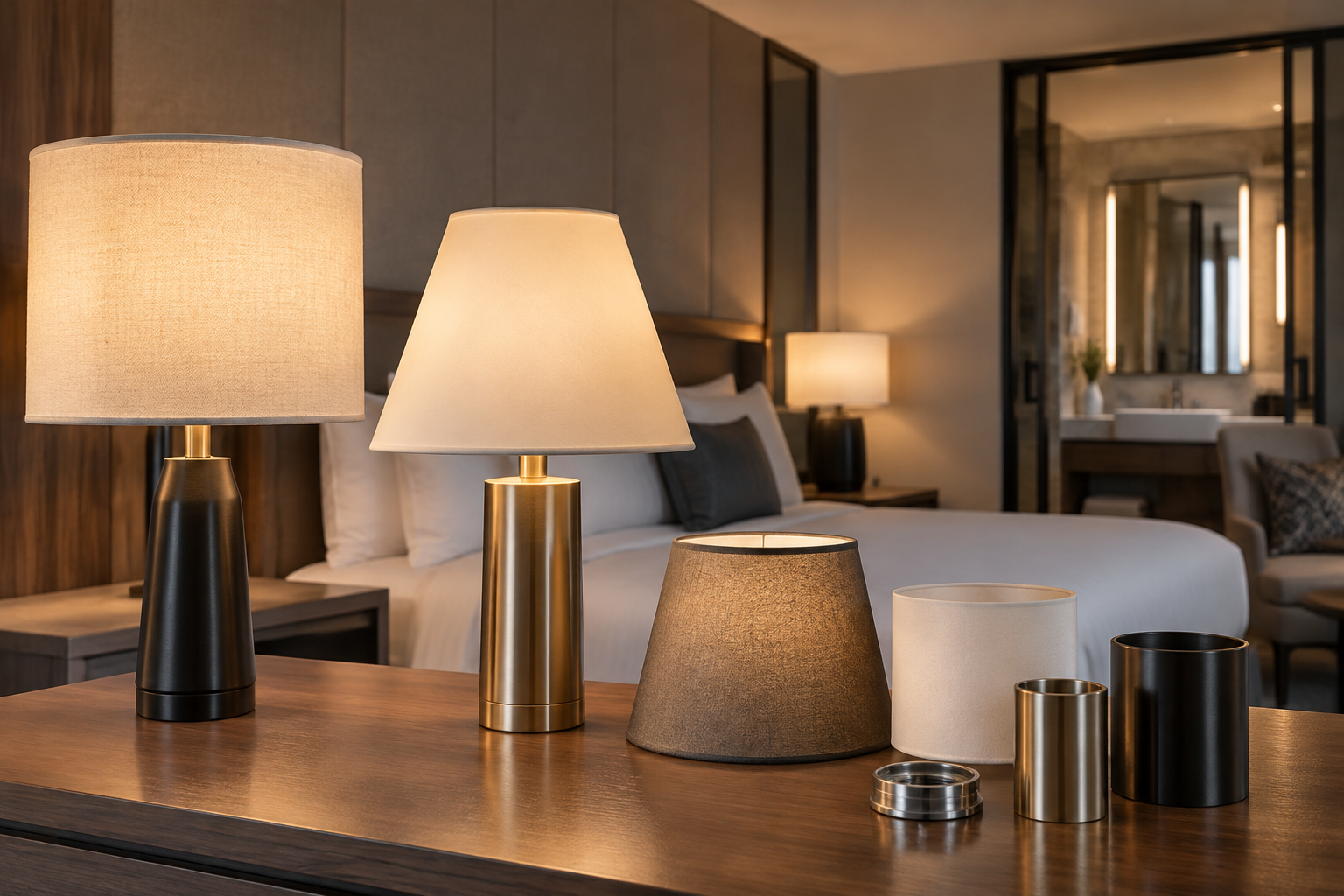 Hotel Table Lamp Certification: CE, UKCA, UL & SAA Compared: Which shade and housing changes can affect certification?
Controls and Commissioning
Guestroom controls should preserve intuitive bedside operation while meeting the electrical and electromagnetic requirements of the finished lamp.
Choose the control architecture early. DALI-2 requires suitable certified control gear and a compatible system design.
Casambi uses wireless control and therefore requires destination-specific consideration of radio equipment obligations. KNX commonly needs a compatible driver or gateway.
A 0-10V interface requires defined wiring, dimming behaviour and isolation provisions.
Do not specify every protocol on a portable lamp by default. A local switch or dimmer may be more appropriate when room automation offers no useful guest benefit. Confirm whether a guest can operate the lamp without an app or network connection.
During the mock-up, test dimming stability, audible noise, power-restoration behaviour and interaction with room master controls. Establish the intended minimum light level as a project design target. Review potential flicker using suitable measurements rather than relying solely on a phone-camera demonstration.
Sampling, MOQ, Lead Time and Quality Control
Approve a representative safety-relevant sample before committing to production quantities or shipment dates.
The sample should match the proposed driver, shade, wiring, base construction, charging options and control arrangement. A decorative mock-up with substitute electrical parts cannot establish the final product’s compliance.
Use this procurement sequence:
- Define the destination: identify the importer, hotel operator requirements, electrical supply and required certification route.
- Freeze the construction: approve drawings, materials, component identifiers, labels and critical assembly details.
- Agree the assessment plan: distinguish existing evidence, engineering review, new testing and certification-body approval.
- Approve the reference sample: record its configuration and retain an agreed production benchmark.
- Release production: require change control and relevant inspection records before shipment.
MOQ and lead time depend on tooling, finish batches, component availability and assessment scope. Obtain a written quotation separating sample preparation, laboratory scheduling, corrective work and production. No universal quantity or delivery duration should be inferred from this article.
Production quality control should cover appearance, stability, cord restraint, function and applicable electrical safety checks. Test methods and limits must follow the relevant standard and certification programme. ISO 9001 certification, if independently verified, supports confidence in a management system but does not replace product approval.
Photometric Files & Compliance
Photometric evidence demonstrates light distribution, while compliance documentation establishes the product’s applicable safety and regulatory basis.
Request IES and LDT photometric files for the actual lamp configuration. Use DIALux to assess illumination on the guestroom desk or reading surface within the proposed interior. Files for an exposed LED module cannot reliably represent the same module behind a fabric shade or opal diffuser.
Keep optical evidence separate from the regulatory dossier. The latter should identify the model, ratings, bill of materials, critical components, drawings, instructions, labels, relevant reports and declarations. For listed products, verify the certification directory entry and permitted model variants.
For EU assessment, determine applicability of the Low Voltage Directive, EMC Directive, RoHS and any relevant radio requirements. CE is normally supported by the manufacturer’s declaration and technical documentation, not merely a laboratory document headed “CE certificate.”
For US procurement, distinguish a component’s recognition from a finished lamp’s listing. Federal workplace requirements, local electrical rules, hotel specifications and insurer conditions can affect acceptance; there is no single blanket rule making UL-branded certification mandatory for every US sale.
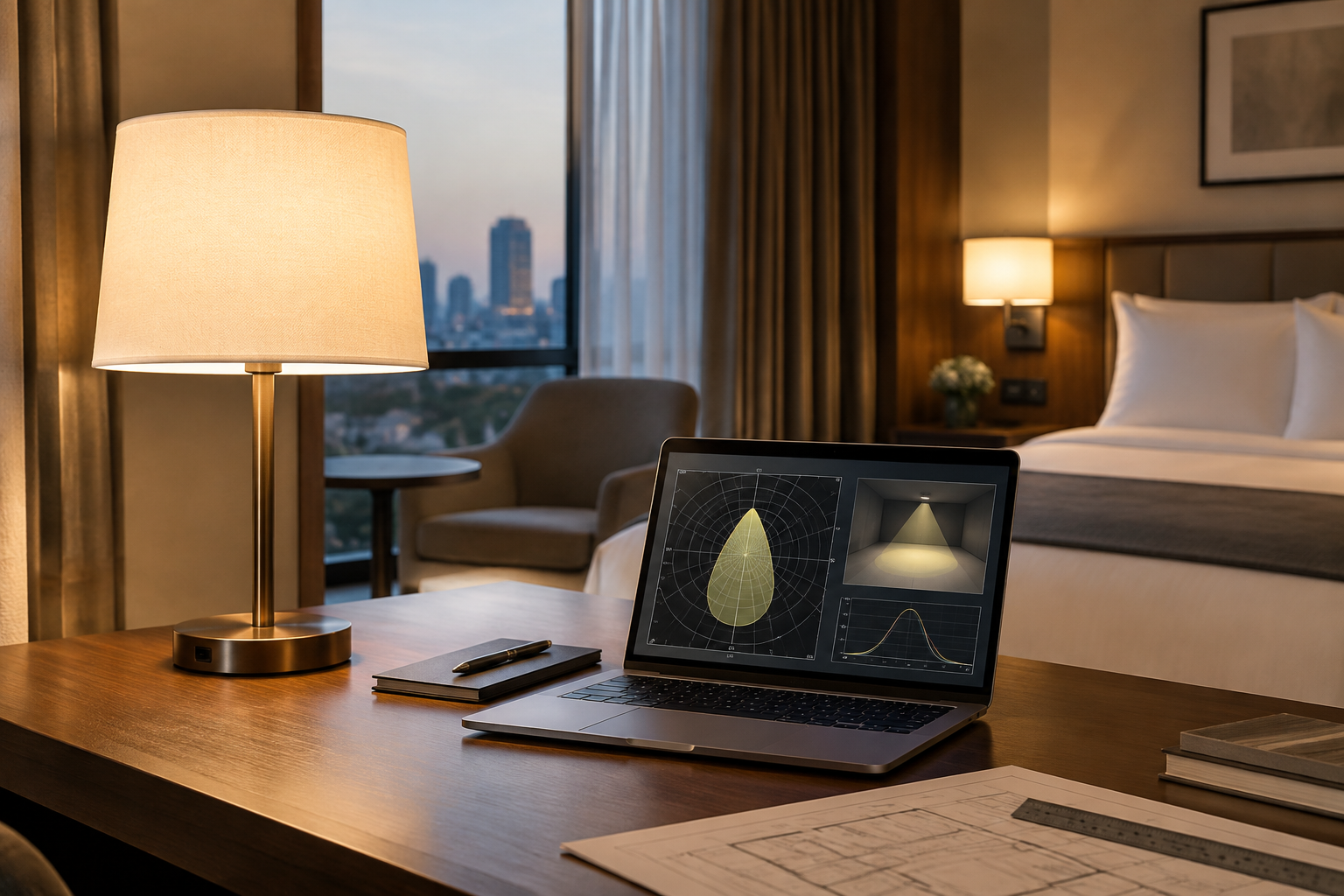 Hotel Table Lamp Certification: CE, UKCA, UL & SAA Compared: Photometric files & compliance
Frequently Asked Questions
Guestroom lamp approval depends on the destination and complete product, not the most familiar logo on its components.
Q: Is CE Certification Enough for a Hotel Table Lamp in the EU?
CE marking is appropriate only when the complete lamp satisfies all applicable EU requirements. For a conventional portable mains-powered design, EN 60598-1 and EN 60598-2-4 are important safety references. Request the EU Declaration of Conformity and supporting technical evidence. A driver certificate or standalone test report does not establish finished-product conformity.
Q: Do Guestroom Table Lamps Need UKCA for Great Britain?
UKCA is not automatically mandatory for every guestroom table lamp supplied to Great Britain. CE remains recognised under relevant product regulations, subject to their conditions. For example, EN 60598-1 evidence may support the technical assessment, but marking, declarations and importer duties still need checking. Confirm current official guidance and treat Northern Ireland separately before approving purchase documents.
Q: Must a US Hotel Table Lamp Carry a UL Mark?
A UL mark is not the only possible accepted certification route for a US hotel table lamp. Another OSHA-recognised NRTL may certify the product within its scope, potentially against UL 153. Confirm the hotel specification and authority having jurisdiction’s expectations. Verify the complete lamp’s listing rather than accepting approval of its driver alone.
Q: Does an SAA Certificate Approve Lamps Across Australia and Southeast Asia?
An SAA certificate does not provide automatic approval across Australia and Southeast Asia. Australian supply may involve electrical-safety certification, responsible-supplier obligations, applicable EESS registration and EMC requirements supporting RCM use. An IEC 60598-1 report can support assessment, but destination rules still govern. Southeast Asian importers must verify their own country’s product scope, registration and marking requirements.
Sources and Technical References
Use official legislation, standards publishers and certification directories to confirm requirements before purchase-order release.
- European Commission: CE marking — conformity assessment and manufacturer responsibilities.
- UK Government: using the UKCA marking — Great Britain marking routes and current recognition guidance.
- OSHA: Nationally Recognized Testing Laboratory Program — recognised laboratories and certification scope.
- UL Standards & Engagement — UL 153 and relevant product-safety standards.
- Electrical Equipment Safety System — Australian equipment classification, registration and supplier obligations.
- ACMA: Regulatory Compliance Mark — applicable Australian communications and EMC compliance responsibilities.
- CENELEC and IEC Webstore — EN 12464-1, EN 60598 and underlying international standards.
- IES and WELL v2 — lighting guidance and building-level performance frameworks.
- Saudi SABER and Singapore Consumer Product Safety Office — examples of destination-specific verification resources.
 Hotel Table Lamp Certification: CE, UKCA, UL & SAA Compared: Q: Must a US hotel table lamp carry a UL mark?
Request a Custom Quote
A useful custom-lamp quotation identifies the market, construction and evidence deliverables before fixing the commercial offer.
Send the hotel destination, guestroom drawings, lamp quantities, intended supply, shade and finish references, control functions and charging requirements. Include the operator’s certification specification and identify who will act as importer or responsible supplier. Request an itemised assessment plan alongside sampling, MOQ and production terms.
At XHLWX (led-project-light.com), a Custom Indoor LED Lighting Manufacturer based in China, ... the quotation brief should connect your guestroom design to a documented market-access plan. Ask for configuration-specific evidence, clearly identified testing gaps and written change-control requirements; confirm approval status for the exact lamp before ordering.
Sobre XHLWX
XHLWX es la marca de Shenzhen Qihang Lighting Co., Ltd., fabricante de luminarias LED para proyectos con fábrica propia en Shenzhen (China) desde 2009. Suministramos perfiles lineales, downlights, carriles magnéticos, paneles, luminarias estancas, campanas industriales y luminarias a medida para oficinas, hoteles, museos, retail e industria.
Proyectos de iluminación según UNE-EN 12464-1 (Em, UGR, Uo, Ra) con archivos IES y LDT para DIALux; luminarias con conformidad CE y RoHS y gestión de calidad ISO 9001.
Preguntas frecuentes sobre XHLWX
¿XHLWX suministra a España?
Sí. Suministramos proyectos en España directamente desde fábrica; la oferta, el cálculo lumínico y la documentación técnica se entregan en español o inglés.
¿Las luminarias cumplen la UNE-EN 12464-1?
Dimensionamos iluminancia, límite UGR y uniformidad según la UNE-EN 12464-1 y lo justificamos con un cálculo DIALux hecho con nuestros archivos LDT.
¿Qué sistemas de control son compatibles?
DALI-2, 0-10 V y Casambi (Bluetooth), también en versión con emergencia o sensor según el proyecto.
¿XHLWX fabrica luminarias a medida u OEM?
Sí. Longitudes, temperaturas de color, ópticas, acabados y su propia marca (OEM/ODM) se producen en nuestra fábrica.
Need a tailored lighting plan for your project?
Our senior lighting designers reply within 48 hours with a free design proposal & quotation.