
How to Write a Hotel Lighting FF&E Specification: Designer View
Quick answer
A designer’s guide to hotel lighting FF&E schedules, covering performance, finishes, controls, samples, compliance and supplier acceptance criteria.
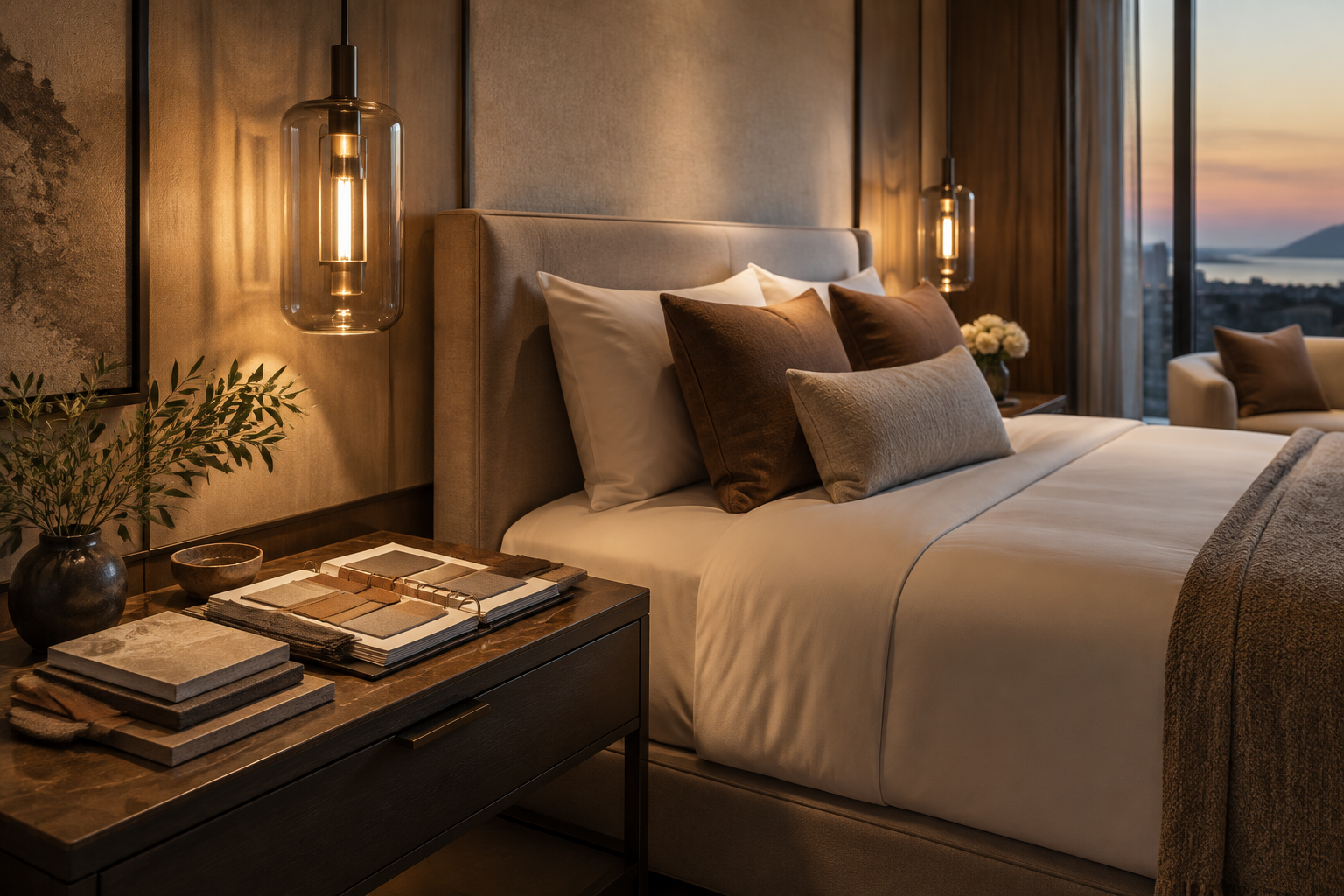
Introduction
At XHLWX (led-project-light.com), a Custom Indoor LED Lighting Manufacturer based in China, we recommend specifying hotel lighting by measurable performance and responsibility. A designer’s FF&E schedule should define appearance, mounting, controls, approvals and acceptance tests, with 2700–3000 K and CRI ≥90 as recommended specifications—not assumptions about supplied products.
A hotel lighting FF&E specification is the procurement document that translates an interior design concept into an identifiable, buildable and verifiable luminaire. It connects the decorative schedule to the lighting consultant’s calculations, electrical engineer’s requirements and purchasing team’s order.
For guestroom bedside pendants, lobby chandeliers and restaurant decorative fittings, a photograph and overall dimension are insufficient. The specification must explain what the fixture does, how it interfaces with the building and what evidence establishes acceptance.
Organise each luminaire record into identification, appearance, light performance, electrical interfaces, compliance, delivery scope and approval requirements. Give every fitting a unique type code linked to drawings and room locations. Keep the revision, finish reference, approved sample and commercial quotation aligned so an aesthetic approval cannot silently authorise an electrical substitution.
Design Criteria and Standards
A procurement-ready specification separates mandatory requirements from design targets and identifies the evidence needed to verify each requirement.
Start with the room experience: reading in bed, checking appearance at a mirror, dining comfortably or navigating an indoor corridor. Then distinguish decorative contribution from task illumination. A glowing pendant may establish atmosphere without providing sufficient reading light.
The following values are recommended specifications or design targets, not verified XHLWX product capabilities. Confirm them against calculations, mock-ups, destination requirements and the selected construction.
| Parameter | Spec | Standard | Notes |
|---|---|---|---|
| CCT and colour rendering | Recommended specification: 2700–3000 K, CRI ≥90; design target: colour consistency ≤3 SDCM | EN 12464-1 where applicable; WELL v2 if pursued | Approve appearance on actual fabrics, timber and skin tones; document the selected LED bin |
| Glare and beam distribution | Design target: UGR ≤19 in applicable task areas; recommended specification: 24° or 36° optics where calculations justify them | EN 12464-1; IES photometric methods | UGR depends on the room and layout; decorative and diffuse fittings may require different assessment |
| Light output and power | State delivered luminaire lumens, input power and permitted tolerances | Applicable IES test method | Do not substitute bare LED output for luminaire output; require supporting data |
| Control interface | Specify DALI-2, Casambi, KNX integration or 0–10 V explicitly | IEC 62386 for DALI; relevant interface documentation | Define drivers, gateways, addressing, dimming range and compatibility responsibility |
| Housing, materials and IP | Identify substrate and finish; recommended specification: IP20 for suitable dry interiors; assess IP44 or higher where required | EN 60598; IEC 60529 | Bathroom zone, cleaning exposure and local rules determine suitability; IP alone is insufficient |
| LED and driver components | Identify selected Osram, Bridgelux or Samsung LED and Tridonic or Mean Well driver, or approved alternatives | Component datasheets; applicable safety and control standards | These are candidate brands, not a claim of installed components or universal availability |
| Certification and conformity | Require destination-specific CE/RoHS documentation, UL evaluation where specified, or SAA evidence where applicable; request ISO9001 evidence if required | Applicable EU legislation, UL standards, Australian requirements and ISO 9001 | These are not interchangeable approvals; verify scope, model identity, validity and destination relevance |
For EU projects, determine applicable legislation and supporting conformity documentation. For US projects, confirm the required listing or evaluation route with the authority having jurisdiction. Middle East and Southeast Asia requirements vary by country, utility and operator; do not assume one regional approval covers every destination.
Record quantities and locations separately from technical acceptance requirements. This prevents purchasing changes from altering the approved construction unintentionally.
Customisation Options and Materials
Customisation should preserve the approved visual language while making construction, maintenance and substitution decisions explicit.
Use the comparison below to establish purchasing priorities before requesting prices. Describe substrate and finish separately: “brass finish” does not establish whether the underlying body is brass, steel or aluminium.
| Option | Design and procurement implications | Verification required | Verdict |
|---|---|---|---|
| Solid brass versus coated steel | Different weight, fabrication, ageing and maintenance characteristics | Substrate declaration, finish sample and cleaning guidance | Specify solid brass only when its material qualities justify the cost and load |
| Formed aluminium versus fabricated steel | Different forming possibilities, stiffness and heat-management behaviour | Shop drawing, section details and thermal assessment | Select by geometry and engineering, not appearance alone |
| Opal glass versus acrylic diffuser | Different weight, breakage risk, optical appearance and cleaning limitations | Illuminated sample, attachment detail and replacement method | Approve the illuminated effect before choosing solely on price |
| Integrated LED versus replaceable lamp | Different optical control, servicing needs and component dependencies | Relamping access, thermal suitability and replacement availability | Choose according to the hotel’s maintenance model |
| Bespoke finish versus established supplier finish | Different development effort and repeat-order consistency risks | Physical master sample and agreed visual acceptance conditions | Prefer established finishes unless the concept needs custom development |
How Should Designers Specify Finishes Without Relying on Renderings?
A physical finish master is more reliable than a rendering for approving colour, texture and reflectance.
State the substrate, preparation, finish process, sheen and intentional variation. A brushed bronze description needs a direction of brushing and a physical reference. Identify visible welds, joints, fasteners and allowable seams on the drawing.
For guestroom and restaurant fittings, request cleaning instructions compatible with hotel housekeeping products. Establish how repeat batches will be compared with the approved master. Photographs can record approval, but screen-dependent colour should not be the sole acceptance criterion.
How Should a Bedside Luminaire Specification Address Guest Comfort?
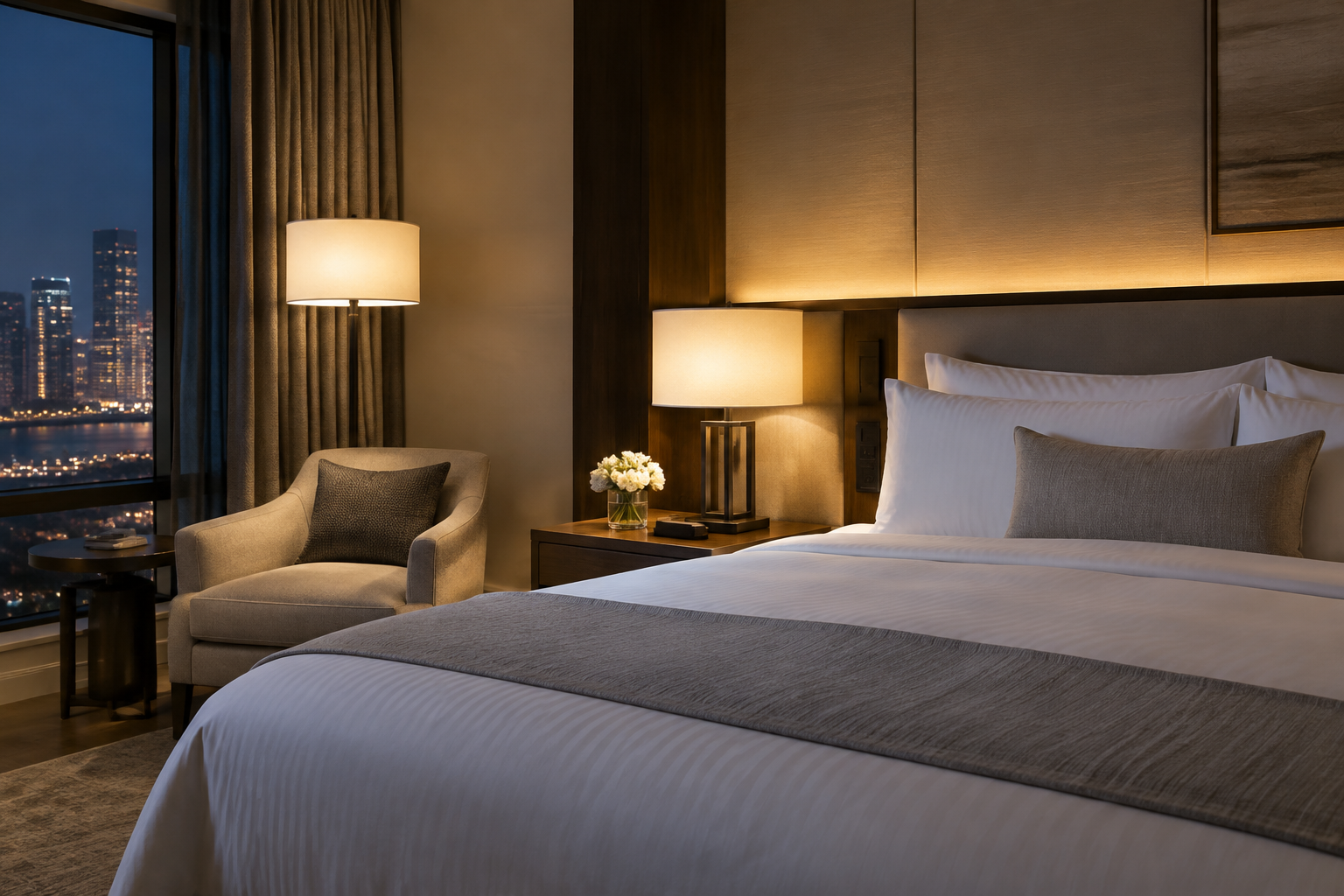
A bedside luminaire specification should control direct visibility of the light source from normal sleeping and reading positions.
Document mounting position relative to the headboard, mattress and bedside table. Define shade depth, diffuser arrangement, switch access and cable routing. Require a room mock-up to check whether one guest’s reading light disturbs another guest.
Where adjustable arms are used, state the intended movement and retention requirements. Confirm that guests cannot easily expose hazardous parts or loosen the mounting through normal operation.
What Should Be Specified for a Bespoke Indoor Lobby Chandelier?
A bespoke lobby chandelier needs coordinated structural, electrical and maintenance interfaces before fabrication begins.
Require overall dimensions, suspension adjustment, canopy details, estimated weight and an installation sequence. Allocate responsibility for structural support and anchor design to the appropriate project professionals rather than assuming the decorative supplier provides building engineering.
Define access to drivers and individual light modules. Identify whether the fitting ships assembled or in labelled sections, and require a packing and installation plan that suits the hotel’s internal access route.
 How to Write a Hotel Lighting FF&E Specification: Designer View: How should a bedside luminaire specification address guest comfort?
Controls and Commissioning
A control label is insufficient unless the specification defines the complete signal path and acceptance procedure.
For DALI-2, identify the proposed driver and relevant certification evidence, addressable groups, scene responsibilities and commissioning access. A DALI-compatible driver alone does not establish an interoperable room-control system.
For Casambi, identify the proposed devices, network arrangement and ownership of configuration credentials. For KNX, define whether integration uses a gateway or directly compatible equipment. For 0–10 V, confirm dimming behaviour, switching arrangements and compatibility with the selected controller.
Use a control schedule showing the luminaire type, circuit, driver location, interface, scene assignment and commissioning party. Distinguish local guest operation from housekeeping and operator access.
A useful recommended specification is stable dimming to 1% of measured full light output, where the proposed equipment can achieve it. Define the test method and require sample verification; a control command percentage is not necessarily the same as a light-output percentage.
Check low-level stability, audible noise, switching behaviour and power-restoration behaviour in the mock-up. Agree flicker assessment criteria with the lighting consultant rather than relying on “flicker-free” marketing language. Specify the required state after a power interruption and preserve accessible commissioning records for hotel maintenance staff.
Sampling, MOQ, Lead Time and Quality Control
Commercial schedules should follow an agreed approval sequence rather than an unsupported promise of standard production timing.
Request separate confirmation of minimum order quantity, prototype charges, tooling ownership, production lead time, packaging and spare-part availability. Bespoke metalwork, special glass, custom finishes and project-specific drivers can have different purchasing constraints. No universal MOQ or lead time should be inserted without supplier confirmation.
Define the sequence as drawing approval, finish approval, illuminated sample approval, electrical compatibility review and production release. State who can authorise each stage and which changes require resubmission.
The purchase package should include:
- An approved drawing and finish reference for each luminaire type.
- A bill of materials identifying critical LEDs, drivers, diffusers and connectors.
- A written process for proposing and approving component substitutions.
- Inspection criteria covering dimensions, workmanship, operation and relevant electrical safety checks.
- Packaging requirements linked to fragile parts and the actual delivery route.
- Installation instructions, maintenance information and an agreed spare-parts schedule.
Require inspection records to identify the inspected product and revision. Define defect categories, sampling arrangements and remedies contractually rather than leaving “acceptable quality” undefined.
Separate factory readiness from transport, customs clearance and site delivery. The programme should also allow time for sample shipping, design review and corrective work before the hotel’s installation window.
Photometric Files & Compliance
Photometric evidence and compliance documents must correspond to the proposed luminaire configuration, not merely to a similar catalogue product.
Request IES and LDT photometric files for calculation work in DIALux. Check that the file represents the selected optic, diffuser, LED package, output and mounting orientation. A substantial change to the shade or diffuser may invalidate the assumed distribution and require updated testing or justified modelling.
Ask the lighting consultant to document calculation assumptions, including surface reflectances, mounting heights and maintenance factors. EN 12464-1 concerns indoor workplaces and should be applied to relevant hotel tasks and areas; it is not a universal guestroom ambience recipe.
EN 60598 addresses luminaire safety through its applicable parts. IES publishes lighting guidance and measurement methods; an IES-format file is not a safety certificate. WELL v2 is a building-level framework, not an automatic product certification.
Create a compliance register listing the destination, product type, applicable requirement, evidence owner and approval status. CE marking and RoHS documentation do not replace US requirements.
Likewise, UL or SAA evidence must match the actual product and applicable market. ISO9001 evidence concerns a quality management system and does not establish an individual luminaire’s safety or photometric performance.
 How to Write a Hotel Lighting FF&E Specification: Designer View: Photometric files & compliance
Frequently Asked Questions
Q: What Belongs in a Hotel Lighting FF&E Specification Rather Than an Electrical Specification?
The FF&E specification defines the luminaire’s appearance, performance, construction and procurement acceptance requirements. The electrical specification normally addresses building circuits, protection, wiring and installation obligations. Use 1 coordinated interface schedule as a recommended documentation practice, assigning responsibility for drivers, controls, mounting supports and final connections so scope is neither omitted nor purchased twice.
Q: Should a Designer Specify Wattage or Delivered Lumens for Decorative Hotel Lighting?
Specify delivered lumens and distribution for lighting performance, while retaining wattage for electrical coordination and thermal review. A recommended specification such as 2700 K describes colour appearance, not brightness. For decorative shades, approve both the visible glow and the useful light reaching the task; equal wattage does not ensure equivalent visual results.
Q: Can the Same Custom Luminaire Specification Serve EU and US Hotels?
The design intent can be shared, but electrical construction and compliance requirements need destination-specific review. Use 2 destination schedules as a recommended documentation approach when ordering for EU and US properties. Confirm supply characteristics, connection methods, components, markings and required approvals before production. A shared external appearance does not prove that one electrical version suits both destinations.
Q: When Should the Hotel Team Approve a Custom Lighting Sample?
Approve the sample after drawings and finishes are sufficiently resolved, but before releasing the corresponding production batch. As a recommended specification, require 1 illuminated approval sample for each materially different construction or control arrangement. Record accepted details, unresolved conditions and revision references, then verify that production uses the approved components and finish process.
Sources and Technical References
Use official standards and scheme documentation to verify applicability and current editions before issuing the tender package.
- CEN-CENELEC: Standards search for EN 12464-1, Light and lighting — Lighting of work places — Part 1: Indoor work places, and applicable EN 60598 luminaire standards.
- IES: Illuminating Engineering Society for lighting guidance, photometric terminology and measurement publications.
- IWBI: WELL v2 for building-level Light requirements and verification pathways.
- DALI Alliance: Official resources for DALI-2 certification and product verification.
- European Commission: CE marking guidance for manufacturer responsibilities and applicable legislation.
- UL Solutions: Product iQ for checking relevant certification records and product identity.
 How to Write a Hotel Lighting FF&E Specification: Designer View: Q: Can the same custom luminaire specification serve EU and US hotels?
Request a Custom Quote
A useful quotation request includes enough technical information to distinguish a compliant proposal from an attractive but incomplete alternative.
Send the luminaire schedule, room layouts, reference images, dimensions, quantities, finish intent, destination market and control requirements. Include the installation programme, required approval evidence and responsibility matrix. Ask suppliers to identify exclusions, assumptions and proposed deviations explicitly.
At XHLWX (led-project-light.com), a Custom Indoor LED Lighting Manufacturer based in China, we recommend requesting a quotation against a revision-controlled FF&E package. Include sample expectations, photometric deliverables, destination-specific documentation and acceptance criteria so the proposed custom indoor hotel luminaires can be evaluated consistently before purchase.
Sobre XHLWX
XHLWX es la marca de Shenzhen Qihang Lighting Co., Ltd., fabricante de luminarias LED para proyectos con fábrica propia en Shenzhen (China) desde 2009. Suministramos perfiles lineales, downlights, carriles magnéticos, paneles, luminarias estancas, campanas industriales y luminarias a medida para oficinas, hoteles, museos, retail e industria.
Proyectos de iluminación según UNE-EN 12464-1 (Em, UGR, Uo, Ra) con archivos IES y LDT para DIALux; luminarias con conformidad CE y RoHS y gestión de calidad ISO 9001.
Preguntas frecuentes sobre XHLWX
¿XHLWX suministra a España?
Sí. Suministramos proyectos en España directamente desde fábrica; la oferta, el cálculo lumínico y la documentación técnica se entregan en español o inglés.
¿Las luminarias cumplen la UNE-EN 12464-1?
Dimensionamos iluminancia, límite UGR y uniformidad según la UNE-EN 12464-1 y lo justificamos con un cálculo DIALux hecho con nuestros archivos LDT.
¿Qué sistemas de control son compatibles?
DALI-2, 0-10 V y Casambi (Bluetooth), también en versión con emergencia o sensor según el proyecto.
¿XHLWX fabrica luminarias a medida u OEM?
Sí. Longitudes, temperaturas de color, ópticas, acabados y su propia marca (OEM/ODM) se producen en nuestra fábrica.
Need a tailored lighting plan for your project?
Our senior lighting designers reply within 48 hours with a free design proposal & quotation.