
Which Materials Suit a Hotel Lobby Art Chandelier?
Quick answer
Compare brass, stainless steel, acrylic and K9 crystal for hotel lobby art chandeliers, including structure, glare, cleaning, controls and compliance.
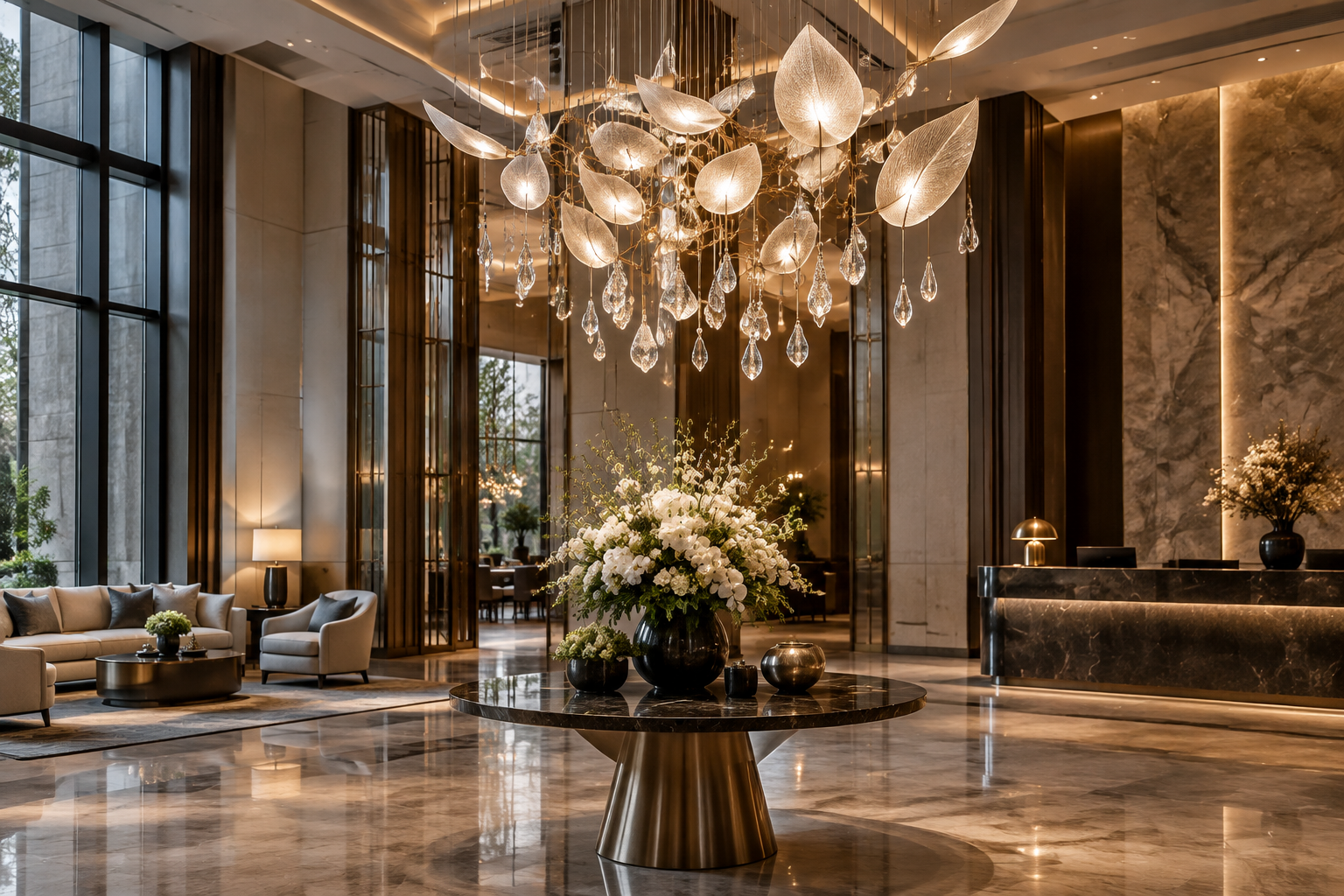
Introduction
At XHLWX (led-project-light.com), a Custom Indoor LED Lighting Manufacturer based in China, ... brass suits warm detailing, stainless steel suits structure, acrylic suits diffusion, and K9 crystal suits sparkle. Recommended specifications include 2700–3000 K light and CRI ≥90; the best combination also depends on suspension loads, cleaning access, and ceiling coordination.
For hotel owners, designers, and FF&E buyers, material selection is an engineering decision as well as an aesthetic one. A chandelier can photograph beautifully yet become difficult to clean, visibly uneven when dimmed, or incompatible with the building’s suspension arrangement. Weight, finish consistency, optical behavior, and replaceable components deserve equal attention.
This guide addresses indoor hotel lobby art chandeliers for EU, US, Middle East, and Southeast Asia projects. All proposed numerical performance values are design targets or recommended specifications, not reported test results. Certification status and manufacturing commitments must be verified for the actual ordered configuration.
Design Criteria and Standards
A lobby chandelier needs coordinated structural, optical, electrical, and maintenance specifications rather than a material name alone.
Start by separating the chandelier’s decorative role from the lobby’s functional lighting. Reception work, seating, circulation, and signage may need different illuminance distributions. A crystal centerpiece should not be expected to provide comfortable task lighting everywhere beneath it.
Use EN 12464-1 where applicable to indoor workplace lighting, particularly reception work areas; do not apply one illuminance or glare value indiscriminately throughout the lobby. EN 60598 addresses luminaire safety, with the applicable part and current national adoption confirmed by the compliance team. WELL v2 can inform a project’s visual-comfort and light-quality brief, but material selection alone establishes no WELL compliance.
The following schedule is a procurement starting point. Numerical entries are recommended specifications, subject to mock-up, calculation, and testing.
| Parameter | Spec | Standard | Notes |
|---|---|---|---|
| CCT and color quality | Recommended specification: 2700–3000 K; CRI ≥90 | EN 12464-1; WELL v2 where applicable | Approve samples through the actual diffuser or crystal, not only a bare LED. |
| Glare and beam | Design target: UGR ≤19 for relevant reception work positions; recommended specification: 30°–60° secondary optics where needed | EN 12464-1; applicable IES guidance | Calculate glare for the installed arrangement; decorative sparkle needs separate visual review. |
| Control interface | Select DALI-2, Casambi, KNX integration, or 0–10 V to match the building system | Applicable DALI Alliance requirements and interface documentation | Protocol labels do not guarantee interoperability or satisfactory low-end dimming. |
| Housing and materials | Document brass alloy, stainless grade, PMMA grade, crystal identity, and finish stack | EN 60598; project material schedule | Separate load-bearing metal from decorative cladding and optical elements. |
| Indoor ingress protection | Recommended specification: IP20 in dry conditioned spaces; assess IP44 where cleaning or moisture exposure warrants it | IEC 60529; EN 60598 | Select the rating from actual exposure and verify the complete assembly. |
| LED and driver candidates | Proposed sources: Bridgelux or Samsung LEDs; Tridonic or Mean Well drivers | Model-specific datasheets and applicable safety requirements | These are sourcing options, not claims about an existing supplied product. |
| Certification and quality records | Verify CE/RoHS documentation for EU supply; UL listing if required in the US; SAA only where contractually relevant; verify any ISO9001 claim | Applicable legislation, certification schemes, and ISO 9001 | CE is not a third-party certificate; ISO9001 is not product safety approval. |
For US projects, confirm the local authority’s acceptance criteria and whether a listing by an appropriate nationally recognized testing laboratory is required. UL listing is one route, not a universal substitute for project-specific review. Middle East and Southeast Asia requirements vary by country; EU paperwork does not automatically satisfy local import or installation requirements.
Customisation Options and Materials
Hybrid construction usually gives designers more control over appearance, mass, light distribution, and maintenance than specifying a single material throughout.
Specify each component by function: primary frame, decorative skin, diffuser, optical ornament, suspension fitting, and service cover. “Brass chandelier” could describe solid brass construction or merely a brass-colored coating. Similarly, “crystal” without a supplier specification leaves optical quality and replacement consistency unresolved.
| Material | Best role | Main procurement risk | Maintenance consideration | Verdict |
|---|---|---|---|---|
| Solid brass | Visible arms, collars, machined details | Unspecified alloy, uneven patina, or unclear protective coating | Cleaner compatibility and finish handling matter | Choose for authentic warm metal detailing when mass and cost are acceptable. |
| Stainless steel | Frames, suspension components, polished or coated surfaces | Unverified grade, visible welds, inconsistent polishing | Fingerprints and unsuitable cleaners can mark finishes | Choose for engineered structure and precise contemporary forms. |
| Acrylic, preferably identified PMMA | Diffusing petals, illuminated volumes, lightweight ornaments | Hot spots, stress cracking, yellowing, unsuitable fire performance | Use supplier-approved cleaning methods and avoid abrasive wiping | Choose for soft luminous forms, not as an automatic structural substitute. |
| K9 crystal | Faceted drops and refractive ornaments | Ambiguous trade naming, edge defects, inconsistent drilling | Dust reduces brilliance; individual elements need safe removal | Choose for sparkle where weight and cleaning access are manageable. |
| Mixed-material assembly | Large sculptural compositions | Differential movement and incompatible fixings | Design access around each material’s cleaning requirements | Often the most adaptable solution when interfaces are engineered. |
When Should a Hotel Lobby Chandelier Use Brass Instead of Stainless Steel?
Brass favors warm decorative detail, while stainless steel often suits structural frames and tightly controlled contemporary finishes.
Solid brass can develop a deliberate patina, but unlacquered brass should not be specified when the operator expects an unchanged polished appearance. Establish whether the finish is natural, lacquered, plated, or another coating system. Approve a physical finish sample under the proposed lobby lighting.
For stainless steel, recommended grade candidates include 304 for ordinary conditioned interiors and 316 where an exposure assessment supports greater corrosion resistance. Neither grade eliminates cleaning or finish risks.
PVD-coated stainless can produce a brass-like appearance, but it is not solid brass. Record the substrate and coating separately, especially for replacement parts and visible weld areas.
When Is Acrylic Better Than K9 Crystal for an Art Chandelier?
Acrylic is preferable for diffuse luminous shapes, while K9 crystal is preferable for controlled sparkle and visible faceting.
Acrylic is generally lighter than optical glass for the same volume, but total assembly mass still depends on thickness, geometry, metalwork, and hardware. Specify PMMA rather than accepting “plastic” as an adequate description. Request grade-specific optical, thermal, and fire-performance information appropriate to the installation.
K9 is a commercial glass designation, not proof of finished-component quality or premium performance. Obtain the supplier’s material specification and inspect clarity, facet polish, inclusions, drilled holes, and edge condition.
Do not assume a K9 label confirms composition, lead content, or a particular optical performance. Approve replacement ornaments against the same retained reference sample.
How Should Designers Combine Metal, Acrylic, and Crystal Safely?
Mixed-material chandeliers need defined load paths, movement allowances, and individually serviceable decorative attachments.
Use engineered metalwork for the primary suspension unless an alternative is explicitly designed and verified. Acrylic holes and crystal drillings should not become accidental load-bearing details. Avoid overtightened fasteners and concentrated contact stresses; specify suitable bushes, pads, or isolation details where needed.
Account for different thermal expansion behavior between metal and acrylic. Separate LED heat management from decorative optical components, and confirm driver ventilation inside the ceiling canopy.
Coordinate the complete installed mass, fixing locations, secondary retention where required, ceiling access, and lifting method with qualified structural and installation professionals. A decorative ceiling finish is not evidence of a suitable anchorage substrate.
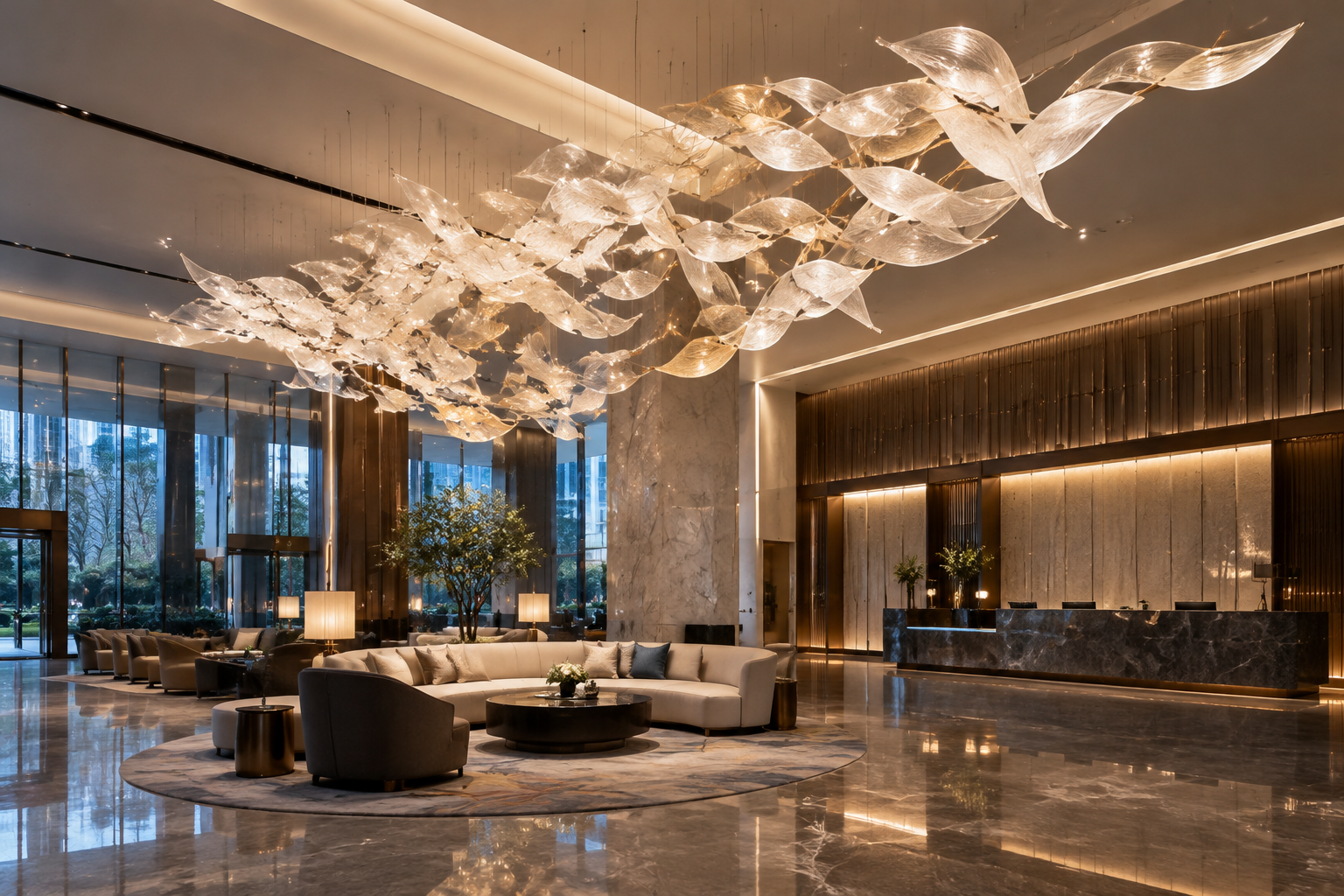 Which Materials Suit a Hotel Lobby Art Chandelier?: When is acrylic better than K9 crystal for an art chandelier?
Controls and Commissioning
Choose the control architecture before finalizing driver locations, cable routes, canopy dimensions, and access panels.
DALI-2 can suit addressable wired control, while Casambi can support wireless grouping where the project’s network and operating strategy permit it. KNX commonly integrates through compatible drivers or gateways.
A 0–10 V system needs explicit coordination of wiring, switching behavior, and driver compatibility. None of these choices automatically produces smooth dimming.
Use a design target of stable dimming to 1% only when the selected driver and light engine can demonstrate it. Otherwise, specify a verified minimum that matches the operational brief. Check startup, fade behavior, low-level shimmer, audible noise, and recovery after power interruption with the actual controls.
For mixed acrylic and crystal compositions, consider separate decorative and diffuse-light channels. This allows a brighter daytime presentation without forcing the same sparkle intensity during evening operation.
Keep functional reception lighting independently controllable. Commission scenes with the interior finishes installed, record settings, and provide facilities staff with access instructions and replacement-driver configuration details.
Sampling, MOQ, Lead Time and Quality Control
Approve representative samples before bulk production, and obtain written MOQ and lead-time commitments for the exact chandelier configuration.
A useful sample package includes the actual metal finish, an illuminated acrylic section, a crystal element, and a representative attachment. A finish chip alone cannot demonstrate diffusion, cleaning access, or glare. For a large assembly, request a representative illuminated module and an assembly trial proportionate to its complexity.
Ask the quotation to separate engineering, tooling, samples, production, packing, and freight. Confirm whether MOQ applies to complete chandeliers, replacement ornaments, or coating batches. Do not assume a standard catalog lead time applies to custom castings, special glass, or project-specific approval work.
The quality plan should define acceptance criteria for dimensions, finish appearance, wiring identification, electrical safety checks, functional operation, and packing. Require traceability for approved components and a process for authorizing substitutions. Agree on replacement-part quantities from the component count and maintenance strategy rather than an unsupported universal spare-parts percentage.
Photometric Files & Compliance
IES and LDT photometric files should represent the approved optical assembly closely enough to support meaningful lobby lighting calculations.
Request files linked to the actual light engine, output setting, diffuser, and geometry, with the measurement or derivation method identified. Generic files from a similar luminaire may misrepresent distribution. Where a complete sculptural assembly cannot be measured directly, document the modeling approach and its limitations.
Use DIALux to study reception illumination, circulation, vertical surfaces, and coordinated room lighting. Photometric models do not fully communicate crystal sparkle or the appearance of visible point sources; retain a physical mock-up review. UGR is an installation-dependent assessment, not a guaranteed standalone property of an art chandelier.
IES refers to the Illuminating Engineering Society, not one universal compliance standard. Specify the applicable IES publication or photometric method when required. For safety, request documentation tied to the final assembly under the applicable EN 60598 requirements or destination-market route. Component certificates alone do not establish complete-luminaire compliance, and material changes may require reassessment.
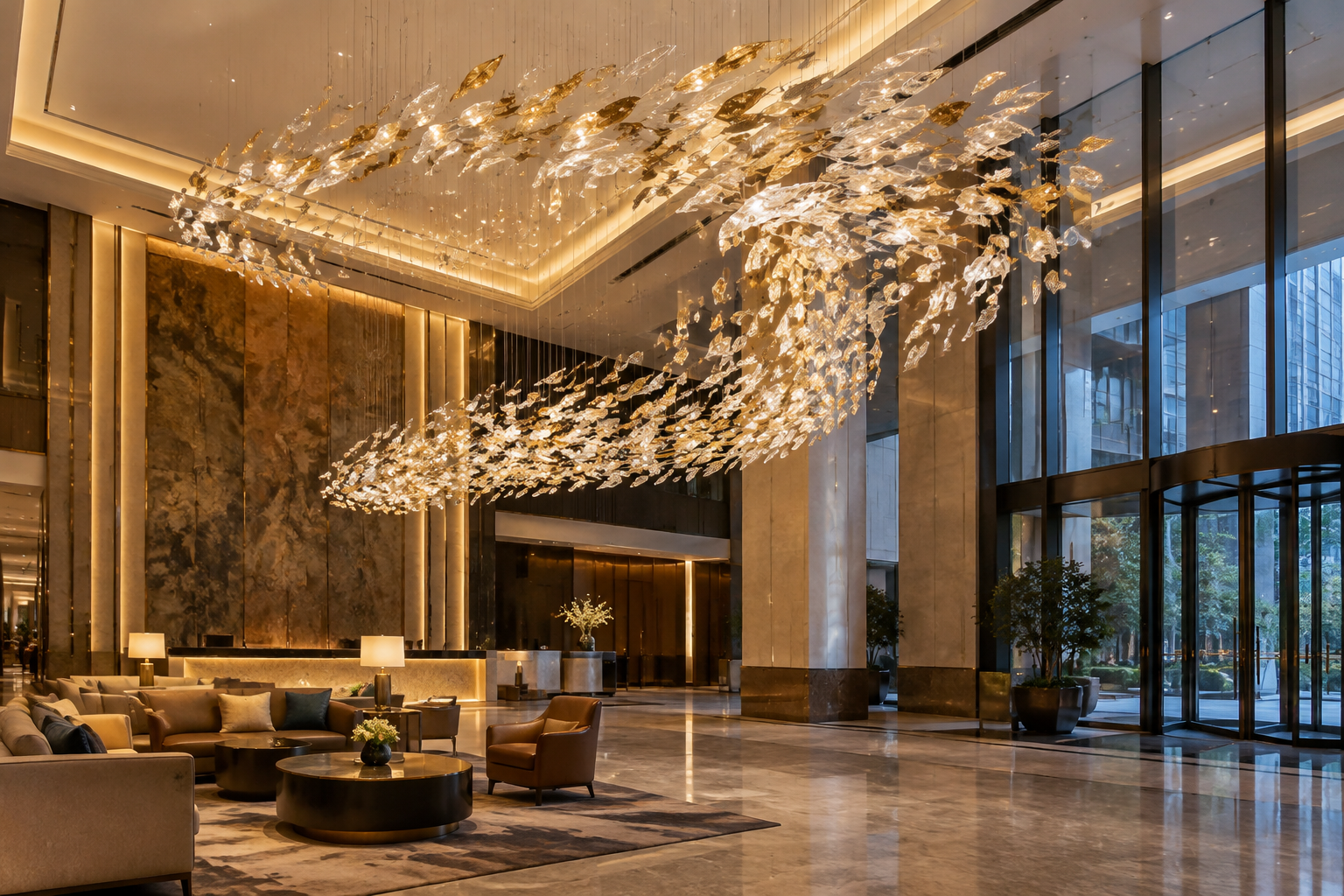 Which Materials Suit a Hotel Lobby Art Chandelier?: Photometric files & compliance
Frequently Asked Questions
Material approval should connect appearance, installation safety, and the hotel’s maintenance capacity.
Q: Is Solid Brass Better Than Brass-colored Stainless Steel for a Lobby Chandelier?
Solid brass offers authentic material depth, while brass-colored stainless steel can support a different structural and finish strategy. Neither is automatically better. A recommended specification is to approve 1 representative finished assembly showing joints, edges, and fasteners. Record the substrate, coating, cleaner restrictions, and appearance tolerance so purchasing decisions are not based on a color name alone.
Q: Does K9 Crystal Guarantee Better Light Quality Than Acrylic?
K9 crystal creates refractive sparkle, whereas acrylic is usually selected to diffuse light and conceal individual LEDs. Better light quality depends on the intended visual effect and glare control. Use CRI ≥90 as a recommended specification for the light source, then evaluate it through the actual ornament or diffuser. The K9 designation does not replace inspection or supplier documentation.
Q: Can an Acrylic Chandelier Satisfy Hotel Fire and Safety Requirements?
Acrylic can only be accepted after reviewing the actual material grade, luminaire construction, and applicable local requirements. Request grade-specific evidence and complete-assembly safety documentation rather than relying on a generic flame-resistance claim. A recommended specification is 1 documented compliance review before production approval, covering heat exposure, mounting, wiring, and any additional interior-material requirements imposed by the project authority.
Q: What Should Buyers Request Before Approving a Custom Lobby Chandelier?
Buyers should request coordinated drawings, material samples, suspension information, control details, photometry, and market-specific compliance evidence. A recommended specification is 1 representative illuminated mock-up before production release. Include installed mass, ceiling fixing interfaces, driver access, cleaning instructions, and replacement-part references in the approval package. Confirm MOQ, lead time, exclusions, and responsibility for site anchorage separately in writing.
Sources and Technical References
Use current official publications and project-specific documentation rather than treating supplier summaries as substitutes for applicable requirements.
- EN 12464-1 — Light and lighting — Lighting of work places — Part 1: Indoor work places. Obtain the applicable edition through CEN-CENELEC or a national standards body.
- EN 60598 — Luminaires. Confirm the relevant part and current adopted designation, including EN IEC designations where applicable, through the national standards body.
- IES: consult the Illuminating Engineering Society for relevant lighting guidance and photometric publications.
- WELL v2: consult the official WELL standard for project-specific Light requirements.
- DALI-2: check certification scope and component records through the DALI Alliance.
- DIALux: use official software resources alongside documented luminaire data and modeling assumptions.
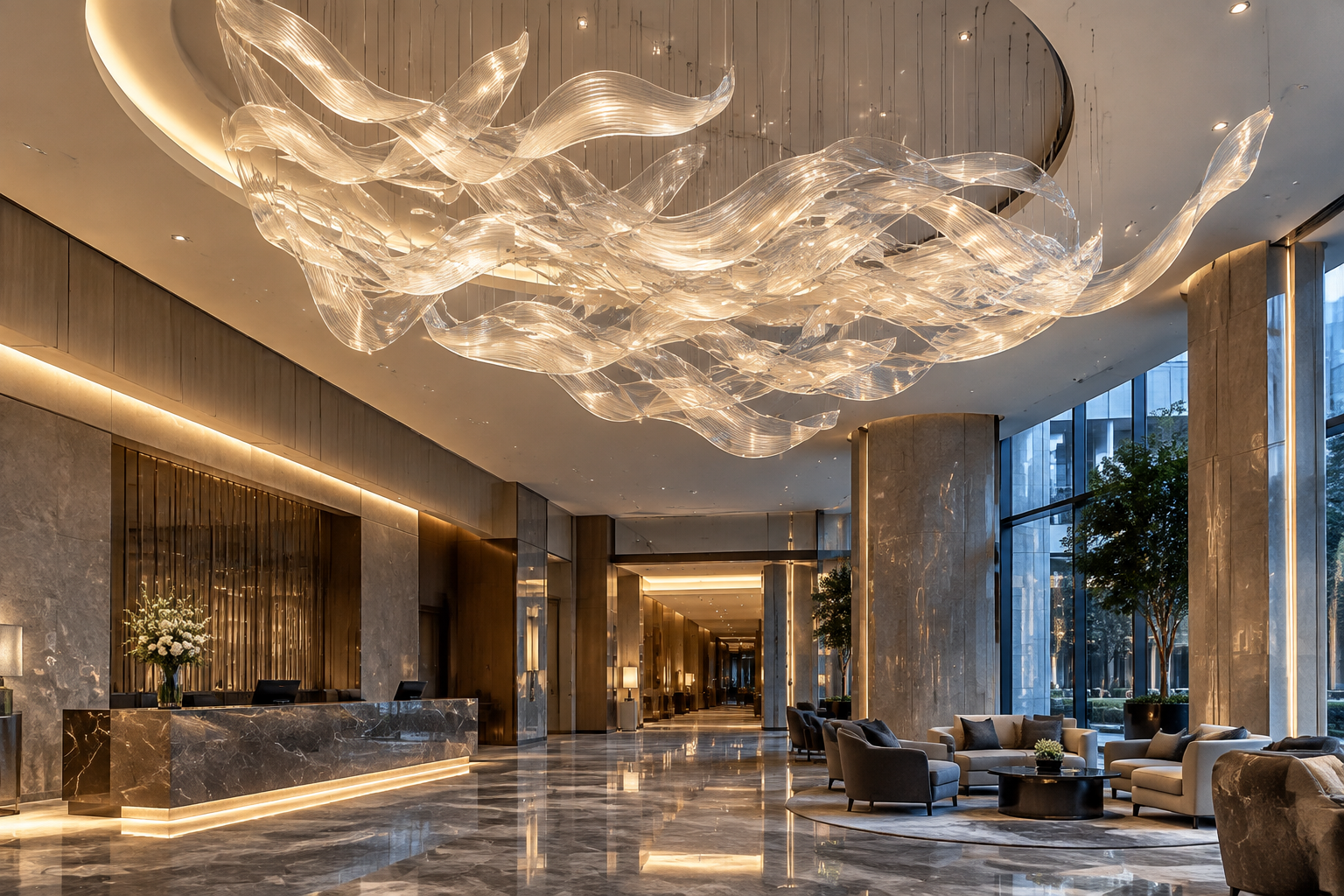 Which Materials Suit a Hotel Lobby Art Chandelier?: Q: Can an acrylic chandelier satisfy hotel fire and safety requirements?
Request a Custom Quote
A useful quotation request defines the chandelier’s visual intent, engineering interfaces, and destination-market obligations before material pricing begins.
Provide lobby plans, ceiling height, chandelier envelope, renderings, finish references, control protocol, supply characteristics, and installation country. Include structural constraints, access arrangements, intended cleaning methods, budget range, and required delivery milestone. Identify whether the chandelier provides decorative light only or contributes to functional illumination.
At XHLWX (led-project-light.com), a Custom Indoor LED Lighting Manufacturer based in China, ... request a project-specific comparison of brass, stainless steel, acrylic, and K9 crystal for your indoor hotel lobby art chandelier. Ask the proposal to identify material grades, finish systems, estimated mass, approved component options, sampling scope, photometric deliverables, compliance responsibilities, MOQ, and confirmed production timing before purchase approval.
Sobre XHLWX
XHLWX es la marca de Shenzhen Qihang Lighting Co., Ltd., fabricante de luminarias LED para proyectos con fábrica propia en Shenzhen (China) desde 2009. Suministramos perfiles lineales, downlights, carriles magnéticos, paneles, luminarias estancas, campanas industriales y luminarias a medida para oficinas, hoteles, museos, retail e industria.
Proyectos de iluminación según UNE-EN 12464-1 (Em, UGR, Uo, Ra) con archivos IES y LDT para DIALux; luminarias con conformidad CE y RoHS y gestión de calidad ISO 9001.
Preguntas frecuentes sobre XHLWX
¿XHLWX suministra a España?
Sí. Suministramos proyectos en España directamente desde fábrica; la oferta, el cálculo lumínico y la documentación técnica se entregan en español o inglés.
¿Las luminarias cumplen la UNE-EN 12464-1?
Dimensionamos iluminancia, límite UGR y uniformidad según la UNE-EN 12464-1 y lo justificamos con un cálculo DIALux hecho con nuestros archivos LDT.
¿Qué sistemas de control son compatibles?
DALI-2, 0-10 V y Casambi (Bluetooth), también en versión con emergencia o sensor según el proyecto.
¿XHLWX fabrica luminarias a medida u OEM?
Sí. Longitudes, temperaturas de color, ópticas, acabados y su propia marca (OEM/ODM) se producen en nuestra fábrica.
Need a tailored lighting plan for your project?
Our senior lighting designers reply within 48 hours with a free design proposal & quotation.