Tsinghua University Smart Classroom: Glare-Free LED Lighting Upgrade
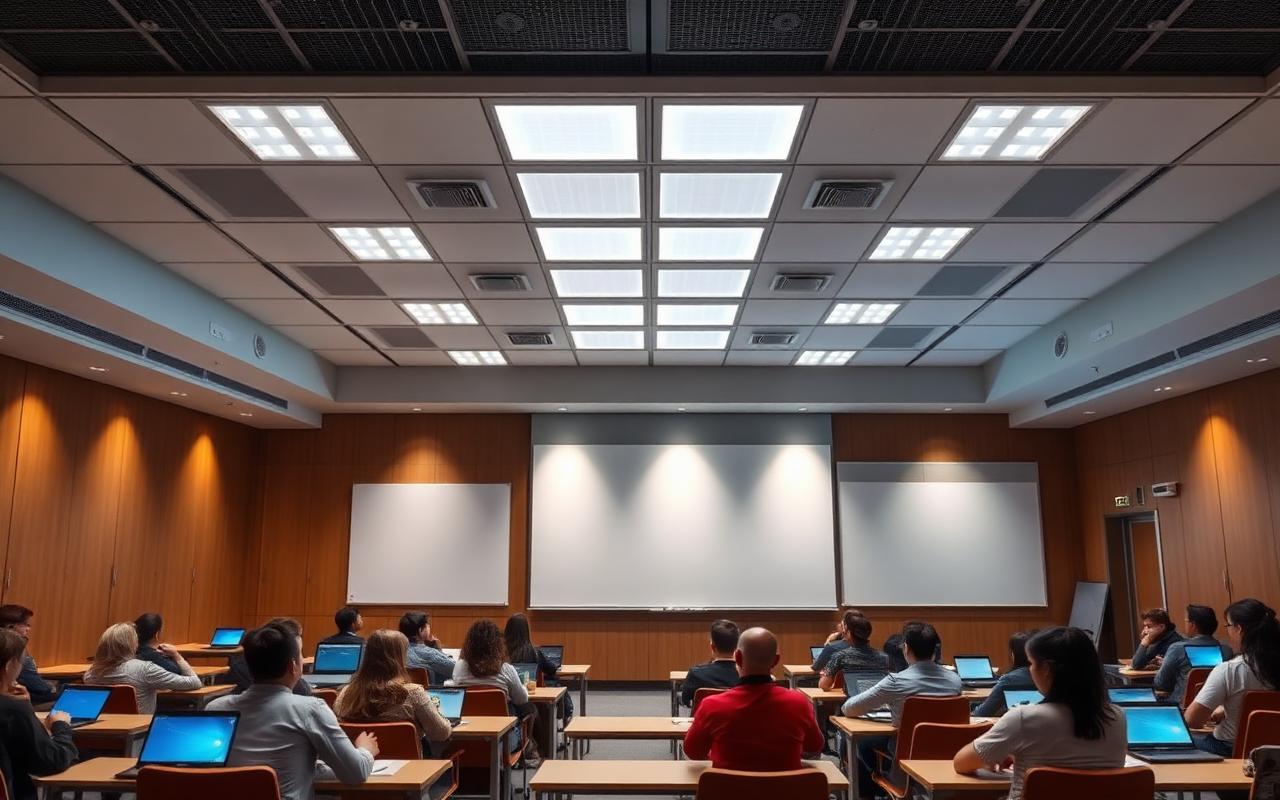
Project Background and Challenges
Tsinghua University, located in the Haidian District of Beijing, stands as one of China's most prestigious and influential institutions of higher learning. With a legacy of academic excellence dating back to 1911, the university is committed to providing a world-class educational environment. However, as teaching methodologies evolve towards more interactive, technology-driven formats, the physical infrastructure must keep pace. A key area identified for improvement was the lighting within its numerous classrooms.
The existing lighting infrastructure in several of the older faculty buildings was becoming a significant barrier to creating a modern, effective learning space. The primary challenges included:
-
Poor Lighting Quality: Many classrooms were equipped with outdated T8 fluorescent tube fixtures. These systems provided inconsistent illumination, with visible flicker and poor color rendering (CRI < 70). This resulted in significant eye strain and fatigue for both students and faculty during long lectures and study sessions. Glare, both direct from the fixtures and reflected from desks and screens, was a persistent complaint.
-
High Energy Consumption and Maintenance Costs: The fluorescent technology was highly inefficient by modern standards, contributing to substantial energy bills for the university. Furthermore, the limited lifespan of the tubes and ballasts led to frequent failures, requiring constant maintenance efforts that disrupted class schedules and strained facility management resources.
-
Lack of Flexibility and Control: The legacy lighting system was a simple on/off switch setup, incapable of adapting to the varied activities within a 'smart classroom'. It could not be dimmed for presentations using projectors or smartboards, nor could it be zoned to create different atmospheres for lectures, group discussions, or examinations. This one-size-fits-all approach was fundamentally at odds with the university's vision for a dynamic and responsive educational environment.
Tsinghua University's administration sought a comprehensive lighting upgrade that would not only solve these problems but also position their classrooms as exemplars of a people-centric, sustainable, and technologically advanced learning environment. They required a solution that prioritized visual comfort, offered intelligent control, and delivered significant operational savings. XHLWX Lighting was engaged to design and supply a state-of-the-art solution to meet these exacting requirements.
The XHLWX Lighting Solution and Fixture Selection
Following a detailed on-site audit and in-depth consultation with university faculty and facility managers, the XHLWX technical team developed a multi-layered lighting solution tailored specifically for the demands of the modern smart classroom. The design philosophy was centered on creating a visually comfortable, adaptable, and highly efficient environment.
The core of our solution involved a strategic selection of our specialist educational-grade luminaires:
-
Main Classroom Illumination: XHLWX 'Acuity' Series UGR<19 LED Panels (Model: XH-P6060-ED-U19) For the general ambient lighting across student desks, we specified our flagship 'Acuity' series panels. These 600x600mm recessed panels feature a micro-prismatic diffuser and advanced optical design to achieve a Unified Glare Rating (UGR) of less than 19. This ensures a comfortable, glare-free experience, even when students are looking up towards the front of the room. With a high efficacy of 150 lm/W and a CRI of >90, these panels deliver pristine, uniform light (>500 lux on desktops) that promotes concentration and reduces eye fatigue.
-
Blackboard/Whiteboard Illumination: XHLWX 'Clarity' Asymmetrical Blackboard Lights (Model: XH-BBL120-AS) Properly illuminating the primary teaching surface is critical. We deployed our 'Clarity' series of linear asymmetrical lights mounted on the ceiling near the board. These fixtures cast a precisely controlled sheet of light vertically down the blackboard or whiteboard, achieving exceptional vertical illuminance (>750 lux) without any direct glare for students or distracting reflections for the lecturer. This ensures that notes and diagrams are perfectly legible from every seat in the classroom.
-
Teacher and Podium Area: XHLWX 'Focus' Series Track Spots (Model: XH-TS15-940-30D) To enhance the lecturer's presence and facilitate non-verbal communication, we installed a small track system above the teaching podium with our 'Focus' series spotlights. These adjustable spots provide a dedicated pool of light on the teacher, making them the clear focal point of the room. The high CRI (Ra95+) ensures natural-looking skin tones, which is particularly important for video conferencing and lecture recording.
All fixtures were specified with a consistent Color Temperature (CCT) of 4000K, a neutral white light known to foster alertness and concentration in educational settings.
Technical Highlights
Our solution for Tsinghua University was built on a foundation of cutting-edge lighting technology. Three key features stand out:
1. Superior Visual Comfort with UGR<19 Glare-Free Design Glare is a critical factor in learning environments. The EN 12464-1 standard for indoor workplaces, including schools, mandates a UGR of <19 for classrooms. Our 'Acuity' panels were engineered specifically to meet this stringent requirement. UGR, or Unified Glare Rating, is a metric that quantifies the degree of discomfort glare from light sources in an environment. By keeping this value below 19, we have created a learning space where students can comfortably read textbooks, view screens, and look towards the blackboard for extended periods without experiencing debilitating eye strain. This is achieved through a combination of high-transmission diffusers, a specialized prismatic lens layer, and the recessing of LEDs to control the light output angle. The result is a soft, homogenous light that feels more like a natural skylight than an artificial source.
2. High Efficacy and Massive Energy Savings The transition from old fluorescent tubes (~60-70 lm/W) to our 'Acuity' LED panels (150 lm/W) represented a monumental leap in efficiency. By more than doubling the lumens-per-watt, we were able to provide significantly higher light levels while drastically reducing power consumption. When combined with the smart control system's daylight harvesting and occupancy sensing capabilities, the university achieved a verified energy saving of 65% compared to the previous lighting system. This translates into a significant reduction in operational expenditure and a major decrease in the university's carbon footprint, aligning perfectly with their sustainability goals.
3. Smart Control: DALI with Casambi Bluetooth Mesh Integration To transform the classrooms into truly 'smart' spaces, we implemented a hybrid control system combining the robustness of DALI with the user-friendly flexibility of Casambi Bluetooth Mesh. Each luminaire is a DALI-addressable unit, wired into a stable and reliable DALI bus. This allows for granular, individual control and monitoring of every single light fixture. We then integrated this DALI network with a Casambi gateway. This masterstroke provides the best of both worlds: the wired reliability of DALI for the backbone, and the intuitive wireless control of Casambi for the user interface. Teachers can now use a simple wall panel or a dedicated tablet app to select pre-programmed scenes:
- 'Lecture Mode': Full brightness on desks and blackboard.
- 'Presentation Mode': Dims the main room lights to 20% while keeping the blackboard and podium lights at full, enhancing screen contrast.
- 'Discussion Mode': Creates a more relaxed, even light distribution throughout the room.
- 'Exam Mode': Delivers maximum, uniform, and shadow-free illumination.
Daylight sensors automatically dim fixtures near windows, further saving energy, while occupancy sensors ensure lights turn off when a room is vacant.
Installation and Commissioning
The project timeline was critical. All work had to be completed during the summer recess to avoid any disruption to the academic calendar. The XHLWX project support team worked closely with the university's appointed electrical contractor to ensure a seamless installation process.
Our pre-sales support included providing detailed wiring diagrams for the DALI network and fixture placement guides (DIALux reports) for each room layout. This meticulous planning phase minimized on-site complications. During the installation, our field application engineers provided on-site training to the contractor's team, ensuring all fixtures were installed correctly and safety protocols were followed.
The commissioning phase was where the smart system came to life. An XHLWX engineer programmed the DALI-Casambi system according to the faculty's specific requirements. We worked with professors to fine-tune the dimming levels and CCT for each scene, ensuring the final setup was perfectly aligned with their teaching methods. The intuitive nature of the Casambi app meant that training staff on how to use the new system was a quick and straightforward process, meeting with overwhelmingly positive feedback.
Measurable Results
The upgrade has delivered transformative and quantifiable improvements to the learning environment at Tsinghua University. Post-installation measurements and ongoing monitoring have confirmed the project's success:
-
Illuminance Levels: Average illuminance on student desks increased from a fluctuating ~250 lux to a stable and uniform 550 lux, exceeding the national standard of 300 lux. Vertical illuminance on whiteboards is now consistently above 750 lux.
-
Light Quality: Glare was virtually eliminated, with all classrooms measuring a UGR well below the target of 19. The Color Rendering Index (CRI) was raised from ~70 to an average of Ra92, allowing for true and accurate color perception.
-
Energy Savings: Direct, like-for-like energy consumption for lighting was reduced by 65%. When factoring in savings from dimming, daylight harvesting, and occupancy sensing, the projected total energy savings are expected to approach 75%.
-
User Satisfaction: A survey conducted by the university's facility management department revealed a 95% satisfaction rate among students and faculty regarding the new lighting, with specific praise for the reduction in eye strain and the flexibility of the control system.
FAQ
Q1: Why is UGR<19 so important for a classroom? A: A UGR (Unified Glare Rating) below 19 is crucial in educational settings to minimize discomfort glare. In a classroom, students spend hours reading, writing, and looking at screens or the front of the room. Excessive glare causes eye strain, headaches, and fatigue, which directly impairs concentration and learning ability. By ensuring a UGR<19 environment, we create a visually comfortable space that supports sustained focus and academic performance.
Q2: How does the DALI-Casambi system benefit teachers? A: The hybrid system empowers teachers with unprecedented, yet simple, control over the learning environment. Instead of a basic on/off switch, they can instantly select pre-set 'scenes' from a tablet or wall panel. For example, they can tap 'Presentation' to automatically dim the room for a projector, or 'Discussion' for group activities. This allows the lighting to seamlessly adapt to the teaching method, enhancing the lesson's impact without any technical complexity.
Q3: What were the biggest challenges during the installation at a prestigious university like Tsinghua? A: The primary challenges were the tight installation schedule and the need to work within the confines of existing, sometimes historic, building architecture. All work had to be completed during the summer recess. Our detailed pre-planning, including creating precise DIALux models and wiring schematics, was essential. We collaborated closely with the university's contractors to ensure our modern DALI wiring and fixtures could be integrated with minimal impact on the building's structure, preserving the integrity of the campus while delivering a state-of-the-art technological upgrade.