
What Lux Levels Does a 5-Star Hotel Lobby Need Under EN 12464-1?
Quick answer
Understand reception and circulation lux levels, lobby design targets, glare control and compliance checks for bespoke hotel lighting. Custom commercial LED
Introduction
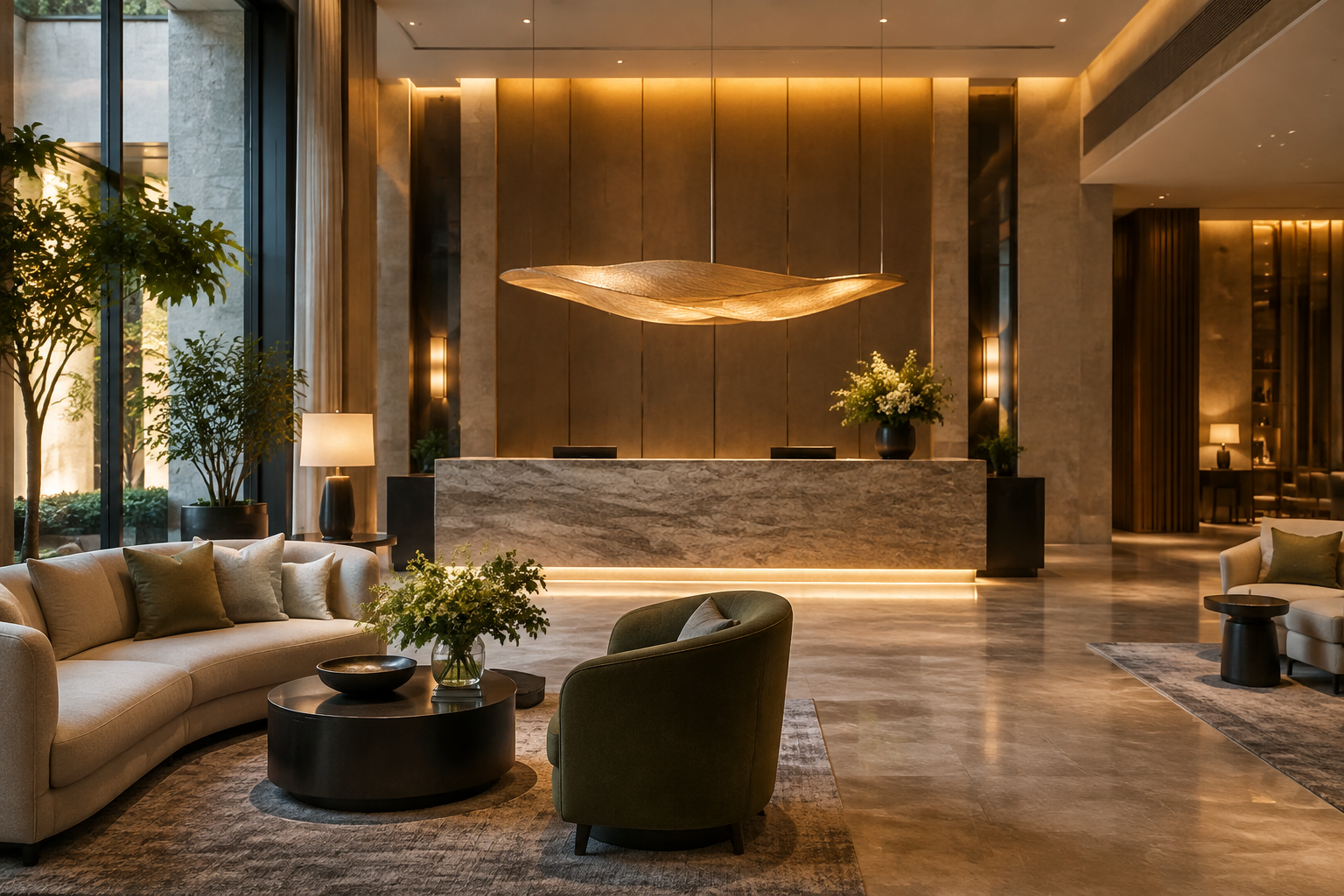
At XHLWX (led-project-light.com), a Custom Indoor LED Lighting Manufacturer based in China, we recommend reception-desk illuminance of 300 lx maintained for EN 12464-1-aligned lobby design. A recommended specification is 100 lx for applicable circulation areas; 200 lx across the wider lobby is a design target, not a star-rating requirement.
The essential distinction is between a named activity and an architectural space. EN 12464-1 specifies lighting requirements for indoor workplaces, including relevant hotel activities.
It does not establish one blanket illuminance requirement for every part of a luxury lobby. Reception work, circulation, lounge seating and decorative displays need separate treatment.
For owners, interior designers and FF&E buyers, the practical answer is a zoned lighting schedule. Identify each task, confirm the applicable standard entry, then coordinate maintained illuminance, glare, colour rendering and atmosphere. A dramatic chandelier can establish identity, but it does not automatically provide sufficient light on a reception worktop.
Design Criteria and Standards
Reception desks and circulation routes require separate illuminance assessments rather than one lobby-wide average.
EN 12464-1:2021, Light and lighting — Lighting of work places — Part 1: Indoor work places is the principal reference for this discussion. Its reception, cashier and porter-desk category provides a maintained illuminance baseline of 300 lx. Relevant circulation-area categories commonly use 100 lx; select the correct category rather than treating every entrance or waiting area as circulation.
Use those figures as recommended specifications only after confirming the activity, applicable edition and project brief. The standard also addresses surrounding areas, background lighting, glare, uniformity and other visual conditions. Context modifiers can justify increased illuminance; the baseline is not necessarily the final design requirement.
For mixed lobby areas, a recommended design target of 150–200 lx can support comfortable orientation and conversation. This is a hospitality design choice, not an EN requirement for a star classification. Reception computer tasks, detailed document handling or other activities may require a different classification and additional task lighting.
The following schedule distinguishes recommended specifications from product characteristics requiring evidence. Numerical product values are design targets, not claims about an existing XHLWX product.
| Parameter | Spec | Standard | Notes |
|---|---|---|---|
| Reception illuminance | Recommended specification: 300 lx maintained on the reception task area | EN 12464-1 | Confirm the reception/cashier/porter-desk category and relevant modifiers |
| Circulation illuminance | Recommended specification: 100 lx maintained where the circulation category applies | EN 12464-1 | Assess routes independently from seating and reception |
| Wider lobby illuminance | Design target: 150–200 lx maintained | Project brief informed by EN 12464-1 | Not a universal hotel-lobby requirement |
| Uniformity | Recommended specification: U0 ≥0.60 for the reception task area | EN 12464-1 | Confirm the selected category; U0 means minimum divided by average illuminance |
| CCT and colour rendering | Recommended specification: 2700–3000 K, Ra ≥90; R9 ≥50 where skin tones matter | EN 12464-1; WELL v2 where pursued | These colour-quality targets are project choices, not universal standard minima |
| Glare and beam | Recommended specification: reception UGR ≤22; beam angles 24–60° as calculated | EN 12464-1 | UGR depends on room geometry and viewing direction, not just the luminaire |
| Controls | Recommended specification: DALI-2, Casambi, KNX integration or 0-10V, selected by zone | IEC 62386 where applicable | Verify driver compatibility, gateway requirements and low-end dimming |
| Housing, materials and IP | Recommended specification: aluminium housing, steel mounting parts; IP20 for suitable dry interiors | EN 60598; IEC 60529 | Cleaning exposure or damp internal locations may require greater protection |
| LED and driver options | Recommended specification: named Osram, Bridgelux or Samsung LED; Tridonic or Mean Well driver, subject to verification | Approved component documentation | Confirm exact models, thermal suitability and procurement availability |
| Compliance and quality evidence | Destination-specific CE/RoHS documentation; appropriate UL evidence for US projects; SAA only where required; ISO9001 evidence if requested | EN 60598; applicable UL standards; ISO 9001 | These are different conformity routes and management requirements, not interchangeable certificates |
Maintained illuminance means the intended service-period value after an agreed maintenance factor, not simply the brightness of a newly installed system.80 converts a 300 lx maintained target into a calculated initial average of 375 lx. That factor must be justified by the actual equipment, environment and maintenance plan.
Customisation Options and Materials
Bespoke luminaires should support the task layout while preserving the lobby’s intended material palette and visual hierarchy.
Decorative scale alone cannot determine photometric suitability. A luminous pendant, shielded downlight and concealed linear profile can produce similar horizontal averages but very different facial visibility, ceiling brightness and reflections.
| Luminaire approach | Best indoor lobby application | Main limitation | Verdict |
|---|---|---|---|
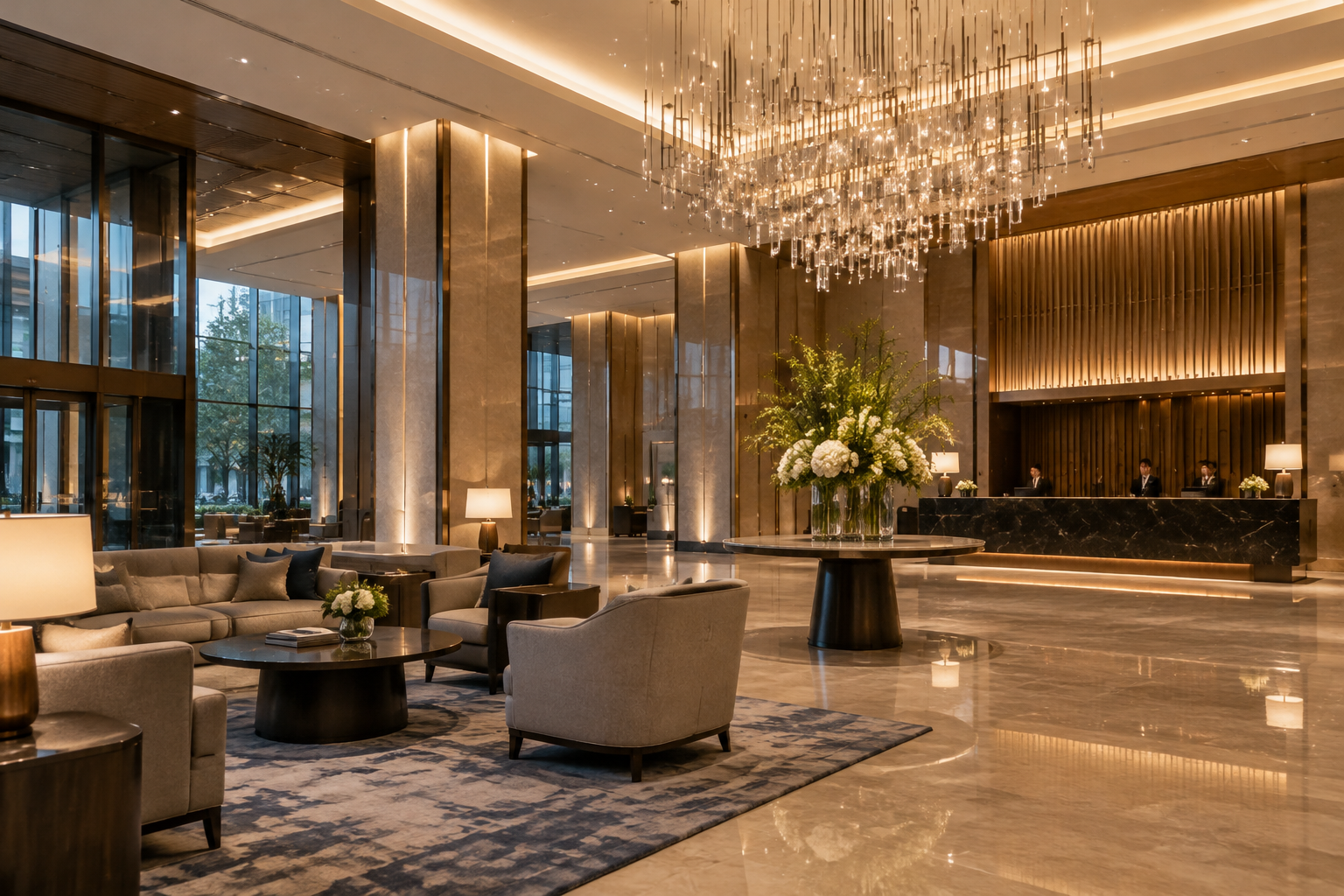
| Decorative chandelier or pendant | Central arrival feature and visual identity | Bright exposed sources can create glare without lighting the desk effectively | Use as a decorative layer, not the sole task-lighting system |
| Shielded recessed downlight | Reception counters and circulation routes | Poor spacing can produce scallops and harsh facial shadows | Preferred where calculated beam overlap and shielding suit the layout |
| Concealed linear profile | Coffers, coves and soft ambient illumination | Output depends strongly on recess geometry and surface reflectance | Effective supporting layer; model the actual construction |
| Adjustable accent luminaire | Indoor artwork, signage and material features | Mis-aiming can create reflected glare or distract from reception | Useful when aiming positions are documented and commissioned |
| Diffused decorative wall light | Lounge seating and hospitality atmosphere | Diffusers may become excessively bright at close viewing distances | Suitable for visual comfort when luminance and mounting are controlled |
How Should a Bespoke Reception Pendant Support the Desk Lux Target?
A reception pendant should deliver useful light to the working surface without exposing guests or staff to uncomfortable source brightness.
Request separate optical control for downward task light and decorative glow where the design permits. Position the luminous element around actual monitor, payment-terminal and document locations.
Verify both seated staff and standing guest views. If the pendant cannot meet the recommended task specification comfortably, add discreet supporting luminaires instead of simply increasing pendant output.
Which Materials Suit a Luxury Lobby Without Compromising Maintenance?
Serviceable metalwork and replaceable optical components generally offer a more controllable maintenance strategy than permanently sealed decorative assemblies.
Specify finish samples for aluminium, plated steel, stainless steel, glass or acrylic against the approved interior palette. Assess fingerprints, cleaning chemicals, diffuser yellowing risk and visible joints.
Heavy decorative components need an agreed support arrangement. Drivers should remain accessible without dismantling fragile ceiling finishes or interrupting the reception operation unnecessarily.
How Can Warm Lighting Preserve Facial Visibility and Finish Colours?
Warm lighting works best when colour rendering and vertical illumination receive the same attention as horizontal lux.
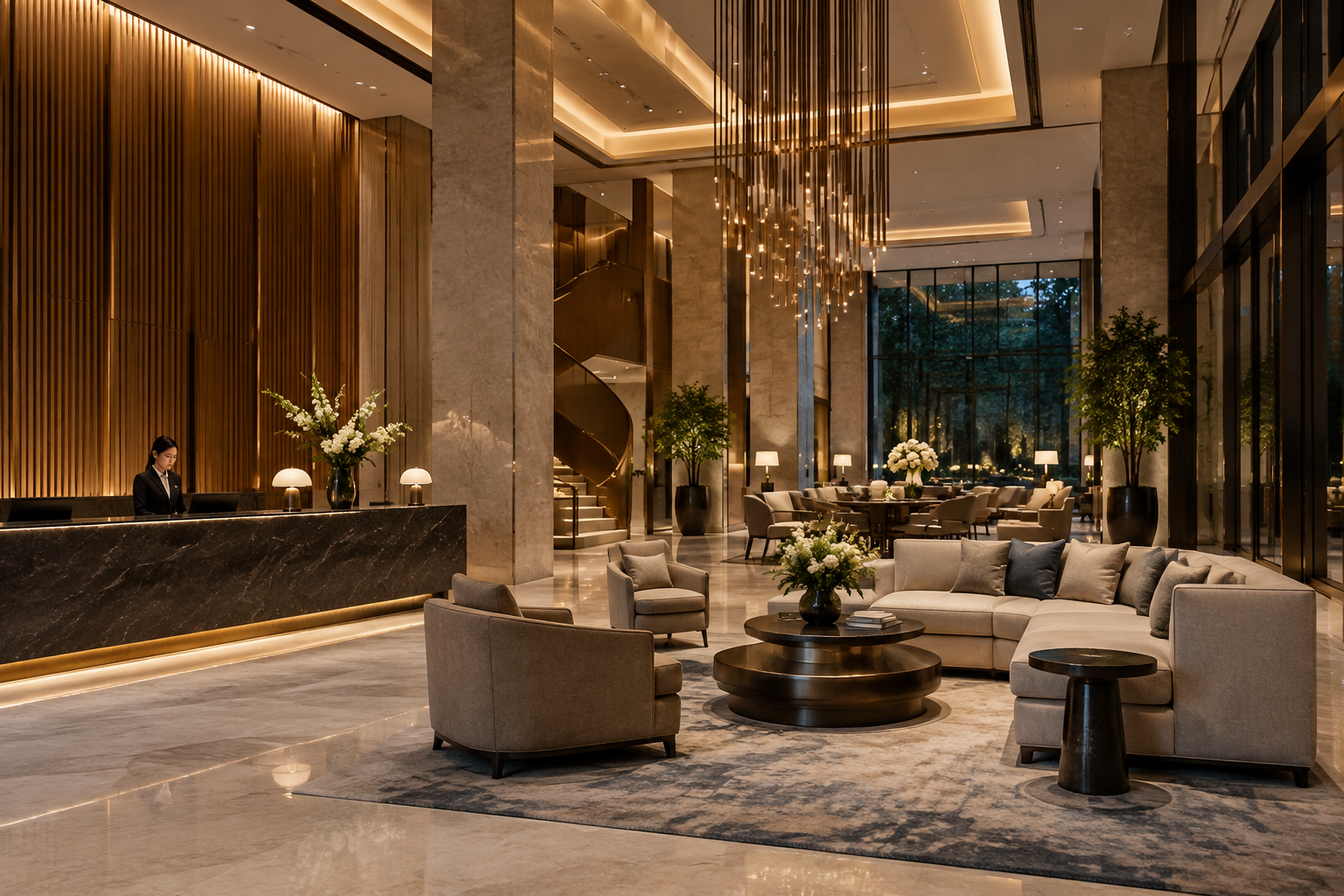
Use the table’s recommended colour-quality targets as a starting point, then review skin tones, stone, timber and upholstery under a physical sample. Avoid relying solely on narrow downward beams above reception positions. Soft reflected light or controlled supplementary light can improve facial visibility without raising the entire lobby’s illuminance or introducing intrusive fittings.
 What Lux Levels Does a 5-Star Hotel Lobby Need Under EN 12464-1?: Which materials suit a luxury lobby without compromising maintenance?
Controls and Commissioning
A successful control system maintains required task lighting while allowing decorative and lounge layers to change independently.
Separate reception task lighting, circulation, ambient coves, decorative fixtures and accents into meaningful control groups. Recommended scene categories include arrival, evening, late-night and cleaning. Scene names are operational instructions, not proof of compliance: an evening scene still needs sufficient maintained illumination wherever staff continue working.
DALI-2 offers interoperable functionality when the specified devices support the required features. Casambi can suit wireless control strategies, subject to radio coverage and system design.
KNX integration requires a documented interface to the lighting system. With 0-10V, verify minimum output, switching arrangements and compatibility across the selected drivers.
Before procurement, test dimming smoothness, visible flicker, power-restoration behaviour and scene recall on the proposed driver and LED combination. A recommended specification of 1% dimming is meaningful only if the complete assembly demonstrates stable operation at that level.
Commission using a calibrated illuminance meter and an agreed measurement grid. Record the task-plane height, scene, daylight contribution, aiming positions and furnishings.
Compare initial readings with the calculated initial condition; do not present handover readings alone as proof of future maintained performance. Retain settings and measurement records for facilities staff.
Sampling, MOQ, Lead Time and Quality Control
Sampling should resolve optical, finish and control risks before the production order is released.
A useful recommended specification is one representative functional sample for each materially different optical or control arrangement. Decorative finish chips alone cannot validate glare, thermal behaviour or dimming. Where scale matters, review a full-size sample in a representative reception or lounge setting.
MOQ and lead time must be quoted against the actual custom design. Tooling, castings, specialist glass, finish processes, driver availability and approval cycles can change both. Do not assume a catalogue delivery promise applies to a bespoke lobby feature.
Agree inspection criteria before production: dimensions, finish consistency, assembly quality, electrical safety checks, driver identification and optical configuration. Define how substitutions are approved. A different LED board, diffuser or driver can affect photometry, colour, dimming and compliance evidence even when the external appearance remains unchanged.
Photometric Files & Compliance
Reliable calculations require photometry for the exact optical configuration and separate evidence for electrical and regulatory compliance.
Request IES and LDT photometric files matching the proposed LED package, output setting, optics and diffuser. Import them into DIALux or another suitable calculation platform with the actual lobby geometry, desk positions, mounting heights and realistic surface reflectances. Include large decorative objects where they materially block or redirect light.
Keep three concepts separate: IES as the Illuminating Engineering Society, an IES-format photometric file, and a laboratory measurement report. A file format does not certify accuracy, and a simulation does not replace installation verification.
For EU projects, establish the applicable legislation and obtain the required EU Declaration of Conformity and supporting evidence. CE marking is not a generic third-party certificate.
RoHS addresses restricted substances; it does not establish lobby lighting quality. EN 60598 is the relevant luminaire-safety standard series, with applicable general and particular requirements selected for the product.
US projects should confirm accepted listing or evaluation requirements with the project team and authority having jurisdiction. Middle East and Southeast Asian destinations have country-specific import, electrical and conformity requirements; EN compliance alone is not a universal market-entry route.
SAA approval is not a general Southeast Asian requirement. ISO9001 concerns the quality-management system, not individual luminaire safety.
 What Lux Levels Does a 5-Star Hotel Lobby Need Under EN 12464-1?: Photometric files & compliance
Frequently Asked Questions
Q: Does EN 12464-1 Require 200 Lx Throughout a 5-star Hotel Lobby?
No; 200 lx is not a universal EN 12464-1 requirement for every luxury lobby. Treat it as a design target for selected ambient areas, not a star-rating rule. Reception desks and circulation require their own task classifications. Confirm the applicable edition, category and contextual requirements before turning an architectural concept into a contractual lighting schedule.
Q: Is 300 Lx at Reception an Initial or Maintained Value?
The recommended reception specification of 300 lx is a maintained value when applying the relevant EN 12464-1 category. Initial output normally needs headroom for expected depreciation. Document the maintenance factor, cleaning assumptions and replacement strategy. Commissioning readings should be checked against the corresponding initial calculation, rather than assuming an initial reading proves long-term maintained compliance.
Q: Can Warm Decorative Lighting Satisfy Reception Lighting Requirements?
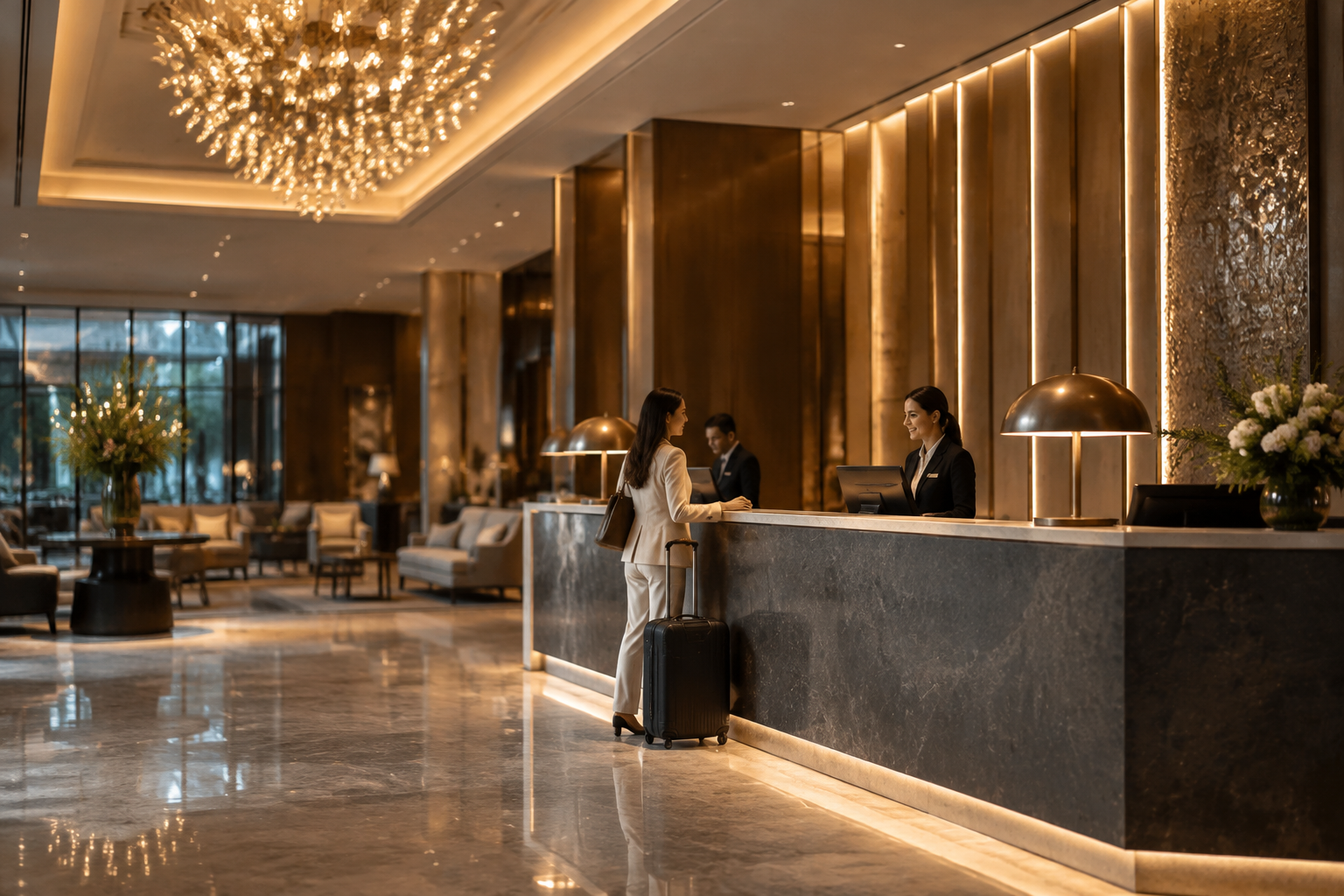
Warm decorative lighting can contribute, but its appearance does not demonstrate adequate task illumination. A recommended specification of 2700–3000 K can support a welcoming atmosphere when paired with suitable colour rendering and optical control. Calculate the worktop, assess glare from staff and guest positions, and add shielded task lighting if the decorative fitting leaves the desk insufficiently lit.
Q: Which Documents Should Buyers Request Before Approving Custom Lobby Luminaires?
Request configuration-specific photometry, drawings, component schedules, control details and destination-appropriate conformity evidence before approval. A recommended specification is one coordinated approval package for each distinct luminaire configuration. Include finish samples, maintenance access and substitution rules. Check that the photometric model and safety documentation apply to the actual assembly rather than a visually similar catalogue product.
Sources and Technical References
Official standards and scheme documents should govern final specifications; manufacturer summaries are supporting guidance rather than substitutes.
- EN 12464-1:2021 — Light and lighting — Lighting of work places — Part 1: Indoor work places. Obtain the licensed text through a national standards body; verify activity tables, maintained illuminance and contextual adjustments. CEN-CENELEC standards catalogue.
- EN 60598 — Luminaires. Consult applicable parts of the series for luminaire safety, not room illuminance. BSI standards catalogue.
- IES Lighting Library. Use applicable Illuminating Engineering Society guidance when developing US project criteria and measurement methods. IES.
- WELL v2, Light concept. Check the selected features and verification requirements where WELL is part of the brief; horizontal lux alone does not demonstrate achievement. WELL v2.
- DALI-2 certification resources. Verify listed device capabilities and certification status rather than relying on a broad compatibility claim. DALI Alliance.
 What Lux Levels Does a 5-Star Hotel Lobby Need Under EN 12464-1?: Q: Can warm decorative lighting satisfy reception lighting requirements?
Request a Custom Quote
A useful quotation starts with a zoned lighting brief rather than a single lobby lux number.
Send the reflected ceiling plan, reception layout, ceiling heights, interior finishes, target scenes and destination market. Include the recommended maintained illuminance schedule, control architecture, decorative references, quantities and required approval milestones. Identify which luminaires need bespoke dimensions, finishes, optics or service-access arrangements.
At XHLWX (led-project-light.com), a Custom Indoor LED Lighting Manufacturer based in China, we can review your indoor hotel lobby brief for bespoke luminaire development. Request a configuration-specific proposal covering recommended specifications, sample scope, photometric deliverables, compliance evidence, MOQ and lead time, with technical assumptions confirmed before production approval.
À propos de XHLWX
XHLWX est la marque de Shenzhen Qihang Lighting Co., Ltd., fabricant de luminaires LED pour projets, avec sa propre usine à Shenzhen (Chine) depuis 2009. Nous fournissons profilés linéaires, downlights, rails magnétiques, dalles, luminaires étanches, high bays et luminaires sur mesure pour bureaux, hôtels, musées, commerces et sites industriels.
Études d'éclairage selon la NF EN 12464-1 (Em, UGR, Uo, Ra) avec fichiers IES et LDT pour DIALux ; luminaires conformes CE et RoHS, système qualité ISO 9001.
Questions fréquentes sur XHLWX
XHLWX livre-t-il en France et en Belgique ?
Oui. Nous livrons les projets en France et en Belgique directement depuis l'usine ; devis, étude d'éclairage et fiches techniques sont fournis en français ou en anglais.
Les luminaires respectent-ils la NF EN 12464-1 ?
Nous dimensionnons l'éclairement, la limite UGR et l'uniformité selon la NF EN 12464-1 et justifions les valeurs par un calcul DIALux réalisé avec nos fichiers LDT.
Quels systèmes de gestion d'éclairage sont compatibles ?
DALI-2, 0-10 V et Casambi (Bluetooth), avec versions éclairage de secours ou détecteur selon le projet.
XHLWX fabrique-t-il du sur-mesure ou de l'OEM ?
Oui. Longueurs, températures de couleur, angles de faisceau, finitions et votre propre marque (OEM/ODM) sont réalisés dans notre usine.
Need a tailored lighting plan for your project?
Our senior lighting designers reply within 48 hours with a free design proposal & quotation.