
How Do Hotel Chandelier Approvals Move from 3D Render to Sample?
Quick answer
Approve bespoke hotel chandeliers with clear 3D review gates, material samples, lighting tests and production sign-off for international projects.
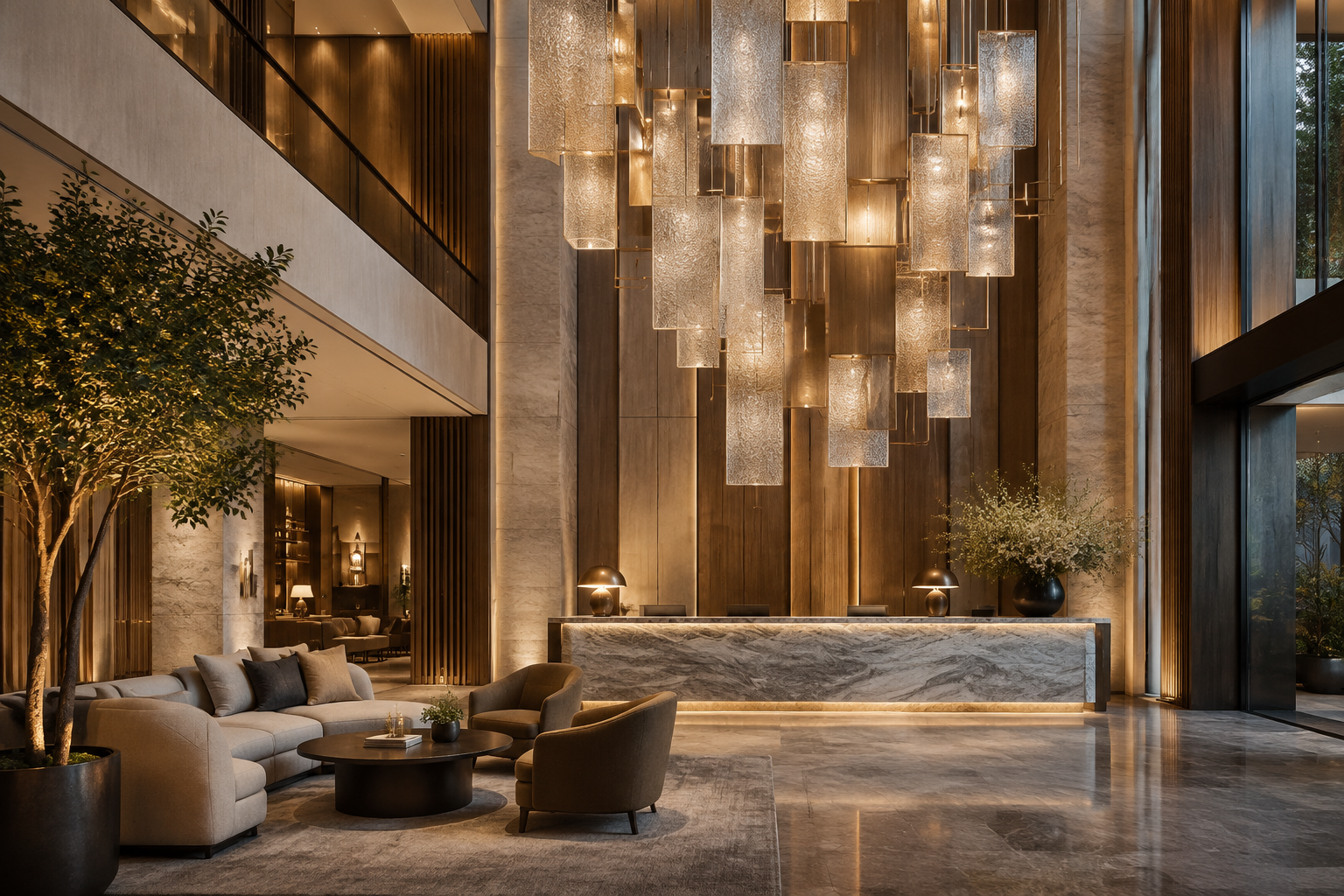
Introduction — Approving a Bespoke Hotel Lobby Chandelier
At XHLWX (led-project-light.com), a Custom Indoor LED Lighting Manufacturer based in China, ... bespoke hotel chandelier approval should progress from coordinated 3D geometry to drawings, material samples and a representative illuminated sample. Use a recommended specification of 4 approval gates and 1 revision register before releasing production, with appearance, performance, mounting and compliance responsibilities explicitly accepted.
For a double-height hotel lobby, an attractive render establishes design intent; it does not prove that the chandelier can be manufactured, installed, cleaned or maintained. Owners, interior designers, FF&E buyers and engineering teams need different evidence before approving the same object.
A practical approval sequence is:
- Concept approval: confirm composition, scale, sightlines and the intended relationship with the reception desk and seating.
- Engineering approval: coordinate dimensions, suspension, component access and electrical interfaces.
- Sample approval: accept materials, illuminated appearance, workmanship and the agreed representation of the finished assembly.
- Production release: sign the controlled drawing package, sample record, bill of materials and inspection criteria.
These are recommended approval gates, not a claim about a completed project. Record who can approve each gate, who must be consulted and which changes require renewed approval. A designer’s visual acceptance should never be mistaken for structural or electrical acceptance.
Design Criteria and Standards — What Should the Approval Specification Contain?
A chandelier approval specification should separate visual intent, measurable performance, installation interfaces and market-specific conformity requirements.
Begin with the room, not the fixture. Obtain the reflected ceiling plan, finished floor levels, ceiling structure information, reception sightlines and adjacent lighting layouts. Identify whether the chandelier provides useful ambient illumination, decorative sparkle or primarily a visual focal point.
All numerical performance values below are recommended specifications or design targets, not measured XHLWX product results. Final values require project agreement and relevant evidence.
| Parameter | Spec | Standard | Notes |
|---|---|---|---|
| CCT | Recommended specification: 2700–3000 K, with an approved reference sample | WELL v2, where relevant to the project brief | Assess against actual stone, timber and upholstery; CCT alone does not predict appearance |
| CRI | Recommended specification: Ra ≥90 | EN 12464-1 for applicable indoor workplace tasks | Request source data and review saturated colours in person |
| UGR and glare | Design target: UGR ≤19 only for applicable task areas where the calculation method is suitable | EN 12464-1 | Not a blanket chandelier rating; assess exposed decorative sources from occupied viewpoints |
| Beam and distribution | Recommended specification: 30°–60° for directional elements; approve diffuse elements separately | IES photometric guidance | Final selection follows room calculations and sample review |
| Control | Specify DALI-2, Casambi, KNX integration or 0-10V according to the control architecture | Relevant protocol documentation | Confirm drivers, gateways, dimming behaviour and responsibility for integration |
| Housing, materials and IP | Recommended specification: fabricated metal with approved glass or crystal; IP20 for suitable dry interiors | EN 60598 and applicable part; IEC 60529 | Verify environment, weight, thermal conditions and cleaning method |
| LED and driver brands | Candidate sources: Osram, Bridgelux or Samsung LEDs; Tridonic or Mean Well drivers | Manufacturer datasheets and applicable product requirements | Name the exact model; brand selection does not establish fixture compliance |
| Certification and conformity | Verify required CE/RoHS evidence, UL or other accepted NRTL route, and destination requirements | Applicable legislation and product standards | SAA applies to relevant Australian approvals; ISO9001 concerns management systems, not product safety |
EN 12464-1 addresses indoor workplace lighting where applicable; it is not a universal decorative-hotel lighting prescription. WELL v2 is a building certification framework, not a chandelier certificate. Agree the applicable criteria with the lighting designer and project compliance adviser before treating any render as an approval deliverable.
Customisation Options and Materials — Selecting What the Physical Sample Must Prove
Material approval must establish which characteristics can be judged digitally and which require a physical reference under project lighting.
The 3D model should resolve overall envelope, suspension arrangement, repeated modules, visible joints and accessible service components. Hidden fabrication details can remain in engineering drawings, but they must not contradict the approved visual geometry.
| Option | Render can establish | Physical sample must establish | Verdict |
|---|---|---|---|
| Brushed metal arms | Proportion, orientation and visible joint positions | Grain direction, seam quality and finish consistency | Approve fabrication and finish together |
| Plated decorative metal | Intended colour family and reflective character | Actual tone, fingerprints and cleaning compatibility | Never approve colour from a screen alone |
| Clear or textured glass | Shape, spacing and broad transparency intent | Tint, bubbles, texture and illuminated reflections | Use representative production-process glass |
| Crystal elements | Composition and nominal density | Edge quality, sparkle and connection details | Review under intended source and viewing angles |
| Opal diffusers | Luminous silhouette and approximate brightness balance | Hot spots, seams and colour consistency | Require an illuminated sample |
How Detailed Should the Hotel Chandelier 3D Model Be Before Client Approval?
The approval model should contain every visible feature and every interface that could change the accepted shape or installation.
Include the ceiling canopy, suspension points, cable exits, decorative modules and maintenance clearances. Show the chandelier within a coordinated lobby model rather than against a blank background. Check arrival routes, reception views and views from upper-level circulation where present.
Submit dimensioned drawings alongside rendered views. State which model is authoritative, which dimensions are controlled and which visual details remain illustrative. A photorealistic image without tolerances or an agreed reference revision is not a manufacturing instruction.
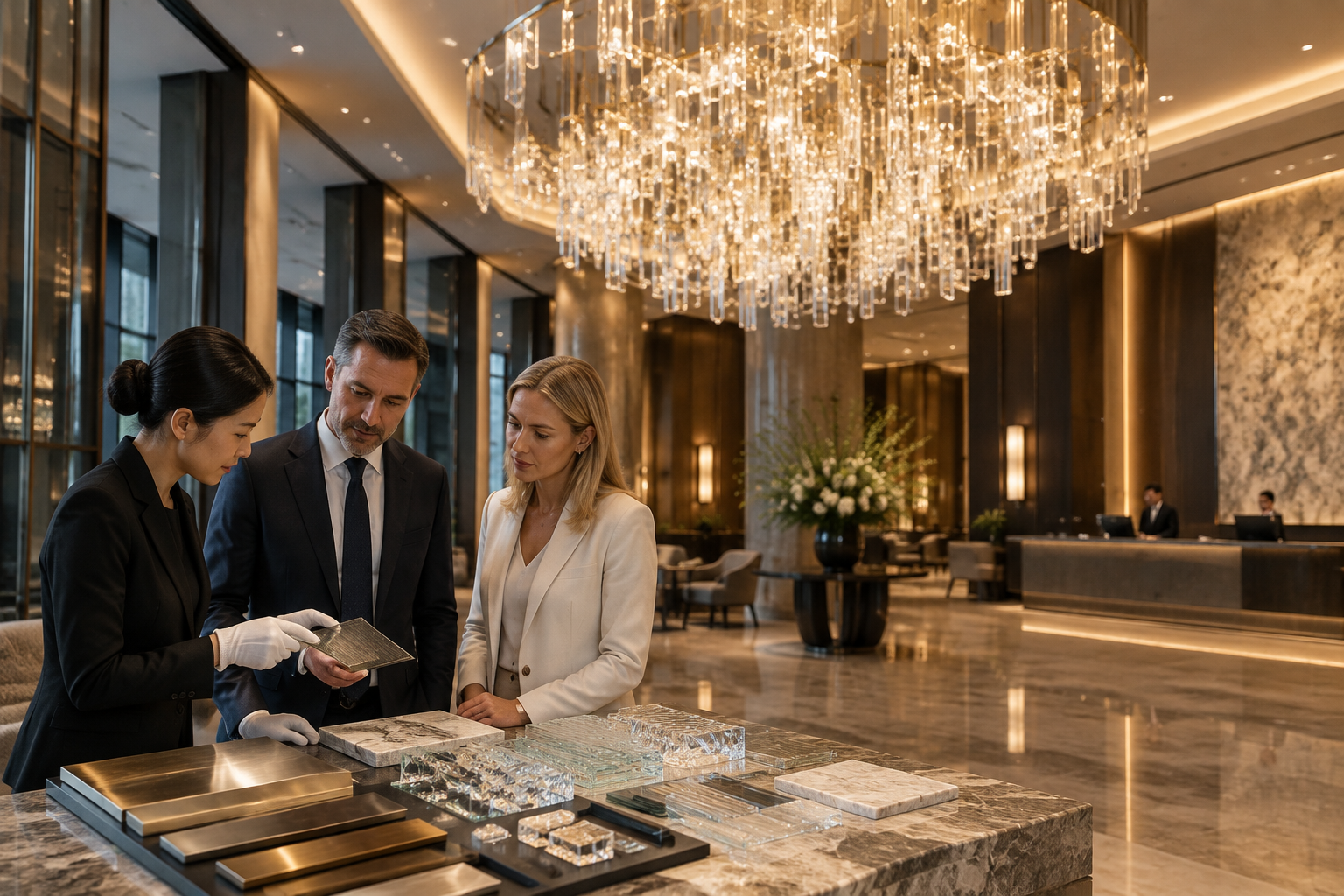
Which Metal, Glass and Crystal Samples Should the Client Sign Off?
The client should approve samples made with the intended material and production process, not merely a visually similar substitute.
Label each sample with its material, finish code, process, supplier reference where relevant and drawing revision. For finishes with natural or process variation, agree an acceptable range rather than assuming every component will match a single coupon perfectly.
Keep corresponding approved references with the buyer and manufacturer. Photograph them for traceability, but retain the physical samples: camera exposure, white balance and display settings can materially distort apparent colour and gloss.
When Is a Full-size Mock-up Necessary Instead of a Partial Sample?
A full-size mock-up is appropriate when scale, assembly interaction or perceived brightness cannot be judged reliably from a representative section.
A partial sample may establish finish, source shielding and module workmanship. It cannot automatically prove whole-fixture balance, cumulative alignment or the visual density of overlapping elements.
Define exclusions in the approval record. Where a complete assembly is impractical, combine a representative illuminated section with dimensional templates, assembly drawings and an installation review. The client should explicitly accept what remains unverified until factory assembly or site installation.
 How Do Hotel Chandelier Approvals Move from 3D Render to Sample?: Which metal, glass and crystal samples should the client sign off?
Controls and Commissioning — Approving the Chandelier Within Hotel Scenes
Control approval must demonstrate the complete driver-and-controller combination, not simply confirm that both components support dimming.
Prepare a control responsibility schedule identifying the chandelier supplier, electrical contractor, controls integrator and hotel operations team. DALI-2 requires compatible devices and correct commissioning; Casambi requires a planned wireless installation and configuration.
KNX commonly interfaces through suitable gateways or actuators. For 0-10V, confirm wiring, driver behaviour and how switching off is achieved.
Approve reception, evening and cleaning scenes using the intended control hardware. A recommended specification is stable dimming to an agreed minimum of 1% where operationally necessary; this is a design target requiring verification, not a universal driver capability.
Check startup, fade behaviour, visible flicker, audible noise and recovery after power interruption. Define the test conditions and acceptance criteria before sampling. Video can help document behaviour, but camera artifacts must not be confused with measured flicker.
Record driver locations and access routes. A visually concealed driver is only acceptable if maintenance staff can reach and replace it without damaging decorative finishes or requiring an unplanned dismantling operation.
Sampling, MOQ, Lead Time and Quality Control — Planning a Controlled Production Release
Sampling scope, minimum order quantity and lead time should be quoted against an agreed design rather than assumed from a render.
For a bespoke lobby chandelier, cost depends on engineering effort, tooling, material processes, component availability and inspection requirements. Ask whether sample charges cover finish coupons, an illuminated module, a full assembly or several different deliverables. Do not assume that a prototype is included in the production price.
The supplier should confirm MOQ and programme after reviewing the design. Separate engineering, client review, sampling, testing, production and transport in the schedule.
Identify what starts each activity and which approvals stop progress. Destination conformity work and unusual materials can affect the critical path.
Use a sample acceptance record containing:
- Drawing and bill-of-materials revision references.
- Approved physical sample identification and photographs.
- Tested LED, driver, optic and control combination.
- Accepted deviations and unresolved actions.
- Named approvers and production-release status.
Quality control should cover dimensions, finish, component identity, assembly fit and the electrical safety checks required by the applicable standard and product construction. Agree any functional run test and inspection sampling plan in advance rather than claiming that a generic duration proves reliability.
Where suspension loads affect the building, obtain review by the project’s qualified structural professional. The production package should identify fixture mass, load paths and mounting interfaces; substrate suitability and site anchors must be resolved by the responsible project parties.
Photometric Files & Compliance — Checking Evidence Before Manufacture
Photometric and compliance evidence must correspond to the proposed construction, not merely to a similar-looking catalogue fixture.
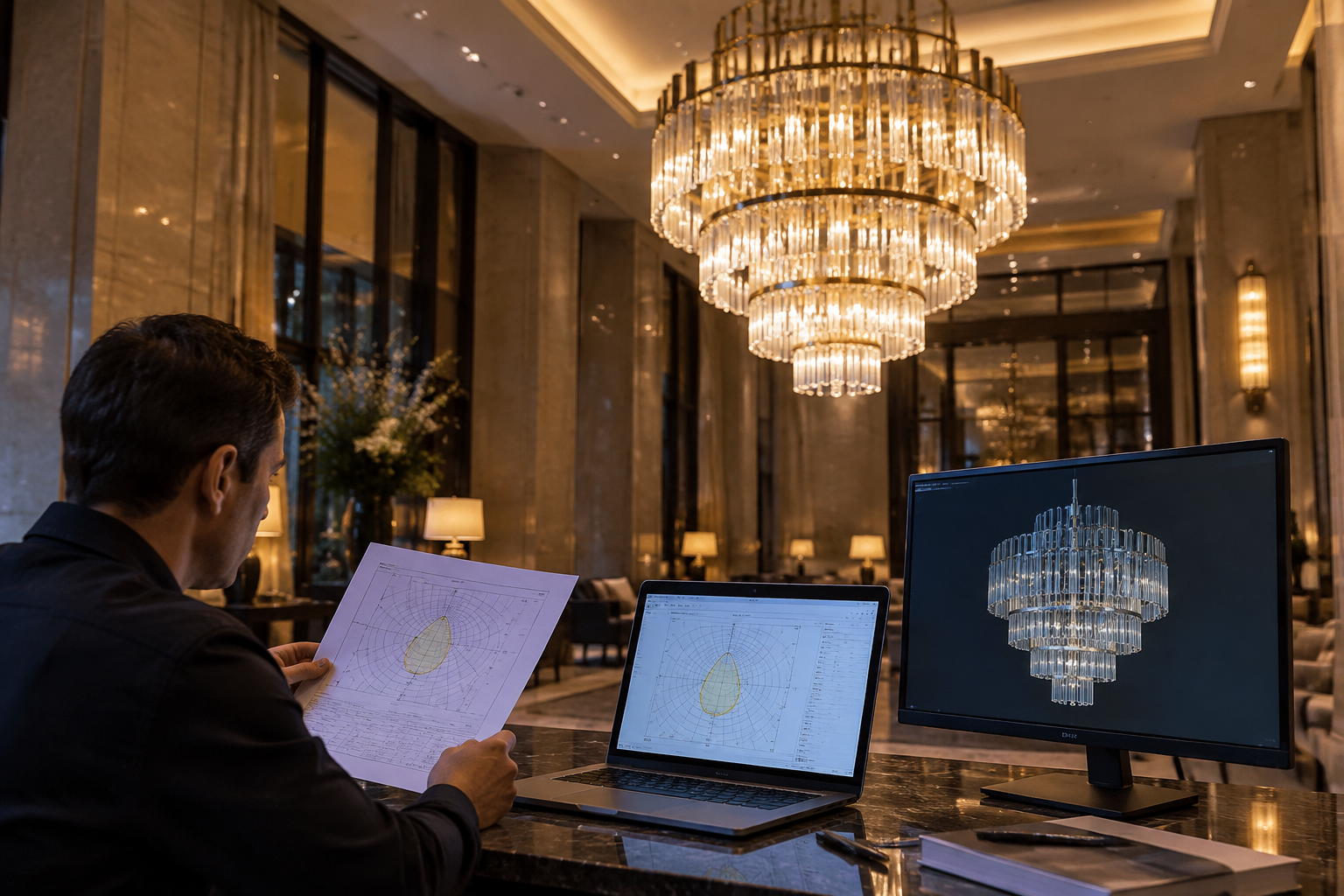
Request IES and LDT photometric files where available and appropriate for the luminaire or its component light engines. Establish whether the data represent a tested complete assembly, a representative module or a modelled distribution. Decorative glass and crystal can alter output and distribution, so component data may not fully represent the assembled chandelier.
Use DIALux to assess the chandelier within the wider lobby lighting scheme. Record room geometry, reflectances, mounting height, maintenance assumptions and the exact photometric file revision. A rendering establishes appearance intent; a lighting calculation estimates performance under stated assumptions.
For EU supply, confirm applicable CE obligations, relevant safety requirements and RoHS documentation. CE marking is not itself a third-party product certificate. For US supply, agree the accepted listing or evaluation route with the project team and authority having jurisdiction; a UL-recognized driver does not automatically establish chandelier compliance.
Middle East and Southeast Asia requirements vary by destination. Confirm national conformity procedures, electrical supply conditions, documentation and language requirements before production. Request evidence for the exact offered configuration, including any deviations from previously evaluated construction.
 How Do Hotel Chandelier Approvals Move from 3D Render to Sample?: Photometric files & compliance — checking evidence before manufacture
Frequently Asked Questions
Q: Can a Hotel Owner Approve a Bespoke Chandelier from a 3D Render Alone?
A render can approve visual intent, but it cannot establish finish accuracy, safety, dimming performance or installation suitability. Use a recommended specification of 4 approval gates: concept, engineering, sample and production release. Require dimensioned drawings and representative physical evidence before authorizing manufacture, with separate acceptance from the responsible design and engineering parties.
Q: How Many Chandelier Samples Should an FF&E Buyer Request?
Sample quantity should follow design risk rather than a universal rule. A recommended specification is at least 1 representative illuminated assembly, supported by finish references for each distinct material treatment. Add samples when processes, optics or connections differ materially. Record which features each sample proves and which aspects still require full-assembly or site review.
Q: What Happens If the Chandelier Changes After Sample Approval?
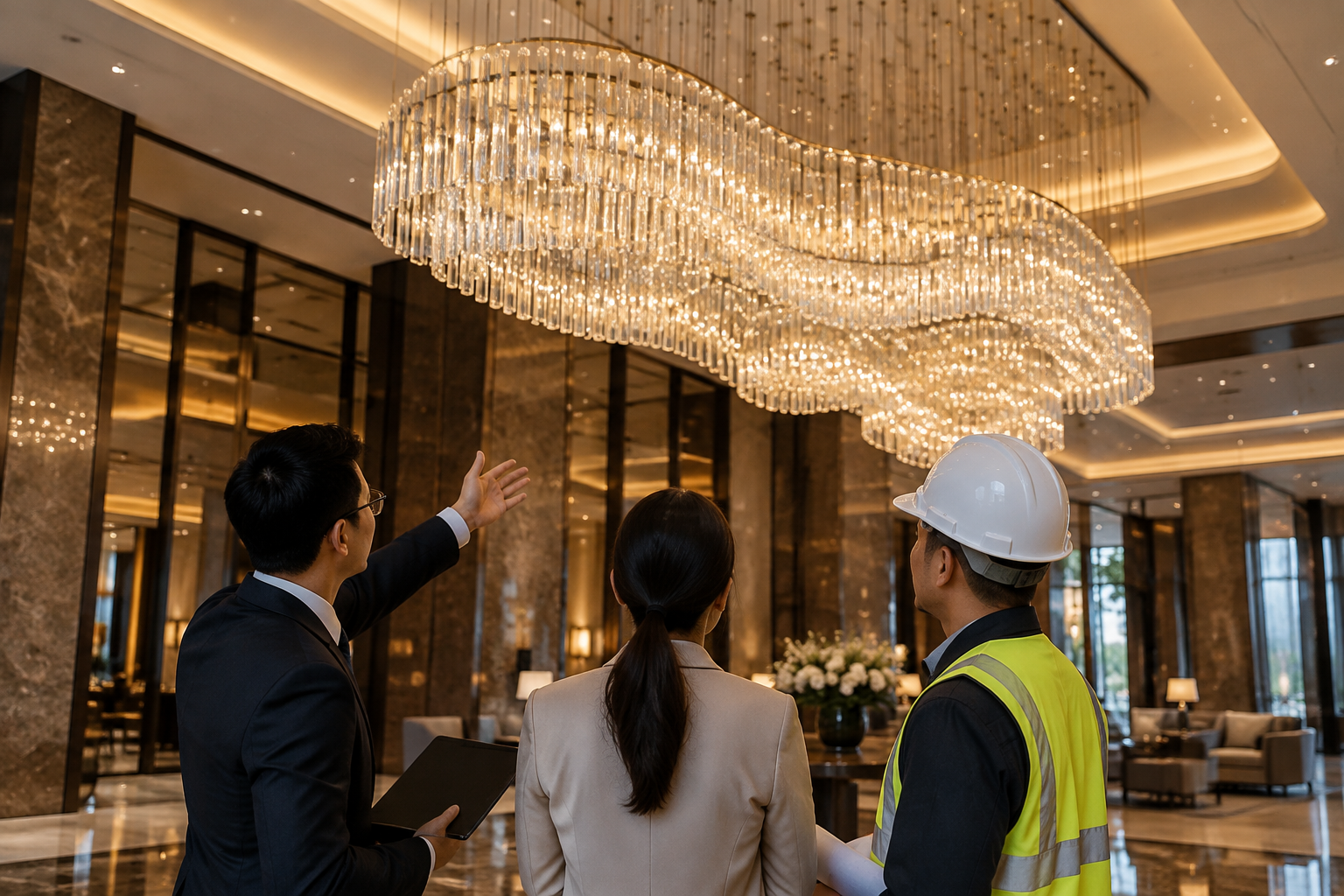
A change should trigger a documented assessment before production continues. Use a recommended specification of 1 controlled change register linking the revised drawing, cost, programme and required reapproval. Changes to LEDs, drivers, materials, suspension or geometry may affect appearance, thermal behaviour, photometry or conformity evidence, even when the replacement looks similar in a render.
Q: Should Decorative Hotel Chandeliers Always Use Warm-white LEDs?
Warm white is often appropriate, but the correct choice depends on materials, surrounding lighting and the hotel’s design intent. A recommended specification of 2700–3000 K is a starting point for lobby sampling, not a mandatory rule. Compare illuminated samples in context and approve colour consistency, glare and dimming behaviour alongside the nominal CCT.
Sources and Technical References — Verifying Requirements and Documentation
Use current official standards and scheme documentation, with applicability confirmed by the project’s qualified advisers.
- EN 12464-1 — Light and lighting — Lighting of work places — Part 1: Indoor work places: consult the applicable national standards body or CEN-CENELEC.
- EN 60598 — Luminaires: select the applicable general and particular requirements; consult national standards bodies and the IEC reference framework.
- IES: consult the Illuminating Engineering Society for photometric and lighting-practice references.
- WELL v2: consult the official WELL standard for project-level lighting features.
- Controls: verify device and system documentation through the DALI Alliance, Casambi and KNX Association.
- Calculation workflow: consult DIALux documentation and retain project assumptions with the calculation report.
These references identify verification routes; they do not assert that any proposed chandelier holds a particular approval or certification.
 How Do Hotel Chandelier Approvals Move from 3D Render to Sample?: Q: What happens if the chandelier changes after sample approval?
Request a Custom Quote — Preparing an Approval-ready Chandelier Brief
An approval-ready enquiry should define the installation context, visual intent, evidence requirements and decision-making responsibilities.
Send the lobby drawings, ceiling heights, preferred chandelier dimensions, reference images, material palette, control protocol, destination market and required delivery date. Identify the intended sample scope, installation responsibilities and documents required for procurement acceptance. Ask the quotation to separate engineering, sampling, testing, production and logistics.
At XHLWX (led-project-light.com), a Custom Indoor LED Lighting Manufacturer based in China, ... the recommended next step is a coordinated brief for your bespoke indoor hotel chandelier. Request a proposal identifying model deliverables, sample scope, compliance evidence, approval responsibilities and production-release conditions, so the accepted render becomes a traceable specification rather than an unresolved promise.
À propos de XHLWX
XHLWX est la marque de Shenzhen Qihang Lighting Co., Ltd., fabricant de luminaires LED pour projets, avec sa propre usine à Shenzhen (Chine) depuis 2009. Nous fournissons profilés linéaires, downlights, rails magnétiques, dalles, luminaires étanches, high bays et luminaires sur mesure pour bureaux, hôtels, musées, commerces et sites industriels.
Études d'éclairage selon la NF EN 12464-1 (Em, UGR, Uo, Ra) avec fichiers IES et LDT pour DIALux ; luminaires conformes CE et RoHS, système qualité ISO 9001.
Questions fréquentes sur XHLWX
XHLWX livre-t-il en France et en Belgique ?
Oui. Nous livrons les projets en France et en Belgique directement depuis l'usine ; devis, étude d'éclairage et fiches techniques sont fournis en français ou en anglais.
Les luminaires respectent-ils la NF EN 12464-1 ?
Nous dimensionnons l'éclairement, la limite UGR et l'uniformité selon la NF EN 12464-1 et justifions les valeurs par un calcul DIALux réalisé avec nos fichiers LDT.
Quels systèmes de gestion d'éclairage sont compatibles ?
DALI-2, 0-10 V et Casambi (Bluetooth), avec versions éclairage de secours ou détecteur selon le projet.
XHLWX fabrique-t-il du sur-mesure ou de l'OEM ?
Oui. Longueurs, températures de couleur, angles de faisceau, finitions et votre propre marque (OEM/ODM) sont réalisés dans notre usine.
Need a tailored lighting plan for your project?
Our senior lighting designers reply within 48 hours with a free design proposal & quotation.