
Magnetic Track Light Guide 2026: 48V System Design
Quick answer
Master 48V magnetic track light system design for retail and residential spaces. Learn about EN 12464-1 standards, DALI-2 controls, and optic specifications.

Introduction — the Design Problem in This Space
com), a Custom Indoor LED Lighting Manufacturer based in China, we engineer magnetic track light systems to resolve complex architectural illumination challenges. Modern retail boutiques and high-end residential interiors increasingly demand miniaturized, low-glare luminaires that integrate seamlessly into minimalist architectural ceiling plains. The primary engineering challenge lies in delivering sufficient lumen output and strict glare control while transitioning from bulky 230V line-voltage systems to sophisticated, low-voltage 48V DC networks.
A 48V magnetic track light infrastructure eliminates the safety hazards associated with exposed line-voltage conductors, allowing for tool-free, snap-in luminaire reconfiguration. However, this flexibility introduces new technical constraints.
Designers must carefully manage DC voltage drop over long linear runs, specify power supply placement to maintain aesthetic cleanliness, and integrate complex communication nodes for dimming. By adopting a system-level design approach, lighting professionals can create highly adaptable illumination schemes that respond to seasonal retail merchandising updates or evolving residential layouts without necessitating costly electrical retrofits.
Lighting Criteria and Standards for Magnetic Track Light Systems
Designing a compliant magnetic track light system requires strict adherence to international visual comfort parameters and recommended illuminance benchmarks. Retail and residential environments have distinct illumination requirements that dictate module selection and spatial layout. For retail displays, DIN EN 12464-1 outlines a recommended specification of 500 lux on merchandise surfaces, coupled with a strict Unified Glare Rating (UGR) of ≤ 19 to prevent visual fatigue among shoppers and staff.
Conversely, high-end residential applications typically prioritize layered ambient lighting. Following the guidelines within IES RP, ambient layers often target a simulation target of 200 to 300 lux at the floor level.
Color quality is equally critical across both sectors. While a standard CRI > 90 is an established baseline, modern design standards increasingly rely on TM-30 metrics, seeking an Rf (Fidelity) > 90 and Rg (Gamut) > 100 to ensure accurate rendering of textures, wood grains, and fabrics.
Furthermore, projects pursuing WELL v2 certification often integrate tunable white LED technology within the magnetic track rails to support human circadian rhythms through dynamic Correlated Color Temperature (CCT) adjustments.
| Parameter | Spec | Standard | Notes |
|---|---|---|---|
| Optics & Glare | UGR ≤ 19, 15°-45° Beam | DIN EN 12464-1 | Deep-recessed baffles essential for high visual comfort |
| Color Quality | CCT 2700K-4000K, CRI > 90 | WELL v2 / TM-30 | Rf > 90 and Rg > 100 required for premium merchandising |
| Control Protocols | DALI-2 / Casambi / 0-10V | IEC 62386 | Enables individual luminaire addressing on a single rail |
| Housing & Safety | IP20 / IK04, Extruded Alum. | EN 12464-1 | Heavy-duty profile supports mechanical load and thermal mass |
| Cert. & Electronics | CE / RoHS / ErP / ISO9001 | EU Directives | Pairs Osram / Bridgelux chips with Tridonic / Mean Well drivers |
Luminaire Selection and Optics
Selecting the proper magnetic track modules requires evaluating beam angles, glare mitigation strategies, and the intended visual hierarchy. The core advantage of a 48V platform is the vast ecosystem of interchangeable luminaire heads. By snapping different optical modules into the electrified busbar, designers can instantly switch between diffuse ambient glows and high-contrast focal accents.
For general illumination, linear wall washers and opaque acrylic diffused inserts provide broad, shadow-free light distribution. However, where dramatic contrast is required, adjustable spotlights utilizing Total Internal Reflection (TIR) lenses become critical.
Spotlights equipped with premium COB (Chip-on-Board) LEDs from Osram or Bridgelux deliver tight 15-degree to 36-degree beams, projecting intense candela levels over long distances. To maintain thermal equilibrium and L90B10 lumen maintenance ratings, these compact modules utilize die-cast aluminum heat sinks that transfer thermal loads directly to the extruded track housing.
| Module Type | Primary Application | Optic / Beam Angle | Verdict |
|---|---|---|---|
| Linear Diffused Insert | Ambient foundational lighting | 110° Frosted Acrylic | Best for achieving baseline lux targets without harsh shadows |
| Dark-Light Grille | High-comfort ambient | 30° / 45° Honeycomb Louver | Optimal for strict UGR ≤ 19 areas like residential living rooms |
| Adjustable Spotlight | Merchandise / Art accenting | 15° / 24° / 36° TIR Lens | Ideal for establishing high-contrast focal points |
| Suspended Pendant | Over-counter task lighting | 24° / 36° Faceted Reflector | Best for layered spatial depth over kitchen islands or registers |
| Asymmetric Wall Washer | Vertical surface grazing | Asymmetric Reflector | Essential for uniformly illuminating art walls and retail shelving |
Explore our complete portfolio of modular inserts on our magnetic track light products page to find the exact optical solution for your spatial requirements.
How Do You Calculate Voltage Drop in a 48V Magnetic Track Run?
To prevent visible dimming across long runs, engineers must calculate cumulative wattage and specify the correct conductor gauges. Unlike 230V systems where voltage drop is negligible over standard architectural distances, 48V DC systems are highly susceptible to resistance losses. As a recommended specification, the voltage reaching the furthest LED module on the track must not drop below 46V to ensure the internal DC-DC drivers operate efficiently.
When designing a continuous track exceeding 15 meters in length, lighting designers should limit the total connected load to 80% of the remote power supply's maximum rating (e.g., loading a 320W Mean Well driver to a design target of 256W). Furthermore, strategically placing the 48V feed point at the center of the track run—rather than at one end—effectively halves the electrical distance, significantly mitigating voltage drop and ensuring uniform lumen output across all installed luminaires.
What Are the Mechanical Load Limits for Suspended Magnetic Tracks?
Suspended track networks demand rigorous weight distribution planning to maintain structural alignment and prevent dangerous rail deflection. A high-quality 48V magnetic track system is constructed from heavy-gauge extruded aluminum, typically featuring an IK04 impact rating. This robust profile acts not only as a housing for the copper busbars but also as the primary structural spine of the lighting installation.
While the internal magnetic strips provide constant holding force, safety standards dictate that mechanical friction locks must bear the actual gravitational load of heavier inserts.5 meters.
Each track adapter is engineered for a design target capacity of up to 3kg, ensuring that heavy decorative pendant modules remain securely fastened even in areas prone to mild seismic activity or mechanical vibration. For comprehensive details on mounting hardware, consult our magnetic track lighting installation guide.
How to Balance Ambient and Accent Lighting in a Single Track?
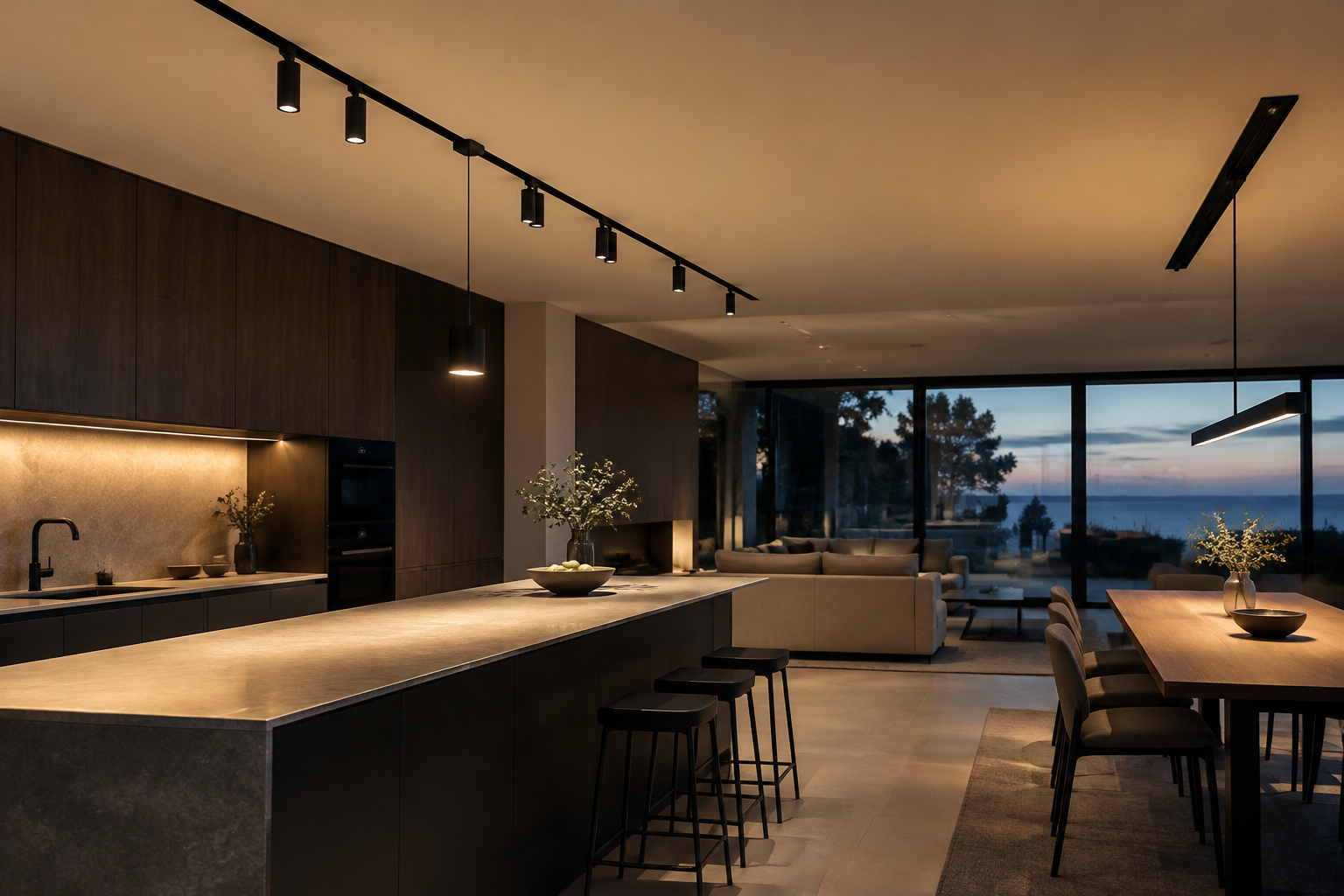
Combining diffused linear inserts with narrow-beam spotlights on the same rail establishes visual contrast and layered spatial depth. A frequent mistake in modern lighting design is over-illuminating a space with homogeneous, flat light. The strength of the magnetic track light lies in its ability to micro-zone illumination.
A highly effective design target for retail environments allocates roughly 40% of the total track wattage to ambient dark-light or frosted linear modules to provide safe navigation lighting. The remaining 60% is dedicated to adjustable TIR spotlights aimed precisely at merchandise displays. This deliberate contrast ratio (often targeting a 3:1 lux ratio between the accent point and the ambient floor) draws the eye naturally toward architectural features and products, vastly improving the experiential quality of the space.
 Magnetic Track Light Guide 2026: 48V System Design: How do you calculate voltage drop in a 48V magnetic track run?
Controls, Energy and Commissioning (DALI-2 / Casambi / Sensors)
Integrating advanced control protocols maximizes energy efficiency and enables dynamic, programmable scene management for multi-functional commercial spaces. Standard on/off switching is no longer sufficient for modern retail and residential environments subject to strict energy codes. A state-of-the-art 48V system utilizes a 4-wire busbar configuration (two wires for 48V DC power, two for digital communication) to deploy DALI-2 networking seamlessly across the entire track length.
With DALI-2 compatible drivers from industry leaders like Tridonic, facility managers can individually address each luminaire, grouping specific spotlights to dim simultaneously while leaving ambient linear modules at full output. For retrofit applications where pulling new low-voltage control wire is cost-prohibitive, Casambi Bluetooth mesh technology offers a robust wireless alternative.
By integrating miniaturized Casambi nodes directly into the track adapters, users gain smartphone-based control over dimming curves and tunable white CCT transitions. Furthermore, integrating daylight harvesting and PIR occupancy sensors directly into the track yields a simulation target of up to 45% energy reduction, easily surpassing baseline ErP directive standby power requirements.
Photometric Files & Compliance (IES / LDT / DIALux / CE / RoHS / ErP)
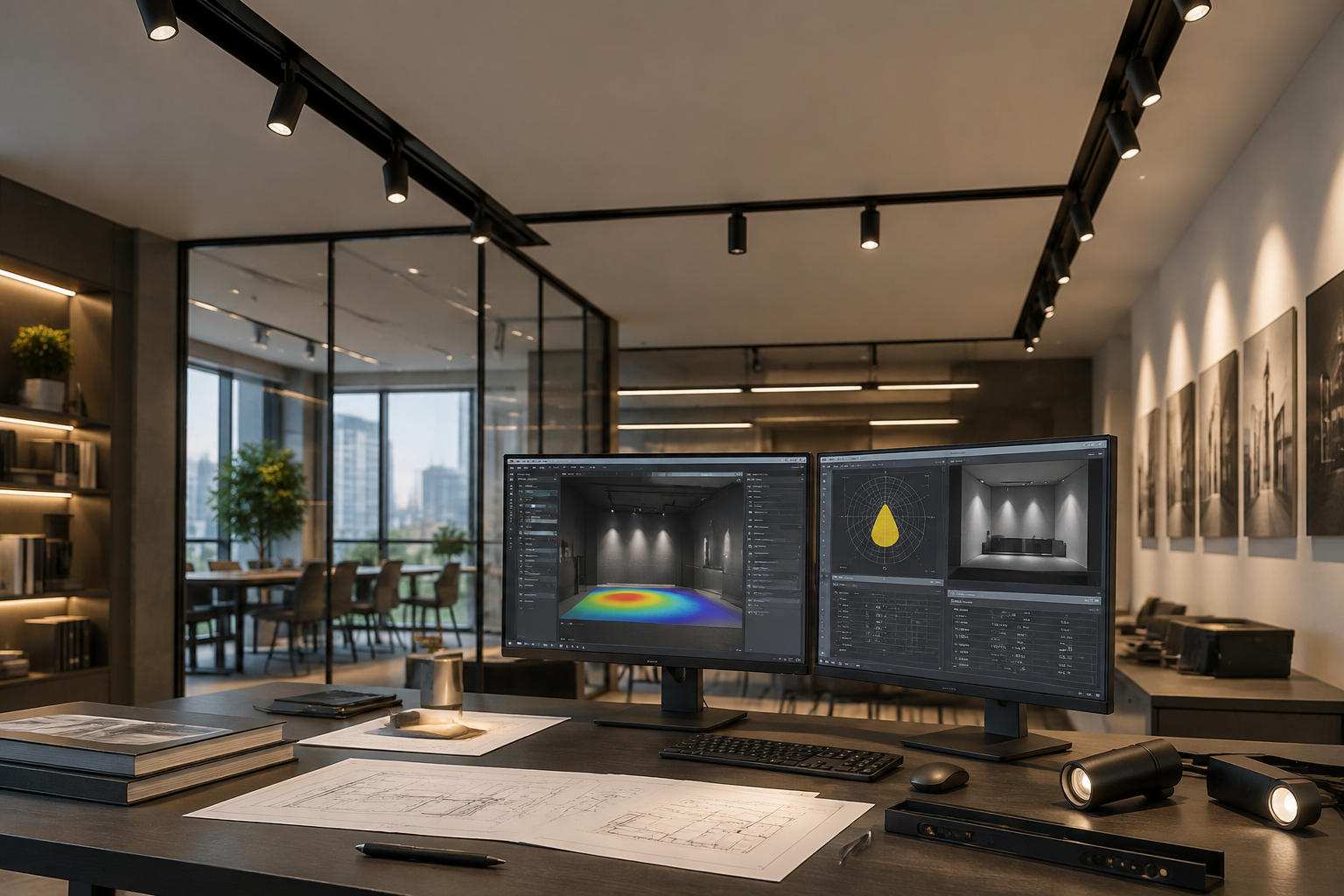
Accurate digital simulation relies entirely on certified photometric data and strict adherence to regional safety and environmental directives. Lighting specifiers cannot afford to guess the performance of a magnetic track light system. Reliable manufacturers provide laboratory-tested IES and LDT photometric files for every available module optic and wattage combination.
By importing these IES and LDT photometric files into DIALux evo, engineers can render highly accurate false-color illuminance maps and verify that the simulation target for UGR and vertical footcandles meets strict EN 12464-1 compliance before procurement begins. Beyond optical performance, specifiers must demand rigorous compliance documentation.
All system components—from the remote driver to the individual LED chips—must carry valid CE marks, RoHS compliance for the restriction of hazardous substances, and meet stringent ErP ecodesign regulations. Manufacturing facilities audited under ISO9001 quality management systems ensure that these compliance metrics remain consistent across mass production runs.
 Magnetic Track Light Guide 2026: 48V System Design: Photometric files & compliance (IES / LDT / DIALux / CE / RoHS / ErP)
Frequently Asked Questions
Review these common technical inquiries to streamline your 48V magnetic track lighting specification, installation, and final commissioning processes.
Q: What Is the Maximum Safe Run Length for a 320W Magnetic Track Light Power Supply?
The recommended specification for a 320W 48V driver is a maximum track length of 15 meters to prevent voltage drop. Designers should load the power supply to only 80% capacity (256W maximum) to ensure driver longevity and maintain uniform illuminance across all connected LED modules.
Q: Can DALI-2 Modules Coexist with Non-dimmable Inserts on the Same Magnetic Track Light Rail?
Yes, a 4-wire magnetic track rail allows DALI-2 signals to pass to compatible drivers while non-dimmable modules draw only from the 48V DC power lines. This design target provides extreme flexibility, letting you mix 10W accent spots with 20W DALI-2 tunable white linear inserts seamlessly.
Q: How Does a Magnetic Track Light System Achieve a UGR < 19 Rating?
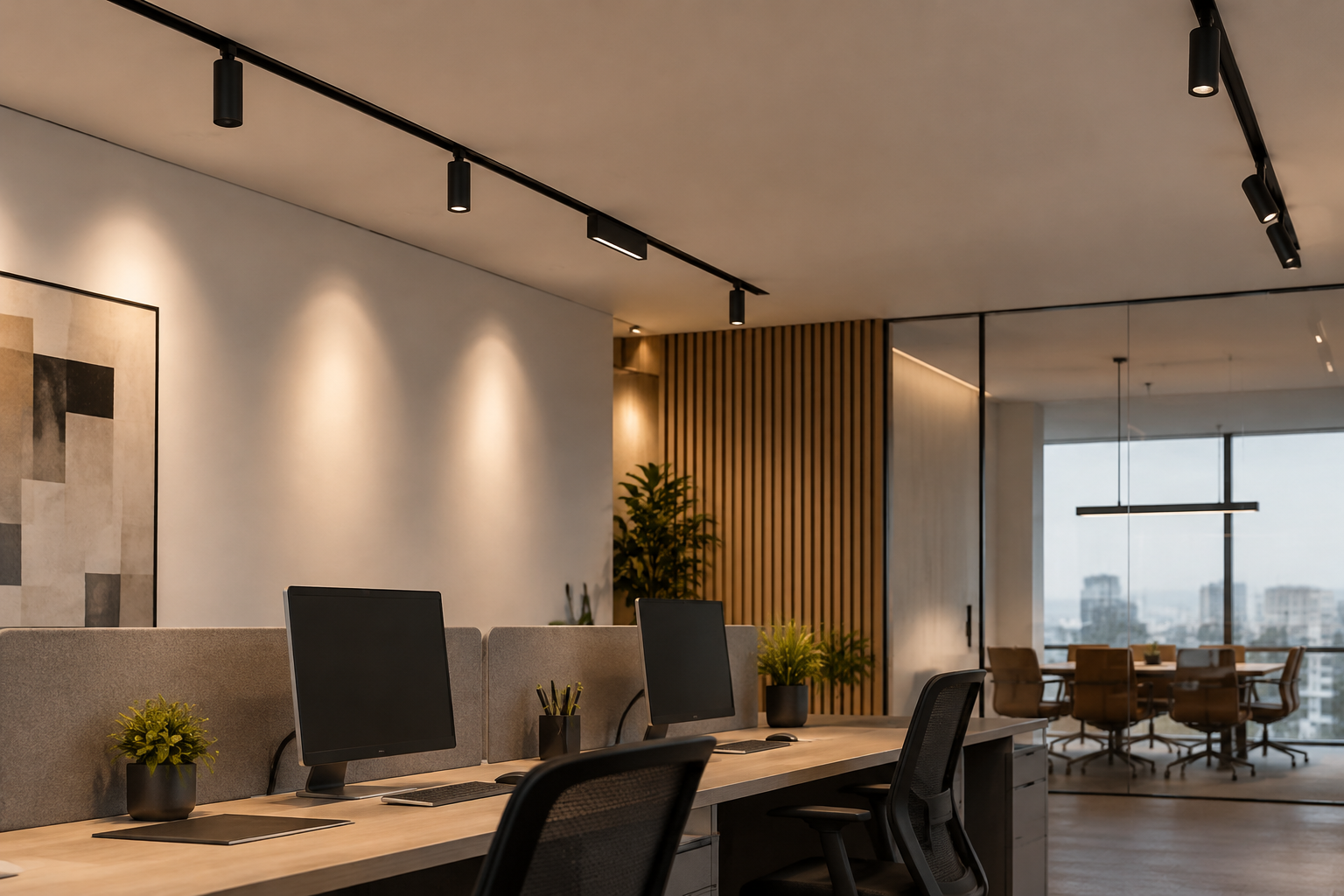
Achieving a UGR rating below 19 involves selecting modules with deep-recessed optics, honeycomb louvers, or dark-light reflectors. By utilizing 30-degree beam angles and hiding the light source within the 48mm deep track profile, the simulation target for glare control strictly complies with DIN EN 12464-1 standards.
Q: What Wire Gauge Is Required Between the Remote 48V Driver and the Magnetic Track Light Feed?
For a 10-meter distance between a remote Mean Well 48V power supply and the track feed, a recommended specification is at least 12 AWG (3.3 mm²) copper wire. This minimizes electrical resistance, ensuring voltage drop remains below the 3% threshold necessary for stable LED module performance.
Sources and Technical References
The technical specifications in this design guide are formulated using recognized international architectural lighting standards and testing methodologies.
- DIN EN 12464-1: European standard specifying indoor workplace lighting requirements, including visual comfort and illuminance targets for retail spaces.
- EN 12464-1: Base European standard for the lighting of indoor work places, dictating UGR limitations and color rendering requirements.
- IES RP: Illuminating Engineering Society Recommended Practices, utilized for establishing layered lux targets in residential and hospitality environments.
- WELL v2: The International WELL Building Institute's standard for advancing human health, heavily referencing TM-30 color fidelity and circadian lighting rhythms.
 Magnetic Track Light Guide 2026: 48V System Design: Q: How does a magnetic track light system achieve a UGR < 19 rating?
Request a Custom Quote
com), a Custom Indoor LED Lighting Manufacturer based in China, we deliver high-performance 48V systems tailored to your architectural specifications. Whether you are illuminating a flagship retail boutique in Paris or outfitting a luxury residential development in Dubai, our engineering team provides comprehensive support—from DIALux planning to custom extrusion modifications. Contact us today with your IES and LDT photometric file requirements to receive a detailed project quotation.
À propos de XHLWX
XHLWX est la marque de Shenzhen Qihang Lighting Co., Ltd., fabricant de luminaires LED pour projets, avec sa propre usine à Shenzhen (Chine) depuis 2009. Nous fournissons profilés linéaires, downlights, rails magnétiques, dalles, luminaires étanches, high bays et luminaires sur mesure pour bureaux, hôtels, musées, commerces et sites industriels.
Études d'éclairage selon la NF EN 12464-1 (Em, UGR, Uo, Ra) avec fichiers IES et LDT pour DIALux ; luminaires conformes CE et RoHS, système qualité ISO 9001.
Questions fréquentes sur XHLWX
XHLWX livre-t-il en France et en Belgique ?
Oui. Nous livrons les projets en France et en Belgique directement depuis l'usine ; devis, étude d'éclairage et fiches techniques sont fournis en français ou en anglais.
Les luminaires respectent-ils la NF EN 12464-1 ?
Nous dimensionnons l'éclairement, la limite UGR et l'uniformité selon la NF EN 12464-1 et justifions les valeurs par un calcul DIALux réalisé avec nos fichiers LDT.
Quels systèmes de gestion d'éclairage sont compatibles ?
DALI-2, 0-10 V et Casambi (Bluetooth), avec versions éclairage de secours ou détecteur selon le projet.
XHLWX fabrique-t-il du sur-mesure ou de l'OEM ?
Oui. Longueurs, températures de couleur, angles de faisceau, finitions et votre propre marque (OEM/ODM) sont réalisés dans notre usine.
Need a tailored lighting plan for your project?
Our senior lighting designers reply within 48 hours with a free design proposal & quotation.