
How Do Twin-Arm Hotel Reading Lights Protect Partner Comfort?
Quick answer
Specify adjustable twin-arm hotel reading lights with narrow beams, shielded optics and tested positioning for reading comfort without disturbing a partner.
Introduction
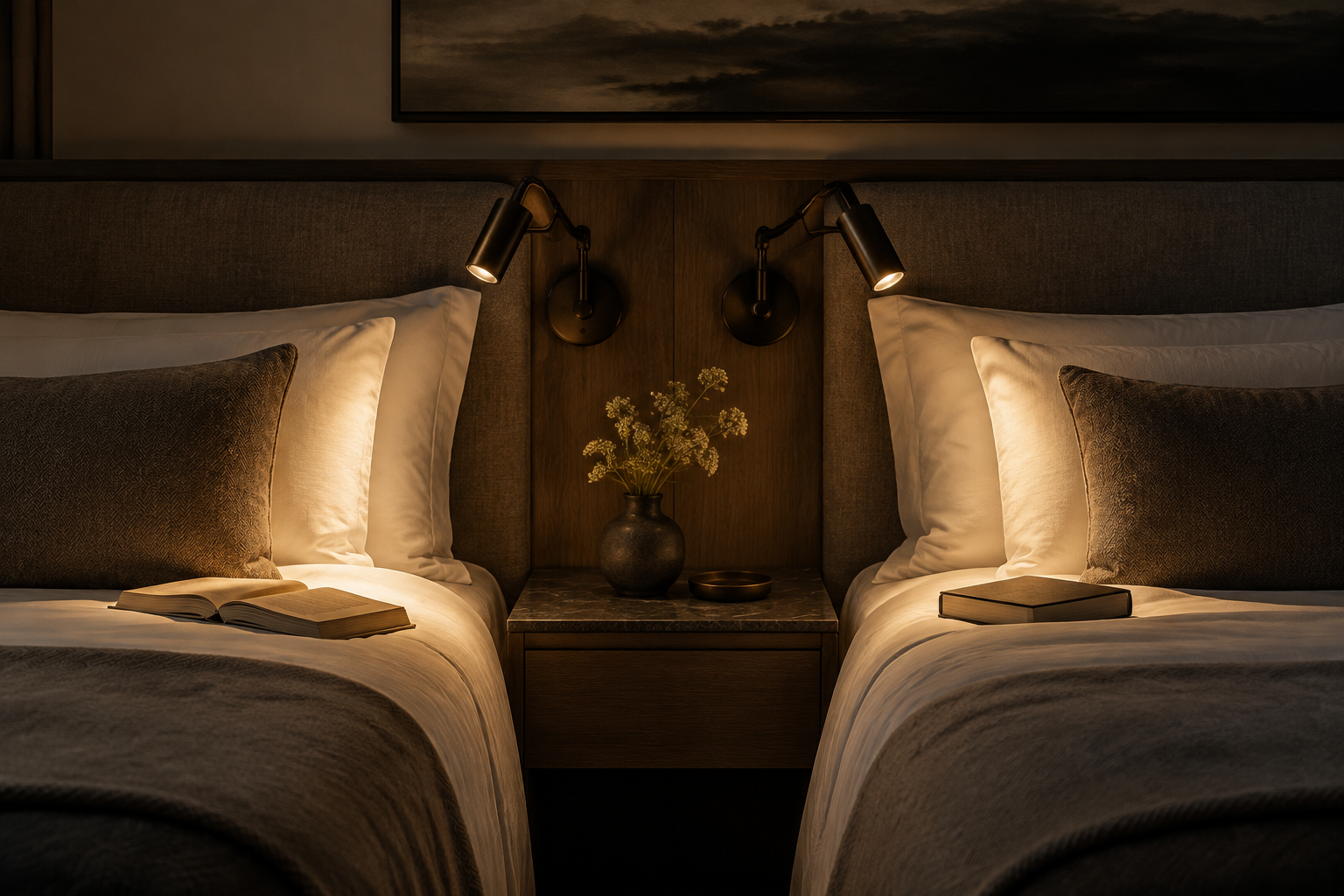
At XHLWX (led-project-light.com), a Custom Indoor LED Lighting Manufacturer based in China, twin-arm bedside lights target reading comfort through controlled aiming. Recommended specifications start with a 15–25° beam and 2700–3000 K light, supported by shielded optics and articulated arms that keep the illuminated area on the page rather than a partner’s pillow.
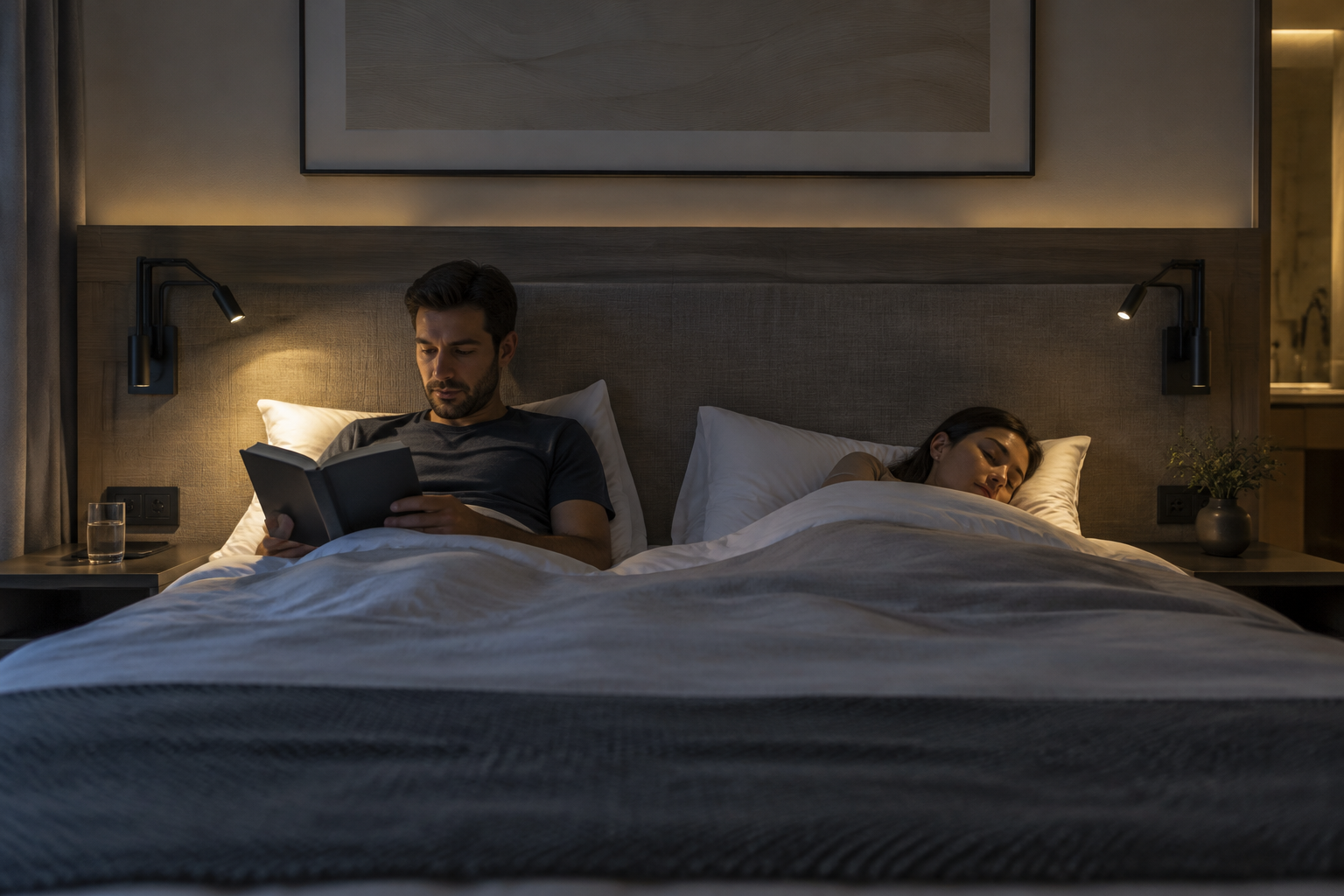
A narrow beam alone cannot guarantee partner comfort. The guest must also be able to position the head, avoid seeing the bright LED directly, and switch or dim the light without disturbing someone beside them. Reflections from glossy pages and pale bedding can remain noticeable even when the beam misses the adjacent pillow.
Here, twin-arm means a double-arm swing mechanism supporting an adjustable reading head, not automatically a fixture with separate heads for separate guests. Procurement drawings should remove that ambiguity before suppliers price the hotel bedside reading light.
Design Criteria and Standards
Specify page illumination, adjacent-pillow spill and source visibility together; beam angle alone does not describe bedside comfort.
Use 300–500 lx on the reading surface as a design target, verified at the actual reading position. For partner comfort, consider no more than 5 lx of additional illuminance at the adjacent pillow as a project design target, measured with other lights unchanged. Neither figure is presented here as a universal hotel-bedroom requirement.
A beam’s nominal diameter can be estimated as 2 × distance × tan(beam angle ÷ 2).21 m.
This geometric estimate excludes spill, beam irregularities and the elongated footprint created by oblique aiming. Validate it against the selected optic’s photometry and a physical sample.
| Parameter | Spec | Standard | Notes |
|---|---|---|---|
| CCT and colour quality | Recommended specification: 2700–3000 K, CRI ≥90 | IES colour-quality guidance; WELL v2 where relevant | Confirm colour consistency and appearance on bedding, skin and book pages. |
| Beam and shielding | Recommended specification: 15–25° beam with recessed source or shielding lip | IES photometric reporting; EN 13032-1 where applicable | Request intensity distribution and spill information, not just a catalogue beam angle. |
| Illuminance and UGR | Design target: 300–500 lx on the page; assess direct glare at both pillows | EN 12464-1 for applicable indoor workplaces | Do not impose an office UGR limit on a bedroom or treat UGR as an intrinsic luminaire rating. |
| Control | Recommended specification: local switching or dimming; DALI-2, Casambi, KNX or 0–10V by project | IEC 62386 for DALI; relevant system documentation | Confirm gateways, wiring topology and exact driver compatibility. |
| Housing, material and IP | Recommended specification: aluminium or brass housing; IP20 for a dry bedside location | EN 60598; IEC 60529 | Confirm heat dissipation, joint strength and suitability for the installed environment. |
| LED and driver sourcing | Recommended sourcing options: Osram, Bridgelux or Samsung LEDs; Tridonic or Mean Well drivers | Exact component datasheets and applicable safety requirements | Brand availability and suitability must be confirmed; these are not claims about installed components. |
| Certification and documentation | Request applicable CE/RoHS evidence, UL listing where required, SAA approval where relevant, and any claimed ISO9001 certificate | Applicable EU legislation; UL 1598 or UL 153 by product type; AS/NZS 60598.1; ISO 9001 | CE is a conformity marking; ISO9001 concerns a quality system, not product approval. Verify scope and validity. |
EN 12464-1 addresses indoor workplaces, so its applicability depends on the activity and space. Use relevant IES guidance and the project brief for the bedroom assessment. WELL v2 requirements apply only where the project pursues relevant features; warm CCT alone does not demonstrate compliance.
Customisation Options and Materials
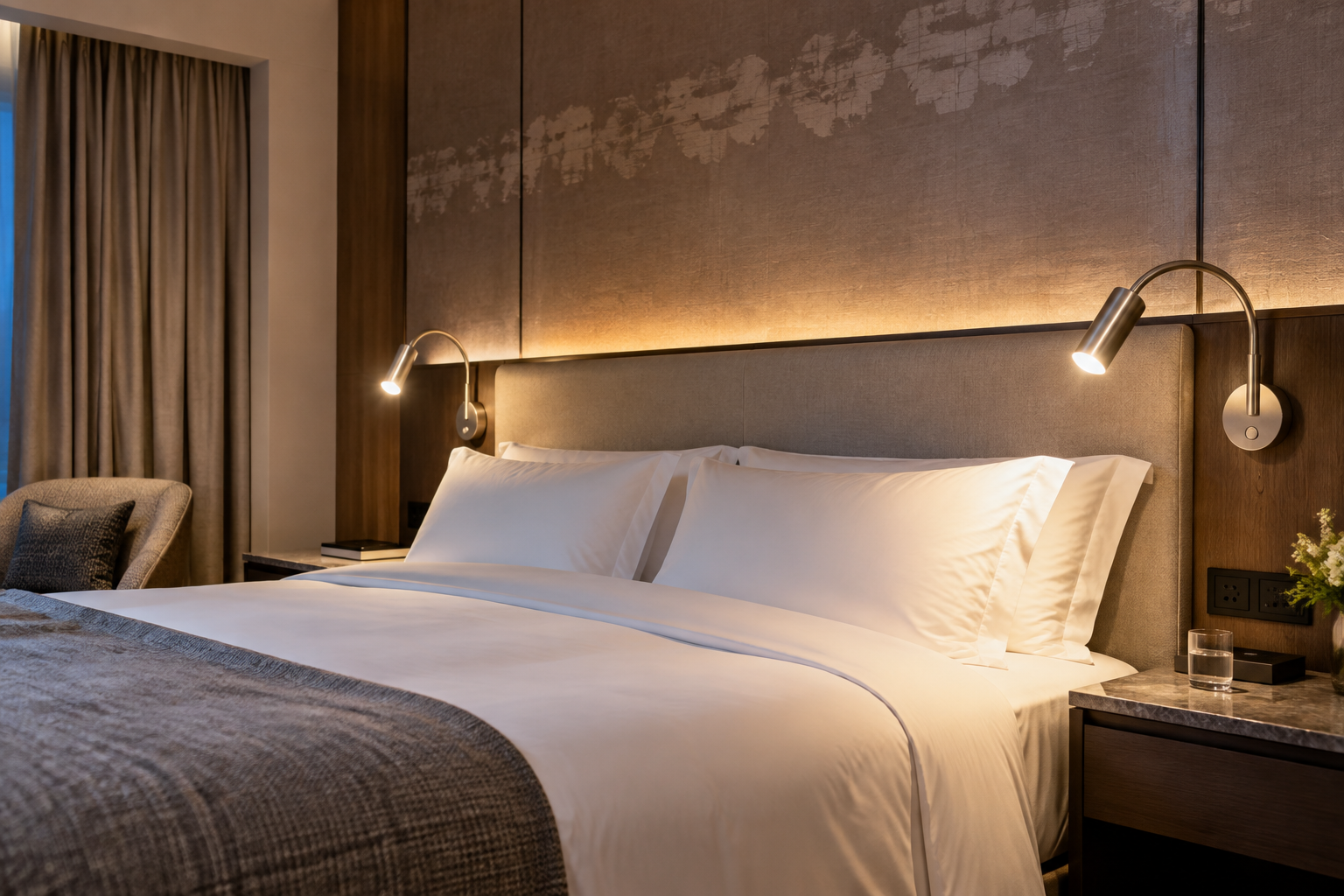
Customise the arm geometry around the bed, headboard and guest’s reading posture before choosing a decorative finish.
The supplier needs a coordinated elevation showing mattress height, headboard thickness, pillow positions, bedside furniture and mounting constraints. Define the reading position with the bed dressed, because pillows can obstruct arm travel and change the required aiming angle.
| Configuration | Reading coverage | Partner-comfort considerations | Procurement verdict |
|---|---|---|---|
| Double-arm swing head with narrow optic | Flexible reach across sitting and reclining positions | Good potential when shielding and joint stops prevent cross-bed aiming | Preferred where posture flexibility matters; validate full arm travel. |
| Short adjustable head with narrow optic | More limited reach and adjustment | Can control spill well if mounting geometry is accurate | Suitable where space is restricted and the reading position is predictable. |
| Double-arm lamp with broad diffuser | Broad coverage with less precise placement | More likely to illuminate nearby bedding and the adjacent sleeping area | Better as supplementary ambient light than partner-sensitive task light. |
| Shared fixture with independently aimed heads | Separate aiming from a common mounting point | Requires independent switching and careful control of crossover light | Consider only after testing both heads with both pillow positions occupied. |
How Should Double-arm Swing Geometry Suit Different Reading Postures?
Arm reach should bring the light to the page without forcing the guest to lean or exposing the LED to the neighbouring sleeper.
Specify the required working envelope rather than accepting an arm-length dimension in isolation. Test upright reading, reclined reading and stowed positions. Each position should avoid head contact, trapped fingers, cable strain and interference with bedside controls.
Joint resistance must balance easy adjustment against sagging. Request an agreed durability test with a documented cycling method and acceptance criteria. Avoid accepting a claimed cycle life without knowing the load, movement range and allowable change in holding torque.
Which Materials and Finishes Suit Heavily Used Hotel Bedside Lamps?
Metal selection should support joint durability, thermal management and cleaning compatibility before it serves the decorative concept.
Aluminium can support a compact, relatively light head, while brass can suit a tactile decorative assembly. Steel mounting plates may provide structural support behind visible components. Material names alone do not establish performance: wall thickness, joint design, fasteners and finish preparation all matter.
Approve finish samples under the bedroom’s intended lighting. Specify cleaning agents and request compatibility checks for coatings, plated surfaces and touch controls. For coastal or humid-market hotels, assess the actual conditioned indoor environment rather than assuming every room has the same corrosion exposure.
Which Narrow-beam Details Reduce Light on the Neighbouring Pillow?
A recessed emitter, controlled spill and restricted aiming usually matter more than selecting the smallest available beam angle.
An excessively tight beam can create a bright patch that requires constant repositioning as a guest turns pages. Choose an optic that covers the intended reading area at the expected throw, then evaluate its edge and surrounding spill.
Add a snoot, shielding lip or asymmetric optic only after checking useful coverage. Mechanical stops can prevent cross-bed aiming, but they must preserve comfortable use from either side. Test glossy magazines as well as matte books, because reflected glare follows different paths from direct light.
 How Do Twin-Arm Hotel Reading Lights Protect Partner Comfort?: Which materials and finishes suit heavily used hotel bedside lamps?
Controls and Commissioning
Independent local control is the foundation of partner comfort, even when the reading lights connect to a room-management system.
Place each switch or dimming control within comfortable reach and make its function understandable in darkness. Define whether the room master switch extinguishes reading lights and whether guests can subsequently restore their own light locally. Avoid unexplained behaviour after power restoration or room-entry scenes.
DALI-2 can support addressable control when the selected driver and system configuration are compatible. A KNX room system may require an appropriate DALI gateway.
Casambi suitability depends on the control device, radio environment and commissioning arrangements. A 0–10V design requires compatible control behaviour and a clearly defined method of switching off.
For dimming, set a recommended specification of stable, usable adjustment down to 10% light output or lower, then test the exact LED-driver-control combination. This is not a guarantee for every compact fixture. Check visible flicker, audible noise, drop-out, startup brightness and consistency between bedside units.
Commission with the actual headboard and bedding installed. Record the approved aiming position and test each guest’s controls independently, including master-off and power-restoration behaviour. Indicator LEDs should not become an unintended source of nighttime disturbance.
Sampling, MOQ, Lead Time and Quality Control
Approve a working bedside mock-up before committing to production quantities or accepting a delivery programme.
The sample should reproduce the proposed optic, driver, arm joints, mounting plate, finish and control interface. A visually similar prototype with a different driver cannot establish final dimming performance, just as a different lens cannot establish partner-light spill.
Minimum order quantity depends on whether the project modifies an existing platform or requires new machining, tooling, finishing or electronics. Request separate commercial information for prototypes, production fixtures and replacement parts. No universal MOQ or lead time is assumed here.
Ask the manufacturer to identify the dependencies behind its schedule: drawing approval, component procurement, finish approval, sample acceptance, applicable testing, production and shipping. Any quoted lead time should state when the clock starts and what changes would reset it.
Agree a quality-control plan covering:
- Arm holding stability, adjustment smoothness and end stops.
- Cable protection through moving joints and mounting interfaces.
- Thermal behaviour, electrical safety and applicable protective measures.
- Beam consistency, aiming accuracy and control performance.
- Finish matching, surface defects, labels and packing protection.
Retain an approved reference sample and require authorisation before substituting LEDs, optics or drivers. Substitution can alter performance even when the housing looks unchanged.
Photometric Files & Compliance
Photometric files support design decisions only when they represent the exact optical configuration being purchased.
Request IES and LDT photometric files, a dimensioned drawing, declared output, electrical power and the test configuration. The documentation should identify the optic, LED, driver setting and any shielding accessory. Ask whether the data come from measured photometry or another method, and request the supporting report where available.
Use DIALux to model the reading plane, headboard, bedding and adjacent pillow with realistic reflectances. Run different head positions and aiming scenarios rather than presenting only the most favourable orientation. Simulations cannot fully reproduce source visibility, moving occupants or reflections from glossy pages, so retain the physical mock-up as an acceptance step.
For EU supply, assess applicable legislation and the relevant EN 60598 requirements, including the appropriate product-specific part. For US projects, confirm whether the construction falls under UL 1598, UL 153 or another applicable route, and establish the listing requirements with the project team.
Middle East and Southeast Asian requirements vary by country and procurement authority. Do not assume CE documentation, a UL component mark or SAA approval automatically permits installation everywhere. Obtain the destination-market compliance checklist before freezing the design.
 How Do Twin-Arm Hotel Reading Lights Protect Partner Comfort?: Photometric files & compliance
Frequently Asked Questions
Q: What Beam Angle Should a Hotel Twin-arm Reading Light Use?
Start with a recommended specification of 15–25°, then validate the footprint at the actual reading distance. A smaller angle is not automatically more comfortable: it can create a concentrated patch and require frequent adjustment. Check page coverage, spill beyond the beam and source visibility from both pillow positions before approving the optic.
Q: Can a Narrow-beam Bedside Lamp Avoid Disturbing a Sleeping Partner?
A narrow beam can reduce disturbance, but it cannot guarantee darkness for the neighbouring sleeper. Set an optional project design target of no more than 5 lx of additional illuminance at the adjacent pillow, then test it in the furnished mock-up. Also check direct LED visibility and reflections from pages and bedding, which a pillow-plane reading alone may miss.
Q: Is DALI-2 Necessary for Adjustable Hotel Reading Lights?
DALI-2 is useful for integrated control, but independent local operation may be sufficient for a simpler room design. Select the interface around the room-management strategy, maintenance capabilities and guest experience. If using 0–10V, verify dimming and off behaviour with the exact driver. For any system, confirm that one guest can operate their light without changing the partner’s light.
Q: What Should FF&E Buyers Approve Before Ordering Custom Swing-arm Lamps?
Approve the working sample, coordinated drawings, finish, optical performance, controls and destination-market documentation before releasing production. Use a recommended specification of CRI ≥90 where colour quality is important, but do not let that single metric replace a bedside trial. The purchase specification should also identify accepted components, substitution rules, spare parts and an agreed quality-control plan.
Sources and Technical References
Use authoritative references to establish applicable requirements, then verify product-specific evidence against the final fixture configuration.
- CEN-CENELEC: European standards information for EN 12464-1 and the EN 60598 series; confirm applicable editions and parts.
- IES: Illuminating Engineering Society for lighting guidance and ANSI/IES LM-63 photometric file documentation.
- IWBI: WELL v2 for project-specific Light feature requirements.
- DALI Alliance: DALI-2 information and product database for certified control components and scope.
- European Commission: CE marking guidance for manufacturer obligations and conformity context.
- UL Solutions: Lighting resources for applicable safety evaluation and certification pathways.
- ISO: ISO 9001 information for quality-management certification context.
 How Do Twin-Arm Hotel Reading Lights Protect Partner Comfort?: Q: Is DALI-2 necessary for adjustable hotel reading lights?
Request a Custom Quote
A useful quotation starts with bedside geometry, optical acceptance criteria and the destination market, not a reference photograph alone.
Send the headboard elevation, mounting construction, mattress and pillow positions, desired reading envelope, finish references, supply voltage, control interface, quantities and delivery requirements. Include applicable approval requirements and explain how partner comfort will be assessed. Request separate confirmation of sample scope, photometric evidence, commercial terms and replacement-component availability.
com), a Custom Indoor LED Lighting Manufacturer based in China, custom bedside-light enquiries should begin with a coordinated technical brief. Request confirmation of the proposed arm mechanism, narrow-beam optic, driver, compliance pathway and sample acceptance plan before approving production. Final performance claims should follow verified documentation and project-specific testing, not assumptions based on appearance.
Chi è XHLWX
XHLWX è il marchio di Shenzhen Qihang Lighting Co., Ltd., produttore di apparecchi LED per progetti con stabilimento proprio a Shenzhen (Cina) dal 2009. Forniamo profili lineari, downlight, binari magnetici, pannelli, plafoniere stagne, campane industriali e apparecchi su misura per uffici, hotel, musei, retail e industria.
Progettazione illuminotecnica secondo UNI EN 12464-1 (Em, UGR, Uo, Ra) con file IES e LDT per DIALux; apparecchi conformi CE e RoHS, sistema qualità ISO 9001.
Domande frequenti su XHLWX
XHLWX fornisce progetti in Italia?
Sì. Forniamo progetti in Italia direttamente dallo stabilimento; offerta, calcolo illuminotecnico e documentazione tecnica sono disponibili in italiano o inglese.
Gli apparecchi rispettano la UNI EN 12464-1?
Dimensioniamo illuminamento, limite UGR e uniformità secondo la UNI EN 12464-1 e li verifichiamo con un calcolo DIALux basato sui nostri file LDT.
Quali sistemi di controllo sono supportati?
DALI-2, 0-10 V e Casambi (Bluetooth), anche in versione emergenza o con sensore secondo il progetto.
XHLWX realizza apparecchi su misura o OEM?
Sì. Lunghezze, temperature di colore, ottiche, finiture e il vostro marchio (OEM/ODM) vengono realizzati nel nostro stabilimento.
Need a tailored lighting plan for your project?
Our senior lighting designers reply within 48 hours with a free design proposal & quotation.