
G9/E14 or Integrated LED: Which Suits Hotel Chandeliers?
Quick answer
Compare G9/E14 lamps and integrated LED modules for custom hotel chandeliers, including dimming, maintenance, photometry and regional compliance.
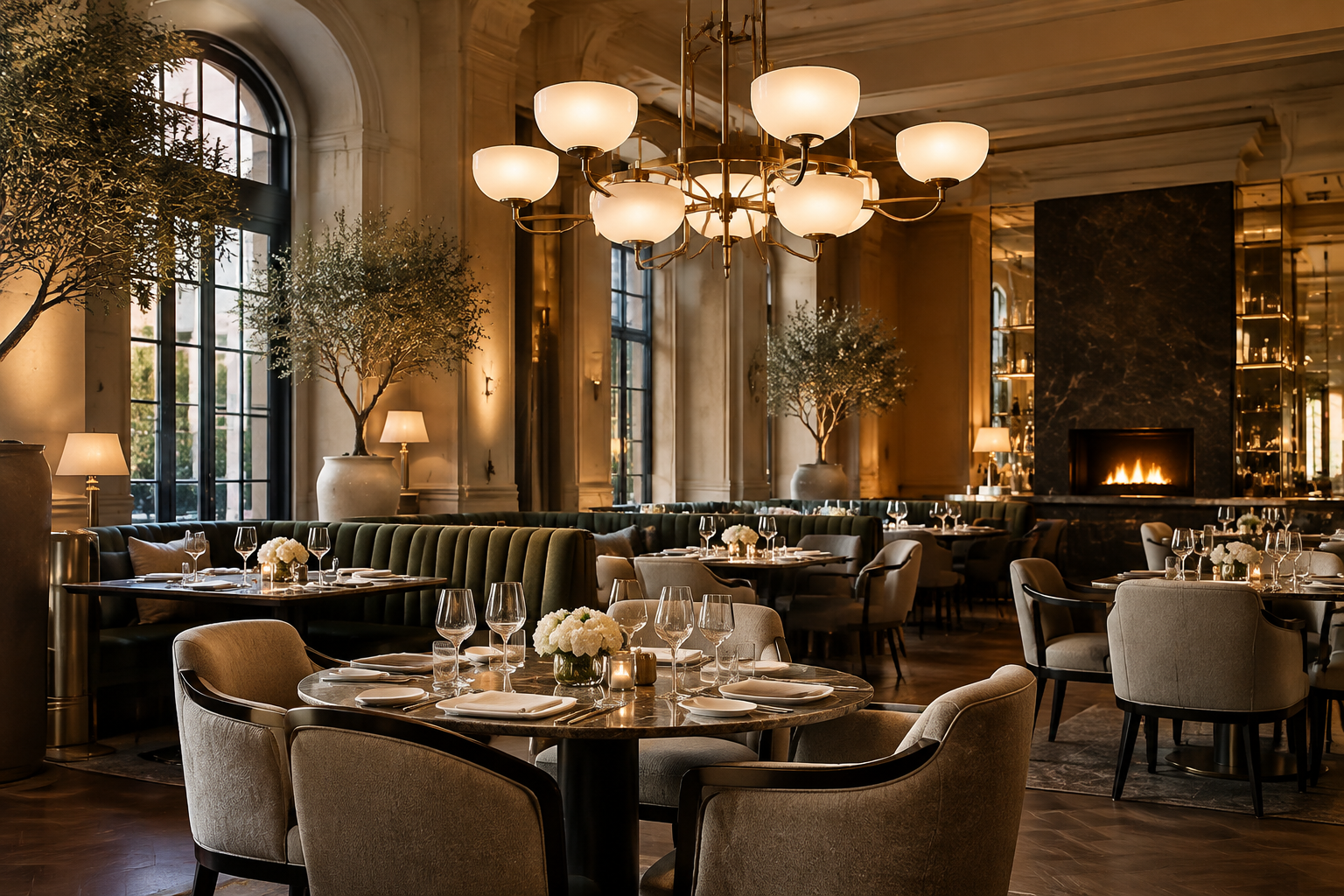
Introduction: Choosing Light Sources for Indoor Hotel Chandeliers
com), a Custom Indoor LED Lighting Manufacturer based in China, G9/E14 lamps favour serviceability; integrated LED modules favour optical control. For indoor hotel chandeliers, a recommended specification of 2700–3000 K and CRI ≥90 suits many hospitality interiors. Choose replaceable lamps for accessible decorative fittings and integrated modules for concealed light and engineered distributions.
Neither architecture is automatically superior. The decision depends on how the chandelier looks, how hotel staff reach it, and whether replacements preserve its appearance. In a tall lobby, access labour can outweigh lamp price; above a restaurant table, visible glare and low-level dimming may dominate.
This guide compares LED G9/E14 lamps with integrated LED modules, rather than treating older halogen lamps as the default alternative.
Design Criteria and Standards for Indoor Hotel Chandeliers
A chandelier specification should separate decorative appearance, task illumination, electrical safety and maintenance access.
Start with the room, not the wattage. Reception desks, restaurant tables and circulation routes have different visual requirements.
EN 12464-1 addresses indoor workplace lighting where applicable; it does not establish a universal chandelier brightness requirement. Assess relevant tasks and surrounding lighting together.
Use EN 60598 for the applicable luminaire safety framework, including relevant particular requirements. IES provides photometric methods and lighting guidance, while WELL v2 requirements apply only where the project pursues relevant features. Neither an attractive rendering nor a high CRI value demonstrates compliance with these frameworks.
The following values are recommended specifications or design targets, not verified XHLWX product ratings or certification claims.
| Parameter | Spec | Standard | Notes |
|---|---|---|---|
| CCT and consistency | Recommended specification: 2700–3000 K; colour consistency within 3 SDCM | Applicable colour measurement methods; project schedule | Approve samples through the actual glass or diffuser |
| Colour rendering | Recommended specification: CRI ≥90 | EN 12464-1 where applicable; project colour criteria | Review skin tones, food and finishes; CRI alone is incomplete |
| UGR and glare | Design target: assess relevant observer positions and task areas | EN 12464-1; applicable IES guidance | UGR is installation-dependent, not a universal chandelier label |
| Beam distribution | Recommended specification: 30° accent or 60° broader module optics where appropriate | IES photometric methods | Decorative lamp distributions depend strongly on shades and glass |
| Control | Recommended specification: select DALI-2, Casambi, KNX interface or 0-10V by project architecture | Applicable protocol requirements | Verify driver, gateway and source compatibility; options are not interchangeable |
| Housing, materials and IP | Recommended specification: metal heat path for modules; IP20 only in suitable dry indoor locations | EN 60598; IEC 60529 | Bathroom or moisture-exposed indoor installations require separate assessment |
| Named source and driver options | Recommended specification: evaluate Bridgelux or Samsung LEDs with Tridonic or Mean Well drivers | Exact component documentation | Brand names are candidate options, not an approved bill of materials |
| Certification and conformity | Recommended specification: document applicable CE/RoHS obligations, UL route, any requested SAA evidence and ISO9001 scope | Destination legislation and applicable product standards | CE is a conformity marking; ISO9001 is not product safety certification |
Specify delivered luminaire output, not merely lamp lumens or LED-board output. Diffusers, decorative glass, shielding and thermal conditions change useful light. Require evidence for the final source, driver and optical assembly.
Customisation Options and Materials for Serviceable Hotel Chandeliers
Source architecture should follow the chandelier geometry and the hotel's maintenance strategy.
The comparison below concerns design tendencies, not measured performance guarantees. Individual lamps, modules and drivers can reverse an apparent advantage.
| Light-source approach | Best-fit indoor application | Principal limitation | Maintenance implication | Verdict |
|---|---|---|---|---|
| G9 LED lamps | Compact decorative arms and small shades | Limited space for electronics and heat dissipation | Lamp changes are straightforward only when access is simple | Choose for compact styling after thermal and dimming checks |
| E14 LED lamps | Candle-style chandeliers and visible decorative lamps | Lamp envelope and luminous appearance remain visible | A controlled replacement-lamp schedule is essential | Strong option when familiar servicing takes priority |
| Permanently integrated LED modules | Slim rings, concealed channels and continuous luminous forms | Repairs may require specialist disassembly | Failed boards can create difficult access or matching problems | Choose only with a credible repair strategy |
| Serviceable integrated LED assemblies | Custom lobby and restaurant chandeliers requiring controlled optics | More engineering and connector space | Replaceable boards and accessible drivers support planned repairs | Often the best compromise for bespoke geometry |
How Do G9 and E14 Lamps Affect Glass Shades and Chandelier Proportions?
G9 and E14 lamps simplify source replacement but constrain the space and appearance around each socket.
Check the complete lamp envelope, including insertion clearance and the route for removing a shade. A physically compatible replacement can still create visible bright spots, altered colour or an unwanted silhouette inside opal glass.
G9 lamps need particular attention in small enclosed chambers. Confirm that the selected lamp permits the intended enclosure and operating orientation.
Never infer suitability from wattage alone. E14 candle lamps offer a familiar decorative appearance, but their luminous surfaces and dimming behaviour vary between models.
When Do Integrated LED Modules Improve a Custom Hotel Chandelier?
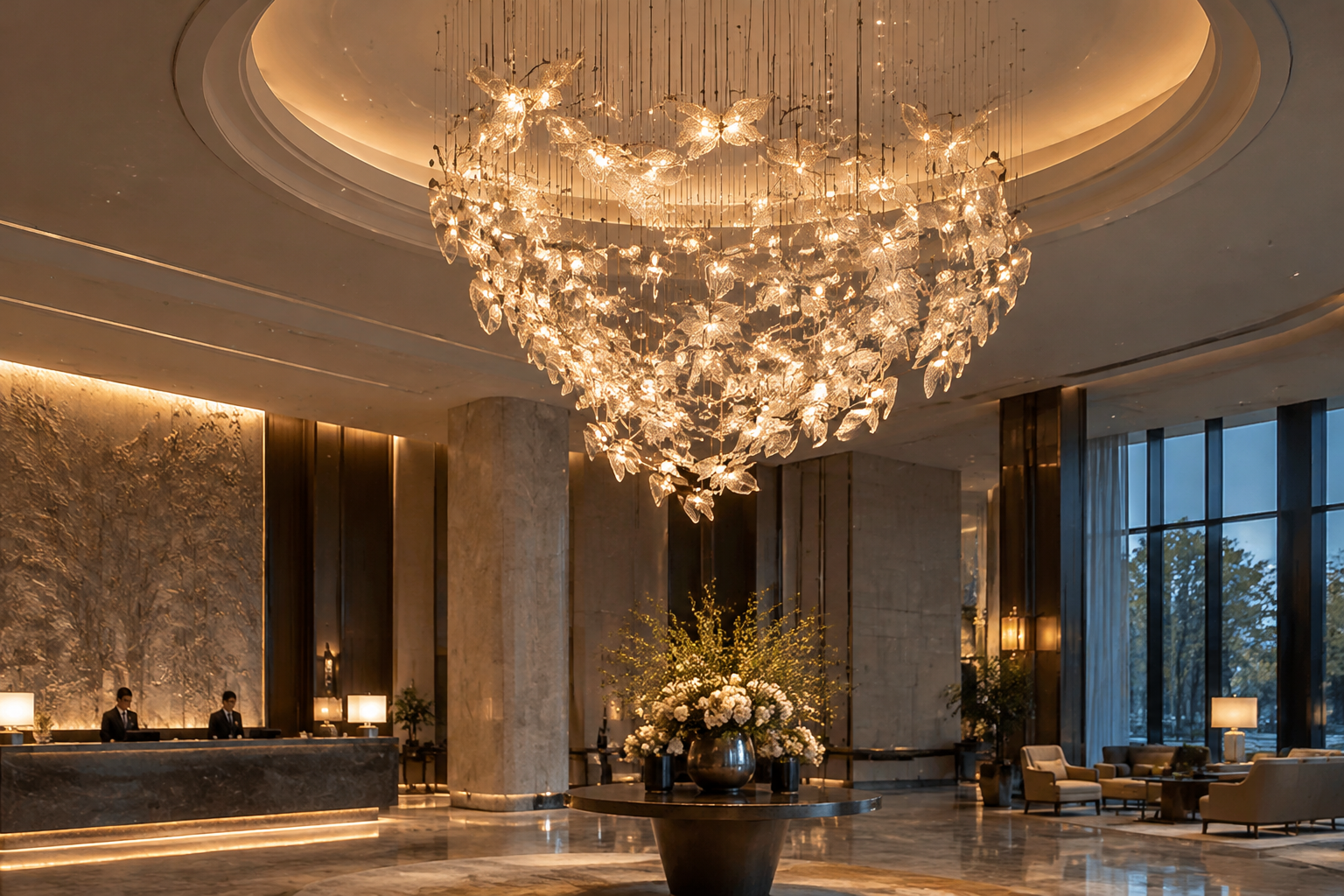
Integrated LED modules suit shapes that need concealed emitters, controlled beams or uninterrupted luminous surfaces.
They allow designers to position light along rings, curves and narrow arms without accommodating a conventional lamp envelope. However, the metal structure must provide a calculated heat path; decorative metal alone is not proof of adequate cooling.
Ask for replaceable module sections, documented connectors and a defined driver location. A remote driver can improve access, but cable length, voltage drop, electromagnetic compatibility and manufacturer limits must be checked. Integrated does not have to mean disposable.
Which Materials Support Finish Quality and Practical Maintenance?
Materials should provide the required appearance without obstructing cooling, electrical protection or component access.
Brass, steel and aluminium offer different forming, weight and finishing characteristics. Aluminium can support module heat spreading, while decorative brass or steel may need a separate thermal solution. Glass and suitable polymer diffusers should be evaluated for transmission, colour shift, cleaning compatibility and long-term appearance.
Approve finish samples under the intended light source. Include removable covers, restrained wiring and accessible fasteners in the drawings so maintenance does not damage decorative surfaces.
 G9/E14 or Integrated LED: Which Suits Hotel Chandeliers?: When do integrated LED modules improve a custom hotel chandelier?
Controls and Commissioning for Hotel Dimming Scenes
Successful dimming depends on the complete control chain, not the light-source category alone.
For G9/E14 lamps, obtain written compatibility information for the exact lamp and dimmer combination. Test the actual circuit load, including the smallest installed group. Phase-cut dimmers may exhibit dropout, shimmer, buzzing or inconsistent start-up when paired with unsuitable lamps.
Integrated modules usually offer more driver choice, but that does not guarantee smooth low-level behaviour. DALI-2 concerns compatible digital control equipment; Casambi requires a suitable wireless architecture; KNX commonly connects through a driver or gateway. With 0-10V, confirm wiring, minimum level and the separate switching arrangement where needed.
For a restaurant scene, a recommended specification is stable dimming to 1% of full output, subject to sample validation. State whether that percentage refers to measured light output rather than a controller position. Do not treat it as a guaranteed capability of every lamp or driver.
Commission reception, dining, cleaning and overnight scenes separately. Check simultaneous start-up, fade consistency, power-restoration behaviour and interaction with other luminaires. Flicker and audible noise require assessment across the dimming range, not only at maximum output.
Sampling, MOQ, Lead Time and Quality Control for Bespoke Chandeliers
Approve a representative illuminated sample before releasing a custom chandelier for production.
The sample should reproduce the critical optical and thermal conditions: shade dimensions, source spacing, diffuser material, enclosure and control equipment. A bare LED board or isolated lamp cannot demonstrate the completed chandelier's performance.
For G9/E14 designs, freeze the approved lamp model and document permitted substitutes. For integrated designs, freeze the module, driver, optics and thermal interface. Unapproved substitutions can change colour, dimming and compliance evidence.
MOQ and lead time require a project quotation. They depend on tooling, casting, glass production, finish development, component availability, approval cycles and destination testing. Distinguish the sample schedule from the production schedule, and identify when the production clock begins.
Request an inspection plan covering dimensions, finish acceptance, wiring, applicable electrical safety checks, thermal verification and functional dimming tests. Ask which checks apply to each unit and which belong to design validation or sampling.
The handover package should identify spare lamps or modules, drivers, removal instructions and reorder references. Purchase spares against the approved configuration, rather than assuming visually similar components will remain interchangeable.
Photometric Files & Compliance for EU, US, Middle East and Southeast Asia
Photometry and compliance documentation must match the chandelier configuration and destination market.
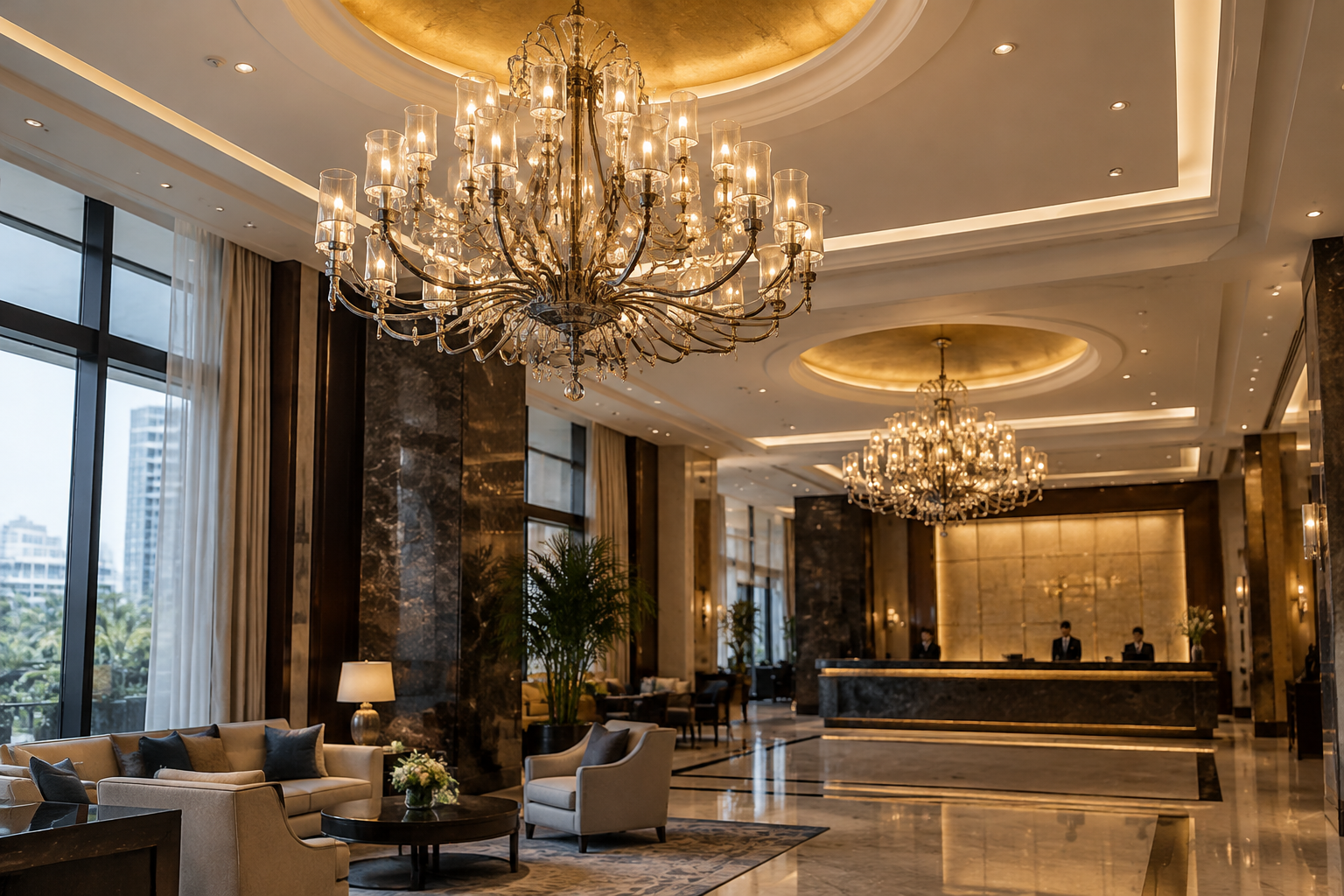
Request IES and LDT photometric files for the relevant optical assembly, together with the test basis and configuration identification. Use DIALux to evaluate illumination and distribution within the complete room. Decorative sparkle, visible source brightness and reflections still benefit from physical mock-ups because calculation images cannot reproduce every perceptual effect.
For EU supply, establish applicable CE obligations and RoHS documentation for the finished product. A component declaration does not establish conformity of the assembled chandelier. For US projects, confirm the required listing or approved evaluation route with the authority having jurisdiction; UL is one possible certification route, not a universal label to assume.
Middle East and Southeast Asia requirements vary by country. Confirm supply characteristics, local approvals and consultant requirements before fixing sockets or drivers. Do not substitute a US-market lamp base for E14 without redesign and approval.
SAA evidence is generally associated with Australia/New Zealand requirements and should not be presented as approval for every destination. Verify certificate scope, model identity and issuing body. Likewise, ISO9001 concerns a management system, not chandelier photometric performance or electrical safety.
 G9/E14 or Integrated LED: Which Suits Hotel Chandeliers?: Photometric files & compliance for EU, US, Middle East and Southeast Asia
Frequently Asked Questions
Q: Are G9 or E14 LED Lamps Better for Easy Hotel Maintenance?
G9 and E14 lamps can simplify maintenance when staff can safely reach and remove them. Specify an approved replacement model, not just the base type. A recommended specification of CRI ≥90 helps preserve appearance, but matching CCT, dimensions and dimming behaviour also matters. In a high lobby, access equipment and shade removal may dominate maintenance effort regardless of lamp price.
Q: Do Integrated LED Modules Always Last Longer Than Replaceable Lamps?
Integrated LED modules do not automatically deliver longer service life than replaceable lamps. Thermal conditions, driver quality and operating hours all matter, while lumen maintenance differs from complete-system survival. A recommended specification is colour consistency within 3 SDCM for approved replacements, subject to availability. Request documented lifetime assumptions, accessible drivers and module replacement instructions rather than relying on an unsupported headline lifespan.
Q: Can G9 and E14 Lamps Dim as Smoothly as Integrated LED Modules?
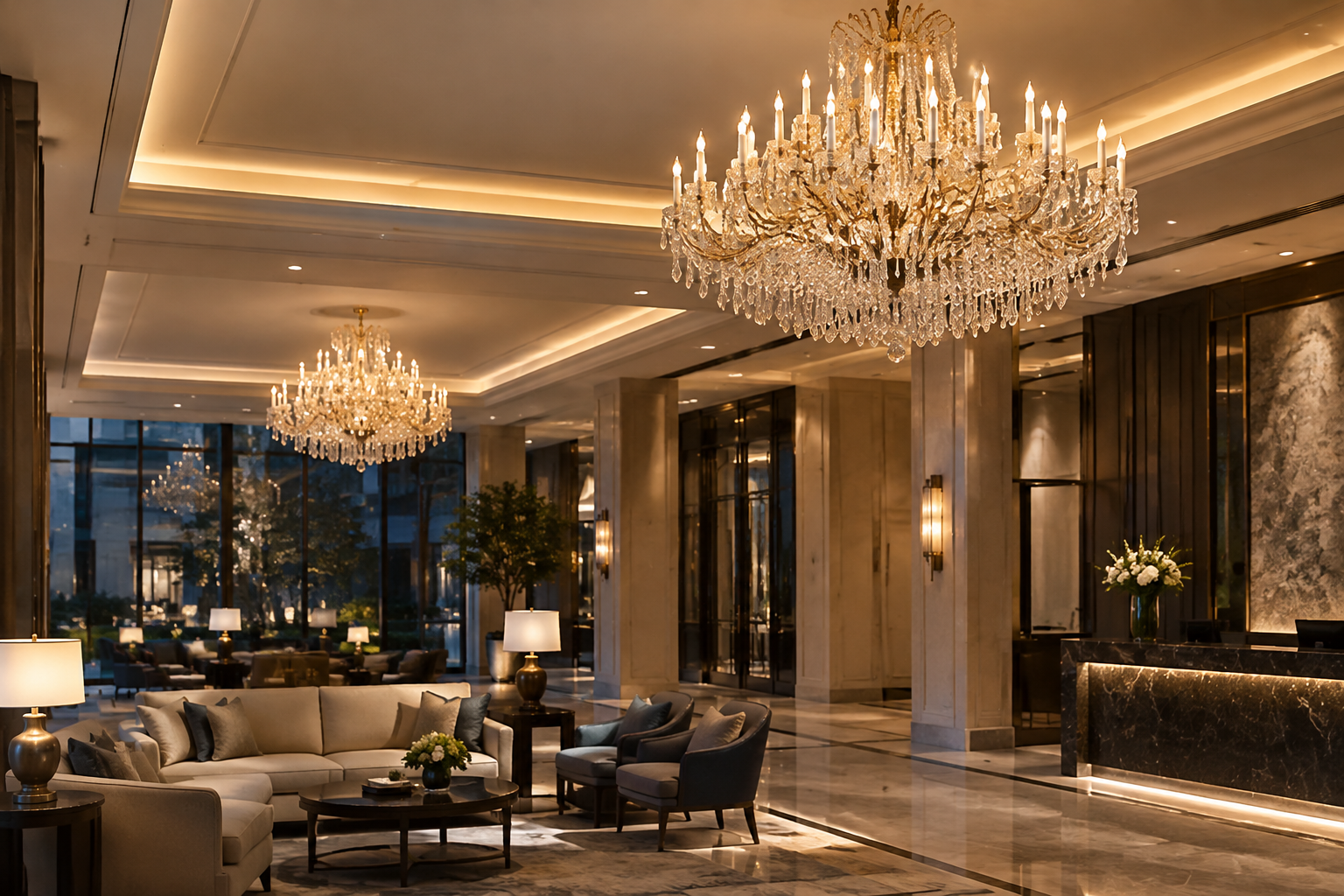
Some G9 and E14 lamps dim smoothly, but performance depends on the exact lamp, dimmer and connected load. Integrated modules can offer more controllable driver options without guaranteeing success. For dining scenes, a recommended specification is stable dimming to 1% output, verified on a representative sample. Check low-level flicker, start-up, dropout and audible noise before approving either architecture.
Q: What Should Buyers Request Before Approving a Custom Chandelier?
Buyers should request coordinated drawings, an approved source schedule, control details, photometry and destination-specific compliance evidence. Include installation access, replacement instructions and the exact driver location. A recommended specification of 2700–3000 K should be confirmed through the chosen glass or diffuser. Require written approval of substitutions, and distinguish a component certificate from evidence covering the completed luminaire.
Sources and Technical References for Chandelier Procurement
Use authoritative references to define requirements, then obtain evidence for the actual chandelier offered.
- EN 12464-1: Indoor workplace lighting requirements; obtain the applicable edition through a national standards body or the CEN-CENELEC network.
- EN 60598: Luminaire safety requirements; confirm the applicable parts and adopted edition. The IEC catalogue provides related IEC 60598 publications.
- IES: Consult the Illuminating Engineering Society for lighting guidance and applicable photometric standards, including ANSI/IES LM-63 for electronic photometric data exchange.
- WELL v2: Review applicable project features through the International WELL Building Institute, rather than assuming a decorative luminaire establishes building-level compliance.
- Controls: Check product and protocol information with the DALI Alliance, KNX Association and Casambi.
Standards editions, national adoption and contractual requirements should be confirmed during specification; these references are not evidence of XHLWX certification.
 G9/E14 or Integrated LED: Which Suits Hotel Chandeliers?: Q: Can G9 and E14 lamps dim as smoothly as integrated LED modules?
Request a Custom Quote for Your Hotel Chandelier Light Source
A useful quotation starts with the chandelier geometry, intended atmosphere and maintenance constraints.
Send the indoor room type, drawings, ceiling height, mounting details, finish references, quantity, destination country, supply information and control system. Identify whether lamps must be locally replaceable and whether drivers can sit in an accessible service location. Ask the quotation to distinguish sample approval, tooling, testing, production and spare-component provisions.
At XHLWX (led-project-light.com), a Custom Indoor LED Lighting Manufacturer based in China, request a project-specific comparison of G9/E14 lamps and serviceable integrated LED modules. Ask for a recommended source architecture, documented component options and clearly stated compliance responsibilities before approving the final chandelier design.
Chi è XHLWX
XHLWX è il marchio di Shenzhen Qihang Lighting Co., Ltd., produttore di apparecchi LED per progetti con stabilimento proprio a Shenzhen (Cina) dal 2009. Forniamo profili lineari, downlight, binari magnetici, pannelli, plafoniere stagne, campane industriali e apparecchi su misura per uffici, hotel, musei, retail e industria.
Progettazione illuminotecnica secondo UNI EN 12464-1 (Em, UGR, Uo, Ra) con file IES e LDT per DIALux; apparecchi conformi CE e RoHS, sistema qualità ISO 9001.
Domande frequenti su XHLWX
XHLWX fornisce progetti in Italia?
Sì. Forniamo progetti in Italia direttamente dallo stabilimento; offerta, calcolo illuminotecnico e documentazione tecnica sono disponibili in italiano o inglese.
Gli apparecchi rispettano la UNI EN 12464-1?
Dimensioniamo illuminamento, limite UGR e uniformità secondo la UNI EN 12464-1 e li verifichiamo con un calcolo DIALux basato sui nostri file LDT.
Quali sistemi di controllo sono supportati?
DALI-2, 0-10 V e Casambi (Bluetooth), anche in versione emergenza o con sensore secondo il progetto.
XHLWX realizza apparecchi su misura o OEM?
Sì. Lunghezze, temperature di colore, ottiche, finiture e il vostro marchio (OEM/ODM) vengono realizzati nel nostro stabilimento.
Need a tailored lighting plan for your project?
Our senior lighting designers reply within 48 hours with a free design proposal & quotation.