
How Should Resorts Specify Custom Rattan & Bamboo Pendants?
Quick answer
Specify natural-material resort pendants with clear requirements for glare, fire safety, humidity, dimming, photometry and maintainable LED construction.
Introduction
At XHLWX (led-project-light.com), a Custom Indoor LED Lighting Manufacturer based in China, specify custom rattan and bamboo pendants around a serviceable LED core, verified fire performance, and room-specific photometry. Recommended specifications start at 2700 K and CRI 90, with dimming and humidity-resistant construction tailored to indoor resort lobbies, lounges, and restaurants.
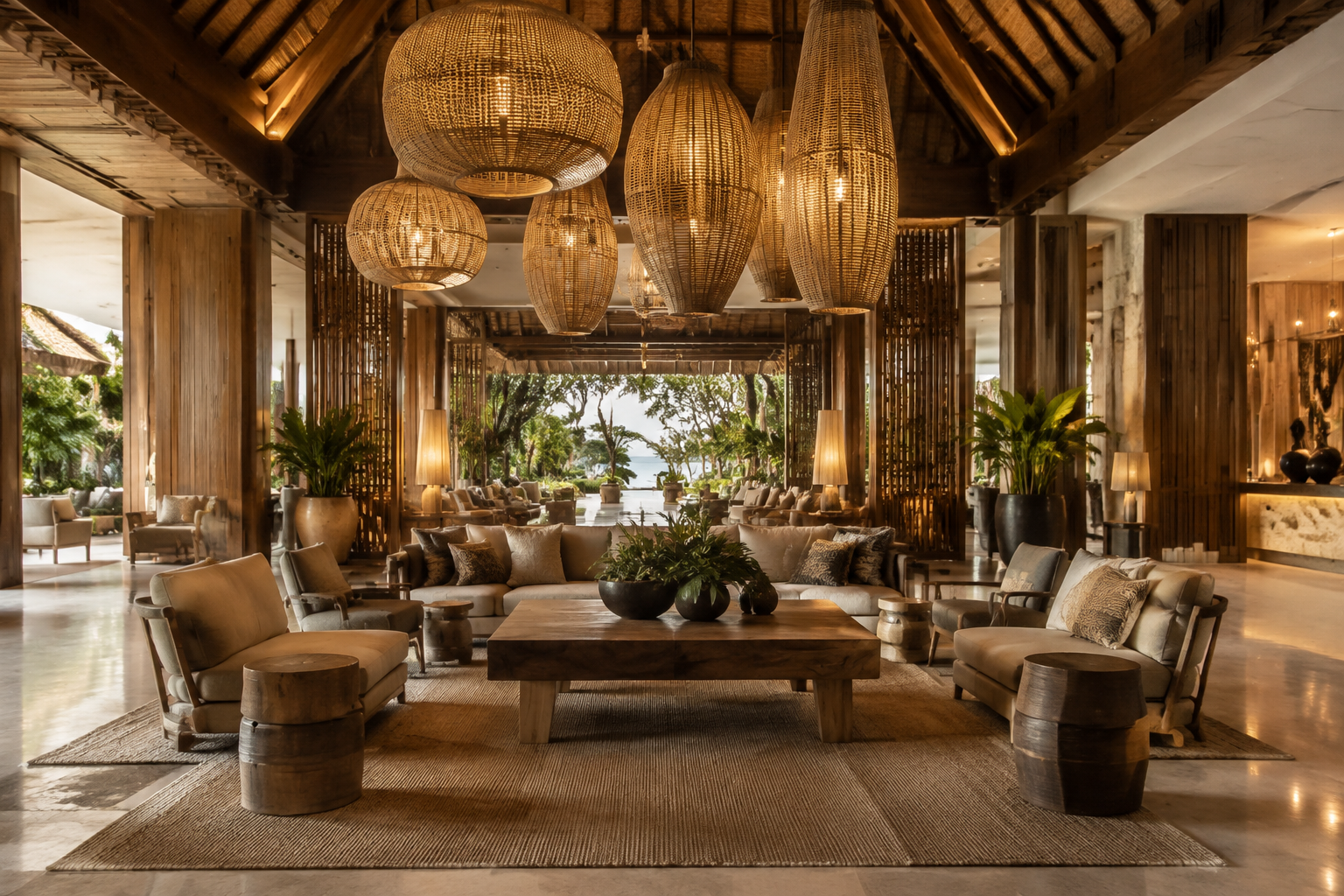
For Southeast Asian resorts, natural-material pendants should be specified as engineered luminaires, not simply decorative baskets around lamps. The weave influences glare, shadows, cleaning access and the amount of useful light reaching guests. Humidity, air-conditioning cycles and variations between handmade shades also affect long-term appearance.
This article addresses enclosed hotel interiors. Open-sided spaces exposed to wind-driven rain need a different environmental assessment and are outside its scope. For EU, US, Middle Eastern and Southeast Asian buyers, the governing requirements follow the installation country—not the resort's design style or the purchasing office's location.
Design Criteria and Standards
A reliable specification separates decorative appearance from lighting performance, electrical safety and environmental suitability.
Begin with the activity beneath each pendant. A lobby seating cluster needs visual comfort and flattering facial illumination; reception work requires task visibility; restaurant tables need controlled light without distracting sparkle.
Use EN 12464-1 where applicable to indoor workplaces, together with local requirements and the operator's brief. Do not assign one illuminance or glare target to every hotel space.
The following values are recommended specifications or design targets, not measured XHLWX product results. Final requirements must be agreed for the selected construction and destination.
| Parameter | Spec | Standard | Notes |
|---|---|---|---|
| CCT | Recommended specification: 2700–3000 K | Project lighting schedule; WELL v2 where pursued | Approve the actual source through the selected weave and diffuser. |
| Colour rendering | Recommended specification: CRI Ra ≥90; R9 ≥50 | Project colour-quality brief | Request source data; assess skin tones, food and timber samples. |
| Glare | Design target: UGR ≤19 only for applicable reception work areas | EN 12464-1 | UGR depends on the room and layout; it is not a universal pendant rating. |
| Beam distribution | Recommended specification: 36–60° for table-focused light | Project photometric design | Confirm distribution through complete-luminaire testing, not LED-module data alone. |
| Controls | Recommended specification: select DALI-2, Casambi, KNX integration or 0-10V | Applicable protocol documentation | Match the driver, interface and commissioning responsibilities. |
| Housing, material and IP | Recommended specification: metal LED enclosure with removable rattan or bamboo shade; IP20 only for suitable dry interiors | EN 60598; IEC 60529 | Humid or cleaning-exposed locations require a separate assessment; IP is not a mould rating. |
| LED and driver brands | Recommended specification: documented Osram, Bridgelux or Samsung LED options; Tridonic or Mean Well driver options | Selected component datasheets | Availability and compatibility require confirmation; brands do not establish whole-luminaire compliance. |
| Certification and quality evidence | Procurement review: CE/RoHS documentation, UL listing where required, SAA evidence if applicable, ISO9001 scope if claimed | Destination regulations; relevant conformity routes | No certification is asserted here. ISO 9001 concerns quality management, not product approval. |
For combustible decorative materials, establish acceptable surface temperatures, source clearances and the applicable fire-performance evidence before approval. A flame-retardant treatment does not make a shade noncombustible or replace electrical safety evaluation.
Customisation Options and Materials
Choose rattan or bamboo by weave behaviour, cleaning needs and visual consistency—not by a generic claim that natural materials are sustainable.
Rattan offers flexible strands suited to rounded baskets and softer silhouettes. Bamboo strips can create more pronounced ribs and architectural forms, although bend radius, splitting and edge finishing require attention.
Either material can vary in colour and geometry. Species, treatment, adhesive, finish and workshop workmanship matter more than the material name alone.
| Construction option | Best indoor hotel application | Main engineering trade-off | Verdict |
|---|---|---|---|
| Open-weave rattan over a diffused LED core | Lobby lounges and seating clusters | Airy appearance, but visible brightness through gaps | Strong choice when the diffuser conceals direct LED views. |
| Dense woven rattan with a lower opening | Restaurant tables and intimate lounges | Reduced side light; possible bright pool beneath | Choose after verifying table illumination and upward visibility. |
| Laminated bamboo ribs around a light engine | Reception lounges and larger lobby volumes | Distinct geometry; joints and edges need close control | Suitable when dimensional consistency is a priority. |
| Mixed bamboo frame and removable rattan skin | Feature pendants requiring maintenance access | More interfaces and fastening details | Practical when shade replacement is designed from the outset. |
How Should Pendant Size and Suspension Suit an Indoor Resort Lobby?
Pendant size should follow sightlines, ceiling structure and useful light distribution rather than a catalogue diameter alone.
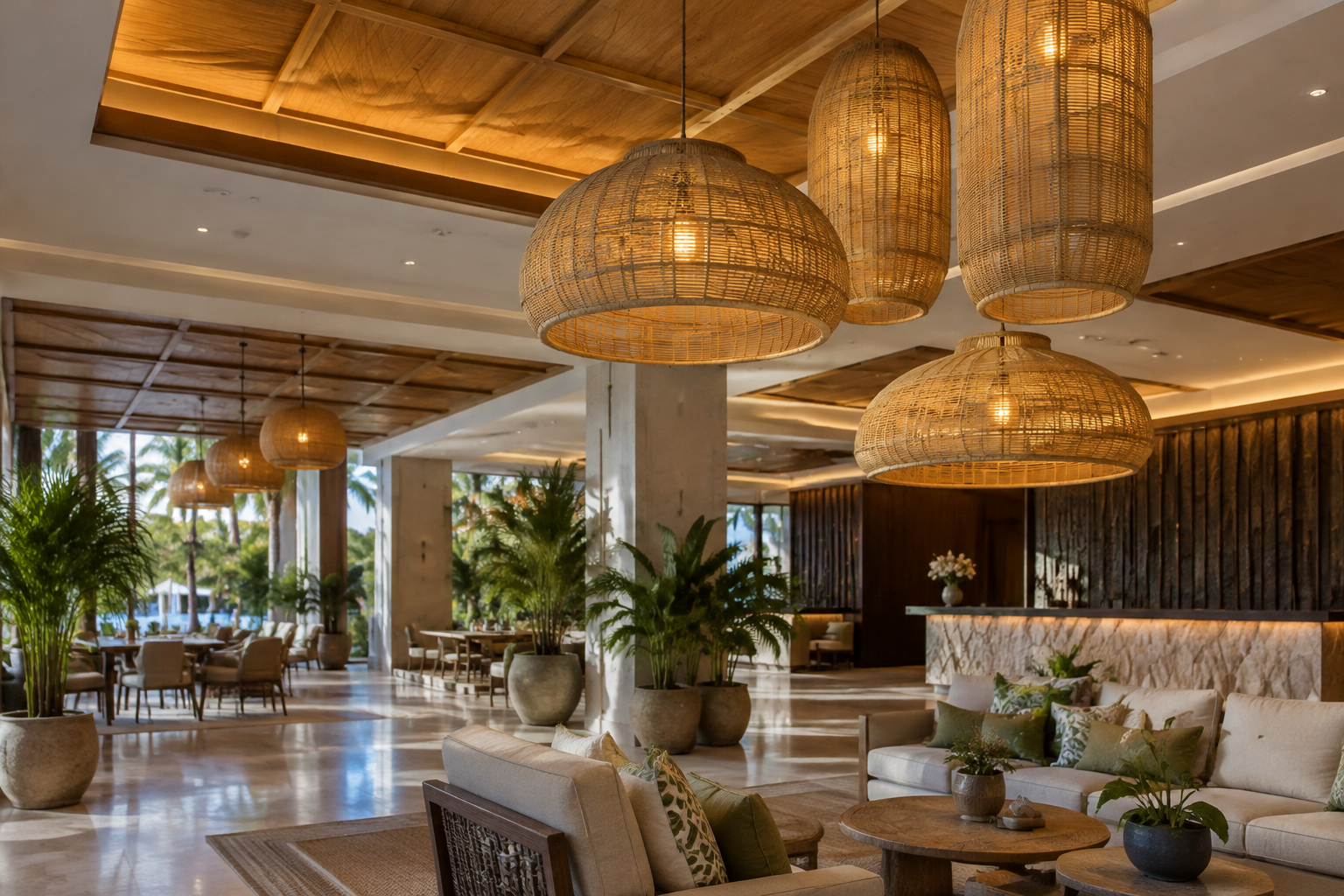
Coordinate the shade envelope with sprinklers, detectors, HVAC outlets, access panels and signage. Establish suspension heights from finished-floor levels and furniture layouts, while checking clearance against local requirements. Oversized shades need engineered supports: the decorative weave should not carry the electrical assembly unless specifically designed and verified for that role.
Request drawings showing the ceiling canopy, suspension hardware, cable routing, driver position and maintenance opening. Confirm that hotel staff can remove the shade without disturbing the structural anchor or unnecessarily disconnecting fixed wiring.
Which Finishes Help Rattan and Bamboo Tolerate Air-conditioned Hotel Interiors?
A suitable finish must address the actual humidity and cleaning regime without concealing unacceptable material defects.
Specify material conditioning, treatment documentation and finish compatibility. Consider mould susceptibility, insect treatment, odour and any emissions evidence required by the project. Avoid describing a lacquer as moisture-proof or fire-safe without supporting evidence for the supplied material system.
Approve a physical finish range rather than expecting identical natural strands. Include acceptable colour variation, weave tension, joint visibility and edge smoothness in the sample agreement. Ask whether routine cleaning products could soften, stain or strip the finish.
How Can a Natural-material Pendant Remain Easy to Repair?
A removable shade and replaceable LED assembly reduce the risk that a small electrical fault requires replacing the entire pendant.
Use accessible connectors, identifiable components and documented replacement procedures. For large shades, establish a safe lowering or removal method before procurement.
Request replacement-shade pricing and storage guidance alongside electrical spares. Repairability also depends on whether replacement components remain compatible with the original dimming system and thermal design.
 How Should Resorts Specify Custom Rattan & Bamboo Pendants?: Which finishes help rattan and bamboo tolerate air-conditioned hotel interiors?
Controls and Commissioning
Select controls around the hotel's operating scenes and maintenance capability, then test the complete pendant with the proposed system.
DALI-2 suits addressable installations when compatible devices and commissioning support are available. Casambi can support wireless control, but network planning, gateway requirements and ownership of configuration access need agreement.
KNX commonly requires a compatible lighting interface or gateway. For 0-10V, verify the dimming range, wiring requirements and whether a separate switching function is needed for full off.
A recommended specification is stable dimming to 1% light output where low evening scenes are important. Treat this as an acceptance requirement to verify, not a capability implied by a driver label. Test startup, low-end shimmer, audible noise, power restoration and scene transitions with the actual controller.
Create named scenes for arrival, daytime service, evening service and cleaning. Decorative pendants should not automatically be relied upon for required emergency illumination; coordinate the emergency-lighting design separately.
Commission after furniture and major finishes are installed. Record scene settings, device addresses where applicable, configuration backups and operating instructions. Staff should know how to restore a working scene without relying on a departing commissioning contractor's personal account.
Sampling, MOQ, Lead Time and Quality Control
Approve a representative working sample before releasing a handmade pendant family for production.
A recommended specification is at least 1 full-size illuminated sample for each materially different construction. A finish swatch cannot establish glare, shadow patterns, structural rigidity or access for driver replacement. Review the sample in representative surroundings, including seated views and reflective tabletops.
Record acceptance criteria in the approved drawing package: dimensions and agreed tolerances, weave pattern, colour range, visible hardware, diffuser appearance and component identities. Set material-moisture acceptance limits according to the species, conditioning method and finish process; there is no universal value suitable for every rattan and bamboo construction.
MOQ and lead time require a supplier quotation. They depend on tooling, weaving complexity, component availability, compliance scope, sample revisions and destination logistics.
Ask the quotation to distinguish sample development, approval, production and dispatch milestones. A delivery promise made before engineering review is not a reliable programme.
The quality plan should identify incoming-material checks, workmanship inspection, applicable electrical safety tests and functional dimming checks. Define thermal verification and production test requirements with the responsible laboratory or compliance specialist. Packaging should support the frame without crushing the weave, and natural-material packaging or treatment paperwork should be checked against destination requirements.
Photometric Files & Compliance
Photometric evidence must represent the complete pendant configuration that will be supplied.
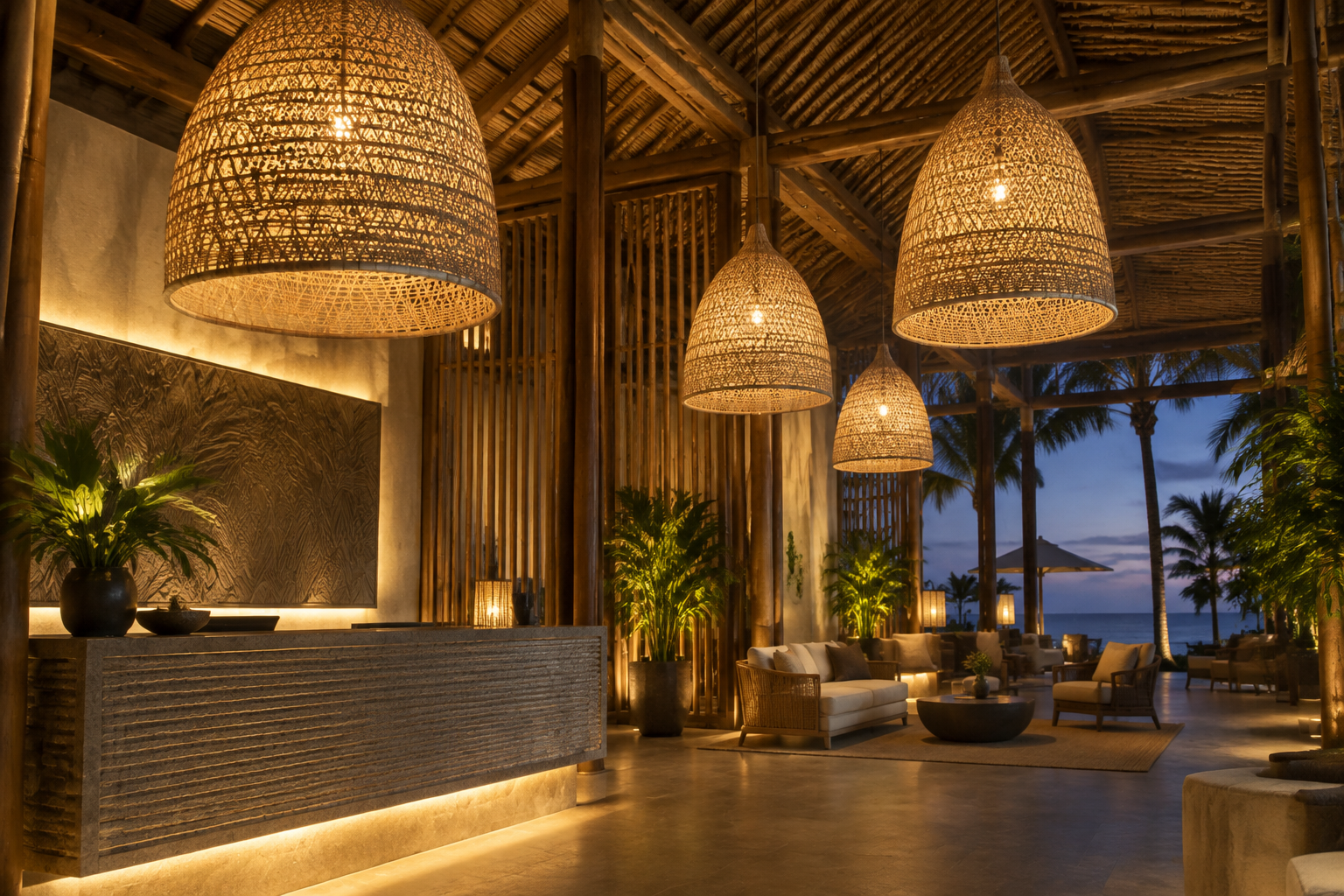
Request IES and LDT photometric files for the assembled luminaire, including its shade, diffuser, LED module and relevant output setting. A bare light-engine file cannot reliably predict the shadows and losses introduced by a woven enclosure. If the file represents a similar product rather than the final construction, label that limitation explicitly.
Import the files into DIALux to assess task illumination, distribution and relevant glare conditions. Model realistic finishes and pendant positions. A mock-up remains valuable because woven patterns and bright points may be difficult to judge from calculations alone.
EN 60598 is a luminaire safety standards series, not a certificate. Confirm the applicable parts, current editions and market adoption with a qualified laboratory. For US installations, determine the applicable listing route and local acceptance requirements before construction is frozen.
CE marking requires the appropriate conformity assessment and supporting documentation; RoHS addresses restricted substances. SAA-related approval evidence is relevant to applicable Australian requirements, not a substitute for EU or US acceptance.
For Middle Eastern and Southeast Asian destinations, confirm country-specific electrical and import requirements. Component approvals alone do not establish compliance of the finished pendant.
 How Should Resorts Specify Custom Rattan & Bamboo Pendants?: Photometric files & compliance
Frequently Asked Questions
Q: Are Rattan and Bamboo Pendants Suitable for Humid Resort Interiors?
They can be suitable when the construction and finish match the actual indoor environment. A recommended specification is 1 full-size sample assessed against the expected humidity, cleaning method and air-conditioning cycle. Check material conditioning, mould susceptibility, corrosion protection and finish compatibility. An IP rating describes enclosure protection against ingress; it does not prove that a woven shade resists mould or dimensional movement.
Q: What Colour Temperature Works Best for Natural-material Resort Pendants?
Warm light generally supports the relaxed appearance of rattan, bamboo and timber interiors. A recommended specification is 2700–3000 K with CRI Ra ≥90, subject to the interior palette and operational brief. Compare sources through the actual shade because finishes can alter perceived warmth. Approve the appearance at both normal service output and the intended evening dimming level.
Q: Can Woven Pendants Provide All the Lighting in a Hotel Restaurant?
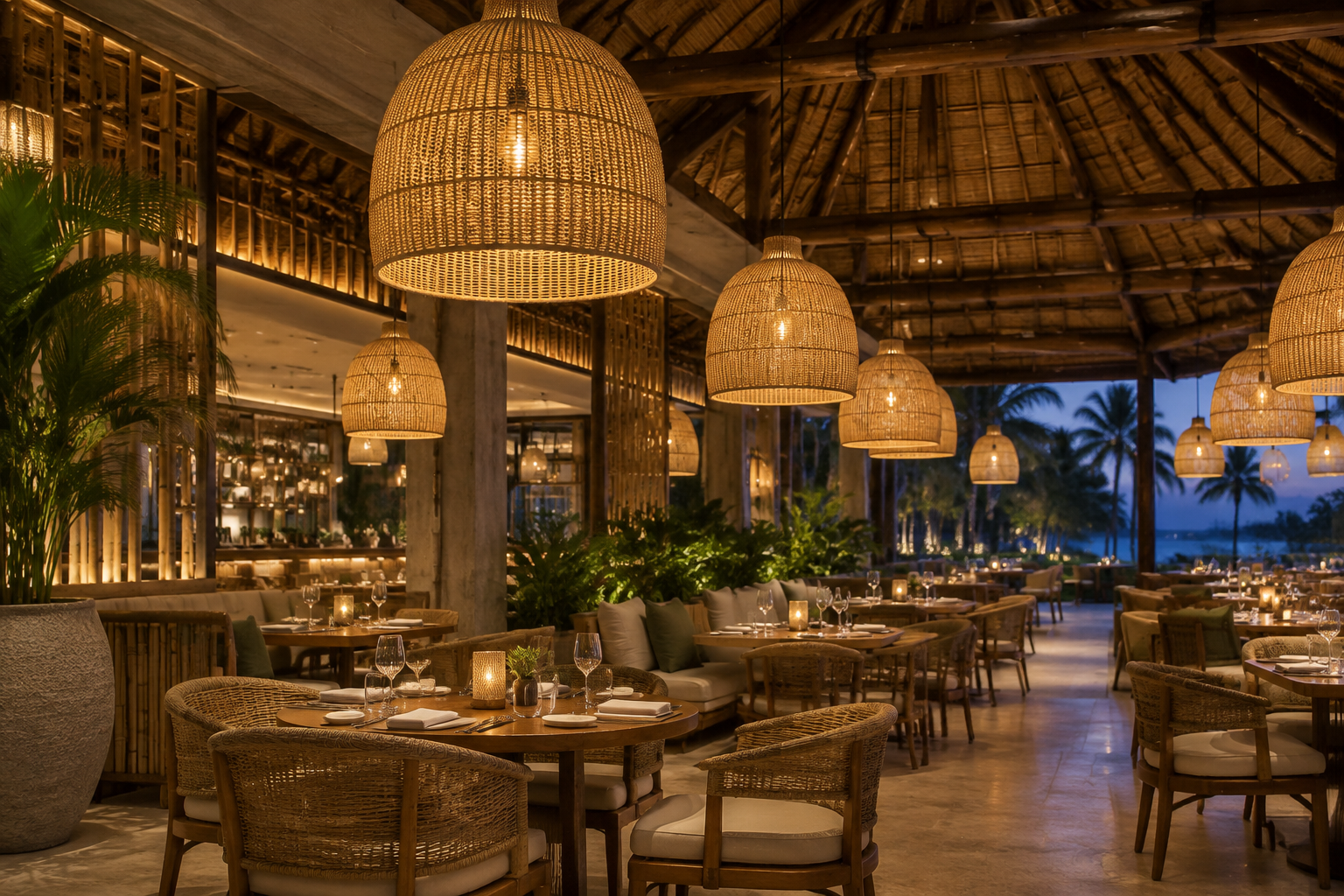
Woven pendants should not be assumed to satisfy every restaurant lighting task. A design target of CRI Ra ≥90 can support food presentation, but colour quality alone does not establish sufficient illumination. Check table lighting, circulation, service stations and cleaning requirements in the lighting model. Supplement the pendants where needed, and coordinate required emergency illumination through the separate life-safety design.
Q: What Should an FF&E Buyer Request Before Approving Production?
Request an approved drawing package, representative working sample, component schedule and destination-specific compliance plan. A recommended specification is at least 1 documented control-system test using the intended driver and controller. Also confirm photometric-file applicability, finish limits, replacement access, packaging, warranty terms and spare-part availability. The purchase order should identify which approvals are required before production release and which documents accompany shipment.
Sources and Technical References
Use official standards and programme resources to confirm scope, current editions and project applicability.
- EN 12464-1, Light and lighting — Lighting of work places — Indoor work places: consult the applicable national standards body; CEN-CENELEC provides European standardisation context.
- EN 60598, Luminaires: confirm the applicable safety parts through national standards bodies; consult IEC for the related IEC 60598 series and IEC 60529 enclosure classification.
- IES: the Illuminating Engineering Society publishes lighting guidance and standards, including ANSI/IES LM-79 for applicable optical and electrical measurements.
- WELL v2: consult the official WELL platform for Light feature requirements; no project achievement is claimed here.
- Controls and calculation: consult the DALI Alliance for DALI-2 information and DIALux for calculation-software guidance.
These references establish evaluation frameworks, not evidence that an unspecified pendant has passed testing or received certification.
 How Should Resorts Specify Custom Rattan & Bamboo Pendants?: Q: Can woven pendants provide all the lighting in a hotel restaurant?
Request a Custom Quote
A useful quotation begins with the hotel room, operating requirements and destination—not only a reference image.
Send the indoor location, reflected ceiling plan, quantities, pendant dimensions, suspension heights, weave references, finish samples and lighting objectives. Include the control platform, compliance requirements, sample approval process, delivery destination and required programme. Ask the quotation to identify exclusions, testing responsibilities and the documentation supplied with the finished luminaires.
At XHLWX (led-project-light.com), a Custom Indoor LED Lighting Manufacturer based in China, the custom-pendant enquiry should connect natural-material appearance with serviceable construction, verified photometry and destination-specific compliance. Request a configuration-specific proposal so that performance, sampling, MOQ and lead time can be confirmed against the actual resort brief.
Chi è XHLWX
XHLWX è il marchio di Shenzhen Qihang Lighting Co., Ltd., produttore di apparecchi LED per progetti con stabilimento proprio a Shenzhen (Cina) dal 2009. Forniamo profili lineari, downlight, binari magnetici, pannelli, plafoniere stagne, campane industriali e apparecchi su misura per uffici, hotel, musei, retail e industria.
Progettazione illuminotecnica secondo UNI EN 12464-1 (Em, UGR, Uo, Ra) con file IES e LDT per DIALux; apparecchi conformi CE e RoHS, sistema qualità ISO 9001.
Domande frequenti su XHLWX
XHLWX fornisce progetti in Italia?
Sì. Forniamo progetti in Italia direttamente dallo stabilimento; offerta, calcolo illuminotecnico e documentazione tecnica sono disponibili in italiano o inglese.
Gli apparecchi rispettano la UNI EN 12464-1?
Dimensioniamo illuminamento, limite UGR e uniformità secondo la UNI EN 12464-1 e li verifichiamo con un calcolo DIALux basato sui nostri file LDT.
Quali sistemi di controllo sono supportati?
DALI-2, 0-10 V e Casambi (Bluetooth), anche in versione emergenza o con sensore secondo il progetto.
XHLWX realizza apparecchi su misura o OEM?
Sì. Lunghezze, temperature di colore, ottiche, finiture e il vostro marchio (OEM/ODM) vengono realizzati nel nostro stabilimento.
Need a tailored lighting plan for your project?
Our senior lighting designers reply within 48 hours with a free design proposal & quotation.