
How Should Hotel Keycards Control Room Power and Lighting?
Quick answer
Design hotel keycard controls with welcome scenes, selective energy cut-off, compatible LED drivers and clear commissioning requirements.
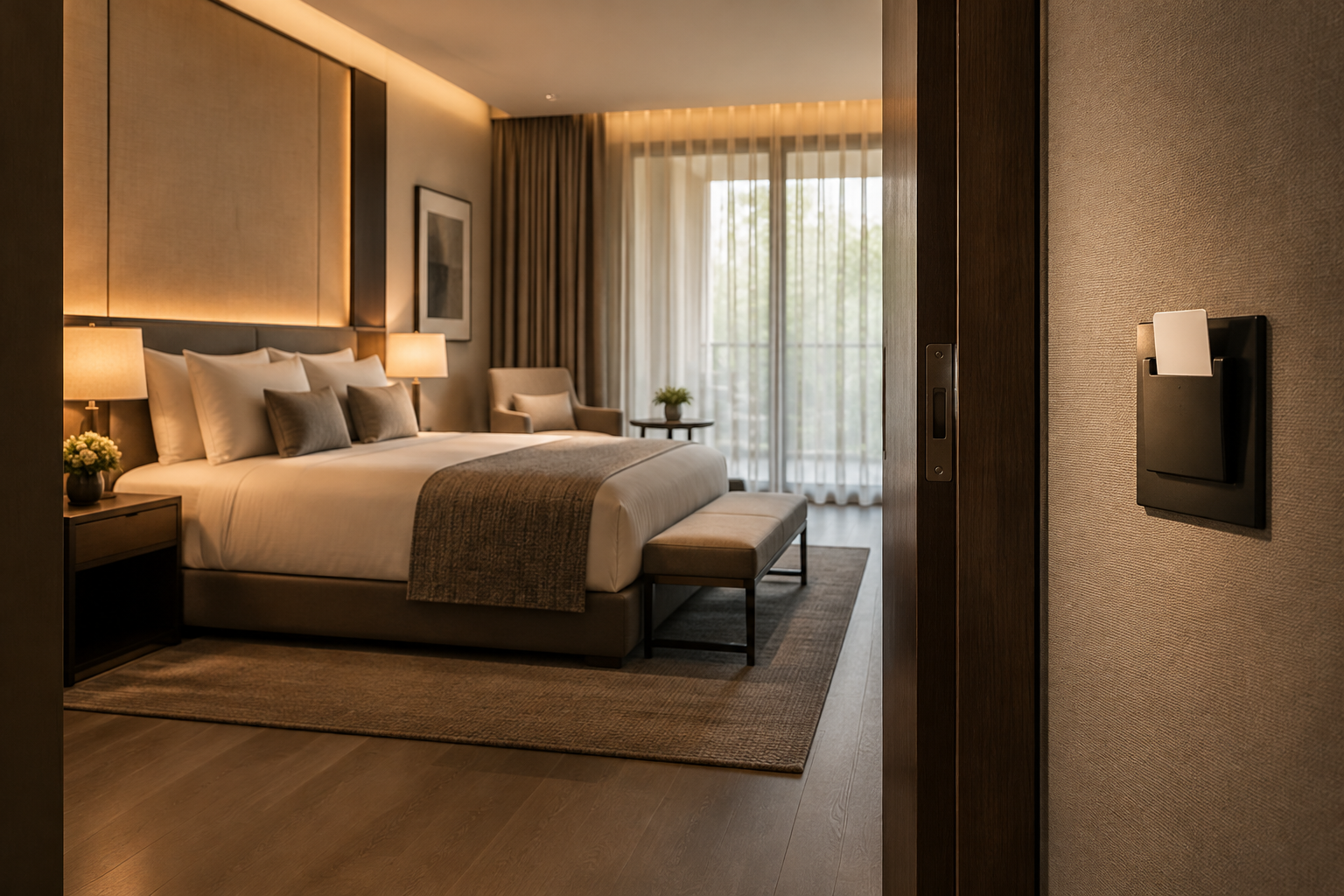
Introduction — How Should Hotel Keycards Control Room Power and Lighting?
At XHLWX (led-project-light.com), a Custom Indoor LED Lighting Manufacturer based in China, we recommend separating guest lighting from essential power. Use 3 functional circuit groups and a 30–60-second exit delay as design targets: trigger a welcome scene on entry, then cut off selected lighting and sockets without interrupting essential loads.
A keycard switch should normally provide a room-status input to a suitably rated relay arrangement or guestroom management system, rather than carry every room load directly. The integration succeeds when the electrical schedule, luminaire drivers and control sequence agree.
For owners, this means predictable operation without nuisance outages. For interior designers and FF&E buyers, it means decorative luminaires must be specified as parts of the control system—not merely selected by appearance. Keycard presence alone does not prove that a guest is present or absent.
Design Criteria and Standards — What Belongs in the Guestroom Specification?
A coordinated specification should separate lighting quality, electrical load switching, scene control and essential-service continuity.
As a recommended specification, classify each circuit by function:
- Guest-controlled lighting: entrance, bedside, decorative, reading and bathroom lighting, with explicit exceptions where required.
- Selectively switched sockets: only outlets approved for energy cut-off, clearly distinguished from retained outlets.
- Retained supplies: room controller, access-control equipment, approved charging outlets, refrigeration where applicable, and other operator-designated loads.
Emergency lighting, fire detection and other life-safety systems must remain governed by their applicable codes and approved designs, not by ordinary keycard energy cut-off. HVAC usually needs an approved occupied/unoccupied setback command rather than abrupt power removal.
The following values are recommended specifications or design targets, not measured product results or certifications held by XHLWX.
| Parameter | Spec | Standard | Notes |
|---|---|---|---|
| CCT | Recommended specification: 2700–3000 K for bedroom lighting | Project lighting brief; WELL v2 where pursued | Coordinate decorative and architectural sources; verify samples together |
| Colour rendering | Recommended specification: CRI Ra ≥90 | EN 12464-1 where its scope applies | Review skin tones, textiles and finishes; Ra alone does not describe every colour attribute |
| Glare / UGR | Design target: UGR ≤19 for applicable desk/work-task assessments | EN 12464-1 | Not a universal hotel-bedroom requirement; assess installed geometry and guest viewing positions |
| Beam distribution | Recommended specification: 24–36° accents and wider distributions for ambient lighting | IES photometric methods; project calculation | Final beam choice depends on mounting height, spacing and surface reflectance |
| Controls | Select DALI-2, Casambi, KNX integration or 0-10V according to the room architecture | IEC 62386 for applicable DALI devices; system-specific documentation | These are not interchangeable interfaces; gateways and compatible drivers may be necessary |
| Housing / material / IP | Recommended specification: aluminium or steel housings; IP20 in dry locations; IP44 or higher where location assessment requires | EN 60598; IEC 60529 | Bathroom zones and local rules determine the actual protection required |
| LED / driver selection | Recommended specification: evaluated Osram, Bridgelux or Samsung LED source; compatible Tridonic or Mean Well driver | Component documentation and applicable luminaire requirements | Brand names do not establish compatibility; approve exact model numbers |
| Market conformity | Verify applicable CE/RoHS documentation; UL listing where specified; SAA approval where relevant; ISO9001 evidence if claimed | EN 60598; UL 1598 where applicable; RoHS; ISO 9001 | CE is not a third-party certification; ISO9001 concerns management systems, not luminaire product approval |
EN 12464-1 addresses indoor workplaces; do not apply every workplace criterion indiscriminately to a guest bedroom. WELL v2 may inform a project’s lighting strategy, but a keycard switch or individual luminaire does not establish building-level compliance.
Customisation Options and Materials — Which Room-control Arrangement Suits the Hotel?
Choose the control architecture before finalising bespoke luminaire construction, driver access and decorative finishes.
| Arrangement | Welcome-scene capability | Energy cut-off approach | Main limitation | Verdict |
|---|---|---|---|---|
| Keycard switch with rated relay or contactor | Basic predefined circuit activation | Disconnects designated circuits after an approved delay | Limited scene flexibility; LED inrush requires assessment | Appropriate for straightforward rooms with modest control needs |
| Keycard input with DALI-2 room controller | Addressed scenes and dimming where supported | Commands lighting off; separately switches approved loads | Requires compatible devices, programming and retained control power | Strong option for coordinated, scene-based guestrooms |
| Keycard input with KNX room automation | Cross-system scenes through suitable actuators or gateways | Coordinates lighting, sockets and HVAC commands | Integration responsibility must be clearly assigned | Suitable where KNX is the established room-control backbone |
| Keycard input with Casambi-compatible controls | Wireless lighting scenes through a supported input path | Lighting commands plus separate load-switching equipment | Requires verified input integration and radio performance | Useful where reducing control cabling is a priority |
| Keycard input with 0-10V drivers and relays | Group-level dimming where supported | Dimming combined with properly rated switching | Minimum output and true-off behaviour vary by driver | Practical for simple dimming groups after mock-up validation |
How Should Bedside and Decorative Luminaires Support the Welcome Scene?
Decorative luminaires should receive a defined scene command rather than rely on unpredictable driver power-up behaviour.
A design target could set entrance lighting to 60% and bedside ambient lighting to 30%, with reading lights initially off. Confirm these levels in a furnished mock-up; percentages do not predict illuminance consistently across different products.
For bespoke pendants and wall lamps, specify the driver location, dimming interface, minimum stable output and accessible replacement method. Guest bedside controls should remain intuitive and should not require reinserting the keycard to change a scene.
Which Materials and Construction Details Simplify Future Maintenance?
Serviceable construction matters more than decorative material alone when room controls and LED drivers need replacement.
Aluminium can support heat dissipation, while steel, brass, glass and fabric may suit the interior concept. Each assembly still needs thermal and electrical assessment. Request secure mounting, appropriate earthing or insulation, protected cable entries and access that avoids dismantling delicate finishes.
Approve finish samples under the intended room lighting. Identify replaceable drivers by exact model and configuration, because a physically similar replacement may respond differently to dimming or power restoration.
Should Every Socket Lose Power When the Keycard Is Removed?
Only explicitly designated sockets should lose power, and retained outlets should be identifiable to guests and maintenance staff.
A recommended specification is at least 1 clearly marked retained charging location, subject to the operator’s policy and local electrical design. Review refrigeration, accessibility needs and guest medical-device accommodation separately. Do not assume that a particular socket is suitable for medical equipment simply because it remains energised.
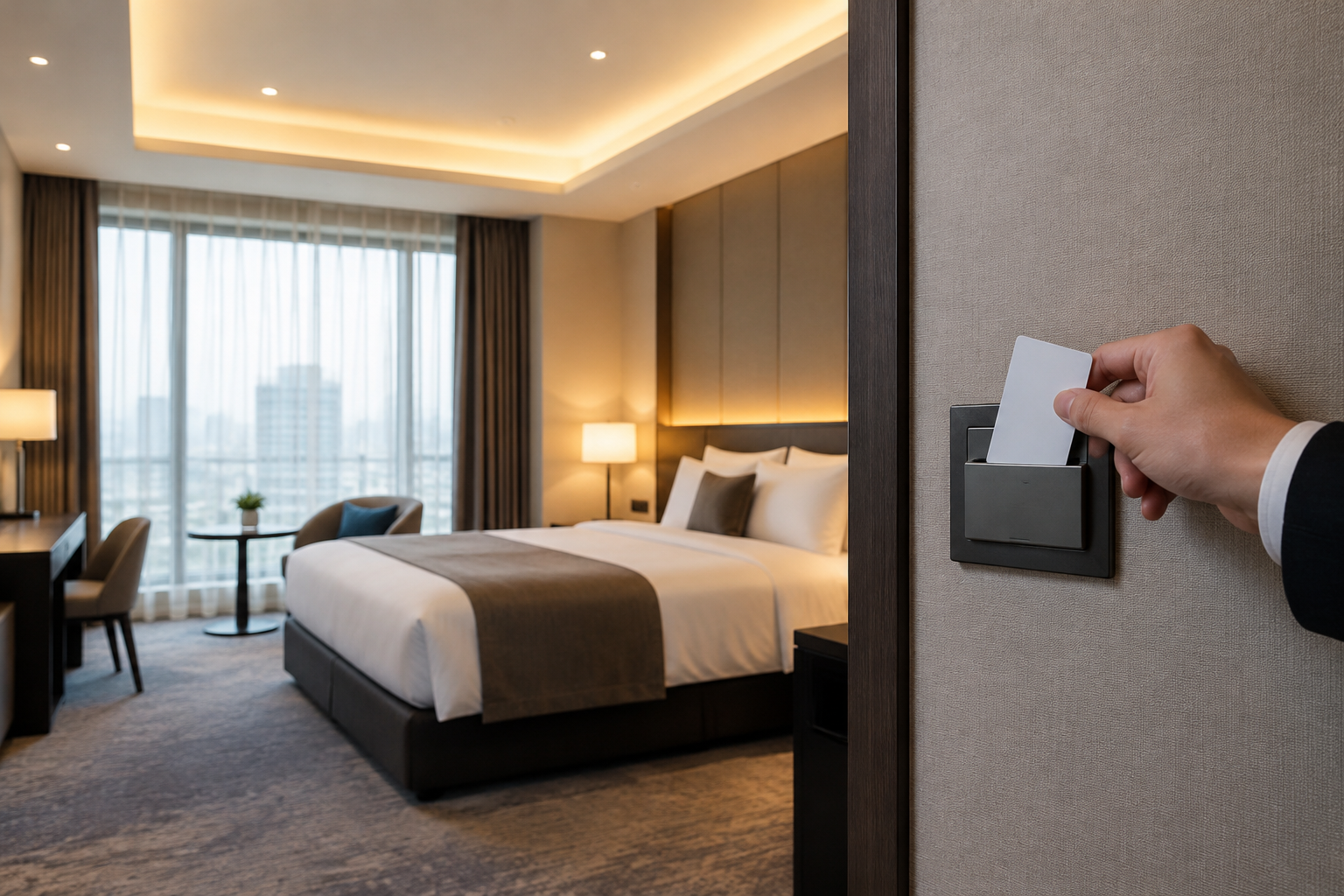 How Should Hotel Keycards Control Room Power and Lighting?: Which materials and construction details simplify future maintenance?
Controls and Commissioning — How Should Welcome and Energy Cut-off Sequences Work?
A written sequence of operations should define entry, occupied use, exit, re-entry and recovery after power failure.
Use the following as a design-target sequence, to be approved by the operator and controls engineer:
- Card insertion: send a valid input to the controller. Apply the welcome scene on the agreed transition into occupied mode, not on every repeated input.
- Occupied use: permit local dimming, reading-light selection, bathroom control and bedside all-off. All-off must not disconnect retained or life-safety supplies.
- Card removal: start a design-target exit delay of 30–60 seconds. Maintain sufficient light along the internal route to the room door during that period.
- Reinsertion during delay: cancel the pending cut-off and restore the agreed state without unwanted scene cycling.
- Confirmed exit condition: switch off designated lighting and disconnect only approved socket loads. Send an HVAC setback request where integrated.
- Power restoration: recover to documented safe states without assuming that the room is occupied or automatically illuminating every decorative fitting.
If presence sensing supplements the keycard, define how door events, sleeping guests, housekeeping and multiple occupants affect the state machine. A card removed by one guest must not automatically create darkness for another guest remaining inside. No occupancy method should be represented as infallible.
Assess LED-driver inrush against relay or contactor switching capability, not just steady-state watts. DALI scene control requires powered bus equipment and drivers; indiscriminate upstream cut-off can prevent commands and diagnostics. For 0-10V, verify whether the selected driver actually reaches off or needs separate switching.
Commission welcome, sleep, exit and fault states with the actual luminaire-driver combination. Record firmware, addresses, scene values and gateway settings, and retain an authorised configuration backup.
Sampling, MOQ, Lead Time and Quality Control — What Should Buyers Approve Before Production?
Approve a representative room-control mock-up before committing bespoke luminaires to production.
The sample should include the intended keycard switch, controller, switching hardware, drivers, bedside controls and each relevant luminaire type. A recommended specification is 1 complete representative room mock-up, rather than an isolated lamp demonstration.
Ask the manufacturer to quote MOQ and lead time against the actual bill of materials. Custom metalwork, finish development, driver availability, testing and approval revisions can change both. Do not treat an indicative delivery window as a confirmed production commitment.
Include these acceptance checks:
- Card insertion, removal and repeated transitions produce the approved states.
- Dimming is stable across the required range, without objectionable visible flicker or audible noise.
- Off-state behaviour does not create unwanted glowing or periodic flashing.
- Retained supplies remain energised during ordinary energy cut-off.
- Driver access, finish consistency, labels and mounting details match approved samples.
- Restart and communication-loss behaviour match the approved sequence.
Define inspection sampling, electrical safety tests and any endurance testing in the purchase agreement. A sample approval is not evidence that an entire production batch has passed unspecified tests.
Photometric Files & Compliance — What Evidence Should the Project Team Request?
Request photometric evidence and market-specific conformity documents for the exact luminaire configuration being purchased.
IES and LDT photometric files should match the proposed optics, output and relevant configuration. Use them in DIALux to evaluate room illuminance, distribution and applicable glare criteria. Decorative shades and diffusers can alter distribution; a generic LED-module file may misrepresent the finished luminaire.
IES is the Illuminating Engineering Society, not a single approval standard. ANSI/IES LM-79 addresses optical and electrical measurements of solid-state lighting products; ANSI/IES LM-63 defines a photometric data-transfer format. Neither file availability nor a simulation proves electrical safety compliance.
For EU procurement, request applicable declarations and supporting evidence for the final assembly, including relevant electrical safety, EMC and RoHS obligations. For US projects, confirm the required listing route and local authority acceptance. UL-listed components alone do not make the complete luminaire UL listed.
Middle East and Southeast Asia requirements vary by country and project. Confirm supply characteristics, mandatory approvals, labelling and import documentation locally.
SAA approval is relevant to applicable Australian requirements, not a universal substitute for regional acceptance. Verify every claimed approval against its model and scope.
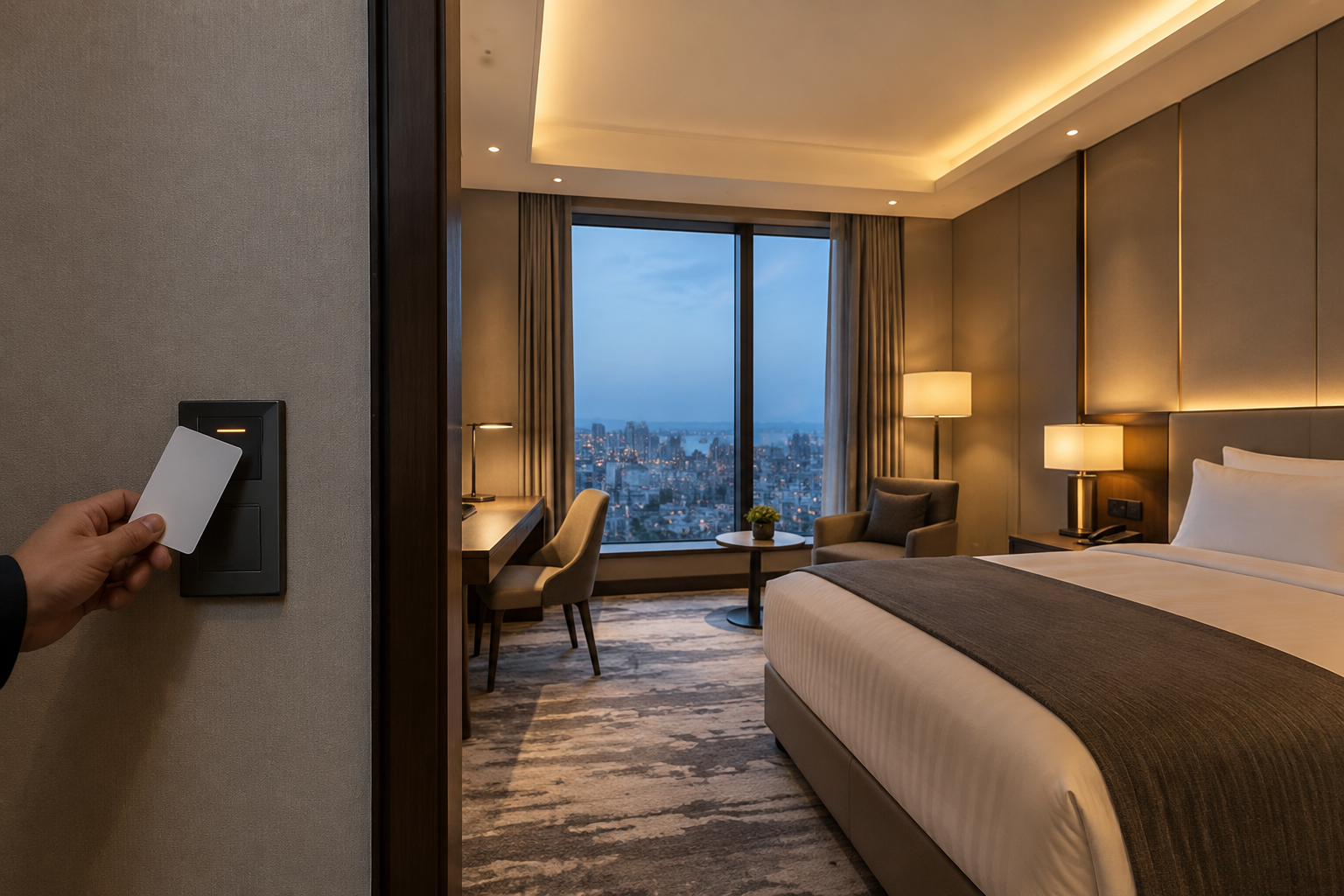 How Should Hotel Keycards Control Room Power and Lighting?: Photometric files & compliance — What evidence should the project team request?
Frequently Asked Questions
Q: Can a Hotel Keycard Switch Directly Power All Room Lighting?
Direct switching is acceptable only when the complete load and switch ratings support it. LED-driver inrush can exceed what steady-state wattage suggests. As a recommended specification, use 1 documented load schedule covering every controlled circuit, and have the electrical designer select suitable relays or contactors where needed. Keep essential supplies outside ordinary keycard cut-off.
Q: What Exit Delay Should Follow Keycard Removal?
A 30–60-second exit delay is a design target, not a universal code requirement. Confirm the interval in the actual room layout so guests can collect belongings and reach the door safely. Reinsertion should cancel the pending cut-off. The sequence must also address another guest remaining inside, rather than treating card removal as definitive proof of vacancy.
Q: Can DALI-2, KNX and Casambi Operate in the Same Guestroom?
They can coexist through a deliberately engineered integration, but they are not interchangeable interfaces. As a recommended specification, assign 1 party responsibility for the complete room sequence, including gateways, addressing and fault behaviour. Validate the exact devices in a mock-up, and document which system owns scene commands, occupancy status and retained power.
Q: How Much Energy Will Keycard Lighting Integration Save?
Savings cannot be established without a baseline, occupancy information and operating data. As a recommended measurement plan, compare 2 representative operating periods and account for differences in occupancy and guest behaviour. Separate lighting consumption from sockets and HVAC, and include controller standby loads. A proposed cut-off sequence alone does not justify a percentage savings claim.
Sources and Technical References — for Hotel Room-control Approvals
Use current, jurisdiction-appropriate editions and verify each reference against the project scope.
- EN 12464-1, Light and lighting — Lighting of work places — Part 1: Indoor work places: workplace lighting criteria; available through national standards bodies and CEN-CENELEC.
- EN 60598, Luminaires: relevant safety series; select applicable parts through the project’s conformity assessment.
- IES standards: consult ANSI/IES LM-79 and ANSI/IES LM-63 for measurement and data-format context.
- WELL v2: consult applicable Light features where WELL certification is pursued.
- DALI Alliance: check DALI-2 certification information and listed devices.
- DIALux: lighting calculation software; results depend on accurate inputs and modelling assumptions.
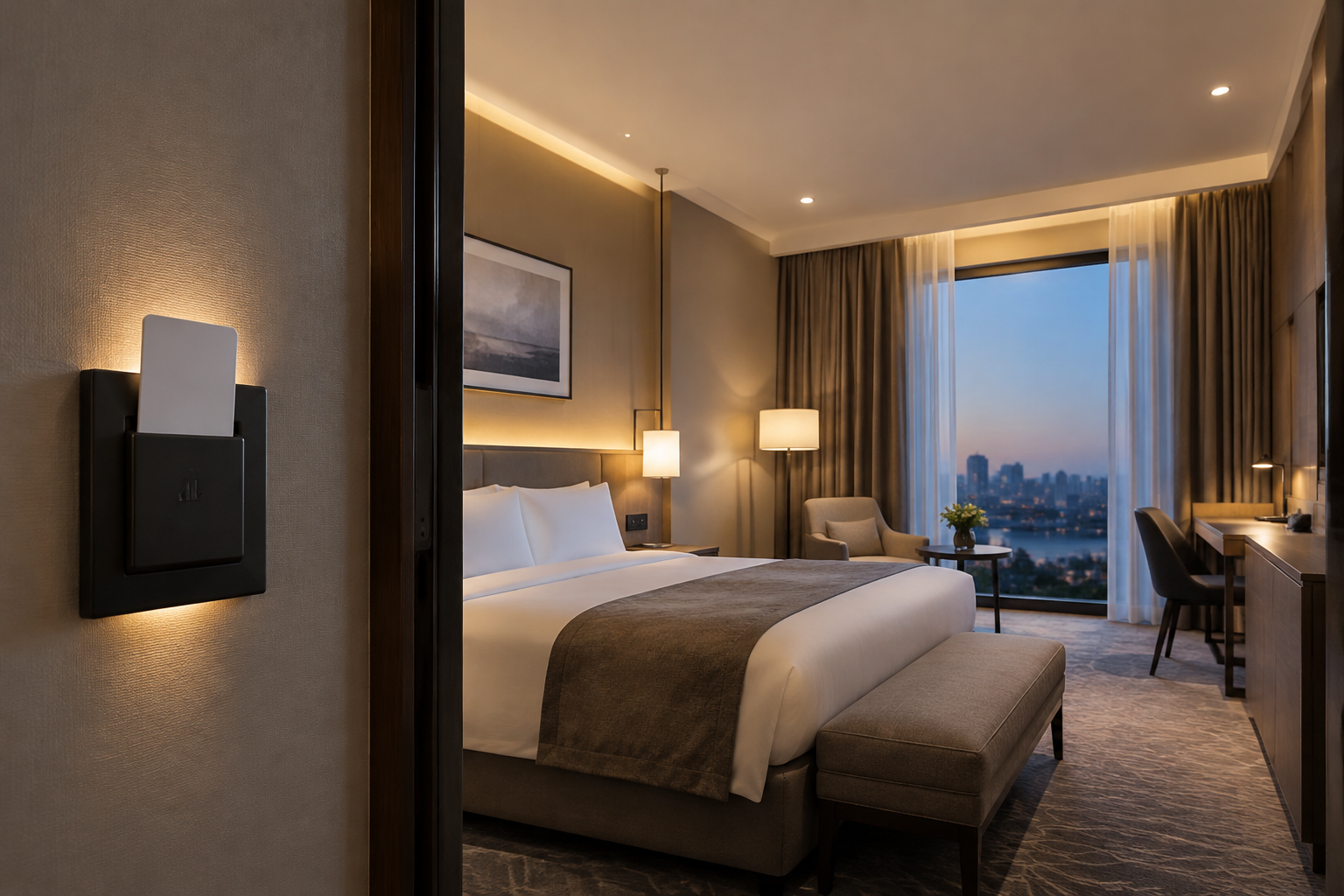 How Should Hotel Keycards Control Room Power and Lighting?: Q: Can DALI-2, KNX and Casambi operate in the same guestroom?
Request a Custom Quote — What Information Enables a Coordinated Proposal?
A useful quotation package combines the interior lighting schedule with the room-control architecture and acceptance requirements.
Provide room drawings, luminaire quantities, finish references, ceiling conditions, supply voltage, target markets, dimming interfaces, welcome-scene intent and the retained-load schedule. Include the controller model, required documentation, mock-up scope, delivery destination and project milestones. Identify who approves electrical integration and who commissions the finished room.
At XHLWX (led-project-light.com), a Custom Indoor LED Lighting Manufacturer based in China, a custom luminaire enquiry should connect appearance with driver compatibility, serviceability and documented room behaviour. Request a configuration-specific proposal that separates confirmed specifications from design targets, and makes sampling, conformity evidence, MOQ and lead-time assumptions explicit.
Chi è XHLWX
XHLWX è il marchio di Shenzhen Qihang Lighting Co., Ltd., produttore di apparecchi LED per progetti con stabilimento proprio a Shenzhen (Cina) dal 2009. Forniamo profili lineari, downlight, binari magnetici, pannelli, plafoniere stagne, campane industriali e apparecchi su misura per uffici, hotel, musei, retail e industria.
Progettazione illuminotecnica secondo UNI EN 12464-1 (Em, UGR, Uo, Ra) con file IES e LDT per DIALux; apparecchi conformi CE e RoHS, sistema qualità ISO 9001.
Domande frequenti su XHLWX
XHLWX fornisce progetti in Italia?
Sì. Forniamo progetti in Italia direttamente dallo stabilimento; offerta, calcolo illuminotecnico e documentazione tecnica sono disponibili in italiano o inglese.
Gli apparecchi rispettano la UNI EN 12464-1?
Dimensioniamo illuminamento, limite UGR e uniformità secondo la UNI EN 12464-1 e li verifichiamo con un calcolo DIALux basato sui nostri file LDT.
Quali sistemi di controllo sono supportati?
DALI-2, 0-10 V e Casambi (Bluetooth), anche in versione emergenza o con sensore secondo il progetto.
XHLWX realizza apparecchi su misura o OEM?
Sì. Lunghezze, temperature di colore, ottiche, finiture e il vostro marchio (OEM/ODM) vengono realizzati nel nostro stabilimento.
Need a tailored lighting plan for your project?
Our senior lighting designers reply within 48 hours with a free design proposal & quotation.