
How Do You Maintain 15 m+ Lobby Chandeliers with Winches?
Quick answer
Plan safe lowering, service access and LED replacement for 15 m+ hotel lobby chandeliers, with winch specifications, L70 guidance and compliance checks.
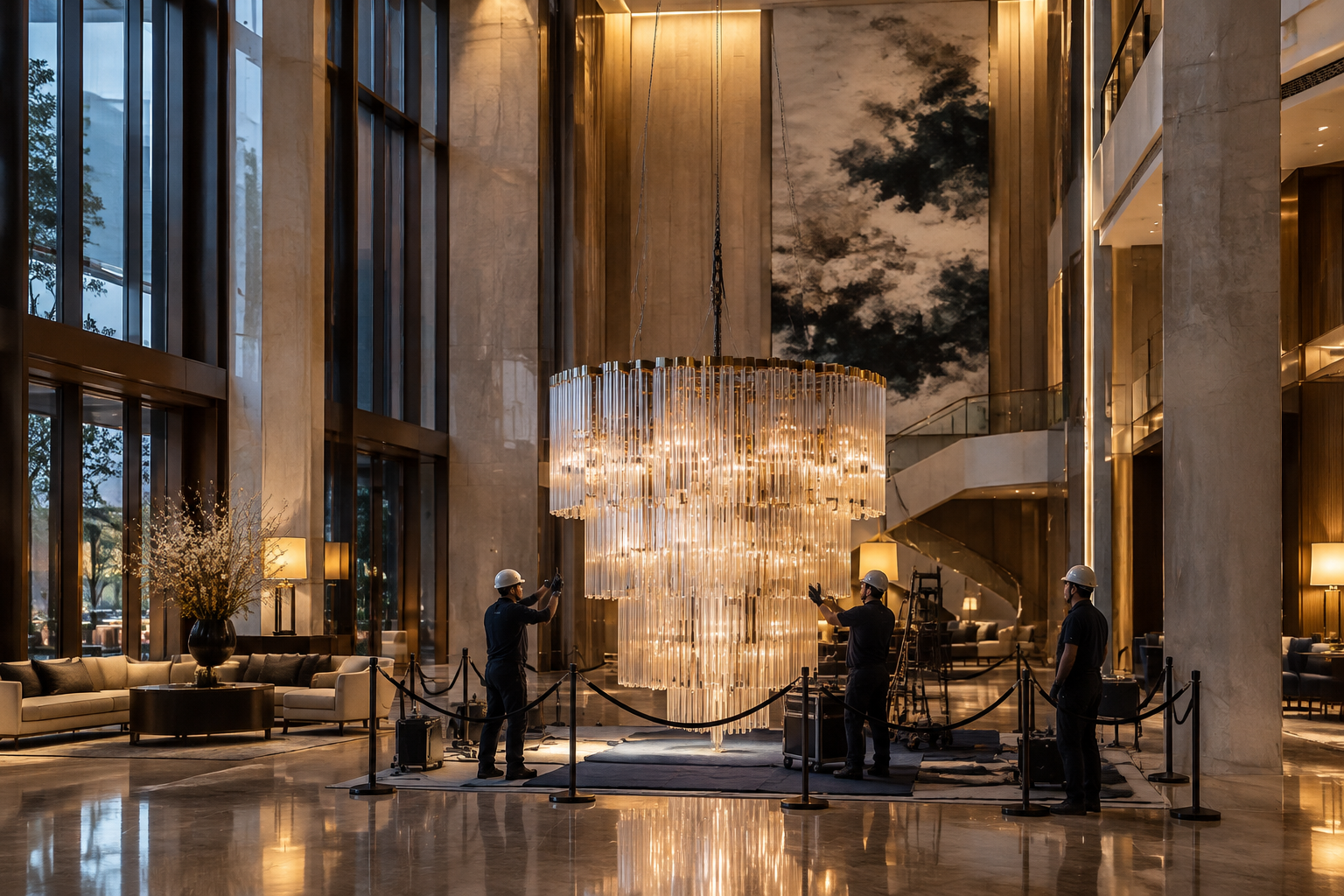
Introduction: Maintaining Chandeliers Above 15 M
safe chandelier maintenance starts with engineered lowering access. For 15 m+ lobbies, specify verified loads, serviceable drivers and documented restraints. L70 describes lumen maintenance, not safe operating life; a 12-month inspection design target must yield to manufacturer instructions and local rules.
A chandelier above a hotel reception hall is both a luminaire and a suspended installation. Its maintenance strategy must address lighting performance, mechanical integrity, electrical isolation and access without exposing guests or staff to suspended-load hazards.
The procurement decision is therefore not simply whether to add a winch. Owners, interior designers and FF&E buyers need coordinated responsibility for the chandelier, lifting equipment, structural support and commissioning. Lowering equipment can improve accessibility, but it introduces components that also require inspection and eventual replacement.
This article provides recommended specifications and design targets, not evidence of installed projects, certified products or measured operating results.
Design Criteria and Standards for a Maintainable High-ceiling Chandelier
Specify the complete suspended assembly and its maintenance method before approving decorative geometry or ceiling coordination drawings.
The lifting specialist needs the documented installed mass, centre of gravity, suspension arrangement and moving cable requirements. Include decorative elements, drivers where attached, mounting hardware and every component carried during lowering. The structural engineer must assess supporting construction and the relevant operating, dynamic and abnormal load cases.
No universal winch rating or safety factor can be selected from chandelier height alone. Require a project-specific engineering assessment and a lifting system explicitly suitable for the proposed installation and operating regime.
| Parameter | Spec | Standard | Notes |
|---|---|---|---|
| CCT and colour rendering | Recommended specification: 2700–3000 K and CRI Ra ≥90 | EN 12464-1; WELL v2 where pursued | Coordinate skin tones, artwork and finishes; neither reference universally mandates this combination. |
| Glare and beam distribution | Design target: UGR ≤22 at applicable work positions; recommended specification: 20–60° optics where directional modules are used | EN 12464-1; relevant IES guidance | Verify task-specific criteria; a decorative chandelier cannot be assigned a reliable room-independent UGR. |
| Controls | Recommended specification: DALI-2 drivers; Casambi alternative; KNX integration through a compatible gateway; 0-10V where required | Applicable DALI/IEC 62386 requirements; selected protocol documentation | Confirm actual compatibility, dimming behaviour and regional electrical requirements. |
| Housing, materials and IP | Recommended specification: aluminium LED carriers, engineered metal frame and captive glass attachments; IP20 for dry interiors where suitable | EN 60598 series | Cleaning methods, humidity and accessible parts may require a different protection specification. |
| LED and driver brands | Recommended candidates: Osram, Bridgelux or Samsung LEDs; Tridonic or Mean Well drivers | Model-specific manufacturer documentation | Brand names do not establish system lifetime, thermal suitability or interchangeability. |
| Lumen maintenance | Design target: projected L70 ≥50,000 operating hours at declared thermal and drive conditions | ANSI/IES LM-80; ANSI/IES TM-21 | A package-level projection is not proof of complete chandelier life. |
| Compliance and quality documentation | Request applicable CE/RoHS evidence, UL listing evidence where required, SAA documentation where relevant, and ISO 9001 certificate if claimed | EN 60598; UL 1598 as applicable; ISO 9001 | CE is not a universal third-party certification; these documents are not interchangeable or automatically applicable. |
Use EN 12464-1 for relevant indoor workplace lighting criteria, particularly reception work areas, rather than treating the entire lobby as one task. WELL v2 applies where the project pursues its requirements; decorative CCT alone does not demonstrate compliance.
Customisation Options and Materials for Lowering Large Lobby Chandeliers
Choose the maintenance architecture alongside the chandelier design, because modularity, mass distribution and access provisions directly affect serviceability.
| Maintenance approach | Main advantage | Principal limitation | Verdict |
|---|---|---|---|
| Engineered whole-chandelier lowering | Brings serviceable components to an accessible work zone | Requires coordinated structure, suspension, travel and floor clearance | Preferred where the installation and operating plan support safe lowering. |
| Independently lowerable sections | Reduces the size of each serviced assembly | Adds interfaces, suspension coordination and reconnection tasks | Suitable for genuinely modular designs with engineered section boundaries. |
| Fixed chandelier with approved access equipment | Avoids permanent lifting machinery within the chandelier system | Requires a workable access route, suitable floor capacity and lobby closure | Viable when access is demonstrated before procurement. |
| Accessible remote drivers with fixed decorative body | Simplifies driver replacement and diagnosis | Does not solve cleaning, LED replacement or suspension inspection | Useful supplementary strategy, not a complete maintenance solution. |
How Should a Winch Be Integrated into a Bespoke Chandelier?
The lifting device must form part of an engineered suspension system, not an accessory selected after fabrication.
Require documentation of rated capacity, intended duty, travel, braking, travel limits, load retention and emergency procedures. A lifting specialist must define protection against unintended descent, including secondary suspension or other engineered retention where required. Do not assume a motor brake alone satisfies permanent overhead suspension requirements.
For multiple lifting points, address synchronisation and uneven loading. Coordinate cable management, connector engagement, anti-rotation provisions and the transition between the operating position and maintenance position. Controls should prevent unauthorised operation and prohibit lighting operation in unsafe intermediate states where necessary.
Which Materials Make a Large Chandelier Easier to Maintain?
Use durable finishes and replaceable decorative components without sacrificing structural reliability or controlled weight distribution.
Aluminium can reduce carrier mass, while steel may suit load-bearing elements; the engineer must determine section sizes and connection details. Brass, plated finishes and glass require cleaning instructions matched to the actual material and coating.
Recommended specifications include captive fasteners, identifiable replacement parts and removable optical modules. Validate how maintenance staff handle fragile pieces at the service position. Changes to glass thickness or decorative quantity require reassessment of mass and balance, not merely aesthetic approval.
What Does L70 Actually Tell a Hotel Owner?
L70 describes the time to a lumen-maintenance threshold, not the failure-free life of a chandelier or its lifting equipment.
The threshold is 70% of initial light output under the stated assessment conditions. ANSI/IES LM-80 provides relevant LED-source maintenance test data; ANSI/IES TM-21 supports projections within its rules. Neither alone demonstrates complete luminaire reliability.
A 50,000-hour L70 design target must identify its evidence, temperature conditions and drive current. Drivers, connectors, optics, finishes and lifting components have separate degradation mechanisms.
Cleaning can recover output lost to dirt, but it cannot reverse intrinsic LED depreciation. Replacement planning must also consider colour shift, component failures and required illumination.
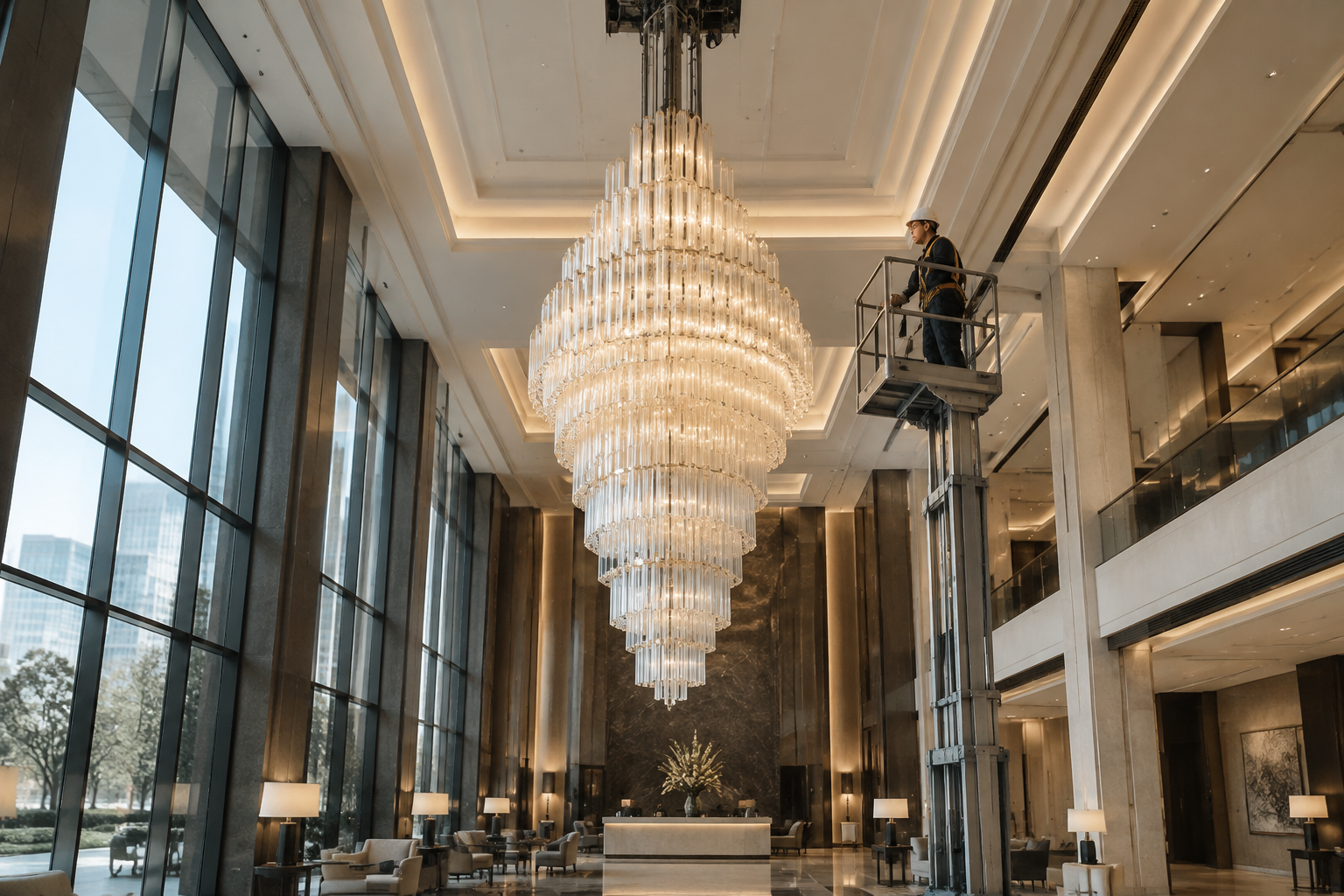 How Do You Maintain 15 m+ Lobby Chandeliers with Winches?: Which materials make a large chandelier easier to maintain?
Controls and Commissioning for Safe Chandelier Lowering
Separate lighting-scene control from lifting safety functions, and verify both systems through a documented commissioning process.
DALI-2, Casambi, KNX and 0-10V can support lighting control, but none should be assumed to provide a safety-rated lifting control system. Assign movement to dedicated, authorised controls specified by the lifting-system designer. Establish electrical isolation and lockout procedures suitable for the equipment and jurisdiction.
Commissioning should address:
- Structural and suspension documentation, including the installed configuration.
- Controlled travel, stopping positions, braking and specified protective functions.
- Safe handling of flexible cables, connectors and strain relief throughout movement.
- The defined maintenance position and any required mechanical support before work begins.
- Lighting scenes, dimming stability, restart behaviour and control-system compatibility.
- Operating instructions, emergency response and staff handover.
The competent lifting specialist should define acceptance tests and any required proof testing; do not improvise test loads on site. Exclude guests and unrelated personnel from the controlled work area during movement and service.
Keep commissioning records, control settings and approved drawings with the asset register. Reassess the installation after alterations that change mass, suspension, electrical components or travel. A replacement driver that fits physically may still differ in dimming, thermal or electrical performance.
Sampling, MOQ, Lead Time and Quality Control for Custom Lifting Chandeliers
Approve a representative serviceability sample before releasing the complete chandelier for manufacture.
The sample should demonstrate the actual LED module, driver arrangement, connector system, finish and removable decorative attachment. Where feasible, review a representative suspension and cable-management assembly. A small illuminated sample cannot validate the structural or lifting behaviour of the complete chandelier.
During approval, ask maintenance staff to review component identification, access clearances, handling requirements and the proposed replacement sequence. Record accepted finishes and electrical component references rather than relying on photographs alone.
Minimum order quantity and lead time are quotation-specific. Request separate durations for engineering, sample approval, lifting-equipment procurement, fabrication, factory testing, packing and delivery. Do not assume the lighting manufacturer supplies or certifies the lifting system unless the contract explicitly assigns that scope.
Quality-control documentation should include applicable electrical safety checks, traceability, installed mass verification, connection checks and dimensional inspection. Lifting-system acceptance requires its own competent review and records. Agree whether factory witnessing is required and what remains for site acceptance.
Procure a labelled spare-parts package with LED modules, compatible drivers, connectors and fragile decorative components selected through the maintenance assessment. Define substitution approval and documentation requirements. Availability of a nominally equivalent component is not sufficient evidence that its use preserves performance or compliance.
Photometric Files & Compliance for EU, US, Middle East and Southeast Asia Hotels
Require lighting evidence and mechanical compliance documentation as separate deliverables, coordinated through the final installed design.
Request IES and LDT photometric files representing the proposed optical configuration, together with their test or calculation basis. Use DIALux to assess reception tasks, circulation, vertical illumination and glare-sensitive viewpoints. Where decorative components alter distribution, generic module photometry may misrepresent the complete chandelier.
A simulation is not a measured project result. Record maintenance-factor assumptions, including dirt accumulation and lumen depreciation, and state which findings remain design predictions.
For EU procurement, request the applicable conformity assessment and declarations, including relevant electrical safety, EMC and RoHS requirements. EN 60598 addresses luminaires; it does not automatically validate a lifting installation. Separate machinery, structural and workplace obligations may apply.
For US projects, confirm listing and installation expectations with the authority having jurisdiction. Middle East and Southeast Asia requirements vary by country and project; obtain destination-specific advice rather than assuming CE or UL documentation provides universal acceptance.
SAA evidence is relevant only where the destination or contract calls for it. ISO 9001 concerns a quality-management system, not product safety approval.
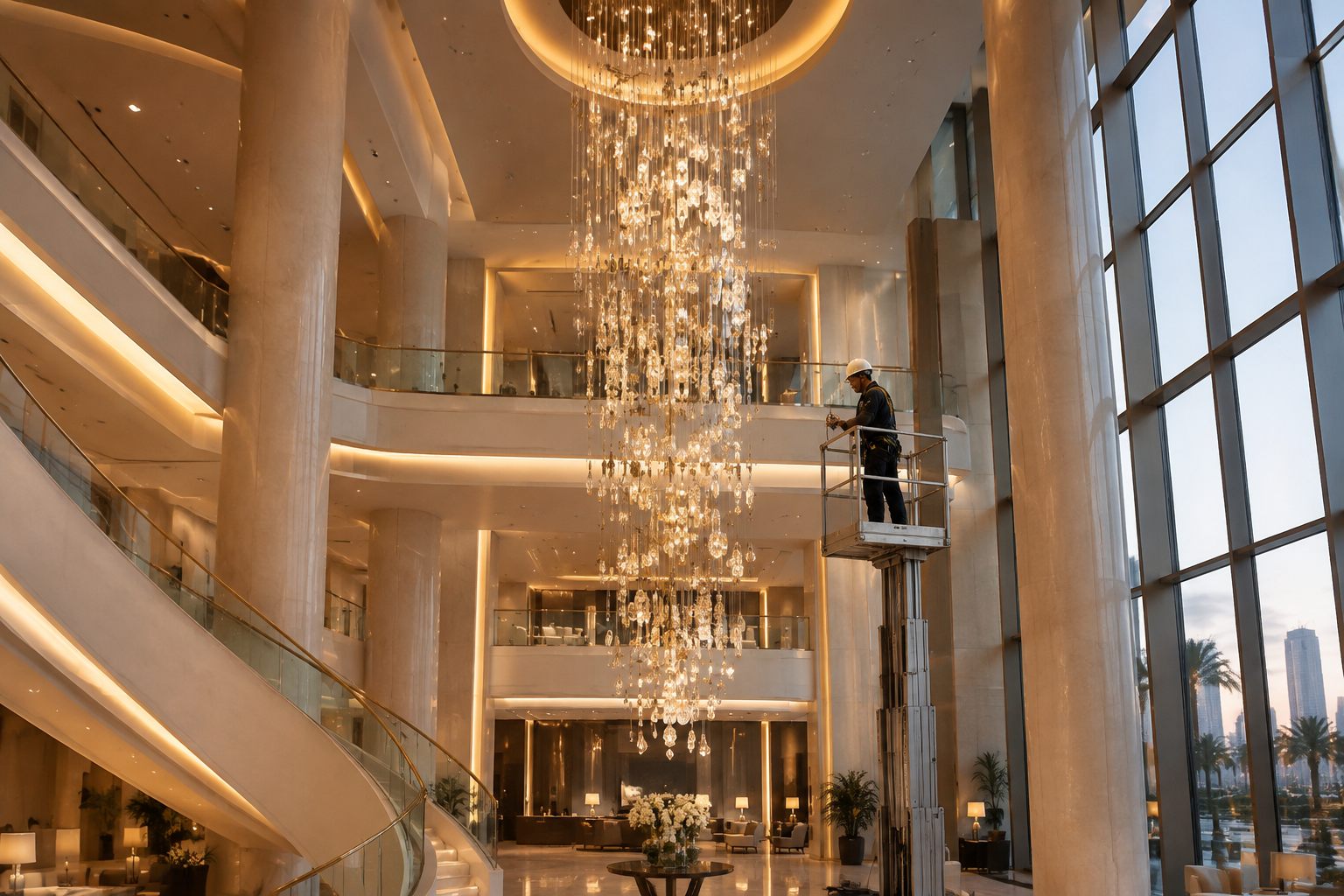 How Do You Maintain 15 m+ Lobby Chandeliers with Winches?: Photometric files & compliance for EU, US, Middle East and Southeast Asia hotels
Frequently Asked Questions
Q: Is a Lowering Winch Always Necessary for a 15 M+ Lobby Chandelier?
A lowering winch is not automatically necessary if another engineered maintenance method provides safe, practical access. For a 15 m+ lobby, compare equipment access routes, floor loading, guest-area closure and service frequency. Select lowering only after confirming structural support, suitable retention, travel clearance and competent servicing arrangements. Remote drivers alone do not eliminate chandelier access needs.
Q: Does an L70 Rating Mean the Chandelier Lasts That Many Hours?
L70 does not establish the failure-free life of the complete chandelier. It identifies a 70% lumen-maintenance threshold under stated assessment conditions, often using projections derived from LED-source data. A 50,000-hour design target therefore needs supporting evidence and thermal assumptions. Driver failure, colour shift, dirty optics and lifting-system deterioration require separate maintenance decisions.
Q: How Often Should a Hotel Inspect Its Chandelier Lifting System?
Inspection intervals must follow applicable law, manufacturer instructions and the installation-specific risk assessment. A 12-month inspection interval may be discussed as a preliminary design target, but it is not a universal recommendation or legal substitute. Competent specialists must establish pre-use checks, periodic examinations, recordkeeping and reassessment after faults, alterations or unusual events.
Q: Can DALI-2 or a Hotel Automation System Operate the Winch?
Lighting automation should not be treated as a lifting safety system. DALI-2 can control compatible lighting equipment, while KNX or other platforms may exchange permitted status signals through engineered interfaces. Movement needs dedicated controls and safeguards selected by the lifting specialist. Specify authorisation, isolation, protective functions and commissioning separately from lighting scenes and guest-facing automation.
Sources and Technical References for Chandelier Maintenance Specifications
Use current editions and project-applicable requirements, rather than relying on standard names as blanket evidence of compliance.
- CEN-CENELEC: EN 12464-1, Light and lighting — Lighting of work places — Part 1: Indoor work places; EN 60598 luminaire standards. Official catalogue access: https://standards.cencenelec.eu/
- Illuminating Engineering Society (IES): ANSI/IES LM-80 and ANSI/IES TM-21 for LED-source maintenance data and projections. https://www.ies.org/standards/
- International WELL Building Institute: WELL v2 requirements and verification resources. https://standard.wellcertified.com/
- DALI Alliance: DALI-2 certification scope and product verification. https://www.dali-alliance.org/
- Equipment manufacturers: model-specific lifting instructions, driver data, thermal limits, declarations and maintenance manuals.
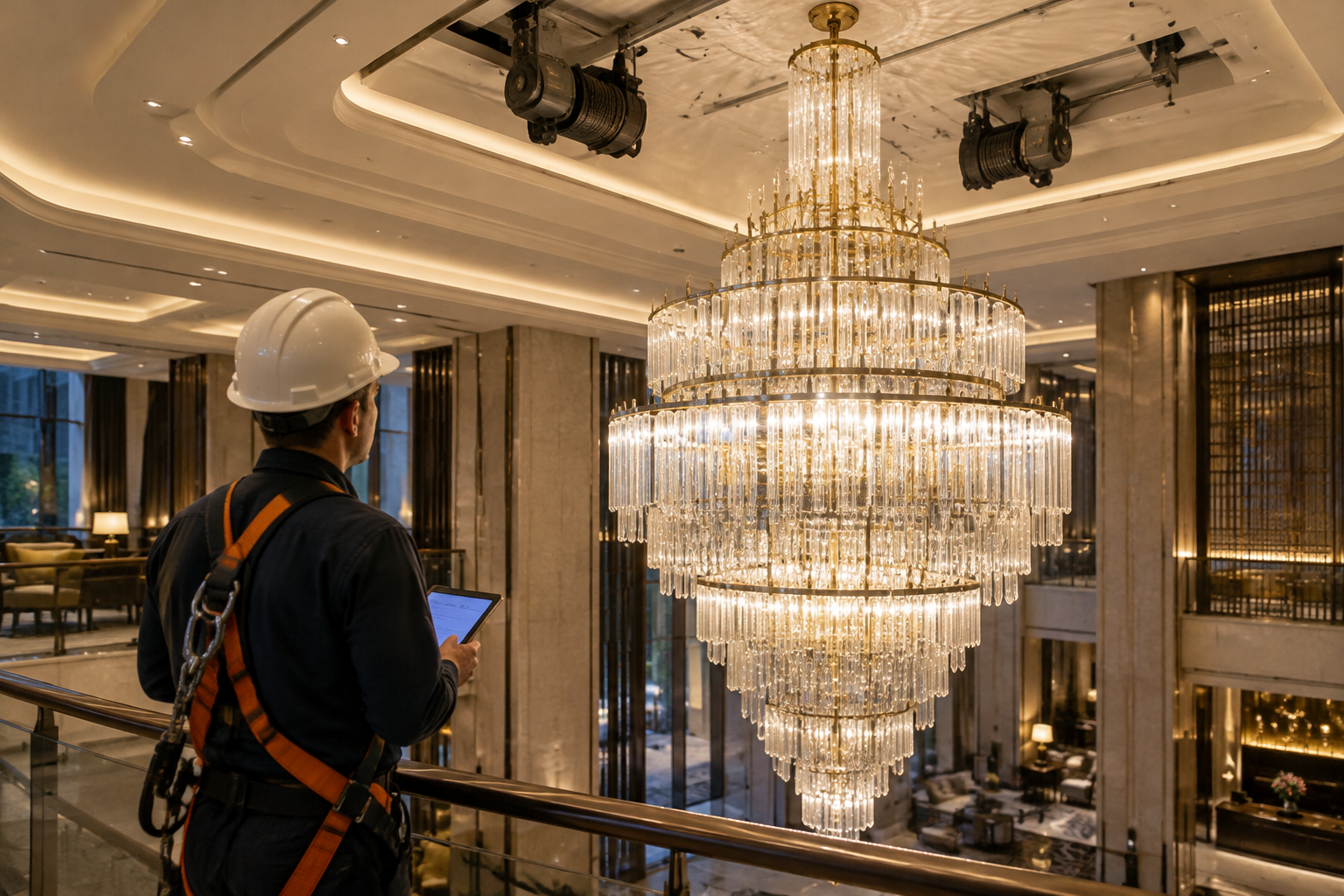 How Do You Maintain 15 m+ Lobby Chandeliers with Winches?: Q: How often should a hotel inspect its chandelier lifting system?
Request a Custom Quote for a Maintainable 15 M+ Lobby Chandelier
A useful quotation starts with the maintenance strategy, not only a chandelier rendering.
Provide lobby sections, suspension height, proposed geometry, estimated mass, structural information, floor access constraints, destination country and control requirements. Identify who supplies and approves the lifting system. Request itemised engineering, sampling, photometry, compliance documentation, spare parts and commissioning responsibilities; confirm MOQ and lead time against the agreed scope.
At XHLWX (led-project-light.com), a Custom Indoor LED Lighting Manufacturer based in China, ... share your lobby drawings and maintenance brief for a project-specific quotation.
Chi è XHLWX
XHLWX è il marchio di Shenzhen Qihang Lighting Co., Ltd., produttore di apparecchi LED per progetti con stabilimento proprio a Shenzhen (Cina) dal 2009. Forniamo profili lineari, downlight, binari magnetici, pannelli, plafoniere stagne, campane industriali e apparecchi su misura per uffici, hotel, musei, retail e industria.
Progettazione illuminotecnica secondo UNI EN 12464-1 (Em, UGR, Uo, Ra) con file IES e LDT per DIALux; apparecchi conformi CE e RoHS, sistema qualità ISO 9001.
Domande frequenti su XHLWX
XHLWX fornisce progetti in Italia?
Sì. Forniamo progetti in Italia direttamente dallo stabilimento; offerta, calcolo illuminotecnico e documentazione tecnica sono disponibili in italiano o inglese.
Gli apparecchi rispettano la UNI EN 12464-1?
Dimensioniamo illuminamento, limite UGR e uniformità secondo la UNI EN 12464-1 e li verifichiamo con un calcolo DIALux basato sui nostri file LDT.
Quali sistemi di controllo sono supportati?
DALI-2, 0-10 V e Casambi (Bluetooth), anche in versione emergenza o con sensore secondo il progetto.
XHLWX realizza apparecchi su misura o OEM?
Sì. Lunghezze, temperature di colore, ottiche, finiture e il vostro marchio (OEM/ODM) vengono realizzati nel nostro stabilimento.
Need a tailored lighting plan for your project?
Our senior lighting designers reply within 48 hours with a free design proposal & quotation.