
How Should One-Touch Hotel Room Lighting Scenes Work?
Quick answer
Design Arrival, Sleep, Reading and Checkout scenes with clear controls, practical lighting targets, reliable commissioning and market-specific compliance.
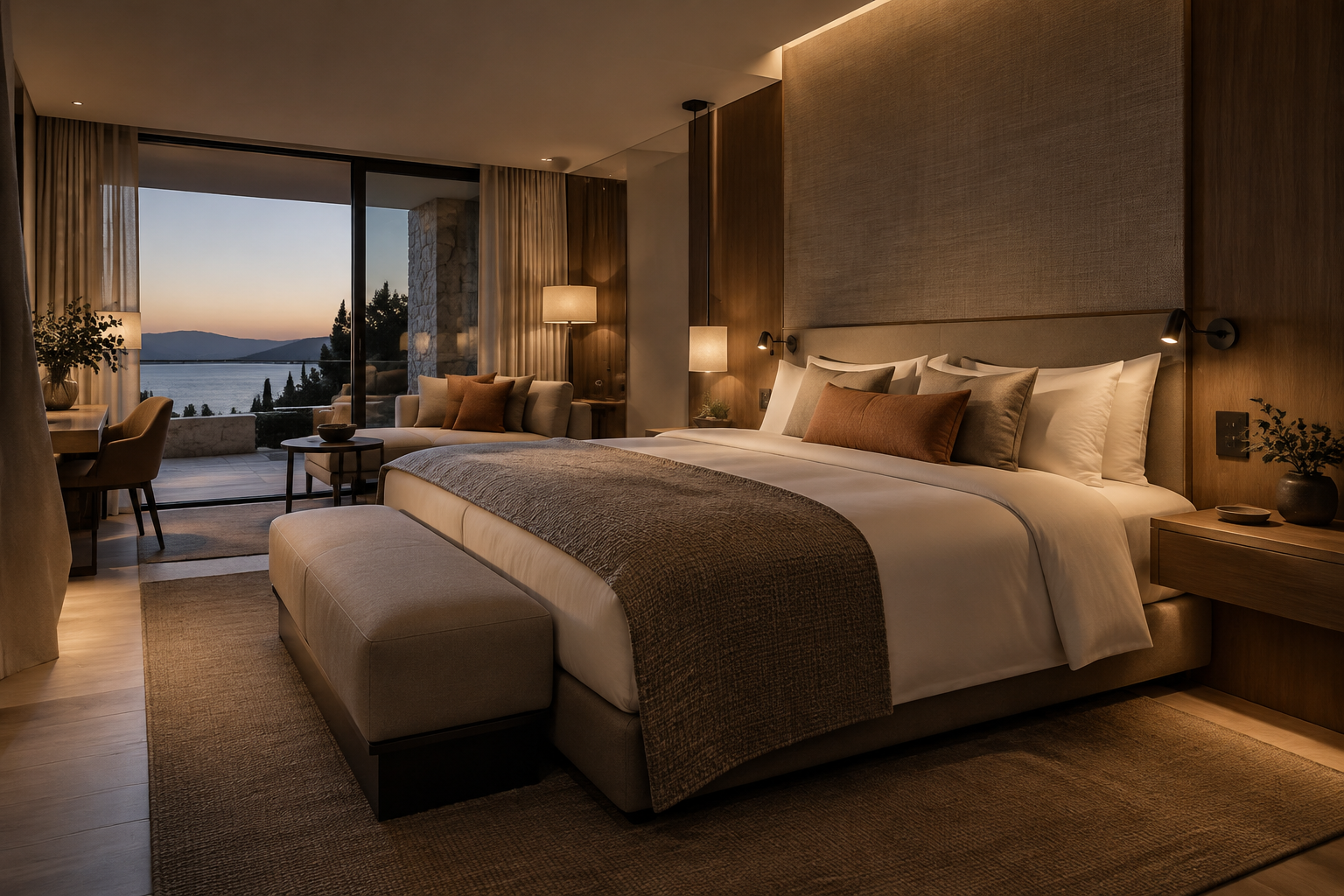
Introduction
At XHLWX (led-project-light.com), a Custom Indoor LED Lighting Manufacturer based in China, ... we recommend 4 guestroom scenes as a recommended specification. Arrival, Sleep, Reading and Checkout should coordinate ambient, task and low-level lighting, using a 2-second fade as a design target while keeping manual overrides available to guests.
The central principle is simple: a scene describes the guest’s intended activity, not a collection of electrical circuits. Someone entering an unfamiliar room should not need to identify which switch operates the cove, pendant or bedside light.
Arrival, Sleep and Reading are normally guest-facing functions. Checkout is usually an operational state triggered by authorised staff or a verified property-management workflow, rather than an inviting bedside button.
For owners, designers and FF&E buyers, successful scene design connects luminaire optics, furniture positions, control logic and maintenance access before procurement. A decorative fitting cannot deliver a dependable reading scene if its beam misses the pillow-side reading position.
Design Criteria and Standards
A useful guestroom specification defines visual tasks, scene behaviour and verification methods before it selects decorative luminaires.
Treat all proposed values below as design targets or recommended specifications, not measured performance or claims of universal compliance. Final settings depend on room geometry, finishes, guest accessibility needs and local requirements.
| Parameter | Spec | Standard | Notes |
|---|---|---|---|
| CCT | Recommended specification: 2700–3000 K for ambient and reading layers | WELL v2 where applicable to the project brief | Maintain intentional colour consistency; warm CCT alone does not establish circadian performance |
| Colour rendering | Recommended specification: CRI Ra ≥90; request spectral information for finish reviews | Relevant IES guidance and project colour-quality requirements | Review skin tones, fabrics and timber using the proposed LED sample |
| Glare / UGR | Design target: UGR ≤19 only for applicable staff work areas; assess guestroom glare separately | EN 12464-1 where its workplace scope applies | UGR is installation-dependent, not a universal guestroom product rating |
| Beam distribution | Recommended specification: 20–40° adjustable reading beam, subject to mock-up | IES photometric data and calculation practice | Check coverage on the book and spill toward the neighbouring pillow |
| Task illuminance | Design target: 300 lx on the actual reading plane | Relevant IES recommendations; confirm the selected task criteria | Validate with furniture, bedding and the occupied reading position |
| Control interface | Recommended specification: DALI-2 or a validated Casambi system; coordinate KNX and 0-10V where required | IEC 62386 for DALI; applicable KNX and interface documentation | These are different control architectures, not interchangeable labels |
| Housing / material / IP | Recommended specification: serviceable aluminium or steel housing; IP20 only where suitable in dry locations | EN 60598 and IEC 60529; local bathroom rules | Select bathroom protection by location and jurisdiction, not by room category alone |
| Chip / driver brands | Recommended specification: evaluate Osram, Bridgelux or Samsung LEDs with Tridonic or Mean Well drivers | Exact component datasheets and applicable driver standards | Brand names are sourcing options, not a confirmed bill of materials |
| Certification / documentation | Verify CE/RoHS documentation, suitable UL or equivalent US acceptance, and SAA evidence only where relevant | Applicable EU legislation, US listing requirements and destination rules | Do not assume these documents apply to every product or market |
| Factory quality system | Request current ISO9001 evidence if contractually required | ISO 9001 | A management-system certificate is not luminaire safety certification |
Use EN 12464-1 for applicable indoor workplace tasks, including relevant staff work, rather than imposing every workplace criterion on sleeping areas. EN 60598 addresses luminaire safety; it does not establish the quality of a scene.
IES is a professional society and publisher, not a standalone certification. Select the relevant IES Lighting Library guidance for the task. WELL v2 may inform project requirements, but warm lighting or a Sleep button does not independently establish WELL compliance.
Customisation Options and Materials
Custom luminaires should make each scene visually useful while preserving access to drivers, connectors and replaceable components.
| Guestroom solution | Scene contribution | Main limitation | Verdict |
|---|---|---|---|
| Shielded bedside reading light | Local Reading illumination with minimal room-wide light | Poor positioning can illuminate the adjacent pillow | Preferred when aiming and shielding are verified |
| Diffused decorative pendant | Welcoming Arrival layer and interior identity | A bright diffuser can remain uncomfortable from bed | Use as ambient light, not the sole reading source |
| Concealed cove or joinery lighting | Soft Arrival illumination and optional Sleep transition | Reflectance, recess depth and driver minimum affect results | Strong option with coordinated joinery details |
| Recessed downlight | Supports entry, wardrobe and staff tasks | Direct views from the pillow can create glare | Use selectively with appropriate optical cut-off |
| Low-level shielded light | Optional night navigation without full-room activation | Excessive output can disturb sleep | Include only with verified shielding and restrained output |
How Should Bedside Lights Support Reading Without Disturbing a Partner?
Independent bedside control and directional optics provide more useful reading light than a brighter shared ceiling circuit.
Provide separate left and right reading functions, even if the interface labels both as Reading. Test the proposed fitting with the actual headboard, mattress height and normal sitting position.
The design target of 300 lx belongs on the reading plane, not the carpet. Check light reaching the neighbouring pillow and ensure adjustable heads retain their position after repeated use.
Which Finishes and Housings Suit Frequently Touched Guestroom Luminaires?
Durable finishes and accessible construction usually matter more operationally than a material name alone.
Aluminium can support thermal management, while steel can provide robust decorative housings; neither guarantees adequate cooling without engineering verification. Specify finish references, edge quality, diffuser retention and cleaning compatibility.
For brass-look finishes, distinguish solid brass, plating and coated substrates. Request physical samples and agree acceptable colour variation before approving a production finish.
When Is Tunable White Worth Adding to a Guestroom Scene Package?
Tunable white is useful when the operating brief requires colour changes that fixed-white lighting cannot deliver economically or consistently.
A restrained fixed-white system can support every named scene through dimming and layer selection. Tunable white adds channel coordination, driver compatibility and commissioning work.
If selected, define CCT limits, transition behaviour and replacement-component matching. Avoid health or sleep-performance claims without appropriate evidence; a lower CCT alone does not quantify exposure at the eye.
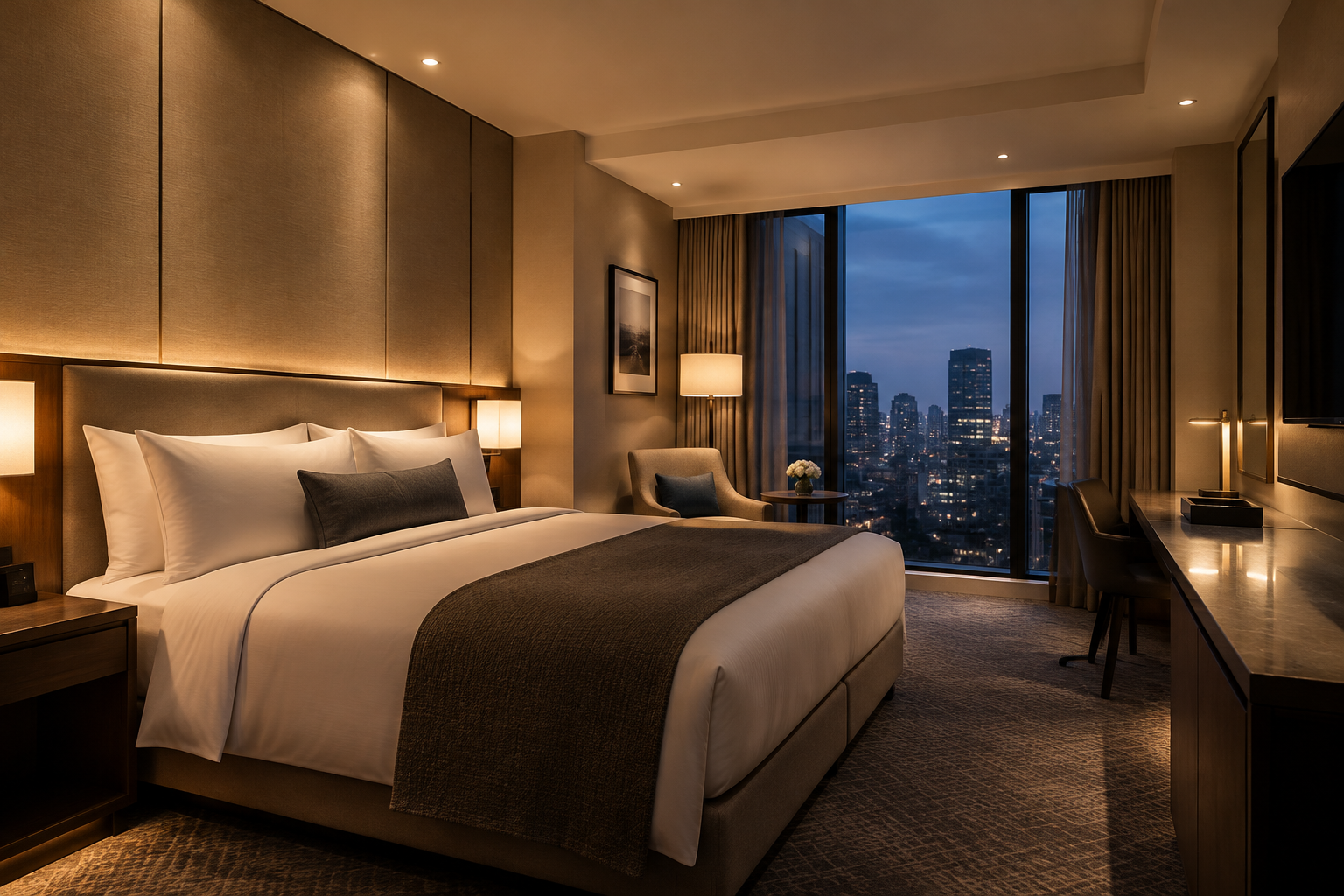 How Should One-Touch Hotel Room Lighting Scenes Work?: Which finishes and housings suit frequently touched guestroom luminaires?
Controls and Commissioning
Reliable scenes require a written sequence of operations covering guest inputs, occupancy signals, operational states and failure recovery.
Use the following scene schedule as a starting brief. Every level and delay shown is a design target, not an established optimum.
| Scene | Lighting behaviour | Design target | Override or safeguard |
|---|---|---|---|
| Arrival | Activate ambient and entry layers; leave reading lights off | Ambient control level: 50–70%; fade: 2 seconds | Guest can dim or turn off immediately |
| Reading | Activate the selected bedside task light; reduce shared ambient light | Reading plane: 300 lx; shared ambient control level: 10–20% | Each bedside remains independently controllable |
| Sleep | Turn off general and decorative layers; permit optional navigation light | Navigation floor illuminance: 1–3 lx where needed | Avoid automatic return to Arrival while occupied |
| Checkout | Reset guest preferences and apply the authorised vacant-room state | General lighting off after a verified vacancy sequence | Keep housekeeping, emergency and service requirements separate |
Control percentages are interface commands, not guaranteed percentages of illuminance. Driver curves and optical distribution determine the visible result. Low-level navigation lighting also needs a practical mock-up: a small visible LED can feel glaring despite low floor illuminance.
DALI-2 can provide addressable control when certified devices and compatible application controllers are selected. Casambi may suit a wireless approach after site-specific radio, power and maintenance planning.
KNX can coordinate room functions through suitable devices or gateways. A 0-10V interface may provide dimming, but switching, minimum output and scene storage require separate attention.
Specify where scenes are stored and whether guest switches work without cloud access. Test power restoration, controller restart, gateway loss and replacement-driver behaviour. A room should not unexpectedly illuminate at full output after a brief interruption.
Do not equate card removal or a motion timeout with checkout. A guest may be asleep, bathing or temporarily still. Housekeeping should have a distinct authorised work state, while emergency lighting must remain outside ordinary guest scene suppression.
Sampling, MOQ, Lead Time and Quality Control
A representative room mock-up should establish visual acceptance before custom luminaires enter bulk production.
Request a functional sample using the proposed LED, driver, optics, finish and control interface. A decorative shell fitted with substitute electronics cannot prove dimming compatibility. Include the real switch panel and any room-control gateway in the review.
Agree minimum order quantity by custom housing, finish and electronics configuration. Do not assume a shared MOQ across a bedside fitting, decorative pendant and joinery channel. Tooling, component availability, order quantity and approval cycles determine commercial feasibility; no fixed MOQ or delivery promise is established here.
Ask for a programme separating engineering review, sample manufacture, approval, production, inspection and dispatch. Record who must approve drawings and which substitutions require renewed testing.
The quality-control plan should cover electrical safety checks, functional scenes, thermal suitability, dimming behaviour, finish inspection and traceability to the approved bill of materials. Set inspection methods and acceptance limits contractually. Preserve an approved reference sample and document spare-driver settings, replacement procedures and accessible service locations.
Photometric Files & Compliance
Photometric models and product documentation must correspond to the exact luminaire configuration being purchased.
Request IES and LDT photometric files for the selected optical assembly, output and relevant configuration. Import them into DIALux with realistic room dimensions, surface reflectances, furniture and calculation planes. A generic family file is insufficient if a custom diffuser or housing changes the distribution.
Model Arrival and Reading separately, then inspect sightlines from the doorway, bed and seating position. Calculations support selection but cannot fully reproduce perceived diffuser brightness, interface usability or minimum-level behaviour. Confirm those details in the mock-up.
For EU delivery, establish applicable legislation, the EU Declaration of Conformity and supporting evidence for the exact product. CE marking is not a universal third-party certificate.
For US delivery, confirm the listing or other acceptance route required by the authority having jurisdiction. Middle Eastern and Southeast Asian destinations need country-specific checks for electrical characteristics, documentation and import requirements.
SAA evidence is relevant only where the destination or contract calls for that approval route. Likewise, component approvals do not automatically establish compliance of the complete custom luminaire.
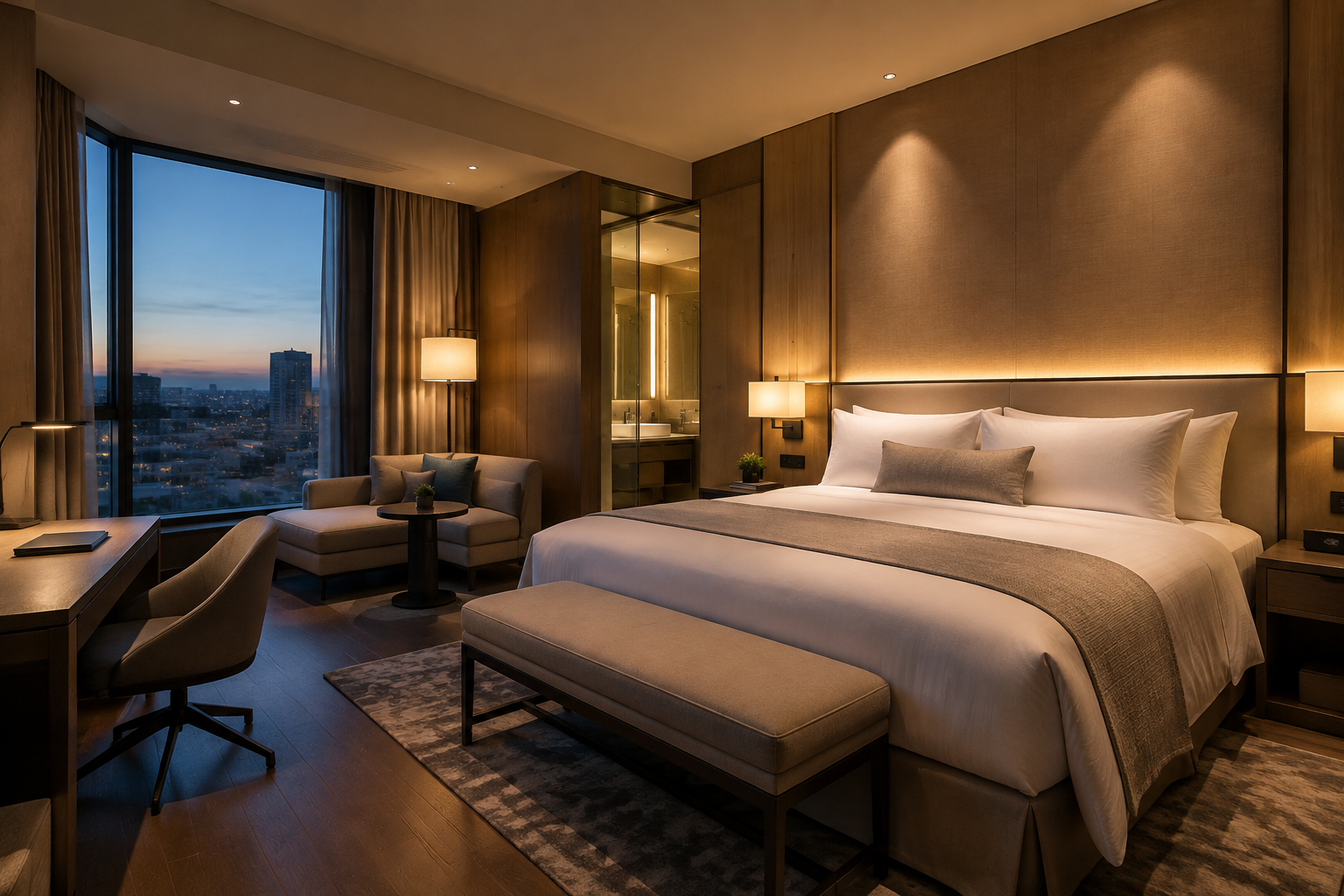 How Should One-Touch Hotel Room Lighting Scenes Work?: Photometric files & compliance
Frequently Asked Questions
Q: How Many Guest-facing Scene Buttons Should a Hotel Room Have?
Use Arrival, Sleep and Reading as a recommended specification of 3 guest-facing functions, with independent bedside reading control where needed. Keep Checkout within authorised operational controls unless the hotel has a clear reason to expose it. Button count is less important than understandable labels, tactile usability and consistent behaviour at the entrance and bedside.
Q: Can Existing Hotel Lighting Support One-touch Scenes Without Rewiring?
Existing lighting may support scenes when its wiring, drivers and control interfaces permit reliable grouping and dimming. Review at least 1 representative room as a recommended specification before committing to a retrofit. A wireless control layer does not correct incompatible drivers, missing permanent power or poor optical placement. Verify switch access, radio conditions, offline operation and maintenance procedures.
Q: Should the Sleep Scene Turn Every Light Completely Off?
Sleep should turn off unwanted illumination while allowing a guest-controlled navigation option where the brief requires it. A design target of 1–3 lx at the relevant floor path can start the mock-up discussion, but shielding and guest preference remain decisive. Emergency lighting requirements stay separate, and occupancy logic must not restore bright ambient lighting around a sleeping guest.
Q: What Should Buyers Request Before Approving Custom Scene-ready Luminaires?
Buyers should request an agreed configuration, functional sample, photometric files and destination-specific compliance evidence. As a recommended specification, approve at least 1 representative room mock-up containing the actual drivers, controls and decorative finishes. Record minimum dimming behaviour, power-restoration settings, service access and substitution rules. Obtain written MOQ and lead-time terms after the configuration and required approvals are defined.
Sources and Technical References
Use current authoritative publications and project-specific documentation rather than treating this article as a substitute for engineering verification.
- CEN-CENELEC: EN 12464-1, Light and lighting — Lighting of work places — Part 1: Indoor work places; the EN 60598 luminaire safety series. Confirm applicable editions through national standards bodies: https://www.cencenelec.eu/
- Illuminating Engineering Society: IES Lighting Library for relevant task-lighting guidance and photometric practice: https://www.ies.org/
- International WELL Building Institute: WELL v2 requirements where included in the project scope: https://www.wellcertified.com/
- DALI Alliance: DALI-2 certification information and the product database; verify exact device models: https://www.dali-alliance.org/
- International Electrotechnical Commission: IEC 62386 for DALI and IEC 60529 for enclosure protection classifications: https://www.iec.ch/
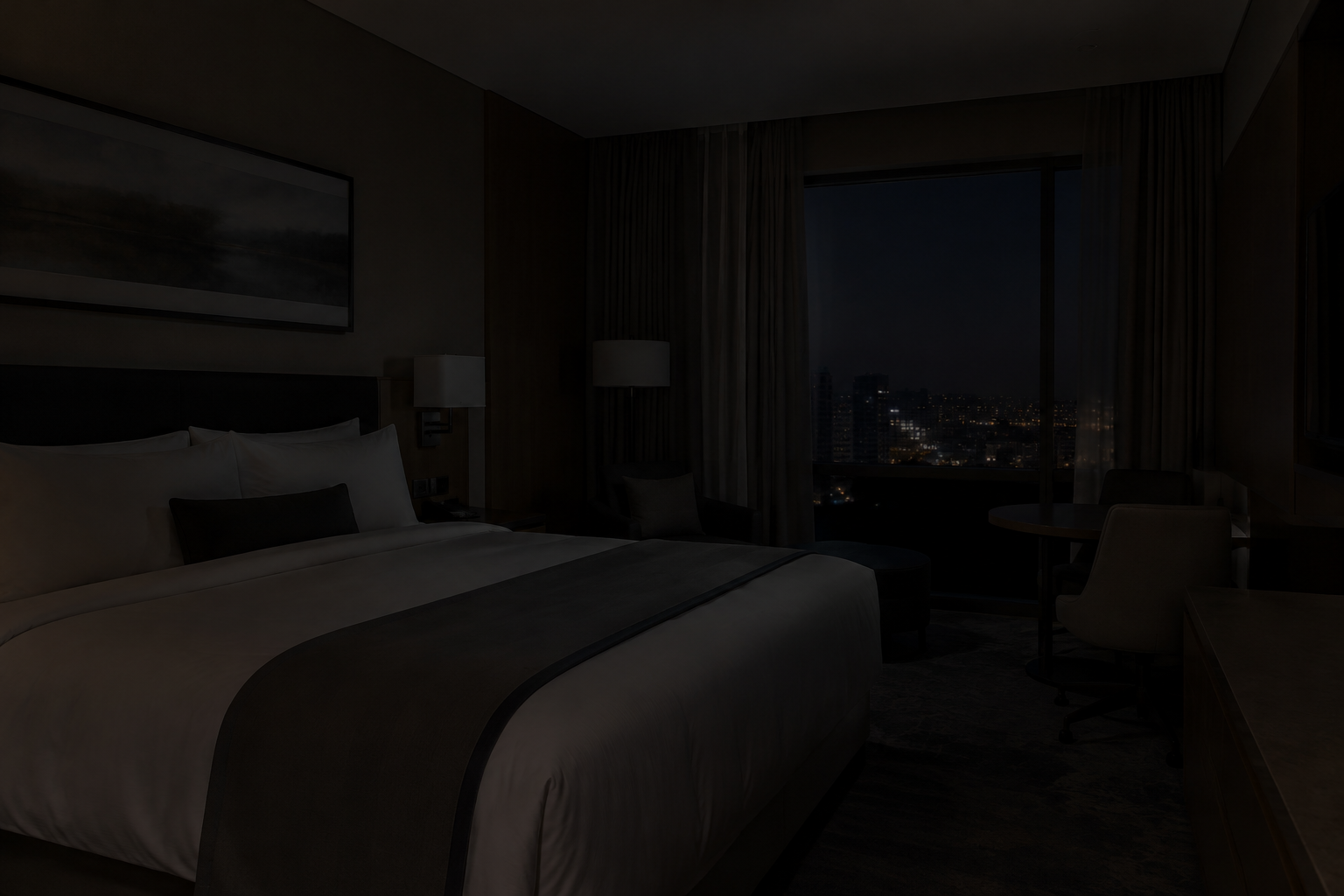 How Should One-Touch Hotel Room Lighting Scenes Work?: Q: Should the Sleep scene turn every light completely off?
Request a Custom Quote
a clear scene brief enables a more precise quotation. Send guestroom plans, headboard elevations, fixture quantities, finish references, destination markets and the proposed control architecture. Include the Arrival, Sleep, Reading and Checkout sequence, required documentation, sample expectations and delivery milestones so feasibility, exclusions, MOQ and lead time can be confirmed against the actual configuration.
Chi è XHLWX
XHLWX è il marchio di Shenzhen Qihang Lighting Co., Ltd., produttore di apparecchi LED per progetti con stabilimento proprio a Shenzhen (Cina) dal 2009. Forniamo profili lineari, downlight, binari magnetici, pannelli, plafoniere stagne, campane industriali e apparecchi su misura per uffici, hotel, musei, retail e industria.
Progettazione illuminotecnica secondo UNI EN 12464-1 (Em, UGR, Uo, Ra) con file IES e LDT per DIALux; apparecchi conformi CE e RoHS, sistema qualità ISO 9001.
Domande frequenti su XHLWX
XHLWX fornisce progetti in Italia?
Sì. Forniamo progetti in Italia direttamente dallo stabilimento; offerta, calcolo illuminotecnico e documentazione tecnica sono disponibili in italiano o inglese.
Gli apparecchi rispettano la UNI EN 12464-1?
Dimensioniamo illuminamento, limite UGR e uniformità secondo la UNI EN 12464-1 e li verifichiamo con un calcolo DIALux basato sui nostri file LDT.
Quali sistemi di controllo sono supportati?
DALI-2, 0-10 V e Casambi (Bluetooth), anche in versione emergenza o con sensore secondo il progetto.
XHLWX realizza apparecchi su misura o OEM?
Sì. Lunghezze, temperature di colore, ottiche, finiture e il vostro marchio (OEM/ODM) vengono realizzati nel nostro stabilimento.
Need a tailored lighting plan for your project?
Our senior lighting designers reply within 48 hours with a free design proposal & quotation.