
Which Deep Anti-Glare CRI95 Hotel Downlights Suit 2026?
Quick answer
Specify deep anti-glare CRI95 dim-to-warm guestroom downlights with practical guidance on optics, controls, mockups and regional compliance.
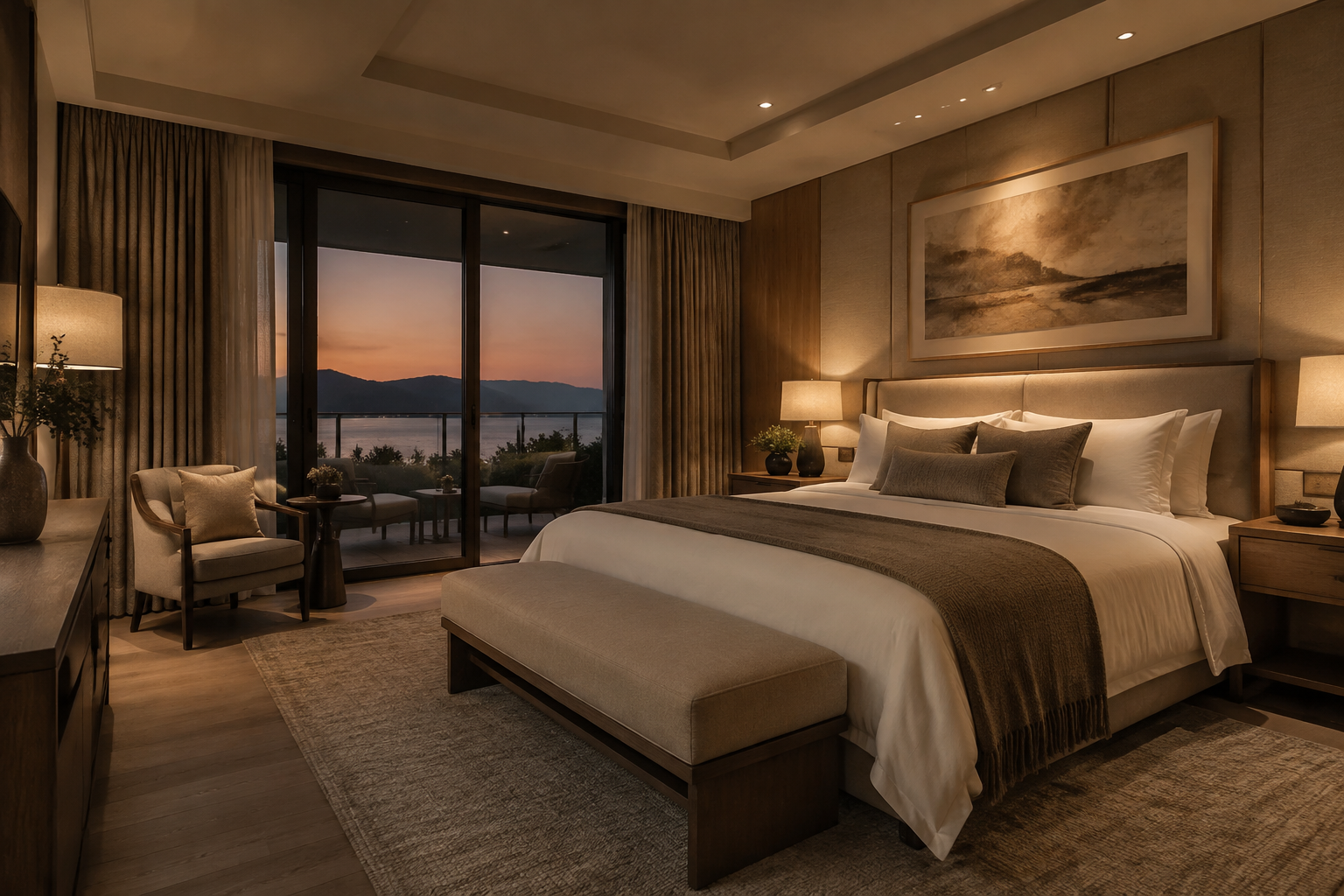
Introduction: Selecting Recessed Downlights for Hotel Guestrooms
At XHLWX (led-project-light.com), a Custom Indoor LED Lighting Manufacturer based in China, ... our recommended specification for 2026 guestrooms is deep-recessed, CRI ≥95 dim-to-warm downlights. Select a recommended specification of 2700–1800 K for evening ambience, then verify shielding, low-level dimming and colour consistency in a furnished room mockup before approving bulk production.
The best guestroom downlight is not simply the deepest housing or the highest colour-rendering number. It is the fitting that illuminates useful surfaces without exposing a bright source to guests lying in bed, watching television or entering a dark room. Recess depth, reflector geometry, beam distribution and placement must work together.
For owners, interior designers and FF&E buyers across the EU, US, Middle East and Southeast Asia, selection also depends on ceiling construction, electrical compatibility and replacement access. This guide provides recommended specifications rather than claims about completed projects, verified savings or existing product certifications. The year identifies the procurement context, not a new universal lighting standard.
Design Criteria and Standards: a Guestroom Downlight Specification Schedule
Specify guestroom downlights around visual comfort, colour quality and controllability rather than wattage alone.
Use the following schedule as a tender starting point. All numerical performance selections are recommended specifications or design targets, not verified XHLWX product results. Standard identifiers are references, not performance claims.
| Parameter | Spec | Standard | Notes |
|---|---|---|---|
| CCT and dim-to-warm | Recommended specification: 2700–1800 K, with an agreed dimming curve | IES measurement guidance; WELL v2 project context | Verify colour temperature at multiple output levels |
| Colour rendering | Recommended specification: CRI Ra ≥95; R9 ≥50 throughout the agreed operating range | CIE colour-rendering method; IES TM-30 as supplementary evaluation | Request evidence at warm, intermediate and full-output settings |
| UGR and shielding | Design target: UGR ≤19 where the calculation method is applicable | EN 12464-1 | UGR is installation-dependent; assess bed-view discomfort separately |
| Beam distribution | Recommended specification: 24° and 36° options for mockup comparison | IES photometric reporting | Final beam selection depends on ceiling height and target surface |
| Control interface | Specify DALI-2, Casambi, KNX integration or 0-10V to match the room system | IEC 62386 for DALI; relevant interface documentation | Confirm gateway, driver and controller interoperability |
| Housing, material and IP | Recommended specification: aluminium heat sink; IP20 for dry areas; assess IP44 or higher for suitable bathroom positions | EN 60598; IEC 60529 | Local bathroom-zone rules determine required protection |
| Chip and driver brands | Candidate LED sources: Osram, Bridgelux or Samsung; candidate drivers: Tridonic or Mean Well | Component datasheets; luminaire-level assessment | These are sourcing examples, not a confirmed bill of materials |
| Certification and quality evidence | Request applicable CE/RoHS documentation, UL evidence where required, SAA if specified, and ISO9001 evidence if claimed | EU legislation; applicable UL standards; ISO 9001 | Verify scope, model identity and destination-market relevance |
EN 12464-1 addresses indoor workplaces; it should not be presented as a universal bedroom illuminance rule. Its treatment of visual tasks and glare can inform relevant working areas, while the guestroom brief and local requirements govern the complete design.
For preliminary layouts, use design targets of 100–150 lx for general circulation and approximately 300 lx on a dedicated reading surface. Define measurement planes, maintenance assumptions and scene settings. A bedside reading light may meet the task requirement more comfortably than a ceiling downlight.
CRI95 also does not guarantee identical appearance between LED packages. Review skin tones, timber, textiles and artwork under the proposed source, using IES TM-30 information where available to supplement CRI.
Customisation Options and Materials: Matching Optics to Ceiling and Interior Details
Customisation should solve a documented visual, dimensional or maintenance problem rather than add decorative complexity.
The optical opening, trim detail and ceiling interface should be reviewed together. A dark baffle can reduce visible brightness, but may change efficiency and appearance. A larger heat sink can support thermal performance, but may conflict with shallow ceiling voids or services.
| Configuration | Guestroom advantage | Trade-off to assess | Verdict |
|---|---|---|---|
| Deep recessed reflector | Shields direct LED visibility from some oblique views | May require greater recess depth and careful spacing | Preferred starting point near bed sightlines |
| Deep baffle with honeycomb accessory | Adds source screening for selected viewing angles | Can reduce delivered light and alter distribution | Use only after testing the complete optical assembly |
| Adjustable recessed downlight | Directs light toward artwork or vertical surfaces | Aiming can expose the source to reclining guests | Suitable when aiming limits are documented |
| Trimless recessed downlight | Integrates with a continuous plaster ceiling | Requires coordinated installation and repair detailing | Choose when finish quality and access are controlled |
| Low-profile recessed downlight | Fits constrained ceiling voids | May compromise shielding or driver accommodation | Accept only after optical and thermal verification |
How Deep Should an Anti-glare Guestroom Downlight Be Above a Bed?
The correct recess depth is the depth that conceals the bright source from critical guest viewpoints while preserving the required beam.
There is no universal housing dimension that guarantees comfort. Check the relationship between aperture diameter, emitter position and reflector profile. Ask the supplier to show a section drawing and identify the shielding-angle convention used; suppliers may measure angles differently.
Evaluate the luminaire from the pillow, bedside chair, desk and doorway. Avoid placing a bright aperture directly in the normal reclining field of view. Where ceiling height or services prevent adequate shielding, repositioning the fitting can be more effective than specifying a deeper housing.
Which Finishes and Materials Suit Deep Anti-glare Recessed Downlights?
A thermally suitable housing and controlled internal finish matter more than matching the visible trim alone.
Aluminium is a common heat-sink material, but alloy, surface treatment and thermal contact details still require review. A powder-coated trim, anodised reflector or plated decorative ring should be sampled against the actual ceiling and interior finishes.
Dark internal finishes often appear quieter when viewed obliquely; light finishes may integrate better with pale ceilings. Neither automatically delivers lower glare in every layout. Request finish samples, coating adhesion information and cleaning guidance, especially where housekeeping chemicals could affect decorative surfaces.
Can CRI95 Dim-to-warm Replace Separate Guestroom Lighting Layers?
Dim-to-warm downlights support evening ambience but do not replace dedicated reading, mirror or bedside lighting.
A warm dimming curve changes spectral appearance as output falls. It does not automatically provide useful vertical illumination, eliminate shadows or deliver comfortable reading light. Balance recessed lighting with appropriate indoor task and decorative luminaires.
Ask whether the warm endpoint is reached before minimum output and whether colour changes smoothly through the operating range. A recommended specification is colour consistency within 3 SDCM at agreed test points, supported by supplier data and visual sample comparison. Do not assume consistency remains unchanged during dimming.
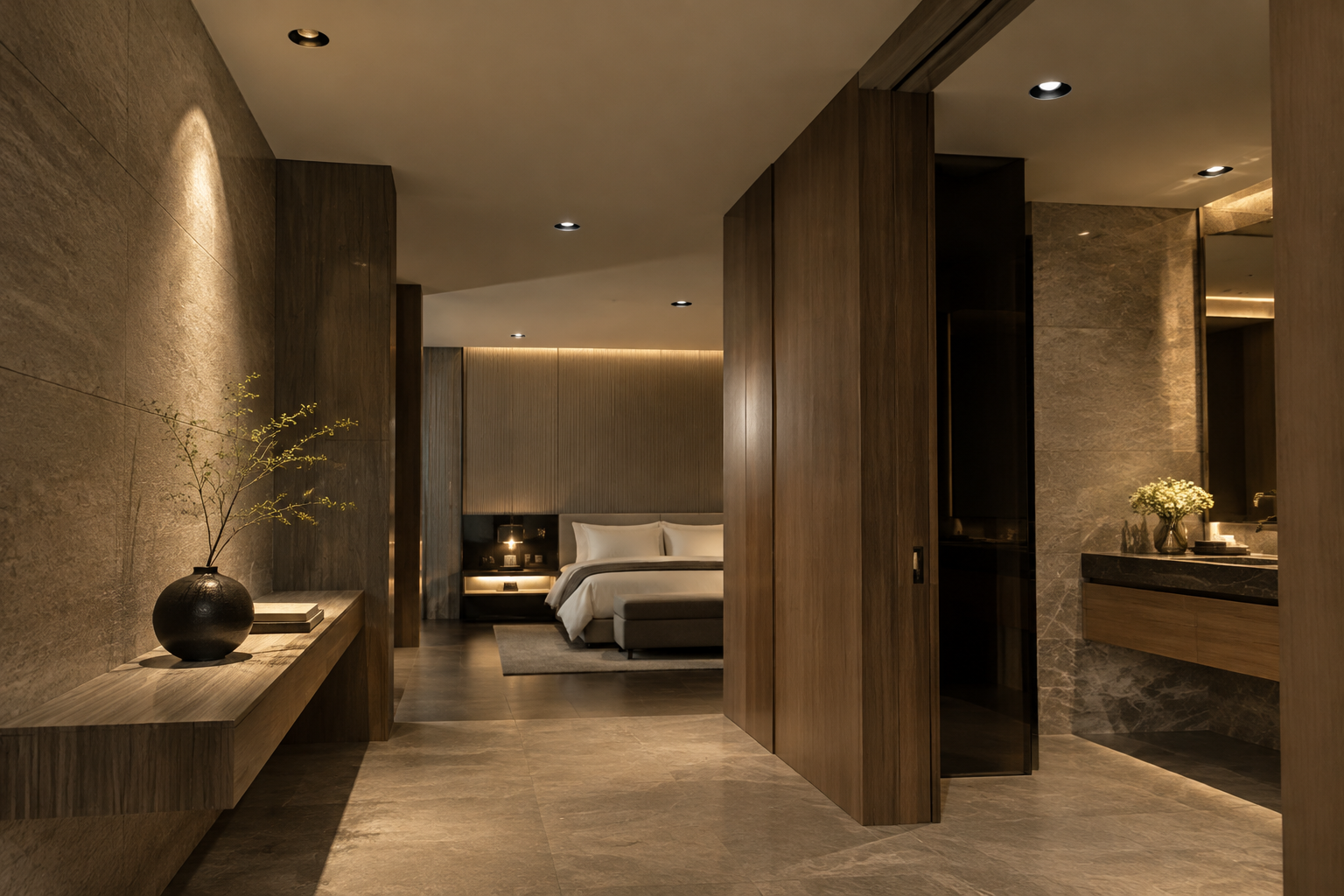 Which Deep Anti-Glare CRI95 Hotel Downlights Suit 2026?: Which finishes and materials suit deep anti-glare recessed downlights?
Controls and Commissioning: Stable Dim-to-warm Scenes Across the Guestroom
Choose the driver, control interface and dim-to-warm engine as one tested system.
DALI-2 supports standardised digital control, but verify the exact component listing and functions rather than accepting a general compatibility claim. A dim-to-warm engine may follow a fixed curve from a dimming command; independently controlled colour temperature requires a different control specification.
Casambi can suit wireless room control where network design, ownership and maintenance are agreed. KNX commonly integrates lighting through suitable actuators or gateways.
With 0-10V, confirm the dimming range, off behaviour, wiring topology and compatibility between controller and driver. These interfaces are not interchangeable procurement labels.
For a premium evening scene, set a recommended specification of stable dimming to 1% of measured full light output, subject to validation. Specify whether that percentage refers to measured luminaire output or a control command: they are not necessarily equivalent.
Commission arrival, reading, relaxation, night and housekeeping scenes with the interior installed. Test slow fades, simultaneous starts, low-level operation, power restoration and guestroom management overrides. Check flicker, audible noise, dropout and unwanted flashes using the proposed controller, not merely a factory bench dimmer.
Sampling, MOQ, Lead Time and Quality Control: Approving Before Bulk Procurement
Approve a representative luminaire and control combination before fixing the production order.
A useful design target is a minimum of 2 working samples for side-by-side comparison, plus finish samples when decorative matching matters. This is a suggested evaluation quantity, not a stated supplier MOQ.
The mockup should reproduce ceiling build-up, available void depth, nearby insulation, driver access and actual interior finishes. Check installation tolerances and whether a failed driver can be removed through the aperture without damaging the ceiling.
MOQ and lead time require a project-specific quotation. Custom tooling, unusual finishes, LED availability, driver selection and destination-market testing can all affect feasibility and schedule. Separate sampling, approval, production, inspection and delivery milestones rather than relying on a single unqualified dispatch promise.
The approved sample should anchor a controlled bill of materials. Record LED package, optical parts, driver model, wiring, finish and identification labels.
Require change approval before component substitution. The quality plan should cover electrical safety checks, appearance, dimensions, functional dimming and agreed photometric sampling, with acceptance criteria defined before production.
Photometric Files & Compliance: Evidence for Layouts and Destination Markets
Photometry and compliance documents must match the exact luminaire configuration being purchased.
Request IES and LDT photometric files for the selected beam, output, reflector and accessory combination. Import them into DIALux to review illuminance, uniformity and relevant glare calculations with realistic room geometry and surface reflectances. A file from a related product is not sufficient evidence for the specified configuration.
For dim-to-warm systems, establish which operating point the file represents. Additional spectral or photometric information at dimmed settings may be needed to assess the evening scene. Renderings cannot replace a furnished mockup for source visibility or colour judgement.
EN 60598 is a luminaire safety standards series; identify the applicable parts and accepted editions with the responsible compliance professional. For EU supply, request the applicable Declaration of Conformity and supporting documentation for relevant legislation, including RoHS where applicable. CE marking should not be described as a universal third-party certificate.
For US projects, confirm the required listing and applicable standards, such as UL 1598 where relevant, with the authority having jurisdiction. Middle Eastern and Southeast Asian markets have country-specific approval routes.
SAA evidence does not automatically establish acceptance there. ISO9001 concerns quality management, not product safety; WELL v2 concerns project-level requirements, not a blanket luminaire certification.
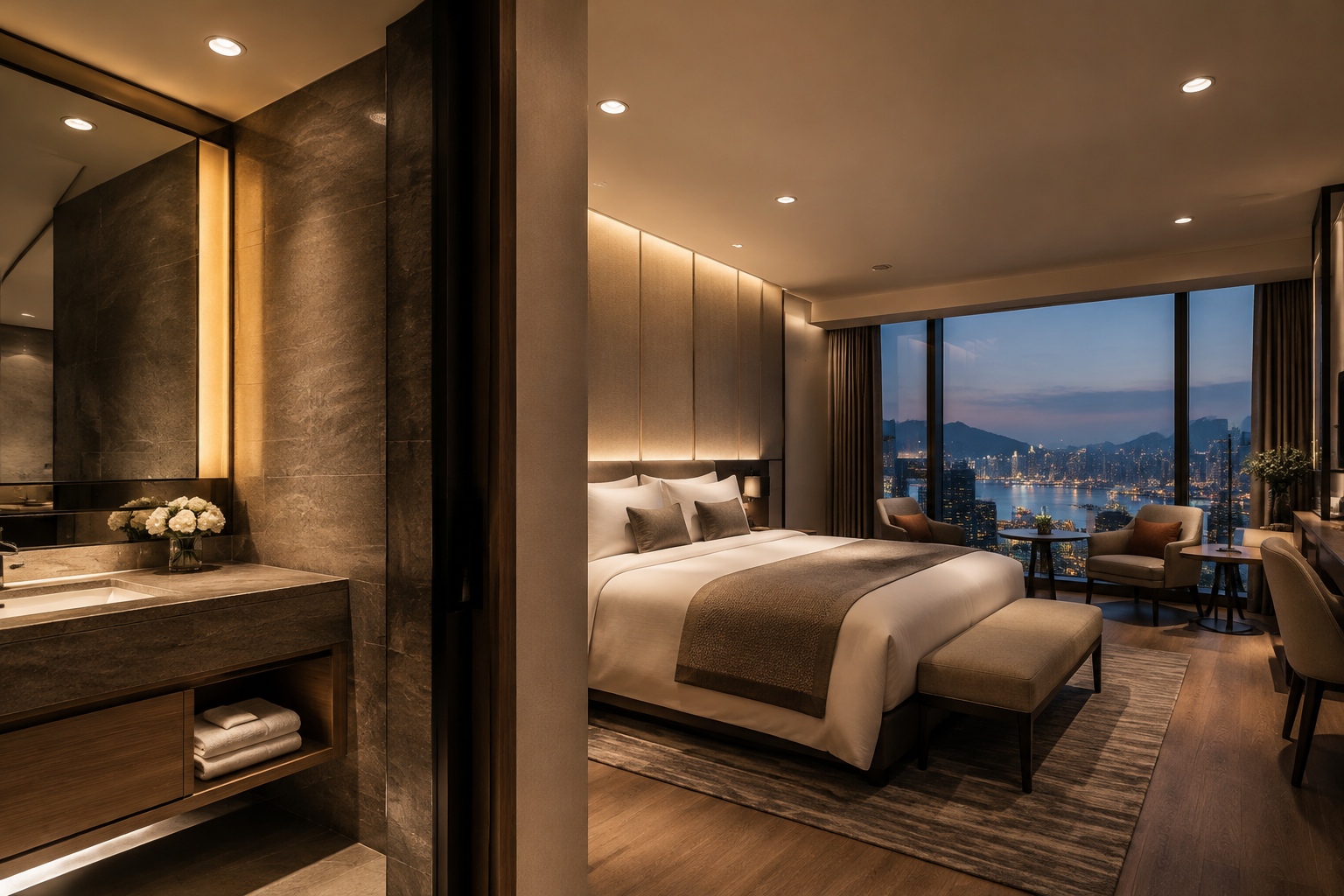 Which Deep Anti-Glare CRI95 Hotel Downlights Suit 2026?: Photometric files & compliance: evidence for layouts and destination markets
Frequently Asked Questions
Q: Does a Deep Recessed Downlight Automatically Achieve UGR Below 19?
No; deep recessing alone does not establish an installation’s UGR. A design target of UGR ≤19 must be evaluated with applicable calculation methods, room geometry, surface reflectances and luminaire positions. Guestroom bed views also need separate assessment because a conventional glare calculation may not represent discomfort experienced by a reclining guest.
Q: What Dim-to-warm Range Should a Hotel Guestroom Specify?
A recommended specification of 2700–1800 K suits projects seeking warm evening ambience. The appropriate endpoints depend on interior finishes, guest expectations and the other lighting layers. Request the complete dimming curve and confirm CRI, output and visual consistency at intermediate settings, rather than approving only the brightest and warmest endpoints.
Q: Is CRI95 Necessary for Every Recessed Guestroom Downlight?
CRI ≥95 is a recommended specification when accurate skin tones, textiles and decorative finishes are priorities. It is not a universal legal requirement for guestrooms. Compare R9, available IES TM-30 data, colour consistency and dimmed performance before selection. A well-controlled lighting layout remains essential even when the source has excellent colour-rendering metrics.
Q: Can Existing Guestroom Dimmers Operate New Dim-to-warm Downlights?
Existing dimmers may work, but compatibility requires testing with the exact driver and connected load. Set a recommended specification of stable operation to 1% output only if the complete system can demonstrate it. Confirm start-up, fade quality, minimum load, off behaviour and absence of noise or flashing before approving a refurbishment-wide replacement.
Sources and Technical References: Checking Standards and Product Evidence
Use primary references to establish scope, then obtain configuration-specific evidence from the supplier.
- CEN-CENELEC: consult the standards catalogue for EN 12464-1 and the EN 60598 series, including applicable national adoptions: cencenelec.eu.
- IES: consult lighting guidance, photometric resources and IES TM-30 information: ies.org.
- International WELL Building Institute: review WELL v2 Light requirements at project level: standard.wellcertified.com.
- DALI Alliance: check DALI-2 certification information and the product database: dali-alliance.org.
- European Commission: review CE marking responsibilities and applicable product rules: single-market-economy.ec.europa.eu.
- UL Solutions and ISO: verify relevant product certification information and the scope of ISO 9001 quality-management certification: ul.com and iso.org.
These references establish terminology and assessment frameworks. They do not certify an unspecified downlight, confirm a supplier’s credentials or replace local regulatory review.
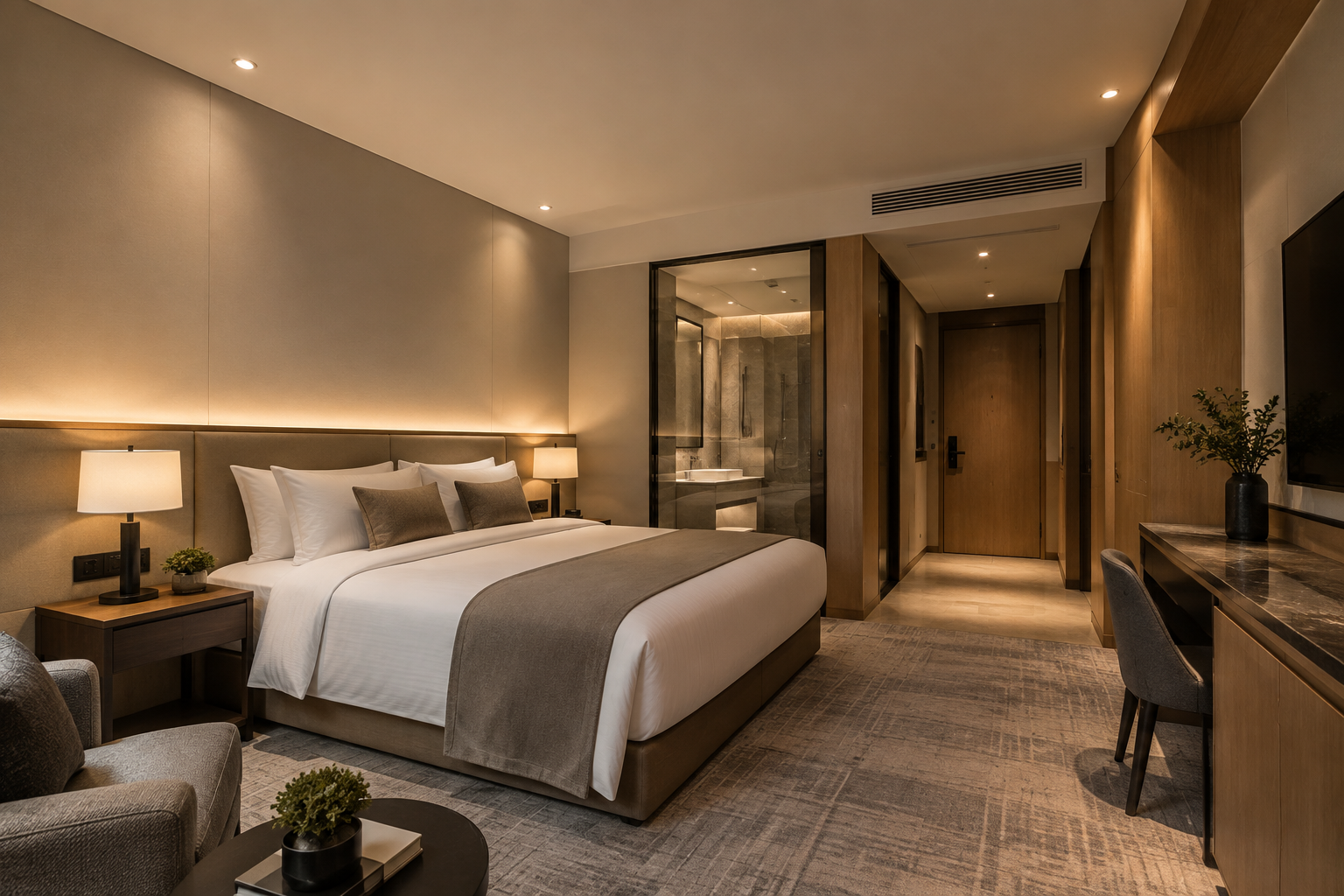 Which Deep Anti-Glare CRI95 Hotel Downlights Suit 2026?: Q: Is CRI95 necessary for every recessed guestroom downlight?
Request a Custom Quote: Submit a Coordinated Guestroom Downlight Brief
A coordinated quotation starts with room geometry, ceiling constraints and the intended control system.
Provide reflected ceiling plans, room sections, critical bed sightlines, ceiling construction, available recess depth, target finishes and quantities by variant. Include supply voltage, destination country, requested certification route, driver location and maintenance access. Identify whether the project needs fixed dim-to-warm behaviour or independently controlled colour temperature.
At XHLWX (led-project-light.com), a Custom Indoor LED Lighting Manufacturer based in China, ... your project brief can form the basis for a configuration-specific quotation. Request proposed optics, component identities, sample arrangements, photometric evidence, compliance scope, MOQ and lead time in writing, with all performance targets and substitutions resolved before production approval.
XHLWXについて
XHLWXは、2009年から中国・深圳に自社工場を持つLEDプロジェクト照明メーカー、Shenzhen Qihang Lighting Co., Ltd.のブランドです。ライン照明、ダウンライト、マグネットレール、パネル、防湿・防塵灯、高天井用照明、特注照明器具を、オフィス、ホテル、美術館・博物館、店舗、工場向けに供給しています。
照度設計はJIS Z 9110およびEN 12464-1の推奨値(維持照度、UGR、均斉度、Ra)を基準とし、DIALux用のIES・LDT配光データを提供します。製品はCE・RoHS適合、品質管理はISO 9001に基づいています。
XHLWXに関するよくある質問
日本のプロジェクトにも納品できますか?
はい。工場から海外プロジェクトへ直接出荷しています。輸送条件や国内の電気用品安全法(PSE)への対応可否は、案件ごとに事前にご相談ください。
JIS Z 9110の照度基準に合わせた設計は可能ですか?
可能です。必要照度、UGR、均斉度を基準に照明計画を行い、当社の配光データを使ったDIALux計算で数値を確認します。
どの調光・制御方式に対応していますか?
DALI-2、0-10V、Casambi(Bluetooth)に対応しています。案件により非常灯やセンサー付き仕様も検討できます。
特注品やOEMにも対応していますか?
はい。長さ、色温度、配光角、本体色、お客様ブランドでのOEM/ODMを自社工場で製作します。
Need a tailored lighting plan for your project?
Our senior lighting designers reply within 48 hours with a free design proposal & quotation.