
Hotel Wall Light MOQ & Sample Fees: How 50–300 Set Pricing Works
Quick answer
Understand custom hotel sconce MOQ, sample fees, tooling charges and 50–300 set pricing, with a practical framework for comparing supplier quotes.
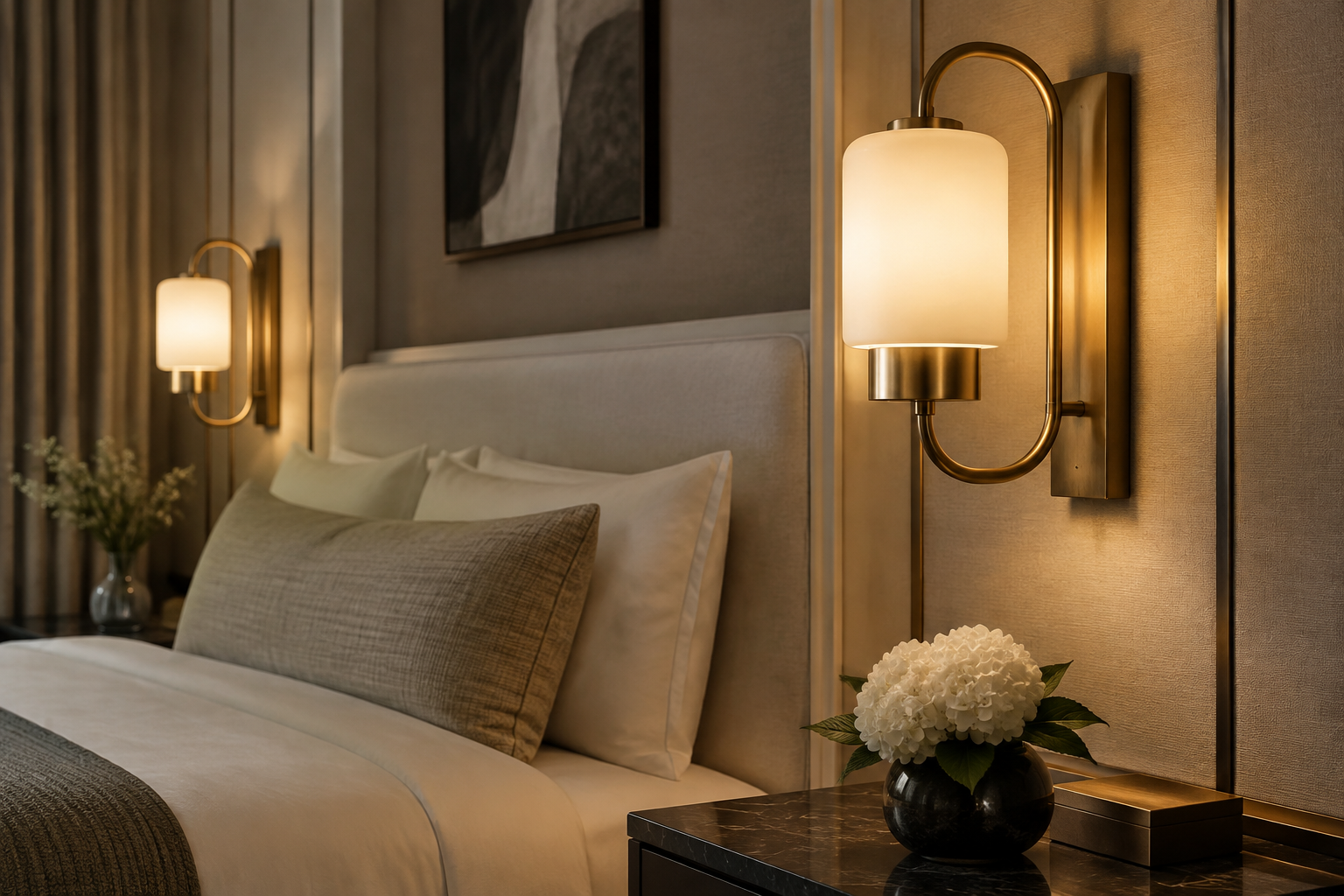
Introduction: How Does Hotel Wall Light Pricing Work at 50–300 Sets?
At XHLWX (led-project-light.com), a Custom Indoor LED Lighting Manufacturer based in China, hotel sconce pricing depends on tooling, sampling, and order quantity. For a recommended procurement range of 50–300 sets, fixed development charges spread across more units as quantity rises; sample fees should separately identify engineering, components, finishes, testing, and freight.
MOQ means minimum order quantity, but a custom wall light rarely has just one minimum. Fabrication, finish processing, glass production, and driver purchasing can each impose different batch constraints. The effective MOQ depends on which constraint governs the approved design.
For hotel owners, interior designers, and FF&E buyers, the useful question is not simply “What is your MOQ?” Ask which costs change with quantity, which remain fixed, and whether the quoted quantity applies per model, finish, or complete order. No supplier-specific prices, sample fees, or delivery commitments are assumed here.
Design Criteria and Standards: What Belongs in a Comparable Hotel Sconce Specification?
A comparable quotation requires a defined set, an approved performance brief, and a destination-specific compliance scope.
Define “set” before comparing prices. It might mean a complete wall luminaire with driver and mounting kit, or a coordinated bedside pair. State whether shades, reading-light modules, local switches, connectors, and installation hardware are included.
The following numerical performance values are recommended specifications, not measured XHLWX product results. Final requirements depend on room use and the approved lighting design.
| Parameter | Spec | Standard | Notes |
|---|---|---|---|
| CCT | Recommended specification: 2700–3000 K | Project brief; WELL v2 where applicable | Approve the appearance with room finishes and adjacent luminaires. |
| CRI | Recommended specification: Ra ≥90 | EN 12464-1 where relevant to the task | Request supporting LED data; CRI alone does not establish complete colour quality. |
| UGR and glare | Recommended design target: UGR ≤19 only where appropriate for the assessed task | EN 12464-1 | UGR depends on the installation; decorative sconces have no universal standalone UGR guarantee. |
| Beam and distribution | Recommended specification: 30–60° for a directional reading module; diffuse distribution for ambient use | IES photometric reporting conventions | Validate beam placement and shielding using the actual optics. |
| Control | Select DALI-2, Casambi, KNX integration, or 0-10V | IEC 62386 for applicable DALI functions; system-specific documentation | These are different architectures, not interchangeable driver labels. |
| Housing, material, IP | Aluminium, steel, or brass; recommended specification: IP20 for dry interiors | EN 60598; IEC 60529 | Bathroom locations require a separate zone and environmental assessment. |
| LED and driver | Specify an approved combination, such as a Bridgelux LED with a suitable Tridonic driver | Component datasheets; applicable luminaire safety requirements | Named brands are selection options, not evidence of stocked or certified assemblies. |
| Certification and documentation | Define CE/RoHS evidence, UL requirements, SAA relevance, and ISO9001 scope separately | Applicable EU legislation; relevant UL standards; destination rules | Verify documents; product approval and factory management certification are different matters. |
EN 12464-1 addresses indoor workplace lighting, not every decorative hotel lighting decision. WELL v2 applies when the project pursues relevant WELL objectives; it is not a blanket luminaire certification.
Customisation Options and Materials: Which Changes Affect Hotel Wall Light MOQ?
MOQ usually rises when a design introduces dedicated tooling, unusual components, or small finish batches.
The following comparison describes procurement logic, not published factory minimums. Request separate quotations for materially different construction routes.
| Construction route | Main setup cost | Sample-fee pressure | Quantity sensitivity | Verdict |
|---|---|---|---|---|
| Adapted existing housing | Drawings, bracket changes, assembly checks | Lower when existing parts remain usable | Often less dependent on dedicated tooling | Best starting point when budget and schedule dominate. |
| Fabricated metal body | Cutting, bending, welding jigs, finish setup | Moderate; appearance depends on workmanship | Batch processing can improve repeatability | Useful for distinctive silhouettes without casting tools. |
| Dedicated cast housing | Mould development, trials, tooling adjustments | Higher before the design is stable | Tooling recovery strongly affects unit economics | Justify through repeat orders or a sufficiently large programme. |
| Custom glass shade | Forming tools, colour trials, reject allowance | Can be significant for unique shapes | Glass processor batch requirements may govern MOQ | Confirm shade economics before freezing the visual concept. |
| Bespoke metal finish | Surface preparation, colour matching, process trials | Driven by finish development | Splitting quantities across colours reduces batch efficiency | Consolidate finishes where the interior scheme permits. |
How Can Buyers Reduce MOQ Without Losing the Intended Hotel Interior Appearance?
Retaining a proven internal assembly while changing visible surfaces can reduce development work.
Consider a standard mounting arrangement, replaceable LED module, or established driver enclosure behind a custom faceplate. This separates decorative identity from electrical complexity.
Ask the supplier to identify reusable components rather than merely offering a cheaper material. A simplified housing is not equivalent if it changes glare, maintenance access, or shade proportions.
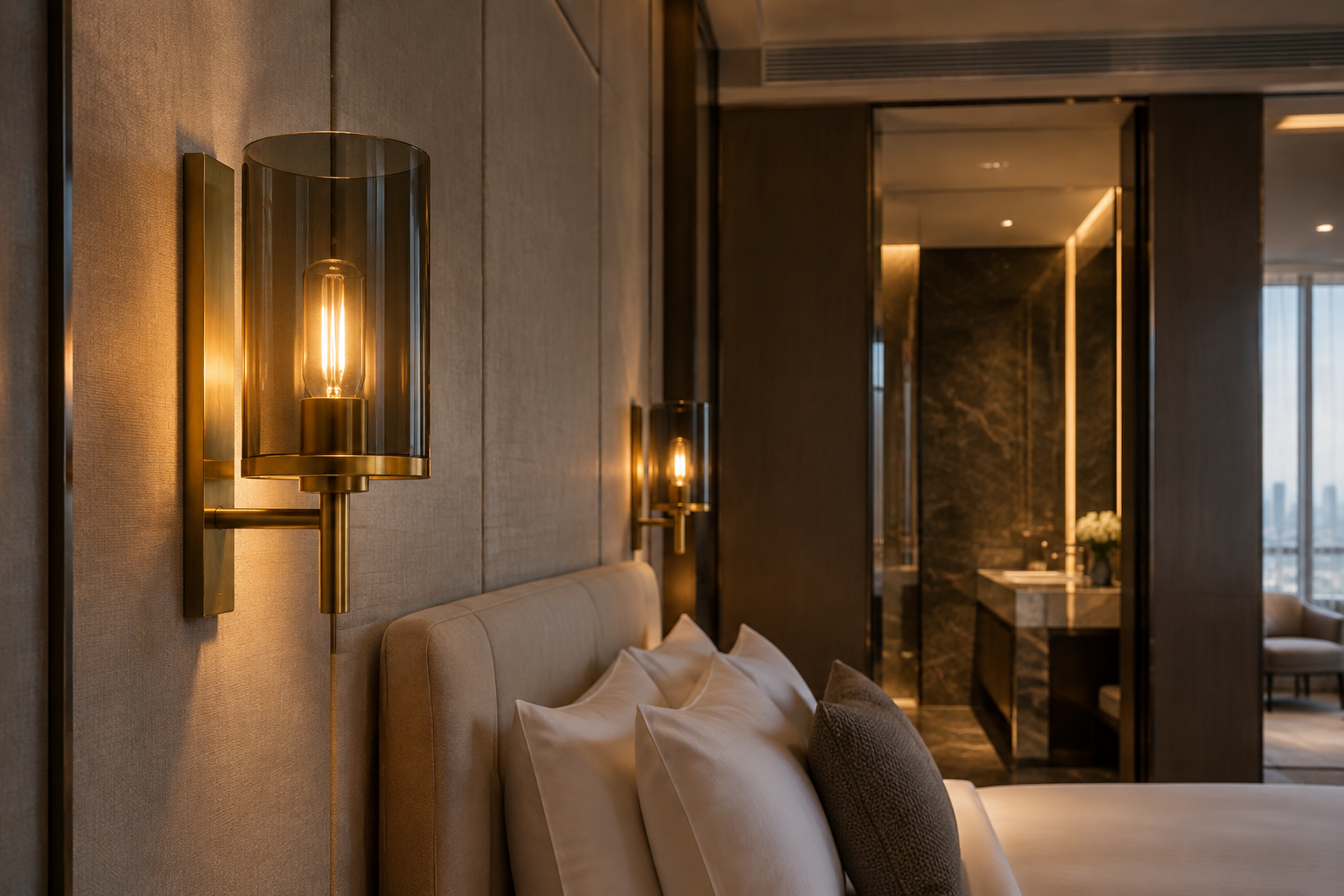
Why Can Brushed Brass and Tinted Glass Increase Sample Fees?
Finish and glass samples require process development that may not transfer directly into saleable production parts.
Brushed brass involves decisions about grain direction, substrate, protective coating, and acceptable colour variation. Tinted glass adds transmission, wall-thickness, and visual consistency considerations.
Approve physical references under the intended lighting. A photograph cannot reliably establish metallic colour or how a shade appears when illuminated.
Can Different Hotel Room Types Share the Same MOQ?
Variants can share purchasing advantages only when their common components and production processes genuinely overlap.
A left-hand and right-hand bedside arrangement might share a body while requiring different wiring or assembly instructions. A suite version with another shade may create an independent supplier minimum. Request a variant matrix showing shared parts, unique parts, finish batches, and separate approval requirements before treating the combined room count as one order.
 Hotel Wall Light MOQ & Sample Fees: How 50–300 Set Pricing Works: Why can brushed brass and tinted glass increase sample fees?
Controls and Commissioning: How Do Dimming Choices Change the Quotation?
Control architecture affects driver cost, wiring, enclosure space, testing, and commissioning responsibility.
DALI-2 requires suitable devices and integration with the specified control system. Casambi requires an appropriate wireless control arrangement and assessment in the actual building.
KNX commonly operates through compatible actuators or gateways. A 0-10V solution requires confirmation of dimming behaviour, wiring, and any separate switching arrangement.
For bedside sconces, define whether a local switch controls the ambient source, the reading module, or both. Specify power-restoration behaviour and coordination with the guestroom management system.
Ask for a functional sample using the intended driver and controller, not a temporary demonstration supply. Witness low-level dimming, startup, audible noise, and visible flicker. Commissioning scope should identify who supplies control addresses, gateways, programming, and on-site adjustment; these services should not disappear inside an undefined “complete set” price.
Sampling, MOQ, Lead Time and Quality Control: How Should 50–300 Set Quotations Be Structured?
A transparent quotation separates development charges from recurring production costs and states the conditions for sample credits.
Use a consistent cost model. Let Q represent ordered sets, F represent agreed fixed development charges, and V(Q) represent recurring cost per set at that quantity. The production subtotal is F + Q × V(Q), before separately identified logistics and taxes. The effective unit cost is V(Q) + F/Q. If tooling is already included in V(Q), do not add it again.
For the proposed 50–300 set procurement range, spreading an unchanged F over 300 rather than 50 sets reduces its per-set allocation to one-sixth. This is arithmetic, not a promised price reduction: components, labour, packaging, and compliance costs do not automatically decline by the same proportion.
Request prices against the same revision. At each quoted quantity, hold materials, finish, driver, packaging, and inspection scope constant. A lower price based on thinner metal or a substituted driver is a specification change, not a volume discount.
Break sample fees into identifiable work. A useful sample quotation distinguishes:
- Engineering drawings, electrical layout, and design-for-manufacture review.
- Prototype fabrication, tooling or jigs, and purchased components.
- Finish trials, shade development, and assembly labour.
- Functional checks, external testing where agreed, and documentation.
- Sample packaging, freight, duties, and destination handling.
A prototype can cost more than a production unit because it uses small-batch purchasing and manual operations. Conversely, a low sample charge may exclude finish development, final optics, or compliance work. Compare scope before comparing the headline fee.
Agree credit conditions before payment. Sample charges may be non-creditable, partly creditable, or creditable against an eligible production order. Record the qualifying model, order quantity, validity period, and treatment of redesigns. Distinguish a commercial sample credit from ownership of moulds, engineering drawings, or exclusive design rights.
Use an approval sequence rather than an unsupported calendar promise. Request separate durations for drawing approval, component procurement, sample fabrication, sample review, production, inspection, and shipping. Lead time should identify its starting event, such as approval of the production sample and receipt of the agreed payment. Finish changes or late driver substitutions can restart relevant checks.
Make the approved sample a production reference. Record dimensions, finish reference, material, component identification, wiring, mounting arrangement, and packaging. Keep a controlled bill of materials and prohibit unapproved substitutions. Define workmanship inspection, electrical safety checks, functional checks, and any batch sampling plan in the purchase agreement.
For EU, US, Middle East, and Southeast Asia deliveries, compare quotations on the same Incoterms basis. Freight, import clearance, local taxes, and destination conformity work can otherwise obscure the real procurement cost.
Photometric Files & Compliance: What Evidence Should Precede Production Approval?
Photometry and compliance evidence must match the proposed luminaire configuration and its destination market.
Request IES and LDT photometric files for the relevant LED, optic, shade, and operating condition. Use DIALux to evaluate the proposed interior layout.
Files from a visually similar product cannot establish the performance of a custom shade or altered optical assembly. Preliminary simulations should be identified as design work, not measured results.
Use the applicable EN 60598 parts and editions when specifying European luminaire safety evidence. CE is a regulatory conformity framework, not a generic third-party certificate.
RoHS concerns restricted substances. For US projects, establish the required listing or field-evaluation route with the relevant authority and project team; recognised components alone do not establish approval of the complete luminaire.
SAA-related requirements are generally relevant to Australian-bound supply, not an automatic substitute for other markets. ISO9001 concerns quality management. Middle Eastern and Southeast Asian requirements must be checked country by country.
 Hotel Wall Light MOQ & Sample Fees: How 50–300 Set Pricing Works: Photometric files & compliance: what evidence should precede production approval?
Frequently Asked Questions
Q: Is 50 Sets a Guaranteed MOQ for Custom Hotel Wall Lights?
No universal MOQ follows from the quantity alone. Within the proposed 50–300 set procurement range, an adapted existing housing may be easier to source than a design needing dedicated glass or casting tools. Ask whether the minimum applies per model, finish, component batch, or order, and request the technical reason for each restriction.
Q: Why Does a Custom Hotel Sconce Sample Cost More Than a Production Unit?
A sample can include development work that production units do not repeat. For a proposed order of 50 sets, engineering, finish trials, prototype fabrication, and purchased components should be identified separately from recurring assembly cost. Confirm whether the sample represents final materials and electronics, and whether freight, external testing, or additional revisions are excluded.
Q: Should Sample Fees Be Refunded When the Production Order Is Placed?
Sample-fee credits are negotiated commercial terms, not an automatic entitlement. Before approving a proposed 300-set programme, record which charges are creditable, the qualifying order conditions, and when the credit appears. Tooling ownership, redesign work, cancelled variants, and third-party testing should be addressed separately so a sample credit does not conceal unresolved development obligations.
Q: Will Ordering 300 Sets Instead of 50 Guarantee a Lower Unit Price?
A larger quantity can reduce fixed-cost allocation, but it does not guarantee a lower comparable price. Across the proposed 50–300 set range, the outcome depends on shared components, finish consolidation, purchasing conditions, and unchanged specifications. Request an itemised quantity comparison and confirm that compliance evidence, packaging, quality checks, and logistics assumptions remain equivalent.
Sources and Technical References for Hotel Sconce Procurement
Official standards and scheme documentation provide the basis for verification, while project contracts define the actual deliverables.
- CEN-CENELEC: standards information for EN 12464-1 and applicable EN 60598 publications; confirm current national editions.
- IEC: IEC Webstore for luminaire safety, ingress protection, and controlgear standards.
- IES: Illuminating Engineering Society for lighting guidance and photometric publications; IES names an organisation, not one universal standard.
- IWBI: WELL v2 for applicable project lighting features.
- DALI Alliance: DALI-2 information for certification scope and product verification.
- European Commission: CE marking guidance for manufacturer obligations.
- UL Solutions: Product iQ for checking relevant certification records.
 Hotel Wall Light MOQ & Sample Fees: How 50–300 Set Pricing Works: Q: Should sample fees be refunded when the production order is placed?
Request a Custom Quote for a Defined Hotel Wall Light Programme
A useful quote request makes design intent, quantity, and approval responsibilities explicit.
Provide drawings or reference images, installation locations, the definition of a set, model and finish quantities, target materials, electrical supply, controls, and destination countries. Include the required sample scope, compliance route, packaging brief, delivery basis, and programme milestones. Request separate development charges, recurring prices, credit terms, exclusions, and evidence deliverables.
At XHLWX (led-project-light.com), a Custom Indoor LED Lighting Manufacturer based in China, a well-defined enquiry supports a more comparable custom sconce quotation. For your proposed 50–300 set programme, request quantity-specific pricing against the same specification, with sample charges, tooling ownership, production approval conditions, and destination documentation clearly identified before committing to manufacture.
XHLWXについて
XHLWXは、2009年から中国・深圳に自社工場を持つLEDプロジェクト照明メーカー、Shenzhen Qihang Lighting Co., Ltd.のブランドです。ライン照明、ダウンライト、マグネットレール、パネル、防湿・防塵灯、高天井用照明、特注照明器具を、オフィス、ホテル、美術館・博物館、店舗、工場向けに供給しています。
照度設計はJIS Z 9110およびEN 12464-1の推奨値(維持照度、UGR、均斉度、Ra)を基準とし、DIALux用のIES・LDT配光データを提供します。製品はCE・RoHS適合、品質管理はISO 9001に基づいています。
XHLWXに関するよくある質問
日本のプロジェクトにも納品できますか?
はい。工場から海外プロジェクトへ直接出荷しています。輸送条件や国内の電気用品安全法(PSE)への対応可否は、案件ごとに事前にご相談ください。
JIS Z 9110の照度基準に合わせた設計は可能ですか?
可能です。必要照度、UGR、均斉度を基準に照明計画を行い、当社の配光データを使ったDIALux計算で数値を確認します。
どの調光・制御方式に対応していますか?
DALI-2、0-10V、Casambi(Bluetooth)に対応しています。案件により非常灯やセンサー付き仕様も検討できます。
特注品やOEMにも対応していますか?
はい。長さ、色温度、配光角、本体色、お客様ブランドでのOEM/ODMを自社工場で製作します。
Need a tailored lighting plan for your project?
Our senior lighting designers reply within 48 hours with a free design proposal & quotation.