Office Lighting Design 2026

The 2026 European technical buyer's guide to office lighting — EN 12464-1, UGR<19, DALI-2, WELL v2, and the 10 specification decisions that drive productiv...

Published: Last updated: 18 min read
office lightingUGR<19DALI-2EN 12464-1WELL v2open plan office lightingoffice LEDtunable white officeLEED office lightingBREEAM lighting
Office Lighting Design 2026

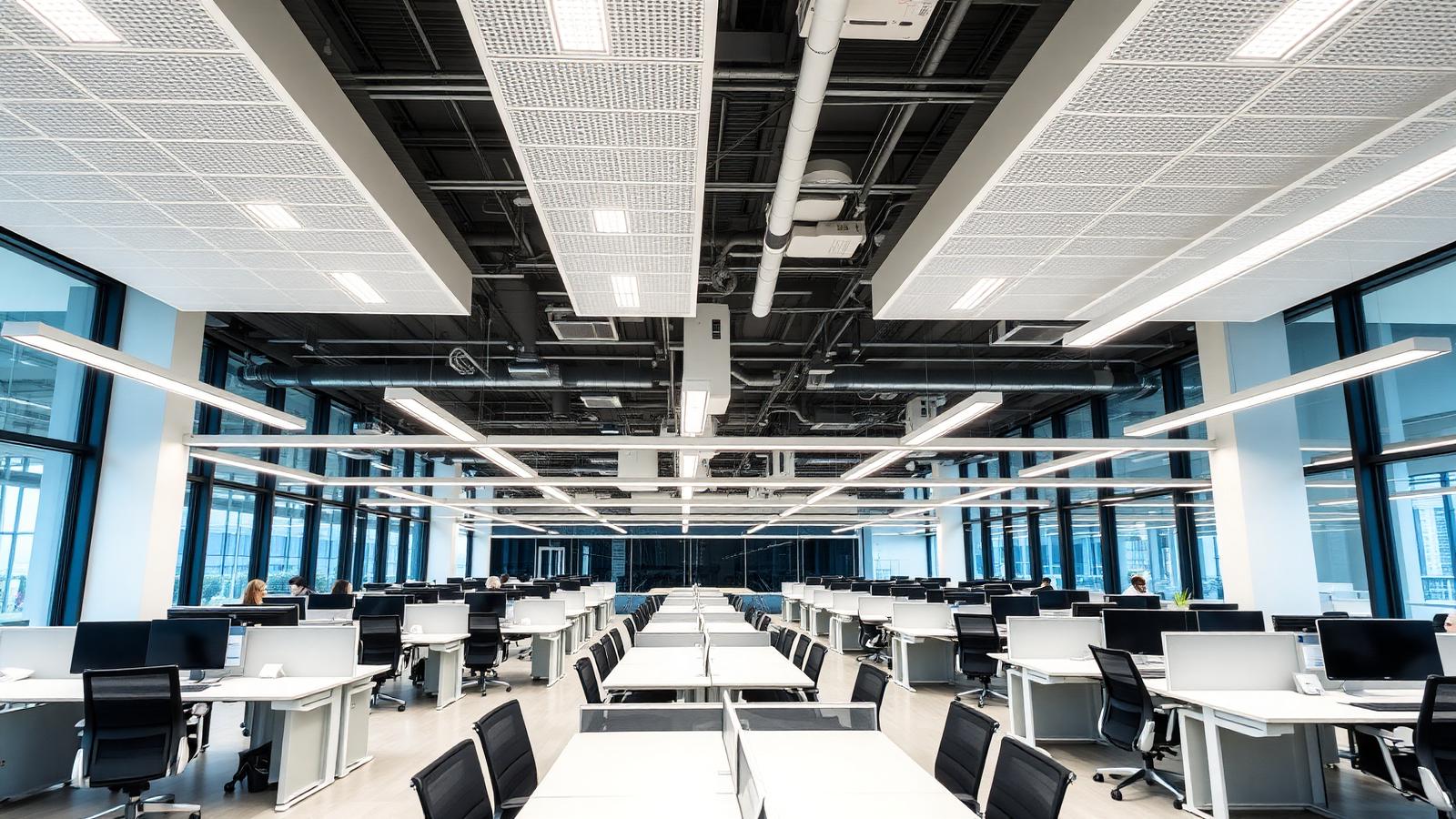
Diagonal view of a European open-plan office with parallel linear LED pendants, acoustic baffle ceiling and daylight harvesting from the window wall — delivering UGR<19 and 500 lux on the working plane per EN 12464-1:2021.

1. Why Office Lighting Has Become a Board-Level Decision

For three decades office lighting was a line item on the M&E schedule — a number of fittings per square metre, a wattage budget, a maintenance contract. Between 2021 and 2026 that quietly stopped being true. Three forces collided: the EU Energy Performance of Buildings Directive (EPBD) recast, the post-pandemic war for talent, and the rapid mainstreaming of WELL v2, LEED v4.1 and BREEAM In-Use. The result is that lighting now sits inside three commercial conversations at once — energy cost, occupant performance, and ESG reporting — and the CFO, the HRD and the Head of Sustainability all have a stake.

This guide is written for the technical buyer who has to satisfy all three audiences with one specification. It maps the requirements of EN 12464-1:2021 (the European standard for indoor workplace lighting), ASHRAE/IES 90.1-2022, WELL v2 Light Concept, and the BREEAM Hea 01 credit, and translates them into the actual product, layout and control decisions a designer or owner must make in the procurement phase. Every recommendation in the following sections is anchored to one of those four documents.

The single most important shift to understand is that glare is now the primary KPI, not lux. EN 12464-1:2021 raised the cylindrical illuminance and uniformity targets, but it kept the headline 500 lux figure on the working plane. What changed is that UGR<19 is no longer a "nice to have" — it is the default acceptance threshold for any open-plan space where screens are used. A specification that delivers 500 lux but UGR 22 will fail a modern post-occupancy evaluation, and increasingly will fail a Cat A handover inspection in the City of London, Frankfurt or Amsterdam.

2. The Pain Points Real Office Buyers Bring to the Table

Before we get to product selection, it is worth being honest about what actually goes wrong. Across the 180+ office projects our team has supported in EU and UK markets between 2021 and 2026, the same five complaints come up again and again from the end-user side, and they are almost never about lumens.

Pain 1 — "We can see the fitting in our screens." This is direct glare reflecting off a 27" monitor at a typical 15-25° viewing angle. It is caused by luminaires with a luminance >3,000 cd/m² at angles above 65° from nadir. The fix is not more diffuser — it is a micro-prismatic or low-luminance louvre that pushes the >65° luminance below 1,500 cd/m². EN 12464-1:2021 §6.3 calls this out explicitly for screen-based work.

Pain 2 — "The light feels clinical / hospital-like / cheap." Almost always a CRI/Ra of 80 with R9 below 50. Skin tones go grey, the wood veneer on the meeting table looks plastic, and brand colours on printed material drift. The fix is CRI≥90 with R9≥50 and a TM-30 Rf≥85, Rg between 96 and 108. The premium per fitting is now under 8% — there is no longer a commercial reason to specify CRI 80 in a Class A office.

Pain 3 — "The lights are on when nobody is here." A pure energy / ESG complaint, but it is also the single biggest source of overrun on the lighting energy budget at handover. The fix is DALI-2 with embedded presence + daylight sensors, zoned at no more than 40 m² per address, with a 15-minute hold-off and a 50% step-dim before full off.

Pain 4 — "The meeting room lighting always looks wrong on Teams/Zoom." A direct consequence of low cylindrical illuminance (Ez) on the face. Hybrid-meeting rooms now need Ez ≥ 250 lux at 1.2m above the floor, with the source positioned 30-45° in front of the seated participant. EN 12464-1:2021 raised this from 150 to 250 lux specifically because of video-conferencing.

Pain 5 — "Reception looks corporate and cold." A briefing/spec problem. Reception is hospitality, not workplace — it should be specified to EN 12464-1 §5 hospitality values (300 lux, 3000K, accent ratio 5:1) not to open-plan workplace values. We see this misapplied in roughly one in three Cat B fit-outs.

The remainder of this guide is structured around solving these five pain points, space by space, with the product, control and commissioning decisions that actually move the needle.

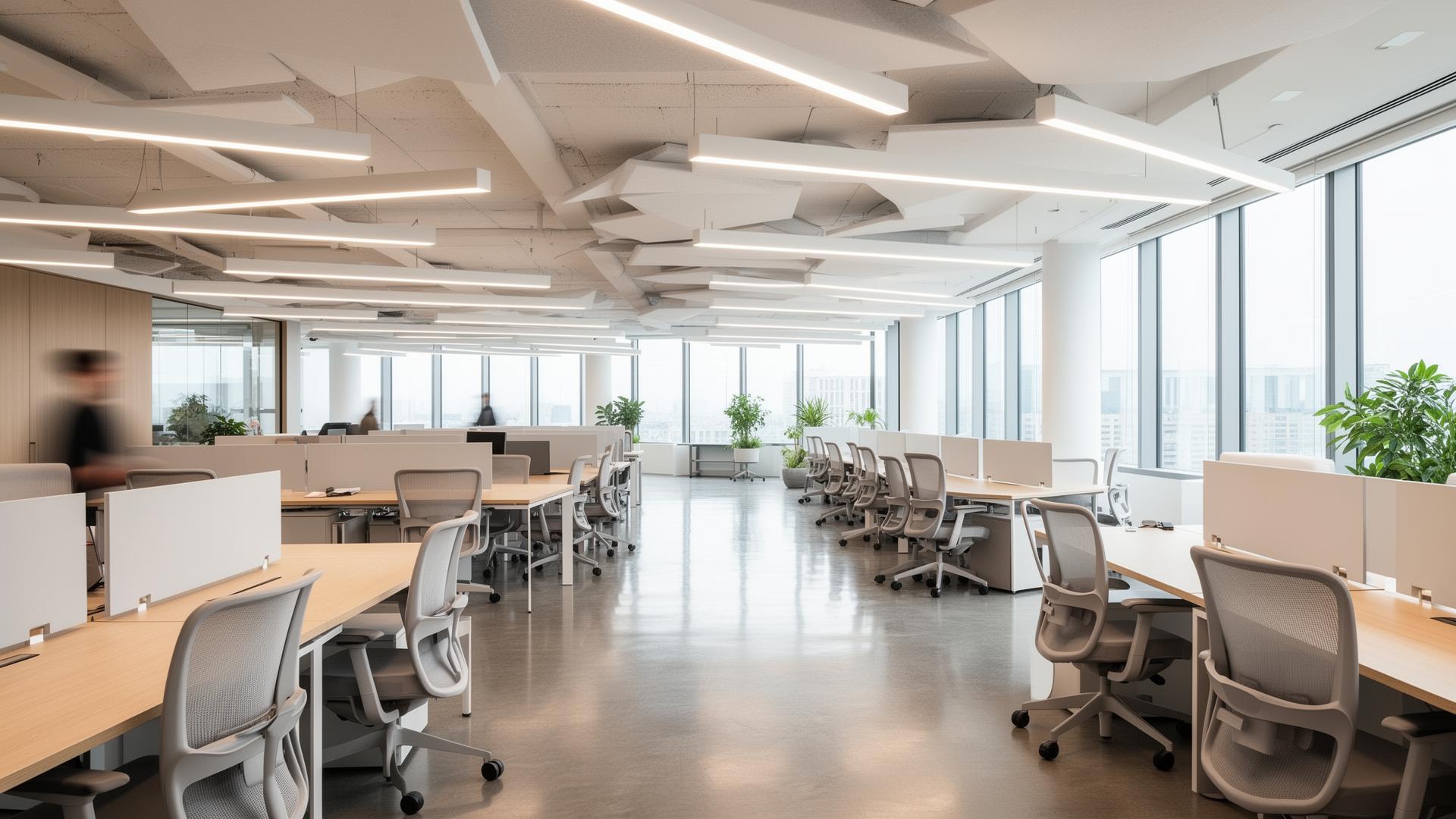
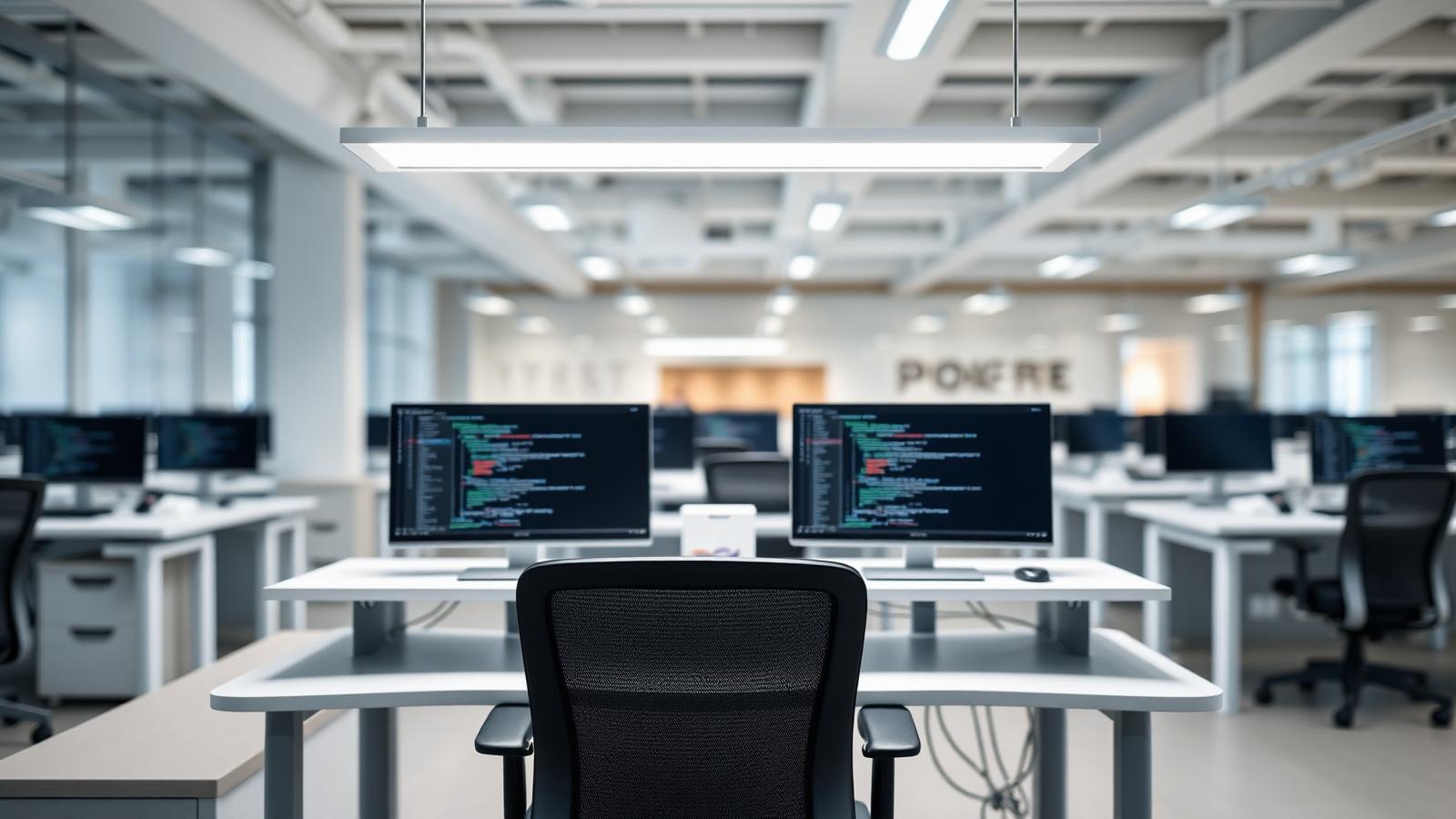
Open-plan workstation zone with linear LED pendants delivering even 500 lux on desks and zero visible reflection on the screens — the EN 12464-1:2021 benchmark for screen-based work.

3. Open-Plan Workstations — The 500 lux / UGR<19 / 0.6 Uniformity Triangle

The open-plan zone is where ~70% of the lighting budget and ~95% of the complaints live. EN 12464-1:2021 §6.2 sets three numerical targets that must be hit simultaneously — and crucially, they are tested at the task area (the 0.6m × 0.6m rectangle in front of the user), not as a room average:

ParameterEN 12464-1:2021 targetWhat it actually means
Maintained illuminance Ē<sub>m</sub>500 lux on task areaAfter 50,000 h depreciation, on the desk surface
Uniformity U<sub>0</sub>≥0.60 on task area, ≥0.40 on surroundingMin/avg ratio — no dark patches
Cylindrical illuminance Ē<sub>m,z</sub>≥150 lux at 1.2mEnsures faces are visible
UGR≤19Direct + reflected glare combined
Modelling ratio0.30 to 0.60Soft shadows, not flat lighting
Lighting Power Density≤6.5 W/m² (ASHRAE 90.1-2022)Energy budget

The single best way to hit all five at once is a continuous linear LED suspended luminaire running parallel to the long axis of the desk bench, mounted 1.2-1.5m above the working plane, on a 2.4-2.8m grid. The fixture should have direct/indirect distribution (typically 70% down / 30% up), micro-prismatic optics (UGR<19 at any viewing angle including across the desk), and CRI≥90 / TM-30 Rf≥85. Plan on 8-10 W/linear metre at 4000K to deliver 500 lux maintained on a 1.6m x 0.8m desk at 0.75m working plane height.

Why direct/indirect and not pure recessed? Pure recessed luminaires (panels, troffers) give a "cave" effect: the ceiling reads dark, the cylindrical illuminance is poor, and faces are under-lit. WELL v2 Feature L05 explicitly rewards direct/indirect schemes because they produce the modelling ratio that makes a space feel comfortable rather than institutional. The 30% upward component bouncing off a 0.7 reflectance ceiling adds 80-120 lux of free indirect light and lifts the cylindrical illuminance above the 150 lux floor without adding any lamp wattage.

Spacing-to-mounting-height ratio (SHR) matters more than fitting count. A common mistake is to specify the right luminaire on the wrong spacing, then add more fittings to "fix" the dark patches between rows. The honest fix is to respect the manufacturer's published SHR<sub>max</sub> (usually 1.5:1 axial, 1.25:1 transverse) and let the linear continuity do the work. A continuous run at the correct spacing will out-perform a denser grid of discrete units on every metric — including capex.

4. Meeting Rooms, Phone Booths and Video-Conferencing — The 250 lux Ez Rule

The post-pandemic redesign of the meeting room is the single biggest change in office lighting since the move from T8 to T5 in the early 2000s. Three things broke simultaneously: rooms became smaller (huddle/booth typology), they became more glazed (acoustic-rated glass partitions), and they became video-first rather than face-to-face-first. EN 12464-1:2021 responded with a specific addition: cylindrical illuminance Ez ≥ 250 lux at 1.2m above the floor for spaces with video conferencing.

The reason this matters is that a horizontal-only lighting scheme — even one delivering 500 lux on the table — will under-light the seated participant's face, causing the camera to either auto-gain (noise, grain) or to render the face in deep shadow against a brighter background. The fix is to add a front-of-face source 30-45° in front of the seated user at 3500K, dimmable to 30%. Practically this is either a recessed asymmetric wall-washer above the screen wall, or a forward-throw linear cove integrated into the screen joinery.

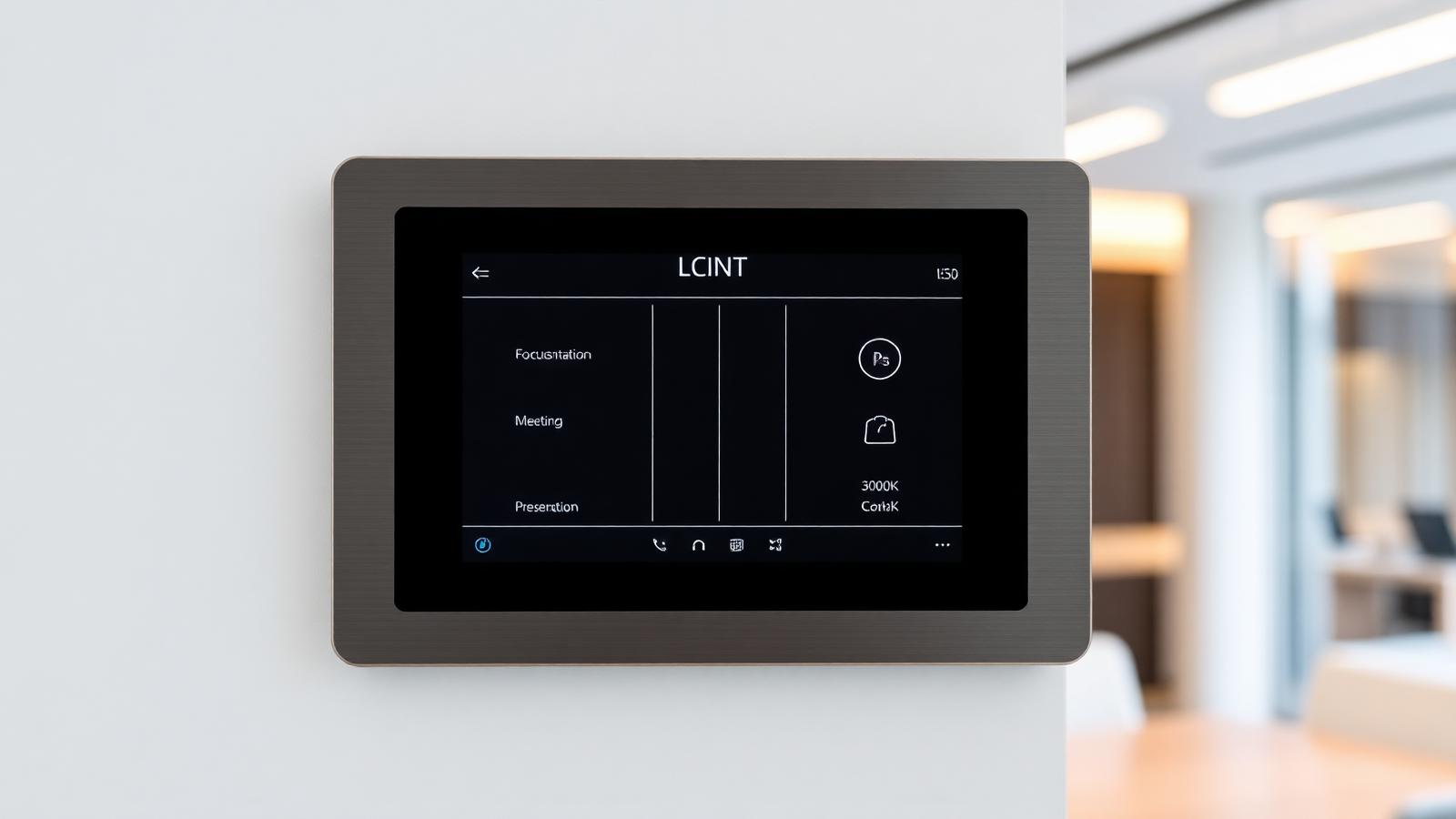
For the table itself, decorative pendants on a DALI-2 dimming circuit at 3500K, scene-programmed for four states (Presentation 50%, Discussion 80%, Video Call 100%, Cleaning 100% cool), give the user a single-touch interface that actually gets used. Avoid PIR-only control in meeting rooms — sedentary occupants trigger nuisance switch-off — use a hybrid PIR + microwave or PIR + acoustic detector with a 30-minute hold-off.

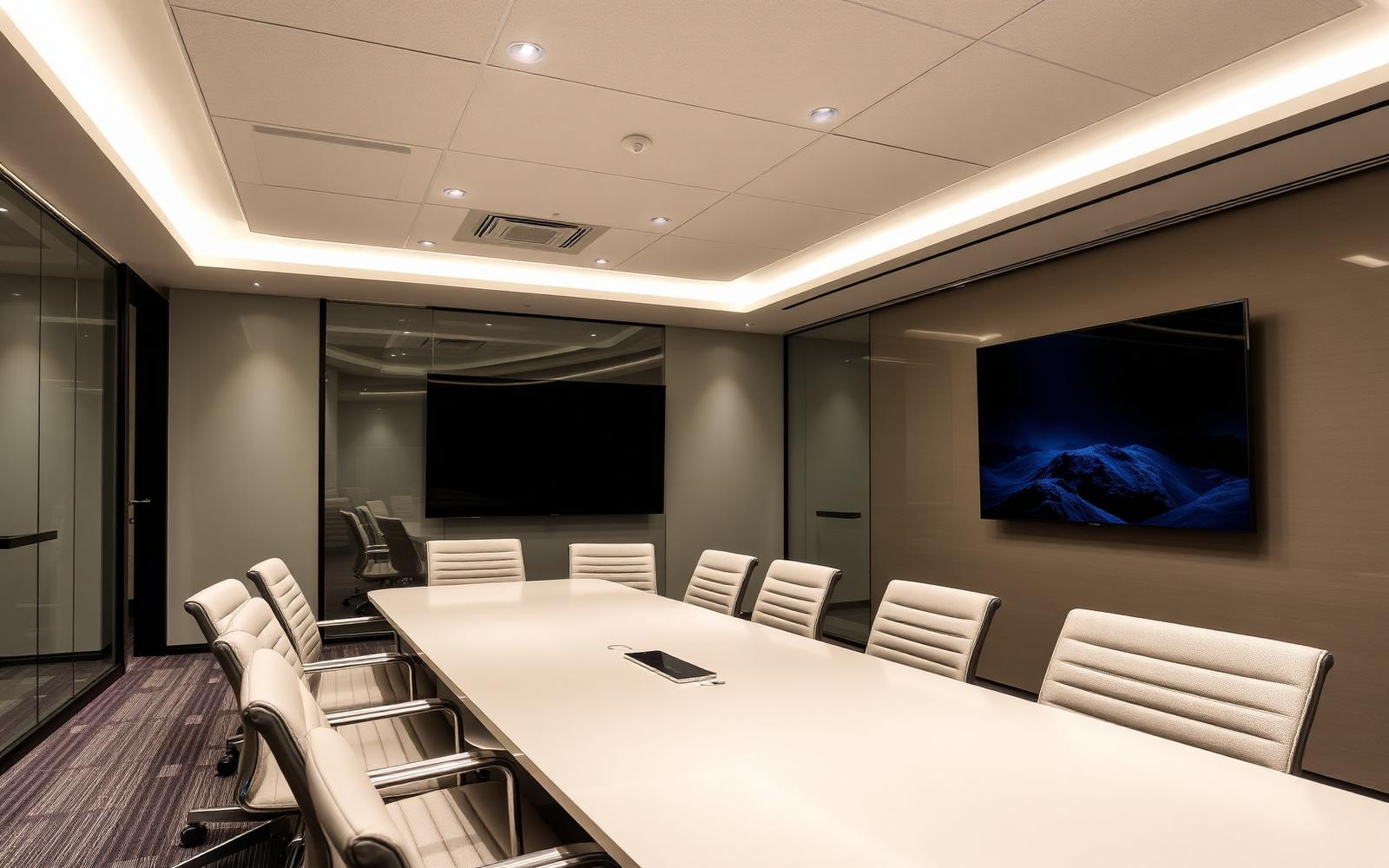
Hybrid-ready meeting room with dimmable LED downlights, an indirect cove for face illumination (Ez ≥ 250 lux) and DALI-2 scene control — meeting EN 12464-1:2021 §6 for video conferencing.

5. Reception, Lobby and Client-Facing Zones — Switch to Hospitality Mode

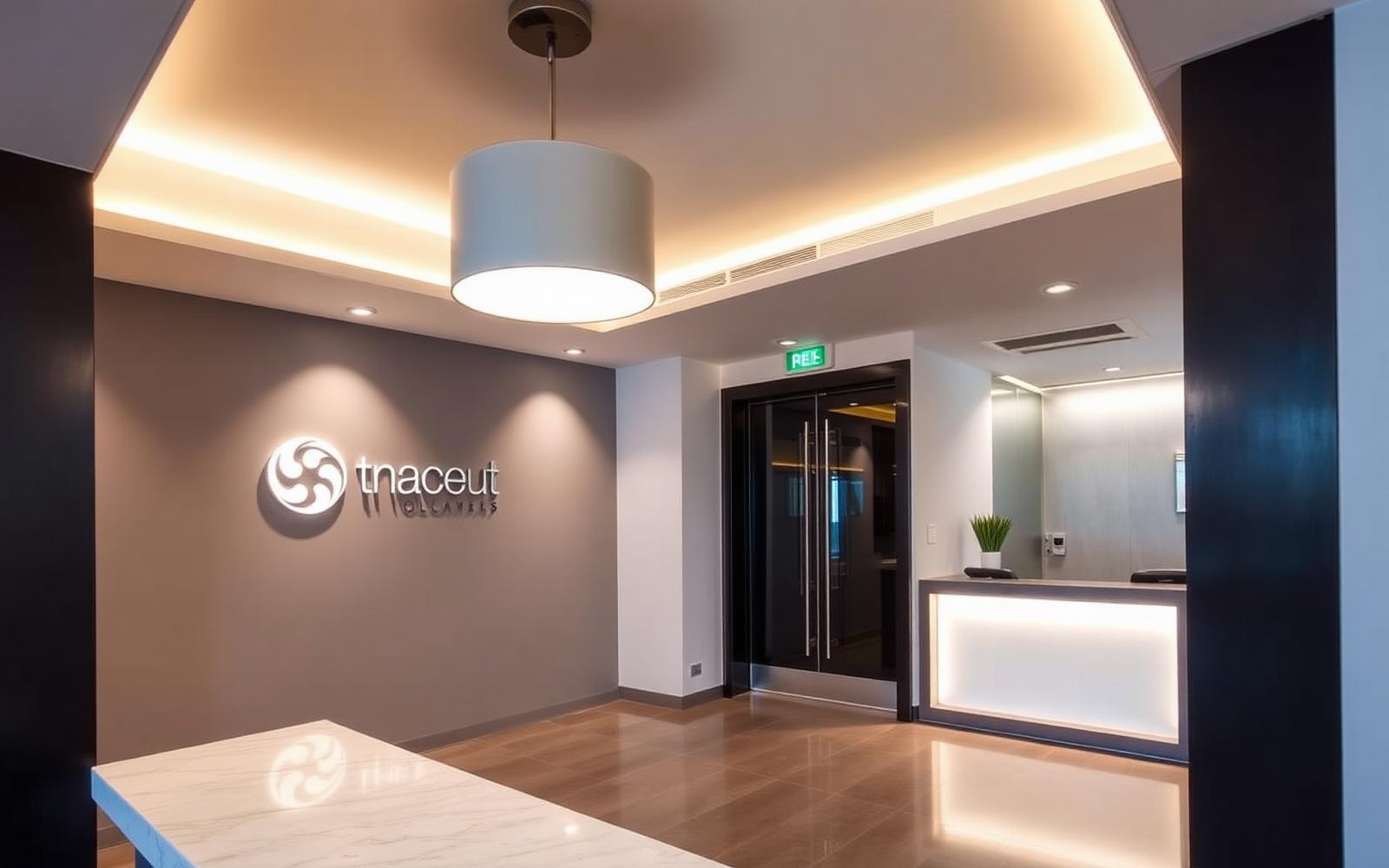
The most common briefing mistake we see is treating reception as part of the workplace specification. It is not. Reception is the brand interface — the first physical impression a client, a candidate or an investor has of the company — and it should be specified to hospitality lighting values, not workplace values.

The targets shift accordingly:

  • Horizontal illuminance: 200-300 lux at the counter (not 500)
  • Vertical illuminance on logo wall: 500-750 lux (5:1 accent ratio over ambient)
  • Colour temperature: 3000K (not 4000K) — warmer, more residential, signals premium
  • CRI: ≥90, R9 ≥ 60 (skin tones on receptionists, materiality of stone/wood/leather)
  • Glare: UGR not the relevant metric here — use luminance contrast control
  • Decorative element: at least one feature pendant or sculptural fixture per zone

The technical kit is adjustable LED spotlights on a recessed track for the logo wall and any artwork, decorative pendants for the counter (coordinated with the architecture, not the same family as the open-plan fitting), and an indirect cove at the perimeter to lift the ceiling and remove the "cave" feeling. DALI-2 with two scenes — Day (warmer accent ratio, brighter ambient) and Evening (deeper accent ratio, dimmer ambient) — covers 95% of operating conditions.

Reception lobby with feature pendant, 3000K accent on the logo wall and indirect cove — hospitality lighting language applied to the workplace front-of-house.

6. Corridors, Circulation and Stairs — Where the Energy Budget Is Won or Lost

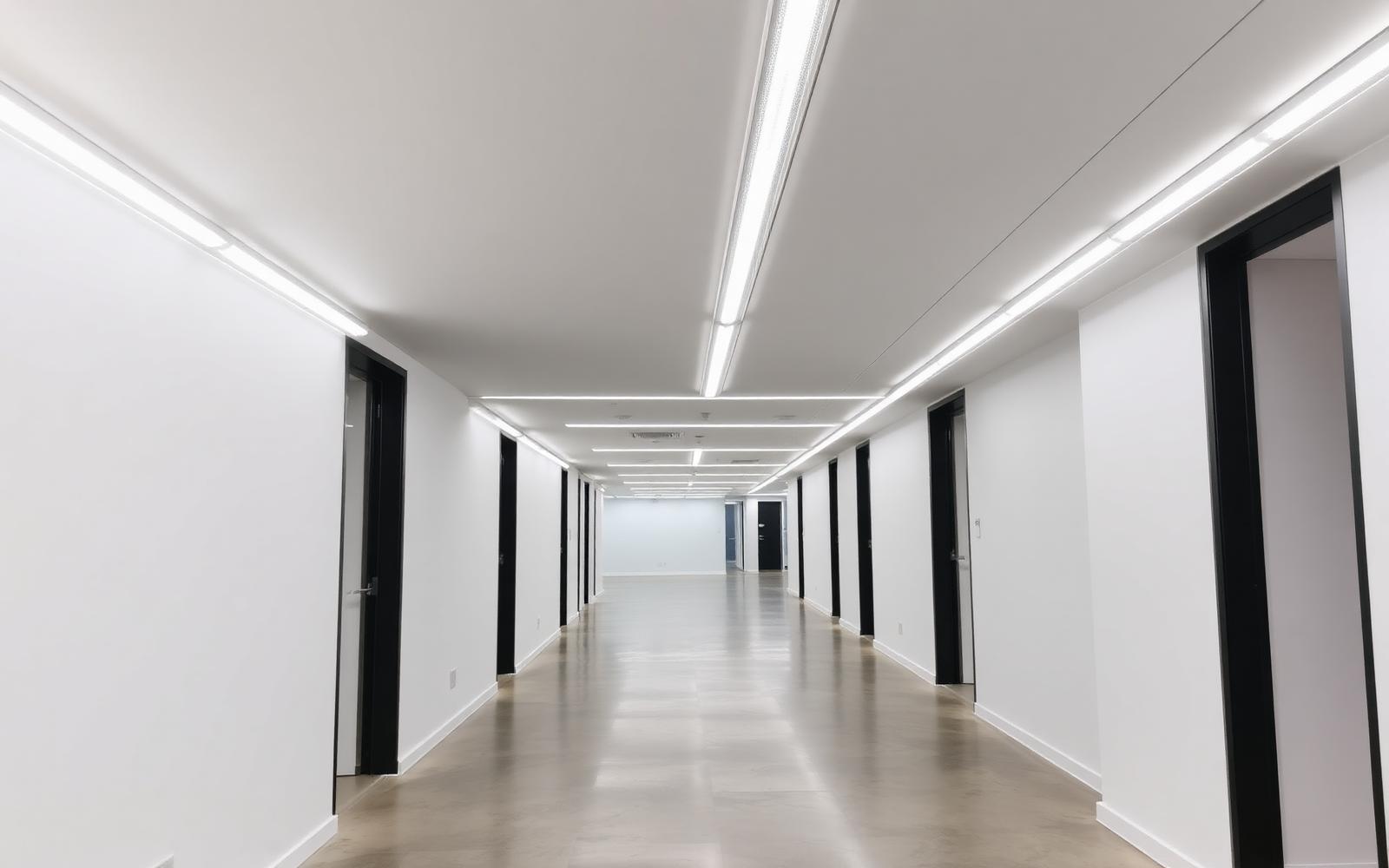
Corridor lighting is typically 15-20% of the total installed lighting load and 40-50% of the lighting energy bill — because corridors are statistically empty 80% of the time but historically lit 100% of the time. The combination of continuous linear LED + DALI-2 + presence detection + daylight harvesting typically delivers a 65-75% energy reduction versus a constant-on T5 scheme, with payback under 3 years on EU/UK electricity prices.

EN 12464-1:2021 sets the corridor target at 100 lux at floor level, U<sub>0</sub> ≥ 0.40, UGR ≤ 25 — modest numbers that make corridors an easy win for energy compliance. The architectural play is to use a continuous recessed linear along the centre of the ceiling at 8-10 W/m, dimmed to 20% in absent state and 100% in occupied state, with a 5-minute hold-off and a 30-second fade. The fade is important — abrupt switching is what users perceive as "the lights going off on me" and is the number one complaint about presence-controlled corridors.

For stairs, the standard is higher (150 lux, treads visible at ≥75% reflectance contrast) because stairs are a fall-risk zone. Use integrated handrail lighting or stair-nosing strips as a secondary system to highlight tread edges — this is now a WELL v2 L02 prerequisite in qualifying projects.

Office corridor with continuous linear LED, motion-sensor dimming and 4000K — the highest-ROI energy intervention in any office retrofit.

7. Breakout, Café and Wellness Zones — The "Third Place" Inside the Office

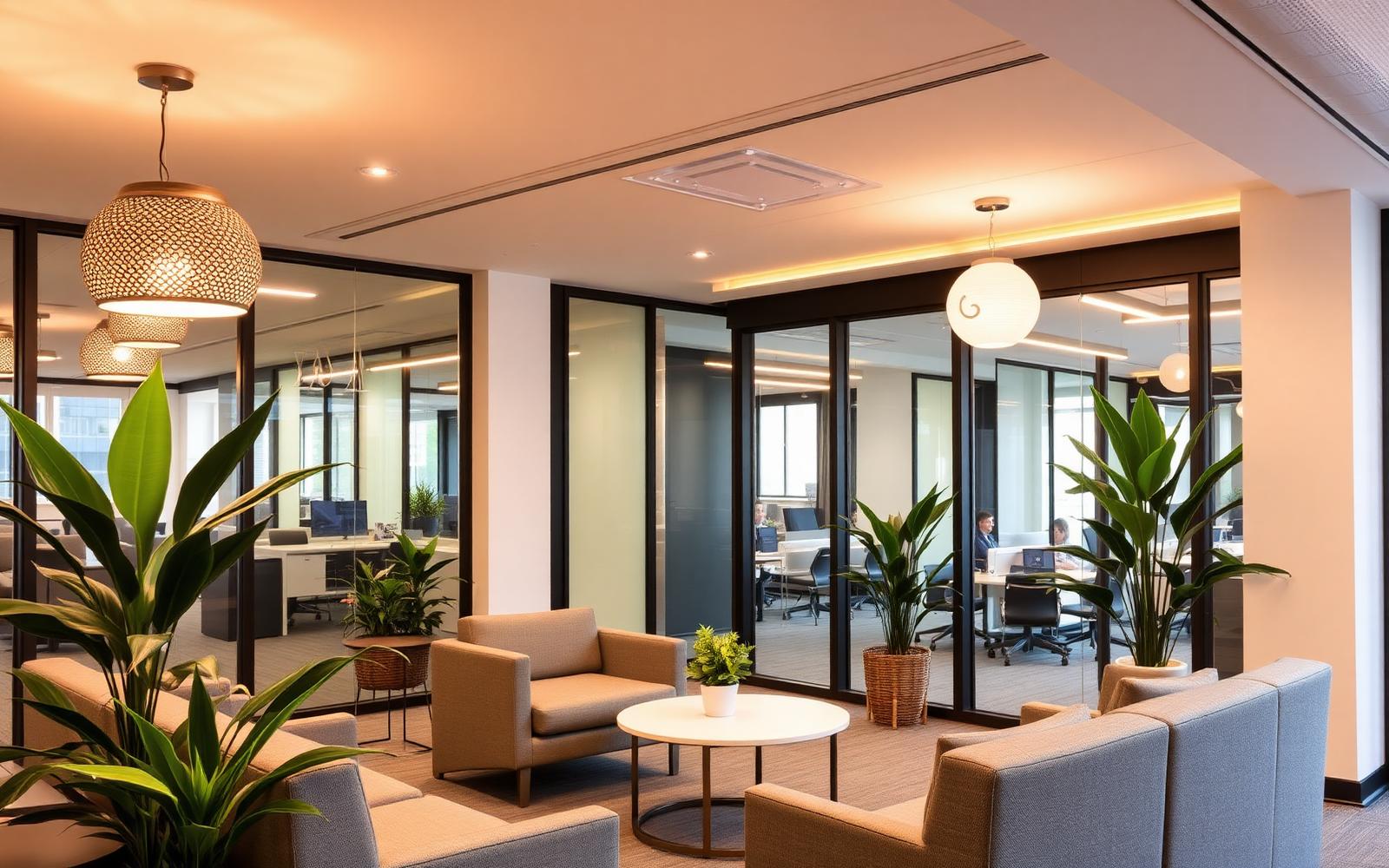
The breakout zone is where the office competes with the home — and where lighting finally gets to be expressive rather than purely functional. The brief here is residential: warmer colour temperature, lower ambient illuminance, decorative fittings, and biophilic alignment with planting and daylight.

Targets:

  • Horizontal illuminance: 150-200 lux (deliberately lower than workplace to signal "informal")
  • CCT: 2700-3000K, with tunable white to 4000K for early-morning energising
  • Decorative ratio: at least 50% of the visible lumens should come from a decorative source (pendant, table lamp, wall sconce), not a recessed downlight
  • Control: scene-based, time-of-day automated (cool/bright morning, warm/dim afternoon, very warm/very dim evening)

This is also the zone where the WELL v2 L03 Circadian Lighting credit is most easily earned. A tunable-white pendant or downlight running a daily curve from 4000K/300 lux EML at 9:00 to 2700K/100 lux EML at 18:00 satisfies the EML thresholds without the user noticing anything other than that the space "feels right" at different times of day. The technical name is Equivalent Melanopic Lux (EML) ≥ 200 between 09:00 and 13:00 at the eye, ≤50 after 19:00.

Breakout collaboration zone with decorative pendants, warm 3000K accents and biophilic design — the office's answer to working from home.

8. Controls — DALI-2, Casambi, Bluetooth Mesh: Which One, When, and Why

Wall-mounted DALI-2 / Casambi touchscreen control panel with scene presets (Focus, Meeting, Presentation, Circadian) — the single decision that determines whether an office scheme will hit its energy target.

If there is a single decision that determines whether an office lighting scheme will hit its energy target and survive its first churn cycle, it is the choice of control protocol. The three credible options in 2026 are:

DALI-2 (IEC 62386 ed.2) — the wired, standardised, multi-vendor incumbent. Best for new build and major refits where the ceiling is open and the structured cabling is part of the package. Supports presence, daylight, scene, emergency monitoring, and energy reporting natively. The right answer for any project >2,000m² or any project pursuing WELL v2 L07 (Electric Light Quality) at higher levels.

Casambi (Bluetooth mesh) — wireless, app-commissioned, no central gateway required for basic operation. Best for fit-outs of existing buildings, heritage retrofits, and any project where running new control wiring is impractical. Now mature, with multi-vendor support and a clear migration path to Bluetooth Mesh 1.1. The right answer for most Cat B fit-outs <2,000m².

Bluetooth Mesh (SIG standard) — the open-standard wireless option, increasingly chosen for portfolio-level deployments where the client wants a single cloud platform across multiple buildings and vendors. Slightly more complex to commission than Casambi but with broader long-term vendor independence.

For most EU/UK Cat B office projects in 2026 our default specification is Casambi for fit-outs ≤2,000m² and DALI-2 for new build and major refits >2,000m². Both deliver the same end-user experience and both meet the energy and reporting requirements of EN 15193, ASHRAE 90.1-2022 and WELL v2.

9. Sustainability, Energy and the EPBD — The 2025-2030 Compliance Curve

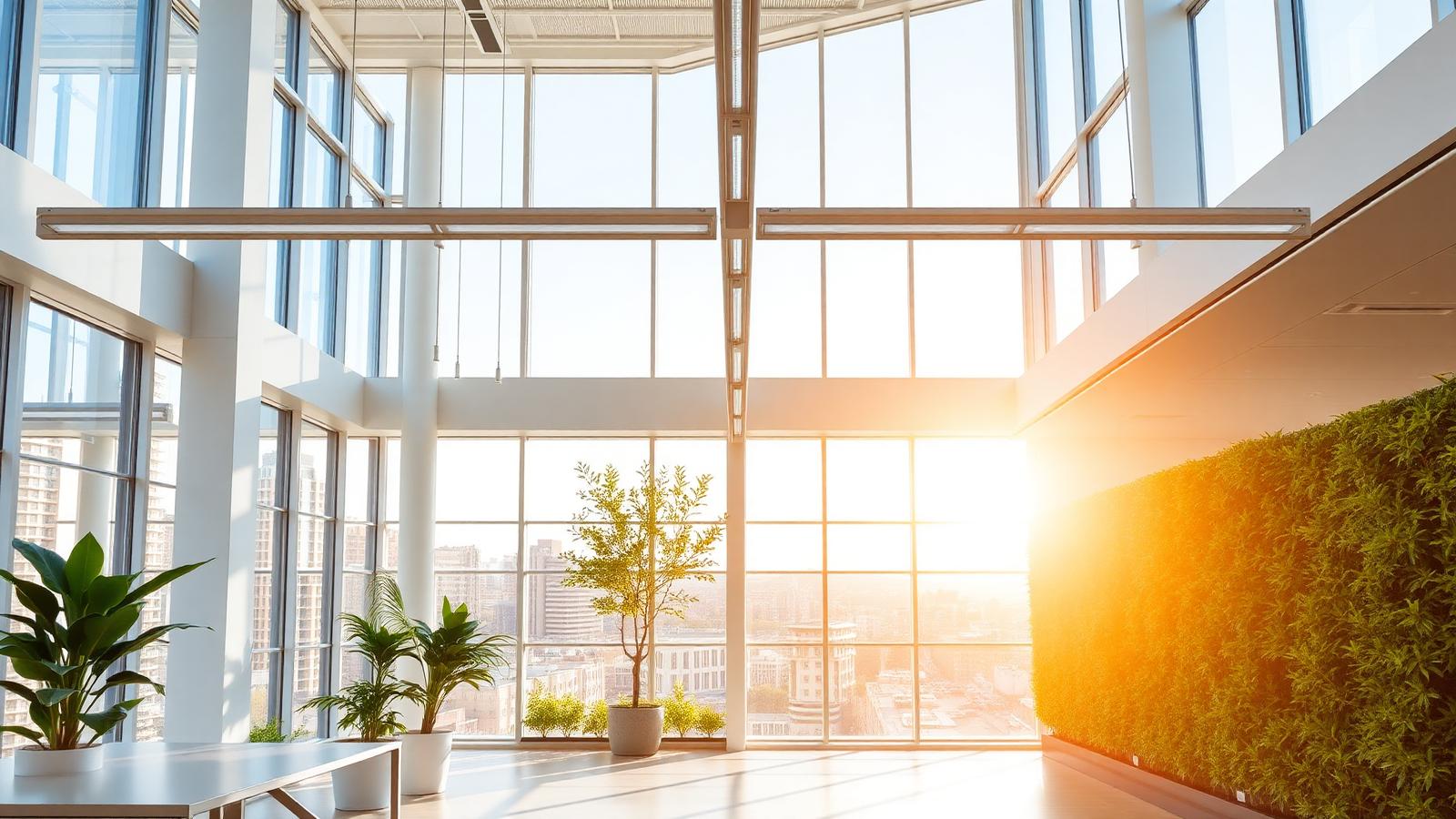
Bright sustainable office with daylight harvesting, automatically dimmed linear LEDs and a biophilic green wall — the EPBD 2030 Zero Emission Building benchmark in practice.

Office lighting is now governed by overlapping European, national and voluntary frameworks that all push in the same direction: lower installed power density, smarter controls, longer service life, recyclable components, and verifiable in-use performance.

The headline numbers a 2026 specification must hit:

  • EPBD recast (2024) — new and major-renovation offices must be Zero Emission Buildings (ZEB) by 2030; lighting LPD must be ≤6.5 W/m² for open-plan, ≤8 W/m² for cellular
  • EN 15193-1:2017 — Lighting Energy Numerical Indicator (LENI) ≤25 kWh/m²/yr for daylit open-plan, ≤35 for non-daylit
  • ASHRAE 90.1-2022 — LPD allowance for offices: 6.5 W/m² (open) / 8.6 W/m² (private)
  • WELL v2 L06 Circadian Light — Equivalent Melanopic Lux (EML) thresholds during specified hours
  • BREEAM Hea 01 — credits for daylight factor, glare control, view-out, and quality of artificial light
  • Circular Economy — luminaires designed for disassembly (Design for Disassembly DfD), separable LED modules, take-back schemes; increasingly demanded by Tier 1 corporate tenants

The good news is that any specification built around the principles above (linear LED at 8-10 W/m, UGR<19, CRI≥90, DALI-2 or Casambi with presence + daylight, 50,000h L80 lifetime) will hit all of these targets simultaneously without needing to add anything. The bad news is that any specification still relying on >12 W/m², CRI 80, or PIR-only control will fail at least three of them.

10. Procurement Checklist — What to Ask the Manufacturer Before You Buy

Use this 12-point checklist on every office lighting tender. Any "no" answer should trigger a clarification or a substitute product.

  1. UGR<19 verified at every viewing angle (G-classification G1 or G2) per the published photometric file?
  2. CRI Ra ≥90 AND R9 ≥50, with TM-30 Rf ≥85 and Rg 96-108?
  3. Lumen maintenance L80B10 ≥ 50,000 hours per LM-80 / TM-21?
  4. Driver-included flicker-free per IEEE 1789-2015 (PstLM ≤1, SVM ≤0.4)?
  5. Native DALI-2 (DiiA certified) or Casambi-ready driver, not an add-on dongle?
  6. Tunable white (1800-6500K) option available on the same housing for circadian zones?
  7. Photometric IES file available for DIALux/Relux modelling?
  8. Energy efficacy ≥130 lm/W at the luminaire (not the chip)?
  9. CE / UKCA / ENEC marking, EMC compliance per EN 55015?
  10. Warranty ≥5 years on luminaire, ≥5 years on driver?
  11. Designed for disassembly (separable LED module, replaceable driver) — circular economy compliant?
  12. Manufactured in an ISO 14001 / ISO 9001 certified facility with an EPD (Environmental Product Declaration) available?

XHLWX office linear, panel and downlight ranges meet all 12 criteria as standard, with photometric files, EPDs and 5-year warranties available on request. Our technical team can support you from the DIALux modelling stage through commissioning and post-occupancy verification.

11. Quick Reference — Lighting Specification by Office Space Type

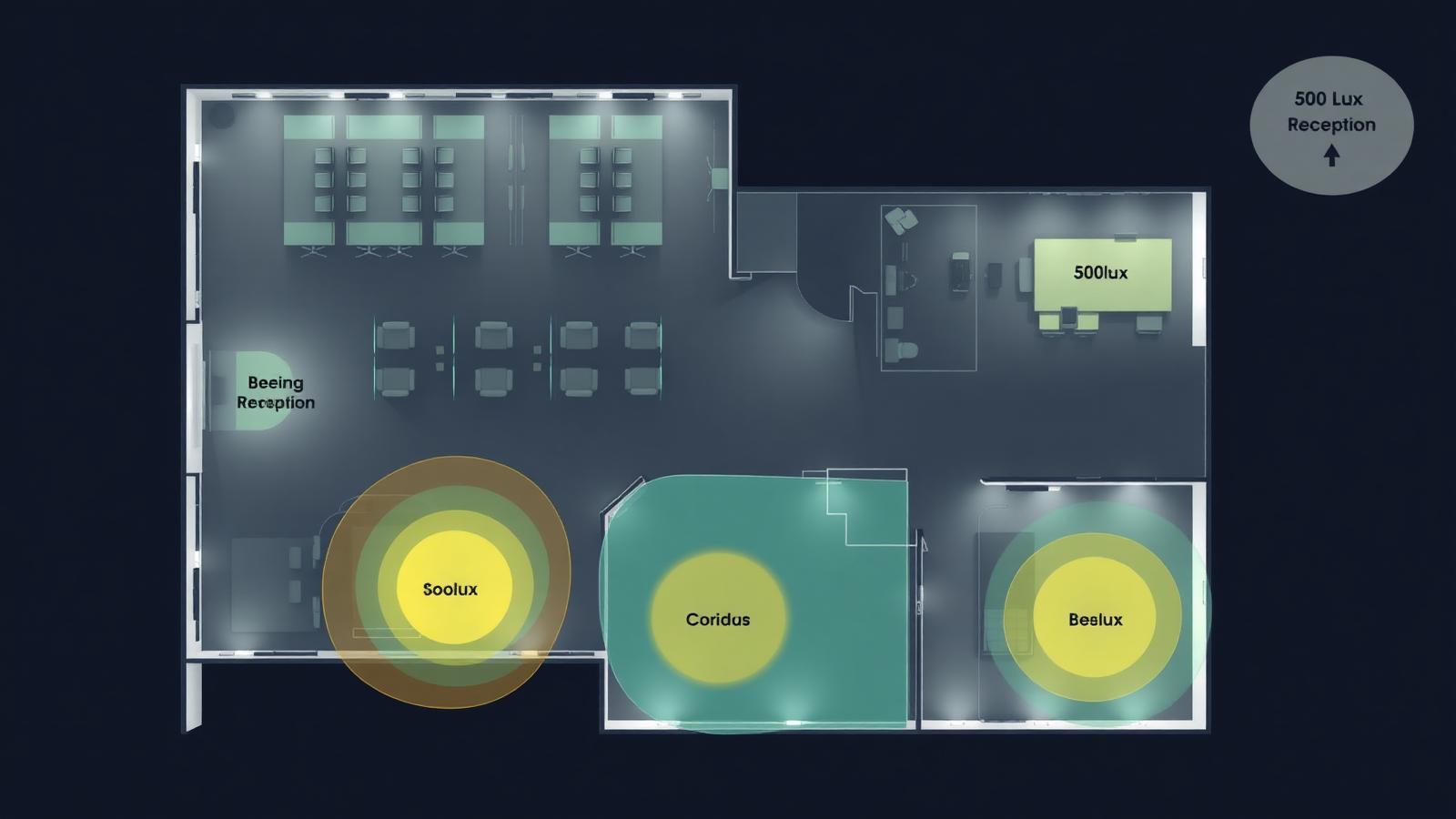
DIALux-style top-down lighting plan showing the multi-zone office floorplate with isolux contours: 500 lux on workstations, 300 lux at reception, 150 lux in breakout, 100 lux in corridors — the complete EN 12464-1:2021 specification on one page.

SpaceĒ<sub>m</sub> (lux)UGRCCT (K)CRIControlLPD (W/m²)
Open-plan workstations500 (task)≤194000≥90DALI-2 + presence + daylight6.5
Cellular office500 (task)≤194000≥90DALI-2 + presence7.5
Meeting room (face-to-face)500 (table)≤193500-4000≥90DALI-2 scene + presence8.0
Meeting room (video-first)500 + 250 Ez≤193500 (tunable)≥90DALI-2 scene + presence9.0
Phone booth / huddle300≤223500≥90Presence on/off7.0
Reception300 (counter) / 500 Vn/a3000≥90Scene + time-of-day6.0
Corridor100 (floor)≤254000≥80Presence + daylight + dim-to-20%3.5
Stair150 (tread)≤254000≥80Presence + always min 30%4.0
Breakout / café150-200≤222700-3000 (tunable)≥90Scene + time-of-day5.0
Toilet / WC200≤253000≥80Presence on/off5.0
Server / IT room500≤224000≥80On/off + emergency8.0
Storage / archive200≤254000≥80Presence on/off4.0

All values aligned to EN 12464-1:2021, ASHRAE/IES 90.1-2022 and WELL v2 minimum thresholds. Use as the basis for the M&E specification; adjust upward for client brand standards or downward only with explicit derogation from the design team.


A correctly specified office lighting scheme in 2026 should make the building cheaper to run, easier to certify, more pleasant to inhabit, and more defensible at the next M&E audit — all from a capex premium of under 10% over a baseline LED scheme. The rest of this conversation is about choosing the right partner to deliver it. XHLWX offers a free DIALux modelling service, EU/UK technical pre-sales, and a 5-year warranty on the full office product range. Get in touch for a free design proposal.

XHLWX Lighting Design Team
Senior Lighting Specifiers

Need a tailored lighting plan for your project?

Our senior lighting designers reply within 48 hours with a free design proposal & quotation.