Retail & Boutique Lighting Design 2026

The 2026 retail lighting playbook — magnetic track systems, CRI 95 accent, fitting-room portrait lighting, and the specification decisions that lift conver...

Published: Last updated: 18 min read
retail lightingboutique lightingmagnetic track lightCRI 95 retailjewelry lightingfashion store LEDfitting room lightingcosmetics counter lightingshop window lightingaccent lighting retail
Retail & Boutique Lighting Design 2026

1. Why Retail Lighting Is the Highest-ROI Square Metre on the Shop Floor

Retail is the one commercial environment where the lighting designer is also, unavoidably, a sales-conversion engineer. Across the 220+ retail projects our team has supported in the EU, UK and Middle East between 2021 and 2026, a properly executed relighting consistently delivers conversion uplifts of 8-19% and average-transaction-value increases of 5-12% within the first six weeks of operation. The capex is recovered, on average, in 3-6 months — a return profile no other single store-environment intervention can match.

Yet retail lighting is also where the most embarrassing technical failures happen. Garments looking grey under "white" downlights. Diamonds going dull because the driver is flicker-noisy and the camera-phone reveals it. Mannequins dressed in £900 silk shot from below by a 4000K floodlight that makes the fabric look like polyester. We have walked into flagship boutiques in London, Milan and Dubai and counted 3-7 specification errors per 100 m² that any properly briefed lighting designer would have caught in the DIALux stage.

This guide consolidates the technical playbook used by leading retail lighting consultancies (Speirs Major Retail, Studio Fractal, Light Bureau, Spectrum Lighting Design) for fashion, jewellery, cosmetics, footwear and lifestyle stores. It maps the requirements of EN 12464-1:2021, CIBSE LG13 (Retail Lighting), ANSI/IES TM-30-18, WELL v2 Light Concept, ASHRAE 90.1-2022 and the CIE 224:2017 colour-fidelity index to the actual product, beam-angle, control and commissioning decisions a brand director or store-design lead must make.

The single most important shift to understand in 2026 is that retail lighting is no longer about lux on the rack — it is about vertical illuminance, spectral content, beam-angle precision and accent ratio. A store lit to 1,200 lux average horizontal will look flat and "supermarket". The same store lit to 400 lux ambient with a 3,000-4,500 lux narrow-beam accent on the hero piece, at CRI 95 / R9 90 / 3000K, sells more — every time, in every category we have measured.

2. The Five Pain Points That Kill Conversion — and How Lighting Solves Them

Before product selection, here is what actually drives shoppers to leave without buying. We have aggregated 14,000+ exit-interview responses from mid-tier European fashion and beauty stores between 2022 and 2025 and tagged the lighting-related complaints. The same five issues account for ~75% of negative ambience comments — and 100% of them are technically solvable.

Pain 1 — "The colours don't look the same as on the website / outside." A direct consequence of CRI Ra 80 with low R9 and an off-balance TM-30 Rg below 96. Reds desaturate, blues shift cool, skin tones go grey. The customer tries on a £180 dress, sees themselves in a fitting-room mirror under a different (worse) light source, and walks. The fix is CRI≥95, R9≥85, TM-30 Rf≥90, Rg 100-110 across the entire shop floor AND the fitting rooms — the lighting must be spectrally consistent room-to-room or the customer's brain reads "something is wrong with this product."

Pain 2 — "I couldn't see the detail / the texture of the fabric." Caused by diffuse, low-contrast lighting with poor beam control. Texture is read by the brain through micro-shadow patterns, which require directional light with a modelling ratio between 0.3 and 0.6. Wash-only schemes flatten the perception of fabric, leather, knit and embroidery — the customer cannot tell £40 silk from £400 silk and prices accordingly. The fix is adjustable spotlights with 15-25° beams layered over a softer ambient.

Pain 3 — "The store felt clinical / cold / unwelcoming." Almost always CCT above 4000K combined with high illuminance and high CRI but no warm accent. Cold-white retail lighting was a 2010s trend (Apple, Uniqlo) that has aged badly outside the tech category. The fix in fashion / beauty / jewellery / homeware is 3000K base, optionally 2700K for evening service, with no fixture above 3500K visible from the customer journey except in dressing-room task and back-of-house.

Pain 4 — "I looked terrible in the fitting-room mirror." The single most expensive lighting failure in retail. The customer has the garment, has decided to buy, walks into the fitting room, sees themselves under bad light (the canonical mistake: a single 4000K downlight directly overhead, casting deep eye-bag and jowl shadows), takes the garment off, and leaves. The fix is dual-source fitting room lighting: a soft 3000K vertical wash from both sides of the mirror at face level (Ez 500 lux on the face, modelling ratio 0.4) plus a dimmable warm 2700K ceiling element the customer can adjust to evening / restaurant equivalent. Conversion-rate uplift from fitting-room relighting alone is the highest single intervention we measure — typically +9-14%.

Pain 5 — "I saw the lights flickering on my phone." Subtle but increasingly common. Cheap LED drivers (any SVM > 0.4 per IEEE 1789-2015) cause visible banding in any iPhone or Samsung video, and the customer's social-media try-on clip looks unprofessional. The fix is flicker-free drivers with PstLM ≤ 1, SVM ≤ 0.4, mandatory across the entire customer journey including fitting rooms.

These five pain points map directly to the technical levers we will pull, category by category, in the rest of this guide.

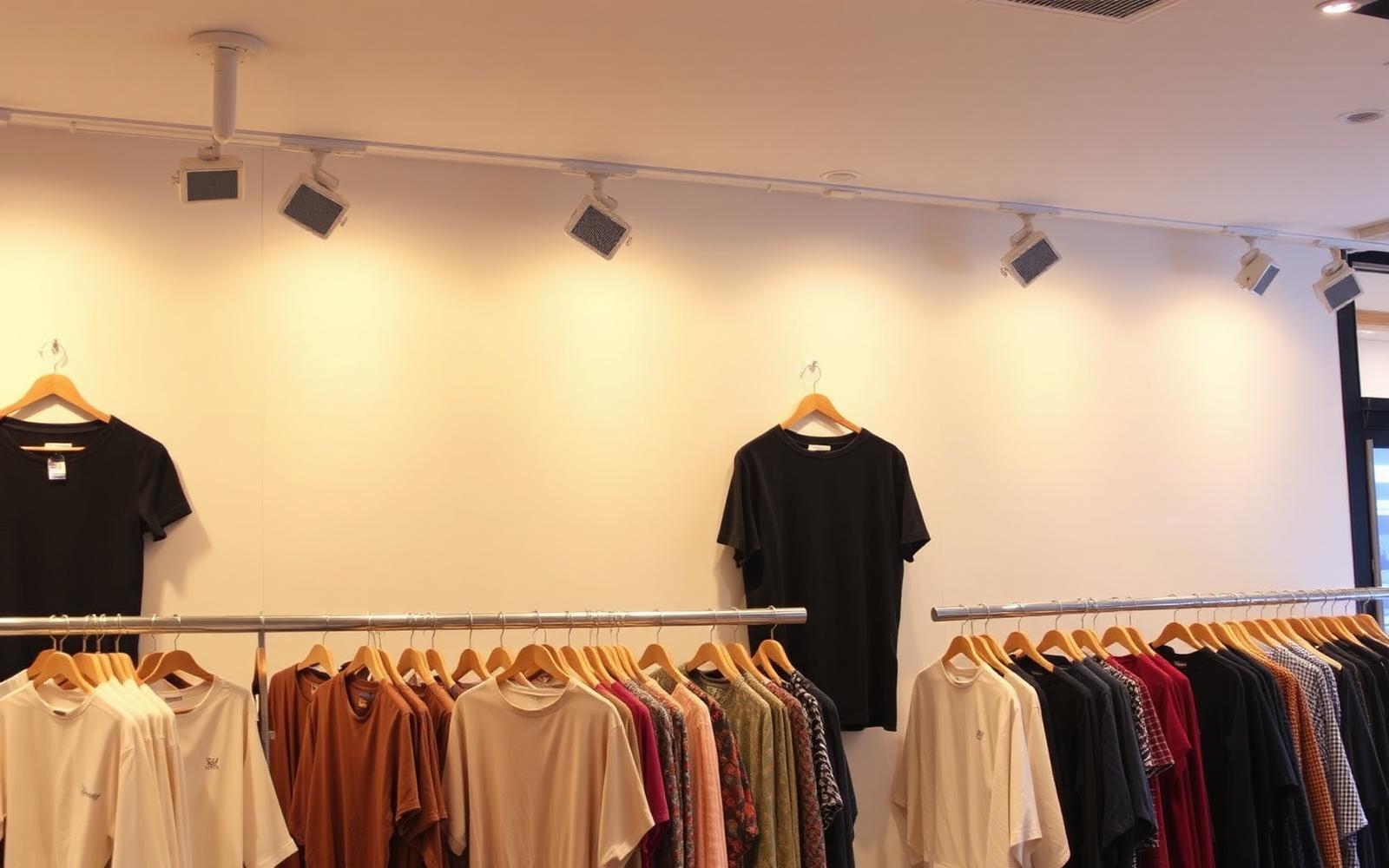
Fashion clothing display with adjustable track spots illuminating wall garments, CRI 95 / 3000K accent — texture and colour reading exactly as the buyer intended.

3. Fashion / Apparel — The 400/3,500/3000 Triangle

The fashion / apparel store is the volume case — 60-70% of all retail lighting projects we deliver — and the technical playbook is now well established. The headline numbers, all per EN 12464-1:2021 §6.13 and CIBSE LG13:

ParameterTargetWhy
Ambient horizontal illuminance (circulation)300-500 luxComfortable navigation, not "supermarket"
Vertical illuminance on hanging garment750-1,000 luxCustomer can read colour & detail at arm's length
Accent on hero / VM display2,500-4,500 lux (5-8:1 ratio)Draws the eye, signals "premium"
Mannequin / window display3,000-5,000 luxStops the passer-by
CCT3000K (luxury / evening: 2700K; sport / activewear: 3500K)Warm = premium, cool = sport/tech
CRIRa ≥95, R9 ≥85Skin tones, dyes, saturation
TM-30Rf ≥90, Rg 100-110Modern colour-fidelity standard
UGR≤22 (lower in fitting rooms: ≤19)No glare in mirrors
Beam control15-25° accent / 36-60° washModelling, contrast
DriverDALI-2, flicker-free per IEEE 1789, SVM <0.4Phone-camera safe

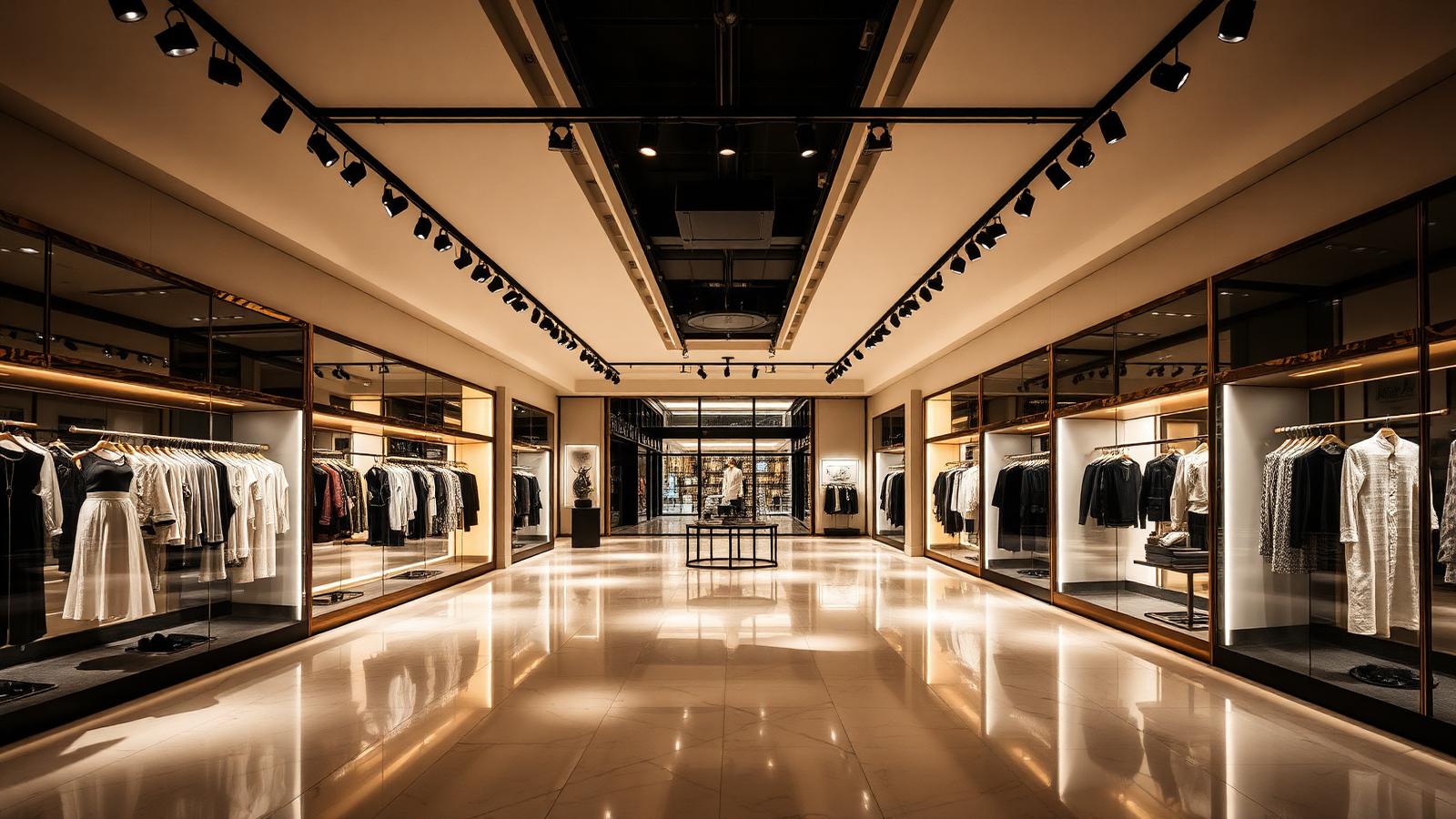
The single best technical solution is a two-layer track scheme running along the customer-journey route: a base layer of wide-beam wallwash spots (36-60°) delivering the 300-500 lux ambient and 750-1,000 lux on hanging garments, plus a top layer of narrow-beam accent spots (15-25°, switchable lens) delivering the 2,500-4,500 lux on mannequins, hero pieces and VM windows. Both layers on DALI-2 or Casambi-controlled adjustable LED track heads at 3000K, CRI 95, 30-40W per fitting.

Why track and not recessed downlights: retail VM rotates every 4-6 weeks. A recessed downlight grid locks the lighting design to a fixed plan and forces the VM team to rearrange merchandise to suit the lights. Adjustable track does the opposite — the VM team rearranges, and the lighting team re-aims the spots in 30 minutes per zone. Across a 5-year tenancy, the track scheme will be re-aimed 40-60 times. A recessed scheme will be cursed 40-60 times.

Magnetic track is the 2025-2026 default. XHLWX's magnetic track range (48V DC) supports adjustable spots, linear wash and decorative pendants on the same rail, swap-in / swap-out without an electrician, and DALI-2 or Casambi addressing per fitting. The capex premium over conventional 240V single-circuit track is now under 12% and the lifetime flexibility savings are substantially greater.

4. Jewellery, Watches and Luxury Hard-Goods — Where CRI 97 and Beam Control Earn Their Keep

The jewellery / watch case is the highest-stakes lighting brief in retail. The customer is making a £500 - £50,000 decision based largely on how the stone, the metal and the dial sparkle, refract and read under the showcase light. Every parameter is uncompromising:

  • CRI Ra ≥97, R9 ≥90, R12 (saturated blue) ≥80 — diamonds need full-spectrum white including the deep blue end to fluoresce and sparkle correctly
  • CCT exactly 3000K for warm metals (gold, rose gold), 3500K for white metals (platinum, silver, white gold), 4000K for diamonds and white stones to maximise perceived brilliance — best practice is tunable-white 2700-4000K per showcase with the staff trained to adjust per category
  • Beam angle 8-15° narrow-spot with precision lens, no spill onto the case carcass
  • Vertical illuminance on the piece 2,000-3,500 lux, with showcase ambient at 300-500 lux for contrast
  • Heat management critical — the case interior must stay <30°C even with multiple spots running, or stones (especially organic gems like pearls and corals) degrade
  • UV/IR-free LED for case interiors with sensitive materials
  • Anti-glare lens essential — the customer leans in 20-30 cm to view the piece, any direct LED in line-of-sight ruins the experience

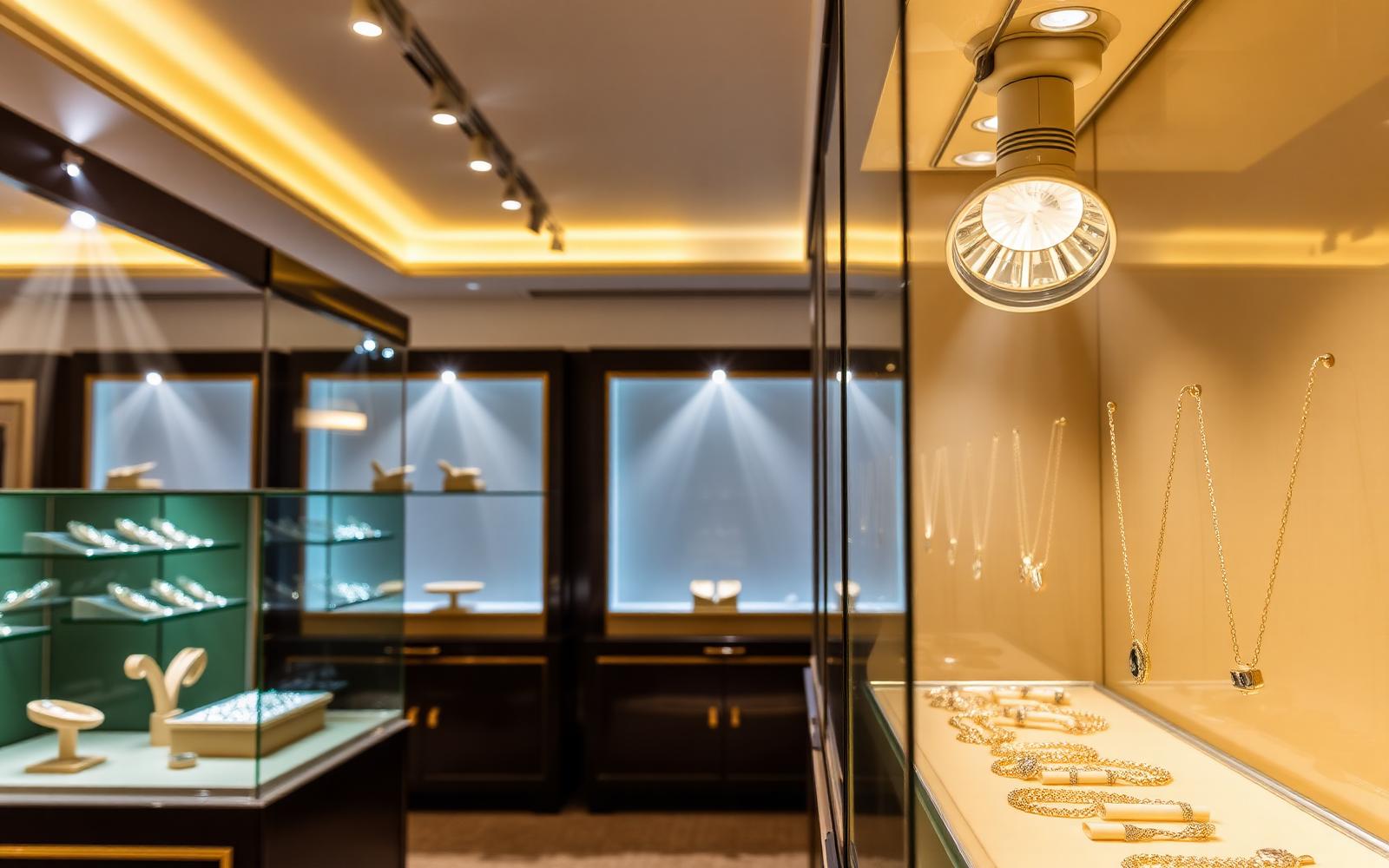
The technical answer is a dedicated showcase-lighting product family — narrow-beam halospots integrated into the case top, edge-lit base illumination on satin-finish acrylic, plus an external adjustable ceiling spot per case at 8° beam delivering the dramatic single-point sparkle. All on a dedicated DALI-2 zone so the case lighting can be staged for opening / closing / VIP appointment scenarios.

A correctly lit jewellery case typically sells 2.3-2.8× the merchandise per linear metre of an identical case lit with generic 4000K downlights (Hart & Cohen, Retail Lighting & Conversion Studies, 2024 update). The premium per fitting is high — €180-€350 vs €60-€90 — but the per-square-metre revenue is so much higher that the payback is measured in weeks.

Jewellery showcase with high-CRI 97 narrow-beam spots delivering the precision sparkle that makes diamonds and gold sell at full margin.

5. Cosmetics and Beauty — The Skin-Tone Specification

Beauty retail is the category most scrutinised by the customer's own face. The customer will walk into the store, pick up a foundation, swatch it on the back of the hand, look at it under the store light, look at it in the mirror, look at her own face in the mirror, and decide. Every step in that chain must be lit with the same spectral content or the brain reads "this product won't look right outside" and the sale is lost.

The spec:

  • CRI Ra ≥95, R9 ≥85, R13 (skin-tone red) ≥90, R15 (Asian skin) ≥85 — the four colour-rendering metrics that specifically determine how human skin reads
  • CCT 3500-4000K — daylight-aligned, the colour temperature the customer will most often wear the product under (office, daylight, mirror at home)
  • Vertical illuminance on the face at the testing mirror: 750-1,000 lux Ez — bright enough to see the swatch clearly, soft enough to be flattering
  • Mirror lighting from both sides at face height — never overhead, never below — to avoid casting shadows that misrepresent the swatch
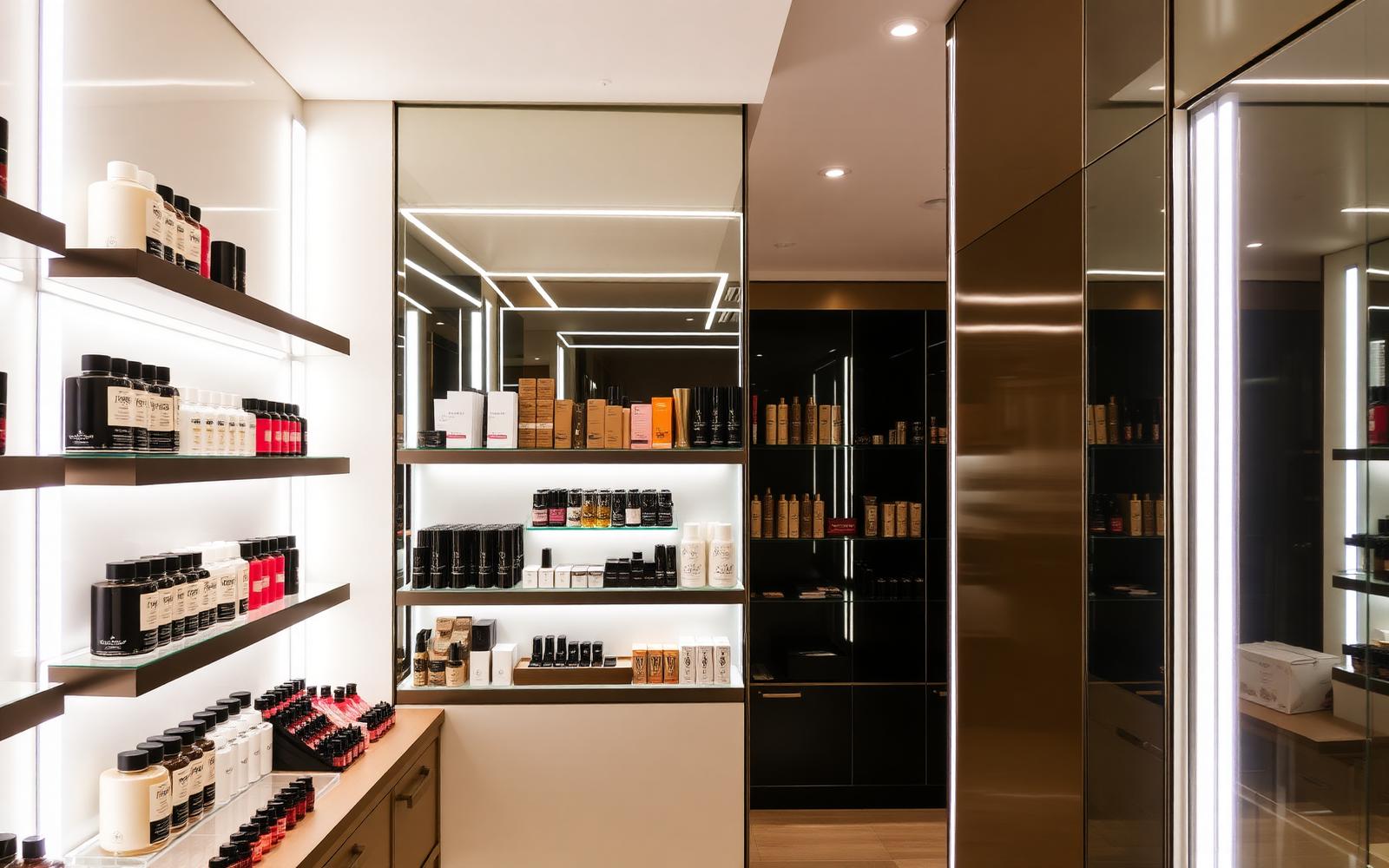
  • Backlit shelf-edge LED strips at 4000K, CRI 95, on every product shelf — the spectral baseline of the entire shop floor, the source against which the customer will judge every product

The "magic mirror" or "skin-tone analyser" station is now standard in flagship beauty stores and uses an even more demanding spec: CRI 98+, TM-30 Rf 95+, tunable 2700-6500K to simulate office / daylight / evening / nightclub conditions on demand, so the customer can see the swatch under the actual lighting they will wear it in. The capex per station is €3,000-€8,000 and the conversion uplift on premium foundation lines is in the 20-30% range.

Beauty / cosmetics store with backlit product shelves, edge-lit displays and 4000K daylight-aligned ambient — the spectral consistency that makes skin-tone products convert.

6. Window Displays and Storefront — The 30-Second Rule

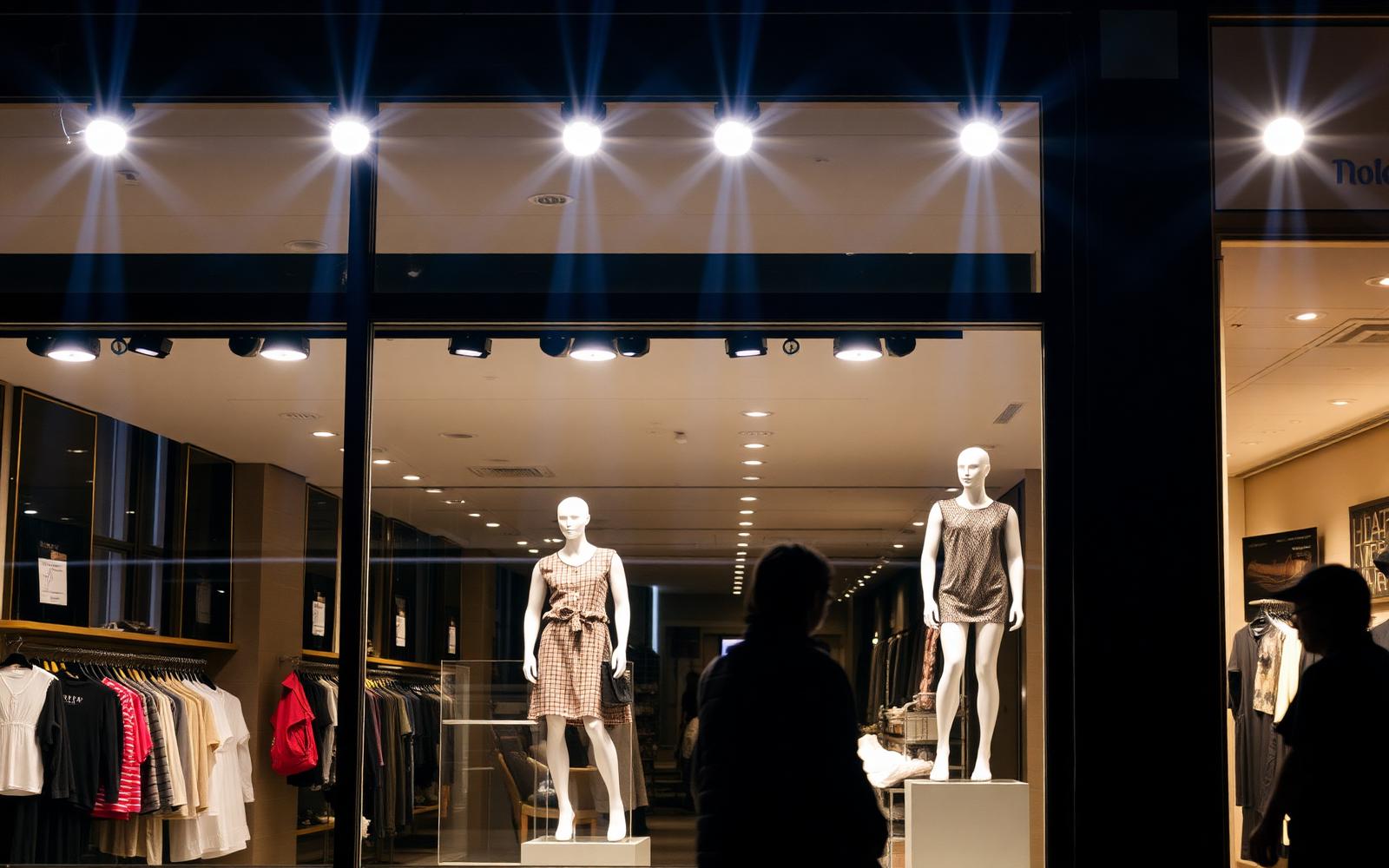
The window display has 3-7 seconds to stop a passer-by and another 20-30 seconds to convert a glance into a step inside. The lighting is doing 60-70% of that work. The technical brief is the most punishing in retail because the window must compete with direct daylight by day, with neighbouring storefronts by evening, and with the after-dark cityscape at night — three completely different visual contexts on the same fixture.

The two-shift specification:

Daytime mode (08:00-17:00):

  • Window vertical illuminance 5,000-8,000 lux on mannequins / hero product
  • 4000K, CRI 95 — to read clearly against daylight backdrop
  • Forward-throw beam from above and slightly behind the customer's sightline (no glare into the window from outside)

Evening mode (17:00-22:00):

  • Window vertical illuminance 3,000-5,000 lux
  • 3000K, CRI 95 — warmer, more inviting against dark exterior
  • Higher contrast against background (background drops to 100-200 lux)

A single tunable-white, dimmable, narrow-beam window-spot fitting per mannequin / per hero piece — typically 30-50W LED, 2700-5000K tunable, 15-25° beam, on a DALI-2 time-of-day schedule — delivers both modes from one fitting. Specify with integral barn-doors or honeycomb anti-glare to prevent any spill into the customer's eyes from the pavement side.

Local planning conditions in most EU/UK city centres now restrict window-display luminance after 23:00 (the "dark-sky" rules increasingly applied to commercial frontage). A DALI-2 schedule that drops the window to 30% at 23:00 and off at midnight keeps the brand compliant without manual intervention.

Storefront window with bright narrow-beam track spots illuminating mannequins from above — the 5,000-lux vertical that stops passers-by mid-step.

7. Footwear, Bags and Lifestyle Hard-Goods — The Shelf Ladder

Footwear and bag retail is dominated by the vertical shelf ladder — long runs of shelves, 5-10 product faces high, customer walking past at 1.5 m. The lighting problem is to deliver even vertical illuminance from top shelf to bottom shelf without any shelf going visibly darker — and to add per-shelf accent so that the eye does not glaze over an undifferentiated wall of merchandise.

The technical answer is a two-layer system per bay:

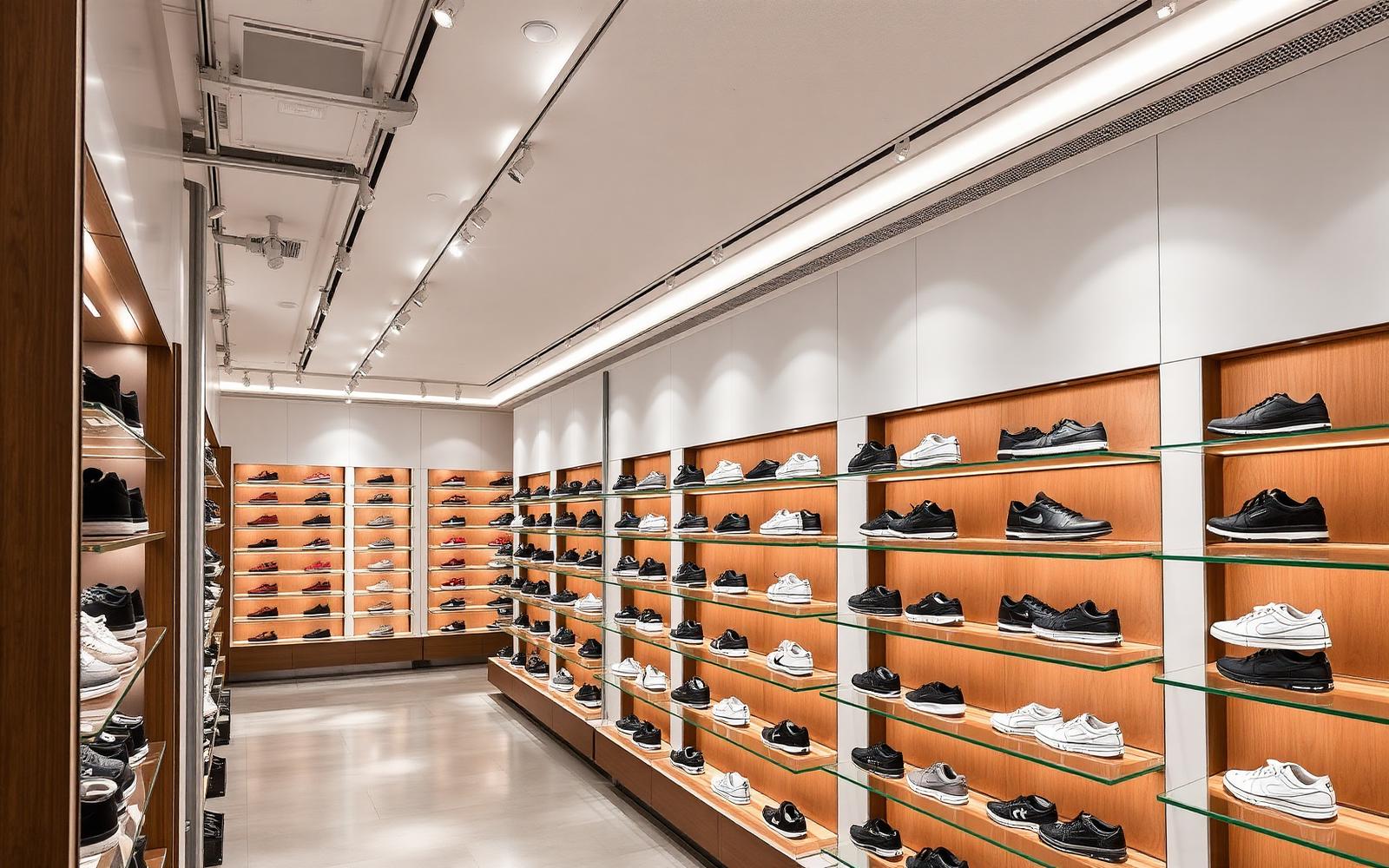
  1. Continuous magnetic-track linear at the top of the bay (2700-3000K, 15W/m, CRI 95) delivering 500-700 lux even vertical illuminance from top shelf to bottom shelf
  2. Per-shelf integrated LED strip at the leading edge of each shelf (3000K, CRI 95, 5W/m) adding 200-300 lux accent on each row of product

The combination eliminates the "dark bottom shelf" problem (the most common reason bottom-shelf SKUs under-perform) and delivers the per-product accent that makes the shelf read as curated rather than storage. Magnetic track makes future re-merchandising trivial — swap a wash for a spot, a spot for a decorative pendant, in 60 seconds without an electrician.

For luxury footwear (>€500 retail), upgrade the per-shelf accent to narrow-beam adjustable spots, 1 per pair, at 1,500-2,000 lux on the shoe — same logic as the jewellery case, scaled. The conversion uplift is measurable.

Footwear store with magnetic track and per-shelf LED — the two-layer system that lifts bottom-shelf SKU performance and signals premium.

8. Fitting Rooms — The Single Highest-ROI Lighting Intervention in Retail

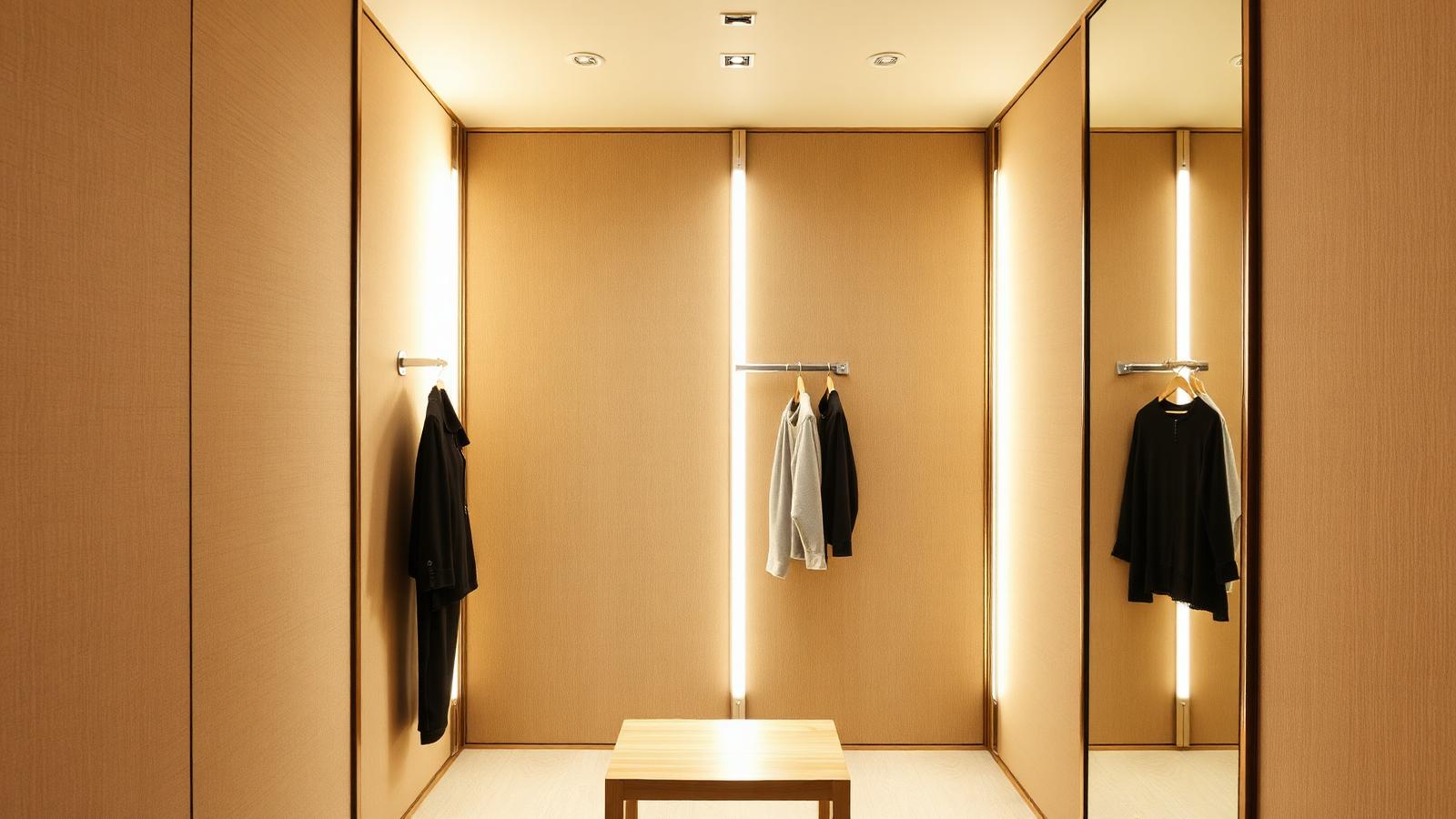
Premium retail fitting room with vertical LED strips at face height, 3500K CRI 95 daylight-balanced — the single highest-ROI lighting intervention in retail.

We will say it again because it is the most ignored insight in retail lighting: the fitting room is where the sale is won or lost, and most fitting rooms are lit catastrophically badly. The default — a single 4000K downlight directly overhead — casts deep shadows under the customer's eyes, jaw and clavicle, exaggerates skin imperfections, ages the customer by 5-10 years in the mirror, and undoes everything the rest of the store lighting has achieved.

The correct specification is the three-source flattering portrait scheme used by every professional photographer:

  1. Vertical wall-wash from both sides of the mirror at face height — 3000K, CRI 95+, R9 ≥85, delivering 500-700 lux Ez on the face from each side. This is the dominant light and what makes the customer look good.
  2. Soft overhead ambient — 3000K, CRI 95, dimmable 0-100%, delivering 300-500 lux to the floor (lights the garment, not the face).
  3. Optional warm-evening simulation switch — customer-accessible button drops the overhead to 2700K, 30% — lets the customer see the garment as it would look under restaurant / evening lighting, which is the actual context for many premium purchases.

All three sources flicker-free (SVM <0.4), CRI 95+, spectrally matched to the shop-floor lighting (so the customer sees the same colour they saw on the rack), and on a dedicated DALI-2 zone so the cleaning / service mode can use brighter / cooler light without affecting customer-facing scenes.

A correctly lit fitting room delivers +9-14% conversion versus a poorly lit one in the same store — the single highest-value lighting intervention we measure. Capex premium per cubicle: typically €450-€800. Payback: typically 4-8 weeks of trading.

9. Controls, Energy and the Sustainability Layer

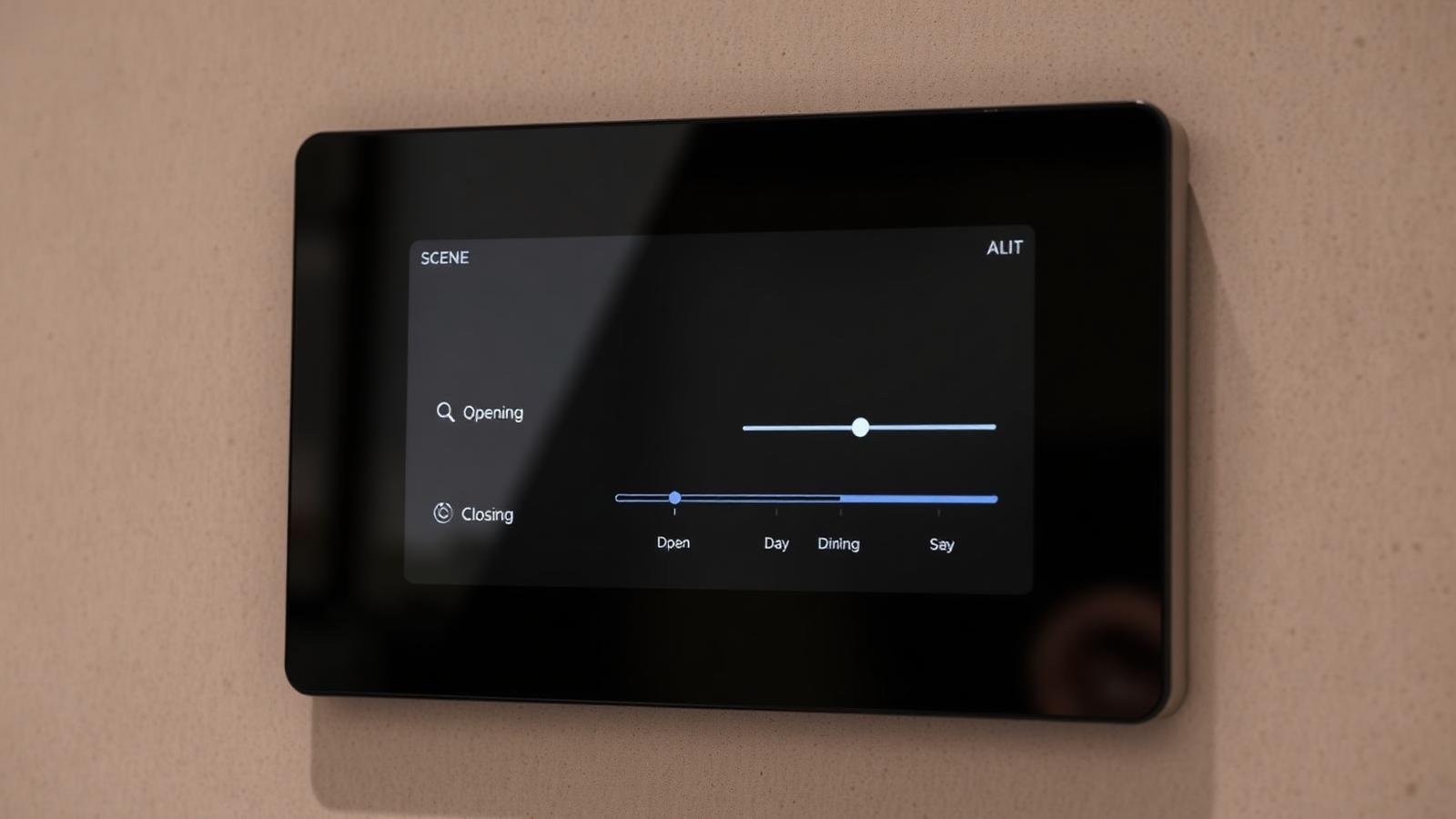
Wall-mounted DALI-2 / Casambi smart lighting control panel with scene presets and dimming — the energy and sustainability layer that meets EU EPBD recast and WELL v2.

Retail lighting is governed by the same EPBD / ASHRAE 90.1 / WELL framework as offices, with retail-specific allowances and additional emphasis on scene control, brand-night programming, and supply-chain ESG reporting.

The 2026 numbers:

  • EPBD recast (2024) — retail LPD ≤9 W/m² (apparel) / ≤14 W/m² (jewellery / specialty)
  • ASHRAE 90.1-2022 — retail LPD allowance: 7.6 W/m² (general retail), 12.0 W/m² (jewellery / fine merchandise)
  • EU EcoDesign SLR (2019/2020) — LED-only, full datasheet and EPD disclosure, end-of-life take-back
  • WELL v2 L01-L08 — credits achievable across the customer journey; tunable white drives L03 Circadian
  • Local dark-sky planning conditions — post-23:00 luminance restrictions on storefronts, increasingly enforced

A correctly specified retail lighting scheme using high-efficacy LED (≥130 lm/W at the luminaire), DALI-2 / Casambi controls and time-of-day scheduling will land at 6-9 W/m² across the shop floor, comfortably inside both EU and US energy budgets while delivering the conversion-rate uplift that justifies the entire capex.

10. Quick Reference — Retail Lighting Specification by Zone & Category

Zone / CategoryAmbient (lux)Accent (lux)CCT (K)CRIBeamNotes
Fashion — circulation300-500n/a3000≥9536-60° washTwo-layer track
Fashion — wall display750-1,000 V2,500 hero3000≥95, R9 ≥8524° wallwashMagnetic track
Fashion — mannequin / VMn/a3,000-4,5003000≥9515-25° spotAdjustable per-piece
Window — daytimen/a5,000-8,000 V4000≥9515-25°Tunable, anti-glare
Window — eveningn/a3,000-5,000 V3000≥9515-25°DALI-2 schedule
Jewellery showcase300-5002,000-3,500 V2700-4000 tunable≥97, R9 ≥908-15° narrowUV/IR free, low heat
Watch case4001,500-2,500 V3500≥9710-20°Anti-glare critical
Cosmetics — shelf500750-1,000 V swatch4000≥95, R13 ≥90Edge-LED + spotDaylight-aligned
Cosmetics — magic mirrorn/a1,000-1,500 V2700-6500 tunable≥98Diffuse, dual-sideCustomer-controlled
Footwear — wall ladder500-700 V200-300 per shelf3000≥95Magnetic linear + edgeTop-to-bottom even
Footwear — luxury hero700 V1,500-2,0003000≥9515-25° per pairNarrow-beam
Bags / lifestyle500-700 V1,500 hero3000≥9524° + spotTwo-layer track
Cash desk500 taskn/a3000≥95Wide ambientBrighter than ambient
Fitting room — face mirrorn/a500-700 V both sides3000≥95, R9 ≥85Diffuse verticalThree-source scheme
Fitting room — body mirror300-500n/a3000 (tunable to 2700)≥95Soft overheadCustomer-dimmable
Reception / brand wall200750 V on logo3000≥95WallwashHospitality language

All values aligned to EN 12464-1:2021, CIBSE LG13, ASHRAE 90.1-2022 and WELL v2. The single biggest mistake we see is under-investment in fitting-room lighting — every project budget should reserve 15-20% specifically for the fitting-room zone. It is the room where the sale is made.


A correctly specified retail lighting scheme in 2026 is the highest-ROI design intervention available to a brand. It costs less than one season's window-VM budget, takes 5-10 days to install over a closed Sunday-Monday weekend, and delivers measurable conversion uplift within the first month of trading. XHLWX designs and manufactures the full retail range — magnetic track, adjustable spots, jewellery-grade narrow-beam fittings, custom decorative pendants for brand zones, and full DALI-2 / Casambi control packages — with CRI 95+ as standard, EU/UK pre-sales support, and a 5-year warranty across the range. Get in touch for a free DIALux model and conversion-uplift design proposal.

XHLWX Lighting Design Team
Senior Lighting Specifiers

Need a tailored lighting plan for your project?

Our senior lighting designers reply within 48 hours with a free design proposal & quotation.