
What Are European Boutique Hotel Wall Light Trends for 2026?
Quick answer
Explore custom sconce trends for European boutique hotels: warm light, sculptural materials, repairable construction, controls and compliance.
Introduction
At XHLWX (led-project-light.com), a Custom Indoor LED Lighting Manufacturer based in China, ... custom sconces should combine restrained forms with verifiable performance. For European boutique hotels in 2026, recommended specifications include 2700 K light and CRI ≥90, alongside shielded optics, repairable components, tactile finishes and scene-ready controls.
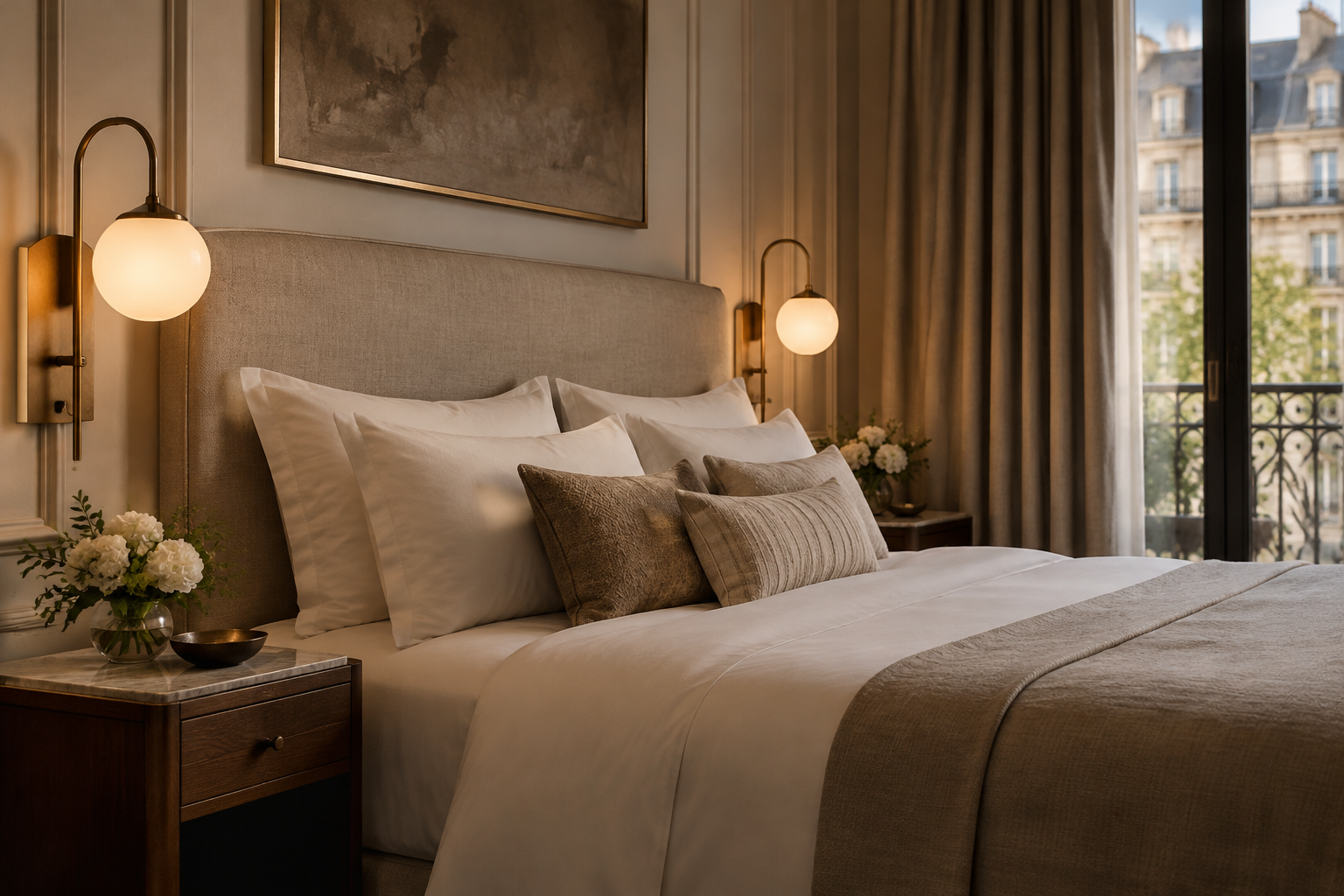
The strongest design direction is a quieter, more architectural wall light: an object that supports the interior rather than competing with it. In guestrooms, this means soft ambient illumination paired with useful reading light. In corridors and lounges, it means controlled brightness, material consistency and accessible maintenance.
These are specification-led recommendations for 2026, not a statistical market forecast. No hotel installations, measured savings or product certifications are claimed here. Unless identified as a standard, regulatory reference or calendar year, numerical performance values below are design targets or recommended specifications, subject to mock-up approval and product verification.
For owners, designers and FF&E buyers, the practical question is not simply which finish looks current. It is whether a custom sconce can preserve that appearance after dimming, cleaning, component replacement and repeated production.
Design Criteria and Standards
A successful boutique-hotel sconce specification defines visual comfort, serviceability and conformity before decorative details are frozen.
Start with the activity at each wall: reading, wayfinding, relaxing or supporting reception tasks. EN 12464-1 addresses indoor workplaces and is relevant where hotel spaces contain workplace tasks; it should not be treated as a universal guestroom mood-lighting prescription. Applicable local requirements and the overall lighting scheme still need review.
The following schedule provides recommended specifications, not a declaration that any proposed luminaire already meets them.
| Parameter | Spec | Standard | Notes |
|---|---|---|---|
| CCT | Recommended specification: 2700 K for guestrooms; 3000 K where appropriate for task-oriented interiors | EN 12464-1 where applicable | Approve the complete light source, optic and diffuser combination |
| Colour rendering | Recommended specification: CRI ≥90; request supplementary colour data | EN 12464-1; WELL v2 where pursued | Check skin tones, timber, fabrics and artwork in the mock-up |
| Glare and UGR | Design target: conceal direct source views; assess UGR where the method applies | EN 12464-1 | UGR depends on room geometry and observer position, not the sconce alone |
| Beam distribution | Recommended specification: 30°–60° reading beam, or diffuse ambient distribution | IES photometric methods; ANSI/IES LM-63 data format | Final distribution depends on mounting, optics and reading position |
| Control | Recommended specification: project-selected DALI-2, Casambi, KNX integration or 0-10V | IEC 62386 for DALI; relevant platform documentation | These are not interchangeable; confirm drivers, gateways and wiring |
| Housing and materials | Recommended specification: aluminium or steel structure with approved decorative materials | EN 60598; applicable fire requirements | Review thermal paths, finish adhesion and cleaning compatibility |
| Ingress protection | Recommended specification: IP20 in suitable dry interiors; bathroom rating determined by location | IEC 60529; national bathroom installation rules | Do not assume one IP rating suits every bathroom zone |
| LED and driver brands | Candidate specification: Osram, Bridgelux or Samsung LEDs; Tridonic or Mean Well drivers | Exact component datasheets and applicable standards | Brand names do not establish finished-luminaire conformity |
| Compliance and credentials | EU: assess CE obligations and RoHS; other markets: assess UL or SAA relevance; verify any ISO9001 claim | Applicable EU legislation; UL standards where required; ISO 9001 | CE is not a universal third-party certificate; ISO 9001 concerns management systems |
Avoid accepting a generic “hotel-grade” description. Require a defined bill of materials, installation method and evidence package tied to the exact product revision.
Customisation Options and Materials
The most useful customisation changes how a sconce performs, ages and integrates with the room—not just its silhouette.
Current design proposals can be organised around three practical directions: tactile materiality, reduced visual clutter and maintainable construction. These directions suit boutique properties because they allow a recognisable identity without forcing every room type to use an identical fixture.
| Design approach | Best indoor hotel setting | Main engineering consideration | Verdict |
|---|---|---|---|
| Diffused glass globe or capsule | Guestroom bedside and lounge walls | Brightness control, glass consistency and safe retention | Strong ambient choice when the source is concealed |
| Shielded metal reading sconce | Guestroom bedside | Aiming, touch temperature and switch accessibility | Best task-focused option when tested from the pillow |
| Stone or ceramic decorative body | Suites and reception seating areas | Weight, anchorage, natural variation and heat paths | Distinctive, but approve material limits before ordering |
| Pleated textile shade | Guestrooms and intimate lounges | Cleaning, shade replacement and local fire requirements | Warm visual character with a clear maintenance plan |
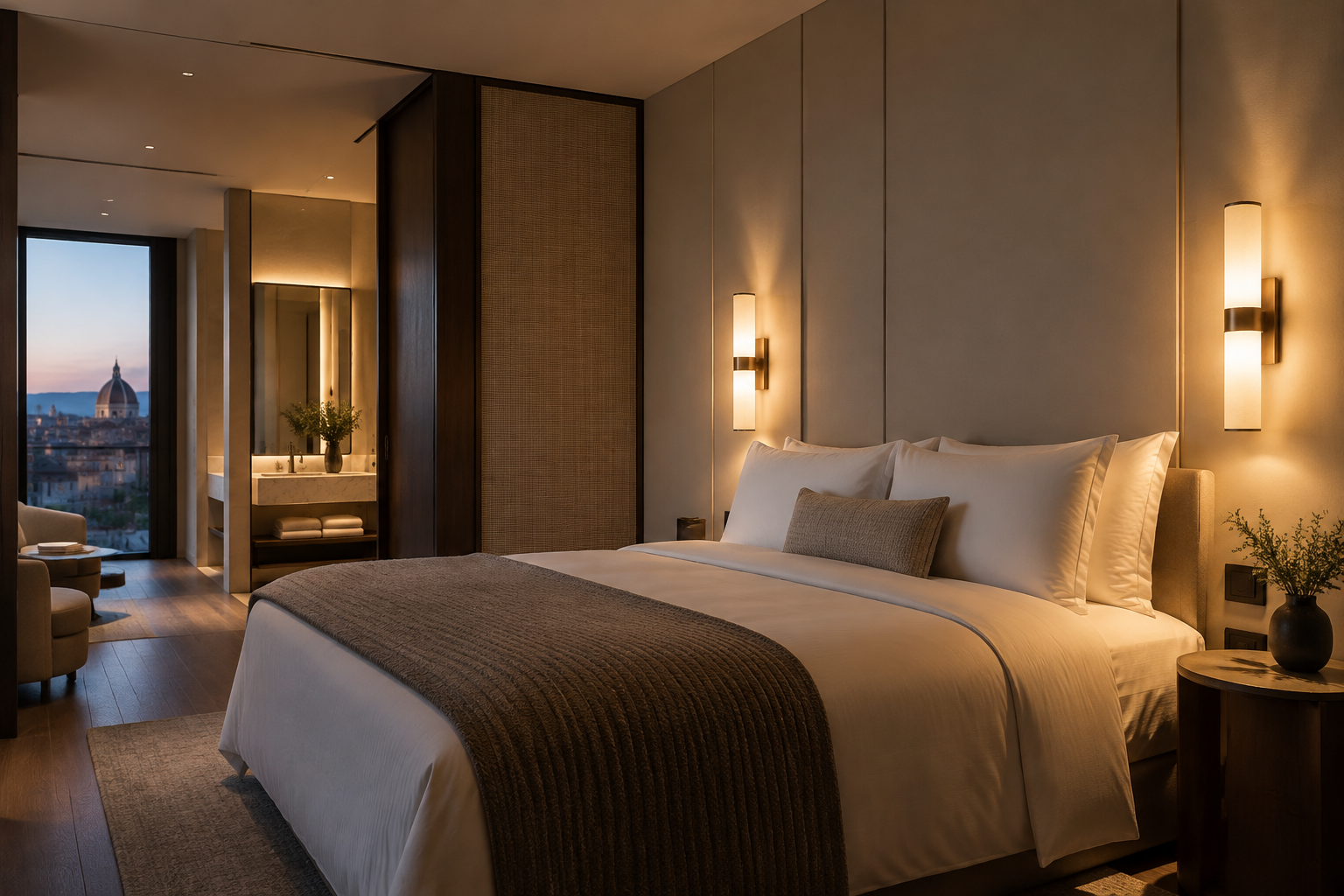
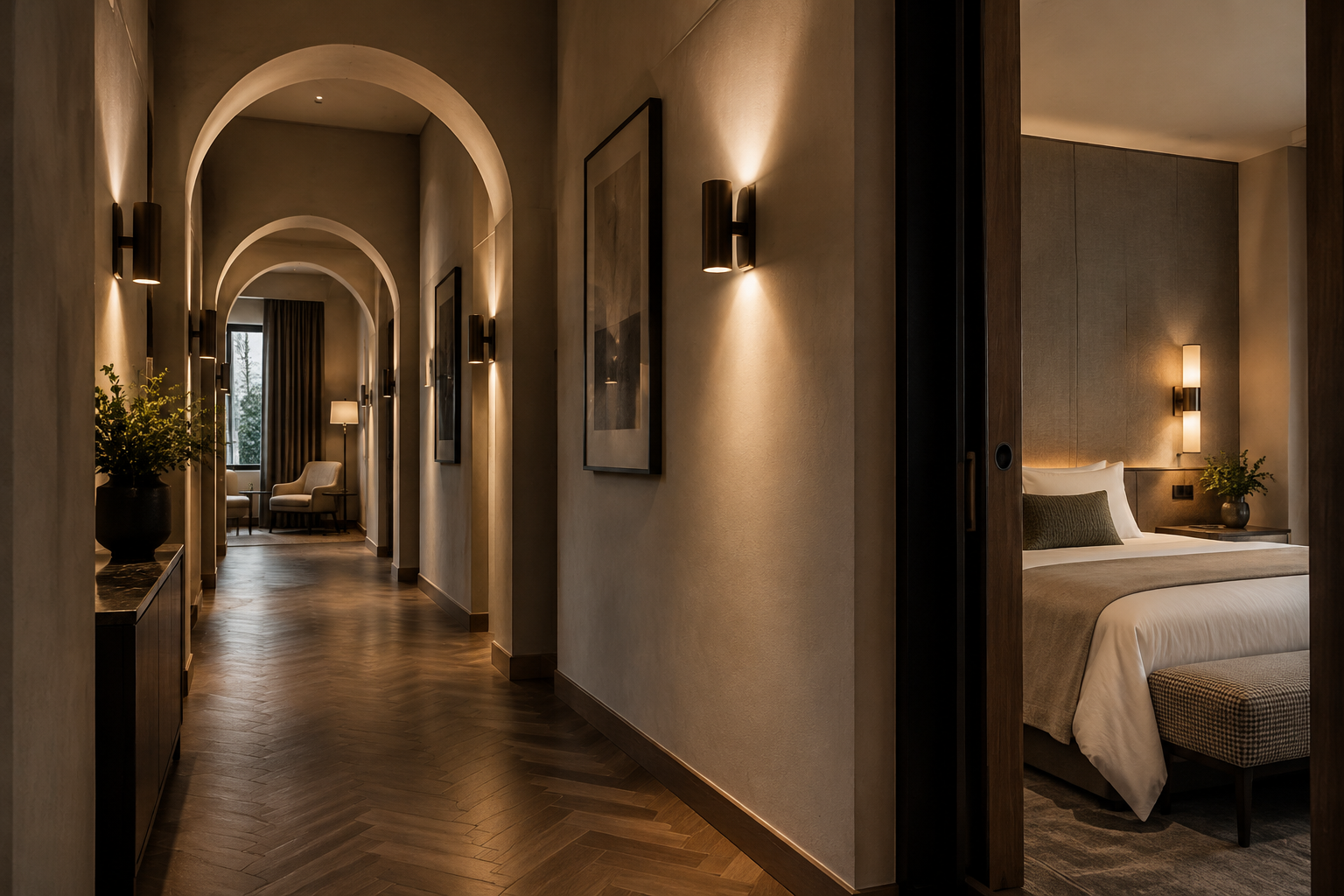
| Slim wall-washing profile | Indoor corridors and reception walls | Wall flatness, grazing artefacts and driver access | Good architectural integration where surfaces are controlled |
Which Finishes Create a European Boutique-hotel Identity Without Becoming Difficult to Maintain?
Muted metals, textured ceramics and restrained glass can create character while keeping replacement and cleaning manageable.
Brushed bronze effects, satin nickel, powder-coated colours and softly textured ceramic bodies are useful design directions, rather than verified rankings of market popularity. Select the finish against the actual wallcovering, joinery and hardware samples.
Ask whether a metallic appearance comes from plating, paint, PVD or solid material. These routes differ in edge coverage, repairability and colour variation.
Specify an approved master sample and acceptable appearance limits rather than relying on a rendered image. For natural stone, agree acceptable veining, translucency and edge variation before production.
How Should Custom Bedside Sconces Combine Ambient Light and Reading Comfort?
Separate ambient and reading functions when one optical system cannot deliver both comfortable background light and useful task illumination.
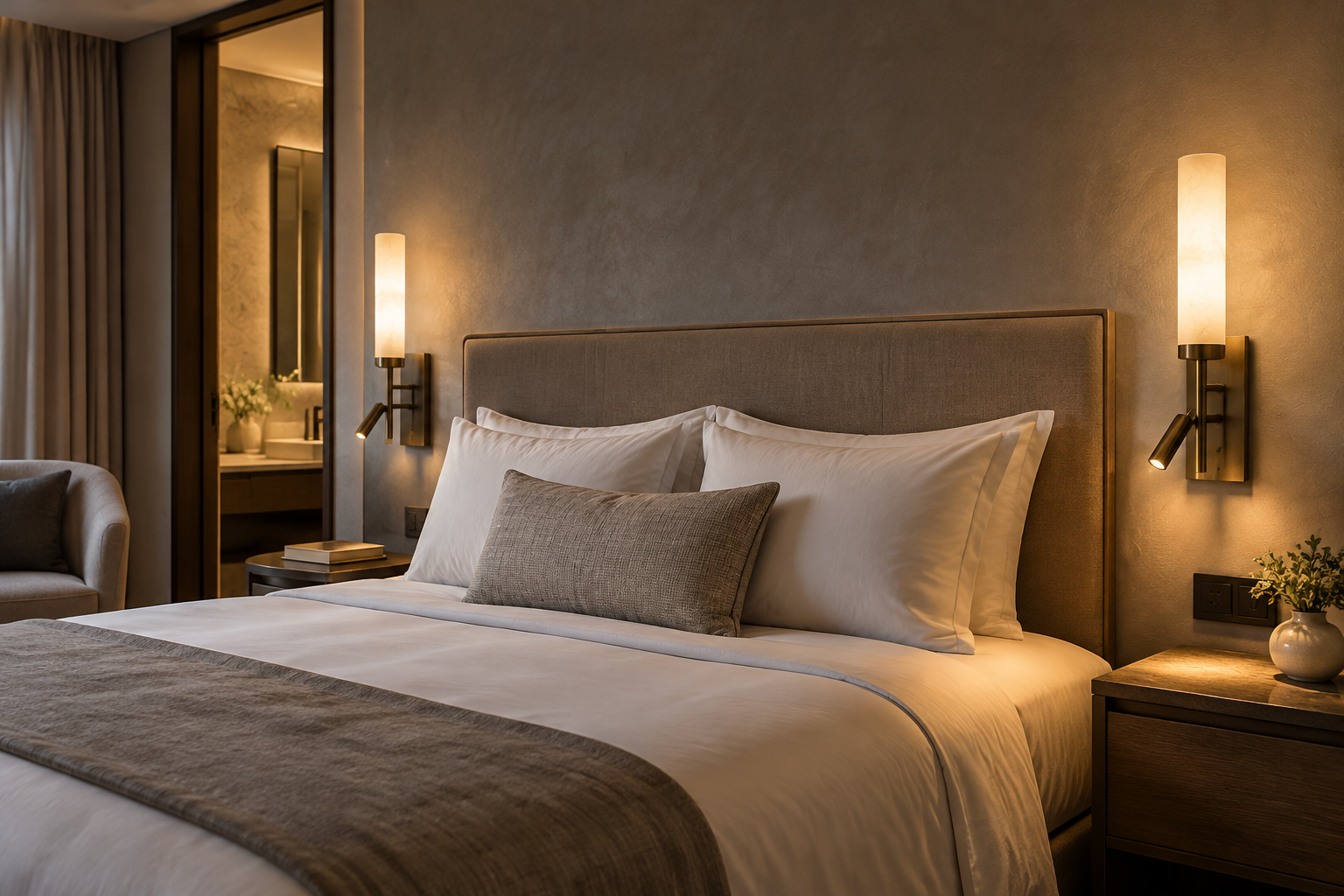
A decorative diffuser can provide atmosphere while a shielded adjustable head supports reading. Independent switching prevents a guest from illuminating the entire bedside area unnecessarily. Position the controls so they are understandable from the bed, including when the room is dark.
As a recommended specification, begin mock-up evaluation with 2700 K ambient light and CRI ≥90. Assess reading coverage using the actual bed, pillow height and headboard geometry. Do not copy a mounting dimension from another property without checking sightlines, reach and glare for this room.
Which Construction Choices Make Bespoke Sconces Easier to Repair?
Accessible drivers, replaceable light engines and documented mechanical interfaces make custom sconces more maintainable.
Avoid permanently bonding serviceable electronics inside a decorative shell unless the replacement strategy is explicitly accepted. Define how maintenance staff remove the diffuser, disconnect the light engine and access mounting screws without damaging the wall finish.
Request an exploded drawing and spare-parts schedule. A replaceable module still needs a controlled specification: electrical output, dimensions, colour quality, thermal interface and connector compatibility. Simply promising “standard components” is insufficient when future replacements could alter brightness or appearance.
 What Are European Boutique Hotel Wall Light Trends for 2026?: How should custom bedside sconces combine ambient light and reading comfort?
Controls and Commissioning
Control compatibility must be demonstrated with the proposed driver, interface and hotel operating sequence before bulk production.
DALI-2 is useful where addressable control, grouping and commissioning records are required. Casambi can suit projects seeking wireless control, subject to site conditions, network design and maintenance ownership.
KNX commonly requires a suitable lighting interface or gateway. With 0-10V, check wiring, low-end behaviour and whether a separate switching arrangement is needed for full off.
Do not assume a dimmable driver works with every control ecosystem. Confirm the exact model, output range, load compatibility and commissioning method. For a recommended dimming target of 1%–100%, require a demonstration with the actual light engine; the interface label alone does not prove that range.
The commissioning brief should describe arrival, reading, relaxation and night-use scenes in plain language. Confirm bedside override behaviour, power-restoration behaviour and what happens if a gateway or wireless connection is unavailable.
Check flicker, audible noise, dropout and inconsistent fades at low output. A recommended CCT-matching target of SDCM ≤3 can support visual consistency, but sample comparison remains essential across different diffuser materials.
Sampling, MOQ, Lead Time and Quality Control
Custom production should proceed through approved drawings, a functional sample and documented inspection criteria rather than an assumed catalogue schedule.
Minimum order quantity depends on tooling, finish processes, material purchasing and component availability. Lead time depends on design maturity, sample revisions, compliance work and shipping arrangements. No universal MOQ or delivery promise can responsibly be assigned before the specification is reviewed.
A useful procurement sequence is:
- Brief approval: confirm room types, quantities, target budget, destination market and control architecture.
- Engineering review: resolve dimensions, mounting, wiring, driver access and material constraints.
- Sample approval: assess appearance, light distribution, dimming, cleaning and installation in a representative room.
- Production release: freeze drawings, bill of materials, finish samples and approved deviations.
- Dispatch review: verify inspection records, labels, installation instructions, packaging and spare-parts identification.
As a recommended quality-control requirement, request 100% functional checks, with appropriate electrical safety testing defined by the applicable standards and inspection plan. Do not substitute an arbitrary burn-in duration for a justified test programme.
The signed sample should remain the visual and construction reference. Any component substitution should trigger documented review, including whether existing test evidence and photometric files remain representative.
Photometric Files & Compliance
Photometric data and conformity evidence must correspond to the offered configuration, not merely to a similar-looking product.
Request IES and LDT photometric files for the selected light engine, optic and diffuser combination. Use them in DIALux to assess distribution, calculated illuminance and interaction with other indoor luminaires. A simulation supports design decisions; it does not certify the fixture or replace an installed mock-up.
For EU supply, assess the applicable electrical safety, electromagnetic compatibility, RoHS and other product obligations. CE marking requires the responsible economic operator to establish conformity through the applicable assessment route and documentation. Ask for the EU Declaration of Conformity and supporting evidence relevant to the exact model.
EN 60598 is a luminaire safety standards family; identify the applicable general and particular standards with the testing specialist. A component report or LED datasheet does not establish compliance of the assembled sconce.
For US projects, identify the required listing or approval route with the project authority; UL 1598 may be relevant to luminaires. SAA relates to Australian certification and is not an EU requirement. Middle Eastern and Southeast Asian destinations need country-specific checks, including electrical supply, documentation and local approvals.
WELL v2 can inform a project pursuing its lighting features, but a warm-white sconce alone does not demonstrate compliance. Evaluate the relevant feature requirements at project level.
 What Are European Boutique Hotel Wall Light Trends for 2026?: Photometric files & compliance
Frequently Asked Questions
Custom sconces work best when aesthetic decisions are supported by room-specific testing and clear procurement responsibilities.
Q: What Colour Temperature Is Recommended for European Boutique-hotel Wall Lights?
A recommended specification is 2700 K for relaxing guestroom ambience, with 3000 K considered for selected task-oriented interiors. Neither is a universal requirement. Compare samples against wall finishes, fabrics and other luminaires, then check dimming behaviour. CRI ≥90 is a useful recommended starting point when skin tones and material appearance matter.
Q: Can One Custom Wall-light Design Serve EU and US Hotel Projects?
A shared decorative design can be developed for both markets, but the electrical assembly, mounting, labels and conformity route may differ. Treat EU and US configurations as 2 controlled variants, a recommended documentation approach rather than an assumption of equivalence. Confirm voltage, wiring provisions and applicable approvals before approving samples or issuing purchase orders.
Q: Is DALI-2 Always Preferable to Wireless Control for Boutique Hotels?
DALI-2 is not automatically preferable; the right choice depends on infrastructure, operational needs and maintenance capability. Compare wired and wireless proposals using a recommended 1-room mock-up before committing. Test guest controls, dimming, power restoration and fault behaviour. Require clear responsibility for commissioning, software access, replacement components and support after handover.
Q: How Can Buyers Reduce Glare from Decorative Bedside Sconces?
Conceal the LED source, control diffuser brightness and test the fixture from normal seated and reclining positions. A recommended mock-up should evaluate at least 2 viewing positions rather than relying on a frontal photograph. Where UGR assessment is applicable, calculate it for the relevant room arrangement; do not accept an unsupported universal UGR claim.
Sources and Technical References
Use primary standards and official programme documentation to verify requirements before finalising the purchase specification.
- CEN-CENELEC: consult EN 12464-1, Light and lighting — Lighting of work places — Part 1: Indoor work places, and applicable EN 60598 luminaire safety standards.
- IEC: consult IEC 60529 for enclosure protection classification and IEC 62386 for digital addressable lighting interface requirements.
- IES: consult relevant lighting guidance and ANSI/IES LM-63 for electronic transfer of photometric data.
- International WELL Building Institute: review current WELL v2 Light feature requirements and verification pathways.
- DALI Alliance: verify DALI-2 certification scope and exact listed products where certification is specified.
- European Commission: review CE marking responsibilities; consult applicable legislation through EUR-Lex.
Check current editions, national adoption and project-specific applicability. These references support specification development; they are not evidence that an unspecified product has passed testing.
 What Are European Boutique Hotel Wall Light Trends for 2026?: Q: Is DALI-2 always preferable to wireless control for boutique hotels?
Request a Custom Quote
A useful quotation request connects the desired visual identity with installation conditions, controls and destination-market requirements.
Send room elevations, reference imagery, quantities by variant, finish samples, mounting details and the intended control system. Include the target budget, required delivery milestone and documentation expectations. Ask the quotation to separate engineering, samples, tooling, production, testing, packaging and spare parts so competing offers can be compared fairly.
At XHLWX (led-project-light.com), a Custom Indoor LED Lighting Manufacturer based in China, ... the recommended next step is a project-specific engineering review. Request a proposal for your indoor hotel sconces with defined sample approvals, photometric deliverables, compliance responsibilities and production assumptions before committing to bulk supply.
XHLWX 소개
XHLWX는 2009년부터 중국 선전에 자체 공장을 운영해 온 LED 프로젝트 조명 제조사 Shenzhen Qihang Lighting Co., Ltd.의 브랜드입니다. 라인 조명, 다운라이트, 마그네틱 레일, 평판 조명, 방수·방진 등기구, 고천장 조명과 맞춤형 조명을 사무실, 호텔, 박물관·미술관, 리테일, 공장 프로젝트에 공급합니다.
조도 설계는 KS A 3011과 EN 12464-1 기준값(유지 조도, UGR, 균제도, Ra)을 바탕으로 하며 DIALux용 IES·LDT 배광 파일을 제공합니다. 제품은 CE·RoHS에 적합하며 품질 관리는 ISO 9001을 따릅니다.
XHLWX 자주 묻는 질문
한국 프로젝트에도 납품할 수 있나요?
네. 공장에서 해외 프로젝트로 직접 출고합니다. 운송 조건과 국내 KC 인증 대응 여부는 프로젝트별로 사전에 협의해 주세요.
KS A 3011 조도 기준에 맞춘 설계가 가능한가요?
가능합니다. 필요 조도, UGR, 균제도를 기준으로 조명 계획을 세우고 당사 배광 파일로 DIALux 계산을 해 수치를 확인합니다.
어떤 조광·제어 방식을 지원하나요?
DALI-2, 0-10V, Casambi(블루투스)를 지원하며, 프로젝트에 따라 비상등이나 센서 사양도 검토할 수 있습니다.
맞춤 제작이나 OEM도 가능한가요?
네. 길이, 색온도, 배광각, 본체 색상, 고객 브랜드 OEM/ODM을 자체 공장에서 제작합니다.
Need a tailored lighting plan for your project?
Our senior lighting designers reply within 48 hours with a free design proposal & quotation.