
How Should 2700K Hotel Room Coves Control Glare in 2026?
Quick answer
Specify concealed 2700K hotel guestroom coves with practical guidance on glare, LED strips, dimming, materials, photometry and procurement.
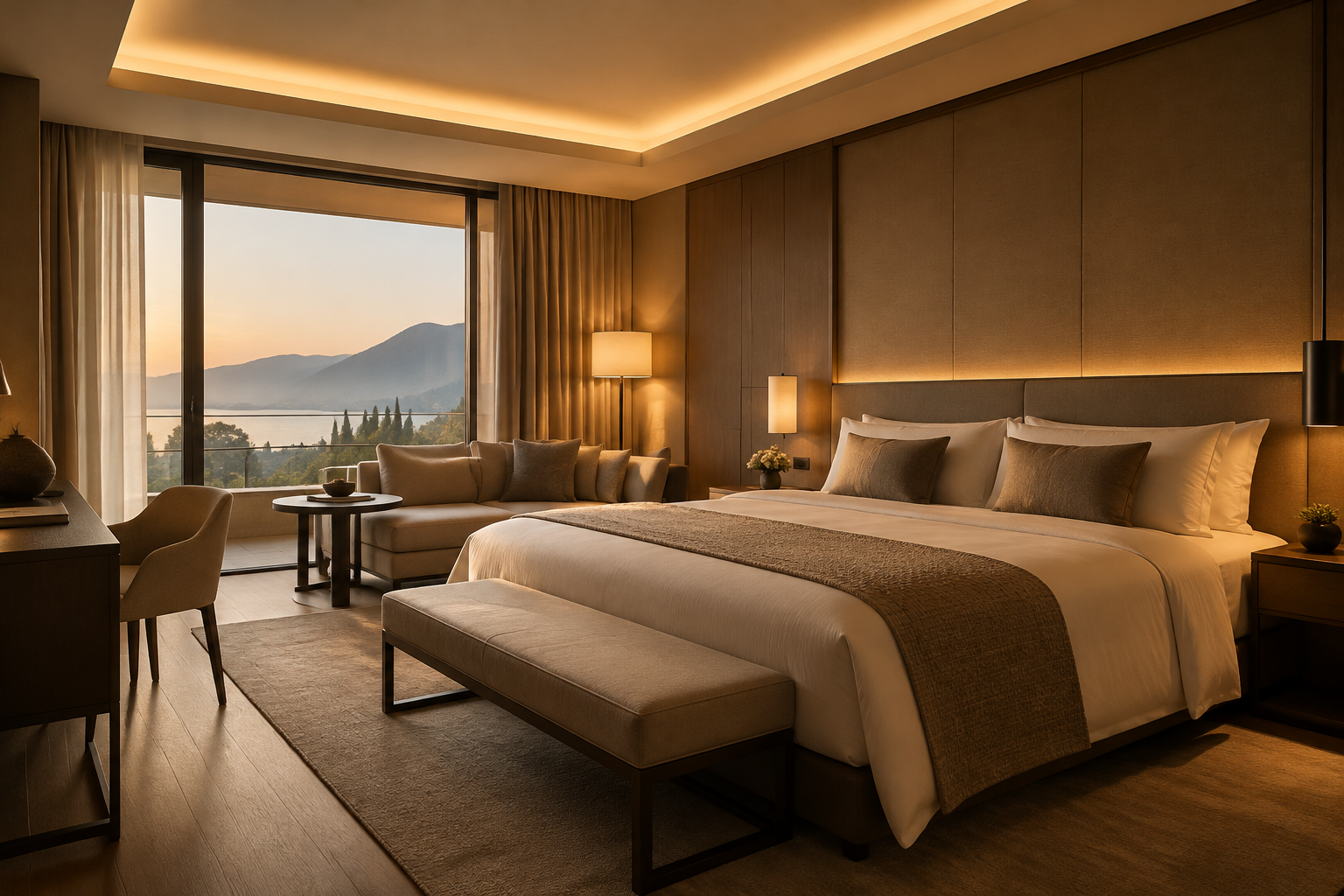
Introduction: Planning Concealed 2700K Guestroom Lighting
At XHLWX (led-project-light.com), a Custom Indoor LED Lighting Manufacturer based in China, ... specify concealed 2700K coves, continuous diffusion and shielded slots for hotel room ambient lighting in 2026. Recommended specifications include CRI ≥90 and a dimmable ambient scene targeting 50–100 lx, refined through room modelling and a full-scale mock-up.
The objective is a calm guestroom, not simply a bright ceiling. A successful cove illuminates the surrounding architecture without exposing LED points, creating harsh reflected lines or washing the television with light. The same arrangement must remain comfortable when guests stand at the entrance, sit beside the bed or recline against the headboard.
For owners, interior designers and FF&E buyers across the EU, US, Middle East and Southeast Asia, procurement should connect the architectural detail to the complete electrical system. Strip, profile, diffuser, driver, controls and access provisions form one coordinated assembly. Unless identified as a standard designation, numerical performance values below are recommended specifications or design targets—not measured product results.
Design Criteria and Standards: Specifying Warm Ambient Light Without Exposed LEDs
A good guestroom specification separates visual comfort, colour quality, useful illumination and electrical compliance rather than treating wattage as the design brief.
Use 2700K as the recommended specification for the main ambient cove where warm finishes and a relaxed evening atmosphere are intended. Review it beside bedside luminaires, bathroom spill light and decorative shades; nominally matching colour temperatures can still look different because of spectral distribution and tint.
The recommended ambient design target of 50–100 lx applies to the agreed occupied-room horizontal reference plane, not automatically to every surface. Record that plane in the lighting brief. Reading, desk work, dressing and housekeeping need separately assessed lighting; a cove should not carry every task.
| Parameter | Spec | Standard | Notes |
|---|---|---|---|
| CCT and colour consistency | Recommended specification: 2700K; colour consistency ≤3 SDCM | Relevant IES measurement methods; project colour brief | Approve a physical sample against actual finishes and adjacent luminaires. |
| Colour rendering | Recommended specification: CRI Ra ≥90; request R9 data | CIE colour-rendering methodology; WELL v2 where applicable | CRI alone does not fully describe skin tones or material appearance. |
| UGR and source shielding | Design target: no direct LED view from agreed guest positions; assess UGR only where applicable | EN 12464-1; CIE glare methodology | Do not assign a universal UGR rating to a strip or cove independently of its installation. |
| Beam and optical distribution | Recommended specification: diffuse distribution around 120°, subject to mock-up | IES photometric methods | The installed profile, diffuser and cove geometry determine the useful distribution. |
| Control | Recommended specification: DALI-2, Casambi, KNX integration or 0-10V, selected to suit the room system | Applicable DALI-2, KNX and electrical requirements | Specify the exact driver, interface, dimming behaviour and system responsibilities. |
| Housing, material and IP | Recommended specification: aluminium heat-spreading profile; IP20 only for suitable dry, protected locations | EN 60598; IEC 60529 | Increase protection where location conditions require it; protection does not replace thermal assessment. |
| LED and driver options | Candidate brands: Osram, Bridgelux or Samsung LEDs; Tridonic or Mean Well drivers | Selected component datasheets and applicable product requirements | Named brands are options, not a statement of stock, approval or assembly certification. |
| Certification and documentation | Request applicable CE/RoHS documentation, UL listing or other accepted US approval evidence, and ISO9001 evidence if claimed; SAA only where required | Applicable market legislation, safety standards and certification schemes | CE is a marking, RoHS a restriction regime, and ISO9001 a management-system standard; SAA is not a default requirement for these markets. |
EN 12464-1 addresses lighting of indoor workplaces; it is not a universal guestroom mood-lighting schedule. Use relevant provisions where applicable to work activities and obtain project-specific requirements. WELL v2 is a building-level framework, not proof that an individual LED strip is certified.
Customisation Options and Materials: Choosing Serviceable Hidden Light Slots
Cove geometry and surface reflectance usually determine comfort more directly than the choice between otherwise comparable LED packages.
Coordinate the slot opening, concealment lip, light-source setback and ceiling finish before freezing joinery drawings. A deeper recess can hide the source but may also reduce useful output or create a bright band near the opening. Avoid selecting dimensions from a reference photograph without checking the actual room section.
| Guestroom detail | Principal benefit | Main risk | Verdict |
|---|---|---|---|
| Ceiling perimeter cove | Broad ceiling illumination and an uncluttered appearance | Bright edge bands or reflected glare on glossy finishes | Prefer where ceiling reflectance and maintenance access are controlled. |
| Headboard uplight slot | Local warmth around the bed | Direct source view when reclining; conflict with reading lights | Use only after checking pillow-level sightlines. |
| Curtain-pocket light slot | Soft illumination of fabric and window-zone surfaces | Uneven folds, fabric proximity or inaccessible components | Suitable with coordinated curtain clearance and service access. |
| Recessed linear ceiling slot | Precise architectural alignment | Visible diffuser luminance and distracting lines above the bed | Choose only with appropriate shielding and dimmed-scene review. |
| Cabinet-top concealed profile | Integrates ambient light with furniture | Trapped heat and difficult driver replacement | Useful when ventilation and removable access are designed in. |
How Should a Cove Hide LED Points from Guests Lying in Bed?
The concealment lip must interrupt the guest’s sightline to the emitting surface without blocking the intended ceiling wash.
Check sections from the entrance, desk chair, bedside seat and reclined sleeping position. A strip hidden from a standing observer may remain visible from the pillow. Corners, mirrored doors and polished trims require additional checks because reflections can reveal a concealed source.
Approve the actual profile and diffuser together. Closely spaced LEDs or a continuous-emitting strip can reduce spotting, but neither automatically solves direct glare. Diffuser transmission, source spacing and viewing angle remain important.
Which Materials Keep Hotel Guestroom Light Slots Visually Consistent?
Stable profiles and approved room finishes help prevent heat-related distortion, colour mismatch and uneven reflected light.
Specify an aluminium profile sized for the chosen strip’s thermal requirements. Select diffuser materials using documented optical, temperature and fire-performance information appropriate to the assembly and location. Do not assume all plastics age or transmit light identically.
Approve powder coating or anodising beside the room’s metalwork. Inside the cove, a consistent matte finish generally produces a gentler reflection than a glossy surface. The thermal path must remain effective after painting, fastening and final installation.
When Should Custom Dimensions Replace a Standard LED Profile?
Custom dimensions are justified when standard profiles cannot satisfy concealment, installation tolerance, thermal performance or maintenance access.
Typical triggers include shallow ceiling voids, non-standard headboards, angled returns and coordinated curtain pockets. Freeze the section only after reviewing the ceiling build-up, wiring route and fixing method.
Make diffuser removal and strip replacement possible without damaging decorative finishes. Where a profile is divided into modules, document joints, feed locations and visible continuity. A longer seamless-looking installation is not necessarily easier to maintain.
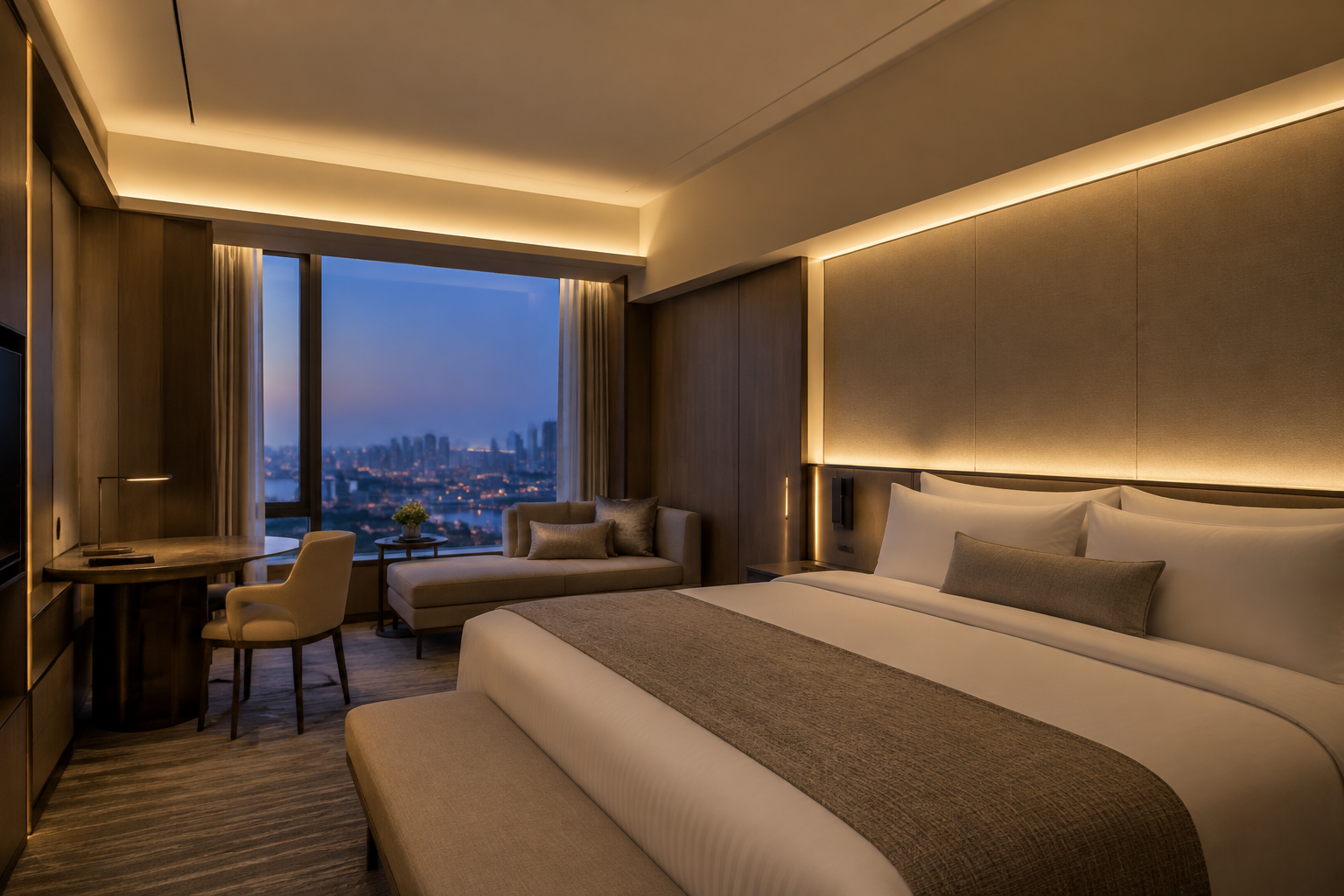 How Should 2700K Hotel Room Coves Control Glare in 2026?: Which materials keep hotel guestroom light slots visually consistent?
Controls and Commissioning: Delivering Quiet, Predictable Guestroom Dimming
The control protocol matters less than a verified combination of driver, controller, load and commissioning settings.
DALI-2 can support addressable scenes and diagnostics when the selected devices and application support them. Casambi may suit wireless scene control, subject to gateway needs, radio conditions and operational policy.
KNX commonly needs a compatible lighting actuator or gateway. For 0-10V, verify the dimming range and how the circuit achieves off; dim-to-off is not universal.
Use a recommended specification of stable dimming to 1% of full output if the evening scene requires very low light. Treat this as an acceptance target, not an assumed capability. Ask whether the stated minimum refers to measured light output or merely a control signal value.
Commission welcome, relax, housekeeping and off scenes around the operator’s brief. Keep bedside task lighting independently controllable.
Test fades, low-end stability, audible driver noise, switch response and recovery after power loss. Document which scenes persist after occupancy-system events and which settings guests can override.
Request temporal light modulation information across the intended dimming range. Camera footage can help identify a concern, but it does not replace suitable flicker measurements or jurisdiction-specific assessment.
Sampling, MOQ, Lead Time and Quality Control: Approving the Complete Assembly
Approve a representative cove assembly before placing the production order, and obtain commercial commitments against a frozen bill of materials.
The sample should include the intended strip, profile, diffuser, driver, connectors and control interface. Build it into the proposed architectural section with representative finishes. Review it in darkness and with adjacent bedside and bathroom lighting operating.
Acceptance criteria should cover colour consistency, visible spotting, diffuser seating, surface finish, dimming behaviour and serviceability. Check thermal performance under representative mounting and enclosure conditions, using the selected components’ limits. Avoid accepting an exposed bench sample as evidence for a sealed or poorly ventilated recess.
MOQ and lead time depend on profile tooling, finish batches, component availability, testing and packaging. No fixed quantities or delivery periods are asserted here. Request separate written commitments for sample preparation, approval, production and dispatch, including the effect of changes after approval.
The purchase specification should identify traceability requirements, inspection records and agreed substitution controls. Preserve the approved sample as the reference, and match room labels and circuit identifiers to the installation drawings. Define replacement-stock requirements with the operator rather than assuming future batches will match perfectly.
Photometric Files & Compliance: Validating the Installed Cove for Each Market
Photometric modelling and market documentation must relate to the proposed assembly, not just to individual components.
Request IES and LDT photometric files for the strip, profile and diffuser configuration being proposed. Import suitable files into DIALux and model the cove’s obstruction geometry, ceiling reflectance and surrounding surfaces. Files describing a bare strip cannot directly establish the performance of a finished concealed slot.
Review illuminance distribution and ceiling brightness together. UGR may be informative in applicable arrangements, but a single catalogue value cannot establish comfort for a custom indirect cove. Pillow-level sightlines and reflected glare still require physical review.
Use EN 60598 as the relevant luminaire safety standards family, selecting the applicable parts and national requirements with a qualified compliance specialist. Component approvals do not automatically approve the finished assembly. US requirements should be agreed with the authority having jurisdiction; EU documentation should address applicable legislation and the supplied product’s classification.
Middle East and Southeast Asia requirements differ by country. Confirm supply characteristics, local conformity procedures and installation rules before finalising drivers. Request verifiable reports and declarations tied to the actual model; do not interpret a logo sheet as sufficient evidence.
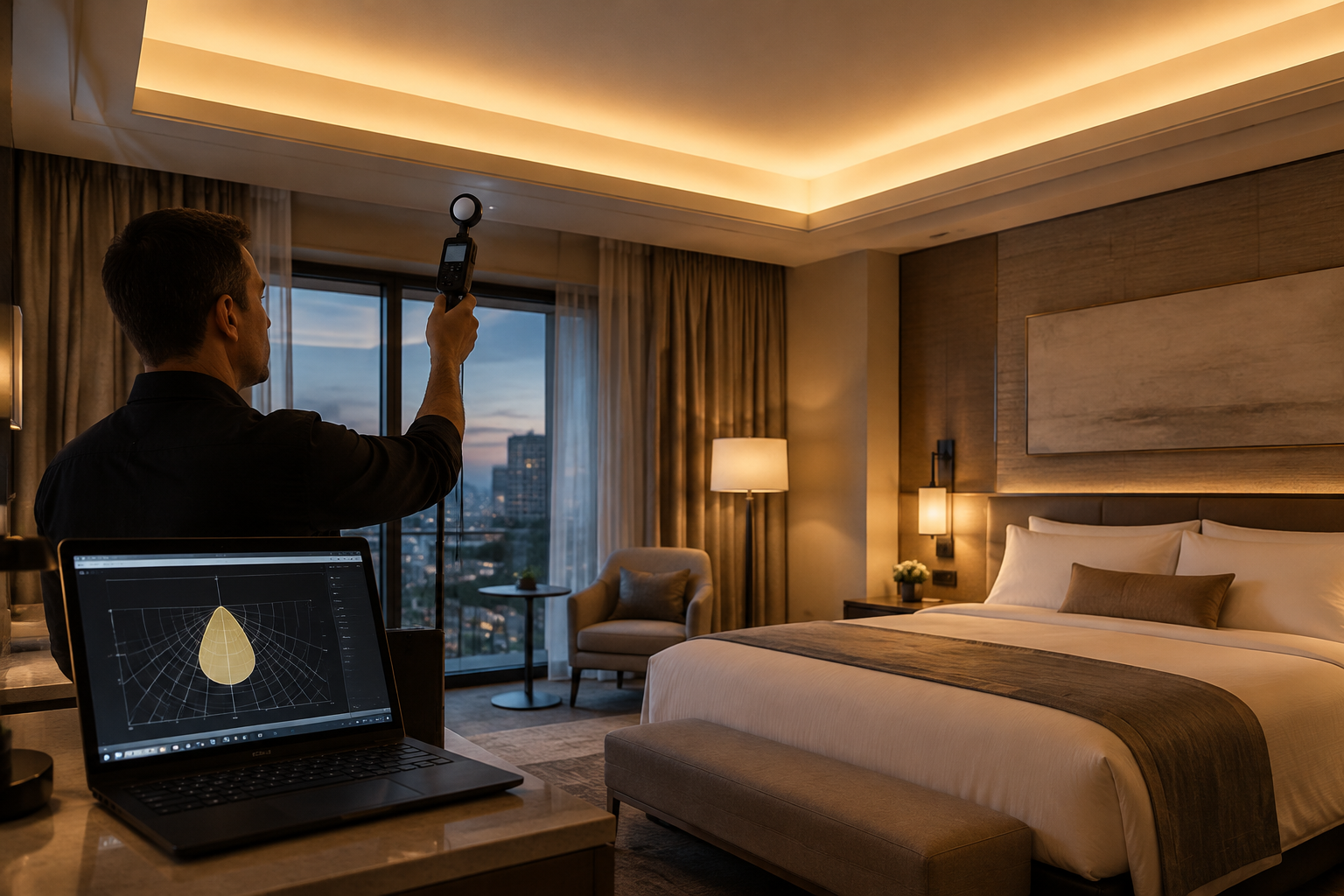 How Should 2700K Hotel Room Coves Control Glare in 2026?: Photometric files & compliance: validating the installed cove for each market
Frequently Asked Questions
Q: Is 2700K Always the Right Colour Temperature for Hotel Room Coves?
2700K is a useful recommended specification for relaxed guestroom ambient lighting, but it is not universally correct. Warm timber and textiles may respond differently from cool stone or painted finishes. Approve a sample alongside bedside lighting and bathroom spill light. Check colour consistency and tint as well as the nominal colour temperature before ordering.
Q: Can a Concealed LED Strip Guarantee UGR Below 19?
No, a concealed strip cannot guarantee a room-level glare outcome by itself. UGR below 19, if adopted as a project design target, requires an applicable assessment method and defined room geometry. Cove brightness, reflections and observer positions still matter. Review the installed arrangement in calculations and check direct source visibility from the bed during the mock-up.
Q: Which Dimming System Works Best for Hotel Guestroom Ambient Lighting?
The best system is the one that integrates reliably with the hotel’s room controls and maintenance workflow. DALI-2, Casambi, KNX-linked drivers and 0-10V can each be appropriate. Specify a recommended low-end target such as 1% output where needed, then test the actual driver and controller together. Confirm off behaviour, power recovery and guest override logic.
Q: What Information Is Needed to Quote a Custom Hotel Cove Assembly?
A useful quote request includes room sections, installation lengths, finishes, electrical supply, control intent and destination-market requirements. State 2700K as the recommended specification if it is approved, and identify any unresolved alternatives. Include access constraints, sample expectations and delivery priorities. Photometric files, test evidence, MOQ and lead time should be requested explicitly rather than assumed.
Sources and Technical References
These references establish assessment methods and regulatory context; none demonstrates certification or measured performance for an unspecified XHLWX product.
- EN 12464-1 — Light and lighting — Lighting of work places — Part 1: Indoor work places. Consult the applicable edition through CEN-CENELEC or a national standards body.
- EN 60598 — Luminaires series. Confirm applicable parts and national adoption; related IEC publications are available through the IEC Webstore.
- IES — Illuminating Engineering Society. Consult relevant guidance and ANSI/IES LM-79 for optical and electrical measurements of solid-state lighting products through IES.
- WELL v2. Review applicable Light concept requirements through the International WELL Building Institute.
- DALI-2 certification. Check specific devices and certification scope through the DALI Alliance.
- EU product rules. Consult European Commission guidance on CE marking and RoHS.
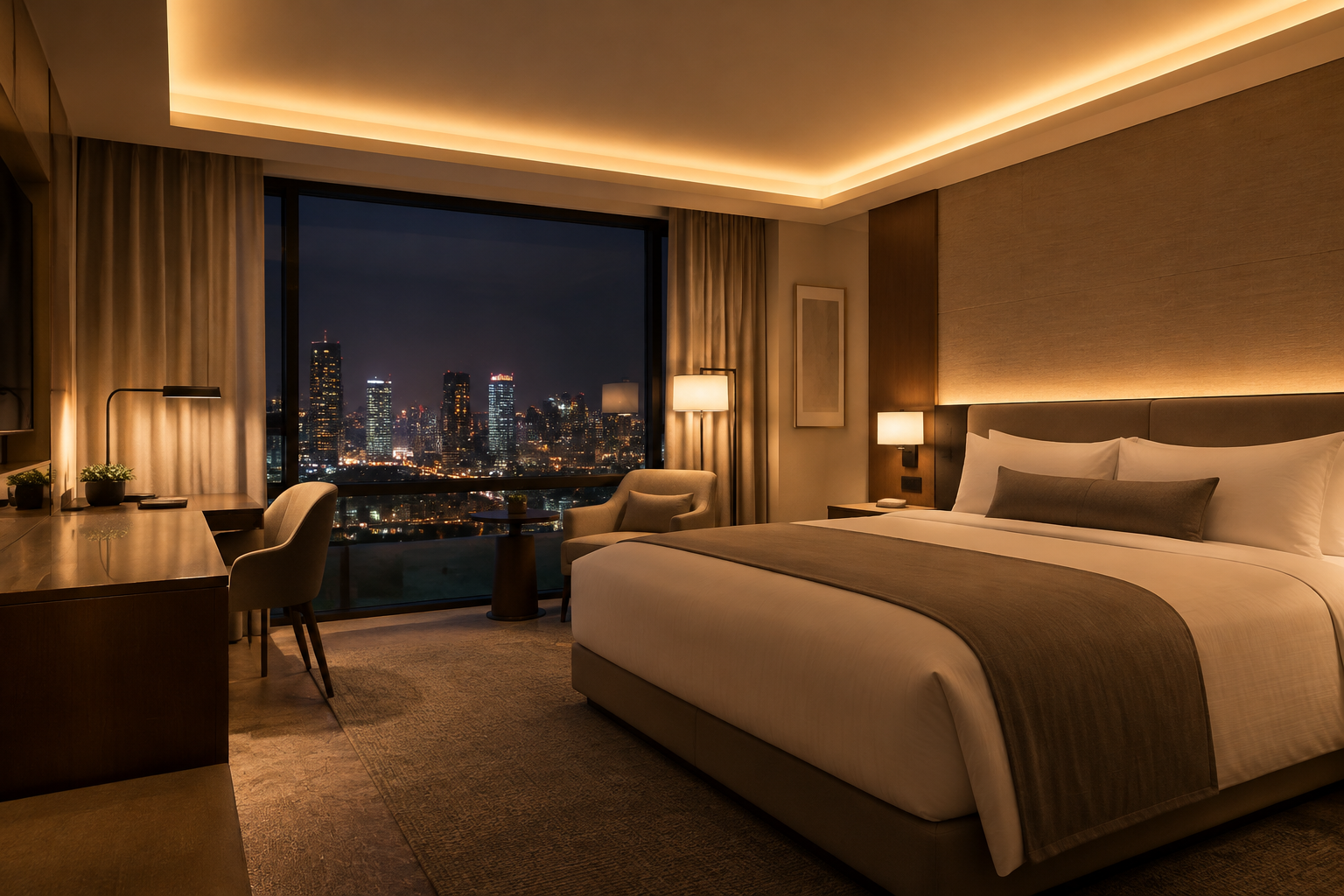 How Should 2700K Hotel Room Coves Control Glare in 2026?: Q: Which dimming system works best for hotel guestroom ambient lighting?
Request a Custom Quote
A precise guestroom brief enables a more defensible quotation than a reference image and a requested strip wattage alone.
start a custom quote enquiry with guestroom plans, cove sections, preferred materials, control interfaces and destination markets. Request a proposed assembly, sample-approval plan, photometric documentation, applicable compliance evidence and itemised commercial terms. Identify the approved 2700K design intent and require written confirmation of dimming, access and substitution criteria before purchase.
XHLWX 소개
XHLWX는 2009년부터 중국 선전에 자체 공장을 운영해 온 LED 프로젝트 조명 제조사 Shenzhen Qihang Lighting Co., Ltd.의 브랜드입니다. 라인 조명, 다운라이트, 마그네틱 레일, 평판 조명, 방수·방진 등기구, 고천장 조명과 맞춤형 조명을 사무실, 호텔, 박물관·미술관, 리테일, 공장 프로젝트에 공급합니다.
조도 설계는 KS A 3011과 EN 12464-1 기준값(유지 조도, UGR, 균제도, Ra)을 바탕으로 하며 DIALux용 IES·LDT 배광 파일을 제공합니다. 제품은 CE·RoHS에 적합하며 품질 관리는 ISO 9001을 따릅니다.
XHLWX 자주 묻는 질문
한국 프로젝트에도 납품할 수 있나요?
네. 공장에서 해외 프로젝트로 직접 출고합니다. 운송 조건과 국내 KC 인증 대응 여부는 프로젝트별로 사전에 협의해 주세요.
KS A 3011 조도 기준에 맞춘 설계가 가능한가요?
가능합니다. 필요 조도, UGR, 균제도를 기준으로 조명 계획을 세우고 당사 배광 파일로 DIALux 계산을 해 수치를 확인합니다.
어떤 조광·제어 방식을 지원하나요?
DALI-2, 0-10V, Casambi(블루투스)를 지원하며, 프로젝트에 따라 비상등이나 센서 사양도 검토할 수 있습니다.
맞춤 제작이나 OEM도 가능한가요?
네. 길이, 색온도, 배광각, 본체 색상, 고객 브랜드 OEM/ODM을 자체 공장에서 제작합니다.
Need a tailored lighting plan for your project?
Our senior lighting designers reply within 48 hours with a free design proposal & quotation.