
How Should Hotel Wall Lights Use Hidden Drivers and ELV Wiring?
Quick answer
Plan concealed drivers, safe ELV wiring, dimming and maintenance access for bespoke hotel sconces across EU, US, Middle East and Southeast Asian projects.
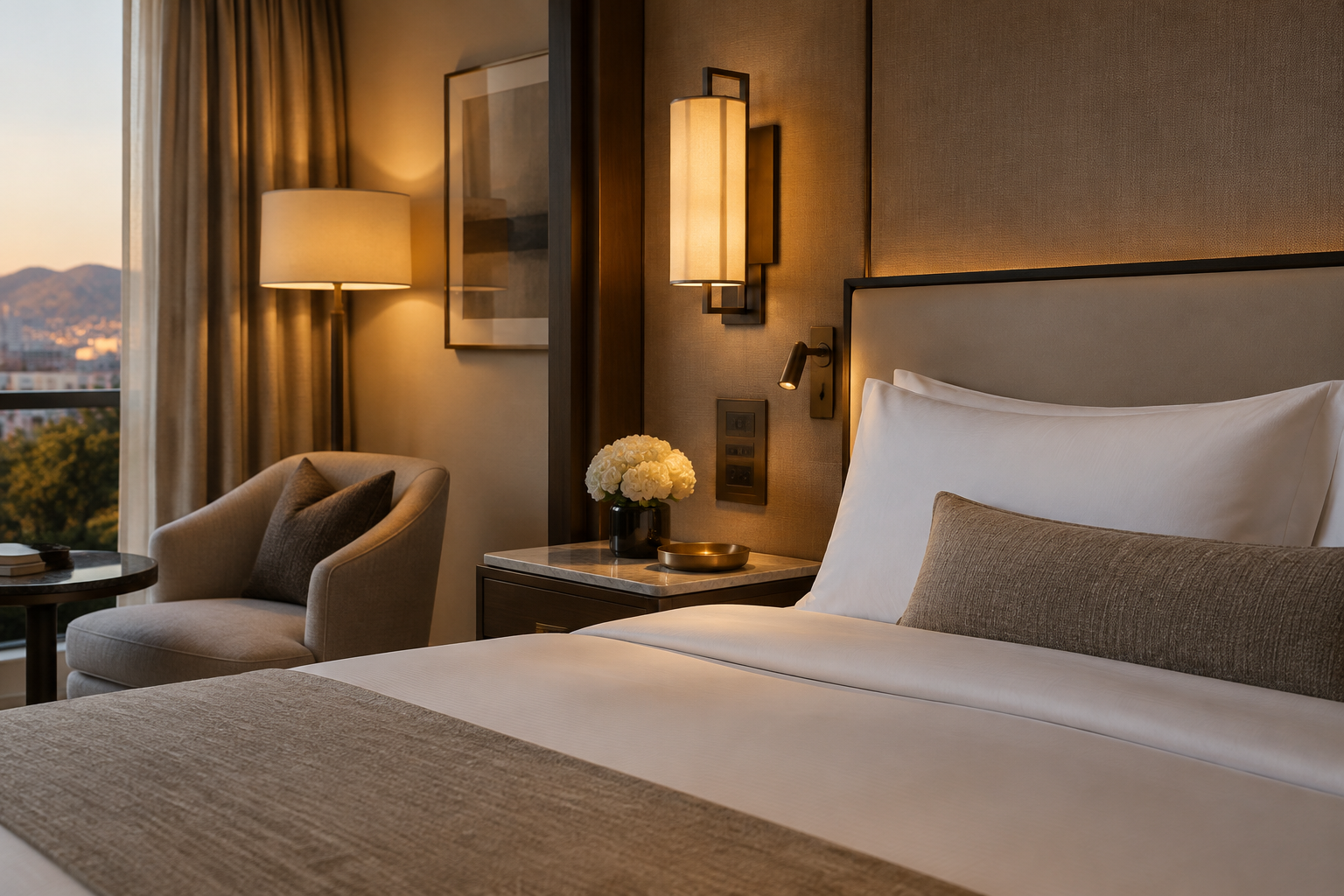
Introduction
At XHLWX (led-project-light.com), a Custom Indoor LED Lighting Manufacturer based in China, ... we recommend accessible concealed drivers and segregated ELV wiring for hotel sconces. Recommended specifications start with 24 V DC constant-voltage fittings and a maximum 3% cable voltage-drop design target; constant-current fittings require a separately matched driver and wiring calculation.
A concealed driver should be invisible to guests, not inaccessible to maintenance staff. For bedside sconces, the best location is usually an accessible joinery compartment, service enclosure or suitable ceiling access zone—not permanently behind upholstered panels.
This guide addresses indoor hotel wall lights for EU, US, Middle East and Southeast Asian procurement teams. All numerical performance values below are design targets or recommended specifications unless identified as calculation results; they are not measured XHLWX product results. Applicable safety requirements must be confirmed by the project's electrical designer and local authority.
Design Criteria and Standards
Safe concealed-driver design starts by matching the LED load, electrical protection, cable route and maintenance access before approving the decorative housing.
First distinguish constant-voltage modules from constant-current LED boards. A constant-voltage driver supplies a specified voltage within its load capacity.
A constant-current driver regulates current within an output-voltage window. Connecting either type to an incompatible light engine can cause failure or unsafe operation.
ELV means extra-low voltage in electrical design, but US dimmer catalogues may use ELV to mean electronic low-voltage phase-cut dimming. Specify the intended meaning. Neither label alone establishes SELV protection, a US Class 2 circuit or dimming compatibility.
| Parameter | Spec | Standard | Notes |
|---|---|---|---|
| CCT and colour rendering | Recommended specification: 2700–3000 K, CRI ≥90 | EN 12464-1 where applicable; WELL v2 project criteria | Approve the LED source behind the actual shade and diffuser |
| Glare and beam | Design target: UGR ≤19 where applicable to the task; recommended reading beam 30–60° | EN 12464-1; IES photometric guidance | UGR depends on room geometry and observer position, not the fitting alone |
| Supply topology | Recommended specification: 24 V DC for compatible constant-voltage modules | EN 60598; applicable power-supply safety standards | Verify SELV or US Class 2 requirements independently |
| Control | Recommended options: DALI-2, Casambi, KNX interface or 0-10V | Applicable protocol specifications and electrical rules | Confirm the complete driver, interface and control combination |
| Housing, material and IP | Recommended dry-room specification: aluminium or steel housing, IP20 | EN 60598; IEC 60529 | Bathroom location may require different protection and installation measures |
| Chip and driver brands | Recommended candidates: Osram, Bridgelux or Samsung LEDs; Tridonic or Mean Well drivers | Model-specific documentation and applicable safety standards | Brand selection does not prove system compatibility or approval |
| Certification evidence | Request applicable CE/RoHS documentation, UL evidence where specified, SAA if contractually relevant, and ISO9001 evidence if claimed | Destination-market requirements | These are different conformity, certification and management-system schemes |
EN 12464-1 addresses indoor workplaces and relevant hotel work areas; it is not a universal guestroom ambience prescription. EN 60598 addresses luminaire safety. WELL v2 may add project-specific lighting requirements, but it does not certify a wall light simply because its colour temperature matches a schedule.
Customisation Options and Materials
Custom sconces work best when the decorative body, replaceable light engine and driver-access strategy are designed as separate, coordinated elements.
Driver location affects more than appearance: it changes cable length, heat management, installation sequencing and the consequences of a single failure.
| Driver arrangement | Main advantage | Main constraint | Verdict |
|---|---|---|---|
| Accessible bedside joinery compartment | Short secondary cable and convenient servicing | Requires ventilation and coordination with FF&E | Preferred when joinery access is reliable |
| Accessible ceiling service enclosure | Keeps the wall fitting compact | Longer cable runs and potential ceiling-access disruption | Suitable after cable and driver-limit checks |
| Driver inside the sconce | Compact electrical scope and short LED connections | Larger body, concentrated heat and luminaire removal for service | Suitable when product construction supports it |
| Shared remote supply for several sconces | Consolidates supply equipment | Shared outages, branch protection and control complexity | Use only with engineered distribution |
How Can a Bespoke Sconce Conceal Wiring Without Trapping the Driver?
A removable mounting plate and planned service route conceal the wiring while preserving access to terminals and replaceable components.
Provide strain relief, protected cable entries and sufficient space for connectors without crushing insulation. Coordinate the mounting plate with the wall box before producing the decorative sample. A shallow European box, US outlet box and project-specific regional box may need different fixing details.
Show the driver access panel on both the lighting drawing and the joinery drawing. A hatch that cannot open after the bedhead is installed is not practical access.
Which Materials Suit Hotel Bedside Sconces with Remote Drivers?
Metal bodies manage mechanical loads effectively, while shades and diffusers determine visual comfort and light distribution.
Aluminium can support heat spreading when properly coupled to the LED board. Steel suits robust mounting structures; brass may suit decorative components. Fabric shades, acrylic and glass require appropriate thermal and mechanical assessment.
Approve the actual finish, diffuser thickness and shade lining. Material substitutions can change temperatures, output and cleaning performance, even when the silhouette remains unchanged.
When Should Each Wall Light Have Its Own Driver?
Individual drivers are preferable when independent dimming, fault isolation and straightforward replacement outweigh the space and cost of additional equipment.
A shared constant-voltage supply can serve compatible branches only when its loading, output classification, branch protection and controls are engineered accordingly. Do not parallel arbitrary constant-current LED boards. For shared arrangements, document how a failed branch is isolated and whether maintenance interrupts other guestroom lights.
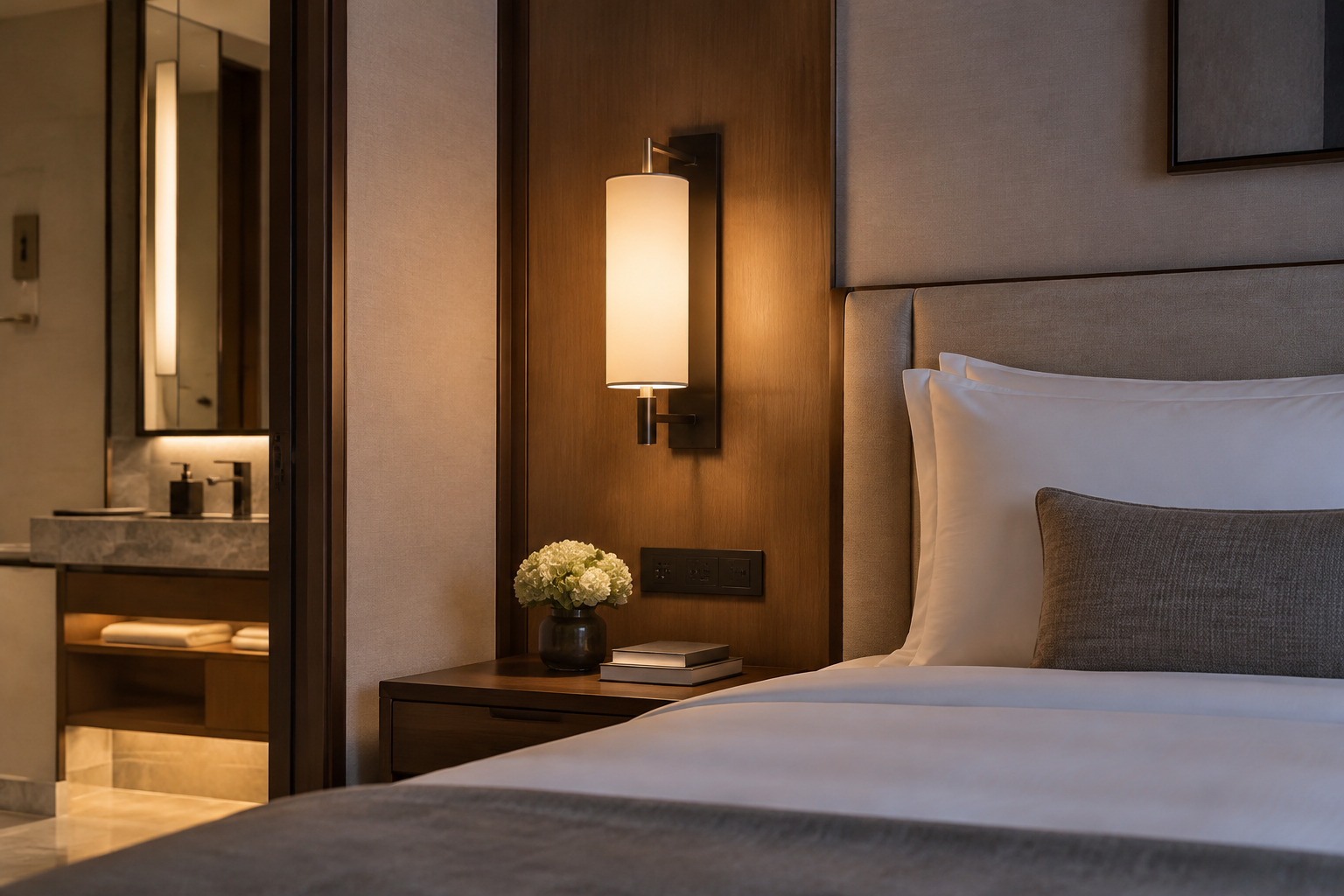 How Should Hotel Wall Lights Use Hidden Drivers and ELV Wiring?: Which materials suit hotel bedside sconces with remote drivers?
Controls and Commissioning
Reliable dimming depends on the complete control chain, not merely a dimmable label on the driver.
DALI-2 supports addressable control when suitable devices and application controllers are specified. Casambi can simplify some control wiring, but metal compartments, network configuration and maintenance access still matter.
KNX normally requires a compatible driver interface, actuator or gateway. A 0-10V installation needs explicit confirmation of its signal behaviour, polarity and off-state switching arrangement.
Do not assume a control pair is SELV or safe to mix with LED output wiring. DALI bus insulation, mains segregation and cable grouping must follow the equipment instructions and applicable installation rules.
For cable sizing, use the complete outgoing-and-returning conductor path:
Voltage drop = circuit current × total loop resistance.
As a design example, take a recommended 24 V DC module rated at 12 W.5 A.
44 Ω at that operating point. This includes connections; it is not a universal cable-length allowance.
Select conductor size using actual route length, material, operating temperature and local installation requirements. Constant-current outputs need a different check: LED forward voltage plus cable drop must remain within the driver's operating window.
Commission at full output and the intended minimum scene. A 1% minimum dimming level may be a design target, but verify flicker, dropout, audible noise and restart behaviour with the complete system.
Sampling, MOQ, Lead Time and Quality Control
A working electrical sample should be approved before decorative production quantities and delivery dates are committed.
Request a sample with the proposed LED board, driver, connectors, cable route representation, finish and control interface. A showroom sample with a short cable does not validate a remote-driver installation using a longer route.
Use an approval sequence covering:
- Electrical schedule: Supply input, output type, load, control protocol and protection concept.
- Mechanical sample: Mounting interface, access, cable entry, finish and shade attachment.
- Functional mock-up: Actual control equipment, representative cable run and intended dimming scenes.
- Thermal review: Driver placement, enclosure conditions and manufacturer temperature limits.
- Production release: Frozen drawings, approved bill of materials and substitution rules.
MOQ and lead time are quotation-specific. They depend on tooling, finish batches, driver availability, testing scope and order mix. No minimum quantity or delivery duration should be assumed without written confirmation.
Ask the supplier to define inspection records and tests appropriate to the construction, including protective-earth continuity where applicable, insulation-related checks, polarity and functional operation. Any burn-in duration should be an agreed inspection requirement, not presented as proof of lifetime.
Record replacement driver models and connector details so hotel maintenance teams can order compatible parts rather than visually similar substitutes.
Photometric Files & Compliance
Photometric evidence and electrical compliance documents answer different questions, and a procurement package should include both.
Request IES and LDT photometric files matching the proposed optical assembly, LED configuration and relevant finish. Use DIALux to evaluate the installation alongside the hotel's other indoor luminaires. Bedside reading performance depends on mounting height, aiming, shade geometry and the reading position—not simply nominal wattage.
Remote drivers also have output-cable limits related to electromagnetic compatibility, start-up behaviour and the equipment's tested configuration. Passing a voltage-drop calculation does not override the manufacturer's maximum secondary-cable length.
For EU projects, request the applicable EU Declaration of Conformity and supporting documentation addressing relevant legislation, including RoHS obligations. CE is not a generic third-party quality certificate.
For US projects, confirm required listing or other acceptance with the authority having jurisdiction. A UL-recognized component does not automatically establish that the complete custom luminaire is listed. Likewise, a Class 2 supply is not the same concept as a Class II double-insulated luminaire.
Middle East and Southeast Asian requirements differ by country. Confirm the exact destination, supply characteristics, conformity route and installation rules. SAA documentation is not a universal approval for these regions. ISO9001 concerns a quality-management system and cannot replace product safety evidence.
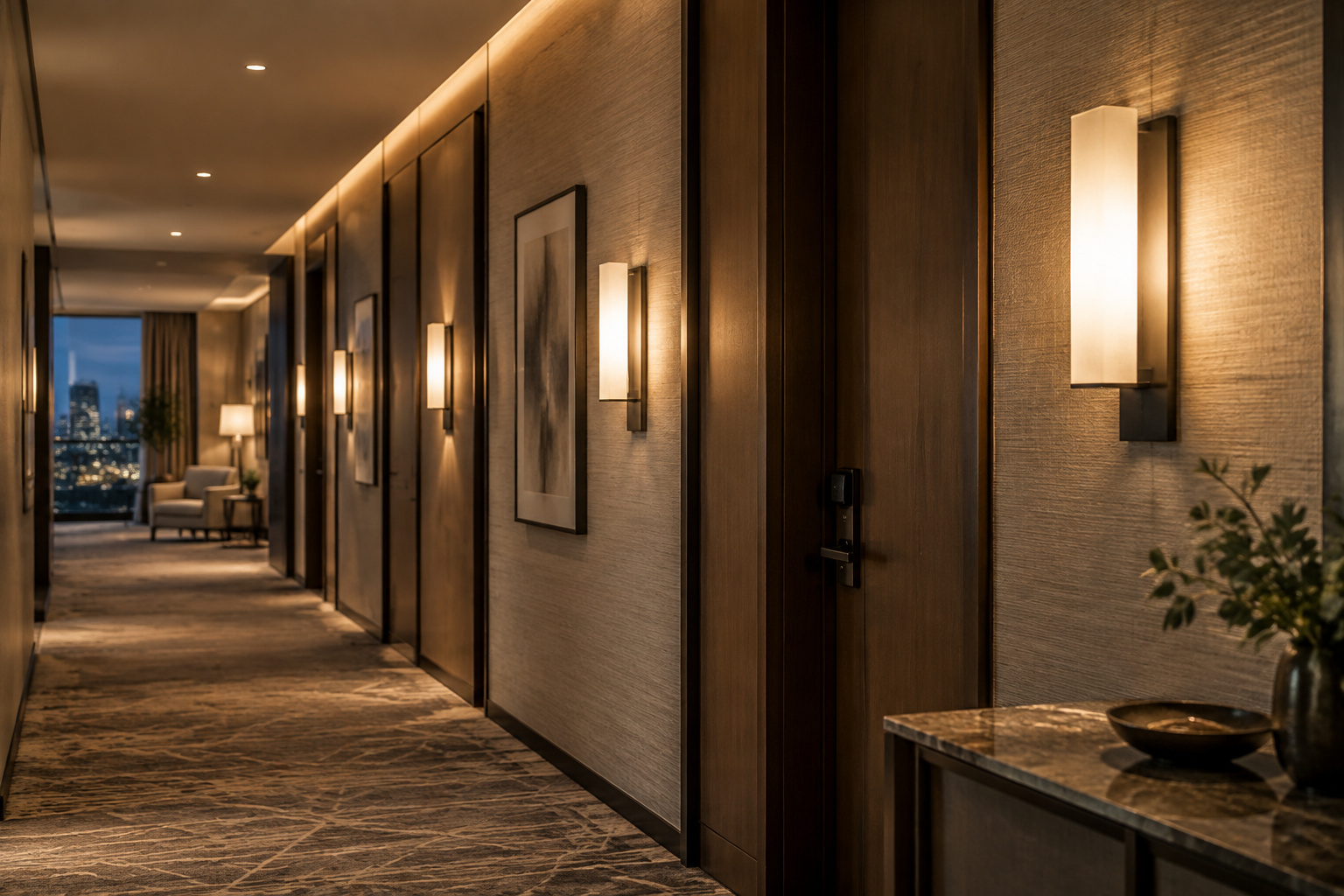 How Should Hotel Wall Lights Use Hidden Drivers and ELV Wiring?: Photometric files & compliance
Frequently Asked Questions
Q: Can a Concealed Driver Be Sealed Permanently Behind a Hotel Headboard?
Concealed drivers should remain accessible for inspection and replacement. A recommended design approach is 1 clearly identified service location per driver or driver group, coordinated with the joinery drawings. Access must also preserve ventilation and safe electrical servicing. Do not assume that removing an entire upholstered headboard is an acceptable routine maintenance method.
Q: Is 24 V Wiring Automatically SELV or Class 2?
A voltage label alone does not establish the circuit's protective classification. A recommended 24 V DC system still needs the correct power supply, separation, wiring and installation conditions. SELV and US Class 2 describe different protection frameworks, while Class II concerns insulation construction. Require documentation for the actual equipment and intended installation rather than relying on terminology in a catalogue.
Q: How Far Can the Driver Be Installed from a Bedside Sconce?
The permissible distance depends on cable resistance, load and the driver's documented output-cable limitations. Use a 3% voltage-drop design target where appropriate, then check conductor sizing, connectors, output behaviour and electromagnetic compatibility constraints. Constant-current systems require output-voltage-headroom checks instead of a simple constant-voltage assumption. The shorter permitted distance from these checks governs the installation.
Q: Which Dimming System Is Best for Custom Hotel Wall Lights?
The best dimming system is the one proven compatible with the hotel's control architecture and selected LED load. Specify DALI-2, Casambi, KNX integration or 0-10V deliberately rather than treating them as interchangeable. If a 1% minimum scene is a design target, test it with the actual driver, controller and cable configuration before approving production.
Sources and Technical References
Use current standards and model-specific documentation to verify safety, photometry and control compatibility before procurement approval.
- CEN-CENELEC: Standards search for EN 12464-1 and the EN 60598 series; confirm applicable editions and parts.
- IES: Illuminating Engineering Society for lighting guidance and photometric resources.
- WELL v2: WELL Standard for applicable project lighting features.
- DALI Alliance: DALI resources and product database for protocol information and certification checks.
- NFPA and UL: NFPA and UL Solutions for US installation-code and product-evaluation context.
- Selected manufacturers: Obtain current driver datasheets, wiring diagrams, cable limits and dimming compatibility documentation.
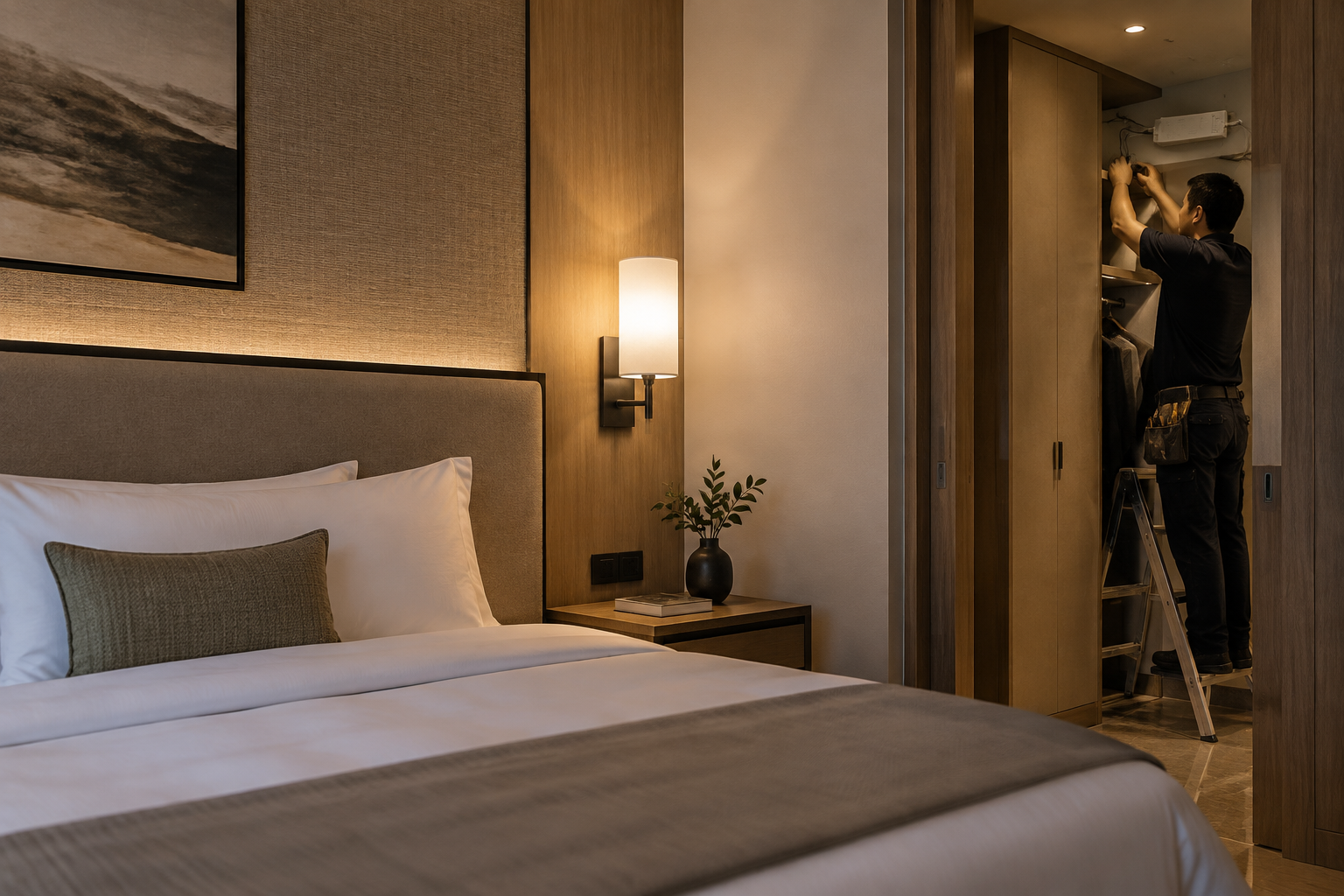 How Should Hotel Wall Lights Use Hidden Drivers and ELV Wiring?: Q: How far can the driver be installed from a bedside sconce?
Request a Custom Quote
An actionable quotation brief combines the decorative design with the electrical architecture and destination-market requirements.
Send the sconce drawing, room application, quantity schedule, wall construction, finish sample, LED load and preferred controls. Include the proposed driver location, cable-route length, access detail and any required certification route. Request separate confirmation of sample scope, MOQ, production lead time, photometric deliverables and compliance evidence.
At XHLWX (led-project-light.com), a Custom Indoor LED Lighting Manufacturer based in China, ... a custom hotel wall-light enquiry should begin with coordinated driver access, matched electrical components and documented wiring requirements. Submit these details to define the quotation scope before the interior design and electrical packages are frozen.
XHLWX 소개
XHLWX는 2009년부터 중국 선전에 자체 공장을 운영해 온 LED 프로젝트 조명 제조사 Shenzhen Qihang Lighting Co., Ltd.의 브랜드입니다. 라인 조명, 다운라이트, 마그네틱 레일, 평판 조명, 방수·방진 등기구, 고천장 조명과 맞춤형 조명을 사무실, 호텔, 박물관·미술관, 리테일, 공장 프로젝트에 공급합니다.
조도 설계는 KS A 3011과 EN 12464-1 기준값(유지 조도, UGR, 균제도, Ra)을 바탕으로 하며 DIALux용 IES·LDT 배광 파일을 제공합니다. 제품은 CE·RoHS에 적합하며 품질 관리는 ISO 9001을 따릅니다.
XHLWX 자주 묻는 질문
한국 프로젝트에도 납품할 수 있나요?
네. 공장에서 해외 프로젝트로 직접 출고합니다. 운송 조건과 국내 KC 인증 대응 여부는 프로젝트별로 사전에 협의해 주세요.
KS A 3011 조도 기준에 맞춘 설계가 가능한가요?
가능합니다. 필요 조도, UGR, 균제도를 기준으로 조명 계획을 세우고 당사 배광 파일로 DIALux 계산을 해 수치를 확인합니다.
어떤 조광·제어 방식을 지원하나요?
DALI-2, 0-10V, Casambi(블루투스)를 지원하며, 프로젝트에 따라 비상등이나 센서 사양도 검토할 수 있습니다.
맞춤 제작이나 OEM도 가능한가요?
네. 길이, 색온도, 배광각, 본체 색상, 고객 브랜드 OEM/ODM을 자체 공장에서 제작합니다.
Need a tailored lighting plan for your project?
Our senior lighting designers reply within 48 hours with a free design proposal & quotation.