
How Do You Specify Gold Chandeliers for GCC 5-Star Hotel Lobbies?
Quick answer
Specify oversized gold chandeliers for GCC luxury hotel lobbies with practical guidance on finishes, structural coordination, dimming and compliance.
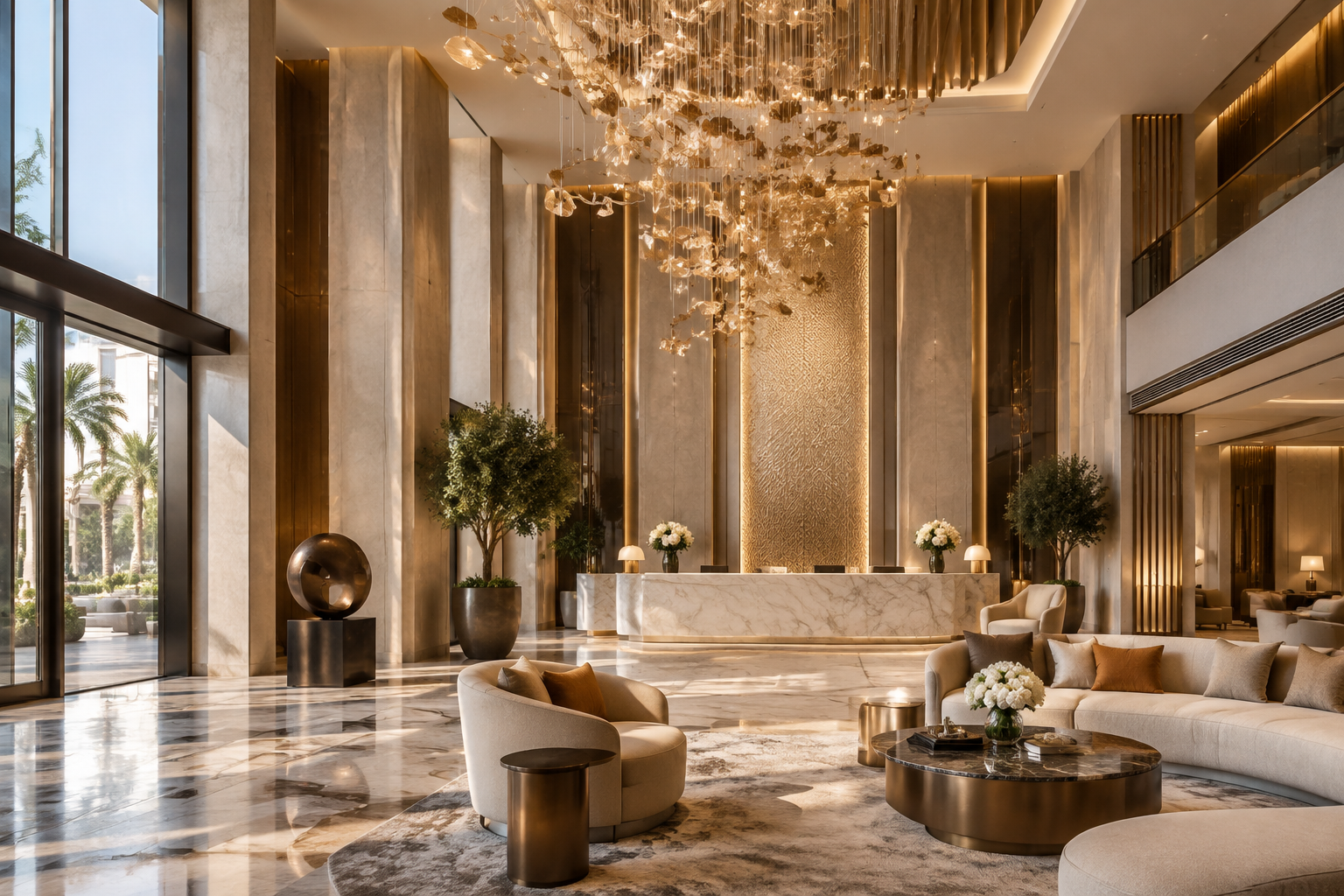
Introduction
At XHLWX (led-project-light.com), a Custom Indoor LED Lighting Manufacturer based in China, ... gold lobby chandeliers require coordinated optical, structural and maintenance specifications. For GCC 5-star interiors, use 2700–3000 K and CRI ≥90 as design targets, then confirm mounting, gold finish samples and dimming compatibility before production.
An oversized chandelier is both a visual centrepiece and a serviceable building component. In a luxury hotel lobby, it must complement the arrival sequence without overwhelming reception, competing with interior signage or creating uncomfortable reflections in polished stone. Gold finishes also need careful approval: brushed champagne, satin brass and mirror gold produce distinctly different appearances under identical light.
For owners, interior designers and FF&E buyers, the strongest brief separates decorative impact from functional illumination. The chandelier can establish identity, while coordinated architectural lighting supports reception desks, circulation and seating. This avoids forcing a decorative object to deliver every lighting task.
GCC procurement also requires coordination across international design teams and local approval routes. An EU designer’s preferred control platform, a US operator’s maintenance requirements and a Middle East contractor’s installation method must resolve into one approved technical package. The same discipline supports Southeast Asian hotel projects, although electrical and regulatory requirements must be checked separately.
Design Criteria and Standards
A reliable specification separates visual design targets from verified product performance, structural requirements and destination-market compliance.
Start with reflected ceiling plans, sections, reception positions and normal guest sightlines. Establish whether the chandelier occupies an atrium, a compressed entrance zone or a seating area. Diameter alone cannot determine suitability: suspension length, luminous surface area, viewing angle and ceiling construction are equally important.
The following values are recommended specifications or design targets, not statements of tested XHLWX product performance. Standards identify relevant assessment routes; applicability requires project review.
| Parameter | Spec | Standard | Notes |
|---|---|---|---|
| CCT and colour rendering | Design target: 2700–3000 K; CRI ≥90 | EN 12464-1; WELL v2 where pursued | Approve gold, stone and fabric samples under the proposed light source. |
| Glare and beam distribution | Design target: UGR ≤19 for applicable reception work areas; recommended specification: 24° or 36° optics for supplementary accents | EN 12464-1; IES lighting guidance | UGR is installation-dependent, not a universal chandelier rating; decorative luminous elements need separate visual assessment. |
| Control interface | Recommended specification: DALI-2, Casambi, KNX integration or 0-10V, selected to match the project | Applicable DALI-2 requirements; control-system documentation | Confirm gateways, driver compatibility and operating behaviour before procurement. |
| Housing, materials and IP | Recommended specification: aluminium or steel structure, selected brass details, replaceable optical elements; IP20 design target for suitable dry interiors | EN 60598; IEC 60529 | Determine protection requirements from the actual cleaning and installation conditions. |
| LED and driver shortlist | Recommended specification: assess Osram, Bridgelux or Samsung LEDs; Tridonic or Mean Well drivers | Component datasheets; applicable luminaire safety requirements | These are candidate brands, not a claim about supplied components or compatibility. |
| Compliance documentation | Specify applicable CE conformity documentation, RoHS evidence, UL certification where required, and SAA documentation where applicable | EN 60598; EU legislation; UL 1598 where applicable | CE is not a universal third-party certificate; SAA is not a default GCC approval route. |
| Quality-system evidence | Request current ISO9001 documentation if required by procurement | ISO 9001 | Verify issuing body, scope and validity; a management-system certificate does not certify a luminaire. |
Use EN 12464-1 for relevant indoor workplace lighting tasks rather than treating every lobby surface as an office task area. WELL v2 is a voluntary building framework, not a chandelier product certification. Neither replaces applicable electrical safety requirements or local approval procedures.
Customisation Options and Materials
Gold appearance depends on substrate, surface preparation, coating and illumination, so physical finish approval is essential before production.
A drawing marked “gold” leaves too much undefined. Specify the substrate, finish process, sheen, brushing direction, acceptable variation and approved cleaning method. Where multiple suppliers provide adjacent metalwork, exchange physical samples rather than relying on colour names or screen images.
| Material or finish route | Main advantage | Main constraint | Verdict |
|---|---|---|---|
| PVD-coated stainless steel | Can deliver a crisp metallic appearance with a durable surface | Colour and consistency depend on process, geometry and preparation | Strong candidate for contemporary gold elements after sample approval. |
| Brushed brass with clear protection | Rich material character and controlled reflections | Weight, coating quality and ageing require evaluation | Suitable for tactile details and warm, understated luxury. |
| Gold-toned coated aluminium | Lower component weight and flexible fabrication | Metallic depth may differ from plated or solid-metal finishes | Useful for large forms where load and fabrication efficiency matter. |
| Electroplated steel components | Broad decorative finish possibilities | Edges, welds and complex recesses need close inspection | Consider when coating quality and maintenance compatibility are demonstrated. |
| Glass or crystal with gold metalwork | Adds sparkle and layered visual depth | Cleaning access, retention and replacement logistics become critical | Best when the hotel accepts the associated maintenance requirements. |
How Should Chandelier Scale Respond to a Double-height Hotel Lobby?
Chandelier scale should follow sightlines, ceiling geometry and structural capacity rather than a fixed room-to-diameter formula.
Study the arrival view, reception backdrop and seated guest perspective in section. A broad, shallow composition may suit a lobby with limited suspension depth, while a cascading arrangement can connect upper and lower visual fields. Avoid blocking interior signage or obscuring important architectural features.
Require a coordinated suspension drawing showing total installed mass, individual support reactions, connection details and access zones. The project structural engineer must verify the supporting structure and anchors. Decorative ceiling finishes must not be assumed to provide load-bearing support.
Which Gold Finish Works Best Beside Marble, Timber and Upholstery?
The best gold finish is the one approved beside the actual interior materials under representative lighting.
Mirror gold can intensify reflections and reveal fingerprints; brushed or satin finishes generally soften reflections. Neither is automatically more luxurious. Request samples that include curves, welded junctions and edges, because flat samples cannot reveal every fabrication effect.
Agree a physical master sample and an acceptable variation range. Check the proposed cleaning chemicals with the finish supplier, especially where hotel housekeeping uses frequently applied disinfectants or polishing products.
How Can an Oversized Chandelier Remain Practical to Maintain?
An oversized chandelier remains maintainable when light engines, drivers and decorative modules can be accessed without dismantling the entire assembly.
Separate replaceable electrical components from ornamental construction wherever practical. Locate remote drivers within their permitted wiring distances and suitable environmental conditions. Label modules and connectors to match the maintenance drawings.
Discuss access equipment, permitted working hours and temporary protection of reception furniture before finalising the form. A concealed component is not truly accessible if servicing requires removing major ceiling finishes.
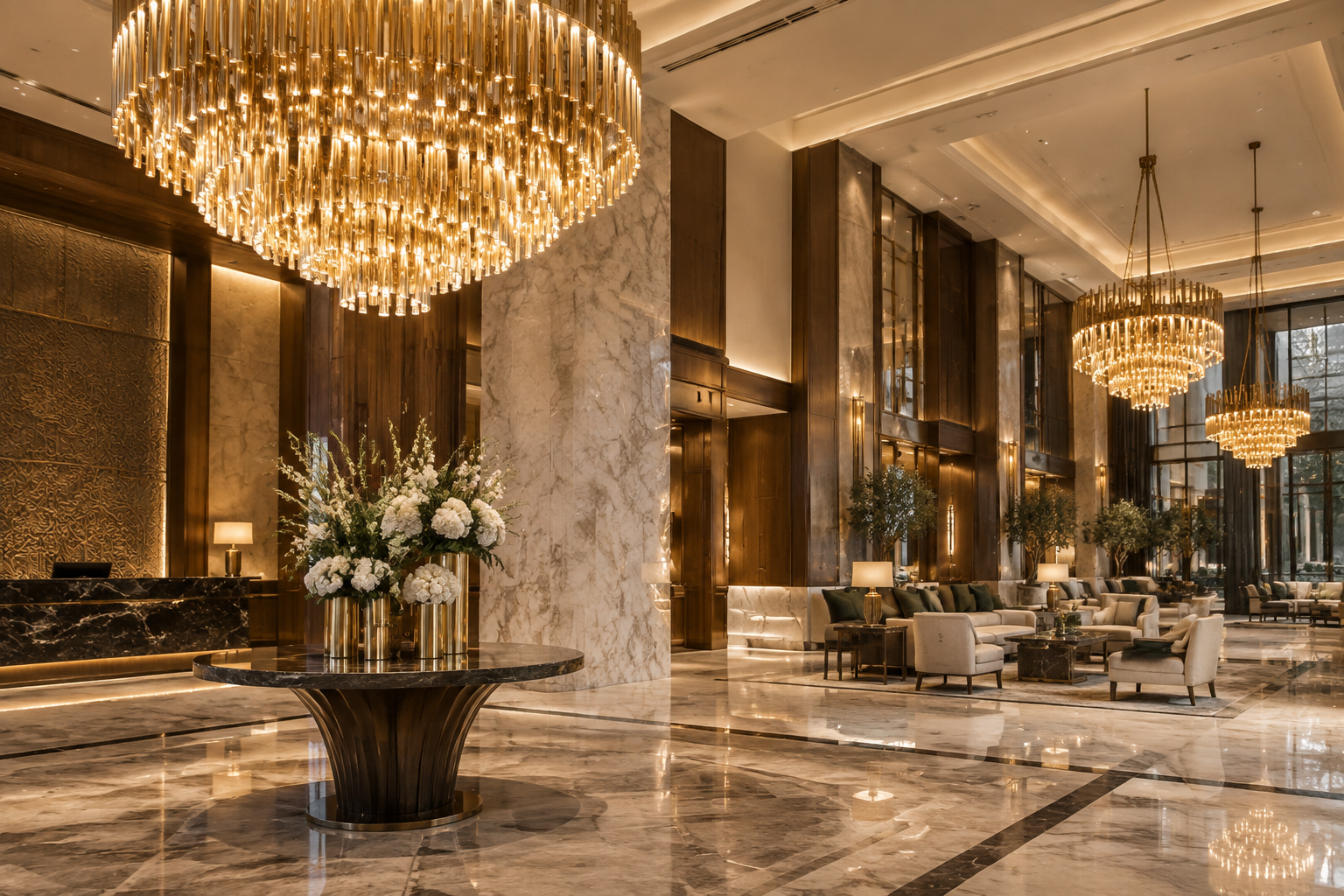 How Do You Specify Gold Chandeliers for GCC 5-Star Hotel Lobbies?: Which gold finish works best beside marble, timber and upholstery?
Controls and Commissioning
Choose the control architecture before approving drivers, because dimming quality depends on the complete control-and-load combination.
DALI-2 can support addressable drivers and organised scene control when the selected devices and system architecture are compatible. Casambi can suit wireless arrangements, subject to radio planning and the chosen gateway strategy.
KNX commonly coordinates wider building functions through suitable lighting interfaces. A 0-10V solution may be appropriate where the project accepts its wiring, addressing and switching limitations.
As a design target, assess smooth, stable dimming down to 1% of rated output where low evening scenes are required. This is not a guaranteed capability: test the exact driver, LED load and controller together. Check flicker, audible noise, start-up behaviour and recovery after a power interruption.
Commission arrival, daytime, evening and housekeeping scenes with the interior designer and hotel operator. Assess guest-facing brightness from seating positions as well as from reception. Keep emergency lighting functions separately coordinated with the relevant life-safety design; a decorative chandelier should not be assumed to fulfil them.
Sampling, MOQ, Lead Time and Quality Control
MOQ and lead time should follow the approved design, fabrication process and testing scope rather than an unsupported catalogue promise.
A bespoke statement chandelier may be assessed as an individual project, but repeat components, finish processes and purchased electronics can impose minimum batch quantities. Request MOQ confirmation separately for the complete assembly, replacement decorative pieces and electrical spares.
Build the programme around design freeze, structural coordination, finish approval, electrical sampling, procurement, fabrication, inspection and packing. Shipping and destination clearance need their own allowances. No reliable production duration can be stated without drawings, quantities, component availability and documentation requirements.
Sampling should address the highest risks first. A finish sample validates appearance; an illuminated module checks light quality and heat management; a representative junction checks workmanship and assembly. A full-size mock-up may be justified where scale, suspension geometry or installation sequencing remains uncertain.
The quality plan should define approved drawings, component traceability, finish acceptance criteria, protective-earth continuity where applicable, electrical safety tests and functional checks. Require inspection records appropriate to the product and approval route. Factory testing does not replace required independent assessment.
Packing should identify assembly order, lifting points and fragile components. Include an illustrated installation manual, wiring diagram, labelled packing list and spare-parts schedule.
Photometric Files & Compliance
Useful photometry must represent the proposed luminous assembly, while compliance evidence must match the supplied configuration and destination market.
Request IES and LDT photometric files for the relevant configuration, supported by available test information and clearly stated limitations. A file from a similar decorative fitting should not be presented as exact project evidence. If the chandelier combines multiple optical modules, document how the calculation model represents them.
Use DIALux to coordinate chandelier output with reception lighting, circulation and adjacent interior surfaces. Input realistic reflectances and installation heights. Calculated illuminance alone will not capture every sparkle, reflection or discomfort issue, so pair simulation with visual review and representative sampling.
EN 60598 provides the relevant luminaire safety framework, with applicable parts determined by product construction. EU supply requires assessment of applicable legislation and supporting conformity documentation. For US projects, confirm the required listing or field-evaluation route with the authority having jurisdiction before fabrication.
GCC countries do not share one universal approval pathway. Confirm destination-specific conformity, importer and electrical requirements.
Southeast Asian markets likewise require country-specific review. Changes to drivers, wiring, materials or construction must be assessed for their effect on previously reviewed documentation.
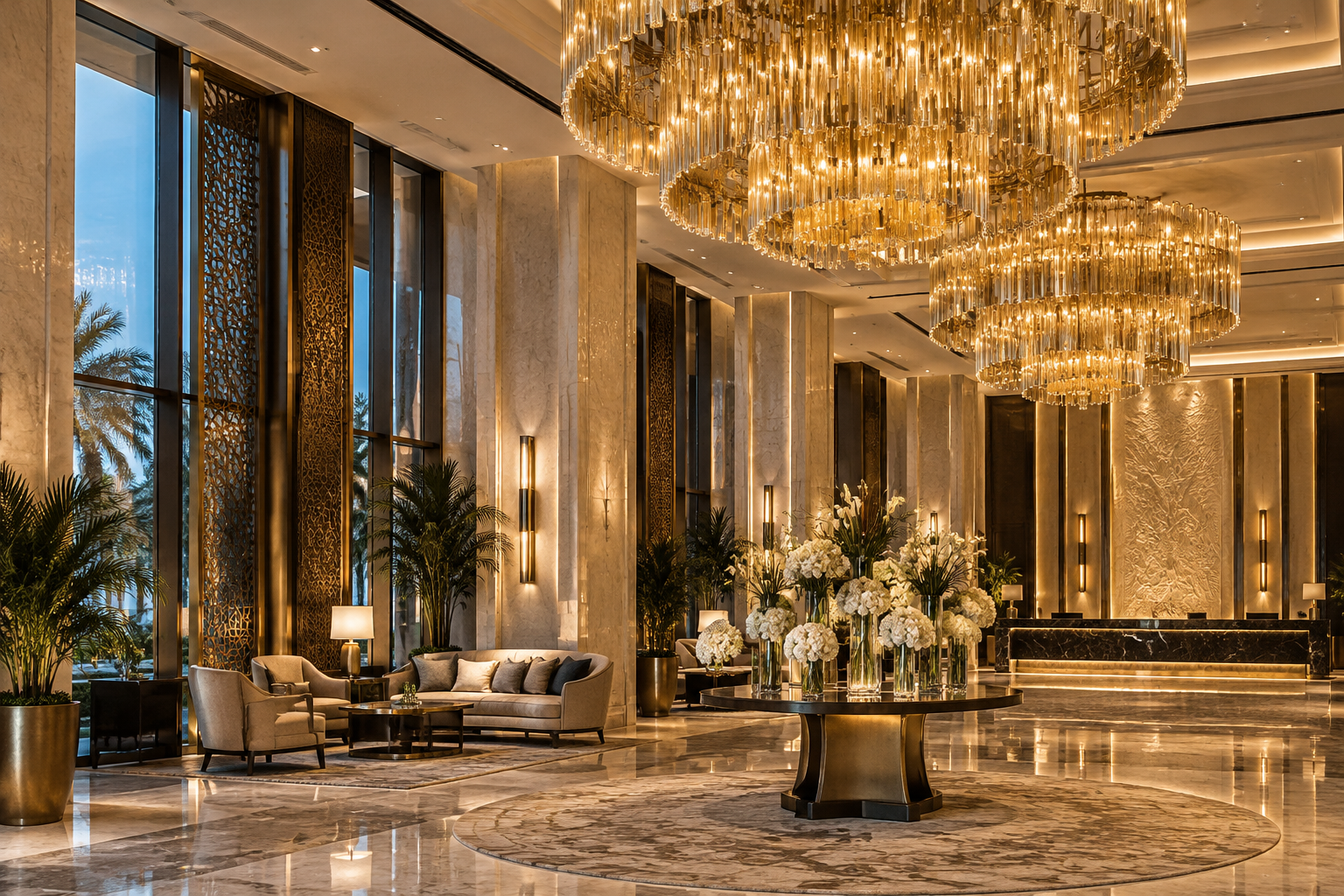 How Do You Specify Gold Chandeliers for GCC 5-Star Hotel Lobbies?: Photometric files & compliance
Frequently Asked Questions
Q: What Colour Temperature Suits a Gold Chandelier in a Luxury Hotel Lobby?
A 2700–3000 K design target is a useful starting point for warm gold finishes and welcoming interiors. Approve it beside actual marble, timber and upholstery samples, not in isolation. A CRI ≥90 recommended specification can support colour fidelity, but the final decision should also consider adjacent lighting, daylight and the appearance of guests’ faces.
Q: Can an Oversized Chandelier Provide All the Lobby Lighting?
An oversized chandelier should not automatically be responsible for every lobby lighting task. Use it as part of a coordinated scheme covering reception, circulation and seating. A UGR ≤19 design target may be appropriate for applicable reception work areas, but it is installation-dependent and does not establish that a sparkling decorative chandelier is comfortable from every viewpoint.
Q: Which Dimming System Should a GCC Hotel Specify?
The preferred system is the one compatible with the hotel’s control architecture and maintenance capability. Compare DALI-2, Casambi, KNX integration and 0-10V using the proposed drivers and wiring arrangement. If evening scenes require low output, adopt a 1% minimum-output design target and verify smooth dimming, reliable starting and recovery in a representative sample before production approval.
Q: What Should Buyers Submit for a Custom Chandelier Quotation?
Submit lobby plans and sections, desired dimensions, suspension conditions, finish references, quantities, destination market and control requirements. For a 5-star lobby, also explain guest sightlines, maintenance access and operator expectations. Request separate confirmation of structural information, sampling scope, compliance evidence, spare parts, MOQ and production milestones so quotations can be compared on equivalent assumptions.
Sources and Technical References
Use current standards and official programme documentation to confirm applicability rather than treating specification summaries as approval evidence.
- EN 12464-1 — Light and lighting — Lighting of work places — Part 1: Indoor work places: consult the applicable edition through a national standards body.
- EN 60598 — Luminaires: consult the applicable general and particular safety requirements through a national standards body.
- IES — Illuminating Engineering Society: ies.org provides lighting guidance and photometric measurement resources.
- WELL v2 — International WELL Building Institute: standard.wellcertified.com provides building-level feature requirements.
- DALI Alliance: dali-alliance.org provides DALI-2 certification information and product verification resources.
- DIALux: dialux.com provides lighting-calculation software and technical support resources.
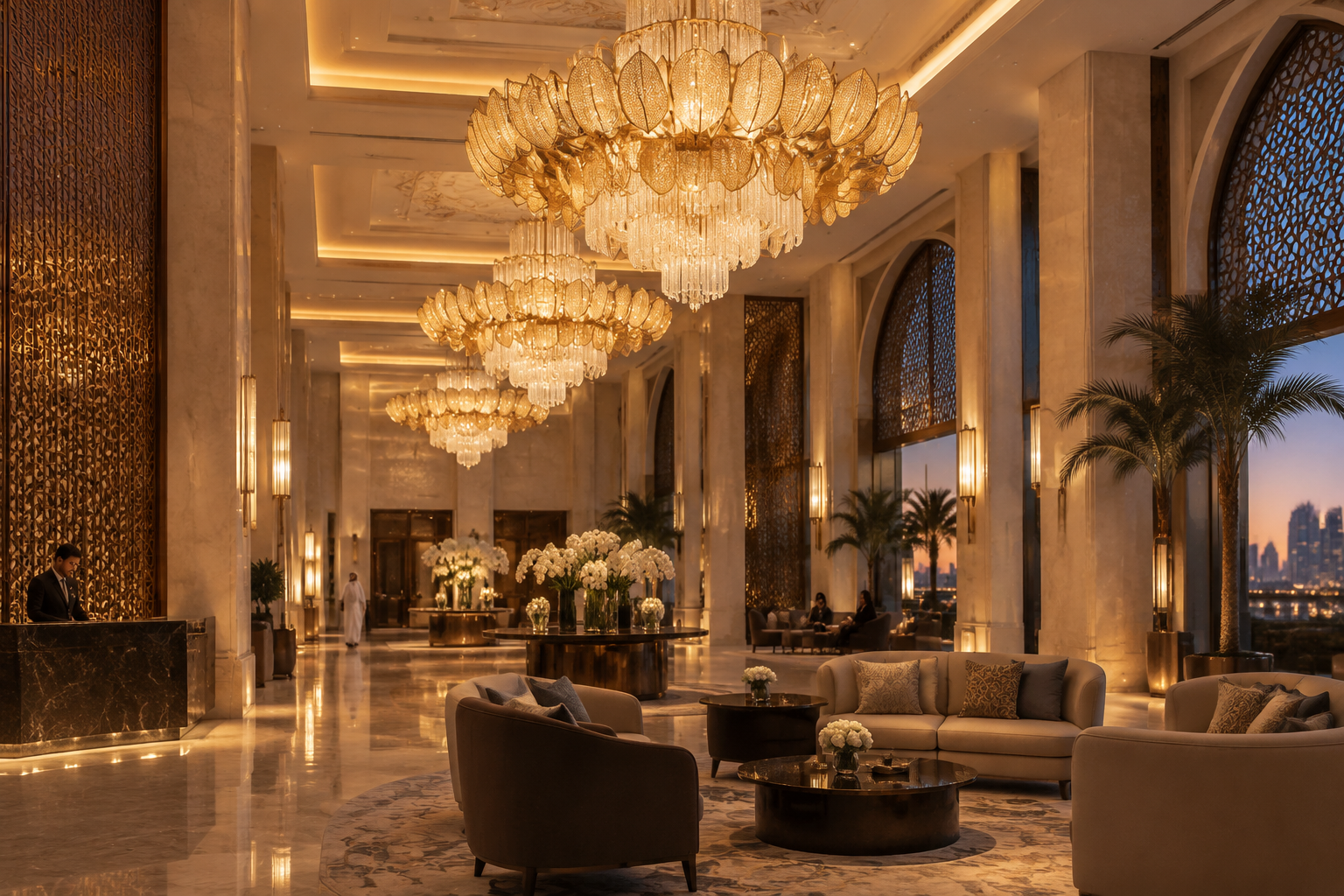 How Do You Specify Gold Chandeliers for GCC 5-Star Hotel Lobbies?: Q: Which dimming system should a GCC hotel specify?
Request a Custom Quote
A comparable custom quote begins with a coordinated design brief and explicit documentation requirements.
Send the lobby drawings, chandelier concept, finish references, electrical supply details, control platform and destination market. Ask the quotation to distinguish confirmed inclusions from provisional assumptions, particularly structural interfaces, photometric evidence, compliance work, installation support and replacement components.
At XHLWX (led-project-light.com), a Custom Indoor LED Lighting Manufacturer based in China, ... your project-specific enquiry should identify unresolved technical requirements before production approval. Request a coordinated proposal for the gold finish, oversized assembly, lighting modules, controls and maintenance approach, with project-specific confirmation of price, MOQ, lead time and available compliance documentation.
XHLWX 소개
XHLWX는 2009년부터 중국 선전에 자체 공장을 운영해 온 LED 프로젝트 조명 제조사 Shenzhen Qihang Lighting Co., Ltd.의 브랜드입니다. 라인 조명, 다운라이트, 마그네틱 레일, 평판 조명, 방수·방진 등기구, 고천장 조명과 맞춤형 조명을 사무실, 호텔, 박물관·미술관, 리테일, 공장 프로젝트에 공급합니다.
조도 설계는 KS A 3011과 EN 12464-1 기준값(유지 조도, UGR, 균제도, Ra)을 바탕으로 하며 DIALux용 IES·LDT 배광 파일을 제공합니다. 제품은 CE·RoHS에 적합하며 품질 관리는 ISO 9001을 따릅니다.
XHLWX 자주 묻는 질문
한국 프로젝트에도 납품할 수 있나요?
네. 공장에서 해외 프로젝트로 직접 출고합니다. 운송 조건과 국내 KC 인증 대응 여부는 프로젝트별로 사전에 협의해 주세요.
KS A 3011 조도 기준에 맞춘 설계가 가능한가요?
가능합니다. 필요 조도, UGR, 균제도를 기준으로 조명 계획을 세우고 당사 배광 파일로 DIALux 계산을 해 수치를 확인합니다.
어떤 조광·제어 방식을 지원하나요?
DALI-2, 0-10V, Casambi(블루투스)를 지원하며, 프로젝트에 따라 비상등이나 센서 사양도 검토할 수 있습니다.
맞춤 제작이나 OEM도 가능한가요?
네. 길이, 색온도, 배광각, 본체 색상, 고객 브랜드 OEM/ODM을 자체 공장에서 제작합니다.
Need a tailored lighting plan for your project?
Our senior lighting designers reply within 48 hours with a free design proposal & quotation.