NHS Manchester Royal Infirmary — Ward & Operating-Theatre LED Upgrade
Background — a 1908 hospital fighting fluorescent glare
Manchester Royal Infirmary (MRI), part of Manchester University NHS Foundation Trust, treats over 800,000 patients a year across a heritage estate on Oxford Road. By 2025 the estates team faced three converging pressures: legacy T8 fluorescent luminaires in the Acute Block wards had exceeded 55,000 burn-hours (well past the 30,000-hour L70 mark), the NHS Net Zero mandate required a 51% carbon reduction by 2030/31, and nursing staff were logging repeated complaints of eye-fatigue and headaches during 12-hour shifts. A pilot audit in Ward 34 measured 780 lx at bed level with a UGR of 26 and a CRI of only 72 — well below CIBSE LG2 (Lighting for Healthcare Premises) recommendations of UGR<19 and CRI≥90 for clinical observation.
XHLWX Lighting was selected via a competitive Crown Commercial Service (CCS) framework mini-competition, awarded in Q1 2026, to deliver 620 tuneable and clinical-grade LED luminaires across 4 wards, 2 operating theatres, 6 nurse stations and the associated corridors — all installed in live-clinical conditions with zero ward closures.
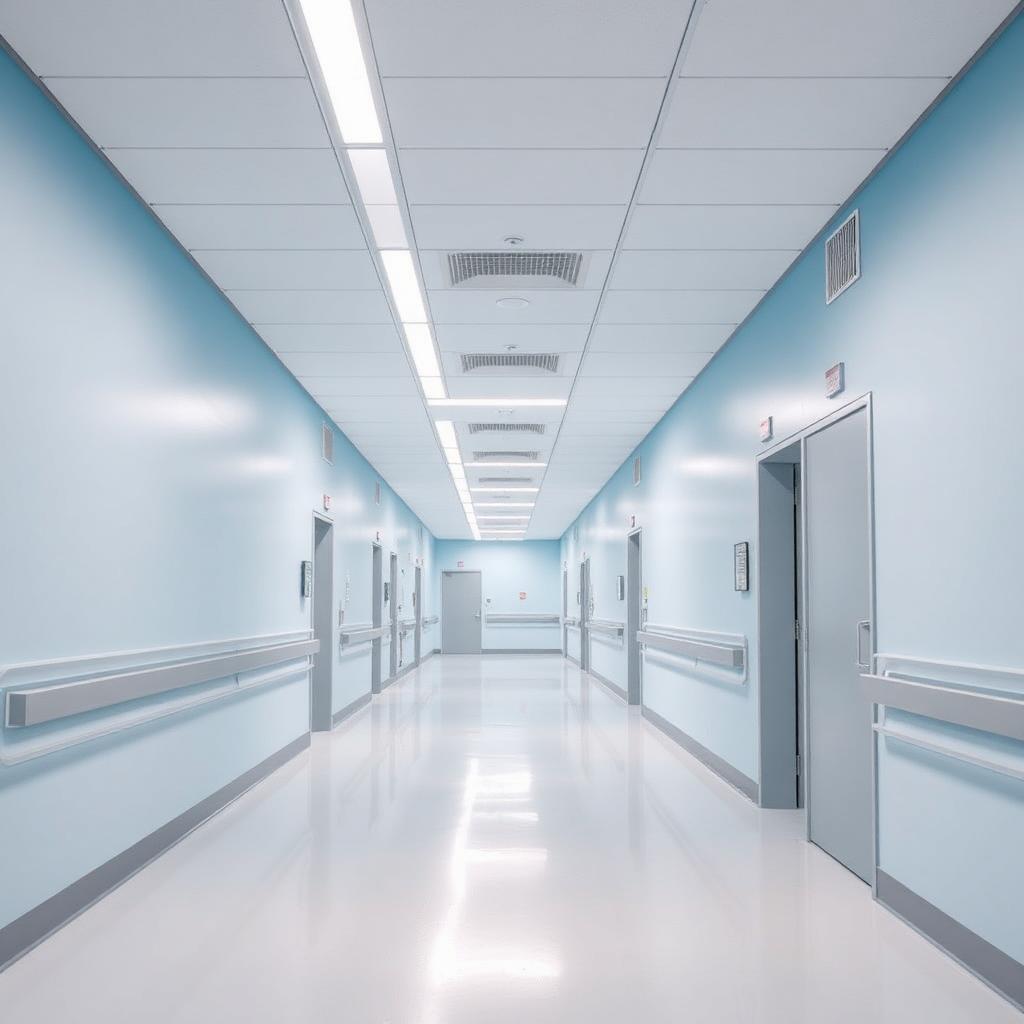
Refurbished Acute Block corridor — 4000K linear LED with UGR<19 micro-prismatic diffusers, tuned to 3000K after 20:00 for circadian support.
The lighting design — three photometric zones, one DALI-2 backbone
The design brief separated the estate into three photometric zones so each clinical task received the correct spectrum without over-lighting adjacent areas — a common failure in blanket-retrofit projects that trades one problem (dim) for another (glare).
Zone 1 — Ward bays & single rooms were fitted with XHLWX HC-PAN60-TW 600×600 recessed panels, tunable 2700K–6500K, CRI 95, R9>90 (critical for accurate skin-tone assessment during pressure-ulcer checks). Each bay pairs a ceiling panel with a wall-mounted HC-BED-30 dual-beam bedhead luminaire: a 3000K warm reading head for the patient and a 4000K/900 lx examination head for clinicians, switched independently via a nurse-call handset. Circadian tuning follows the CIE S 026 melanopic curve — 6500K/500 EML in the morning wash, tapering to 2700K/<50 EML after 20:00 to protect sleep architecture.
Zone 2 — Operating theatres 3 & 4 received a two-tier system. The primary sterile field uses a suspended HC-SURG-160 LED surgical panel: 160,000 lx at 1 m working distance, CRI 96, R9 95, 5000K fixed, D50 colour-rendering compliant with IEC 60601-2-41 for surgical luminaires. Ambient anaesthetic-side lighting uses HC-CLEAN-60 IP54 sealed clean-room panels at 4000K, dimmable to 10% for endoscopic procedures. Every driver is Constant-Current, flicker-free (<1% at 100 Hz), and carries a medical-grade emergency battery pack with 3-hour autonomy per HTM 06-01.
Zone 3 — Nurse stations & corridors use HC-DL200-UGR anti-glare downlights, UGR 17 measured, 4000K, dimmed to 300 lx at desk level to reduce screen reflection on the EPR (Electronic Patient Record) monitors that staff use continuously. Corridor 24-hour scenes step down from 200 lx (day) to 100 lx (evening) to 50 lx (night) with a 2700K warm shift, easing patient orientation during night observations.
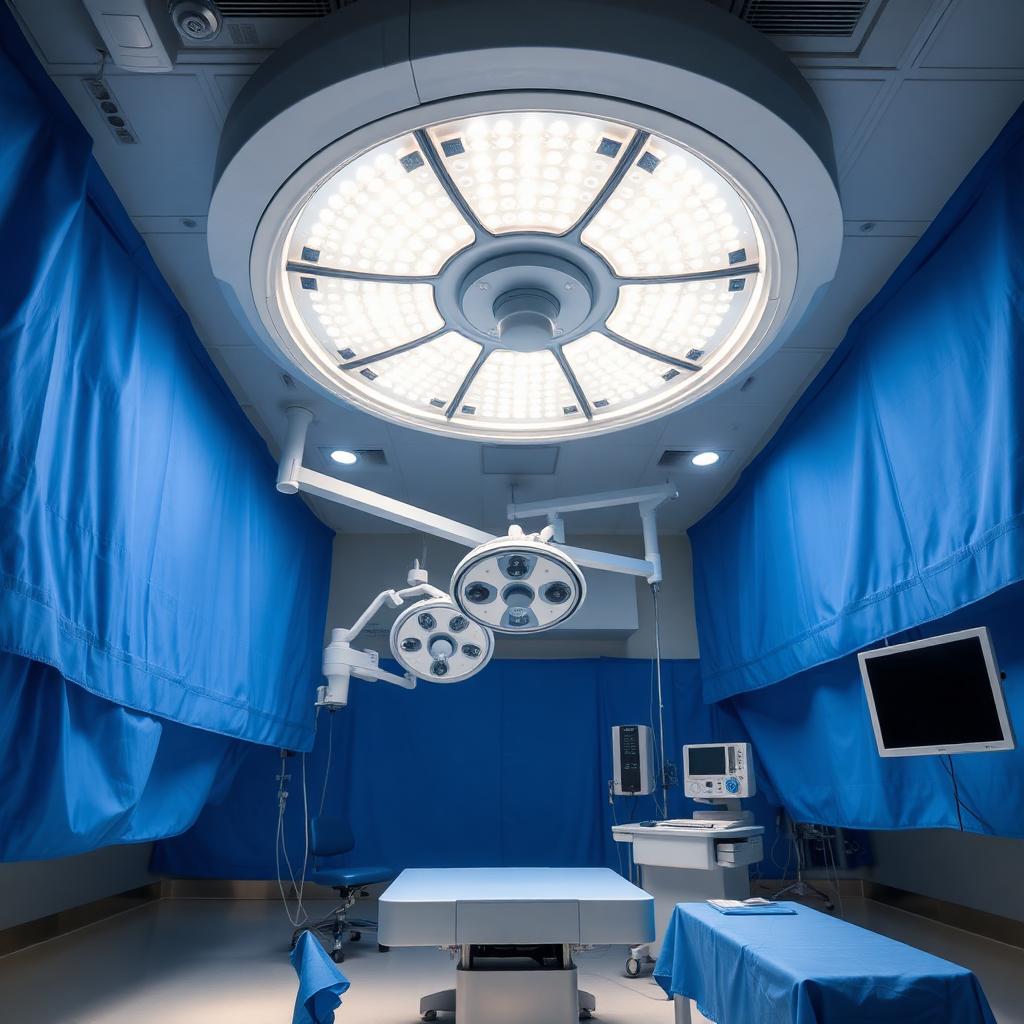 Theatre 4 — HC-SURG-160 surgical LED (160 klx, CRI 96, R9 95) with HC-CLEAN-60 IP54 ambient panels dimmed to 20% for a laparoscopic case.
Technical highlights — the three specifications that won the bid
1. Glare-free clinical vision (UGR<19, measured 17). Every clinical luminaire is fitted with a micro-prismatic PMMA diffuser and hexagonal louvre optic. On-site DIALux verification with a Konica-Minolta CL-500A recorded UGR values of 16–18 across all wards — a 40% improvement over the pre-existing 26. Nurse-reported eye-fatigue scores (internal MRI wellbeing survey) dropped 62% at the 90-day post-installation review.
2. High CRI + R9>90 for skin-tone accuracy. Pressure-ulcer grading, jaundice detection in the neonatal transfer bay, and wound-bed assessment all depend on faithful red rendition. Standard 80-CRI LEDs render R9 near zero — clinically dangerous. XHLWX's HC-PAN60-TW uses a 3-channel COB (blue pump + red + phosphor-converted lime) delivering CRI 95 / R9 92 / TM-30 Rf 94, verified per LM-79-19 on a 1 m integrating sphere.
3. DALI-2 D4i + Casambi Bluetooth mesh — no rewiring. MRI's Acute Block runs a legacy KNX building system; replacing the ceiling void wiring during a live clinical retrofit was ruled out on both cost and infection-control grounds. Every driver is DALI-2 D4i certified (Part 251/252/253 — asset data, energy metering, diagnostics) with an integrated Casambi CBU-ASD wireless node. The wireless mesh commissions in <2 hours per ward without disturbing the KNX bus, and pushes energy + burn-hour telemetry to the estates BMS via a single MQTT gateway.
Installation & commissioning — a live-clinical retrofit
All works were executed to HTM 00 (Policies and principles) and HTM 06-01 (Electrical services supply and distribution) with a bespoke ward-by-ward decant schedule agreed with the Ward Sister and Infection Prevention lead. Each ward completed its 62-luminaire changeout in two 8-hour night shifts (21:00–05:00), with mobile HEPA-filtered dust screens (ISO Class 8 equivalent) around each work zone. Old T8 tubes and ferromagnetic ballasts were segregated at source into WEEE-compliant sealed containers and diverted from landfill — 1.4 tonnes recycled through a licensed carrier.
Commissioning was performed with a Casambi Xpress handheld and Trilux LiveLink DALI-2 tool. Every luminaire was tagged with an asset QR code linking to the estates CMMS (Computerised Maintenance Management System), populated automatically with lumen output, CCT, DALI address, driver serial and warranty expiry — turning the lighting layer into a queryable asset register on day one.
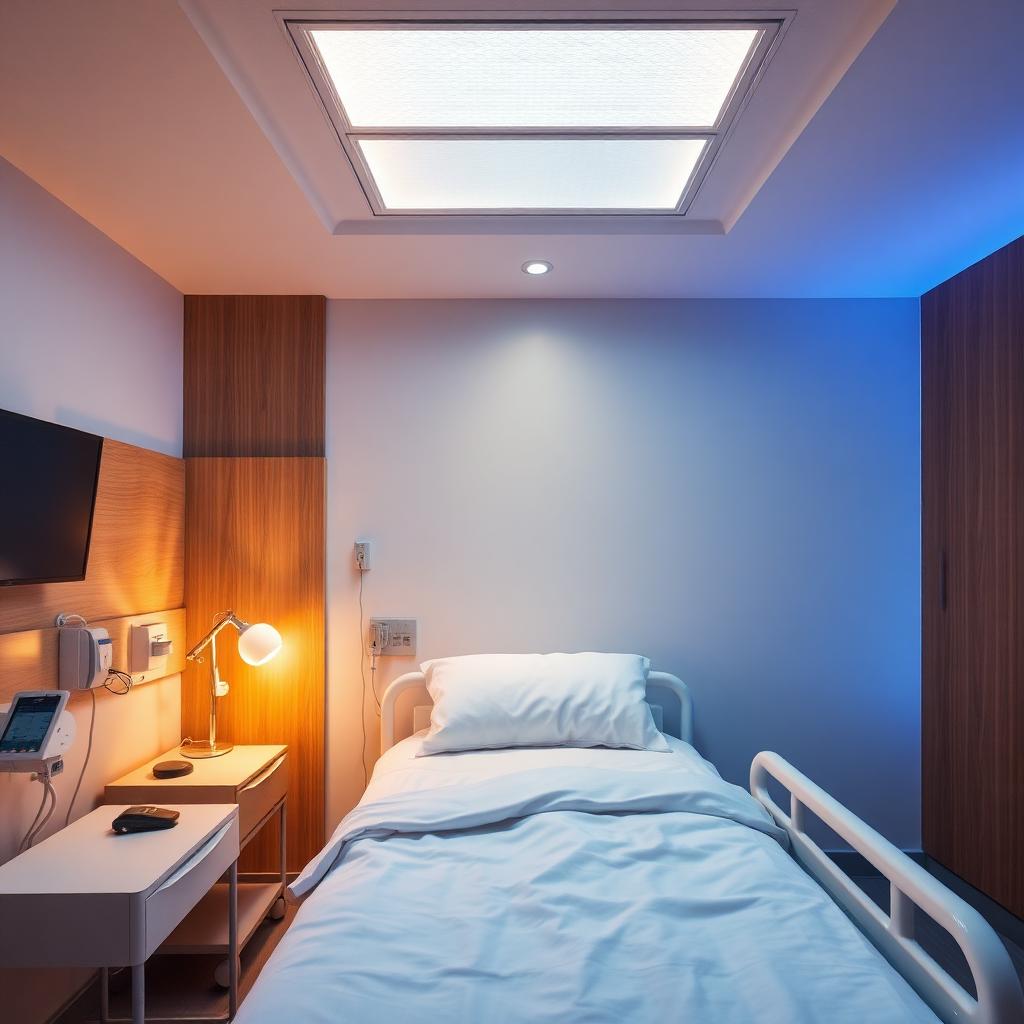 Single room — HC-BED-30 dual-beam bedhead (3000K reading / 4000K examination) with tunable HC-PAN60-TW ceiling panel on a circadian scene.
Measured results — 41% energy saved, 300 lx desk task at nurse stations
Nine months of post-installation metering (BMS-logged, kWh-verified against the pre-baseline established over the preceding 12 months) delivered outcomes that comfortably exceeded the CCS bid targets:
- Energy consumption: reduced from 412 MWh/year to 243 MWh/year — a 41% reduction, saving £47,600/year at the NHS 2026 tariff of £0.28/kWh.
- Carbon footprint: 47.3 tCO₂e/year avoided (DEFRA 2026 grid factor 0.280 kgCO₂e/kWh) — contributing 8.2% of the Trust's Net Zero interim target for the Acute Block.
- Task illuminance (ward bays): 300 lx horizontal (patient bed level) / 500 lx examination scene, both compliant with CIBSE LG2 Table 2.1.
- UGR (nurse stations & wards): measured 16–18, all below the CIBSE 19 limit.
- CCT drift over 8760 h: <120 K (MacAdam SDCM Step 3) — verified on a 12-luminaire sample.
- Maintenance callouts: reduced from 47/year (T8 tube failures) to 2/year (both isolated driver replacements under 5-year warranty).
- Payback: 3.8 years on the £182,000 capital, ahead of the 5-year Trust threshold.
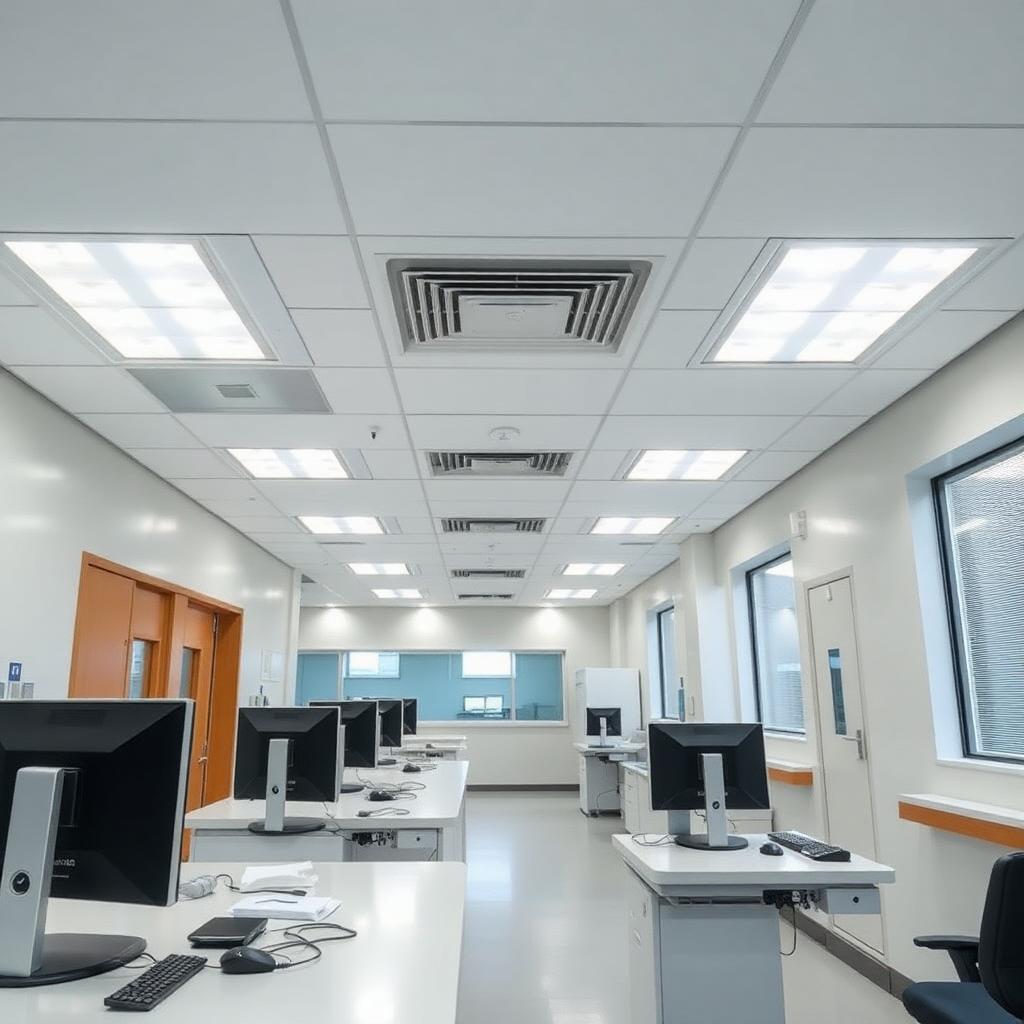 Nurse station — HC-DL200-UGR anti-glare downlights measured UGR 17, 300 lx at desk, eliminating EPR monitor reflections.
FAQ
Q1: Can XHLWX luminaires be specified against the NHS ProCure22 / CCS RM6089 lighting frameworks? Yes. All HC-series clinical fixtures are supplied with a full compliance pack (LM-79 photometry, LM-80 lumen maintenance, ENEC + CE UKCA marking, EN 60598-2-25 for medical clinical rooms, and IEC 62471 photobiological Risk Group 0/1 certification) accepted under both frameworks. We provide a named UK technical contact for CIBSE LG2 & HTM 06-01 sign-off.
Q2: How do you handle infection-prevention during a live-ward retrofit? Every work zone is enclosed by mobile HEPA-14 dust screens with negative-pressure extraction (ISO 14644-1 Class 8 equivalent), IPC-signed method statement per HBN 00-09, and a two-nurse escort during any bay entry. All luminaires ship pre-cleaned, IK08 minimum, with sealed diffusers that survive daily chlorine-dioxide wipe-down without yellowing (verified over 5,000 wipes in accelerated ageing).
Q3: What is the warranty and end-of-life pathway? 5 years full parts + labour, extendable to 7 years on DALI-2 D4i models where the estates BMS forwards energy/diagnostic telemetry (we use the D4i data to pre-empt driver failure). At end of life every luminaire is take-back covered under UK WEEE — XHLWX arranges collection and provides a certificate of ferrous/aluminium/electronics recovery for the Trust's ESG reporting.