Ohio EV Gigafactory: High-Bay & Cleanroom Lighting for Peak Efficiency
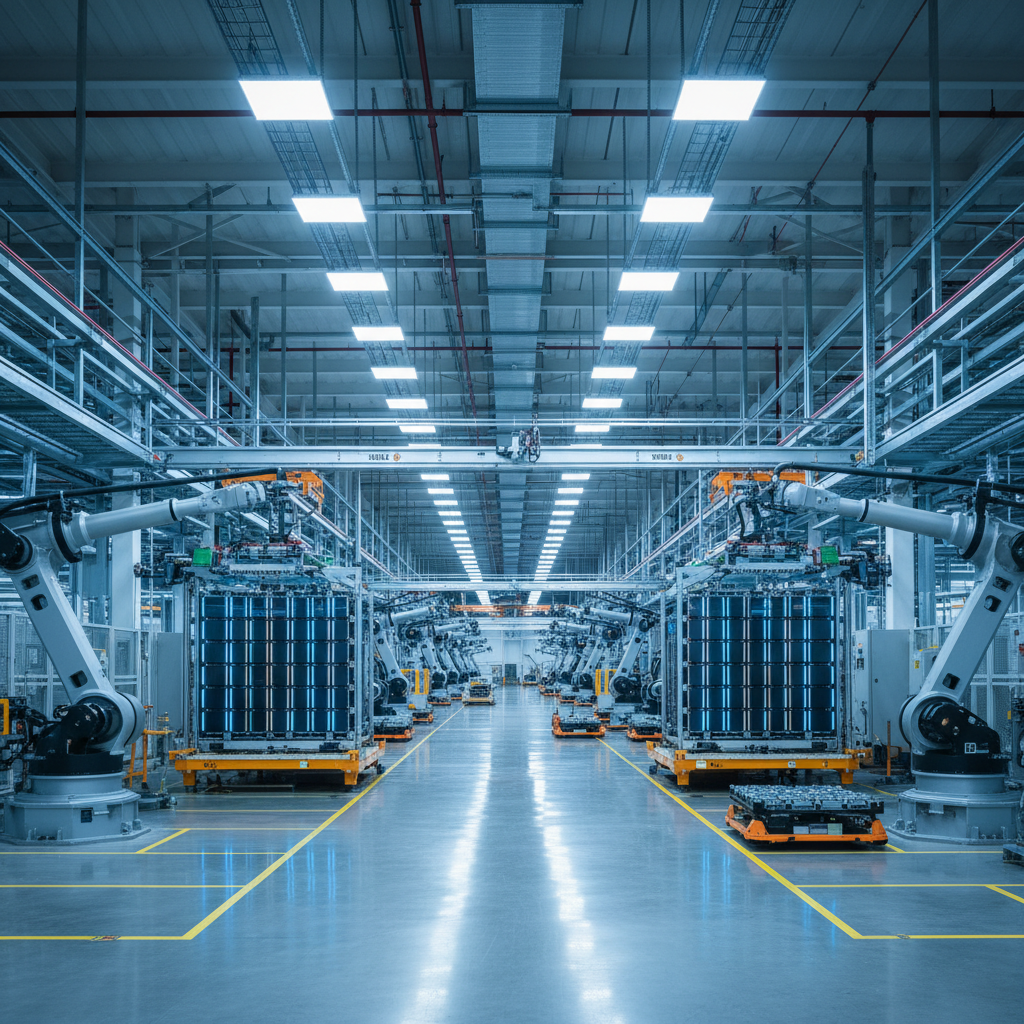
The rapid expansion of the electric vehicle (EV) market has catalyzed the development of gigafactories—colossal manufacturing plants dedicated to producing lithium-ion batteries at an unprecedented scale. One of the newest and most advanced of these facilities, located in the historic automotive hub of Lordstown, Ohio, represents the pinnacle of modern industrial engineering. When the facility's developers approached XHLWX Lighting, they presented a complex challenge: illuminating a space of immense scale that housed both rugged, high-ceiling assembly areas and ultra-sensitive, particle-controlled cleanrooms. The lighting solution needed to be more than just powerful; it had to be intelligent, efficient, safe, and compliant with multiple, often conflicting, environmental standards.
Project Background: The Gigafactory Challenge
Spanning over 2.8 million square feet, the Lordstown gigafactory is a city unto itself, dedicated to the entire battery manufacturing lifecycle—from raw material processing and electrode coating to cell assembly and final module packaging. This intricate process flow creates a diverse range of lighting requirements under one roof.
- High-Bay Production Halls: These cavernous spaces, with ceiling heights exceeding 20 meters, are the heart of the factory. They contain heavy machinery, automated robotic arms, and miles of conveyance systems. Lighting here must provide exceptional vertical and horizontal illuminance for worker safety, operational visibility, and quality control, all while combating the immense energy costs associated with illuminating such a vast volume.
- Cleanroom Environments: A significant portion of battery manufacturing, particularly electrode coating and cell assembly, must occur in stringently controlled cleanrooms (up to ISO Class 5). In these zones, the lighting fixtures themselves are a potential source of contamination. They must be completely sealed, easy to clean, non-shedding, and resistant to chemical agents, without compromising on light quality essential for precision tasks.
The client's vision for a 'factory of the future' demanded a lighting system that was not just a utility, but a strategic asset contributing to operational excellence, sustainability goals, and worker well-being.
Addressing Critical Pain Points
Our initial consultations with the project's engineering team identified several key pain points that a conventional lighting approach would fail to address:
- Exorbitant Energy Consumption: Traditional metal halide or high-pressure sodium high-bay lighting would result in massive electricity bills and a significant carbon footprint, directly contradicting the green ethos of an EV company.
- Poor Light Quality and Glare: Inadequate or glaring light in industrial settings is a leading cause of accidents and decreased productivity. With workers operating forklifts and interacting with complex machinery, visual comfort and clarity were non-negotiable safety requirements.
- Contamination Risks in Cleanrooms: Standard light fixtures are not built for cleanroom environments. Gaps, crevices, and material composition can lead to particle shedding, compromising entire batches of sensitive battery components and leading to costly production losses.
- Inflexible, High-Maintenance Systems: A static 'on/off' lighting system is inefficient. The client required a dynamic, intelligent system that could adapt to changing shift patterns, daylight availability, and specific task requirements, all while minimizing the need for costly maintenance involving scissor lifts in a 24/7 operational environment.
The XHLWX Lighting Solution: A Dual-Pronged Approach
To meet these diverse needs, XHLWX developed a comprehensive, tailored lighting solution centered around two core product families, integrated under a single intelligent control network.
For the High-Bay Production Areas: XHLWX Stellaris™ Series
We deployed over 6,000 units of our flagship Stellaris™ 3 Pro High-Bay Luminaires. These fixtures were specifically chosen for their robust design and superior optical performance.
- Optical Design: We specified a combination of 90-degree and 120-degree beam angles, using advanced modeling software to ensure perfect overlap and illumination uniformity across the entire factory floor. This eliminated dark spots between fixtures, a common issue in large-scale installations.
- Durability: The Stellaris™ features a die-cast aluminum housing (ADC12) with a corrosion-resistant powder coating and an IP66 rating, making it impervious to dust and moisture common in industrial environments.
For the Cleanroom Environments: XHLWX PureForm™ CR Series
The cleanroom sections required a completely different approach. Here, we installed 1,500 units of our PureForm™ CR IP65 Sealed Panel Luminaires.
- Cleanroom Compliance: The PureForm™ CR is designed from the ground up for critical environments. It features a single-piece, seamless aluminum frame with no exposed fasteners or gaps where particles could accumulate. The PMMA front cover is non-shedding and resistant to common cleaning and sterilization chemicals.
- Precision Optics: These panels deliver exceptionally uniform, low-glare light with a high Color Rendering Index (CRI > 95), which is crucial for the visual inspection of electrode coatings and cell components where subtle color variations can indicate defects.
Technical Highlights: Precision, Control, and Efficiency
Our solution was engineered around three core technical pillars that delivered tangible benefits to the gigafactory's operations.
-
Superior Glare Control (UGR<19): Worker safety was paramount. Both the Stellaris™ and PureForm™ fixtures were equipped with our proprietary nano-optic lens technology. This multi-layered optical system precisely directs light onto the target workplane while shielding the light source from direct view, even at steep angles. Across the entire facility, we achieved a Unified Glare Rating (UGR) of less than 19, a level typically associated with premium office environments. This dramatically reduces eye strain for forklift operators and technicians who frequently look upwards, enhancing both safety and concentration.
-
Class-Leading Luminous Efficacy (175 lm/W): The cornerstone of our energy-saving strategy was the extreme efficiency of our latest-generation LED modules. The Stellaris™ 3 Pro luminaires achieve a remarkable system efficacy of 175 lumens per watt. This industry-leading performance means the factory achieves its target brightness levels using significantly less power than competitor solutions, directly translating into lower operational expenditures and a reduced environmental impact that aligns with the client’s sustainability mandate.
-
Intelligent Wireless Control (DALI + Casambi): We implemented a powerful hybrid control system. Each luminaire is DALI-enabled, allowing for individual addressing, dimming, and performance monitoring. This DALI backbone is then networked wirelessly using Casambi Bluetooth Mesh technology. This innovative approach provided the best of both worlds: the robustness and data-richness of DALI with the installation simplicity and user-friendly interface of Casambi. It eliminated the need for thousands of meters of dedicated control wiring, saving significant installation time and cost. The system enables daylight harvesting in perimeter zones, task-tuning for specific work cells, and automated scheduling based on shift patterns, further amplifying energy savings.
Installation and Commissioning: A Seamless Integration
Deploying a lighting system of this magnitude on an active construction site required meticulous planning and collaboration. XHLWX's remote technical support team worked hand-in-hand with the US-based electrical contractors. All luminaires were delivered pre-configured and labeled by zone, streamlining the physical installation process. The commissioning of the Casambi control network was remarkably efficient. Once a fixture was powered on, it was automatically detected by the wireless mesh. The entire network of over 7,500 lights was configured and grouped logically via a tablet interface in a matter of days, a process that would have taken weeks with a wired system.
Measured Results: Exceeding Expectations
The post-installation audit, conducted by an independent third party, confirmed that the XHLWX solution not only met but exceeded all project specifications.
- Illuminance Levels: The high-bay assembly lines achieved a consistent average of 550 lux at the workplane, with uniformity (Uo) exceeding 0.7. The critical inspection zones within the cleanrooms registered a flawless 800 lux, providing perfect clarity for quality control.
- Light Quality: CCT was measured at a consistent 5000K across the facility, providing a clean, alert, and productive atmosphere. The CRI of 95+ in the cleanrooms was verified, ensuring true-to-life color perception for critical tasks.
- Energy Savings: When benchmarked against the original specification based on standard LED high-bays (130 lm/W) and a basic on/off control system, the XHLWX solution delivered a calculated 40% additional energy saving. When compared to a legacy metal halide system, the total energy reduction for lighting was an astounding 72%.
This project stands as a testament to XHLWX's ability to engineer and deliver world-class lighting solutions for the most demanding industrial environments. By integrating cutting-edge fixture technology with intelligent, wireless controls, we provided the Lordstown gigafactory with a lighting system that enhances safety, optimizes production, and sets a new benchmark for energy efficiency in manufacturing.
FAQ
Q1: Why was a DALI-Casambi hybrid system chosen over a single wired or wireless protocol? A1: This hybrid approach offers unparalleled flexibility and robustness. The DALI protocol within each fixture provides granular, reliable control and allows for detailed energy and performance monitoring at the individual luminaire level. Layering Casambi's Bluetooth Mesh on top eliminates the need for extensive control cabling, which drastically reduces installation costs and complexity in a massive facility. It combines the reliability of a wired driver protocol with the scalability and ease-of-use of a wireless front-end, providing the best of both worlds.
Q2: How do the PureForm™ CR luminaires meet the stringent ISO Class 5 cleanroom standards? A2: The PureForm™ CR series is purpose-built for cleanroom compliance. Key features include an IP65 rating, certifying it is fully sealed against dust and water ingress. The housing is a single, seamless piece of extruded aluminum with no cracks or crevices where contaminants can gather. The front lens is made from a special non-shedding, chemical-resistant polymer. This design prevents the fixture itself from releasing particles into the environment, allowing it to be used in environments as sensitive as ISO Class 5.
Q3: What is the long-term reliability and maintenance plan for the Stellaris™ high-bay lights? A3: The Stellaris™ 3 Pro luminaires are designed for a virtually maintenance-free operational life. They have a rated lifespan of L90B10 at 100,000 hours, meaning that after 100,000 hours of operation (over 11 years in a 24/7 facility), 90% of the luminaires will still have at least 90% of their initial light output. The IP66 rating and robust construction protect internal components from the industrial environment. This long lifespan and durability eliminate the need for regular lamp replacements, significantly reducing maintenance costs and operational downtime.