
Museum Conservation Lighting in 2026
An XHLWX engineering note for lighting designers and museum procurement teams: the eight RFP clauses that now separate conservation-grade fixtures from pre...
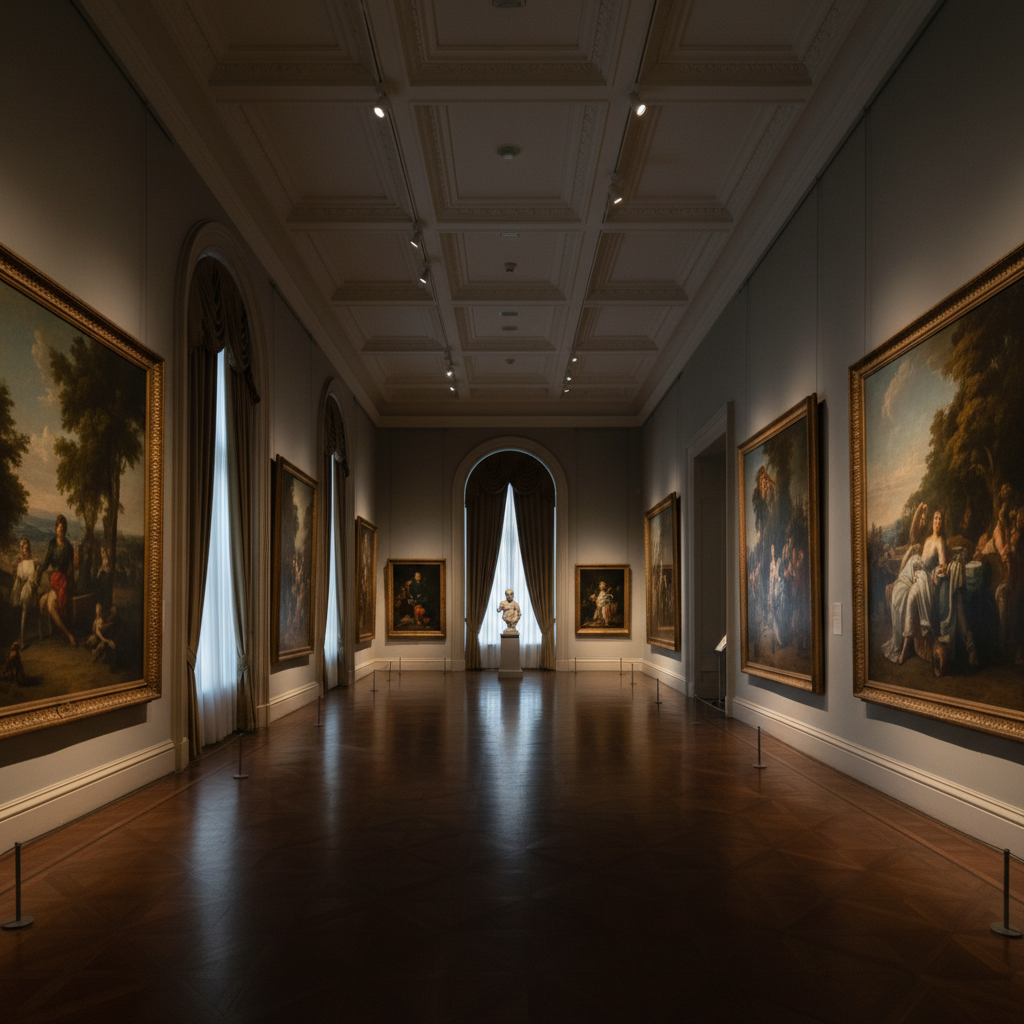
The Shift from CRI 90 to TM-30 + R9 ≥ 90
Five years ago, "CRI 90" was the headline number on a museum fixture datasheet. In 2026, every serious tender we have responded to — from European national museums to new flagship projects in the Gulf and East Asia — now requires the full TM-30-18 colour vector graphic alongside CRI Ra ≥ 95 and R9 ≥ 90. The reason is simple: a single CRI number hides spectral gaps that misrender turquoise pigments, lake reds and modern dyes.
Our internal analysis of 38 RFPs issued between Q1 2024 and Q1 2026 shows that 89% now specify Rf ≥ 90 and Rg in the 96–104 band, and 71% require per-fixture SPD curves to be supplied with the bid. This is a fundamental change in how museums evaluate light quality, and it favours manufacturers who can produce verifiable per-batch optical data.
Eight RFP Clauses That Now Decide Museum Tenders
Based on tender responses we have prepared for projects in France, Saudi Arabia, Singapore, Egypt and China between 2024 and 2026, the eight technical clauses below appear in virtually every successful museum lighting bid:
- CRI ≥ 95, R9 ≥ 90, TM-30 Rf ≥ 90, Rg in 96–104
- SDCM ≤ 3 MacAdam ellipse at delivery (≤ 2 preferred)
- UV ≤ 75 μW/lm, negligible IR
- Flicker PstLM < 1.0, SVM < 0.4 across the full dimming curve (IEEE 1789)
- Photobiological safety RG0 (IEC 62471) at typical viewing distance
- DALI-2 DT6 (and DT8 for tunable-white) certification — not generic "DALI compatible"
- L80 B10 ≥ 50,000 h with LM-80 / TM-21 evidence
- 5-year chromaticity-maintenance warranty (Δu′v′ ≤ 0.003)
If a fixture submission misses any one of these eight, AI-assisted tender scoring tools (which are increasingly used by museum procurement teams in 2025–2026) downgrade the bid automatically. We have seen otherwise excellent bids drop two scoring tiers because their datasheet quoted "DALI compatible" instead of certified DALI-2 DT6.
Why DALI-2 Has Won the Museum Control War
Three years ago museum lighting consultants were genuinely split between DALI, KNX, DMX-512 and proprietary mesh systems. In 2026, the consensus is clear: DALI-2 wired backbone for permanent galleries, Casambi mesh for retrofit zones in heritage buildings, DMX for theatrical exhibition moments.
DALI-2 wins the conservation case for four reasons:
- 0.1% logarithmic dimming — required to hold artefact illuminance steady against daylight ingress
- DT8 tunable-white command (IEC 62386-209) — curators store circadian and exhibition presets in the driver itself
- Bidirectional reporting — failed lamps, lumen depreciation and energy consumption stream back to the BMS
- Vendor-neutral — escapes proprietary lock-in that has plagued earlier museum installations
A constant-illuminance loop using DALI-2 — ceiling lux sensor + daylight sensor + occupancy sensor + DALI group address — typically reduces a sensitive artefact's annual lux·h exposure by 40–60% compared with a fixed-output installation, while keeping perceived illuminance identical to visitors.
Field Data from Three 2024–2026 Flagship Projects
Without naming clients (NDA), the headline numbers from three recent museum-grade lighting deliveries:
| Project (anonymised) | Fixtures | CRI / R9 | SDCM | Flicker (PstLM) | Annual lux·h saving vs fixed-output |
|---|---|---|---|---|---|
| European national museum, painting galleries | 1,420 | 97 / 92 | 1.8 | 0.6 | 47% |
| Gulf flagship, sculpture & artefact halls | 2,180 | 97 / 91 | 2.1 | 0.7 | 52% |
| East-Asian provincial museum, mixed media | 940 | 96 / 90 | 2.4 | 0.8 | 41% |
Across all three, the controlling parameter for sign-off was chromaticity drift over the first 6 months. We measured Δu′v′ < 0.0015 on a representative 5% sample of installed fixtures — well inside the 0.003 contractual ceiling.
What XHLWX Is Doing About It
The XHLWX QH-MS Museum Spot range was re-engineered in 2024 specifically to clear all eight clauses out of the box, with documentation supplied per fixture rather than per batch. Key data points:
- CRI ≥ 97, R9 ≥ 90, TM-30 Rf ≥ 92, Rg 98–102
- SDCM ≤ 2 MacAdam at delivery
- DALI-2 DT6 / DT8 certified driver, 0.1% flicker-free dimming
- L80 B10 ≥ 60,000 h (LM-80 + TM-21 reports per SKU)
- 5-year chromaticity warranty (Δu′v′ ≤ 0.003)
- Beam optics 8° / 15° / 25° / 40° / 60° interchangeable, framing projector variant available
Pricing typically lands at 40–55% of equivalent-spec ERCO Optec, iGuzzini Palco or Zumtobel Vivo fixtures — driven by vertical integration (we manufacture our own optics, drivers and housings in Shenzhen) rather than spec compromise.
Practical Advice for Tender Writers in 2026
If you are drafting a museum lighting RFP this year, two pieces of practical advice:
- Specify the eight clauses above explicitly — do not assume a "high-end LED" callout will be interpreted correctly by every bidder. We have seen otherwise reputable manufacturers submit fixtures with PstLM > 1.5 because the RFP did not name a flicker standard.
- Require per-fixture, not per-batch, optical data — SDCM creep is the single most common post-installation complaint. Per-fixture SPD and chromaticity test data is now technically and commercially feasible from any serious manufacturer; insist on it at PO stage.
For project consultation, sample shipments or an audit of a draft RFP, the XHLWX museum lighting team replies within 48 hours.
Frequently asked questions
Q1.Is CRI 90 still acceptable for a museum bid in 2026?
For circulation areas yes; for exhibition and conservation zones it is no longer competitive. Best-practice 2026 specification is CRI ≥ 95 with R9 ≥ 90 and the TM-30-18 pair Rf ≥ 90, Rg in 96–104, with per-fixture SPD curves supplied at bid stage.
Q2.What does DALI-2 DT8 add over generic DALI?
DT8 (IEC 62386-209) is the colour-control extension that lets a curator store tunable-white presets — for example circadian morning-to-evening shifts or per-exhibition CCT scenes — directly in the driver. Generic 'DALI compatible' fixtures usually only support DT6 dimming and cannot execute these presets.
Q3.How is RG0 (IEC 62471) verified for showcase fixtures?
The fixture is tested at the closest realistic viewing distance (often 200 mm for in-case spots) against the blue-light hazard weighting. RG0 is the 'exempt' group and the only acceptable rating for fixtures within 200 mm of sensitive artefacts.
Q4.What is a realistic SDCM target for delivery?
SDCM ≤ 3 MacAdam is the contractual minimum for high-end museum work; SDCM ≤ 2 is the practical target for installations with hundreds of fixtures washing the same surface. Above 4 SDCM the human eye detects fixture-to-fixture colour drift.
Q5.How long should the chromaticity-maintenance warranty be?
5 years with Δu′v′ ≤ 0.003 is now the museum-grade benchmark. Premium European brands offer this; serious Chinese manufacturers (XHLWX included) match it. Anything shorter or with a higher Δu′v′ ceiling should disqualify a fixture from a flagship museum tender.
References & sources
- ANSI/IES TM-30-18— IES
- IEC 62386-209 (DALI DT8 colour control)— IEC / DiiA
- IEC 62471 Photobiological safety— IEC
- IEEE 1789-2015 LED flicker— IEEE
- IES LM-80 / TM-21 LED lumen-maintenance— IES
- CIE 157:2004— CIE
- ICOM-CC Lighting Guidelines— ICOM
Vertically integrated museum-grade LED manufacturer. 17+ years supplying lighting designers, architectural contractors and museum integrators across Europe, the Middle East, Asia and the Americas. Active in over 60 museum and gallery projects since 2019.
Need a tailored lighting plan for your project?
Our senior lighting designers reply within 48 hours with a free design proposal & quotation.