
Shenzhen LED Factory Expansion: Analyzing the 2024 Supply Chain Impact
Shenzhen Qihang Lighting's recent Phase II factory expansion, adding automated SMT lines, boosts capacity to over 50,000 units monthly. We analyze the impact
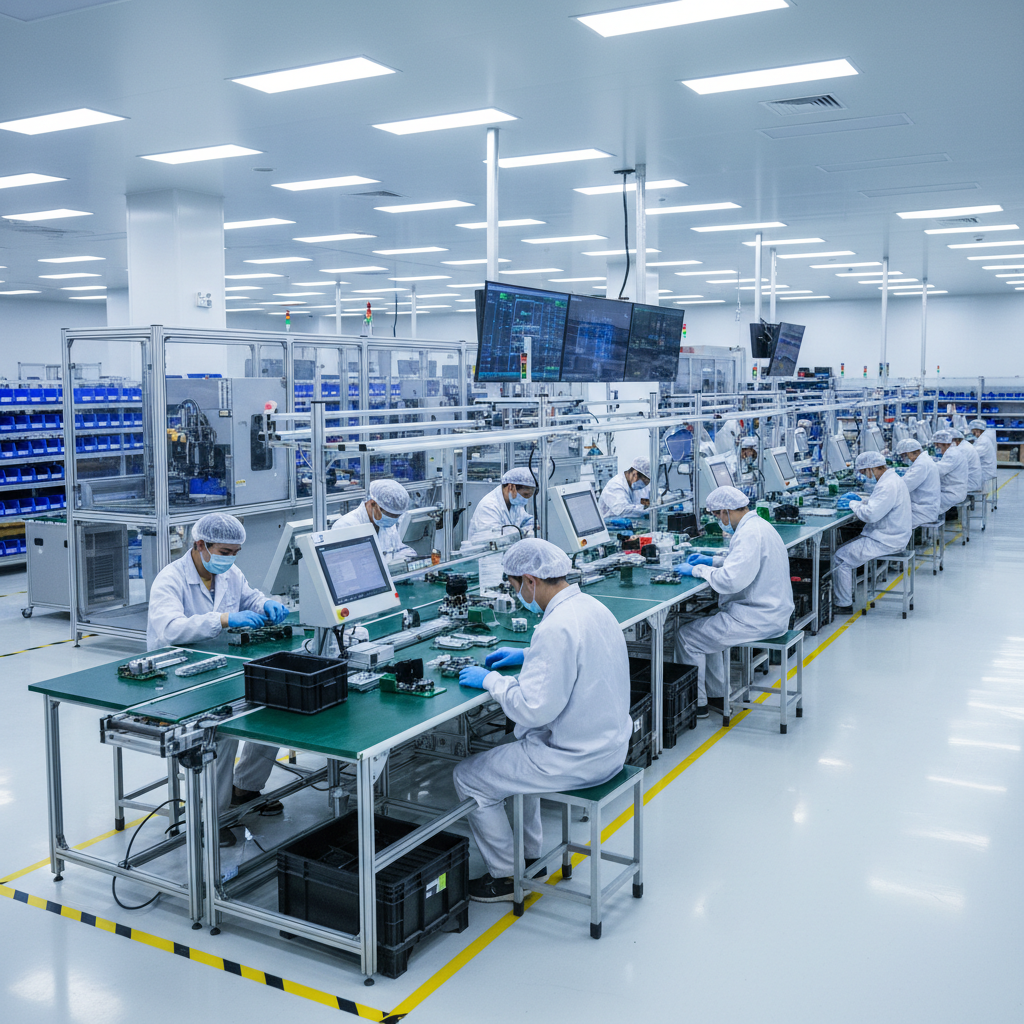
At XHLWX (led-project-light.com), a Custom Indoor LED Lighting Manufacturer based in China, we closely monitor supply chain developments that impact our European, US, and Middle Eastern clients. A significant recent event is the completion of the Phase II expansion at Shenzhen Qihang Lighting’s Guangming factory, a move that signals a strategic shift in the region's manufacturing landscape.
The addition of two fully automated Surface-Mount Technology (SMT) lines and a dedicated aging test line is more than just a capacity upgrade; it’s a statement about the future of high-specification LED lighting production. This analysis delves into what this development means for lead times, quality assurance, and the procurement process for international lighting specifiers and contractors.
What Changed — and Why It Matters Now
The core of the news is a substantial increase in production capability. The two new SMT lines, coupled with the existing infrastructure, push the factory's potential monthly output to over 50,000 luminaires. In a market still recalibrating after years of supply chain disruptions, this increase in capacity is a critical development. It suggests a move by leading manufacturers to build resilience and predictability back into the global supply network. For a European architect or a US lighting designer, this means a potential easing of the long lead times that have plagued complex projects since 2020.
More importantly, the investment is not just in speed but in precision and reliability. Fully automated SMT lines drastically reduce the potential for human error in placing and soldering LEDs and other sensitive electronic components onto printed circuit boards (PCBs).
This automation leads to superior batch-to-batch consistency in color temperature (CCT) and lumen output, a critical factor for large-scale architectural projects where uniformity is paramount. The parallel investment in a new aging test line is equally significant.
This facility allows for accelerated life testing, subjecting products to stressful conditions (e.g., high temperatures and rapid on/off cycles) to identify potential failure points before they ever leave the factory. This focus on proactive quality assurance is a direct response to the demands of the high-stakes commercial and architectural lighting markets, where post-installation failures can be prohibitively expensive.
This expansion is a strategic response to several market pressures. Firstly, the increasing technical demands of regulations like the EU's ErP (Ecodesign) directive require highly efficient and reliable electronics, which automated production facilitates.
Secondly, as projects become more sophisticated, the demand for customized yet scalable solutions grows. This move enables the factory to produce the electronic 'hearts' of luminaires at a scale that can support a wide range of custom housing and optic configurations without creating a bottleneck.
For buyers, this signals a maturing of the Chinese manufacturing base, shifting from a focus on pure volume to one of precision, quality, and supply chain reliability.
The Technical Detail Behind the Headline
An expansion of this nature is designed to produce highly specified luminaires that meet stringent international standards. To understand the practical implications, consider the typical specifications for a high-performance linear LED module that would be produced on these new lines. Such a product is the backbone of custom lighting solutions for offices, retail, and hospitality.
| Parameter | Specification | Standard / Method | Notes for Specifiers |
|---|---|---|---|
| Optics (CCT/CRI/Color Fidelity) | 2700K – 5000K, 3-Step MacAdam | ANSI C78.377-2017 | Guarantees color consistency across fixtures, crucial for large open-plan spaces. |
| CRI >95 (R9 >80) | CIE 13.3-1995 | Essential for accurate color rendering in retail, galleries, and high-end residential. | |
| TM-30-20 (Rf >90, Rg 100±3) | IES TM-30-20 | Provides a more complete picture of color rendition than CRI alone. | |
| UGR <16 with micro-prismatic optic | EN 12464-1 | Meets strict European standards for visual comfort in office environments. | |
| Control & Dimming | DALI-2 Device Type 8 (DT8) | IEC 62386 | Enables tunable white control over a single DALI address, simplifying wiring and commissioning. |
| Casambi (Bluetooth Low Energy) | Wireless | Offers app-based control perfect for retrofit projects or where new control wiring is impractical. | |
| Housing & Mechanical | Extruded Aluminium 6063-T5 | - | Provides excellent thermal management and can be cut to custom lengths ±1mm. |
| IP20 (Standard) / IP54 (Optional) | IEC 60529 | IP54 rating available with appropriate gasketing for use in damp locations. | |
| Certification & Lifetime | CE, RoHS, ErP (EU) 2019/2020 | EU Directives | Non-negotiable for market access in the European Union. ErP compliance ensures high efficiency. |
| L80/B10 @ 60,000 hours | IES LM-80 / TM-21 | Indicates that 90% of the fixtures will maintain at least 80% of initial lumen output for 60,000 hours. | |
| Key Components | LED Chip: Samsung LM281B+ Pro | Manufacturer Spec | A widely trusted mid-power chip known for high efficacy (>190 lm/W) and reliability. |
| Driver: Tridonic advanced series | Manufacturer Spec | A premium European brand driver known for low flicker, high efficiency, and DALI-2 certification. |
What This Means for Specifiers and Buyers
This kind of targeted investment in manufacturing technology directly addresses the primary concerns of today's lighting professionals: reliability, speed, and compliance. But how does it translate into actionable advantages for your next project?
How Will Increased SMT Automation Affect Customisation and Project Timelines?
Counterintuitively, automation in this context enhances customization. By standardizing and accelerating the production of the core electronic light engines, manufacturers can decouple PCB production from the final luminaire assembly. This allows for a more agile 'assemble-to-order' model. While the custom-extruded housing, specific powder-coat finish, and unique optic are being prepared, the electronic components can be produced and tested in parallel. This significantly shortens the critical path of the project schedule. For a typical custom linear lighting order, this could reduce lead times from a challenging 8-10 weeks down to a more manageable 4-6 weeks, representing a potential time saving of up to 40%.
What Quality and Consistency Metrics Should I Demand from a Factory with This New Capacity?
With a factory promoting its new automated lines, specifiers are in a stronger position to demand deeper quality assurance data. Move beyond the standard datasheet. Request batch-specific photometric reports to verify color consistency falls within the promised 3-step MacAdam ellipse. Ask for a summary of the aging test parameters and results for the product family you are specifying; for example, a 1000-hour test at an ambient temperature of 45°C with a 1-hour on/off cycle. An advanced manufacturer should be able to provide this data. Furthermore, inquire about their SMT line's first-pass yield percentage; a high yield (typically >99.5%) is a direct indicator of manufacturing process quality and a predictor of long-term product reliability.
Does This Expansion Signal a Price Decrease for High-spec European and US Projects?
While increased efficiency and scale can lead to better cost structures, it's unlikely to trigger a simple price drop for high-specification products. The investment is in quality, compliance, and reliability—not just a race to the lowest cost. The value proposition for a US or EU buyer is not a 5% price reduction but a 95% reduction in the risk of project delays, callbacks, and non-compliance. The primary benefit is access to a more robust, predictable supply chain partner who can deliver certified, high-performance products on time. The cost savings are realized through smoother project execution, lower installation risk, and reduced lifetime maintenance, rather than just a lower initial unit price.
Compliance Checklist (IES / LDT / DIALux / CE / RoHS / ErP)
For any product originating from an expanded facility like this to be viable for Western markets, it must come with a comprehensive package of compliance and design documentation. Here is a non-negotiable checklist for specifiers:
-
Photometric Data (IES / LDT): Every luminaire configuration must be supplied with its corresponding IES and LDT photometric files. These are essential for lighting designers to accurately simulate lighting performance in software like DIALux or AGi32. Without these files, it's impossible to verify if a design will meet illuminance (e.g., 500 lux), uniformity, or glare (UGR) requirements as per standards like EN 12464-1.
-
CE Marking & Declaration of Conformity: This is the mandatory passport for any product entering the European Economic Area. It signifies that the product meets EU safety, health, and environmental protection requirements. Always request the full Declaration of Conformity, which lists the specific directives and standards the product adheres to.
-
RoHS Compliance: The Restriction of Hazardous Substances directive is critical. Verification ensures the product is free from lead, mercury, and other hazardous materials, which is a legal requirement in the EU and a common standard for environmentally conscious projects globally.
-
ErP (Ecodesign) Regulation: This is arguably the most important technical hurdle for the EU market. Products must comply with regulation (EU) 2019/2020, which sets stringent minimums for energy efficiency (lm/W) and a maximum of 0.5W for standby power for control gear. Ask for the specific efficiency data and confirmation of compliance; non-compliant products cannot be legally placed on the EU market.
-
ISO 9001:2015 Certification: While not a product certification, ISO 9001 certification for the factory's Quality Management System is a powerful indicator of process control and commitment to quality. A facility making this level of investment in hardware should have a certified QMS to manage it.
Frequently Asked Questions
Q: How Exactly Do New SMT Lines Improve the Quality of an LED Fixture?
Automated SMT lines ensure microscopic precision in placing components, achieving a consistent solder temperature and volume for every joint. This dramatically reduces the risk of cold solder joints or component stress, which are primary causes of early electronic failure. This precision ensures every luminaire performs exactly as designed, especially regarding its thermal pathway, directly impacting its 60,000+ hour rated lifetime.
Q: What Is the Purpose of an 'aging Test Line' and Why Should I Care?
An aging line performs accelerated life testing to find and eliminate weaknesses. Luminaires are run for hundreds of hours (e.g., 500-1000 hours) at elevated ambient temperatures, often around 45-50°C, and cycled on and off repeatedly. This simulates years of use in a short period, revealing potential driver failures or LED degradation. A manufacturer who invests in this can achieve a field failure rate well below 0.2%.
Q: Will This Capacity Increase Actually Reduce Project Lead Times by 30%?
A 30% reduction is a realistic target for the production portion of the timeline. A capacity increase to over 50,000 units monthly means the electronic components for a 2,000-unit project can be made in just over a day. This allows the factory to move from a 'make-to-order' to an 'assemble-to-order' model, cutting the typical 8-week cycle for custom linear fixtures down to 5-6 weeks from order to shipment.
Q: Are Products from These New Lines Immediately Certified for the EU Market?
The product family is certified (CE, ErP, RoHS) based on representative samples. The new lines operate under the factory's existing ISO 9001 quality management system, which ensures that every unit produced adheres to the same standards as the certified sample. Reputable manufacturers conduct ongoing batch testing to validate continued compliance, providing an unbroken chain of quality from design to delivery.
Talk to Our Engineering Team
While this industry development at Shenzhen Qihang is promising for the entire sector, navigating the complexities of sourcing and specification requires a dedicated partner. At XHLWX (led-project-light.com), a Custom Indoor LED Lighting Manufacturer based in China, our engineers work directly with specifiers in the EU, US, and Middle East to ensure every project's technical and compliance requirements are met from day one. Contact us to discuss how we can de-risk your next project and leverage these supply chain advancements for your clients.
Need a tailored lighting plan for your project?
Our senior lighting designers reply within 48 hours with a free design proposal & quotation.