
Why CRI is Outdated: TM-30 is the New Standard for Color Quality
TM-30 uses 99 color samples vs CRI's 8, providing a far more accurate measure of color fidelity (Rf) and gamut (Rg) for modern LED lighting specification.
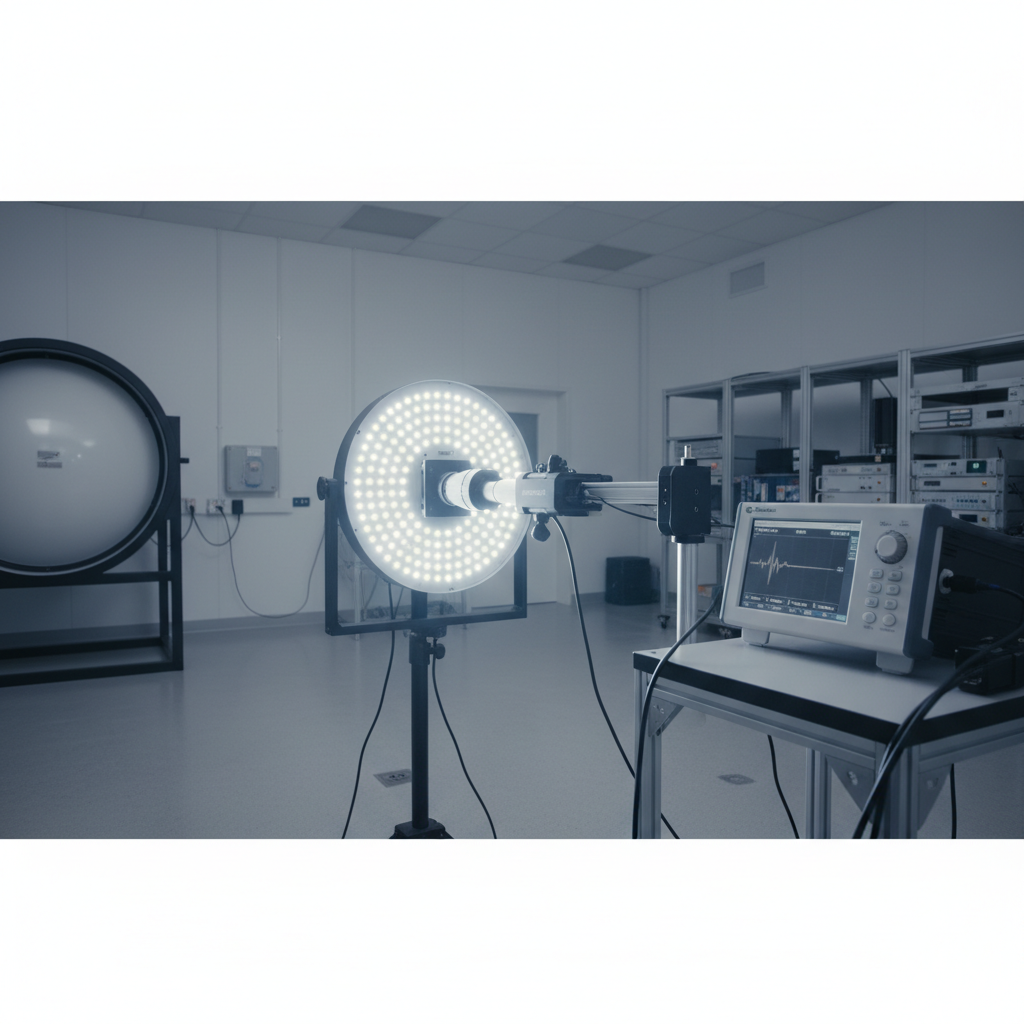
At XHLWX (led-project-light.com), a Custom Indoor LED Lighting Manufacturer based in China, our engineering team regularly consults with specifiers across the EU and US who are grappling with outdated lighting metrics. For decades, the Color Rendering Index (CRI) has been the primary shorthand for color quality.
However, with the nuance and spectral engineering possible with modern LEDs, CRI is no longer sufficient. It is an outdated metric from a pre-LED era that fails to capture the true visual performance of a light source.
The industry is now moving towards IES TM-30-20, a comprehensive two-metric system that provides a far more accurate and useful characterization of how a light source renders color. Understanding this shift is critical for anyone specifying lighting for commercial, retail, or architectural projects today.
What Changed — and Why It Matters Now
The original Color Rendering Index, defined in CIE 13.3-1995, was developed to evaluate incandescent and fluorescent light sources. Its method is based on comparing the light source in question to a reference illuminant (like a black body radiator or daylight) across just eight pastel-colored test samples (TCS), designated R1 through R8. The average performance across these eight samples produces the general CRI (Ra) score out of 100.
The problem is twofold. First, the eight samples are all low in saturation, meaning they don't represent the vibrant colors common in modern interior design, retail displays, or even natural environments.
Second, the crucial R9 value, which measures the rendering of saturated red, is not included in the general Ra score. A light source can have an Ra of 95 but an R9 of 10, resulting in terrible rendering of skin tones, red meats, and rich wood finishes.
LED manufacturers could 'game' the system by optimizing their spectral power distribution (SPD) to perform well on the eight pastel samples, while neglecting performance on more saturated colors.
This is why the Illuminating Engineering Society (IES) introduced TM-30. First published in 2015 and updated to TM-30-20, this method uses 99 Color Evaluation Samples (CES) that are much more representative of real-world colors. It also provides two key metrics instead of one:
- Rf (Fidelity Index): This works similarly to CRI, measuring the average closeness of the rendered colors to the reference illuminant on a scale of 0-100. Because it uses 99 diverse color samples, it is a far more robust and reliable measure of color fidelity than CRI (Ra).
- Rg (Gamut Index): This measures the average change in saturation (i.e., the 'vibrancy' or 'grayness') of the 99 color samples. An Rg of 100 means no average change in saturation. An Rg > 100 means colors are, on average, more saturated or vibrant. An Rg < 100 means they are less saturated or muted.
This matters now more than ever. As LED technology allows for precise spectral tuning, TM-30 empowers designers to specify not just for accuracy (Rf) but also for the desired level of vibrancy (Rg).
A museum might want an Rf of 95 and an Rg of 100 for perfect authenticity, whereas a high-end grocer might prefer an Rf of 90 and an Rg of 108 to make fresh produce look more appealing. CRI simply cannot provide this level of design control.
The Technical Detail Behind the Headline
To understand the practical difference, consider the specifications for a high-performance linear LED luminaire designed for an architectural office in Germany. A specifier should no longer accept just 'CRI 90+' on a submittal. Instead, a modern specification sheet should provide a full suite of performance data that can be verified in a lighting design simulation. The table below outlines the key parameters a specifier should demand.
| Parameter | Specification | Industry Standard (Benchmark) | Notes for Specifiers |
|---|---|---|---|
| Color Fidelity (TM-30 Rf) | 92 | >= 90 for high-quality spaces | Rf is a more reliable fidelity metric than CRI. |
| Color Gamut (TM-30 Rg) | 103 | 95-105 for most applications | An Rg over 100 indicates increased average saturation. |
| CRI (Ra) / R9 | >95 / >80 | Ra > 90 / R9 > 50 | Still request CRI/R9 as a secondary check. High R9 is critical for skin tones. |
| Unified Glare Rating (UGR) | <19 | <19 for offices (EN 12464-1) | Essential for visual comfort; verified in DIALux. |
| Control Protocol | DALI-2 DT8 (Tunable White) | DALI-2 / 0-10V / Casambi | DALI-2 provides individual addressing and diagnostics. |
| LED Chip Brand | Samsung LM283B+ PRO series | Samsung / Bridgelux / Osram | Reputable chip brands ensure consistency and reliability. |
| Driver Brand | Tridonic GEN4 | Tridonic / Mean Well / Osram | The driver is as critical as the chip for lifetime and performance. |
| Housing Protection | IP44 | IP20 (general) / IP44+ (damp) | IP44 is splash-proof, suitable for general commercial use. |
| Luminaire Length | Custom (e.g., 2245mm) | Project-specific | Custom lengths allow for seamless integration into architecture. |
| Certifications | CE, RoHS, ErP, ISO9001 | CE, RoHS, ErP (for EU) | Ensures legal market access and quality manufacturing processes. |
What This Means for Specifiers and Buyers
For lighting specifiers, architects, and electrical contractors in Europe and the United States, the transition to TM-30 necessitates a change in workflow and documentation. Simply specifying a 'CRI 90' luminaire is no longer a guarantee of quality. It leaves the project vulnerable to value-engineering with inferior products that technically meet the CRI spec but deliver poor visual results.
To protect design intent and ensure client satisfaction, specifiers must become fluent in the language of TM-30. The primary action is to update specification documents to require TM-30-20 data for all primary luminaires. This includes demanding the full IES report, which contains the color vector graphic, not just the two headline numbers (Rf and Rg).
How Do I Specify TM-30 Values for a High-end Retail Project?
For a high-end fashion boutique or showroom, color is a business driver. You want fabrics and materials to be rendered accurately but also with vibrancy to attract customers. A robust specification would be: CCT 3000K, a fidelity index Rf ≥ 90 to ensure colors are true, and a gamut index Rg between 100 and 107 to add a slight 'pop' without appearing unnatural. For specific displays, like jewelry, you might even push Rg higher. The key is to define this intent in the specification, preventing substitution with a standard CRI 90 fixture that might have a dulling Rg of 95.
What Are the Risks of Ignoring TM-30 and Only Using CRI?
The most significant risk is a mismatch between expectation and reality, leading to a dissatisfied client and potential rework. Imagine a corporate headquarters where the architect specified American cherry wood panels. The lighting submittal showed a CRI 92 fixture, which was approved. However, the installed fixture had a poor R9 value and an unflattering TM-30 profile. The result: the expensive wood panels look dull and yellowish, and employee skin tones appear unhealthy. Specifying Rf ≥ 90 and R9 > 50 would have prevented this issue entirely, as these metrics ensure good rendering of saturated reds.
Will Using High TM-30 Rated LEDs Affect My Project's Energy Consumption?
This is a common concern, but one largely mitigated by modern LED technology. While there was once a significant efficacy penalty (lumens per watt) for high-CRI light sources (often a 15-20% drop), today's leading LED chips from manufacturers like Samsung and Bridgelux have minimized this trade-off. The efficacy penalty for an Rf 90+ LED compared to a standard Rf 80+ LED is often less than 5-7%. High-quality fixtures can now easily deliver both superb color quality (Rf > 90) and meet stringent energy codes like the EU's ErP Regulation (EU) 2019/2020, which mandates high efficacy. You no longer have to choose between saving kWh and excellent light quality.
Compliance Checklist (IES / LDT / DIALux / CE / RoHS / ErP)
For any project in the EU or US, a rigorous compliance and verification process is essential. Use this checklist when evaluating a potential lighting manufacturing partner:
-
Photometric Files: Does the manufacturer provide full IES and LDT photometric files for every product configuration? These are the foundational data files for any professional lighting design. Without them, accurate simulation is impossible.
-
Design Simulation: Have you imported the IES/LDT files into DIALux (the industry standard in Europe) or AGi32 to simulate the lighting plan? Verify that the design achieves the target illuminance levels (e.g., 500 lux for offices), uniformity, and glare ratings (UGR < 19). Your manufacturer should be able to provide support for this process.
-
TM-30 Data: Does the manufacturer provide a full TM-30-20 report, including the color vector graphic? Do not accept just an Rf and Rg value. The full report confirms the data's validity and provides deeper insight into how specific colors are rendered.
-
Regulatory Compliance: For the European market, demand the Declaration of Conformity (DoC) showing compliance with CE, RoHS (Directive 2011/65/EU), and the latest ErP Ecodesign regulation (EU) 2019/2020. This is a non-negotiable legal requirement for market access.
-
Quality Systems: Does the manufacturing facility hold an ISO9001:2015 certification? This demonstrates a commitment to quality management, process control, and continuous improvement, reducing the risk of product defects.
Frequently Asked Questions
Q: What Is a “good” TM-30 Score?
It depends on the application. For general office and architectural lighting where color accuracy is key, a fidelity score of Rf ≥ 90 and a gamut score of Rg between 95 and 105 is an excellent target. For retail or hospitality environments looking to enhance vibrancy, an Rg up to 110 may be desirable. An Rf below 85 is generally considered poor quality for professional applications.
Q: Can I Convert a CRI Value to a TM-30 Value?
No, a direct mathematical conversion is impossible. CRI is calculated from only 8 pastel color samples, while TM-30's Rf metric uses 99 diverse samples. A luminaire can be engineered to score well on the 8 CRI samples while performing poorly on the other 91. This is why you must request full TM-30 data directly from the manufacturer for an accurate assessment.
Q: Does TM-30 Replace CRI Completely?
Officially, the IES recommends TM-30 as the preferred method. However, CRI is still deeply entrenched in the industry and present on many datasheets. The best practice for specifiers today is to demand both. Specify your primary requirements using TM-30 (e.g., Rf ≥ 90, 95 < Rg < 105) and use CRI as a secondary check, specifically demanding a minimum R9 value greater than 50.
Q: How Does TM-30 Relate to the New EU ErP Regulations?
They measure two different, but equally important, aspects of luminaire performance. The ErP Ecodesign Regulation (EU) 2019/2020 primarily focuses on energy efficiency (efficacy, measured in lm/W) and power consumption. TM-30, on the other hand, defines the quality of that light. A compliant fixture must meet the high efficacy targets of ErP while also delivering the high-quality color rendering defined by your TM-30 specification.
Talk to Our Engineering Team
At XHLWX (led-project-light.com), a Custom Indoor LED Lighting Manufacturer based in China, we believe that empowering specifiers with the right data leads to superior project outcomes. The move from CRI to TM-30 is a significant step forward for the lighting industry, enabling a more precise and intentional approach to design. If you need to specify luminaires with guaranteed TM-30 performance, require custom-length housings, or need support with DIALux simulations and full photometric files for your next EU or US project, please contact our engineering sales team at len@led-project-light.com.
Need a tailored lighting plan for your project?
Our senior lighting designers reply within 48 hours with a free design proposal & quotation.