
Choosing Commercial Dimming: DALI-2 vs 0-10V vs Wireless Analysis
A deep dive for specifiers on selecting commercial dimming controls. We analyze wiring, dimming depth, flicker, and protocol interoperability for EU/US projec
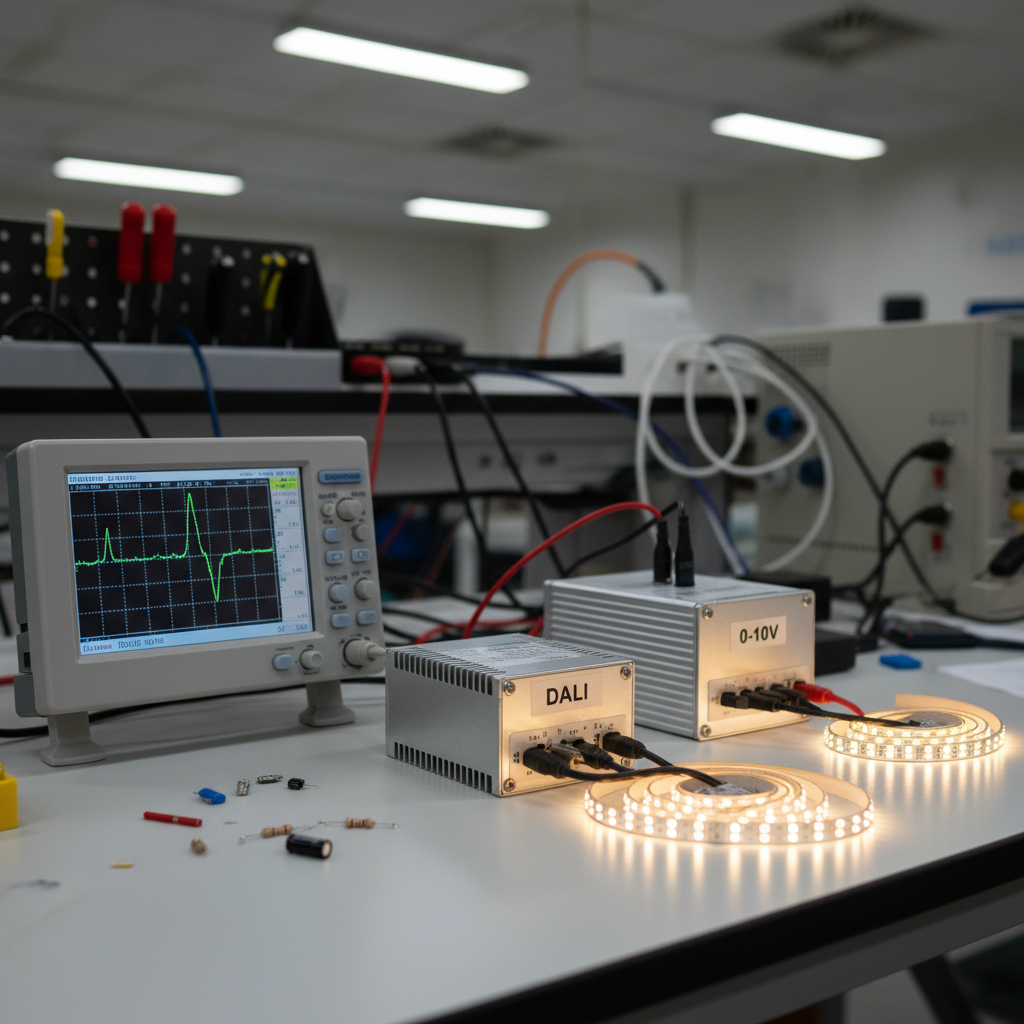
At XHLWX (led-project-light.com), a Custom Indoor LED Lighting Manufacturer based in China, our engineering team regularly consults with specifiers navigating the increasingly complex landscape of lighting controls. The choice between legacy analog systems like 0-10V, robust digital protocols like DALI-2, and flexible wireless solutions such as Casambi is no longer a simple matter of preference.
It's a critical decision impacting project budget, installation timelines, energy code compliance, and the ultimate occupant experience. Missteps can lead to flickering lights, incompatible components, and systems that fail to meet modern demands for data and efficiency.
What Changed — and Why It Matters Now
The conversation around commercial lighting has fundamentally shifted from mere illumination to intelligent building infrastructure. This evolution is driven by three key forces: stringent energy regulations, the demand for human-centric environments, and the integration of lighting into the broader Internet of Things (IoT) ecosystem. Regulations like the EU's Ecodesign Directive (ErP) 2019/2020 have imposed strict limits on energy consumption, including standby power, making efficient control non-negotiable. Simultaneously, the WELL Building Standard and similar initiatives have highlighted the importance of light quality, including flicker-free dimming and tunable white capabilities, to support occupant health and productivity.
Historically, 0-10V dimming was the default choice for its simplicity and low cost. However, its limitations—one-way communication, susceptibility to noise, and inconsistent dimming performance—are becoming increasingly apparent in sophisticated projects.
This has paved the way for digital and wireless protocols to take center stage. DALI-2, the latest version of the Digital Addressable Lighting Interface standard (IEC 62386), offers certified interoperability, bi-directional data communication, and superior dimming performance.
Wireless systems built on Bluetooth Mesh, like Casambi, offer unparalleled installation flexibility, dramatically reducing labor costs in both new builds and retrofits. Understanding the technical trade-offs between these systems is now essential for any contractor, specifier, or facility manager aiming to deliver a future-proof lighting project.
The Technical Detail Behind the Headline
To understand the practical differences, it's crucial to analyze how these control protocols interact with the luminaire itself. The choice of protocol dictates the wiring topology, the driver specifications, and the ultimate performance capabilities. A high-quality LED luminaire can be specified with drivers compatible with any of these systems, but the resulting functionality will vary significantly. The table below illustrates a typical specification for a premium linear LED luminaire, showing how control choice affects key parameters.
| Parameter | Specification | Standard / Protocol | Notes for Specifiers |
|---|---|---|---|
| Optics (CCT/CRI) | 3000K / >90 Ra | IES TM-30-18 | For office/retail, specify Rf >90 and Rg ~100 for accurate color rendering. |
| Glare Control (UGR) | <19 | EN 12464-1 | Mandatory for office workstations; achieved through microprismatic diffuser design. |
| Control Protocol | DALI-2 / 0-10V / Casambi | IEC 62386 / EN 60929 / Bluetooth Mesh | DALI-2 is best for data & interoperability; 0-10V for simple cost-sensitive jobs; Casambi for retrofits. |
| Dimming Performance | 100% to 0.1% Depth, Logarithmic Curve | IEEE 1789-2015 | DALI-2 drivers excel here. Check 0-10V drivers carefully as many only dim to 10%. Specify PWM frequency >3kHz to eliminate flicker. |
| Driver & Chip | Tridonic DALI-2 Driver, Samsung LM281B+ LEDs | CE / RoHS / ErP | Using certified, branded components ensures reliability and compliance. ErP requires standby power <0.5W. |
| Housing & IP Rating | Extruded Aluminum, Custom Lengths / IP40 | N/A | IP40 is standard for dry indoor locations. Higher ratings available for specific needs. |
| Manufacturer Cert. | ISO9001:2015 | Quality Management | Ensures consistent production quality and traceability from the manufacturer. |
What This Means for Specifiers and Buyers
The technical specifications directly translate into critical project decisions. The selection of a dimming protocol is a commitment that extends from the initial design schematics to long-term facility management. European and US specifiers must weigh the upfront costs against the total cost of ownership, including installation labor, commissioning complexity, energy savings, and maintenance benefits.
How Does Wiring Complexity Affect My Project Budget and Timeline?
Wiring is a major cost center in any lighting installation. For a 50,000 sq ft office space, the difference in labor can be substantial.
- 0-10V: Requires a separate 2-core, low-voltage cable run from the controller/dimmer to every group of luminaires. While the cable is inexpensive, the labor to run these dedicated circuits for each control zone can be extensive. It is prone to voltage drop over long distances (>100ft / 30m), which can cause inconsistent dimming levels. It's also susceptible to induced electrical noise if run parallel to mains cables, requiring careful routing or shielded cable.
- DALI-2: Uses a 2-core, polarity-insensitive bus that can be wired in a free topology (star, line, or tree) and often run in the same conduit as the mains power (check local codes). A single DALI bus can control up to 64 luminaires individually. This radically simplifies wiring layouts, as complex zone assignments are handled in software during commissioning, not in the physical wiring. This reduces design time and on-site labor.
- Wireless (e.g., Casambi): This option eliminates control wiring entirely. Each luminaire and control device has a built-in radio, forming a self-organizing and self-healing mesh network. This is a game-changer for retrofit projects in buildings with solid concrete ceilings or historic preservation constraints. While individual components may be slightly more expensive, the savings on labor and conduit can reduce total installed costs by 20-30% or more.
What Level of Dimming Performance and User Experience Do I Need?
The quality of dimming directly impacts occupant comfort. Poor performance is immediately noticeable and undermines the perceived value of the entire lighting system.
- Dimming Depth and Curve: The human eye perceives brightness logarithmically, not linearly. A good dimming system uses a logarithmic curve to ensure the perceived dimming is smooth from 100% down to the lowest levels. DALI-2 mandates this curve. High-quality DALI-2 drivers can dim smoothly to 0.1%. In contrast, many 0-10V systems exhibit a noticeable “step” at the low end and often cannot dim below 10% or even 5%, abruptly shutting off.
- Flicker and Stroboscopic Effects: Flicker, even when imperceptible, can cause headaches, eye strain, and fatigue. The IEEE 1789-2015 standard provides guidance on safe flicker levels. Flicker is a function of the driver's PWM (Pulse Width Modulation) output. To be safe, specify drivers with a PWM frequency above 3,000 Hz. While possible with 0-10V, it's a standard feature of high-quality DALI-2 and wireless-enabled drivers.
How Can My Lighting System Generate Data and Integrate with Other Building Systems?
Modern buildings are data-driven. The lighting system, as the most ubiquitous network in a building, is a rich source of operational intelligence.
- 0-10V: This is a one-way street. The controller sends a voltage signal, and the luminaire responds. There is no return path for data. You cannot query a luminaire for its energy consumption, operational hours, or failure status. Integration with a Building Management System (BMS) is limited to zone-level on/off status.
- DALI-2: This is a two-way digital highway. DALI-2 adds extensive data feedback capabilities. According to IEC 62386, Part 251 allows for luminaire data (e.g., runtime), Part 252 for energy data (real-time power consumption), and Part 253 for diagnostics (e.g., lamp failure). This data enables predictive maintenance, detailed energy audits, and space utilization analysis. DALI-2 systems can be easily integrated into a BMS via certified gateways.
- Wireless: These systems are inherently data-rich, often connecting to a cloud-based dashboard. They can provide all the data of a DALI-2 system plus additional insights like occupancy heatmaps from sensor data. This offers powerful remote management capabilities but requires consideration of network security, data privacy, and potential ongoing cloud service fees.
Compliance Checklist (IES / LDT / DIALux / CE / RoHS / ErP)
For EU and US projects, specifiers must ensure every component meets a web of regulatory and performance standards. A manufacturer should make this process transparent and provide all necessary documentation.
- Photometric Files: Always request luminaire-specific
IES(for North America) andLDT(for Europe) photometric files. These are essential for creating accurate lighting simulations in software likeDIALux. A simulation is the only way to verify a design will meet required illuminance levels (e.g., 500 lux for an office), uniformity, and glare ratings (UGR < 19), proving compliance with standards like EN 12464-1 before purchase. - CE Marking: This is a mandatory conformity marking for products sold within the European Economic Area (EEA). It signifies that the manufacturer has verified the product complies with relevant EU directives, such as the Low Voltage Directive and the EMC Directive.
- RoHS Directive: The Restriction of Hazardous Substances directive is crucial for environmental compliance in the EU. Ensure the manufacturer provides a declaration of conformity, confirming the product is free from restricted materials like lead and mercury.
- ErP Directive (EU) 2019/2020: This Ecodesign regulation is critical. As of September 1, 2021, it sets high efficiency standards (
lm/W) for light sources and standby power limits for control gear (<0.5W). Specifying an ErP-compliant driver and light engine is not optional; it is a legal requirement for market access in the EU.
Frequently Asked Questions
Q: Is 0-10V Dimming Obsolete for New Commercial Projects?
Not entirely, but its use case is narrowing. For simple, budget-driven projects requiring basic zone dimming without data feedback, it remains a viable option. However, for any project requiring deep dimming below 5%, granular control, energy reporting, or integration with a BMS, digital protocols like DALI-2 or wireless systems are vastly superior and more future-proof.
Q: Can I Mix DALI and DALI-2 Devices on the Same Bus?
Yes, DALI-2 was designed to be backward-compatible with legacy DALI devices. You can add a DALI-2 certified driver to an existing DALI system. However, to gain the full benefits of DALI-2, such as guaranteed interoperability and standardized data feedback, all components on the bus, especially the application controller, should be DALI-2 certified.
Q: What Is the Best Dimming Choice for Human-Centric Lighting (HCL)?
DALI-2 is the clear winner for HCL applications. Its Device Type 8 (DT8) functionality allows for both brightness and color temperature (CCT) to be controlled via a single DALI address. This simplifies wiring and commissioning for tunable white luminaires, enabling smooth transitions from warm (2700K) to cool (6500K) light throughout the day, which would otherwise require two separate 0-10V channels and controllers.
Q: How Reliable Are Wireless Lighting Controls Like Casambi in a Large Office?
Modern wireless systems using Bluetooth Mesh are extremely reliable. The mesh architecture means there is no single point of failure; each luminaire acts as a repeater, strengthening the network. In a typical 20,000 sq ft office, with proper node density, the network is self-healing and robust. Command latency is typically under 50 milliseconds, making the system's response feel instantaneous to the user.
Talk to Our Engineering Team
The choice of a dimming protocol is a foundational decision with long-term consequences for cost, performance, and future-readiness. At XHLWX (led-project-light.com), a Custom Indoor LED Lighting Manufacturer based in China, we specialize in helping our EU, US, and Middle East partners make the right choice. Our team can provide fully documented, compliant luminaire packages with your choice of 0-10V, DALI-2, or wireless controls, complete with IES and LDT photometric files for DIALux planning and all necessary CE, RoHS, and ErP certifications. Contact us to discuss your project's specific requirements.
Need a tailored lighting plan for your project?
Our senior lighting designers reply within 48 hours with a free design proposal & quotation.