
Qihang's Tunable White Line: A Deep Dive for EU/US Specifiers
Qihang Lighting's new tunable white product line (2200K-6500K) signals a market shift. Our analysis covers the technical specs, control needs, and compliance
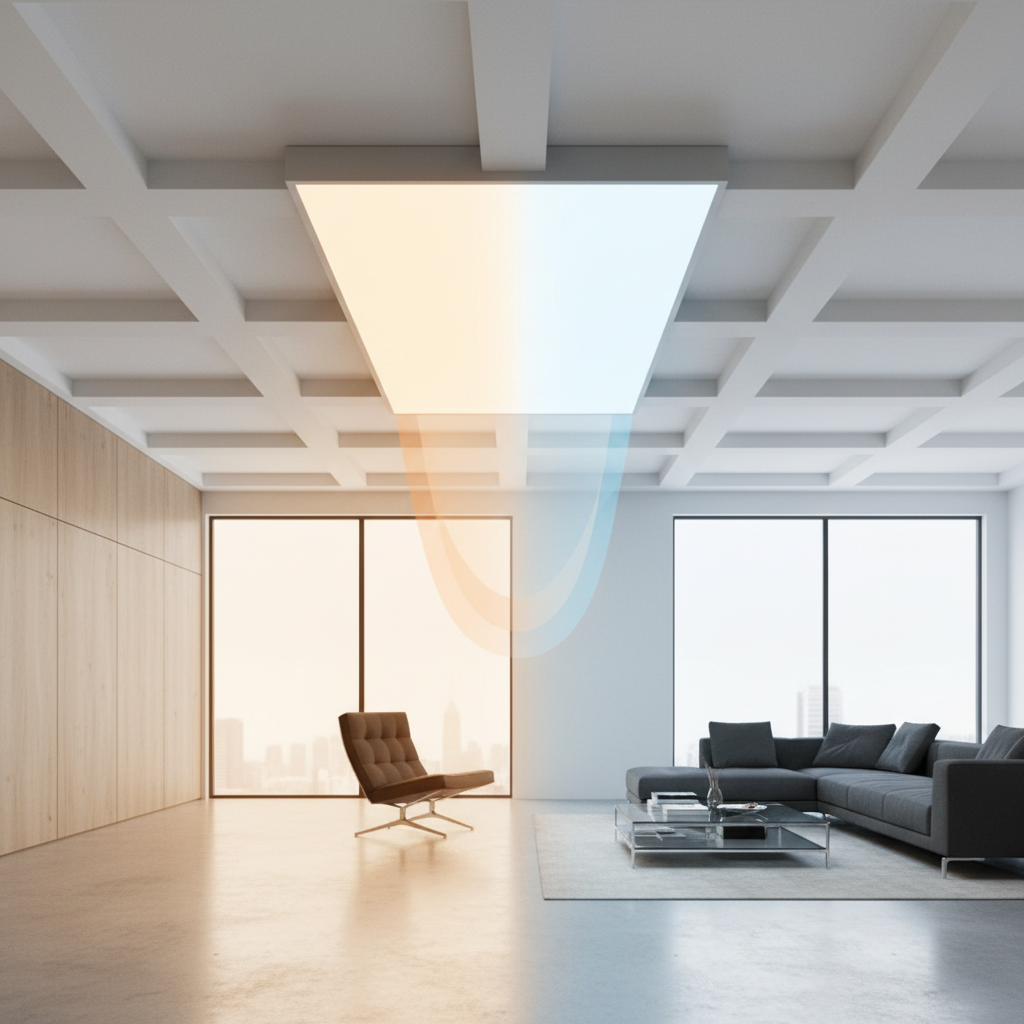
At XHLWX (led-project-light.com), a Custom Indoor LED Lighting Manufacturer based in China, we continuously monitor market shifts to provide our partners with timely analysis. The recent announcement from competitor Qihang Lighting regarding their new, comprehensive tunable white product line is a significant development worth dissecting.
This move, which offers steplessly adjustable color temperatures from a warm 2200K to a cool 6500K, confirms the accelerating adoption of Human-Centric Lighting (HCL) principles in mainstream commercial and institutional projects. It’s a clear signal that the market is moving beyond static illumination towards dynamic, responsive environments that enhance both well-being and space flexibility.
What Changed — and Why It Matters Now
The core change is the widespread availability of accessible, high-quality tunable white technology. For years, HCL was a niche, premium concept, often complex and expensive to implement. Qihang's launch indicates that manufacturing scale and technology maturation are bringing these solutions into the standard specification portfolio. This matters immensely for projects where the function of a space changes throughout the day. A corporate conference room, for instance, can now be tuned to a crisp 5000K for a high-alert morning presentation, transition to a neutral 4000K for collaborative afternoon work, and then shift to a relaxing 2700K for an evening networking event—all within the same lighting installation.
The 'why now' is driven by a confluence of factors. Firstly, the growing body of scientific research linking light exposure to circadian rhythm, productivity, and mood has legitimized HCL.
Standards like the WELL Building Standard now award points for circadian lighting design, pushing developers and designers to incorporate it. Secondly, the COVID-19 pandemic reshaped our relationship with indoor spaces, placing a greater emphasis on health and wellness.
Finally, the evolution of control technologies, particularly DALI-2 and its DT8 protocol for color control, has simplified what was once a programming nightmare. This launch isn't just about a new product; it's about the industry reaching a tipping point where dynamic lighting is no longer a luxury, but an expected feature for modern, high-performance buildings.
The Technical Detail Behind the Headline
To understand the impact of this launch, we need to look beyond the headline CCT range. A successful tunable white implementation depends on a host of underlying technical parameters. For a specifier, the quality of light, control integration, and physical housing are paramount. Based on the initial announcement, a typical high-performance linear fixture from this new line would likely need to meet or exceed the following specifications for consideration in a demanding European or US project.
| Parameter | Specification | Typical Standard | Notes for Specifiers |
|---|---|---|---|
| Correlated Color Temp (CCT) | 2200K - 6500K Tunable | DALI DT8 Control | Ensures full range for human-centric scenes, from sunrise to high noon. |
| Color Rendering Index (CRI) | Ra > 95 | Ra > 90 (Commercial) | Essential for accurate color representation, especially in retail/galleries. |
| TM-30-18 Fidelity/Gamut | Rf > 92, Rg ≈ 100 | Rf > 90 | Provides a more complete picture of color rendition than CRI alone. |
| Unified Glare Rating (UGR) | UGR < 16 | UGR < 19 (Office) | Critical for visual comfort in workspaces; achieved with micro-prismatic diffusers. |
| Beam Angle | 90° with Asymmetric Option | Varies by application | A versatile 90° is good for general lighting; asymmetric for wall washing. |
| Control Protocol | DALI-2 (DT8) / 0-10V / Casambi | DALI-2 | DALI-2 with DT8 is the gold standard for smooth, flicker-free color tuning. |
| LED Chip / Driver Brand | Bridgelux Thrive™ Vesta® | Osram, Samsung, etc. | Named brands like Bridgelux and Tridonic ensure reliability and performance. |
| Housing / IP Rating | Extruded Aluminium / IP40 | IP20 (Indoor) | IP40 provides dust protection suitable for most commercial interiors. |
| Certifications | CE, RoHS, ErP (EU) 2019/2020 | ISO9001 Factory | Mandatory for EU market; ErP compliance is key for energy efficiency. |
This level of specification separates a professional-grade product from a low-cost alternative. Key details like a TM-30 Rf over 92 and a UGR below 16 indicate a focus on high-quality visual environments, not just the ability to change color. The use of premium components like Bridgelux chips and a driver compatible with DALI-2 DT8 ensures longevity and seamless integration with building control systems.
What This Means for Specifiers and Buyers
The introduction of more market options for tunable white is a positive development, but it also introduces new layers of complexity for specifiers, contractors, and facility managers. Moving from a static to a dynamic lighting plan requires a shift in thinking across the entire project lifecycle.
How Will Implementing Tunable White Affect Project Budgets and Return on Investment?
Initially, tunable white luminaires and their associated control systems carry a 20-35% cost premium over standard static CCT, DALI-dimmable fixtures. This upfront investment can be a hurdle. However, the ROI calculation must extend beyond initial hardware costs. For commercial real estate, spaces equipped with HCL can command higher lease rates and attract premium tenants focused on employee wellness. In hospitality, it allows a single space to be perfectly lit for multiple revenue-generating functions. Energy savings can also be realized, as a properly commissioned DALI system can incorporate daylight harvesting and occupancy sensing, potentially reducing lighting energy consumption by up to 60% compared to a basic switched system. The long-term value lies in flexibility, user well-being, and property appreciation.
What Are the New Control System Requirements to Properly Manage a Tunable White Installation?
This is the most critical consideration for contractors. A tunable white fixture is only as good as its control system. Simply specifying a "tunable white" luminaire is not enough. For precise and smooth control of both intensity and color, the DALI-2 protocol with a Type 8 (DT8) command structure is the industry best practice. A single DT8 driver uses one DALI address to manage both functions, simplifying wiring and commissioning. Alternatives like using two separate DT6 drivers (one for intensity, one for CCT) are more cumbersome. Wireless solutions like Casambi offer excellent flexibility for retrofits but may require careful planning for scalability and network reliability in large-scale new builds. The specifier must clearly define the control intent and protocol to avoid costly on-site integration problems.
How Can a Specifier Ensure Color Consistency and Quality Across Hundreds of Fixtures?
With two variables (intensity and color) in play, consistency is a major challenge. First, demand tight color binning from the manufacturer, ideally within a 3-step MacAdam ellipse, to ensure fixtures look identical at the same CCT setting. Second, verify the CCT tracking performance; the color temperature should remain stable as the fixture is dimmed from 100% down to 1%. Low-quality drivers may cause the CCT to drift during dimming. Third, always request and review quality control documentation for the specified batch of luminaires. Finally, commissioning is key. The control system must be programmed by a qualified technician to ensure that all fixtures respond uniformly and that the pre-set scenes accurately reflect the design intent.
Compliance Checklist (IES / LDT / DIALux / CE / RoHS / ErP)
For European and US projects, specifying products from any manufacturer, including new lines from Qihang, requires a rigorous compliance and documentation check. Before committing to a product, a specifier or purchasing manager must verify the following:
-
Photometric Data: The manufacturer must provide comprehensive IES and LDT photometric files for each variant of the luminaire. This data is non-negotiable. Without it, lighting designers cannot accurately model performance in software like DIALux EVO or AGi32. A simulation in DIALux is essential for predicting illuminance levels (lux), ensuring uniformity, and verifying compliance with standards like EN 12464-1 for workplace lighting.
-
CE Marking (EU): This demonstrates conformity with EU health, safety, and environmental protection standards. It must be supported by a formal Declaration of Conformity and technical files covering the Low Voltage Directive (LVD) and Electromagnetic Compatibility (EMC) Directive.
-
RoHS Compliance: The Restriction of Hazardous Substances directive must be adhered to, limiting the use of specific materials like lead and mercury. This is a standard requirement for most global markets.
-
ErP Regulation (EU): This is a crucial, relatively new requirement. All lighting products entering the EU market must comply with the Ecodesign for light sources and separate control gears regulation, (EU) 2019/2020, also known as the Single Lighting Regulation (SLR). This sets strict minimums for energy efficiency (lm/W), standby power (<0.5W), and flicker (PstLM), and includes requirements for reparability and disassembly, pushing the industry towards a more circular economy.
Frequently Asked Questions
Q: What Is the Main Difference Between Dim-to-warm and Tunable White Lighting?
The key difference is control independence. Tunable white allows you to adjust brightness (intensity) and color temperature (CCT) separately. For example, you can have a cool 6000K light at 10% brightness. Dim-to-warm, however, follows a fixed curve, mimicking an incandescent bulb. As you dim the light from 100% to 1%, its color temperature automatically shifts from a set warm CCT (e.g., 3000K) to an even warmer one (e.g., 2200K).
Q: Does Tunable White Lighting Actually Improve Workplace Productivity?
Evidence strongly suggests it can. Studies from organizations like the Fraunhofer Institute for Building Physics have shown that dynamic lighting scenes mimicking natural daylight can improve cognitive performance and alertness. In a typical office application, cycling the CCT from a neutral 4000K in the morning to a cooler 5500K for peak focus hours and back down can result in productivity gains of up to 15% and reduce errors, supporting a business case for the investment.
Q: What Is DALI DT8 and Why Is It so Important for Tunable White Fixtures?
DALI DT8 is a specific device type within the DALI-2 lighting control standard designed for color-tunable light sources. Its primary advantage is efficiency. It allows a single DALI short address to control both the intensity and the color temperature of a luminaire. This simplifies wiring, reduces the number of required components, and makes commissioning the system much faster and less complex than older methods that required two separate addresses (and often two drivers) for one fixture.
Q: Can I Integrate New Tunable White Fixtures into Our Existing Building Management System (BMS)?
Yes, integration is a common requirement. Most modern tunable white systems based on DALI-2 can be connected to a BMS (such as BACnet or KNX) via a DALI gateway. This gateway acts as a translator, converting high-level commands from the BMS—like "Set Scene: Morning Focus" or time-based schedules—into the specific DALI DT8 commands that the luminaires understand. This enables centralized monitoring, scheduling, and control of the entire lighting system alongside HVAC and security.
Talk to Our Engineering Team
While market developments from companies like Qihang are valuable indicators, the success of any advanced lighting project lies in expert planning and custom-tailored solutions. For specifiers, contractors, and developers in the EU, US, and Middle East, achieving the perfect balance of performance, compliance, and budget requires a collaborative manufacturing partner. At XHLWX (led-project-light.com), a Custom Indoor LED Lighting Manufacturer based in China, our engineering team specializes in translating complex HCL concepts into reliable, specification-grade luminaires. We provide full photometric support, ensure compliance with all regional standards including ErP, and work with you to deliver a solution optimized for your project's unique demands. Contact us to discuss your next tunable white specification.
Need a tailored lighting plan for your project?
Our senior lighting designers reply within 48 hours with a free design proposal & quotation.