
Why SDCM<3 is the New Gold Standard for Professional LED Lighting
Discover why professional lighting projects now demand SDCM<3 color consistency. Learn how exceeding 3-step MacAdam ellipses impacts visual merchandising, bra
What Changed — and Why It Matters Now
At XHLWX (led-project-light.com), a Custom Indoor LED Lighting Manufacturer based in China, we’ve witnessed a critical shift in project specifications that every specifier, contractor, and facility manager in Europe and the US must understand. The once-acceptable tolerance for color variation in LED lighting has been drastically tightened.
Where a 5-step MacAdam ellipse (5 SDCM) was previously tolerated, the professional benchmark has decisively moved to a maximum of 3-step (SDCM<3). This isn't a cosmetic preference; it's a fundamental requirement for quality, brand integrity, and long-term asset value.
The change is driven by a convergence of factors. Firstly, LED manufacturing and binning technology have matured, making tighter color control more accessible.
Secondly, client expectations have soared. In high-end retail, hospitality, and corporate environments, visual consistency is non-negotiable.
A visible difference in the color of white light between two adjacent fixtures—a common issue when SDCM exceeds 4 or 5—creates a jarring, low-quality impression that can damage brand perception. Imagine a luxury boutique where one downlight casts a cool, bluish-white light onto a handbag while the next casts a warm, yellowish light.
The product's color is distorted, and the store's carefully curated atmosphere is broken.
Furthermore, European regulations like the Single Lighting Regulation (SLR) (EU) 2019/2020, part of the ErP Directive, are pushing the entire industry towards higher quality and performance metrics. While not explicitly mandating SDCM levels for all applications, the spirit of the regulation promotes high-quality, long-lasting products, and poor color consistency is increasingly seen as a sign of a sub-standard luminaire. For projects aiming for excellence and future-proofing, specifying SDCM<3 has become the baseline.
The Technical Detail Behind the Headline
Standard Deviation of Color Matching, or SDCM, is the metric used to quantify the variation of a light source's color from a defined target CCT (Correlated Color Temperature). It’s measured in 'steps' based on the MacAdam ellipse system.
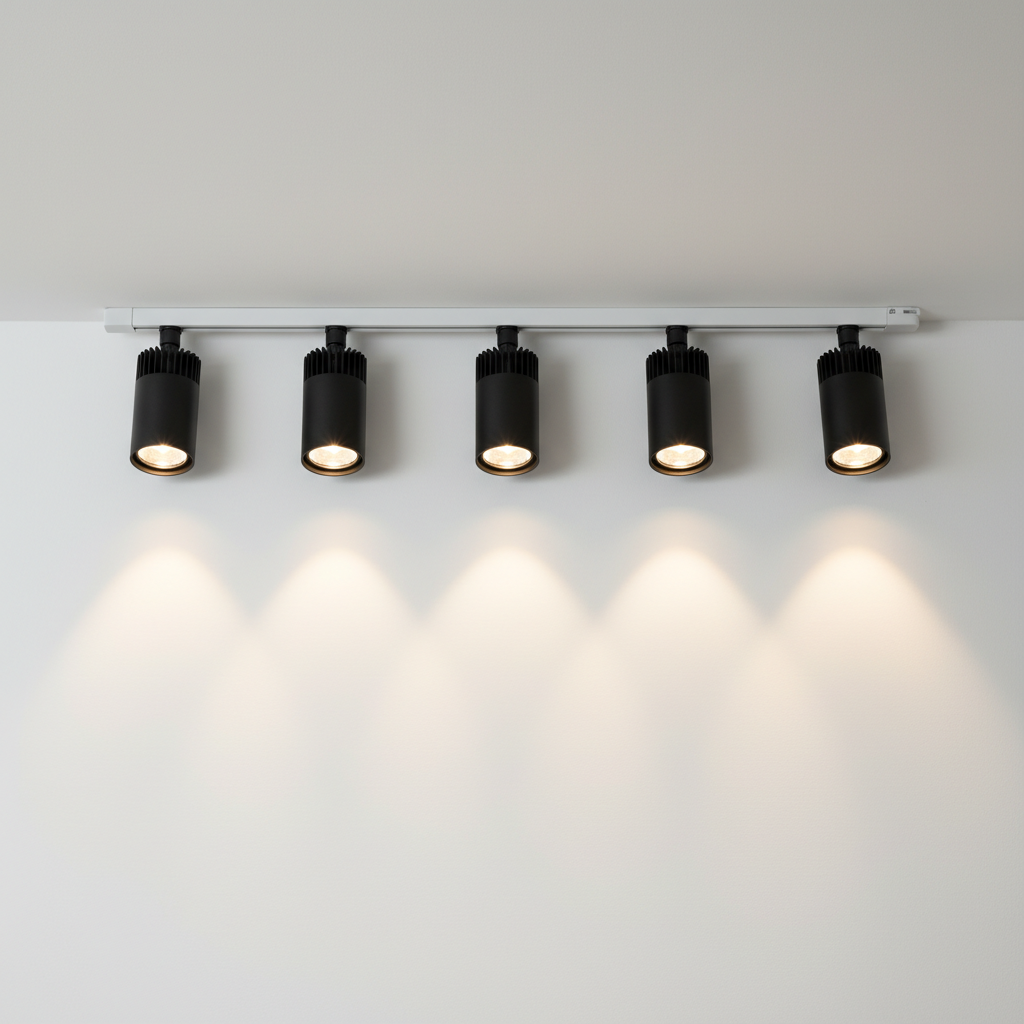
A 1-step ellipse represents a color difference that is imperceptible to the human eye. As the number of steps increases, the potential color variation grows, and at around 4-5 steps, the difference becomes obvious and distracting, especially in applications with multiple luminaires in close proximity, such as office ceilings or retail track lighting.
Achieving an SDCM<3 rating requires a rigorous manufacturing process called 'binning'. During LED production, chips naturally have slight variations in their color output.
Binning is the process of sorting these chips into specific groups, or 'bins', based on their precise color coordinates. A <3 SDCM specification means using only the chips from a very small, central group of bins around the target CCT.
This ensures that every luminaire produced for a project will be visually identical.
Below is a typical specification table for a high-performance linear LED module designed for architectural and commercial projects, highlighting the parameters that ensure top-tier color consistency and overall quality.
| Parameter | Specification | Standard | Notes |
|---|---|---|---|
| CCT Consistency | <3 SDCM | ANSI C78.377-2017 | Critical for multi-luminaire projects to avoid visible color differences. Guarantees visual uniformity. |
| Color Rendering Index (CRI) | >95 Ra | CIE 13.3 | Museum/Retail Grade. Ensures that the colors of objects, textiles, and skin tones appear natural and vibrant. |
| TM-30 Fidelity Index (Rf) | >92 | IES TM-30-20 | A more comprehensive color rendering metric than CRI, essential for specifying for art galleries and high-end retail. |
| Glare Rating (UGR) | <16 | EN 12464-1 | Achievable with appropriate optics. Ensures high visual comfort in office and educational environments. |
| Control Protocol | DALI-2 DT8 / 0-10V / Casambi | IEC 62386 | Provides options for simple dimming (0-10V) to advanced digital control, including Tunable White (DT8). |
| LED Chip Brand | Samsung LM281B+ Pro | Manufacturer Data | Tier-1 chip selection ensures high efficacy (over 160 lm/W), reliability, and color stability over lifetime. |
| Driver Brand | Tridonic / Mean Well | Manufacturer Data | Premium drivers with low ripple (<5%) and a 5-year warranty are crucial for flicker-free operation and longevity. |
| Housing IP Rating | IP44 | IEC 60529 | Protects against objects >1mm and water splashes from any direction, making it suitable for most indoor commercial spaces. |
| Certification | CE / RoHS / ErP / ISO9001 | EU Directives | Non-negotiable for European market access, confirming safety, environmental, and energy performance standards. |
What This Means for Specifiers and Buyers
For lighting specifiers, architects, and electrical contractors, the shift to SDCM<3 is a call to update their standard specifications immediately. Relying on outdated or incomplete specs exposes a project to significant risks, including client dissatisfaction, costly replacements, and reputational damage.
The key is to move from viewing lighting as a commodity to treating it as a critical building system that impacts human perception and operational efficiency. Simply specifying a CCT like '4000K' is no longer sufficient; it must be accompanied by a color consistency requirement of '<3 SDCM'.
How Do I Ensure My Lighting Specification Prevents Color Drift Over the Lifetime of the Installation?
This is a crucial question that goes beyond the initial SDCM rating. You need to look at luminaire lifetime metrics, specifically L80/B10 at a stated number of hours (e.g., 50,000 hours).
This rating means that after 50,000 hours, only 10% of the luminaires will have fallen below 80% of their initial lumen output. Equally important is to ask the manufacturer for color maintenance data (e.g., a C-rating per IES LM-80/TM-21).
High-quality luminaires with robust thermal management (well-designed heat sinks) and premium drivers will not only maintain their brightness but also their color point. A fixture that starts at 2.5 SDCM but drifts to 6 SDCM after just 10,000 hours has failed.
Always demand long-term performance data, not just day-one specs.
What Are the Cost Implications of Moving from a 5-step to a 3-step MacAdam Ellipse Specification?
Historically, there was a significant cost premium for tighter binning, as it utilized a smaller percentage of the LED production yield. While a marginal cost increase of 5-10% may still exist, the landscape has changed.
Advances in manufacturing have made <3 SDCM LEDs more accessible. More importantly, the value proposition has flipped.
The small upfront investment in <3 SDCM lighting is an insurance policy against far greater costs down the line. The cost of one service call to investigate a client's complaint about mismatched lights, plus the labor and material to replace the offending fixture, can easily exceed the total initial cost premium for an entire project.
Specifying <3 SDCM is an exercise in risk management and total cost of ownership reduction.
If My Project Involves Different Types of Luminaires, How Can I Guarantee They All Match?
This is a common challenge in modern building design, where a single open-plan space might contain linear pendants, recessed downlights, and adjustable track spots. The solution is to partner with a manufacturer who can offer project-based, single-bin sourcing.
This means the manufacturer commits to using LED chips from the exact same bin for every luminaire type destined for your project. This is a core capability of a flexible, customer-focused company like XHLWX.
It requires meticulous supply chain management and production planning, but it's the only way to guarantee absolute color harmony across a diverse range of fixture form factors, ensuring the architectural vision is perfectly realized.
Compliance Checklist (IES / LDT / DIALux / CE / RoHS / ErP)
To ensure your project's success and compliance, every specifier must demand and verify the following from their lighting supplier:
-
IES and LDT photometric files: These are the digital DNA of a luminaire. Without them, you are specifying blind. These files, which must be requested for every single product, contain all the data on light distribution, intensity, and power consumption. They are the essential input for any professional lighting design software.
-
DIALux (or other simulation software): Before a single fixture is ordered, the IES and LDT files should be used in a DIALux simulation. This allows the designer to build a virtual model of the space and confirm that the specified products will achieve the required illuminance levels (e.g., 500 lux on office desks), uniformity, and visual comfort. Crucially, it can predict the Uniform Glare Rating (UGR), verifying if the design will meet the EN 12464-1 standard of UGR<19 for office work.
-
CE / RoHS Certification: For any project within the EU or for clients who adhere to global standards, these are mandatory. The CE mark is the manufacturer's declaration of conformity with EU safety and health requirements. The RoHS declaration confirms the product is free from hazardous substances like lead and mercury, a critical environmental consideration.
-
ErP Directive Compliance: This is a major driver of lighting technology in Europe. The latest regulations, (EU) 2019/2020 and (EU) 2019/2015, set strict minimum energy efficiency requirements (lm/W) and performance criteria, including flicker and stroboscopic effect limits. A compliant luminaire delivering 140 lm/W can reduce energy consumption by over 60% compared to older fluorescent or halogen systems, leading to substantial operational savings in kWh and a lower carbon footprint.
Frequently Asked Questions
Q: What Is the Difference Between SDCM and CRI?
SDCM measures color consistency, or the variation in white light between luminaires. A <3 SDCM rating ensures fixtures look identical to one another. CRI (Color Rendering Index) measures color accuracy, how faithfully a light source reveals the true colors of objects. A high-quality specification demands both: <3 SDCM for uniformity and a CRI of >90 for vibrant, accurate color rendition.
Q: Can I Mix Different Batches of <3 SDCM Lights on the Same Project?
We strongly advise against it, even with a tight <3 SDCM rating. Minor variations between production runs can still occur and may be visible in critical applications. For projects requiring absolute perfection, it is best practice to order all luminaires at once. This allows the manufacturer to guarantee they are all sourced from a single LED bin and production batch, ensuring total uniformity.
Q: What Is a Realistic CCT Tolerance for a 3-step MacAdam Ellipse at 4000K?
A 3-step MacAdam ellipse centered on 4000K allows for a color temperature variation of approximately ±90K to ±100K. This means any luminaire within this tightly controlled batch will have a measured CCT between roughly 3900K and 4100K. This narrow range is virtually imperceptible to the human eye, delivering excellent visual consistency across an entire installation.
Q: Does a Tighter SDCM Rating Affect a Luminaire's Energy Efficiency?
Not directly, but the two are often correlated. The process of binning for <3 SDCM involves selecting the most premium portion of an LED production run. These top-tier LED chips often exhibit both superior color consistency and higher efficacy (lm/W). Therefore, specifying <3 SDCM for color quality can incidentally lead to selecting a more energy-efficient product, potentially improving lm/W by 5-10% over lower-binned alternatives.
Measured Proof: Our Own SDCM 2.0 Lab Test Report
Our 4000K Ra90 LED light source measured SDCM 2.0, Ra 92.0, CCT 4119K in an independent EVERFINE spectroradiometer test — well inside the SDCM<3 benchmark discussed above.
| Parameter | Measured result | Benchmark |
|---|---|---|
| Colour tolerance | SDCM 2.0 | SDCM<3 |
| Colour rendering | Ra 92.0 | CRI>90 |
| CCT | 4119K | 4000K nominal |
Download the SDCM 2.0 / Ra90 EVERFINE test report (PDF)
Talk to Our Engineering Team
At XHLWX (led-project-light.com), a Custom Indoor LED Lighting Manufacturer based in China, our engineering team specializes in navigating these complex specifications to deliver flawless results for our EU, US, and Middle East partners. We understand that achieving perfect color consistency is paramount.
Whether you need to ensure thousands of linear fixtures match perfectly in a corporate headquarters or require a mix of custom-length profiles and downlights all sourced from a single bin, we have the technical expertise and supply chain control to make it happen. Contact us today to discuss your project's specific requirements, request detailed photometric data, or get a DIALux design consultation.
Need a tailored lighting plan for your project?
Our senior lighting designers reply within 48 hours with a free design proposal & quotation.