
Decoding EN 12464-1: Is Your Office Lighting Truly Compliant?
Beyond the 500 lux baseline, EN 12464-1 demands UGR<19 and CRI>80 for compliant European office lighting. We analyze the nuances of the standard, including HC
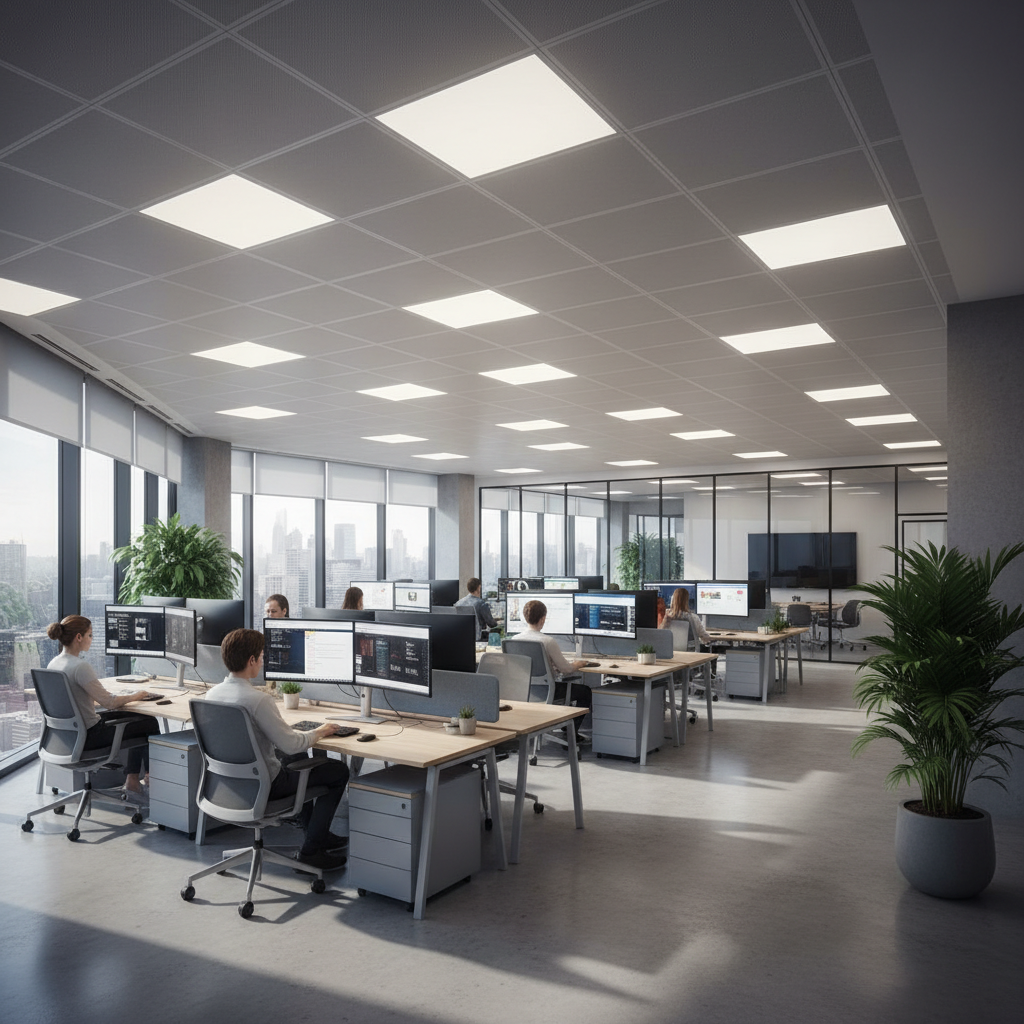
At XHLWX (led-project-light.com), a Custom Indoor LED Lighting Manufacturer based in China, we frequently guide our European and US partners through the complexities of regional lighting standards. A cornerstone of European commercial projects is the EN 12464-1:2021 standard for indoor workplaces.
While many recall the headline figures—500 lux on the task area, a Unified Glare Rating (UGR) below 19, and a Colour Rendering Index (CRI) over 80—the reality of compliance is far more nuanced. This updated standard, which superseded the 2011 version, places a greater emphasis on the total luminous environment, not just isolated task surfaces, impacting everything from luminaire selection to control strategy.
What Changed — and Why It Matters Now
The transition from EN 12464-1:2011 to the latest 2021 version marked a significant evolution in lighting design philosophy. The previous standard was often interpreted as a simple checklist for horizontal illuminance on the desk. The 2021 update encourages designers to consider the entire visual experience of occupants, introducing more detailed recommendations for aspects like illuminance on vertical surfaces (walls) and cylindrical illuminance (light on faces), which are crucial for facial recognition and communication.
This shift matters for several reasons. Firstly, it aligns the standard with modern workspace design, where collaboration and flexibility are key.
Lighting is no longer just for individual tasks but for creating an adaptable, comfortable, and visually interesting environment. Secondly, it formally acknowledges the growing importance of non-visual effects of light, paving the way for Human-Centric Lighting (HCL) strategies.
While the standard doesn't mandate HCL, its annexes provide guidance that supports dynamic lighting solutions.
For example, while 500 lux remains the benchmark for typical desk work, projects aiming for higher alertness or wellbeing might specify systems capable of delivering 750 lux or more, often with a cooler Correlated Colour Temperature (CCT) of 4000K or 5000K during peak productivity periods. Implementing such a system with modern LED technology and smart controls can still yield energy savings of over 60% compared to legacy fluorescent systems, while drastically improving the quality of the lit environment.
The Technical Detail Behind the Headline
Achieving compliance with EN 12464-1 is not about a single metric but about a holistic system of luminaire performance, placement, and control. A compliant luminaire for a modern office must meet a stringent set of criteria. Below is a typical specification table for a high-performance linear LED luminaire designed for European office applications.
| Parameter | Specification | Standard (EN 12464-1) | Notes |
|---|---|---|---|
| Correlated Colour Temperature (CCT) | 3000K / 4000K / Tunable White | User preference, ≥3000K recommended | 4000K is a common specification for concentration. Tunable white supports HCL. |
| Colour Rendering Index (CRI) | Ra > 90 | Ra > 80 (mandatory) | A CRI above 90 offers superior color accuracy and visual comfort. |
| TM-30-18 Fidelity/Gamut (Rf/Rg) | Rf ≥ 90, Rg ≈ 100 | Not mandated, but best practice | Provides a more complete color rendering profile than CRI alone. |
| Unified Glare Rating (UGR) | < 19 | < 19 for office work (e.g., writing, typing) | Achieved via high-quality micro-prismatic or nano-optic diffusers. |
| Lighting Control Protocol | DALI-2 DT6 / DT8 | Not mandated, but facilitates compliance | Essential for energy management, daylight harvesting, and tunable white (DT8). |
| Recommended Driver Brand | Tridonic / Mean Well / BOKE | N/A | Prioritize drivers with >50,000-hour lifespans and 5-year warranties. |
| Recommended LED Chip Brand | Samsung / Bridgelux / Osram | N/A | Directly impacts efficacy (lm/W), color stability, and L80/B10 lifetime. |
| Housing IP Rating | IP40 | IP20 minimum for dry indoor spaces | IP40 provides superior protection against dust and insects over time. |
| Required Certifications | CE, RoHS, ErP | Mandatory for EU market access | ISO9001 for manufacturing process quality assurance. |
What This Means for Specifiers and Buyers
For lighting specifiers, architects, and electrical contractors, the key takeaway is that specifying a compliant project requires more than just selecting a product with "UGR<19" on its datasheet. A luminaire's UGR value is calculated for a standardized room and viewing position.
The actual glare experienced in a real-world installation depends heavily on the room's geometry, the reflectances of the ceiling, walls, and floor, and the precise layout of the fixtures. This makes professional lighting design simulation an indispensable part of the process.
Furthermore, the focus on the "luminous environment" means designers must consider light distribution more carefully. It's no longer sufficient to pool light onto desks. Wall washing, accent lighting, and ensuring adequate vertical illuminance create a more balanced and comfortable space, directly contributing to compliance with the spirit, if not the letter, of the standard's new recommendations.
How Do I Ensure a UGR of Less Than 19 Across an Entire Open-plan Office?
Achieving a compliant UGR<19 is a design task, not just a product feature. The first step is to use a luminaire with optics specifically engineered for low glare.
However, the crucial second step is to perform a lighting simulation using software like DIALux or Relux. By building a 3D model of the office space—including furniture, and accurate surface reflectance values (e.g., ceiling >0.7, walls >0.5, floor >0.2)—you can place the luminaires and calculate the UGR for multiple potential observer positions throughout the room, ensuring it remains below 19 in all critical areas.
Is 500 Lux on the Task Area Always Enough for Modern Office Work?
While 500 lux is the required minimum average maintained illuminance (Ēm) on the task area, the standard also recommends illuminance uniformity and levels for adjacent areas to avoid excessive contrast. The immediate surrounding area (a 0.5m band around the task) should be at least 300 lux, and the background area should be at least 100 lux. For projects incorporating Human-Centric Lighting, the system should be designed to dynamically exceed 500 lux, perhaps reaching 750-1000 lux with a cooler CCT (4000K-5000K) for a limited period to boost alertness, before returning to a more relaxed state.
What Is the Role of DALI-2 and Other Control Systems in Achieving EN 12464-1 Compliance?
Controls are a critical enabler of both compliance and enhanced performance. A DALI-2 (Digital Addressable Lighting Interface) system is invaluable for meeting the standard's requirements efficiently.
Daylight harvesting sensors can dim luminaires near windows to maintain the target 500 lux level consistently, saving significant energy (often 25-40% kWh reduction). Presence detectors can turn off lights in unused areas.
For HCL, DALI-2 DT8 drivers are the industry standard for smooth, reliable control of both intensity and CCT in tunable white luminaires, allowing for pre-programmed scenes that support occupants' circadian rhythms.
Compliance Checklist (IES / LDT / DIALux / CE / RoHS / ErP)
European and US contractors sourcing from China for EU projects must follow a rigorous verification process. Use this checklist to ensure your specification is robust:
- Request Photometric Data: Always demand full IES and LDT photometric files from the manufacturer for any considered luminaire. These files are the raw data required for any professional lighting simulation.
- Perform Independent Simulation: Use DIALux or an equivalent software package to model the actual project space. Import the IES/LDT files and verify that your proposed layout meets all EN 12464-1 criteria, including average illuminance (Ēm), uniformity (U₀), and UGR.
- Verify All Certifications: Do not take claims at face value. Request copies of the Declaration of Conformity for the CE mark. Ensure products are RoHS compliant. Critically, verify compliance with the latest ErP (EcoDesign) Regulation (EU) 2019/2020, which sets minimum efficacy (lm/W) and reparability requirements.
- Review Technical Datasheets: Scrutinize manufacturer datasheets for clear statements on CRI (Ra), UGR tables, lumen output (specifying fixture or module lumens), and lifetime metrics (e.g., L80/B10 @ 50,000 hours).
- Define the Control Strategy: Specify the control protocol (DALI-2, 0-10V, Casambi) early. Ensure the chosen luminaires, drivers, and control devices are all compatible and will deliver the desired functionality, from simple dimming to complex HCL scenes.
Frequently Asked Questions
Q: What Is the Minimum CRI Required by EN 12464-1 for Office Spaces?
The standard mandates a minimum Colour Rendering Index (CRI) of Ra > 80 for general office tasks like writing and data processing. However, for applications where color judgment is critical, such as graphic design studios or textile inspection areas, a higher value of Ra > 90 is strongly recommended to ensure accurate color perception and reduce visual strain.
Q: Does the 500 Lux Requirement Apply to the Entire Room?
No, the 500 lux (Ēm) requirement specifically applies to the "task area," which is typically the desk surface where primary work is performed. The standard also specifies illuminance for surrounding areas: the "immediate surrounding area" (a 0.5m band around the task area) should be at least 300 lux, promoting visual comfort and reducing eye fatigue.
Q: Can I Use Any Luminaire with a UGR<19 Rating and Be Compliant?
Not necessarily. A luminaire's UGR rating is calculated based on a standardized room geometry. Actual glare in your specific installation depends on the room's dimensions, surface reflectances, and the layout of the luminaires. A professional lighting design using DIALux simulation is required to verify the final UGR value for the intended observer positions is below 19.
Q: What Are the Benefits of Using DALI-2 Controls Over Simple On/off Switching?
DALI-2 offers significant advantages. It enables daylight harvesting, which can save up to 40% in lighting energy costs by dimming fixtures when natural light is present. It also allows for presence detection, individual luminaire monitoring, and sophisticated Human-Centric Lighting scenes that modulate intensity and CCT, all of which contribute to compliance and occupant wellbeing.
Talk to Our Engineering Team
Navigating the detailed requirements of EN 12464-1:2021 is crucial for success in the European market. From selecting the right UGR<19 linear profile to implementing a full DALI-2 tunable white system, the technical choices impact both compliance and the final quality of the workspace.
At XHLWX (led-project-light.com), a Custom Indoor LED Lighting Manufacturer based in China, our engineers specialize in developing luminaires that meet these exacting standards and provide the necessary photometric data and support for your projects. Contact us to discuss your next office lighting specification.
Need a tailored lighting plan for your project?
Our senior lighting designers reply within 48 hours with a free design proposal & quotation.