
ODM Lighting Quotation Systems: Qihang V2.0 Speeds Up Custom Projects
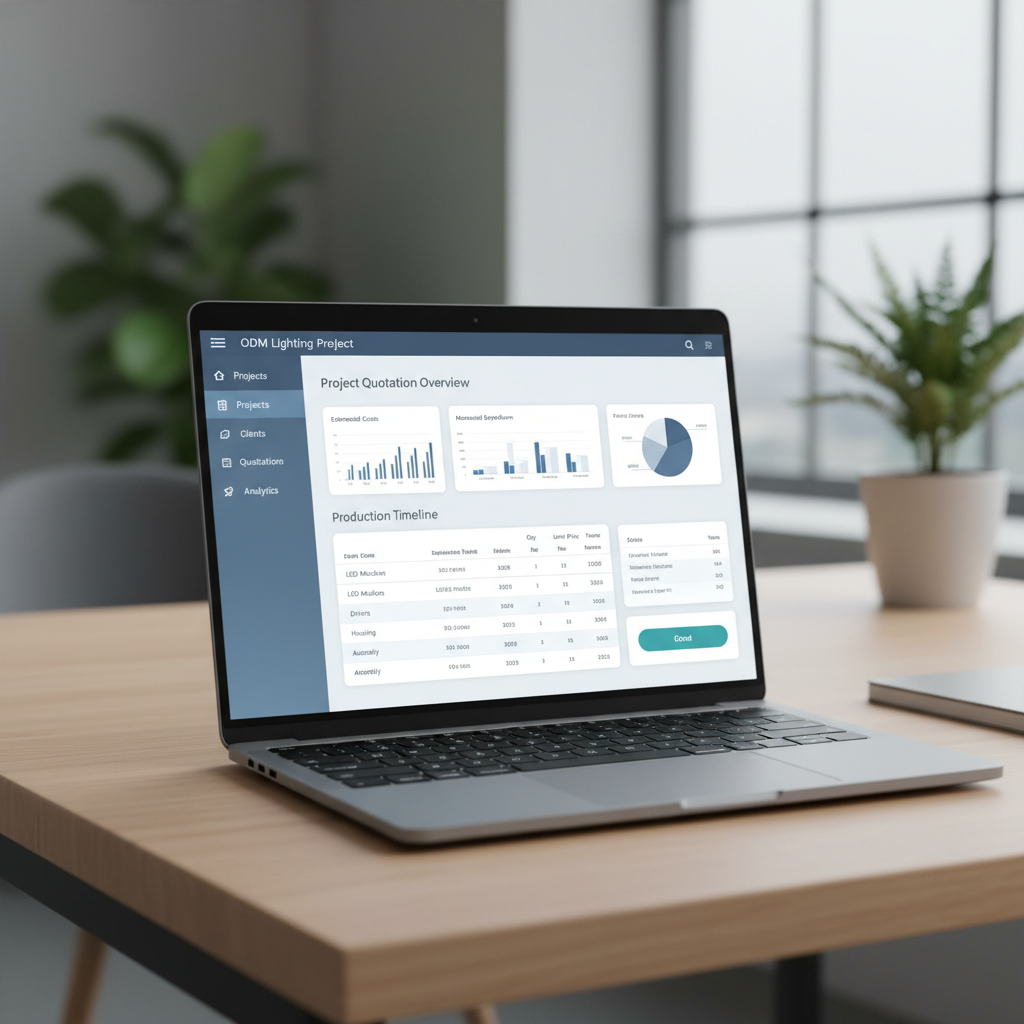
Qihang Lighting's new V2.0 system promises custom ODM lighting proposals in 48 hours, a major shift for EU/US specifiers needing rapid project validation.
What Changed — and Why It Matters Now
At XHLWX (led-project-light.com), a Custom Indoor LED Lighting Manufacturer based in China, we analyze market shifts that impact how lighting projects are specified and delivered. The recent announcement from Shenzhen Qihang Lighting Co., Ltd. regarding the launch of their 'ODM Project Rapid Quotation System V2.0' is more than just a software update; it represents a significant acceleration in the custom lighting supply chain.
This system, which promises a structural proposal and initial quote within 48 hours of uploading drawings or a Bill of Materials (BOM), directly addresses a major pain point for architects, lighting designers, and contractors in Europe and the United States: the excruciatingly long lead time for custom project feasibility and budgeting.
Traditionally, obtaining a quote for a modified or fully custom luminaire involved a multi-week process of emails, drawing exchanges, language barrier clarifications, and engineering reviews. This timeline is often incompatible with the aggressive bidding schedules and value engineering phases of modern construction projects.
In a post-2020 world, where supply chain stability is a top concern, the ability to quickly validate a custom design and its associated cost from a manufacturing partner is invaluable. It de-risks the specification process, allowing designers to be more ambitious and contractors to bid with greater confidence.
The shift from a weeks-long dialogue to a 48-hour digital handshake means that project momentum is maintained, and custom lighting solutions can be considered on a level playing field with off-the-shelf products, fundamentally changing the procurement landscape.
The Technical Detail Behind the Headline
For a system to generate a meaningful quote within 48 hours, it must operate on a sophisticated, parameter-driven model of a manufacturer's capabilities. It's not magic; it's a structured process that takes specified inputs and maps them to pre-engineered solutions and components.
This speed is achieved by focusing on modularity, where core components (LED modules, drivers, extrusions, optics) can be combined in countless permutations. A specifier using such a system would provide their performance and dimensional requirements, and the system's logic would assemble a viable product concept and price.
The output is a starting point for a final, detailed specification. Consider a typical custom linear luminaire for an office project in Germany; the specifier needs to define a range of parameters which the quotation system then processes.
Here is an example of the technical data that would underpin such a rapid proposal for a custom recessed linear system:
| Parameter | Specification Example | Relevant Standard / Context | Notes for Specifiers |
|---|---|---|---|
| Color Temperature (CCT) | 3000K / 4000K, 3-step MacAdam | (EU) 2019/2020 (ErP) | Specify CCT based on space function (e.g., 3000K hospitality, 4000K office). |
| Color Rendition (CRI / TM-30) | CRI >92, TM-30 Rf >90, Rg ~100 | TM-30-18 | High CRI is standard; TM-30 provides a fuller picture of color fidelity. Crucial for retail/gallery. |
| Unified Glare Rating (UGR) | <19 (with micro-prismatic diffuser) | EN 12464-1 | Mandatory for compliant office lighting in the EU. Depends on optics and room geometry. |
| Control Protocol | DALI-2 Device Type 6 / Casambi | IEC 62386 | DALI-2 is essential for interoperability in smart buildings. Casambi offers wireless flexibility. |
| Driver Brand & Model | Tridonic LCI series / Mean Well LDC series | ISO 9001 (for manufacturer) | Specify brand for reliability and warranty alignment. Ensure it matches control system. |
| LED Chip Brand | Samsung LM281B+ / Osram Duris E | LM-80 | Tier-1 chip brands ensure higher efficacy (lm/W) and longer lifetime (L80/B10). |
| Housing Protection | IP20 (standard) / IP44 (optional) | EN 60529 | IP20 is for dry interiors. IP44 is needed for areas with potential moisture (e.g., bathrooms). |
| Housing Lengths | Custom, based on standard extrusion lengths like 1125mm / 2245mm | Project Specific | System calculates optimal cuts and joins for continuous runs, minimizing waste. |
| Key Certifications | CE-LVD, CE-EMC, RoHS, ErP | Directive 2014/35/EU, 2011/65/EU | Non-negotiable for EU market access. The quote must confirm compliance capability. |
What This Means for Specifiers and Buyers
The move towards digitized, rapid ODM (Original Design Manufacturing) services has profound implications for how projects are developed and executed. It's not just about speed; it's about enabling more informed, creative, and cost-effective design choices early in the project lifecycle.
How Does a 48-hour Quote System Impact Project Bidding and Feasibility Studies?
The primary benefit is the dramatic compression of the decision-making timeline. A specifier or lighting designer can now, within two days, ascertain whether a custom lighting concept is within budget.
This allows them to present more innovative and tailored solutions in their initial proposals, backed by realistic cost data. Previously, they might have defaulted to a standard, less-optimal product simply to meet a bidding deadline.
This rapid feedback loop empowers designers to iterate quickly. If the first quote is too high, they can adjust parameters—perhaps a slightly lower CRI, a different control method, or a revised mounting detail—and get a revised quote almost as quickly.
This agility makes bids more competitive and reduces the risk of costly value-engineering exercises post-award that compromise the original design intent.
What Information Should a Specifier Prepare to Get an Accurate ODM Quote so Quickly?
The adage 'garbage in, garbage out' applies perfectly here. The speed and accuracy of the quote are directly proportional to the quality of the information provided.
To leverage a 48-hour system effectively, a specifier in the US or Europe should prepare a concise technical package. This must include: 1.
Drawings: Architectural plans (DWG or PDF), ideally with reflected ceiling plans, showing the intended locations and lengths of luminaires. 2. Performance Requirements: A clear list of desired CCT, CRI, lumen output (or target lux levels on a workplane), and UGR limits (e.g., <19). 3.
Control Intent: Specify the required control system, such as DALI-2 for integration with a BMS, 0-10V for simple dimming, or a wireless protocol like Casambi. 4. Physical Constraints: Details on ceiling type (plasterboard, grid), plenum depth, mounting method (recessed, surface, pendant), and desired finish color (e.g., RAL 9016). 5.
BOM/Concept: If available, a preliminary Bill of Materials or a conceptual sketch of the desired luminaire provides invaluable context for the manufacturer's engineers. Providing this information upfront allows the manufacturer's system and personnel to bypass the initial discovery phase and move directly to a concrete proposal.
Are There Potential Downsides or Risks to Relying on Automated Quotation Systems?
While highly beneficial, these systems are not a panacea. The primary risk is over-reliance on the initial quote, which is typically a budgetary or structural proposal.
It's a highly educated estimate, not a final, binding offer. The nuances of a complex installation, unique material finishes, or unforeseen engineering challenges may only become apparent during a more detailed, human-led review.
Specifiers must view the 48-hour quote as the start of a conversation, not the end of one. There is also a risk that such systems may guide users towards a manufacturer's pre-configured 'comfort zone', potentially stifling truly ground-breaking innovation that falls outside the system's parameters.
The key is to use the system for what it is—a powerful tool for rapid initial validation—while still engaging in a detailed technical dialogue with the manufacturer's engineering team to finalize the product for production.
Compliance Checklist (IES / LDT / DIALux / CE / RoHS / ErP)
A fast quote is meaningless if the product cannot be legally sold or professionally specified in the target market. For European and North American projects, a rapid proposal must be immediately followed by a clear pathway to full compliance and documentation. Any ODM manufacturer, including those offering fast-track systems, must be able to confirm their ability to provide the following.
First and foremost, specifiers must demand access to photometric data. This means a library of IES and LDT photometric files for their standard product configurations.
For custom-configured luminaires, the manufacturer should have a clear process for generating new photometric files. These files are the digital DNA of a luminaire, containing all the data about its light distribution.
Without them, a lighting designer cannot perform accurate simulations in software like DIALux or AGi32 to verify that the proposed lighting scheme meets project requirements, such as achieving 500 lux on office desks or meeting vertical illuminance targets in a retail space.
Secondly, the product must meet all regional regulations. For the EU market, this is non-negotiable.
The manufacturer must self-certify and provide a Declaration of Conformity for:
-
CE Marking: This indicates conformity with health, safety, and environmental protection standards. It covers the Low Voltage Directive (LVD) and the Electromagnetic Compatibility (EMC) Directive.
-
RoHS (Restriction of Hazardous Substances): This directive restricts the use of specific hazardous materials found in electrical and electronic products.
-
ErP (Energy-related Products Directive) & SLG (Single Lighting Regulation): Under Regulation (EU) 2019/2020, this sets strict minimums for energy efficiency (lm/W), standby power, and flicker, while also mandating the availability of replaceable light sources and control gear to promote a circular economy.
A quote from a rapid system should be seen as an assurance that a product meeting these requirements can be built. The final purchase order should be contingent on the delivery of this documentation.
Frequently Asked Questions
Q: How Accurate Is a Price from a 48-hour Rapid Quotation System?
A 48-hour quote is a budgetary estimate, typically accurate to within 10-15% of the final production cost. It's designed for initial planning and bidding. The final price is confirmed after a detailed technical review of all project specifics, including non-standard finishes, complex mounting, and final driver/LED selections.
Q: What Types of Custom Lighting Are Best Suited for These Rapid Systems?
These systems excel with modular product families, such as linear aluminum profiles, track lighting systems, and downlights. Customizations in length, CCT, output, and control for these types cover roughly 80% of architectural lighting needs. Highly sculptural or entirely novel luminaire forms will still require a more traditional, hands-on design process.
Q: What Is the Real Difference Between ODM and OEM for a Lighting Specifier?
OEM (Original Equipment Manufacturer) is when a factory builds a product based on the client's complete, pre-existing design. ODM (Original Design Manufacturing) is a collaborative process where the specifier provides performance and aesthetic goals, and the manufacturer uses its own engineering and design resources to create the final product. Rapid quote systems are an ODM tool.
Q: If I Request a Custom Length and Optic, How Quickly Can I Get Photometric Files for DIALux?
For standard configurations, IES and LDT files should be available instantly from the manufacturer's database. For a unique configuration generated by the system, a new file must be created. A reliable ODM partner can typically generate and validate a new photometric file within 72 hours, using data from their in-house goniophotometer and simulation software.
Talk to Our Engineering Team
The emergence of tools like the Qihang V2.0 system validates a core principle of modern manufacturing: efficiency, speed, and customization are no longer mutually exclusive. These systems are a powerful first step, enabling specifiers to dream bigger within tighter deadlines.
However, the success of any custom lighting project ultimately hinges on the engineering expertise and collaborative spirit of the manufacturing partner. The digital tool opens the door, but it is human expertise that walks the project through to a successful conclusion, ensuring every technical and compliance detail is flawlessly executed.
At XHLWX (led-project-light.com), a Custom Indoor LED Lighting Manufacturer based in China, our process combines digital efficiency with deep engineering expertise to deliver bespoke lighting solutions for the most demanding projects in the EU, US, and Middle East. Contact us to discuss how we can bring your next vision to light.
Need a tailored lighting plan for your project?
Our senior lighting designers reply within 48 hours with a free design proposal & quotation.