
BAU 2026 Analysis: COB Linear Integration is the New Standard
Post-BAU 2026 analysis reveals a major industry shift. The integration of COB linear lighting into architectural aluminum profiles is now the benchmark for hi
What Changed — and Why It Matters Now
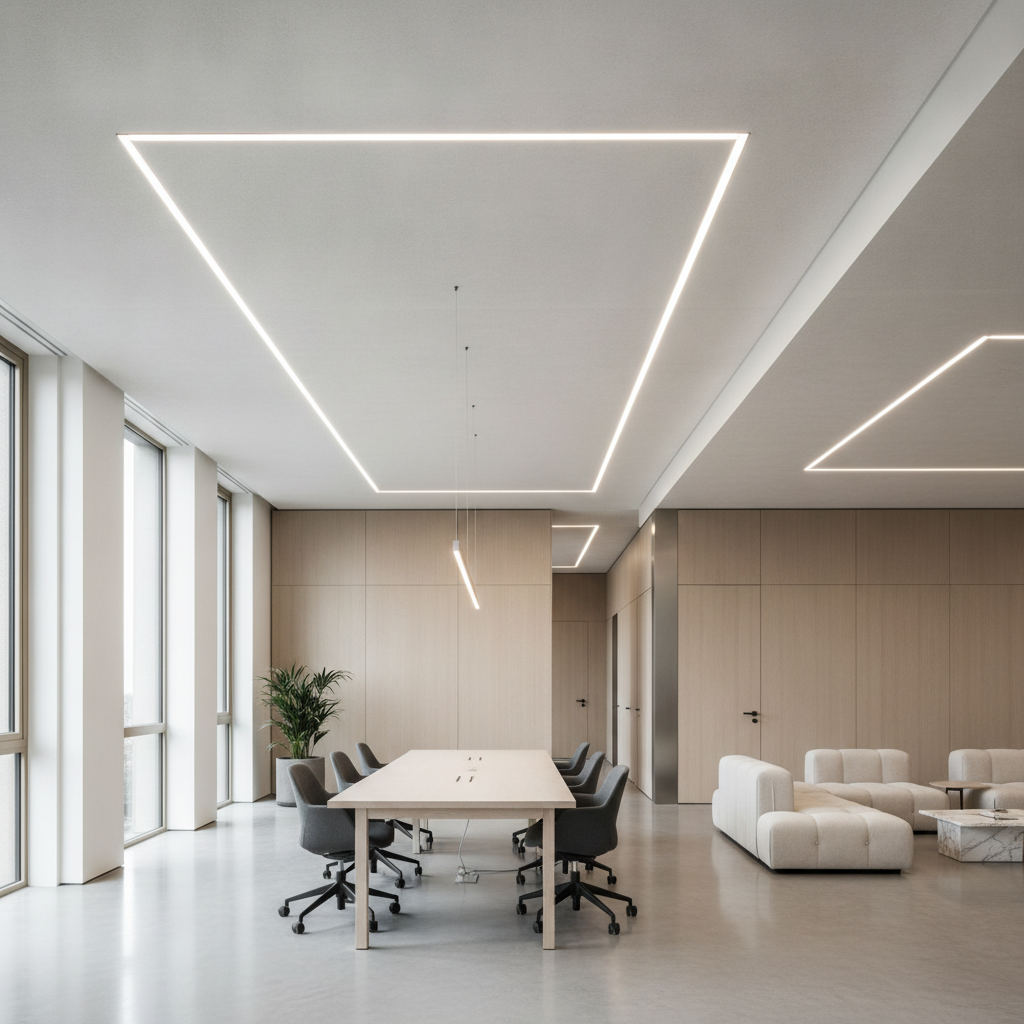
At XHLWX (led-project-light.com), a Custom Indoor LED Lighting Manufacturer based in China, our on-site observations at the Munich BAU 2026 exhibition confirm a fundamental shift in architectural lighting specification. While incremental developments are common, this year marked a tipping point: the deep integration of Chip-on-Board (COB) linear lighting with architectural aluminum profiles has moved from a niche, high-end option to the definitive trend for commercial, office, and hospitality facades and interiors.
Over 40 notable lighting brands showcased solutions centered on this principle, characterized by uplight-free designs and no visible fixture openings. This 'disappearing act' where the light source becomes an integral part of the ceiling or wall architecture is the new standard for creating clean, minimalist, and human-centric environments.
This matters now more than ever due to a convergence of factors. Architecturally, the demand for 'quiet' ceilings and uninterrupted surfaces has been growing for years.
This trend finally provides a technologically mature solution that doesn't compromise on light quality. From a performance standpoint, the latest COB technology delivers superior uniformity, eliminating the 'scalloping' or 'dotting' effect of older SMD LED strips.
Economically, while initial specification requires closer collaboration, the long-term benefits of energy efficiency and reduced maintenance are compelling. This shift is also propelled by regulations like the EU's Single Lighting Regulation (SLR), (EU) 2019/2020, which has pushed manufacturers towards more efficient and higher-quality light sources, making older technologies like fluorescent tubes obsolete and even first-generation LED modules appear dated.
The market is now demanding not just light, but integrated, high-performance illumination that serves the architecture.
The Technical Detail Behind the Headline
The headline trend is underpinned by significant advancements in COB manufacturing, driver technology, and profile extrusion. The ability to produce long, continuous reels of high-density COB strips allows for seamless lines of light previously impossible to achieve.
When paired with precision-engineered aluminum profiles that act as both housing and heatsink, the result is a highly stable and reliable lighting system. Many systems, like the 24V low-voltage magnetic track structures observed at the show, offer incredible modularity, allowing for seamless splicing without any dark spots for lengths up to 6 meters and beyond.
Below is a typical specification table for a high-performance system aligned with this trend.
| Parameter | Specification | Standard / Target | Notes |
|---|---|---|---|
| Optics | |||
| CCT / SDCM | 2700K, 3000K, 3500K, 4000K / <2-step MacAdam | EN 12464-1 | Tunable white options (2700K-6500K) also available. |
| CRI / R9 | Ra ≥95 / R9 >90 | CRI 90+ | Essential for accurate color rendering in retail and hospitality. |
| TM-30-18 | Rf ≥92, Rg ≈100 | High Fidelity | Ensures vibrant, natural rendering of a full color gamut. |
| UGR | <13 (with micro-prismatic diffuser) | UGR<19 (Office) | Achieves exceptionally low glare for visual comfort. |
| Beam Angles | 100°, 120° (diffuse); 30°, 60° (with lens) | Application Dependant | Versatility for general, accent, or wall-washing applications. |
| Control | DALI-2, 0-10V, Casambi (Bluetooth Mesh) | DALI-2 Certified | Enables individual addressing, scene setting, and BMS integration. |
| Chip/Driver | Bridgelux Thrive™ COB / Tridonic ADVANCED Driver | Flicker-free (<3%) | High-quality components ensure longevity and performance. |
| Housing | |||
| Material / Profile | 6063-T5 Anodized Aluminum / Recessed, Surface, Pendant | Custom Lengths | Profiles can be recessed (trim/trimless), surface-mounted or suspended. |
| Max Length | Seamless runs up to 10m+ | Project Specific | Achieved with continuous COB and specialized connectors. |
| IP Rating | IP20 (Indoor) / IP54 (with potting/cover) | Varies by location | IP54 suitable for bathrooms (Zone 2) or covered outdoor areas. |
| Certification | CE, RoHS, ErP, ISO9001:2015 | EU/Global Market Access | ErP compliance confirms adherence to EU energy efficiency rules. |
What This Means for Specifiers and Buyers
The move towards deeply integrated lighting systems fundamentally changes the workflow for architects, lighting designers, contractors, and facility managers. It requires earlier planning, closer collaboration, and a more holistic view of the building process. The era of simply selecting a fixture from a catalog and dropping it into a ceiling grid is over for high-end projects.
How Does This Trend Affect Project Planning and Budgeting?
Project planning must now involve the lighting manufacturer or specialist integrator at the architectural design stage. The choice of recessed aluminum profiles directly impacts ceiling and wall construction details.
Budgets must evolve from a simple fixture cost to a system cost, which includes the profiles, COB light engines, drivers, and potentially more complex installation labor. However, specifiers can present this to clients as a value investment.
The total cost of ownership is often lower due to significant energy savings (60-75% reduction over legacy fluorescent systems), virtually zero maintenance over a 50,000-hour lifespan, and the added real estate value of a premium, modern aesthetic.
What Are the New Challenges in Installation and On-site Coordination?
For electrical contractors, the primary challenge is the shift in sequencing. Trimless recessed profiles must be installed with absolute precision by the framing/drywall contractor before the ceiling is finished and painted.
This requires clear communication and detailed shop drawings. Managing low-voltage (24V or 48V) DC wiring requires careful planning of remote driver locations for accessibility and thermal management.
Ensuring perfect, shadow-free joints in long seamless runs demands attention to detail and use of the manufacturer's specified connectors and alignment hardware. The benefit of magnetic track systems is that the final light modules can be snapped into place after all construction dust has settled, reducing risk of damage.
Are There Aesthetic and Performance Trade-offs to Consider?
While the primary aesthetic benefit is a clean, minimalist look, the trade-off can be a perceived lack of flexibility compared to traditional spotlights. However, this is largely mitigated by modern systems.
Using a combination of diffuse profiles for ambient light and lensed profiles for accent or task lighting within the same architectural channel provides immense flexibility. From a performance standpoint, there are virtually no trade-offs, only gains.
The light quality, as evidenced by CRI ≥95 and UGR<13, is far superior to most conventional fixtures. The key is proper design and simulation to ensure the right amount of light is delivered exactly where it is needed.
Compliance Checklist (IES / LDT / DIALux / CE / RoHS / ErP)
For European and US specifiers, vetting a manufacturer's compliance is non-negotiable. When evaluating these new integrated systems, your checklist must include:
-
IES and LDT photometric files: These are the digital DNA of a luminaire. A serious manufacturer must provide these standardized files for every product configuration (CCT, output, diffuser type). Without them, accurate lighting calculations are impossible.
-
DIALux: You must ensure the manufacturer's products are supported in lighting design software. This means they provide either full DIALux plug-ins or, at a minimum, fully compatible IES and LDT photometric files. This is the only way to professionally simulate and verify that a design will meet illuminance (e.g., 500 lux for offices) and glare (UGR<19) requirements as stipulated by standards like EN 12464-1.
-
CE / RoHS / ErP: For the EU market, these are mandatory. The CE mark declares conformity with health, safety, and environmental protection standards. RoHS (Restriction of Hazardous Substances) is crucial for environmental compliance. Most importantly, the ErP (Energy-related Products) directive, via the SLR, dictates strict efficiency and performance criteria. Ask for Declarations of Conformity and proof of ErP registration to ensure the products are legally sellable in the EU and meet modern energy targets.
Frequently Asked Questions
Q: What Is the Real-world Difference Between a CRI of 80 and CRI 95+?
A CRI of 80 is considered standard, but it can make colors appear dull or washed out. A CRI of 95+, especially with a high R9 value (over 90 for red), renders colors with exceptional fidelity. In a retail setting, this means merchandise looks vibrant and appealing. In an office or home, it means skin tones and natural materials look healthy and true to life, contributing to a higher quality visual environment.
Q: How Are Seamless Runs Over 5 Meters Achieved Without Dark Spots?
This is accomplished through a combination of technologies. First, Chip-on-Board (COB) lighting is manufactured in continuous rolls, eliminating the gaps found between older SMD chips. Second, manufacturers use precision-engineered aluminum profiles and connectors that ensure perfect physical and electrical continuity. For runs exceeding a single power feed's capacity (typically 5-10 meters), multiple circuits are planned to meet at a single point with overlapping light emission, creating an optically seamless appearance.
Q: Can These Integrated Systems Be Dimmed and Controlled?
Absolutely. High-end systems are designed for advanced control. The most common professional protocol is DALI-2, which allows each fixture to be individually addressed, dimmed, and integrated into a Building Management System (BMS) for automated scenes or daylight harvesting. Other options include simpler 0-10V analog dimming and wireless control via Bluetooth Mesh systems like Casambi, which is excellent for retrofits or projects where new control wiring is difficult.
Q: What Is the Typical Energy Saving When Retrofitting an Office from Fluorescent Troffers to Integrated COB Linear Lighting?
The energy savings are substantial, typically ranging from 60% to 75%. A standard 600x600mm fluorescent troffer consumes about 70-80W. An equivalent LED linear system providing superior light quality (500 lux at the task plane with low glare) might only consume 20-30W. Over a year in a typical office, this can translate to hundreds of kWh saved per fixture, leading to a rapid return on investment.
Talk to Our Engineering Team
The clear message from BAU 2026 is that architectural lighting has entered a new phase of seamless integration, driven by performance, aesthetics, and efficiency. For specifiers and developers, embracing this trend requires a partner who understands not just the product, but the entire design and construction process.
The technical specifications, compliance requirements, and installation nuances demand a level of expertise beyond off-the-shelf supply. At XHLWX (led-project-light.com), a Custom Indoor LED Lighting Manufacturer based in China, our engineering team is equipped to provide the detailed photometric data, DIALux support, and custom profile solutions needed to bring these sophisticated designs to life for your projects in the EU, US, and Middle East.
Need a tailored lighting plan for your project?
Our senior lighting designers reply within 48 hours with a free design proposal & quotation.