
Qihang's 8000-Unit High Bay Deal: A Retail LED Retrofit Analysis
A deep dive into a 8,000-unit LED high bay deal in France, highlighting 62% energy savings and smart controls. We analyze what this means for EU retail specif
What Changed — and Why It Matters Now
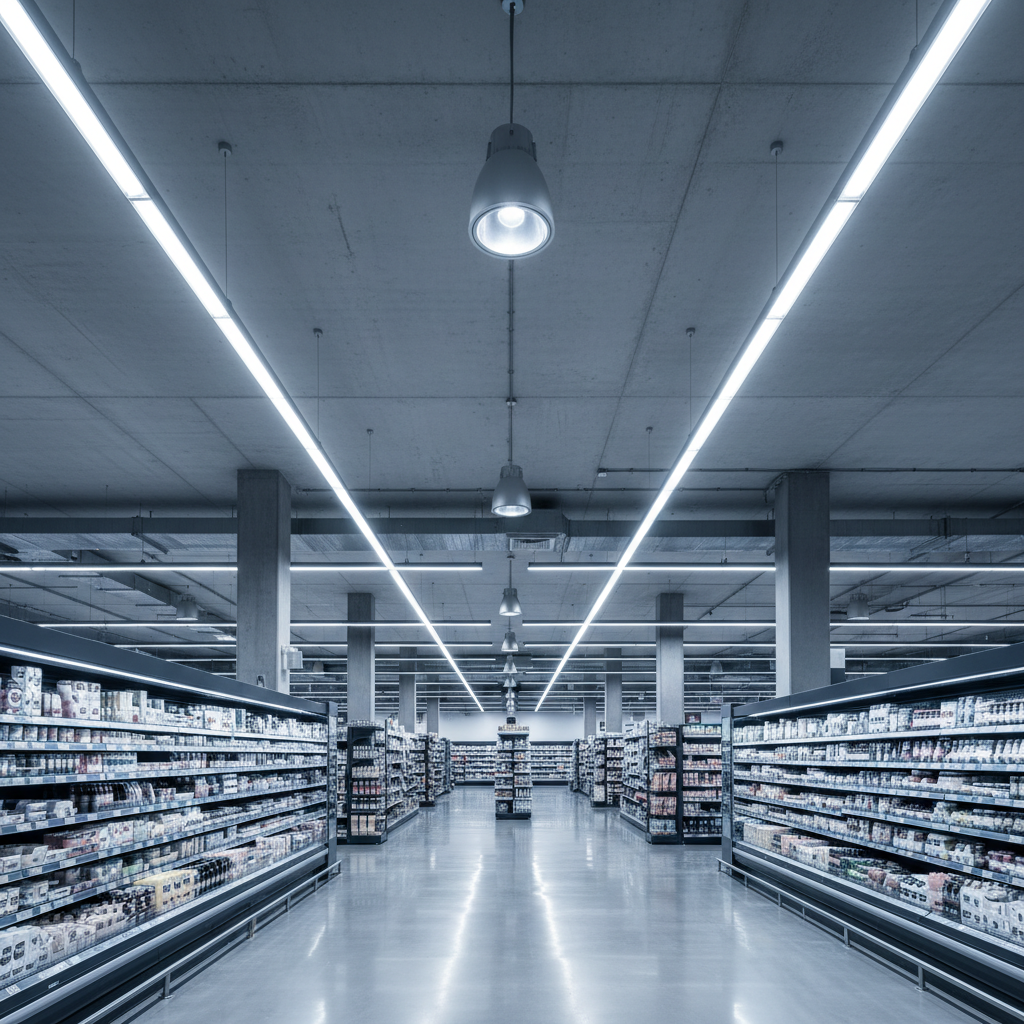
At XHLWX (led-project-light.com), a Custom Indoor LED Lighting Manufacturer based in China, we closely monitor market shifts that signal major trends for our European and US clients. The recent announcement of a three-year framework supply agreement between Shenzhen Qihang Lighting and a major French supermarket chain is one such event. The deal covers the phased replacement of legacy 400W metal halide lamps with 8,000 QH-HB12 LED high bay luminaires across 24 large-format retail stores. The first shipment of 1,800 units has already arrived at a central warehouse in Lyon, marking the beginning of a project that underscores the unstoppable momentum of large-scale commercial LED retrofits.
Why does this matter now? The project's headline figures are compelling: an anticipated 62% reduction in annual lighting electricity consumption and an average payback period of just 2.1 years.
In the context of volatile European energy prices, which have frequently exceeded €0.25 per kWh in France since 2022, such savings are not just a line item but a strategic financial decision. For a typical store in this chain, with approximately 333 fixtures operating 12 hours a day, switching from a 450W (including ballast) metal halide to a 160W LED fixture saves over 400,000 kWh annually per location.
Furthermore, the integration of Casambi Bluetooth Mesh for zonal dimming and scheduling demonstrates that large-scale projects now consider granular control as a standard requirement, not an optional luxury. This move signals a mature market where ROI is calculated not only on energy savings but also on operational flexibility and future-proofing.
The Technical Detail Behind the Headline
To achieve the performance metrics outlined in the French supermarket project, the specified luminaire must meet stringent criteria for efficiency, light quality, and durability. While the exact specifications of the QH-HB12 luminaire are proprietary, a typical project of this nature would demand technical parameters similar to those detailed below. These represent the new baseline for competitive, high-performance high bay lighting in the European retail sector.
| Parameter | Specification | EU Standard Reference | Notes |
|---|---|---|---|
| Luminous Efficacy | >160 lm/W | ErP (EU) 2019/2020 | Essential for achieving ~62% energy savings over 400W metal halide. |
| Optics & Glare | UGR < 22, Asymmetric Beam | EN 12464-1 | Critical for visual comfort in aisles and to prevent disabling glare for staff and shoppers. |
| Color Quality | CCT: 4000K, CRI: Ra >80 | TM-30-18 (Rf | 4000K provides a clean, neutral light. TM-30 metrics ensure vibrant, natural rendering of fresh produce and packaging. |
| Control System | Casambi Bluetooth Mesh | DALI-2 (as alternative) | Wireless mesh allows for flexible zoning and scheduling without new control wiring, reducing installation costs. |
| Driver & LED Chip | Mean Well ELG/XLG Series | Samsung LM281B+ Pro | Using brand-name components ensures reliability, long lifetime (L80B10 > 50,000 hrs), and simplifies maintenance. |
| Housing & Protection | Aluminium, IP65, IK08 | EN 60529, EN 62262 | IP65 rating protects against dust and water jets during cleaning. IK08 provides impact resistance. |
| Certifications | CE, RoHS, ErP | LVD, EMC, RoHS 3 | Mandatory for market access in the European Union, guaranteeing safety, material, and energy compliance. |
What This Means for Specifiers and Buyers
This large-scale retail retrofit provides a clear blueprint for specifiers, contractors, and procurement managers planning similar upgrades. The focus has shifted from simple lumen-for-lumen replacement to a holistic evaluation of light quality, control intelligence, and total cost of ownership (TCO). Success hinges on understanding the interplay between these elements.
How Do Wireless Controls Like Casambi Impact Total Project ROI Beyond Energy Savings?
While the 62% energy saving is the primary driver, the choice of Casambi wireless controls significantly enhances the project's return on investment. Firstly, it eliminates the cost and disruption of installing new control wiring (like DALI) in existing, operational stores, a major saving in labor and materials. Secondly, it provides ultimate flexibility. Store layouts change; with a wireless mesh system, lighting zones and dimming schedules can be reconfigured via a simple app in minutes, without an electrician. This adaptability allows the retailer to fine-tune lighting for promotions, seasonal changes, or varying opening hours, generating further operational savings and improving the customer experience over the luminaire's 10+ year lifespan.
What Are the Key Optical Parameters to Consider When Replacing 400W Metal Halide in Retail?
Replacing a 400W metal halide (MH) lamp is not just about matching lumen output. Specifiers must address the quality of light. The primary consideration is glare. MH lamps are intense point sources that create high-glare environments. A modern LED high bay uses a larger surface area with engineered lenses to control light distribution, achieving a Unified Glare Rating (UGR) of <22, as recommended by EN 12464-1 for retail spaces. This dramatically improves visual comfort. Secondly, beam shape is crucial. Asymmetric or rectangular beam distributions are ideal for long aisles, pushing light where it's needed—on the products—and not wasting it on the top of shelving. Finally, color rendering, measured not just by CRI but also by TM-30 metrics, is vital for making products, especially fresh food, look appealing.
Why Is a Phased, Multi-year Rollout Attractive for Large Retail Chains?
For an enterprise with dozens or hundreds of locations, a phased, three-year rollout as seen in this agreement is a highly pragmatic strategy. It allows the capital expenditure (CapEx) to be spread across multiple fiscal years, making the investment more manageable. It also functions as a rolling pilot program; lessons learned from the initial 24 stores can be applied to future phases, optimizing installation methods and control settings. Operationally, phasing minimizes disruption. Retrofitting one or two stores at a time during off-hours is far less impactful than a chain-wide blitz. This approach also de-risks the supply chain, as the manufacturer can plan production for predictable batch deliveries, ensuring a stable supply of consistent, quality-tested luminaires over the project's duration.
Compliance Checklist (IES / LDT / DIALux / CE / RoHS / ErP)
A successful project specification for the EU market hinges on a robust documentation and compliance package. For a specifier or contractor, this is non-negotiable.
-
Photometric Files: The manufacturer must provide accurate IES and LDT photometric files for each luminaire. These data files are the digital DNA of the fixture, describing how it distributes light. Without them, professional lighting design is impossible.
-
Lighting Design Simulation: Before purchasing a single fixture, the entire store layout must be simulated in software like DIALux or Relux. Using the IES/LDT files, designers can verify that the proposed solution will meet all project requirements, including average illuminance (e.g., 500 lux on the floor), uniformity, and, crucially, glare limits like UGR < 22. This simulation becomes the proof of concept for the client and a key contractual document.
-
Mandatory EU Certifications: The product must bear the CE mark, indicating conformity with EU health, safety, and environmental standards (including the Low Voltage Directive and EMC Directive). RoHS (Restriction of Hazardous Substances) compliance is also mandatory, restricting the use of materials like lead and mercury. Finally, the luminaire must comply with the Ecodesign for light sources and separate control gears regulation ((EU) 2019/2020), known as ErP. This sets minimum energy efficiency and performance criteria, ensuring underperforming products cannot be sold in the EU.
Frequently Asked Questions
Q: Is a 2.1-year Payback Period Realistic for a Metal Halide to LED High Bay Retrofit?
Yes, it is highly realistic in the current European market. With electricity prices often above €0.25/kWh, a 62% energy saving from replacing a 450W system with a 160W LED fixture can result in annual savings of over €100 per fixture. For a store with 300+ fixtures, the total project cost can often be recouped in 24-30 months, making the business case very strong.
Q: How Complex Is It to Commission a Casambi System in a Large Supermarket?
While powerful, Casambi commissioning is surprisingly straightforward for trained installers. After physical installation, fixtures are automatically detected by the Casambi app. They can then be grouped into zones (e.g., 'Aisle 3', 'Checkout Area', 'Produce Section') and have scenes or timed schedules applied wirelessly. For 8000 units across 24 stores, a standardized, pre-planned commissioning template would be used to ensure consistency and rapid deployment.
Q: Why Is UGR < 22 so Important in a Supermarket Environment?
A Unified Glare Rating (UGR) below 22 is critical for both customer and employee comfort and safety. High glare from old metal halide lights can cause visual discomfort, headaches, and make it difficult to read labels on high shelves. A low-UGR environment feels more pleasant, reduces eye strain for cashiers and stockers working long shifts, and creates a higher-quality shopping experience that can encourage customers to stay longer.
Q: Besides Energy Savings, What Is the Biggest Improvement When Switching from 400W Metal Halide to LED?
The most significant improvement beyond the 62% energy savings is light quality and control. Unlike metal halide lamps that have poor color rendering (CRI 60-70) and take 5-15 minutes to warm up, modern LEDs offer instant-on light with high CRI (>80) for better product appearance. The ability to dim and schedule the lights, which is impossible with metal halide, provides further savings and operational flexibility.
Talk to Our Engineering Team
This French retail project serves as an excellent case study for the technical and financial benefits of a well-executed LED lighting and controls upgrade. The specifications and strategies employed are becoming the new standard for commercial retrofits across Europe and North America. At XHLWX (led-project-light.com), a Custom Indoor LED Lighting Manufacturer based in China, our engineering team specializes in developing luminaires that meet these exact requirements, from custom optics to integrated wireless controls and full compliance documentation for EU and US markets. To discuss how a similar, data-driven approach can be applied to your next project, we invite you to start a conversation with our specialists.
Need a tailored lighting plan for your project?
Our senior lighting designers reply within 48 hours with a free design proposal & quotation.