
Classroom Panel Light QH-PL08 Analysis: The New UGR<16 Benchmark
A deep dive into the Qihang QH-PL08 panel light. This analysis covers its UGR<16 micro-prismatic optics, CRI>90, and DALI-2 controls for EN 12464-1 compliance
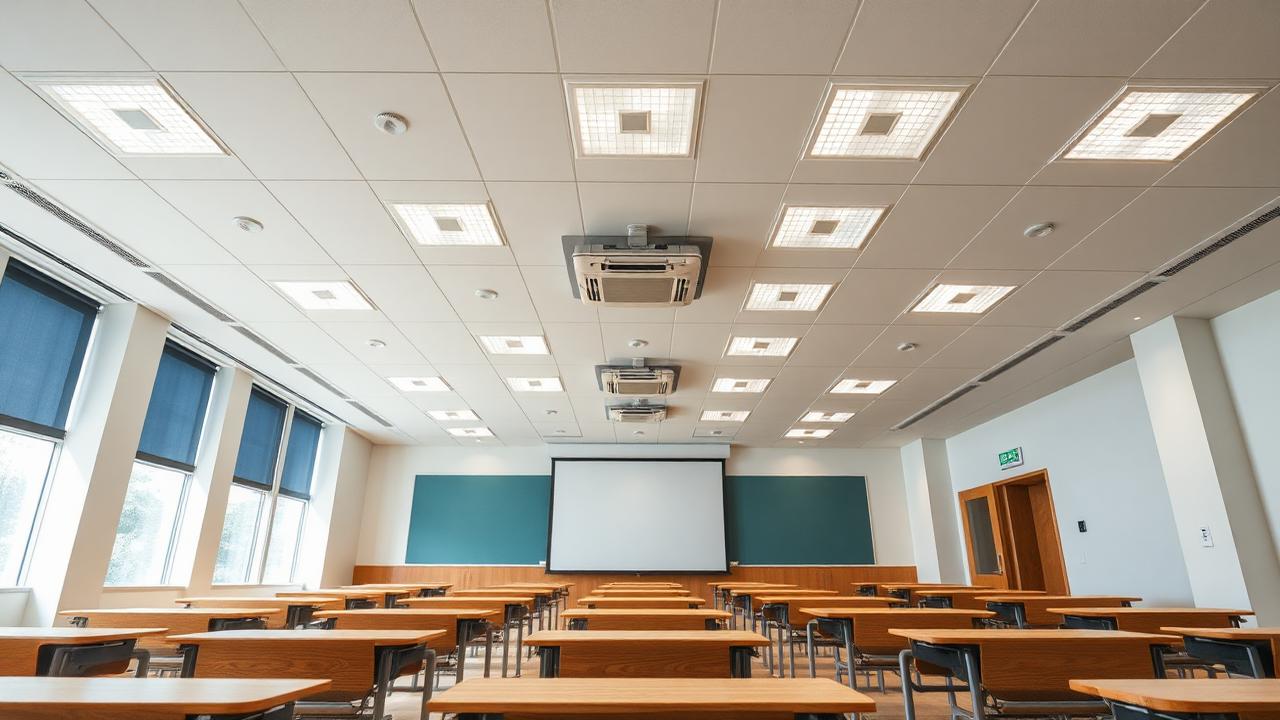
What Changed — and Why It Matters Now
At XHLWX (led-project-light.com), a Custom Indoor LED Lighting Manufacturer based in China, we constantly analyze market shifts and new technologies to inform our clients. A significant recent development is the introduction of highly specialized luminaires like the Qihang Lighting QH-PL08 classroom panel light.
While a new product launch is routine, this particular fixture signals a broader, crucial trend in the architectural lighting industry: the move from simply illuminating spaces to engineering human-centric lighting environments that demonstrably improve well-being and performance. The QH-PL08, with its direct-lit micro-prismatic design achieving a Unified Glare Rating (UGR) of less than 16, a Color Rendering Index (CRI) above 90, and flicker-free performance compliant with IEEE 1789, is a direct response to tightening international standards and a growing body of scientific evidence linking light quality to learning outcomes.
For decades, educational lighting was primarily about achieving a target illuminance (lux) on the desk, often with little regard for visual comfort. The result was frequently overlit spaces with high glare from luminaires, computer screens, and whiteboards.
This glare forces the human eye's pupil to constrict, causing eyestrain, headaches, and a measurable decrease in concentration and information retention among students. The European standard EN 12464-1:2021 (Light and lighting - Lighting of work places - Part 1: Indoor work places) has become increasingly stringent in its recommendations for educational facilities, pushing for lower UGR values precisely to combat this issue.
A UGR of <19 is considered acceptable for general office work, but achieving UGR<16, as the QH-PL08 does, represents a move toward best-practice, high-performance visual environments. This is no longer a luxury; it's becoming a baseline expectation for new school construction and refurbishment projects across Europe and North America.
The simultaneous compliance with China's GB 7793-2010 standard for classroom lighting underscores that this is a global trend, driven by a universal understanding of how light impacts student health and academic success.
The Technical Detail Behind the Headline
The performance claims of a luminaire like the QH-PL08 are entirely dependent on the synergy of its components. Achieving market-leading metrics like UGR<16 and CRI>90 simultaneously is a significant optical and electrical engineering challenge.
It requires careful selection of LEDs, driver technology, and, most importantly, the light-shaping optical assembly. Below is a representative specification table that breaks down how such a high-performance panel is constructed.
This level of detail is what specifiers must now demand from manufacturers to ensure they are delivering a truly compliant and effective lighting solution, not just one that meets a single headline metric.
| Parameter | Specification | Standard / Target | Notes |
|---|---|---|---|
| Optical System | Micro-Prismatic PMMA Diffuser | UGR<16 | The key component for glare control. Prismatic structures direct light downwards, cutting off high-angle light that causes discomfort. |
| Color Temperature (CCT) | 4000K | 3500K - 5000K | 4000K is a common specification for learning environments, providing a neutral white light that promotes alertness without feeling cold or clinical. |
| Color Rendering (CRI) | Ra > 92 | Ra > 90 (EN 12464-1 Rec.) | A high CRI ensures that colors are rendered vividly and accurately, crucial for art, science, and a natural feel. |
| Color Fidelity (TM-30) | Rf > 90, Rg ≈ 100 | Rf > 85, Rg 95-105 | TM-30 provides a more complete picture of color rendition. High fidelity (Rf) and saturation (Rg) are key for visual appeal. |
| Beam Angle | 85° Asymmetric | N/A | A controlled beam angle focuses light on the task area (desks), minimizing light spill on walls and reducing perceived glare. |
| Control Protocol | DALI-2 | DiiA Certified | Enables digital, addressable control for scene setting (e.g., projection mode), daylight harvesting, and system feedback. |
| LED Chip Brand | Samsung LM301B Series | N/A | Use of high-efficacy, reputable chips from brands like Samsung or Bridgelux is essential for long-term reliability and color stability. |
| Driver Brand | Tridonic / Mean Well | Flicker <1% (IEEE 1789) | A high-quality driver ensures flicker-free operation and smooth dimming, critical for preventing visual fatigue. |
| Housing | Extruded Aluminum Frame, SPCC backplate | IP40 | Provides thermal management for the LEDs and ensures durability. IP40 is standard for indoor, dry locations. |
| Standard Dimensions | 595 x 595 mm | Fits 600x600mm grid ceilings | Designed for easy retrofitting into common suspended ceiling systems in Europe and other regions. |
| Certifications | CE, RoHS, ENEC, ErP | (EU) 2019/2020 | Essential for market access in the EU, confirming safety, material compliance, and energy efficiency. |
What This Means for Specifiers and Buyers
The emergence of integrated, high-performance panels like the QH-PL08 fundamentally changes the procurement and specification process for educational lighting. It shifts the burden of complex optical design from the lighting designer to the manufacturer.
Previously, achieving a low-glare environment might have involved using indirect luminaires or complex reflector systems, which often came with higher costs and installation complexity. Now, a specifier can achieve a compliant, high-quality result by selecting a single, well-documented product.
For electrical contractors, this simplifies installation. A DALI-2 enabled panel is often installed using a simple 5-core cable (L, N, E, DA, DA) and can be part of a plug-and-play system, reducing on-site wiring time and commissioning complexity.
For the end-user—the school district or facility manager—it means a more reliable, energy-efficient, and effective learning environment with a lower total cost of ownership. The key is knowing what questions to ask and what documentation to demand.
How Does Integrated DALI-2 Control Simplify Classroom Lighting Scenes?
Integrated DALI-2 control transforms a static light fitting into a dynamic part of the classroom's educational toolkit. Unlike simple on/off switches or basic 0-10V dimmers, DALI-2 (Digital Addressable Lighting Interface, version 2) is a two-way communication protocol.
This allows each luminaire, or groups of luminaires, to be individually addressed and controlled. In a modern classroom, this unlocks several critical scenarios.
As mentioned in the initial product brief, the system can link the main classroom lights with dedicated blackboard or whiteboard lights. A teacher can press a single button on a wall panel to switch to "Presentation Mode," which might automatically dim the main lights to 30% (around 150 lux) while bringing the whiteboard light to 100% (750 lux on the vertical surface), ensuring students can easily see both the projected image and their notes.
Other pre-programmed scenes could include "General Teaching" (100% power, 500 lux on desks), "Group Work" (zoned lighting), and "End of Day" (all off). Furthermore, DALI-2's two-way nature allows for integration with sensors for daylight harvesting—automatically dimming lights near windows to save energy—and presence detection.
It provides feedback to the building management system, flagging luminaire or driver failures for proactive maintenance. This level of granular control and intelligence is impossible with older analog systems and is foundational to creating a truly smart, responsive, and energy-efficient educational space.
What Are the Long-term Energy and Maintenance Savings of Such a Panel?
The financial case for upgrading to high-performance LED panels is compelling. Let's compare a modern 36W LED panel like the QH-PL08 to the legacy fluorescent troffer it typically replaces.
A common 600x600mm fluorescent fitting used four 18W T8 tubes, consuming 72W. When you add the 10-15% energy loss from the magnetic ballast, the total system wattage was closer to 80-85W.
The 36W LED panel represents an immediate energy saving of approximately 55-60% per luminaire.
Let's scale this for a medium-sized school with 30 classrooms, each using 12 luminaires (360 total). Assuming they operate for 6 hours a day, 200 days a year (1200 hours/year):
-
Old Fluorescent System: 360 fittings x 80W x 1200h = 34,560 kWh per year.
-
New LED System: 360 fittings x 36W x 1200h = 15,552 kWh per year. This is an annual saving of 19,008 kWh.
At an average European electricity cost of €0.25/kWh, this translates to a direct financial saving of €4,752 per year. This calculation doesn't even include the further savings from DALI-2 controls, which can add another 20-30% reduction through dimming and daylight harvesting.
On the maintenance side, a typical T8 fluorescent tube has a rated life of 15,000 hours but with significant lumen depreciation. A quality LED panel is rated for L80B10 at 50,000 hours or more, meaning it will retain at least 80% of its initial light output for over 20 years in a typical school environment.
This virtually eliminates the recurrent cost and disruption of re-lamping classrooms.
Why Is a Micro-prismatic Diffuser Crucial for Achieving UGR<16?
The secret to exceptional glare control lies in the luminaire's optical design, and the micro-prismatic diffuser is the hero component. To understand its importance, one must first understand what UGR measures.
The Unified Glare Rating is a value calculated based on the luminance of the luminaire against the background luminance, its solid angle at the observer's eye, and its position. In simple terms, it's a mathematical model of perceived discomfort glare.
A standard opal or frosted diffuser creates a large, uniformly bright surface. While this looks smooth and pleasant when viewed directly from below, it emits light in a very wide, almost Lambertian, distribution.
This means a significant amount of light is emitted at high angles (60-90 degrees from vertical), which travels directly into the eyes of people sitting elsewhere in the room, causing glare. To achieve a low UGR, you must control this high-angle light.
A micro-prismatic diffuser does exactly this. Its surface is composed of thousands of tiny, precisely engineered prisms or pyramids.
These structures use the principles of refraction and total internal reflection to redirect light rays. Light that would have escaped at a high, glare-inducing angle is instead bent and directed downwards into the useful 0-60 degree zone.
This shapes the beam, concentrating light onto the workplane where it is needed and creating a sharp cut-off at higher angles. This precise control is what allows a direct-lit panel to achieve a UGR value below 16, something previously thought possible only with more complex and expensive indirect lighting systems.
Compliance Checklist (IES / LDT / DIALux / CE / RoHS / ErP)
For a specifier in Europe or a contractor working on a US project with European standards, verifying a product's compliance is a non-negotiable, multi-step process. Simply accepting a manufacturer's headline claims is not enough.
First, demand the complete photometric data package. This must include both IES (for the North American market) and LDT (for the European market) formatted files for the exact luminaire specified. These files are the digital DNA of the luminaire's light output.
Second, these files must be imported into lighting design software like DIALux or Relux. Using the actual room dimensions, surface reflectances, and furniture layout of the classroom, the designer must run a simulation.
This is the only way to verify that the specified product will meet the required standards in that specific space. The simulation will generate a detailed report showing the average illuminance on the workplane (e.g., confirming it meets the 500 lux target for classrooms) and, critically, it will calculate the UGR value based on the actual viewing positions within the room.
A product that is UGR<16 on its datasheet might be UGR=17 in a small, low-ceiling room, making this simulation step vital.
Third, verify the certification portfolio. For any product sold in the EU, the CE mark is mandatory, indicating conformity with health, safety, and environmental protection standards.
Alongside this, look for the RoHS (Restriction of Hazardous Substances) compliance certificate, which restricts the use of specific hazardous materials. Increasingly important is the ErP (Energy-related Products) directive, specifically regulation (EU) 2019/2020.
This sets strict minimum requirements for energy efficiency (lm/W) and standby power consumption for control gear, effectively removing inefficient products from the market. For added assurance of quality and safety, third-party certifications like ENEC (European Norms Electrical Certification) are a strong positive signal.
Frequently Asked Questions
Q: What Is the Ideal Unified Glare Rating (UGR) for a Classroom?
The European standard EN 12464-1 specifies a maximum UGR of 19 for general teaching classrooms. However, this is a baseline limit. For tasks requiring high levels of concentration or involving digital screens, best practice and new guidelines strongly recommend a lower value. A UGR of less than 16, as achieved by top-tier panels, provides a significantly more comfortable and effective learning environment by minimizing visual stress and eye fatigue for students and teachers alike.
Q: Why Is a CRI Greater Than 90 Important for Educational Settings?
A Color Rendering Index (CRI) above 90 ensures that the light source renders colors almost as accurately as natural daylight. This is critical in schools for a variety of reasons. In art classes, students can see and mix paint colors accurately. In science labs, color-based experiments and chemical titrations are unambiguous. Even in general classrooms and cafeterias, it makes the environment, teaching materials, and even food look more natural and appealing, contributing to a more positive and engaging atmosphere.
Q: How Much Energy Can a Typical School Actually Save by Upgrading to These LED Panels?
The savings are substantial. A single 36W high-performance LED panel replaces an old 80W fluorescent fitting (including ballast losses), saving 44W. For a medium-sized primary school with 200 such fittings running for 1,200 hours per year, the annual energy reduction is over 10,500 kWh. This not only lowers the school's electricity bill significantly but also reduces its carbon footprint, providing a tangible example of sustainability for students.
Q: What Are the Main Differences Between DALI-2 and 0-10V Control?
DALI-2 is a digital, two-way communication protocol, while 0-10V is a simple, one-way analog signal. With 0-10V, you can only dim a group of lights together and the system provides no feedback. DALI-2 allows for individual digital addressing of each luminaire, enabling complex scene-setting, zoned control, and individual performance monitoring. It provides valuable data back to the building management system, such as lamp failures or energy usage, making it a far more intelligent and flexible solution for modern smart buildings.
Talk to Our Engineering Team
Navigating the complexities of modern lighting standards, from glare ratings and color science to digital control protocols, requires a partner with deep technical expertise. The principles demonstrated in advanced products like the QH-PL08 are central to our own design philosophy.
We help specifiers, contractors, and brand partners move beyond the datasheet to achieve genuinely high-performance lighting solutions tailored to their specific project needs in the EU, US, and Middle East. At XHLWX (led-project-light.com), a Custom Indoor LED Lighting Manufacturer based in China, our engineers are ready to assist with everything from initial design consultation and DIALux simulations to the development of fully customized luminaires that meet the most demanding specifications.
Need a tailored lighting plan for your project?
Our senior lighting designers reply within 48 hours with a free design proposal & quotation.