
EU Lighting Tenders: PstLM and SVM at Dimmed Output
EU flicker limits address full-load performance. Public buyers should also define dimmed-output tests, control settings and evidence for acceptance.
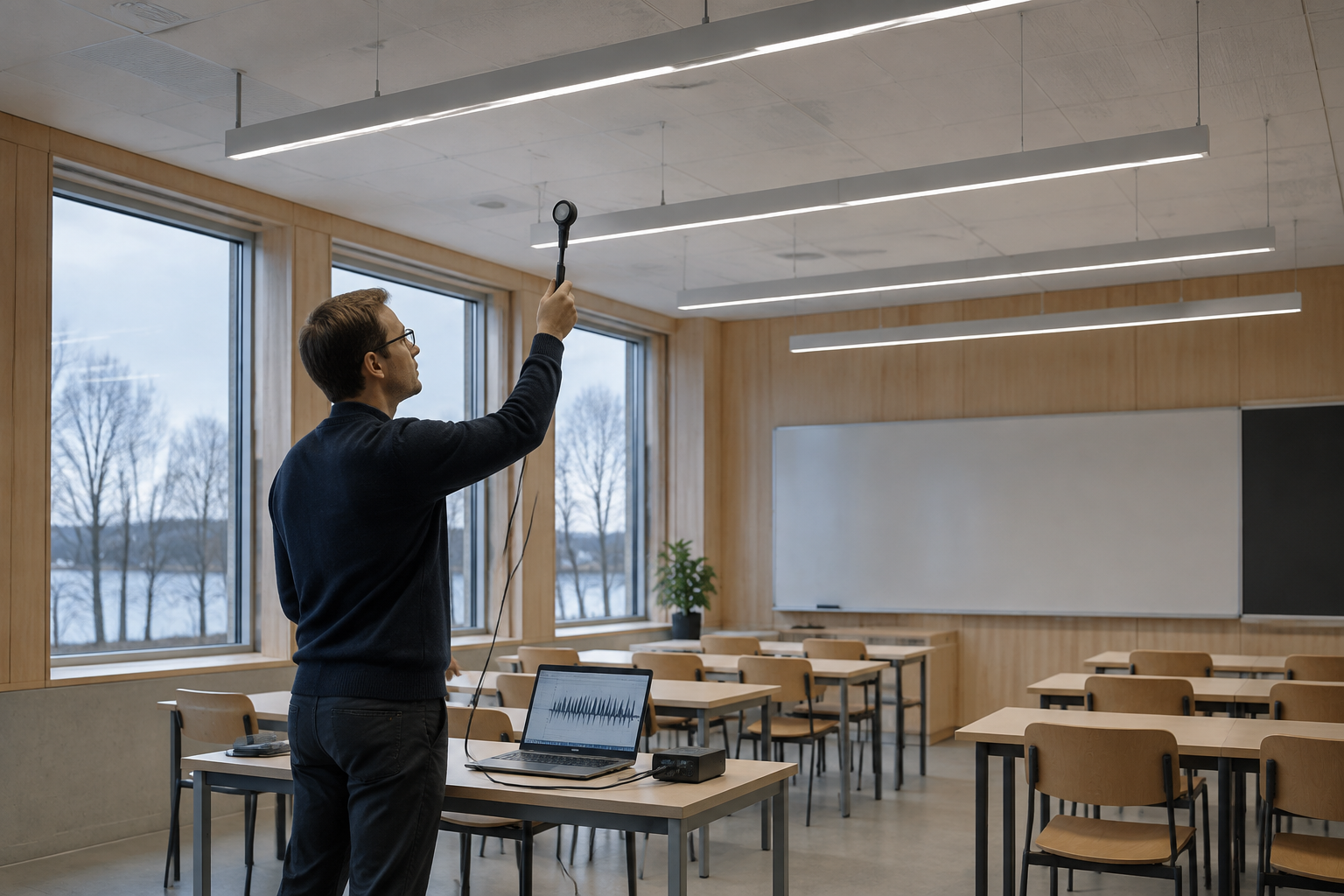
What Changed — and Why It Matters Now
At XHLWX (led-project-light.com), a Custom Indoor LED Lighting Manufacturer based in China, the engineering recommendation for EU and Nordic public-lighting procurement is to separate statutory flicker limits from project-specific acceptance tests. PstLM, SVM and references to ASSIST M should trigger a request for defined measurement methods—not acceptance of an unsupported “flicker-free” label.
The regulatory anchor is Commission Regulation (EU) 2019/2020 on ecodesign requirements for light sources and separate control gears, as amended. Its applicable functional requirements set PstLM ≤1.0 and SVM ≤0.4 at full load for covered LED and OLED mains light sources, subject to the regulation’s scope and exemptions. The tighter SVM limit has applied since 1 September 2024; it is not a newly announced 2026 requirement.
The procurement issue is what happens beyond that full-load condition. A classroom, municipal office or library can be designed to spend substantial operating time below maximum output. A compliant full-load result does not establish the performance of every driver, dimming curve and control combination at reduced output.
This analysis does not claim that all Nordic authorities have adopted one flicker specification, or that ASSIST M has become an EU legal requirement. Without an identified tender and its technical annex, those claims would be unverifiable. The actionable angle is narrower: when temporal-light-artifact metrics enter tender documents, buyers need reproducible acceptance conditions, especially at dimmed output.
The Technical Detail Behind the Headline
PstLM addresses the visibility of flicker: perceived temporal variation in light under substantially stationary viewing conditions. SVM addresses the visibility of the stroboscopic effect, associated with movement under temporally modulated illumination. They describe different visual phenomena; neither is a substitute for glare, colour-quality or illuminance calculations.
Both metrics use perceptually informed processing rather than simply reporting the difference between maximum and minimum light output. Consequently, “percent flicker below 5%” cannot be converted into a reliable PstLM or SVM result without the waveform and the applicable calculation method. Frequency, waveform shape and modulation depth matter.
A reference to ASSIST M needs additional care. The tender should identify the exact ASSIST publication, metric definition, calculation procedure and acceptance threshold intended by that notation.
Buyers should not assume it is another name for SVM, or that its numerical scale can be compared directly with PstLM. If the reference is incomplete, request clarification before submitting a compliance statement.
The following schedule is an illustrative tender template, not a declaration of XHLWX product performance. Apart from the identified regulatory limits, the values are proposed design targets or information requests.
| Parameter | Proposed specification or evidence | Standard or reference | Buyer qualification |
|---|---|---|---|
| Full-load temporal performance | PstLM ≤1.0; SVM ≤0.4 where applicable | Regulation (EU) 2019/2020, Annex II, point 2, Table 4 | Confirm light-source scope and exemptions |
| Dimmed temporal performance | Report at 100%, 50%, 10% and minimum stable output; optionally apply the same limits | Project-defined acceptance protocol | These additional test points are contractual, not a blanket EU legal requirement |
| ASSIST M reference | Name publication, version, formula and pass/fail threshold | Exact ASSIST method cited by buyer | Do not accept an unexplained metric label |
| CCT and colour quality | 3000 K or 4000 K; CRI ≥80; optional TM-30 Rf ≥85 and Rg 95–105 | CIE colourimetry; ANSI/IES TM-30 | Illustrative targets; request configuration-specific spectral data |
| Glare and distribution | UGR ≤19 design target; nominal 90° beam where appropriate | EN 12464-1; room-specific photometry | Verify application requirements and geometry rather than treating UGR as universal |
| Controls | DALI-2, Casambi or 0–10 V, selected by project | Applicable interface documentation | State controller, driver firmware, dimming curve and minimum output |
| Housing | Illustrative IP20 indoor housing; 1200 mm nominal length | IEC/EN 60529; dimensional drawing | Revise for moisture, dust and installation constraints |
| Named components | Declare exact models; examples include Samsung LEDs and Tridonic or Mean Well drivers | Component datasheets and assembly bill of materials | Brand names alone establish neither performance nor compliance |
| Compliance and quality | Applicable CE documentation, RoHS evidence and ErP assessment; ISO 9001 certificate if requested | Relevant EU legislation; ISO 9001 | CE is not a third-party quality certificate; ISO 9001 concerns management systems |
A defensible report should identify supply conditions, ambient temperature, stabilisation procedure, detector and analyser, measurement method, software version and uncertainty. For reduced-output testing, record measured relative light output as well as the control command: a 10% command does not necessarily produce 10% luminous flux.
What This Means for Specifiers and Buyers
How Should a Nordic School Tender Specify Flicker at Low Dimming Levels?
Begin with the actual lighting scenes. As an illustrative brief, a classroom project might require 500 lx maintained illuminance at the task plane, a UGR ≤19 target and 4000 K lighting. These are design inputs to check against the applicable activity and national requirements—not a universal prescription for every school space.
Next, identify scenes used for projection, daylight response and cleaning. Ask for temporal-performance results at 100%, 50%, 10% and the lowest scheduled operating level. Add 1% only if the installation genuinely requires that output and the offered assembly supports it.
Write separate acceptance criteria for statutory full-load compliance and contractual dimmed performance. If PstLM ≤1.0 and SVM ≤0.4 are required at every tested level, label that as a project condition. Record who supplies the samples, who pays for testing and how a failed combination is corrected.
For Nordic procurement, identify the jurisdiction. EU membership and EEA participation are not identical legal situations; buyers in Norway or Iceland should confirm the applicable national implementation rather than copying an EU clause without review.
What Evidence Should Contractors Request for DALI-2, Casambi or 0–10 V Dimming?
Request a report for the complete offered LED-and-driver combination, operated through the specified control arrangement. Interface compatibility or certification does not, by itself, establish the assembled luminaire’s PstLM and SVM values across its dimming range.
The submittal should identify driver model, rated current, LED load, firmware where relevant, minimum output and control settings. Substituting a driver with the same wattage can change temporal behaviour; require approval and renewed evidence when a relevant component or setting changes.
Specify steady-state measurements after each scene settles, then evaluate transitions separately for stepping, flashing or dropout. A satisfactory steady-state reading does not establish the quality of a fade between 50% and 10% output.
For public tenders covered by Directive 2014/24/EU, Article 42 governs technical specifications and addresses equal access and unjustified barriers. A named driver brand should therefore be handled carefully, with objectively defined performance and legally appropriate equivalence provisions—not used as a shortcut for test evidence.
How Should US Specifiers Adapt an EU Flicker Requirement Without Importing the Wrong Rules?
A US owner can adopt PstLM and SVM as contractual performance criteria, but should not describe EU ecodesign limits as universally binding US law. Confirm applicable electrical-safety, energy-code and owner requirements separately; CE documentation does not replace required US approvals.
Test the actual supply variant. Evidence for a 230 V, 50 Hz assembly should not automatically be extended to a 120 V or 277 V, 60 Hz version with another driver. Require representative testing or a documented technical justification for the offered configuration.
Keep energy claims separate from flicker claims. For example, 100 luminaires drawing 30 W for 3000 hours consume 9000 kWh annually.
If measured average input power falls to 70% through controls, consumption becomes 6300 kWh, a calculated 30% saving before other loads and schedule changes. Good temporal performance does not itself prove that saving.
 EU Lighting Tenders: PstLM and SVM at Dimmed Output: How should a Nordic school tender specify flicker at low dimming levels?
Compliance Checklist (IES / LDT / DIALux / CE / RoHS / ErP)
Use separate evidence packages for spatial lighting performance, temporal performance and regulatory conformity. A single catalogue page cannot establish all three.
- Confirm the legal baseline. Review Regulation (EU) 2019/2020, particularly Annex II, point 2, Table 4, alongside amendments including Regulation (EU) 2021/341. Use the applicable consolidated text and check exemptions.
- Request spatial photometry. Obtain IES and LDT photometric files matching the proposed optic, output and configuration. Use DIALux to assess maintained lux, uniformity and glare against the project brief. These files do not establish PstLM or SVM performance.
- Request temporal measurements. Require the calculation method and edition, tested electrical conditions, operating points and identification of the complete assembly. Where independent testing is required, check that the laboratory’s accredited scope covers the relevant work.
- Define ASSIST terminology. If ASSIST M appears, attach or identify the precise source and acceptance method. Do not leave bidders to interpret an undefined threshold differently.
- Check conformity documentation. Review the EU Declaration of Conformity and applicable technical documentation. RoHS Directive 2011/65/EU addresses restricted substances; it is not evidence of low flicker. ErP assessment must follow the relevant product scope.
- Separate management certification. If ISO 9001 is requested, verify certificate scope, site and validity. It does not certify a luminaire’s optical or temporal results.
- Control procurement changes. Under applicable public-procurement rules, consider Directive 2014/24/EU Article 44 concerning test reports and certification. Set proportionate evidence requirements and account for legally required acceptance of equivalent evidence.
- Define handover checks. Compare installed part numbers and programmed limits against approved samples. Retest representative units after relevant substitutions, and preserve settings with the commissioning record.
 EU Lighting Tenders: PstLM and SVM at Dimmed Output: Compliance checklist (IES / LDT / DIALux / CE / RoHS / ErP)
Frequently Asked Questions
Q: Are PstLM ≤1.0 and SVM ≤0.4 Mandatory at Every Dimming Level in the EU?
The applicable ecodesign requirements address full-load performance for covered LED and OLED mains light sources, subject to scope and exemptions. They do not create a blanket requirement for those values at every dimming setting. A buyer can specify additional contractual tests at 50%, 10% and minimum output, but should clearly distinguish those conditions from the statutory baseline.
Q: Can a Supplier Use an ASSIST M Result Instead of an SVM Report?
Not automatically. Ask for the exact ASSIST method, its version and the meaning of the reported M value. An SVM requirement of ≤0.4 must be demonstrated using the applicable SVM method, rather than inferred from another metric. If both are specified, define separate thresholds and require sufficient reporting to evaluate each result independently.
Q: Does a DALI-2 Driver Guarantee Low Flicker at 1% Output?
No. DALI-2 relates to the applicable digital control requirements, not a universal guarantee of assembled-luminaire temporal performance. Behaviour at 1% depends on the driver, LED load, dimming technique and settings. Request measurements for the offered combination at its declared minimum stable output, and confirm whether a 1% command actually produces approximately 1% light output.
Q: Can DIALux Calculations Replace Flicker Testing for a Public Tender?
No. DIALux calculations using suitable photometric files support spatial assessments such as a 500 lx task-plane target and project-specific glare evaluation. PstLM and SVM require time-resolved light measurements and the appropriate processing. Submit the lighting calculation and temporal-performance report as complementary evidence, with both tied to the same proposed luminaire configuration.
Talk to Our Engineering Team
At XHLWX (led-project-light.com), a Custom Indoor LED Lighting Manufacturer based in China, the recommended starting point for a project review is the tender’s exact flicker clause, supply voltage, control interface, required CCT and lowest scheduled light output. Ask our engineering team to identify the proposed LED-and-driver combination and clarify what configuration-specific evidence is available or still requires testing. European and US buyers should settle those questions before approving samples, substitutions or purchase orders.
 EU Lighting Tenders: PstLM and SVM at Dimmed Output: Q: Can a supplier use an ASSIST M result instead of an SVM report?
Need a tailored lighting plan for your project?
Our senior lighting designers reply within 48 hours with a free design proposal & quotation.