
EN 1838 Emergency Lighting Levels: Why Tender Editions Matter
EN 1838:2024 makes edition control critical. Buyers must connect escape-route calculations with emergency luminaire evidence and commissioning.
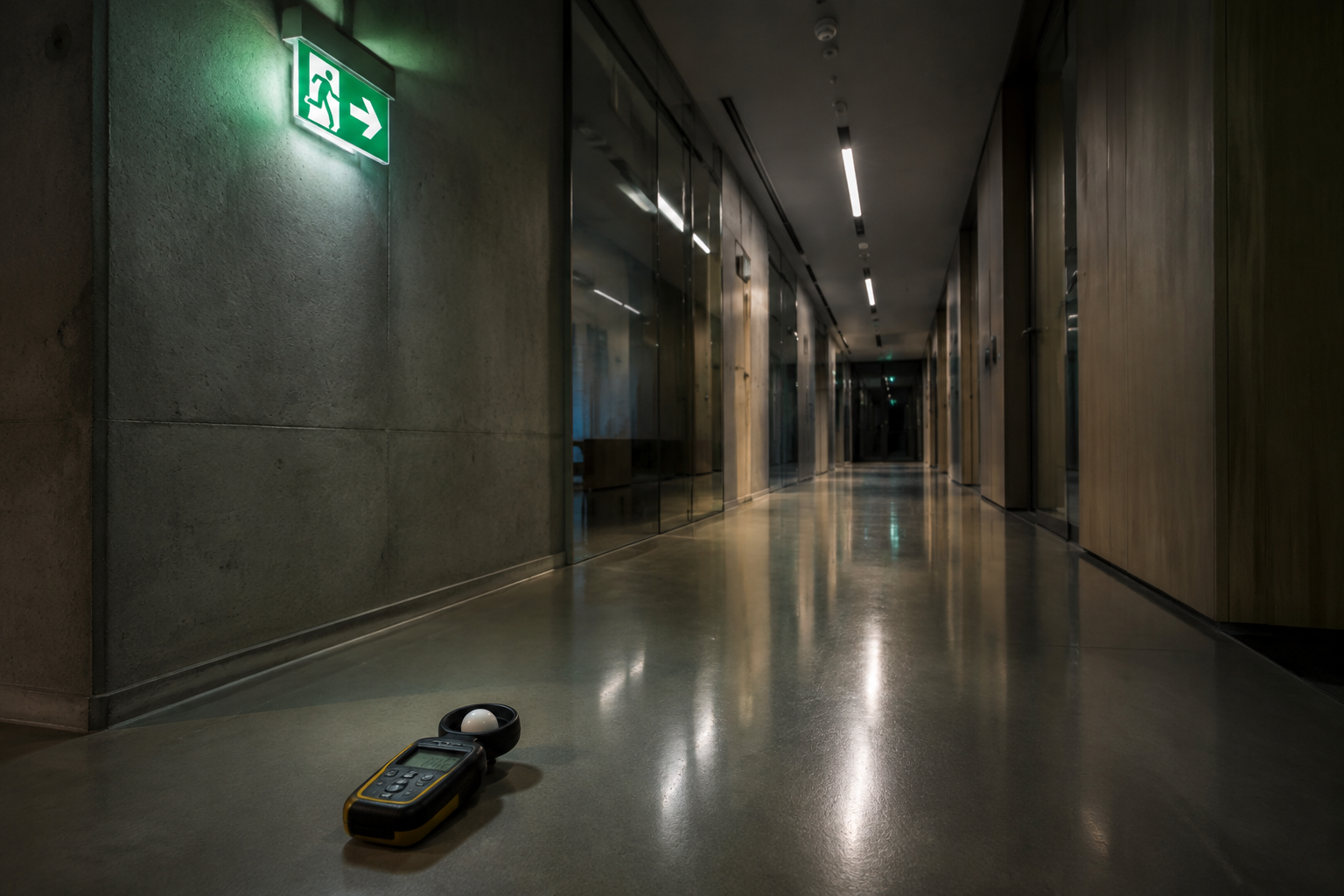
What Changed — and Why It Matters Now
At XHLWX (led-project-light.com), a Custom Indoor LED Lighting Manufacturer based in China, the practical procurement issue is connecting EN 1838 emergency lighting levels with the emergency luminaire requirements of EN 60598-2-22. A compliant lighting calculation and a compliant luminaire are different deliverables. European specifiers need both, while US contractors must establish the applicable local code and listing requirements before accepting an EN-based package.
The publication of EN 1838:2024 makes edition control especially important. Tender documents that simply request “EN 1838 compliance” can leave designers, manufacturers and commissioning contractors working to different assumptions. National adoption, transition arrangements and the edition referenced by the project must be checked rather than inferred from a catalogue statement.
One consequential issue is escape-route coverage. The familiar EN 1838:2013 approach for routes up to 2 m wide used a minimum of 1 lx along the centreline and 0.5 lx across the central band covering at least half the width. Those legacy criteria should not automatically be carried into a project adopting the 2024 edition. Revised coverage requirements need to be reflected in the calculation area, not merely in a new standard number on the drawing.
This is a specification-risk analysis, not a report of a new product launch. The underlying distinction remains: EN 1838 addresses the emergency lighting delivered within the building; EN 60598-2-22, including editions carrying the EN IEC prefix, addresses particular requirements for emergency luminaires. Neither document independently establishes the complete fire-safety strategy or guarantees approval by the relevant authority.
The Technical Detail Behind the Headline
Emergency lighting must be evaluated using the light available during emergency operation—not the luminaire's normal mains output. A fitting delivering 3,000 lm normally might use a substantially lower emergency output; the actual value must come from the proposed equipment's documentation. Applying a guessed percentage to a normal-mode file can misrepresent both output and distribution.
The following table is a procurement template, not a declaration of XHLWX product performance. Targets are illustrative unless explicitly identified as a legacy standard reference.
| Parameter | Requirement or illustrative target | Reference or evidence | Buyer action |
|---|---|---|---|
| Escape-route illuminance | Legacy EN 1838:2013: 1 lx centreline and 0.5 lx central band for routes up to 2 m wide | Project-adopted EN 1838 edition | Rebuild calculation zones for the adopted edition; do not reuse legacy geometry automatically |
| Open-area lighting | Legacy EN 1838:2013: minimum 0.5 lx on the floor, excluding a 0.5 m perimeter border | EN 1838 and project fire strategy | Confirm the current edition's area definitions, exclusions and obstructions |
| Optics and colour | Example normal-mode target: 4,000 K, CRI ≥80, TM-30 Rf ≥80 and Rg 95–105 | Supplier spectral report and project brief | Treat these as design targets, not universal emergency-lighting thresholds |
| Glare and beam | Example office target: UGR ≤19; dedicated escape-route or open-area distribution | Normal-lighting calculation plus emergency intensity limits | Do not substitute a UGR claim for emergency disability-glare checks |
| Controls | DALI-2 emergency control gear where specified; Casambi or 0–10 V for normal lighting where appropriate | Interface documentation and emergency operating logic | Verify that normal controls cannot inhibit required emergency operation |
| Housing and length | Example indoor target: IP20, 1,200 mm integrated linear fitting; higher IP where conditions require | Product drawing and applicable test evidence | Confirm battery space, access, ambient temperature and mounting orientation |
| Driver and LED identification | Named Tridonic emergency gear or another approved equivalent; exact part number required | Bill of materials and compatibility evidence | A component brand is not proof of complete-luminaire compliance |
| Emergency duration | 1 h or 3 h as specified by the project—not a universal selection | Fire strategy, national rules and rated-duration evidence | Calculate and verify output at the relevant operating conditions |
| EU conformity and quality | CE declaration, RoHS evidence, ErP scope assessment; ISO 9001 certificate only if claimed | Applicable legislation and certificate scope | Separate legal conformity, product tests and factory quality-system evidence |
EN 1838:2013 also provides useful, explicitly edition-labelled reference points: high-risk task-area lighting is at least 10% of the normal required illuminance and not less than 15 lx. Escape-route and open-area provisions include response-time requirements, with 50% of required illuminance within 5 seconds and full required illuminance within 60 seconds.
High-risk tasks require a different, faster response assessment. Check the corresponding provisions in the edition adopted for the actual contract.
Emergency glare is another frequently missed distinction. EN 1838 uses intensity-related limits associated with mounting height and viewing conditions. A normal-lighting UGR calculation cannot establish compliance with those emergency provisions.
For authoritative edition checks, consult the relevant national standards body's catalogue, such as BSI Knowledge, and the IEC Webstore for IEC 60598-2-22. Read the adopted standard rather than relying exclusively on a supplier's summary.
What This Means for Specifiers and Buyers
How Should a European Contractor Update a Tender That Cites EN 1838 Without a Year?
Issue a clarification before comparing quotations. State the national adoption and edition, the building's emergency-lighting strategy, required operating duration, maintenance assumptions and approval responsibilities. Identify escape routes, open areas, high-risk tasks, stairs, changes of level and safety-equipment locations on coordinated drawings.
Then request a revised calculation with clearly defined assessment surfaces and exclusion zones. A minimum value reported on a centreline is not interchangeable with a minimum across a wider floor area. Ask the designer to identify which edition-specific clauses govern each calculation zone.
Keep exit-sign visibility separate from floor illuminance. A 1 lx floor result does not prove that an exit sign has adequate luminance, contrast, viewing distance or visibility around an obstruction. The tender should request evidence for both wayfinding and movement through the space.
Can an Integrated Linear Luminaire Use Its Normal IES File for Emergency Calculations?
Only when the documentation establishes that the file and its scaling correctly represent emergency operation. Request IES and LDT photometric files identified by product code, optic, mounting arrangement and operating mode. If emergency mode powers a separate LED board or changes the emitting geometry, simple scaling of normal-mode photometry may be inappropriate.
Use DIALux to model the actual room and evaluate the specified emergency scenarios. Record mounting heights, partitions, calculation grids, emergency flux and maintenance assumptions. A software report supports verification; it is not a product certificate or an authority's approval.
For illustration, a documented 300 lm emergency output is only 10% of a 3,000 lm normal output. That arithmetic does not establish usable spacing. Distribution, mounting height and obstructions determine whether the required minimum illuminance is reached between fittings.
What Must US Buyers Change Before Accepting an EN-based Emergency Lighting Package?
Start with the authority having jurisdiction and the locally adopted building, electrical and life-safety requirements. EN 1838 calculations and CE documentation are not substitutes for the product approvals required in a US jurisdiction. UL 924 is a relevant emergency-lighting and power-equipment standard, but the equipment and system architecture determine the precise evaluation route.
Many US projects specify 90 minutes of emergency operation; confirm the applicable requirement rather than copying it into every schedule. A European 1 h selection cannot be assumed to meet that requirement, and a 3 h battery label alone does not demonstrate the necessary US approval.
Ask whether emergency operation is self-contained, centrally supplied or inverter-backed. Specify transfer behaviour, branch-circuit sensing and the treatment of dimming controls. A luminaire responding correctly to a DALI command during normal operation has not thereby demonstrated its behaviour during a supply failure.
 EN 1838 Emergency Lighting Levels: Why Tender Editions Matter: How should a European contractor update a tender that cites EN 1838 without a year?
Compliance Checklist (IES / LDT / DIALux / CE / RoHS / ErP)
A defensible handover package should connect the exact product configuration to the exact building calculation. Before releasing production or approving a substitution, check the following:
- Edition register: Record the adopted EN 1838 and EN 60598-2-22 editions, applicable amendments and national installation requirements. Avoid an undated “latest standard” clause that leaves responsibilities unclear.
- Luminaire evidence: Obtain reports or other appropriate conformity evidence identifying the emergency gear, battery, charging arrangement, enclosure and relevant operating conditions. An ordinary luminaire with an added battery is not automatically a verified emergency assembly.
- Photometric traceability: Match emergency IES/LDT data to the scheduled optic and configuration. Require the DIALux report to state emergency output, maintenance assumptions and calculation zones.
- Battery conditions: Record rated duration, charging requirements, ambient-temperature limits and replacement instructions. Verify access arrangements, particularly where fittings are installed above occupied spaces or difficult ceilings.
- CE documentation: For equipment within its scope, Directive 2014/35/EU, Article 6, sets manufacturer obligations. Check the EU Declaration of Conformity and assess other applicable legislation, including EMC requirements. CE is a conformity marking, not a generic third-party certificate.
- RoHS documentation: Directive 2011/65/EU, Article 4 and Annex II, establish substance restrictions. Request documentation covering the actual product configuration and any claimed exemptions.
- ErP scope: Assess Regulation (EU) 2019/2020, including Article 1 and Annex III. Emergency-specific provisions require a scope assessment; neither blanket exemption nor blanket application is a safe assumption.
- Commissioning records: Define functional tests, duration tests, fault reporting and maintenance records under the applicable installation and maintenance framework, including EN 50172 where relevant. Factory evidence cannot establish performance after installation.
Energy comparisons should remain secondary to life safety. As an illustrative estimate, a continuous 1 W difference in charging or monitoring demand equals 8.76 kWh per fitting annually: 1 W × 8,760 hours ÷ 1,000. Compare documented operating modes before extending that estimate across a building.
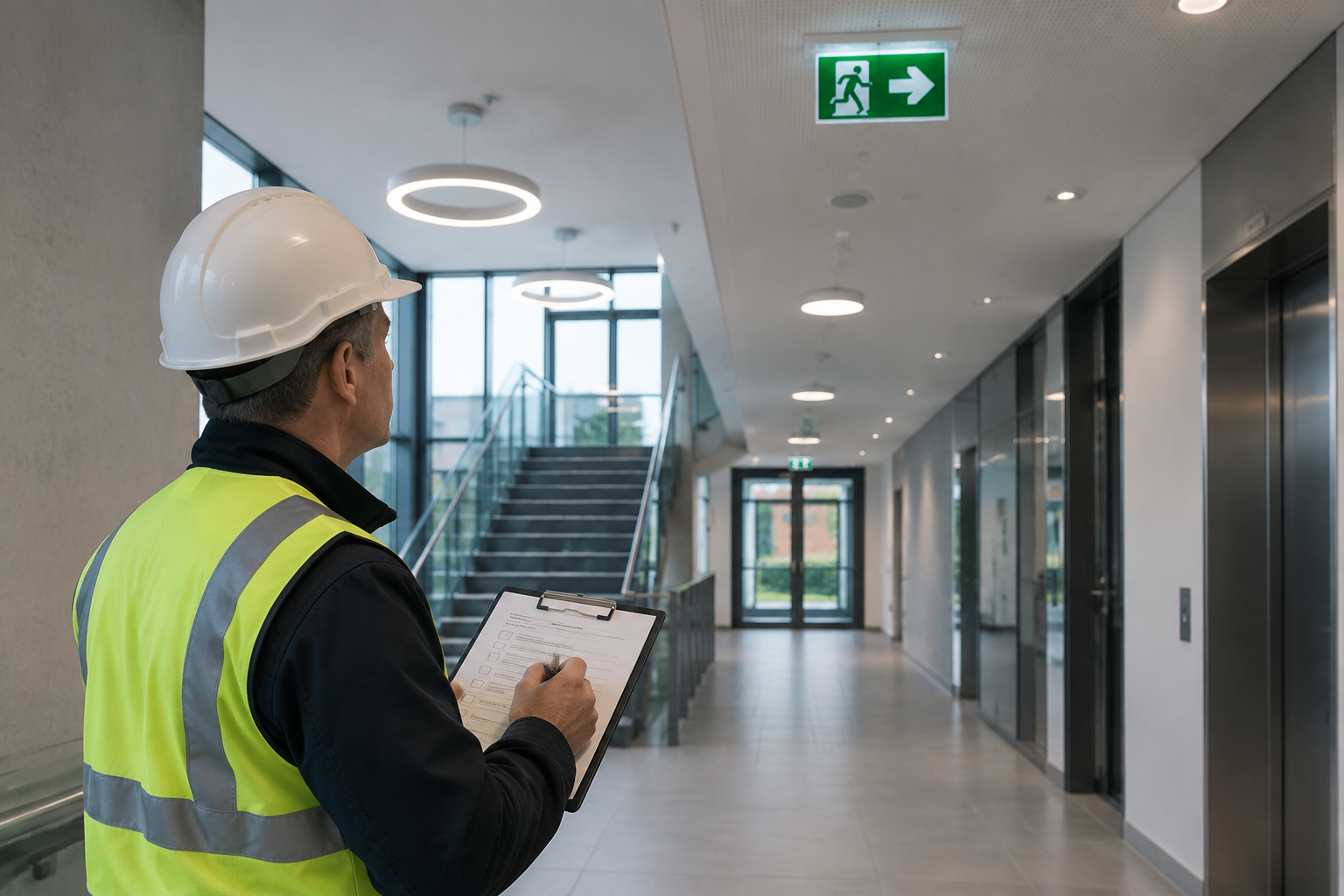 EN 1838 Emergency Lighting Levels: Why Tender Editions Matter: Compliance checklist (IES / LDT / DIALux / CE / RoHS / ErP)
Frequently Asked Questions
Q: Does EN 1838 Always Require Only 1 Lx on an Escape-route Centreline?
No. The familiar 1 lx centreline criterion comes from the EN 1838:2013 provisions for routes up to 2 m wide, alongside a central-band requirement. Projects adopting EN 1838:2024 must use that edition's coverage provisions. State the edition and calculation boundaries explicitly; a centreline result alone should not be accepted as universal evidence of compliance.
Q: Does Compliance with EN 60598-2-22 Prove That a Building Meets EN 1838?
No. EN 60598-2-22 addresses emergency luminaire requirements, while EN 1838 addresses lighting performance within the space. A compliant luminaire can still be installed too far from its neighbour or obscured by a partition. Verify emergency-mode photometry, mounting positions, required duration such as 1 h or 3 h, and installed performance against the adopted project requirements.
Q: Is a DALI-2 Emergency System Mandatory for Every European Project?
No. DALI-2 is a possible control and monitoring specification, not a universal requirement of EN 1838. IEC 62386-202 addresses self-contained emergency control gear within the DALI framework. Buyers should specify required testing, reporting and failure behaviour. Casambi or 0–10 V normal-lighting controls must be assessed separately from the equipment responsible for emergency operation.
Q: Can a Contractor Replace a Specified Emergency Driver with an Equivalent Brand?
Only after checking the consequences for the complete assembly. Matching a nominal power rating does not establish equivalent charging, battery protection, emergency flux or duration. For a 3 h specification, obtain evidence covering the replacement gear, battery and LED load together. Update photometric assumptions and conformity documentation where necessary, and secure the approval required by the contract.
Talk to Our Engineering Team
At XHLWX (led-project-light.com), a Custom Indoor LED Lighting Manufacturer based in China, an emergency-lighting enquiry should begin with the project country, adopted standard editions, reflected ceiling plan, supply architecture and required duration. Request a clearly scoped engineering review identifying proposed configurations, available emergency-mode photometry and outstanding evidence. For European and US buyers, the next step is to resolve those gaps with the responsible designer and approving authority before procurement—not after installation.
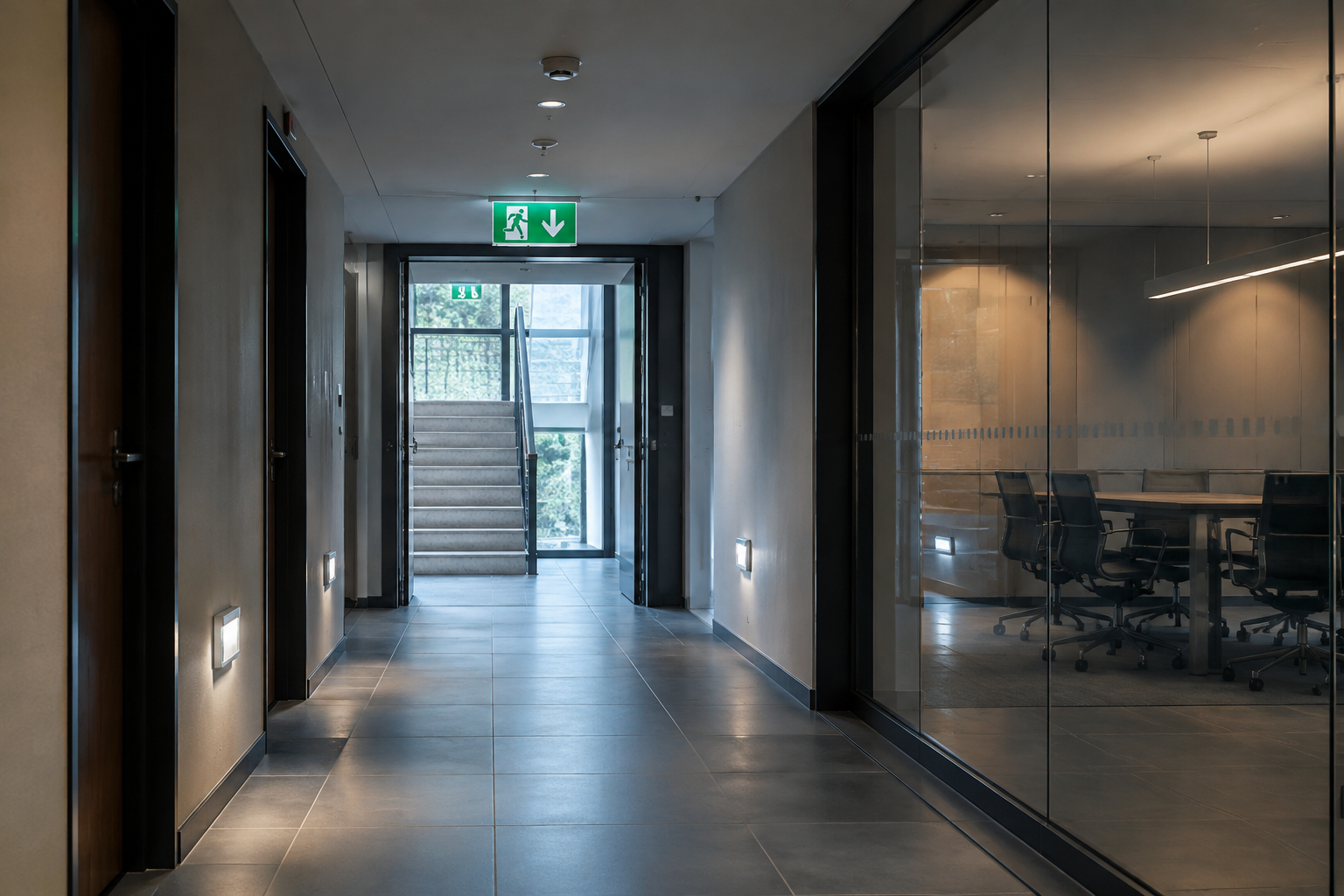 EN 1838 Emergency Lighting Levels: Why Tender Editions Matter: Q: Does compliance with EN 60598-2-22 prove that a building meets EN 1838?
Need a tailored lighting plan for your project?
Our senior lighting designers reply within 48 hours with a free design proposal & quotation.