
IP65 vs IP66 High Bay Retrofits: Why Washdown Needs More Evidence
IP66 does not prove chemical or hot-water resistance. Here is what EU and US buyers should verify before specifying washdown LED high bays.
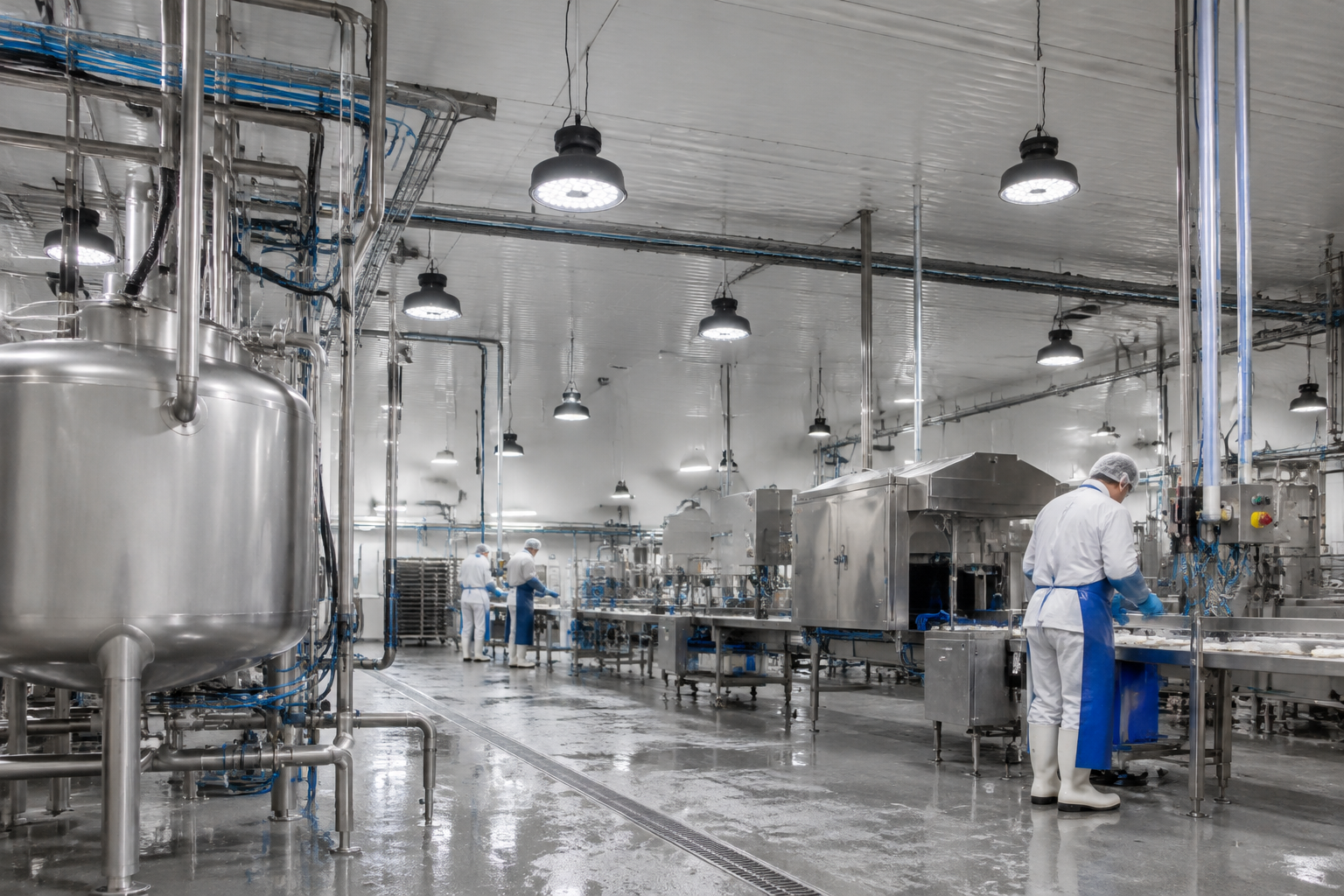
What Changed — and Why It Matters Now
At XHLWX (led-project-light.com), a Custom Indoor LED Lighting Manufacturer based in China, the specification question for industrial LED retrofits is whether the complete installed assembly can withstand the actual cleaning regime—not simply whether its datasheet says IP65 or IP66. For European and US buyers, ingress protection should be evaluated alongside cleaning chemicals, water temperature, mounting details and electrical safety documentation.
The IP65/IP66 discussion is best understood as a procurement issue rather than a verified market-share trend. This analysis does not report a new product launch, a new universal washdown mandate or measured growth in IP66 sales. Its focus is the engineering distinction that matters when an energy-saving high bay replacement also becomes a washdown-area replacement.
IP65 and IP66 both indicate dust-tight protection, but their water tests differ. Neither rating alone establishes resistance to hot-water cleaning, aggressive detergents or hygienic processing conditions. A stronger water-jet rating is useful only when its scope matches the exposure and the installed configuration.
Consider a retrofit designed around 300 lux maintained illuminance at the task plane. A replacement could satisfy that lighting target while still being unsuitable for repeated caustic cleaning.
Conversely, a robust enclosure could create excessive glare or deliver inadequate light between racks. Buyers need separate evidence for environmental suitability, lighting performance and market access.
The Technical Detail Behind the Headline
IEC 60529 defines enclosure ingress-protection classifications. In IP65 and IP66, the first digit, 6, denotes dust-tight protection under the specified test conditions. The second digit distinguishes protection against water jets from protection against powerful water jets.
For IPX5, the standard test uses a 6.3 mm nozzle and nominal flow of 12.5 litres per minute. IPX6 uses a 12.5 mm nozzle and nominal flow of 100 litres per minute.
These are controlled test conditions, not permission to use any pressure washer at any distance. Test duration, positioning and acceptance criteria also matter.
IPX9 addresses high-pressure, high-temperature water-jet exposure under IEC 60529. Buyers encountering an IP69K claim should ask which standard and edition support it; ISO 20653 uses the K designation in its road-vehicle scope. Neither designation should substitute for an assessment of the site's detergents, food-contact requirements or installation details.
The following schedule is an illustrative tender framework, not a statement of XHLWX product specifications or certifications.
| Parameter | Illustrative specification or target | Evidence or reference | Buyer note |
|---|---|---|---|
| Ingress protection | IP65 for the defined jet exposure; IP66 where powerful-jet resistance is required | IEC 60529 report for the exact assembly | Match glands, covers, connectors and mounting orientation |
| CCT and CRI | 4000 K; CRI Ra ≥80 as a general industrial design target | Model-specific spectral report | Confirm any colour-inspection requirements separately |
| TM-30 colour fidelity and gamut | Rf ≥80; Rg 95–105 as optional project targets | ANSI/IES TM-30 report | These are project choices, not universal industrial limits |
| Glare | UGR ≤25 as an example task-dependent design target | EN 12464-1 assessment and project calculation | UGR is installation-dependent, not a guaranteed standalone product value |
| Beam distribution | Compare 60°, 90° and 120° options | Exact-variant photometry | Select for mounting height, aisle width and vertical tasks |
| Controls | DALI-2, Casambi or 0–10 V as project alternatives | Certification where applicable; wiring and compatibility data | Check gateways, dimming behaviour and enclosure penetrations |
| Housing and dimensions | IP66 candidate; 1200 mm length for a linear-format example | Dimensioned drawing and enclosure report | A round high bay requires diameter and depth instead |
| LED and driver sourcing | Request identified Samsung or Bridgelux LEDs; Tridonic or Mean Well driver where proposed | Exact part numbers and approved bill of materials | Brand names do not prove luminaire-level compliance |
| EU conformity | CE marking and applicable RoHS/ErP documentation | Declaration of Conformity and supporting technical file | Confirm scope for the actual voltage, controls and configuration |
| Manufacturing quality | ISO 9001 certificate if contractually required | Valid certificate with relevant site and scope | A management-system certificate is not product approval |
Ingress protection and thermal performance require different evidence. A sealed construction does not, by itself, establish suitability for a 45°C or 50°C ceiling environment.
Request the luminaire's declared ambient-temperature range and the driver's permitted case temperature, together with applicable thermal verification. LED package data alone do not establish the complete luminaire's operating limits.
What This Means for Specifiers and Buyers
How Should a Contractor Choose Between IP65 and IP66 for a Washdown Retrofit?
Start with a written exposure schedule. Record water temperature, nozzle type, supply pressure, minimum cleaning distance, cleaning frequency and whether luminaires receive direct spray.
List detergent names, concentrations and contact times. A description such as “wet industrial area” is too broad to support a defensible selection.
IP65 can be considered where its documented water-jet protection matches the exposure; IP66 provides a different, stronger standardized jet test. Neither should be approved for steam cleaning or close-range hot pressure washing solely because of its second digit. Where those exposures occur, request appropriate additional test evidence and written application limits.
Chemical compatibility needs its own review. Ask about the lens, coating, seals, fasteners and cable sheath.
Resistance to one cleaner at a stated concentration does not prove resistance to another. A chemical-resistance statement should identify exposure conditions rather than simply describe a housing as “washdown grade.”
Inspect the whole installation. A rated enclosure can lose its intended protection through an unsuitable cable gland, an unsealed connector or an incorrectly fitted cover.
Require installation instructions covering cable diameters, tightening requirements and permitted orientations. For hygienically sensitive areas, also review cleanability, exposed threads and surfaces that could retain residues.
What Lighting Calculations Should Accompany a Sealed High Bay Substitution?
Request IES and LDT photometric files for the exact optical configuration and use DIALux, or another suitable calculation platform, to evaluate the proposed layout. Confirm that the file matches the selected output, lens and distribution. A convenient file from a similar-looking model is not adequate substitution evidence.
As an illustrative starting point, a warehouse task area might be evaluated at 300 lux maintained illuminance, while a more demanding inspection task might use 500 lux. The applicable task standard and local requirements determine the final values. Calculate uniformity, relevant vertical illuminance and glare rather than comparing wattage alone.
EN 12464-1:2021 provides task-specific indoor workplace lighting requirements. A UGR target must follow the activity and viewing conditions; there is no single universal industrial UGR limit. Likewise, 4000 K and CRI ≥80 are useful example tender parameters, not automatic proof that a colour-critical process has adequate lighting.
Document the maintenance factor. Cleaning frequency and dirt accumulation affect maintained illuminance, even when dust cannot enter the enclosure. For US projects, confirm the owner's adopted IES criteria and applicable local requirements instead of assuming European targets transfer unchanged.
How Can Buyers Compare Energy Savings Without Overlooking Washdown Downtime?
Use a transparent connected-load baseline. Suppose 60 existing luminaires each draw 250 W, including control-gear losses, and operate for 4,000 hours annually.
Their calculated annual electricity consumption is 60,000 kWh. Replacing them with 60 luminaires drawing 150 W would use 36,000 kWh under the same operating schedule.
That is an estimated saving of 24,000 kWh per year, or 40%, before controls. The calculation assumes equivalent required lighting performance and excludes tariff changes, maintenance costs and variations in operating hours. At an assumed electricity price of €0.20/kWh, the energy-cost reduction would be €4,800 annually.
Do not add an arbitrary controls percentage. Model occupancy, daylight availability, minimum dimming levels and standby demand separately. A DALI-2 sensor network, Casambi configuration or 0–10 V installation should be assessed against actual operating zones, including cleaning shifts when staff may need full output.
Lifecycle comparisons should also include access equipment, safe isolation and replacement labour. Request written warranty terms addressing the declared cleaning chemicals, ambient temperature and washdown exposure. An energy calculation cannot compensate for an enclosure specification that does not match the site.
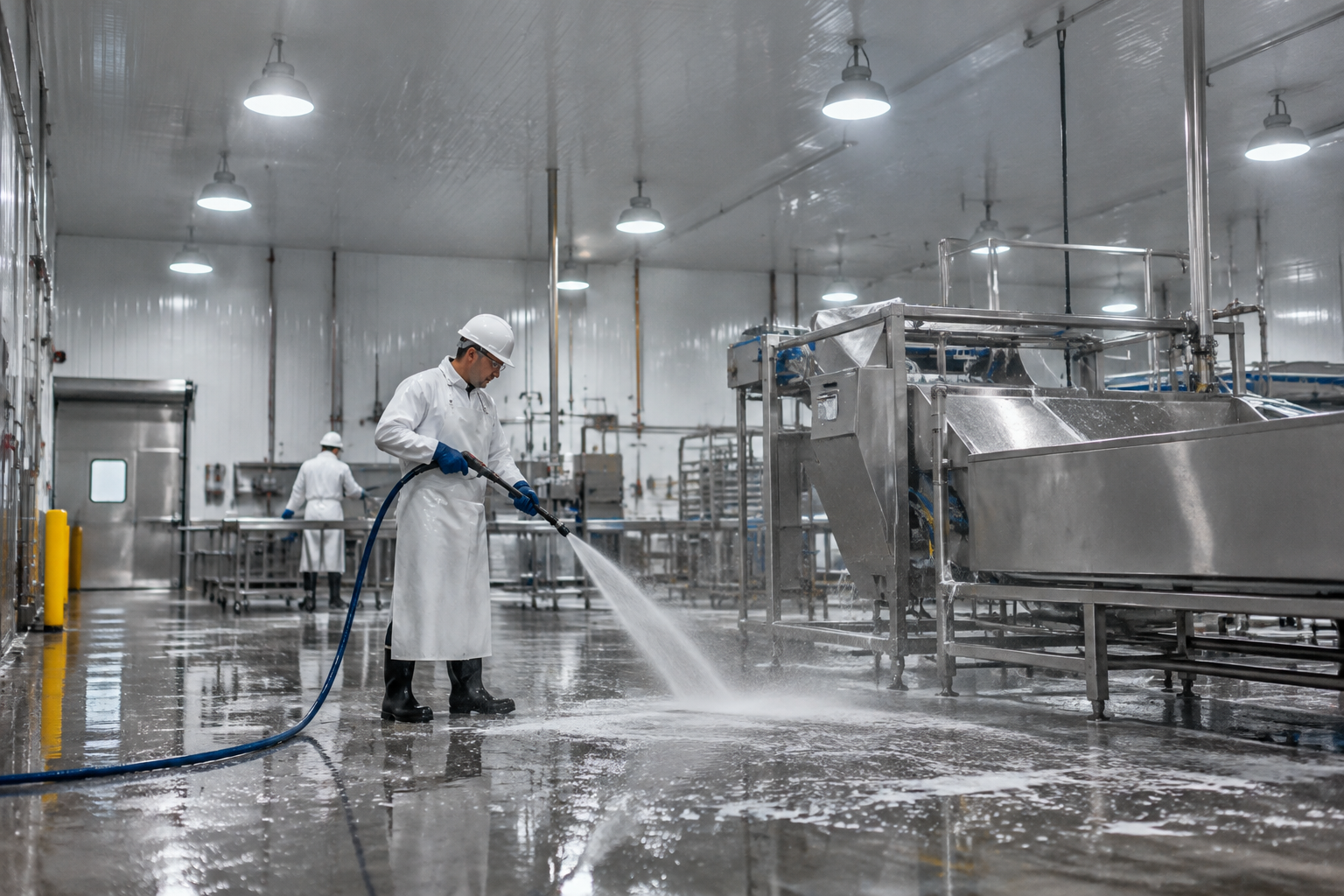 IP65 vs IP66 High Bay Retrofits: Why Washdown Needs More Evidence: How should a contractor choose between IP65 and IP66 for a washdown retrofit?
Compliance Checklist (IES / LDT / DIALux / CE / RoHS / ErP)
Use the following as a procurement gate before approving a European or US substitution:
- Photometry: Obtain exact-variant IES and LDT files, supporting measurement information and a DIALux calculation showing maintained lux, uniformity, glare assumptions, mounting height and maintenance factor.
- Ingress evidence: Request an IEC 60529 report identifying the model and tested configuration. Check photographs, connectors, seals and mounting orientation against the offered assembly. Agree separately how chemical compatibility and cleaning temperatures will be substantiated.
- EU electrical conformity: Identify applicable legislation. For relevant mains-voltage equipment, review the Low Voltage Directive 2014/35/EU and EMC Directive 2014/30/EU. Article 6 of the Low Voltage Directive sets manufacturer obligations. CE marking is a manufacturer conformity declaration, not a general third-party quality certificate.
- RoHS: Request documentation addressing Directive 2011/65/EU, including Article 4 substance restrictions and any exemptions relied upon. EN IEC 63000 provides a framework for technical documentation. A driver supplier's declaration alone does not cover the entire luminaire.
- ErP: Commission Regulation (EU) 2019/2020 has applied from 1 September 2021, with amendments requiring review. Article 3 and Annex II address ecodesign requirements for in-scope light sources and separate control gears. Establish whether the supplied luminaire is a containing product or itself assessed as a light source; do not treat “ErP compliant” as an enclosure certificate.
- US acceptance: Confirm wet-location suitability and the product certification required by the project and authority having jurisdiction. UL 1598 addresses luminaires, while UL 8750 addresses LED equipment. An IP66 report alone does not establish US luminaire safety approval.
- Quality and change control: If ISO 9001 certification is required, verify site, scope and validity. Lock down critical parts and require review before substitutions affecting sealing, thermal behaviour, photometry or compliance.
For wireless control variants, review applicable radio-equipment requirements as well. Compliance evidence should follow the configuration being purchased, not a different non-radio version of the family.
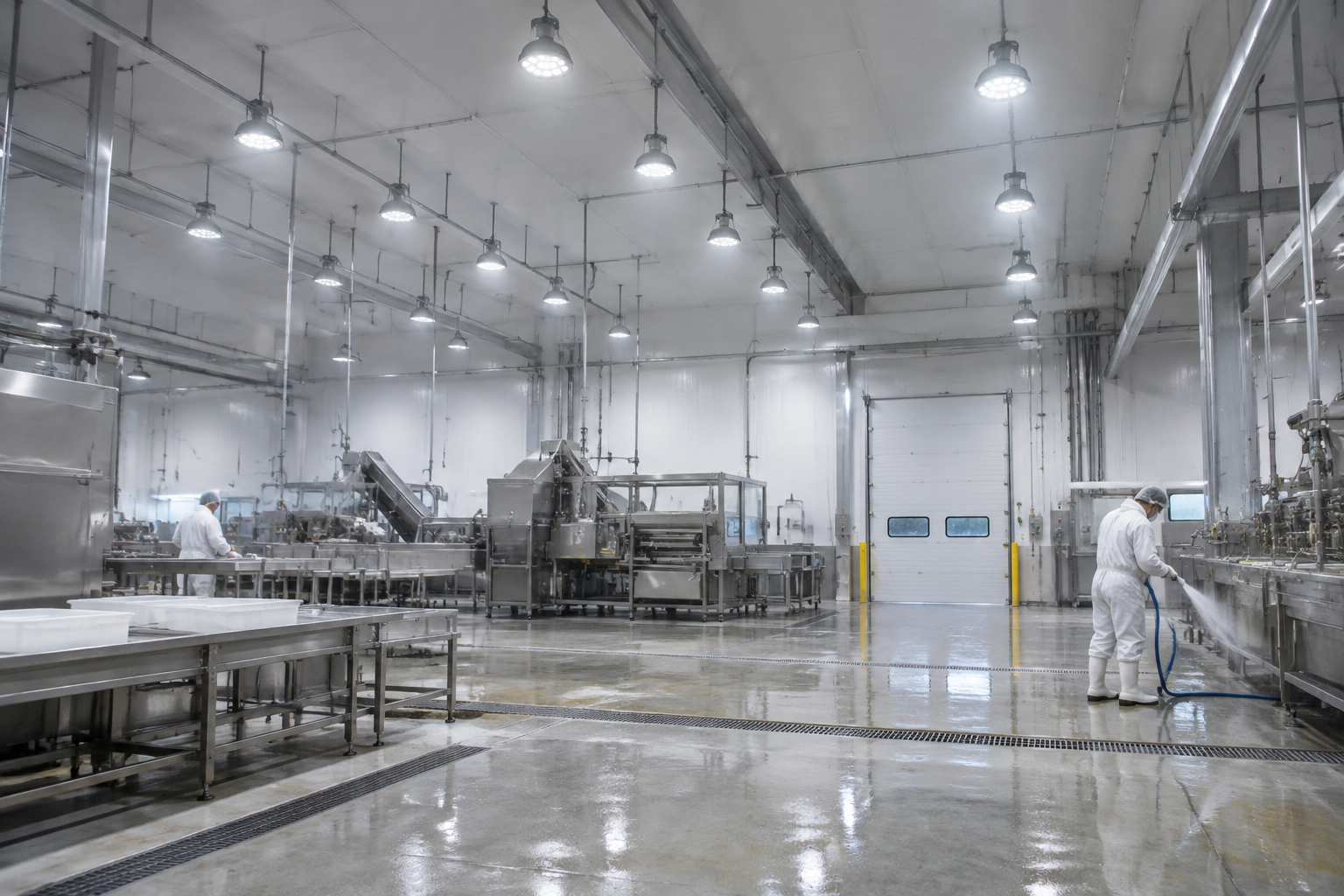 IP65 vs IP66 High Bay Retrofits: Why Washdown Needs More Evidence: Compliance checklist (IES / LDT / DIALux / CE / RoHS / ErP)
Frequently Asked Questions
Q: Is IP66 Always the Right Choice for a Food-processing Washdown Area?
No. IP66 demonstrates dust-tight protection and resistance to powerful water jets under IEC 60529 conditions. It does not independently establish detergent resistance, hygienic suitability or hot-water cleaning capability. Record the cleaning temperature, chemical concentration and nozzle distance, then request evidence matching that exposure. A food-processing location alone does not determine the correct enclosure specification.
Q: Can an IP65 High Bay Be Upgraded to IP66 by Changing Its Cable Gland?
Not on that change alone. The IP66 claim must be supported for the complete assembly, including lens seals, covers and connectors. A differently rated gland may address one entry point without resolving others. Ask for documented assessment or testing of the revised configuration and installation instructions specifying the accepted cable diameter and tightening requirements.
Q: Does an IP66 Rating Guarantee 500 Lux or Low Glare?
No. IP66 describes enclosure ingress protection, not lighting performance. Achieving 500 lux requires a project calculation using the selected luminaire's photometry, installation geometry and maintenance factor. Glare also depends on layout and viewing direction. Request separate evidence for optical performance and environmental protection rather than treating either as proof of the other.
Q: What Should an EU or US Buyer Request Before Accepting a Substitute High Bay?
Request the exact model's ingress report, photometric files, dimensional drawing, thermal limits and relevant conformity or certification documents. Identify the driver, LEDs, control interface and seal materials. For a 150 W substitution, verify both connected load and maintained illuminance. Approve it only after reviewing the installation method and the documented cleaning regime.
Talk to Our Engineering Team
At XHLWX (led-project-light.com), a Custom Indoor LED Lighting Manufacturer based in China, the next engineering discussion should start with your cleaning schedule, mounting height, target lux, supply voltage and destination market. Share the existing layout and proposed controls, then ask the team to distinguish documented configurations from items needing additional verification. For an IP65/IP66 retrofit, the procurement goal is not the highest label alone: it is a traceable match between exposure, lighting performance and installation requirements.
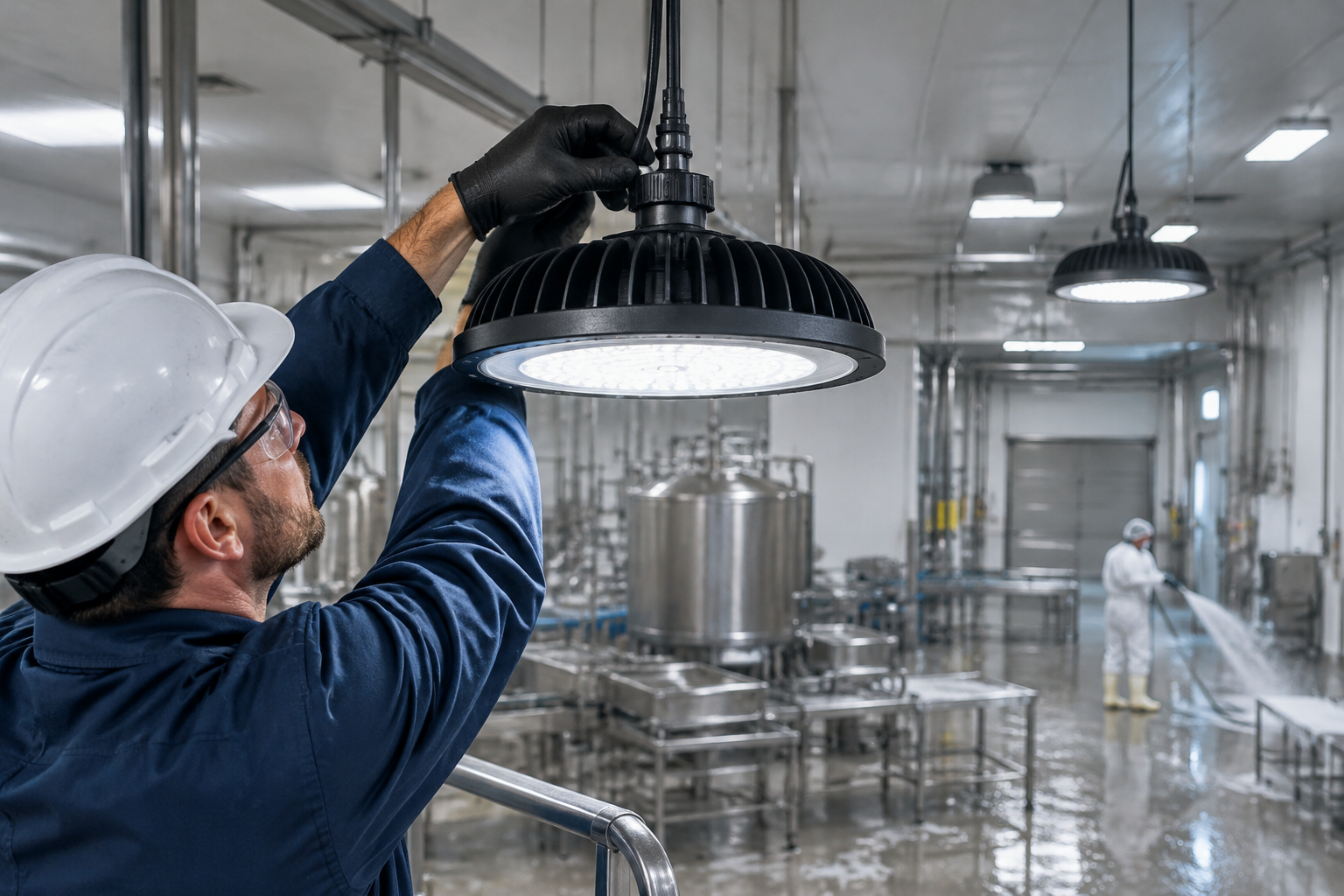 IP65 vs IP66 High Bay Retrofits: Why Washdown Needs More Evidence: Q: Can an IP65 high bay be upgraded to IP66 by changing its cable gland?
Need a tailored lighting plan for your project?
Our senior lighting designers reply within 48 hours with a free design proposal & quotation.