
L80B10 LED Tender Requirements: Why LM-80 Alone Falls Short
LM-80 and TM-21 can support LED lifetime claims, but not prove B10 alone. How public buyers can build defensible lighting tender gates.

What Changed — and Why It Matters Now
At XHLWX (led-project-light.com), a Custom Indoor LED Lighting Manufacturer based in China, the buyer-facing question is how to make an L80B10 LED lifetime requirement auditable before contract award. For public offices, schools and other long-operating-hour buildings, the distinction matters: an LM-80 report and a TM-21 calculation can support an LED lumen-maintenance projection, but they do not, by themselves, establish a finished luminaire’s L80B10 performance.
This is an analysis of procurement requirements, not an announcement of a new universal testing mandate. The actionable change for buyers is to turn a catalogue lifetime into an evidence gate: define the claimed performance, identify acceptable proof and decide how missing documentation affects bid evaluation.
The legal framework already supports evidence-based specifications. Directive 2014/24/EU, dated 26 February 2014, addresses technical specifications in Article 42 and test reports, certification and other means of proof in Article 44. Their provisions concerning equivalent solutions and evidence matter when drafting a tender that names a particular testing method.
The procurement conclusion is straightforward: LM-80 and TM-21 evidence should be checked for relevance and completeness, not treated as automatic proof of B10. If a bidder supplies only an average lumen-maintenance projection, the buyer still needs a defensible basis for the claimed population distribution and separate information about abrupt failures.
The Technical Detail Behind the Headline
In a properly defined gradual lumen-depreciation claim, L80B10 at 50,000 hours describes a population in which no more than 10% falls below 80% of initial luminous flux at that time. The specification must identify the product population, operating conditions and treatment of abrupt failures. It should not be paraphrased as “90% of luminaires will remain operational,” because lumen depreciation and sudden failure are different outcomes.
ANSI/IES LM-80 measures luminous-flux and color maintenance of LED packages, arrays or modules under specified conditions. ANSI/IES TM-21 uses qualifying LM-80 data to project long-term lumen maintenance.
Neither method, on its own, characterizes every driver, optical material, connector or thermal interface in a finished luminaire. The official IES standards catalogue identifies the relevant documents; a tender should name the applicable editions rather than request an unspecified “latest report.”
Most importantly, a TM-21 projection of average lumen maintenance is not a B10 population-distribution demonstration. Ask for the calculation inputs, sample count, test duration, temperature conditions, drive current and reporting limit, followed by an explanation of how the finished-product claim was derived.
The following table is an illustrative tender schedule, not a statement of tested XHLWX product performance or available certifications.
| Parameter | Illustrative requirement or design target | Evidence or reference | Tender review note |
|---|---|---|---|
| Lifetime claim | L80B10 at 50,000 h, ambient 25°C | Defined statistical method and product-level supporting evidence | Do not infer B10 from TM-21 alone |
| LED maintenance | LM-80 dataset and TM-21 calculation | Applicable ANSI/IES editions | Match LED designation, current and temperature |
| CCT and color quality | 3000 K or 4000 K; CRI Ra ≥90 | Spectral measurement report | Select one approved configuration per space |
| TM-30 color rendition | Rf ≥85; Rg 95–105 as design targets | ANSI/IES TM-30 report | Evaluate the same CCT and LED option offered |
| Glare and beam | Calculated UGR ≤19; nominal 90° beam | EN 12464-1 where applicable; photometry | UGR depends on room geometry and arrangement |
| Controls | DALI-2, Casambi or 0-10V, as scheduled | Exact driver/controller records and functional test | Specify minimum dimming level, for example 1% |
| Housing | IP20 for dry interiors; nominal 1200 mm length | IEC 60529 evidence and dimensioned drawing | Select a different IP rating where exposure requires it |
| LED and driver identity | Samsung or Bridgelux LED; Tridonic or Mean Well driver, or equivalent | Full component codes and datasheets | Brand names alone do not establish performance |
| EU conformity | CE documentation; applicable RoHS and ErP compliance | EU declarations and supporting technical records | These are not L80B10 certificates |
| Quality management | ISO 9001 certificate if specified | Valid certificate with relevant manufacturing scope | System certification does not prove product lifetime |
For projection length, examine the selected TM-21 edition and sample-size rules. Under the familiar six-times reporting limit applicable to qualifying datasets with at least 20 samples, 10,000 hours of testing supports a maximum reportable projection horizon of 60,000 hours.
That is a limit, not a guarantee that L80 reaches 60,000 hours. The calculated decay may produce a shorter result.
Likewise, 6,000 hours multiplied by six gives 36,000 hours under that rule, not evidence for a reportable 50,000-hour projection. Smaller sample sets can face stricter limits. A spreadsheet output must be checked against the method’s reporting requirements before it becomes a contractual claim.
What This Means for Specifiers and Buyers
How Should a Public Buyer Write an L80B10 Evidence Gate Without Excluding Equivalent Proof?
Separate minimum compliance from award scoring. The technical schedule should state the lifetime target, ambient temperature, operating current, switching assumptions, dimming configuration and acceptable evidence. The submission schedule should identify which documents are required with the bid and which may follow before production approval, subject to applicable procurement rules.
For an EU public contract, align the evidence clause with Articles 42 and 44 of Directive 2014/24/EU and the relevant national implementation. Avoid requiring a single laboratory or manufacturer by name without a lawful justification. Specify the performance to be demonstrated and the conditions under which equivalent evidence will be assessed.
A useful draft clause is: “For the offered configuration, submit LED lumen-maintenance test evidence, the applicable projection calculation, an operating-temperature correlation and the statistical basis supporting the stated B10 value. Identify exclusions and separately disclose abrupt-failure assumptions.” Have the authority’s procurement adviser review the final wording.
Define the consequence of an evidence gap before opening bids. A minimum requirement should not quietly become an optional promise after award. Conversely, a tender should not automatically reject equivalent substantiation where procurement law requires it to be considered.
What Must a Contractor Verify When the LED Package or Driver Changes After Award?
Freeze the approved configuration in a controlled component schedule. Record the LED package designation, drive current, driver model, optical assembly, thermal design and control interface. A Samsung-to-Bridgelux substitution, for example, requires more than confirmation that both products are LEDs of the same nominal wattage.
Check whether the replacement has relevant maintenance data and whether its operating temperature remains within the conditions supporting the projection. Where temperature correlation is used, document the measurement location and its relationship to the LED supplier’s specified thermal reference point. An external housing temperature is not automatically an acceptable substitute.
Driver changes also require review. Different output current, dimming behavior or thermal limits can alter the operating conditions on which the original evidence depended. Require written approval and an evidence update before shipment; retain a sample identifier or configuration record so delivered units can be traced to the approved submission.
How Should a 50,000-hour Claim Affect Maintained Illuminance and Lifecycle Cost?
Translate hours into the building’s operating schedule. At an assumed 3,000 hours annually, 50,000 hours represents approximately 16.7 years. At 6,000 hours annually, it represents approximately 8.3 years. Neither calculation converts a lumen-maintenance claim into a warranty covering every component for that period.
Use the maintenance factor appropriate to the design interval, cleaning plan and replacement strategy. For illustration, combining a lumen-maintenance factor of 0.80 with luminaire and room maintenance factors of 0.95 each, and a survival factor of 1.00 under a defined prompt-replacement policy, gives approximately 0.72.
A 500 lux maintained target would therefore require about 694 lux initially. This is a design example, not a universal factor.
Keep energy arithmetic separate from lifetime evidence. Replacing 200 luminaires rated at 80 W with 32 W alternatives, operating 3,000 hours annually, reduces calculated electricity use from 48,000 to 19,200 kWh: a 60% reduction before additional control effects. That comparison is meaningful only if the replacement delivers the required maintained lighting performance.
 L80B10 LED Tender Requirements: Why LM-80 Alone Falls Short: How should a public buyer write an L80B10 evidence gate without excluding equivalent proof?
Compliance Checklist (IES / LDT / DIALux / CE / RoHS / ErP)
Use this checklist at technical evaluation and repeat the configuration checks before production release:
- Photometric identity: Request IES and LDT photometric files for the offered optic, CCT and output setting. Check file metadata against the report and quotation. These files describe light distribution; they do not establish lifetime.
- Room calculation: Run the approved configuration in DIALux. Record mounting heights, reflectances, calculation planes and maintenance assumptions. Verify the project’s maintained lux, uniformity and glare criteria rather than accepting a standalone “UGR <19” label.
- Lifetime evidence: Cross-reference the LM-80 LED identifier, TM-21 inputs, temperature correlation and B10 substantiation. Record any missing link as an unresolved technical qualification.
- EU electrical conformity: Identify applicable legislation, including the Low Voltage Directive 2014/35/EU and EMC Directive 2014/30/EU where relevant. Wireless configurations may instead bring Radio Equipment Directive 2014/53/EU requirements into scope. Check the actual configuration and EU declaration of conformity.
- RoHS: Review evidence under Directive 2011/65/EU, as amended, for the supplied electrical and electronic equipment. A generic component statement is not a substitute for assessing the finished product’s applicable obligations.
- ErP: Establish whether the supplied items are light sources, separate control gears or containing products under Regulation (EU) 2019/2020, as amended. Its requirements generally applied from 1 September 2021. Regulatory maintenance requirements and a contractual L80B10 promise are different obligations.
- US project acceptance: Confirm the electrical safety listing, marking and installation requirements applicable to the jurisdiction and contract. LM-80 and TM-21 do not replace these checks, and CE documentation is not a substitute for US acceptance requirements.
Where lifecycle cost is an award criterion, Article 68 of Directive 2014/24/EU provides the relevant framework. Publish the calculation method and bidder data requirements rather than relying on unsupported replacement-cost estimates.
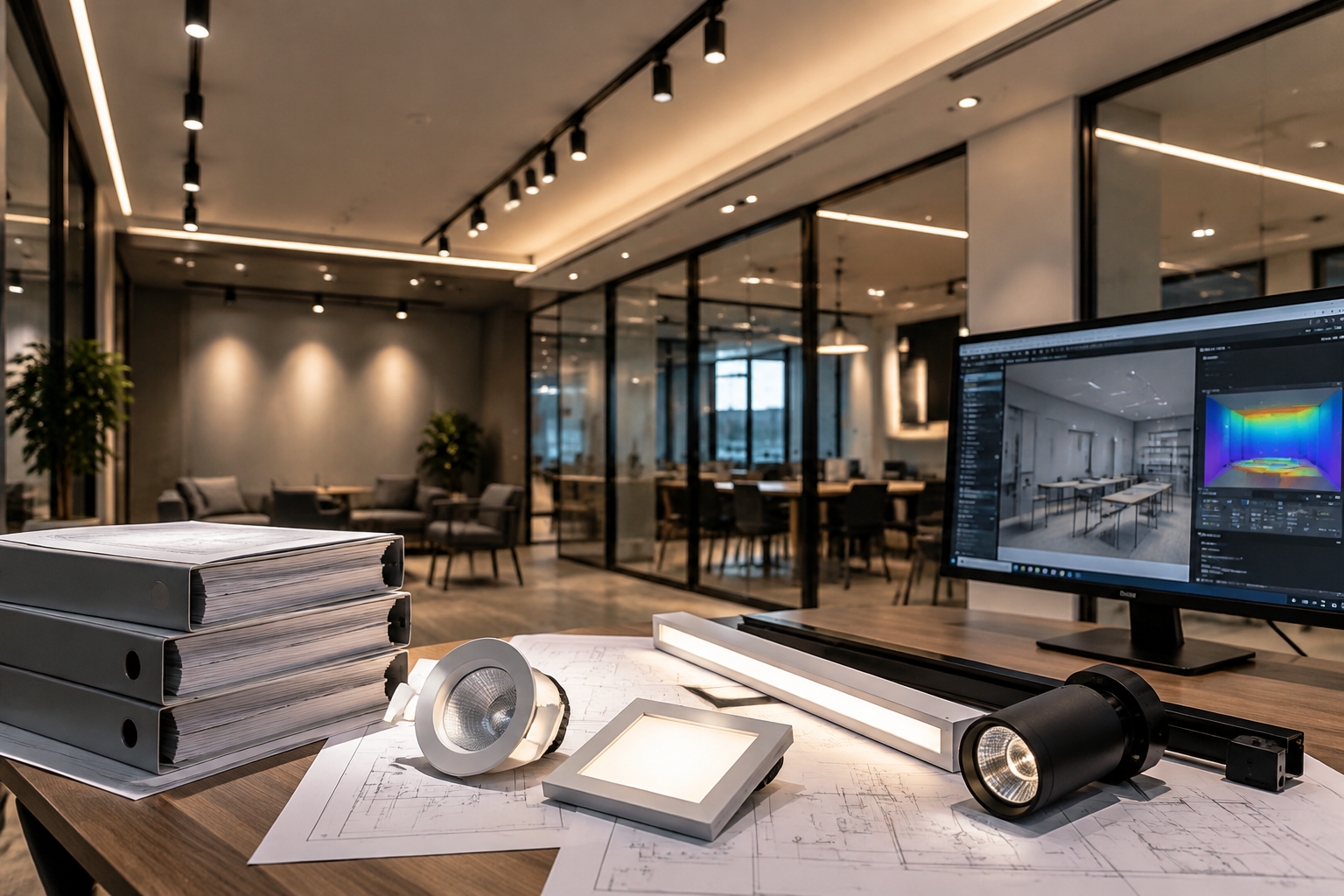 L80B10 LED Tender Requirements: Why LM-80 Alone Falls Short: Compliance checklist (IES / LDT / DIALux / CE / RoHS / ErP)
Frequently Asked Questions
Q: Does an LM-80 Report Prove a Luminaire Meets L80B10 at 50,000 Hours?
No. LM-80 measures maintenance behavior of LED packages, arrays or modules under specified conditions. A 50,000-hour finished-luminaire claim also needs a relevant projection, operating-condition correlation and evidence supporting the B10 population claim. Driver failures and optical degradation require separate consideration; they cannot be inferred from the LED report alone.
Q: Is 10,000 Hours of LM-80 Testing Always Enough for a 60,000-hour Claim?
No. Under the six-times reporting limit for qualifying datasets with at least 20 samples, 10,000 test hours permits a maximum projection horizon of 60,000 hours. The actual projected L80 value may be lower. Buyers must also check the applicable TM-21 edition, sample-size conditions and whether the luminaire’s LED operating conditions support using that dataset.
Q: Can a Public Tender Require LM-80 and TM-21 Documentation?
A tender can specify relevant evidence requirements, subject to the applicable procurement framework. In EU procurement, Articles 42 and 44 of Directive 2014/24/EU address specifications and means of proof, including provisions concerning equivalence. Buyers should define the performance requirement, acceptable evidence and submission deadline, then obtain procurement review rather than assume one report format is universally mandatory.
Q: Should an L80B10 Rating Determine the DIALux Maintenance Factor by Itself?
No. L80 at a stated time addresses one aspect of maintenance, not the complete lighting installation. For example, 0.80 lumen maintenance combined with two 0.95 maintenance factors gives approximately 0.72 before any additional survival adjustment. DIALux inputs should reflect the design interval, cleaning schedule and replacement policy, with each assumption documented for the buyer.
Talk to Our Engineering Team
For a useful technical review, assemble the room schedule, annual operating hours, ambient-temperature assumptions, maintained illuminance targets and tender evidence clause. Include the proposed control system and document-submission deadlines so unresolved lifetime claims can be identified before bid acceptance.
At XHLWX (led-project-light.com), a Custom Indoor LED Lighting Manufacturer based in China, the appropriate engineering discussion starts with the exact proposed configuration and the evidence needed to assess it. Ask for a configuration-specific submission plan covering photometry, component traceability, thermal correlation and the basis of any L80B10 claim; treat unsupported values as open qualifications, not procurement-ready guarantees.
 L80B10 LED Tender Requirements: Why LM-80 Alone Falls Short: Q: Is 10,000 hours of LM-80 testing always enough for a 60,000-hour claim?
Need a tailored lighting plan for your project?
Our senior lighting designers reply within 48 hours with a free design proposal & quotation.