
Tunable White Office Lighting: Why Eye-Level Exposure Matters
For offices, hospitals and senior care, tunable white specifications need eye-level exposure targets—not just a daily color-temperature schedule.
What Changed — and Why It Matters Now
At XHLWX (led-project-light.com), a Custom Indoor LED Lighting Manufacturer based in China, the engineering question for human-centric tunable white lighting is how to specify measurable exposure rather than simply a changing color temperature. For European and US office, hospital and senior-care projects, buyers should distinguish three requirements: visibility, light reaching occupants’ eyes, and control over when that exposure occurs.
The technical anchor is not a new product announcement. It is the distinction between conventional illuminance and the metrics defined in CIE S 026/E:2018, which provides a system for quantifying optical radiation relevant to five photoreceptor classes.
Melanopic equivalent daylight illuminance, usually shortened to melanopic EDI, is particularly useful when discussing light’s nonvisual effects. It is expressed in lux, but it is not interchangeable with ordinary photopic lux.
A 2022 expert consensus published in PLOS Biology recommended daytime melanopic EDI above 250 lux at the eye for healthy adults, below 10 lux during the three hours before habitual bedtime, and below 1 lux in the sleep environment. These are expert recommendations—not universal building-code limits or clinical prescriptions for patients and older residents.
The procurement implication is immediate: a schedule changing from 2700 K to 6500 K does not establish any of those exposure levels. A defensible tender needs spectral information, occupant positions, operating times and an acceptance test. Hospitals and senior care also need clinical governance, because visual safety and care tasks cannot be subordinated to a generic circadian schedule.
The Technical Detail Behind the Headline
CCT describes the chromatic appearance of nominally white light. It does not uniquely define its spectral power distribution.
Two sources at 4000 K can therefore have different melanopic daylight efficacy ratios, or melanopic DER. Under CIE S 026, melanopic EDI can be calculated by multiplying photopic illuminance by melanopic DER for the same incident light.
For example, an illustrative eye-level measurement of 300 photopic lux with melanopic DER 0.75 corresponds to 225 lux melanopic EDI. With a ratio of 0.90, the same photopic illuminance corresponds to 270 lux melanopic EDI.
These are calculation examples, not measured XHLWX product results. They show why CCT alone cannot establish exposure.
The following procurement schedule contains proposed design targets and evidence requests, not a claim that every configuration is available or certified.
| Parameter | Proposed specification or evidence | Standard or reference | Buyer’s verification step |
|---|---|---|---|
| Tunable white optics | 2700–6500 K; CRI Ra ≥90 as a project target | CIE colorimetry; EN 12464-1 where applicable | Check output and power at both endpoints and intermediate settings |
| Color fidelity and gamut | TM-30 Rf ≥85; Rg 95–105 as design targets | ANSI/IES TM-30 | Request reports for the actual spectral settings |
| Glare and distribution | Office target UGR ≤19; nominal 90° beam where suitable | EN 12464-1:2021; CIE UGR method | Calculate the installed arrangement, not just an isolated luminaire |
| Nonvisual exposure | Report melanopic DER and eye-level melanopic EDI | CIE S 026/E:2018 | Obtain spectra and identify measurement position and viewing direction |
| Controls | DALI-2 with DT8 Tc; Casambi or 0–10 V by project design | IEC 62386-209 for DT8 color control | Verify color commands, overrides and power-restoration behavior |
| Housing and dimensions | IP20 for suitable dry interiors; IP44 where justified; 1200/1500 mm proposed lengths | IEC 60529 for IP classification | Confirm cleaning requirements and exact construction |
| Chips and drivers | Samsung LED packages or Tridonic drivers as named sourcing options | Selected component datasheets | Lock part numbers; approve substitutions before production |
| EU conformity | CE documentation, RoHS evidence and applicable ErP assessment | 2014/35/EU; 2014/30/EU; 2011/65/EU; 2019/2020 | Check exact models, scope and applicable amendments |
| Quality system | ISO 9001 certificate requested if contractually required | ISO 9001:2015 | Verify issuer, validity and manufacturing-site scope |
DT8 Tc provides a standardized route for controlling color temperature; it does not measure melanopic exposure or guarantee a health outcome. Likewise, a basic single-channel 0–10 V intensity interface does not independently specify both brightness and CCT. Any tunable white implementation using analog interfaces needs an explicit channel map and sequence of operation.
What This Means for Specifiers and Buyers
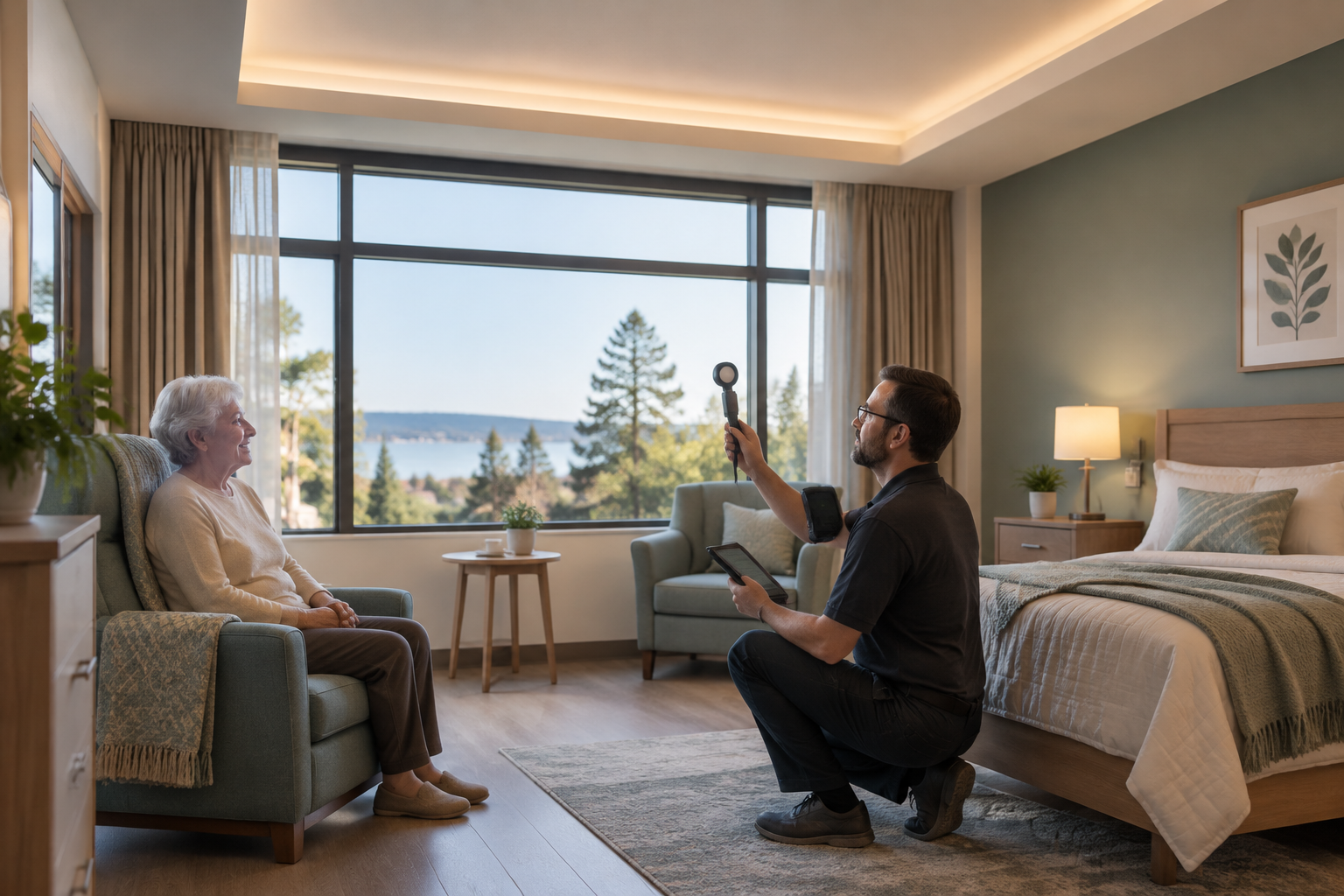
How Should an Office Tender Distinguish Desk Illuminance from Eye-level Exposure?
For office writing, typing, reading and data processing, EN 12464-1:2021 specifies maintained task illuminance of 500 lux and a limiting UGR value of 19, alongside other requirements. Those visual criteria remain essential. They do not establish the melanopic exposure of someone looking horizontally toward a screen.
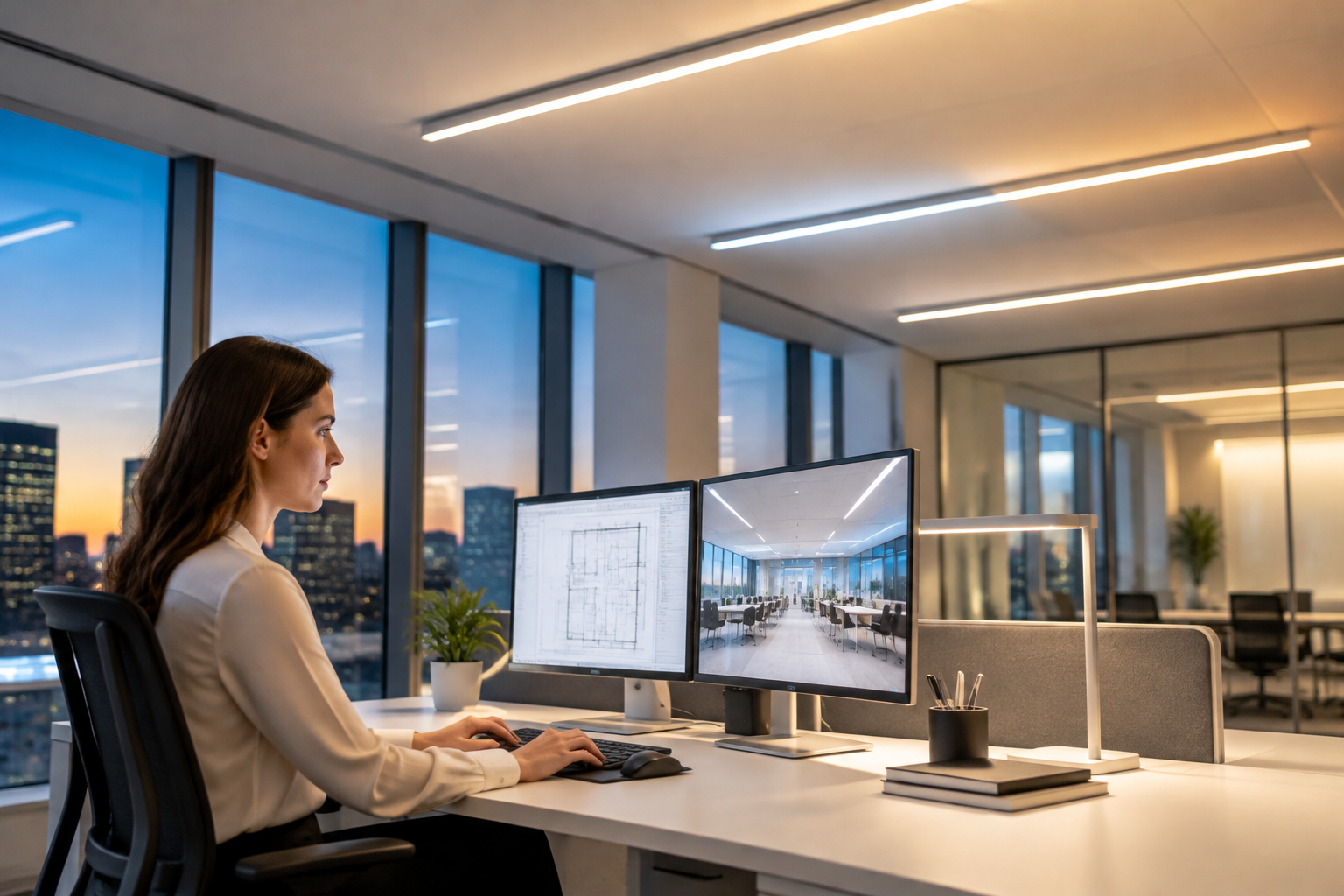
Ask the designer to model representative seated eye positions at an agreed height, such as 1.2 m, and record viewing direction. A downward distribution can illuminate desks effectively while providing a different vertical exposure from a luminous wall or indirect component. Daylight, blinds, partitions and screen orientation must be included in the assumptions.
Tender documents should separate horizontal task calculations from eye-level assessment. Require daytime, evening and reduced-occupancy scenes, with their spectral settings and power demand. Describe any 250-lux melanopic EDI objective as a project target informed by healthy-adult recommendations—not a replacement for workplace lighting compliance.
How Should Hospitals and Senior-care Facilities Handle Nighttime Overrides?
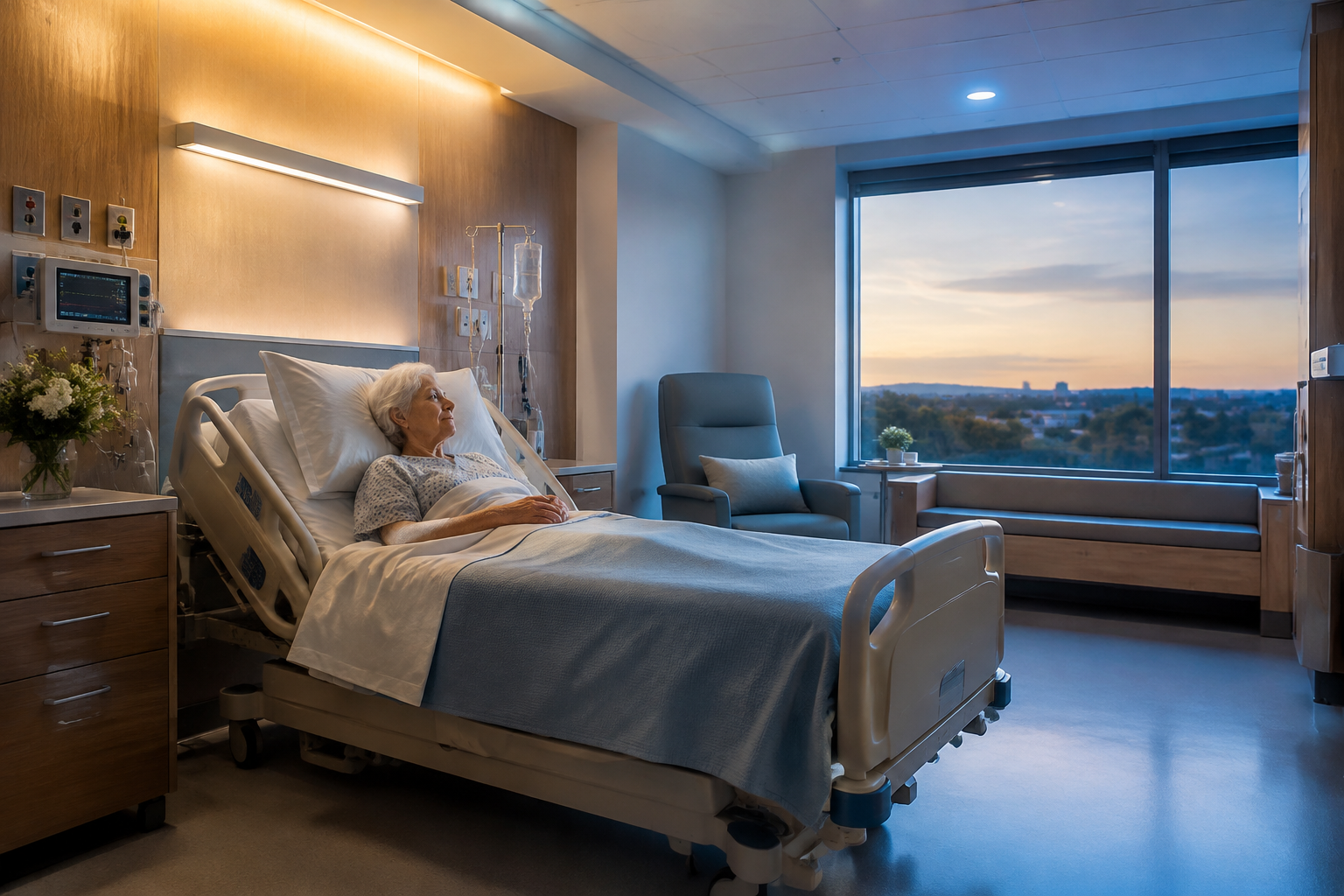
Start with the care workflow, not an automatic CCT curve. Bedrooms, nurse stations, treatment areas and corridors have different visual tasks and operating hours. A low-exposure sleep environment may be desirable, but examinations, medication checks and safe transfers require adequate visibility.
A proposed resident-room sequence might include a daytime scene, an evening scene and a localized nighttime task scene. Specify shielding, distribution and location as well as CCT. A 2700 K source operated at high illuminance should not be assumed to produce low melanopic exposure merely because it looks warm.
Require staff-accessible overrides, a visible mode indication and a documented return sequence. For example, a 20-minute automatic return could be tested as an operational proposal, but clinical staff must decide whether it is appropriate.
Emergency lighting and essential care functions must remain independent of optional wellness scheduling. Do not promise improved sleep, reduced falls or treatment of dementia without project-specific clinical evidence.
What Evidence Should a US or European Buyer Require Before Approving Savings?
Treat energy performance as a separate calculation. Tunable white can support scheduled dimming, daylight response and occupancy control, but changing CCT does not itself establish an energy saving. Input power and luminous output may vary across the tuning range and control settings.
Consider an illustrative office with 80 luminaires averaging 35 W for 3,000 equivalent full-load hours annually. Lighting consumption would be 8,400 kWh.
A genuinely achieved 30% reduction would bring consumption to 5,880 kWh, saving 2,520 kWh. This estimate excludes additional control loads and is not a forecast for a particular installation.
Request a scene-by-scene power schedule and a transparent baseline. Raising vertical illuminance to meet an exposure target may offset some dimming savings.
In the US, confirm the locally adopted energy code and the electrical safety approval route with the authority having jurisdiction. For relevant luminaire categories, UL 1598 is a common evaluation standard; CE marking does not replace US acceptance requirements.
 Tunable White Office Lighting: Why Eye-Level Exposure Matters: How should an office tender distinguish desk illuminance from eye-level exposure?
Compliance Checklist (IES / LDT / DIALux / CE / RoHS / ErP)
Use a document package tied to the exact luminaire, driver, LED board and firmware configuration. A component certificate or generic family brochure is not sufficient evidence for every customized assembly.
- Photometry: Request IES and LDT photometric files for representative CCT and output settings, or documented evidence supporting any scaling assumptions. Run DIALux calculations using the actual room geometry, reflectances, maintenance factor and furniture arrangement. Keep horizontal task grids separate from vertical eye-position grids.
- Spectral evidence: Obtain spectral power distributions and CIE S 026 calculations for the selected operating scenes. Conventional photometric files describe luminous intensity distribution; they do not normally provide the full spectrum needed for melanopic calculations. Where spectra differ between sources, combine their contributions consistently rather than assigning one room-wide ratio without justification.
- Glare and comfort: Verify UGR for relevant office arrangements and observer positions. Review bright surfaces from beds and recliners separately; an office glare calculation cannot automatically establish comfort for a resident looking upward. Check dimming stability across scheduled operating states.
- CE and RoHS: Review the EU declaration of conformity and supporting technical documentation. The Low Voltage Directive 2014/35/EU and EMC Directive 2014/30/EU apply where their respective scopes are met. RoHS Directive 2011/65/EU Article 4 addresses restrictions on hazardous substances in electrical and electronic equipment, subject to applicable scope and exemptions.
- ErP and energy information: Commission Regulation (EU) 2019/2020 has applied since 1 September 2021, with subsequent amendments requiring review. Article 3 and Annex II set ecodesign requirements for covered light sources and separate control gears. Determine whether the supplied item is a light source, separate control gear or containing product; do not assume identical obligations for every complete luminaire. Assess Regulation (EU) 2019/2015 energy-label obligations separately.
- Handover and maintenance: Record control addresses, scene levels, schedules, time-zone settings and override rules. Verify any requested ISO 9001 certificate independently; it concerns a quality-management system, not the conformity of a particular luminaire. Specify how replacement drivers or LED boards will preserve the accepted spectral and control behavior.
Commissioning should include electric-light-only measurements and representative daylight conditions. Record instrument calibration, spectral capability, eye position, viewing direction and active scene. A standard lux meter can verify photopic illuminance, but it cannot independently verify melanopic EDI without suitable spectral information or validated spectral measurement capability.
 Tunable White Office Lighting: Why Eye-Level Exposure Matters: Compliance checklist (IES / LDT / DIALux / CE / RoHS / ErP)
Frequently Asked Questions
Q: Does 6500 K Tunable White Lighting Guarantee Adequate Daytime Exposure?
No. CCT describes appearance rather than the complete spectrum or the light reaching the eye. As a calculation example, 300 photopic lux multiplied by melanopic DER 0.75 gives 225 lux melanopic EDI. A 6500 K label cannot establish that ratio or illuminance. Request spectral data and measurements at representative occupant positions before accepting an exposure claim.
Q: Should Every Hospital Bedroom Meet 250 Lux Melanopic EDI?
Not automatically. The 2022 consensus recommendation above 250 lux concerns daytime exposure for healthy adults; it is not a universal hospital requirement. Patient condition, sleep timing, medication, visual needs and clinical procedures require assessment. Specify separate daytime, evening and nighttime scenes, then obtain clinical approval for exposure objectives and override behavior rather than imposing one setting throughout a ward.
Q: Can DIALux and Ordinary Photometric Files Prove Circadian Performance?
They support spatial lighting calculations, but conventional IES and LDT files do not normally contain the full spectral information required by CIE S 026. Use photometric calculations together with spectra and melanopic DER values for the relevant settings. Assess an agreed eye position, such as 1.2 m for a seated office scenario, and verify the installed result through appropriate measurements.
Q: What Should Contractors Test Before Handing Over Tunable White Controls?
Test dimming, CCT commands, scheduling, occupancy response, manual overrides and recovery after power loss. Include at least 3 representative scenes: daytime, evening and nighttime. Check brightness and color behavior at the lowest scheduled output, not only at full power. Deliver a signed settings record and a replacement-component policy so later maintenance does not silently alter the accepted lighting conditions.
Talk to Our Engineering Team
At XHLWX (led-project-light.com), a Custom Indoor LED Lighting Manufacturer based in China, the starting point for an engineering discussion should be a measurable brief. Share room drawings, occupant positions, care or office schedules, the target CCT range, visual criteria and preferred control architecture.
Ask for configuration-specific photometry, spectral evidence and a proposed commissioning plan before approving samples. For EU and US buyers, that makes tunable white a verifiable lighting specification rather than an unsupported promise about wellbeing.
 Tunable White Office Lighting: Why Eye-Level Exposure Matters: Q: Should every hospital bedroom meet 250 lux melanopic EDI?
Need a tailored lighting plan for your project?
Our senior lighting designers reply within 48 hours with a free design proposal & quotation.